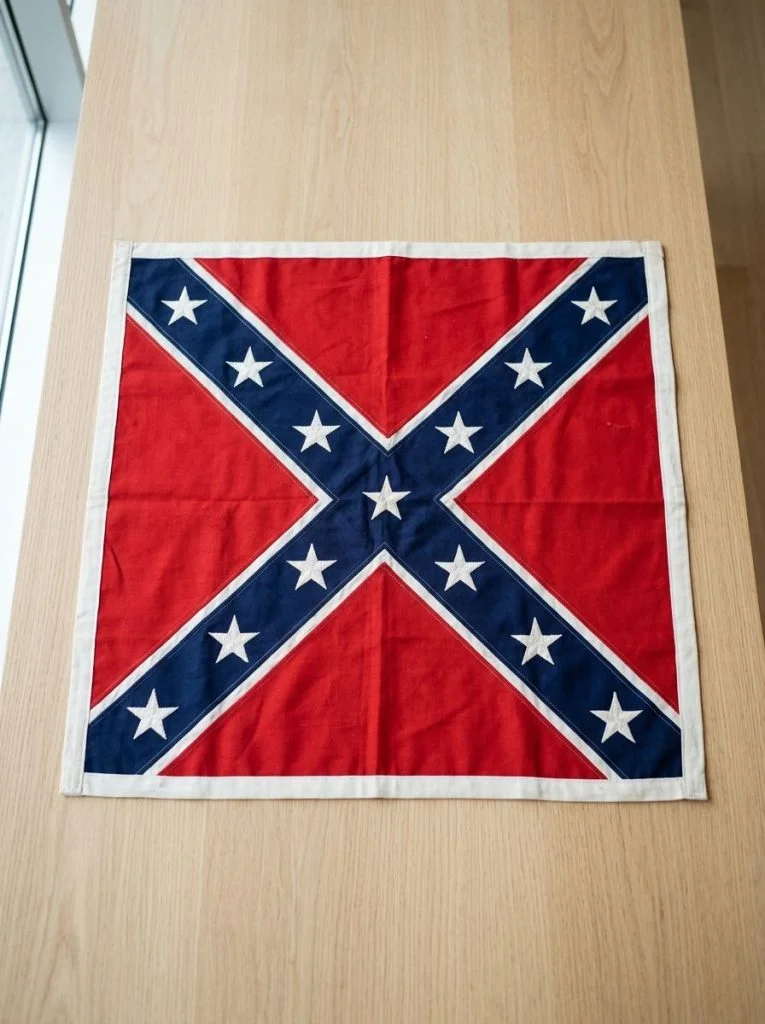
Confederate battle flags came in different shapes because there was never one official battle flag for the Confederate war effort. Each army issued its own: the Army of Northern Virginia carried a nearly square flag with a white border from late 1861, while the Army of Tennessee, the Trans-Mississippi departments and the navy flew rectangular versions of the same Southern Cross design. When you shop Confederate battle flags in 2026, the shape is the fastest way to tell which army a reproduction honors — so match the shape to the unit before you buy.
- There was never one official Confederate battle flag: each army issued its own.
- Square with a white border means the Army of Northern Virginia, issued from late 1861.
- Rectangular versions served with the Army of Tennessee, the Trans-Mississippi and the navy.
- Original infantry flags ran 48 inches square, artillery 36 and cavalry 30.
- The modern 3×5 rectangle follows the post-war reunion flag, not the square original.

Why the shape question matters to a buyer
Shape is not a style choice on these flags — it is a date and a unit rolled into one piece of cloth. Pick the wrong shape for a display or an impression and the flag contradicts the story next to it. Pick the right one and the whole setup reads true to people who know the material. That is why collectors and reenactors argue about shapes at all: the differences were real, they were deliberate, and they survived in the originals.
Why do Confederate battle flags have different shapes?
Because the Confederate army never adopted a single official battle flag. Each army and corps designated its own pattern, and the shapes grew apart from there. The National Park Service's study of Southern battle flags puts it plainly: the Confederate Army never had an official battle flag — instead, each army or corps had a designated one. Shape is therefore a unit marker, not a national standard.
| Flag | Carried by | Shape | Period |
|---|---|---|---|
| Battle flag with white border | Army of Northern Virginia | Nearly square, 48/36/30 inches by branch | Late 1861 to 1865 |
| 1864-pattern battle flag | Army of Tennessee | Rectangular | 1864 to 1865 |
| Second naval jack | Confederate navy | Rectangular | 1863 to 1865 |
| Corps flags | Hardee's corps and others | Blue with white disc, no cross | Varies by corps |
Read the table left to right and the question answers itself: three armies, a navy and a set of corps flags, none of them centrally standardized. The square and the rectangle are the two survivors, but they were choices made by different quartermasters, not one design committee.
The square flag: the Army of Northern Virginia
William Porcher Miles of South Carolina drew the Southern Cross design in 1861 as a proposed national flag, and his drawing was rectangular. The Confederate Congress passed on it. The design found a second life after First Manassas in July 1861, where the Confederacy's first national flag resembled the United States flag so closely that gun smoke made the two nearly impossible to tell apart, and General Beauregard wanted a field flag that never could be confused with the enemy's colors.
Generals Johnston and Beauregard and Quartermaster-General Cabell approved the new battle flag at Fairfax Court House in September 1861. Johnston suggested making it square rather than rectangular, chiefly to save cloth, and he set a size for each branch of the army: 48 inches square for infantry, 36 for artillery and 30 for cavalry. A modern 3×5 display flag is smaller and longer by comparison, which is worth knowing when a listing describes a 52-inch square cotton reproduction as large — by the 1861 standard, it is.
The white border was not decoration either. Units painted their battle honors on it, regiment by regiment, which is why surviving Army of Northern Virginia originals read like service records. Thirteen stars on the blue saltire became the settled count, covering the eleven seceded states plus Kentucky and Missouri.

The rectangular flags: the western armies and the navy
The Army of Tennessee went through at least eight different designs over the course of the war, according to the National Park Service's survey. Its 1864 pattern battle flag was rectangular and clearly based on the Army of Northern Virginia's square, and the departments west of the Mississippi used rectangular patterns as well. The Confederate navy flew its own rectangular cousin of the design, the second naval jack, from 1863 until 1865.
One detail worth settling for collectors: a popular claim holds that the naval jack used a lighter blue than the army's battle flag. Museum research on surviving exhibits points the other way — the jack's dark blue matches the battle flag's. If a seller's description leans on a lighter-blue navy story, that is a dating claim to check, not a fact to assume.
Not every cross-less flag is an error, either. Some units carried designs with no cross at all — Hardee's corps flew a blue flag with a plain white disc. When a shape or pattern looks off, the flag may be exactly right for a different unit.
After the war the rectangle won the popularity contest. Veterans' reunions standardized on the rectangular version because manufacturers could mass produce it more easily, and that rectangle — not the square original — is what most people picture when the design comes to mind in 2026.
Why there was never one official battle flag
Three practical reasons stacked up.
- The flag belonged to the armies, not the government. It was adopted at army level in September 1861 and was never made a national flag, though the design was later folded into the cantons of the second and third national flags, adopted in May 1863 and March 1865.
- Supply lines were separate. The Richmond quartermaster outfitted the Army of Northern Virginia while the western armies sourced flags closer to home, so patterns and shapes drifted apart.
- The armies learned by experiment. The Army of Tennessee in particular kept redesigning as command and circumstances changed, which is why its flags passed through so many patterns.
What shape should a reproduction be?
Let the unit decide. A nearly square cotton flag with a white border, around 52 inches, is the period-correct choice for an Army of Northern Virginia camp display, a heritage exhibit or a collector's wall. A 3×5 rectangle is the familiar modern form, and it is the practical pick for marching, porch poles and everyday display. Both reproduce documented designs, and neither is more legitimate than the other — they answer different questions.
| Reproduction | Best for | Key limitation |
|---|---|---|
| Square cotton flag with white border, about 52 inches | Army of Northern Virginia camp displays and collections | Heavier fabric; reads as a display piece, not a porch flag |
| Rectangular 3×5 flag, sewn or printed | Everyday display, marching and the familiar look | Smaller and longer than the original issue |
When you are ready to Shop Ultimate Flags, compare the square and rectangular versions of the same design side by side and pick by unit, not by habit. Ultimate Flags carries battle flag patterns in both constructions, which is the easiest way to see what the shape change actually does to the look.

Related questions about battle flag shapes
Was the rectangular rebel flag a naval jack?
It matches the second Confederate naval jack, which was rectangular and flew from 1863 to 1865, and it also resembles the Army of Tennessee's 1864 pattern. The common rectangular flag of today traces to both, and to the post-war reunion flags.
Which shape came first?
The square came first. The Army of Northern Virginia issued square battle flags from late 1861, while the well-known rectangular versions date to 1863 for the navy and 1864 for the Army of Tennessee.
Why do modern reproductions usually come rectangular?
Post-war veterans' reunions favored the rectangle because manufacturers could mass produce it, and the modern display business inherited that standard. Square reproductions are still made for buyers who want the Army of Northern Virginia look.
FAQ
Why do Confederate battle flags have different shapes?
Because each Confederate army issued its own battle flag. The Army of Northern Virginia flew a nearly square flag with a white border from late 1861, while the Army of Tennessee, the Trans-Mississippi and the navy used rectangular versions.
What shape was the original Confederate battle flag?
The original designer’s drawing was rectangular, but General Johnston had it made square to save cloth, and the Army of Northern Virginia issued it that way from September 1861. Infantry flags ran 48 inches square.
Was the Confederate battle flag ever a national flag?
No. It was adopted at army level and never made a national flag, although the design was placed in the canton of the second and third Confederate national flags in 1863 and 1865.
What sizes did the square battle flags come in?
48 inches square for infantry, 36 for artillery and 30 for cavalry, as set when the flag was approved in September 1861.
Is a rectangular battle flag wrong for an Army of Northern Virginia display?
Yes, if accuracy is the goal. The Army of Northern Virginia carried square flags with white borders, while rectangles served with the Army of Tennessee, the Trans-Mississippi and the navy.
Can you display a Confederate battle flag today?
Yes. The flag is legal to display in the United States and appears in museums, battlefield parks, reenactments and historical collections as historical material.
One last thing
The square was a quartermaster's economy measure, not a design statement — Johnston cut the corners to save cloth, and the army he was supplying happened to be the one whose flags drew the most attention after the war. Buy the shape the unit actually carried, and the reproduction tells the true story.
Related guides