Yes, America had a 49 star flag, and it was real, official and brief. President Dwight D. Eisenhower established the design by Executive Order 10798 on January 3, 1959, the day Alaska entered the Union. It became the official flag on July 4, 1959, and gave way to the 50 star flag exactly one year later. Few banners in our history carry so much story in so little time.
TL;DR
- The 49 star flag added one star for Alaska. Eisenhower established it by Executive Order 10798 on January 3, 1959.
- It became official on July 4, 1959, following the customary Independence Day change, and was first officially raised at Fort McHenry.
- The stars were set in seven staggered rows of seven, a layout chosen partly because a 50th star could be added later.
- It was the official flag from July 4, 1959 through July 3, 1960, then replaced when Hawaii’s admission called for a 50th star.
- Authentic flags from that year are scarce, which is why collectors and history lovers prize the design.
Table of Contents
- The short answer: when the 49 star flag flew
- A new flag in the making: the road to 1959
- What the 49 star flag looked like
- Fort McHenry, July 4, 1959
- The Washington Monument display
- Why only one year? Hawaii and the 50 star flag
- Common questions about the design
- Displaying and collecting a 49 star flag today
- Bring Alaska’s year home
- FAQ
- Sources
The short answer: when the 49 star flag flew
The dates matter, and they are easy to blur. Alaska was admitted to the Union on January 3, 1959, but the National Park Service’s government history records that the new state’s star was added officially on July 4, 1959, following the customary Independence Day change.
So there are two moments to remember:
- January 3, 1959: Alaska becomes a state and the executive order establishing the 49 star design is signed.
- July 4, 1959: the 49 star flag becomes the official flag of the United States.
The American Presidency Project’s record of that January day shows that the new flag was unfurled right after Eisenhower signed the proclamation and the order, even though its official effective date was still months away. Imagine that room: a new star on the field of blue, and a nation already looking toward the Fourth.
A new flag in the making: the road to 1959
The story begins earlier than most people suppose. According to the Eisenhower Presidential Library, the administration was already considering a new flag for possible Alaska and Hawaii statehood as early as 1953. Statehood for both territories was a long-debated question, and the planners did not want to be caught unprepared when it came.
A committee submitted designs, and the President made the final choice. That is worth pausing on. The flag is not merely a piece of cloth that changes when a map changes. Each alteration is a deliberate act of the republic, weighed, drawn and signed. The banner that rallied soldiers at Valley Forge and flew over Fort McHenry grows by decree and by custom, and it carries each new chapter on its blue canton.
For readers who want the wider sweep of how the Stars and Stripes took shape, our guide to the evolution of American flags in history walks through the earlier versions.

What the 49 star flag looked like
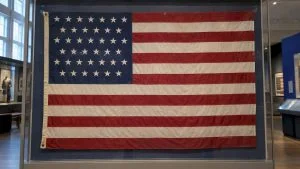
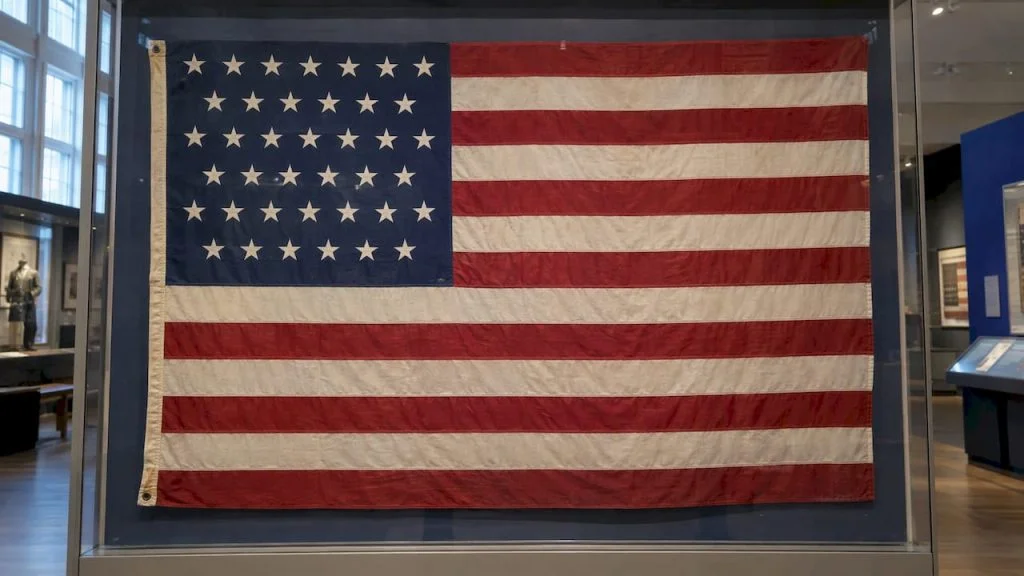
The selected design placed 49 stars in seven staggered rows of seven. Picture a square-ish field in which each row is offset from the one above it, so the stars seem to interlock like the stitches of a quilt. The thirteen red and white stripes remained unchanged, honoring the original colonies.
There was a practical wisdom behind the layout. Eisenhower favored this arrangement because it allowed a 50th star to be added without a complete redesign. Hawaii’s statehood was still pending, and the planners knew it. In effect, the 49 star flag was drawn with its successor already in mind.
How it differs from the flag before it
Before 1959 the nation flew the 48 star flag, the banner of the First World War era, the Second World War and the years of recovery after. If you want to see that earlier design, we carry the 48 star flag collection, including a cotton sewn 48 star flag for the 1912 to 1959 period. Side by side, the 48 and 49 star flags tell a clear story: one star, one new state, one more chapter of the American saga.
Fort McHenry, July 4, 1959
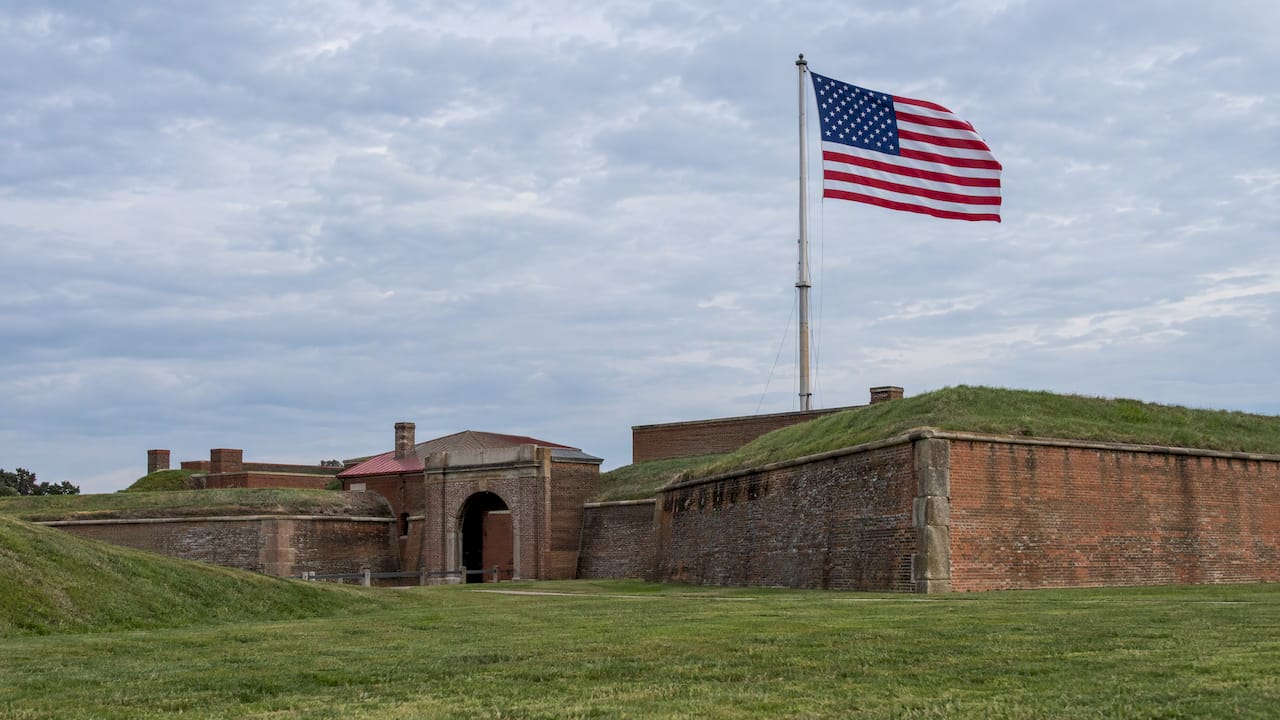
Where does a new flag first rise? For the 49 star flag, the answer carries a certain poetry. Historical records document its first official raising at Fort McHenry on July 4, 1959, with Interior Secretary Fred A. Seaton presiding.
Fort McHenry is the Baltimore fort whose defiant flag inspired our national anthem. To raise the Alaska flag there was to connect the newest star to the oldest of our patriotic memories. A year later the same ground saw the 50 star flag take the 49 star flag’s place on July 4, 1960.
The first flags were made by the Army
The Army’s Quartermaster Depot in Philadelphia produced the first 49 star flag, a detail you may see in other accounts of the design. We mention it as general background only; the primary records we rely on here are the presidential and park service documents linked in this article.
The Washington Monument display
Another place where the change was visible was the ring of flags around the Washington Monument. The National Park Service records that 49 star flags were added to the Washington Monument display on July 4, 1959 and remained there until they were replaced by 50 star flags on July 4, 1960.
Think of the ritual: crews lowering one set of flags and raising another, tourists beneath them, perhaps none realizing how short a season the 49 star design would have. Such small ceremonies are how a nation updates its most visible symbol.
Why only one year? Hawaii and the 50 star flag
The 49 star flag’s life was short because Hawaii’s admission required a 50th star. According to the National Park Service, the 50 star flag recognizing Hawaii became official on July 4, 1960, replacing the 49 star flag after its one year official period.
The law itself keeps the record. The U.S. Code compilation notes that the flag prescribed by Executive Order 10798 was to remain the official flag until July 4, 1960, when the flag prescribed by Executive Order 10834 took over.
| Detail | 49 star flag |
|---|---|
| Established | January 3, 1959, by Executive Order 10798 |
| Reason | Alaska’s admission as a state |
| Star layout | Seven staggered rows of seven |
| First official raising | Fort McHenry, July 4, 1959 |
| Official period | July 4, 1959 through July 3, 1960 |
| Successor | 50 star flag, official July 4, 1960 |
Why the Fourth of July?
The lag between statehood in January and the official flag in July was not a delay or a mistake. The National Park Service account shows that the effective date was governed by established flag-change custom rather than simply by the day a state was admitted. New stars arrive on Independence Day, a tradition that ties each new state to the founding moment. It is a quiet piece of national ceremony, and it explains why the 49 star flag’s official year runs from one Fourth of July to the next.
Common questions about the design
Because the flag was so short-lived, rumors circulate. Some people say it was never real, or that it had an odd layout. The record is plain: it was established by executive order, it had seven staggered rows of seven stars, and it was the official flag for one year. When you see a flag with 49 stars, you are looking at Alaska’s banner, not a novelty.
Our perspective on the 49 star flag
We have spent years among flags, and the 49 star flag is one that always stops a visitor. It was official for only a single year, yet it holds an entire chapter: the last frontier entering the Union, a nation at midcentury, and a president thinking ahead to the next star.
That is what we believe flags are for. They are not decoration alone. They are memory made visible, and each version of the Stars and Stripes whispers its own tale of who we were on a particular Fourth of July.
This is why we carry historical American flags and not only the current design. A 49 star flag on a wall, or flying on a Fourth of July, lets a family, a teacher or a collector hold a specific year of American history. We stand behind giving people the chance to tell those stories honestly, with the real design, in the real proportions, and with respect for the flag’s own record.
John Hough
Displaying and collecting a 49 star flag today
A historical flag earns its place in a home, a classroom, a museum corner or a veterans hall. The 49 star flag works well for any of these because it is instantly distinctive: the staggered grid reads as unusual, and viewers lean in to count.
If you are building a collection, think in terms of the sequence. The 48 star flag, the 49 star flag and the 50 star flag mark a single turning point in American history. Our historical flags collector’s selection guide helps you decide what to add and in what order. If you also collect the 48 star design, our notes on telling a 48 star replica from an antique and on what a 48 star flag is worth to collectors are useful companions.
For flying outdoors, material and build matter more than most buyers expect. Our flag qualities and uses guide explains the options, and if you plan to fly more than one flag, see how to approach displaying multiple flags on one pole or separate staffs.
Bring Alaska’s year home
Ready to hold this piece of history? Our 49 star USA flag for Alaska, an outdoor flag made in America, is built for display, whether you are marking the Fourth of July, teaching a class or completing a set of historical American flags.

To browse the full range, from the 48 star flag to state flags, military flags and flagpoles, visit our flag collections page.
FAQ
Did America have a 49 star flag?
Yes. Executive Order 10798, signed January 3, 1959, established the 49 star design for Alaska. It became the official flag on July 4, 1959, and remained so until July 4, 1960.
How long was the 49 star flag official?
It was the official flag for one year, from July 4, 1959 through July 3, 1960. On July 4, 1960, the 50 star flag replaced it because Hawaii’s admission required a 50th star.
How were the stars arranged on the 49 star flag?
The 49 stars sat in seven staggered rows of seven. Eisenhower favored the layout because it allowed a 50th star to be added when Hawaii joined the Union.
Why did the flag change on July 4 and not when Alaska became a state?
Alaska was admitted on January 3, 1959, but flag changes follow Independence Day custom. The new star was therefore added officially on July 4, 1959, the first Fourth of July after statehood.
Where was the 49 star flag first raised?
Historical records document its first official raising at Fort McHenry on July 4, 1959, with Interior Secretary Fred A. Seaton presiding. Forty-nine star flags also joined the Washington Monument display that day.
Sources
- Design of the 49- and 50-Star Flags, Eisenhower Presidential Library
- The Origins and History of the Washington Monument Flag Display, National Park Service (govinfo)
- 4 U.S.C. § 1: Flag; stripes and stars on, U.S. House of Representatives
- Remarks Upon Signing the Proclamation Admitting Alaska to the Union and the Executive Order, The American Presidency Project