Reading inscriptions on a Civil War flag comes down to sorting the text into one of four kinds — a unit designation, a battle honor, a presentation inscription or an issue marking — then transcribing it exactly and checking it against regimental records. Get that order right and a marked flag can usually tell you the army it served with, the years it was carried and often the exact regiment. Get it wrong and a modern reproduction ends up captioned as a wartime original. In 2026 most of the records you need to check against are digitized, so the verification step is faster than it has ever been.
- Four inscription types: unit designation, battle honor, presentation text, issue marking.
- Transcribe wording exactly, abbreviations included, before searching any records.
- Battle honors list the battles a unit fought while carrying that flag.
- Star counts and flag patterns date a flag when lettering is missing.
- Confirm every match in regimental records — the flag alone never settles it.

How do you read inscriptions on Civil War flags?
Start by naming the kind of text you are looking at, because each kind answers a different question and each one is verified differently.
| Inscription type | What it looks like | What it tells you |
|---|---|---|
| Unit designation | "4th N.C. Inf." lettered on a regimental color | The exact regiment or command that carried it |
| Battle honor | Embroidered or painted place names | The battles fought under that specific flag |
| Presentation inscription | Names, a date and often a motto | Who gave the flag, to whom and when |
| Issue marking | Depot stamps, maker initials, stenciled numbers | Which sew shop or quartermaster issued it |
A flag can carry one of these or all four, and they were added at different times by different hands. Read them as layers, not as a single caption.
Unit designations: the wording that names the regiment
A regimental color usually announces itself. Federal regiments painted or embroidered their designation on both the blue regimental color and the Stars and Stripes they carried beside it — a marking such as "4th N.C. Inf." names the unit directly, and "Co. A" narrows it to one company. Confederate battle flags in the Eastern theater were often lettered the same way, and headquarters flags carry the general's name.
Transcribe the wording exactly as written, abbreviations and spelling quirks included, because the wartime records use those same forms. "N.C." reads as North Carolina in the muster rolls; modernizing it before you search costs you the match. Painted lettering also fades differently from the fabric — text that is barely visible head-on can stand out under angled light, so photograph before you conclude that a flag is unmarked.
Star counts and patterns: reading a flag with no lettering at all
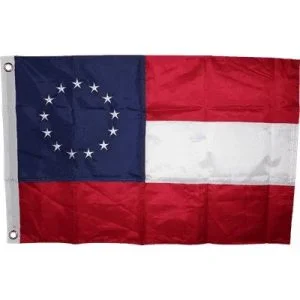
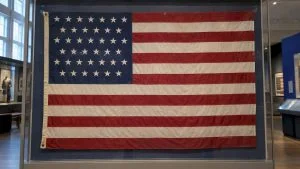
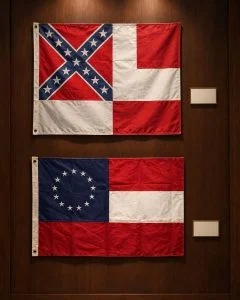
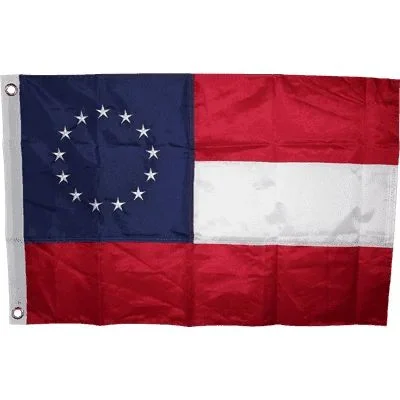
When a flag carries no text, the pattern itself does the talking. The Confederate first national, the Stars and Bars, was adopted in March 1861 with seven stars for the first seven seceded states and settled at thirteen covering the eleven seceded states plus Kentucky and Missouri. Union flags date by star count: 34 stars from 1861, 35 after West Virginia joined in 1863, 36 in 1864-65. Shape narrows the army — a square battle flag with a white border belongs to the Army of Northern Virginia from late 1861, while rectangular battle flags served the Army of Tennessee and the Trans-Mississippi.

Battle honors: the place names that record the fighting
Battle honors are the strongest inscriptions a battle flag can carry. These are place names — Williamsburg, Seven Pines, Sharpsburg, Fredericksburg, Chancellorsville, Gettysburg — embroidered, painted or stenciled on the field to record the battles where the unit fought under that flag. The set of honors belongs to one regiment or battery, so the list often identifies the unit on its own: a square cotton flag marked "Williamsburg" and "Seven Pines" points to a regiment that fought in the 1862 Peninsula Campaign under the Army of Northern Virginia.
Read honors as a sequence, not a summary. Honors were added at different times, often by different hands, and an 1862-issued flag carrying a Gettysburg honor is not a contradiction — it is a flag that stayed in service into July 1863. That sequence is also why an honor list is rarely complete: regiments sometimes lost the flag before the latest honors could be added.
Presentation inscriptions: who gave the flag and when
Many regimental colors were not government issue at all. Ladies' aid societies, town councils and local donors commissioned and presented flags to regiments, and those presentation flags carry the richest inscriptions of the war: the regiment's name, the presenting organization, the date, and often a motto or a Bible verse. A presentation inscription is dated primary evidence — it pins the flag to a specific day and place.
These inscriptions repay archival work. Presentations were civic events, reported in local newspapers with the wording quoted, so digitized newspaper archives in 2026 can turn a transcription into a full story: who sewed it, who spoke at the ceremony and which company accepted it. When a collector documents a presentation flag, that newspaper report is the source that makes the flag's caption airtight.
Maker and issue markings: the smallest inscriptions, the sharpest dating
The least glamorous inscriptions are the most useful for separating period flags from later copies. Army depots stamped or stenciled issue markings, sew shops left maker initials, and quartermaster records tie issued flags to dates and quantities. The Army of Northern Virginia's battle flags came through a depot system from 1862, so construction details and depot markings together bracket a flag's origin tightly. Reproduction makers do not replicate wear patterns or depot stamps, which is one reason examiners check the back of the flag and the hoist before they trust any lettering on the front.

How to transcribe and verify an inscription in five steps
- Photograph in angled light. Raking light across the fabric brings out painted lettering that is invisible head-on, and the photos become your working copy.
- Transcribe exactly. Copy every character, abbreviation and misspelling. Never clean up the wording before you search — the records match the original forms.
- Date the pattern first. Star count, flag shape and construction narrow the years before any record search, and they tell you which records to search.
- Search the records. The Official Records of the War of the Rebellion, state adjutant-general reports, regimental histories and newspaper archives for presentation ceremonies each confirm a different inscription type.
- Compare with surviving originals. The Smithsonian's collection and state battle-flag museums publish photographs you can match lettering styles and honors against.
When the inscription runs out — a flag with only partial lettering, or honors that stop mid-list — the five-clue method for matching a Civil War flag to its unit and battle picks up where the text leaves off, adding pattern, star count and construction to the search.
Choosing a reproduction with inscriptions that hold up
A reproduction with lettering has one more accuracy test than a plain flag: the wording has to match a documented original. Before buying, check that the unit designation, honor list or presentation text on the flag traces to a real record, not to a generic design. Sewn cotton with embroidered stars reads closest to the period look, and the lettering should be stitched or painted cleanly enough to transcribe at arm's length. When you are ready to Shop Ultimate Flags, compare the lettered designs against the records the same way you would check an original — in 2026 that check takes minutes, and it is the difference between a flag with a story and a flag with decoration.
What an inscription can and cannot tell you
- It can name the unit, but not always the whole service. An honor list records battles fought under that flag; battles fought under an earlier or later flag stay off it.
- It can date a presentation, not a battle. A presentation inscription fixes the flag's start date; the honors sequence is what tracks the service afterward.
- It does not prove authenticity by itself. Lettering can be added later, and wartime inscriptions have been copied onto reproductions — construction and markings carry the authenticity case.
- It can be incomplete. Painted text fades, embroidery wears, and some regiments simply never marked their flags.
Related questions about Civil War flag inscriptions
Why do some Civil War flags have no inscriptions at all?
Plain issue flags were common. National colors often carried no marking beyond the stars, depots issued battle flags unmarked until the army added designations, and painted lettering on hard-used flags wore away long before the fabric did. An unmarked flag is normal, not suspicious.
What do the place names embroidered on a battle flag mean?
They are battle honors — the record of the engagements where the regiment fought while carrying that flag, added one battle at a time. A run of names such as Sharpsburg and Fredericksburg maps the unit's service and often identifies it outright.
Are inscriptions on reproductions historically accurate?
On well-made reproductions, yes — the lettering copies a documented original, inscription for inscription. On poor ones, wording is invented or misplaced. Check the flag's text against regimental records before buying, and treat any design no record supports as decoration, not history.
FAQ
How do you read inscriptions on Civil War flags?
Sort the text into its type — unit designation, battle honor, presentation inscription or issue marking — transcribe it exactly, then verify it against regimental records such as the Official Reports and state adjutant reports. The inscription type tells you which record confirms it.
What were Civil War flags usually inscribed with?
Regimental designations such as a unit number and state, battle honors listing the battles fought under the flag, presentation inscriptions naming the donors and date, and depot or maker markings. Larger flags carried several of these at once.
What do battle honors on a Civil War flag mean?
They are place names such as Sharpsburg or Gettysburg embroidered or painted on the flag to record the battles fought while carrying it. The full honor list belongs to one unit and often identifies the regiment on its own.
How do you date a Civil War flag with no writing on it?
Read the pattern instead: seven stars date an early 1861 first national, thirteen stars the later war, 34 to 36 stars bracket Union flags from 1861 to 1865, and a square battle flag with a white border points to the Army of Northern Virginia from late 1861.
Were Civil War flags inscribed by the government?
Not always. Regiments, army depots and private donors all added lettering, and presentation flags from ladies’ societies carried the most elaborate inscriptions of all. Depot markings identify the government-issued pieces.
How do you verify an inscription on a flag you want to buy?
Transcribe the wording exactly, date the flag’s pattern and star count, then search regimental records and newspaper archives for a match. A 2026 buyer can check most unit designations and presentation texts online in under an hour.
One last thing
Honors were added battle by battle, often by different hands years apart — so an 1862-issued flag carrying an honor earned in 1864 is not a fake; it is a flag that stayed in service. That single fact trips up more new collectors than any other, and it is why the records, not the lettering alone, always get the final word on a Civil War flag.