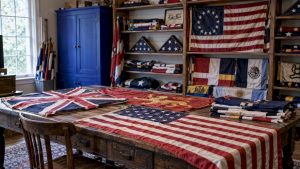
Confederate flags for sale in 2026 range from casual printed banners to sewn reproductions built to match the exact flags that flew between 1861 and 1865. This guide shows you how to document a reproduction before you buy it: the design dates to check, the square sizes that identify each branch of the army, the unit honors that make a flag historically specific, and the construction details that separate a faithful copy from a lookalike.
- Documenting a reproduction means checking design dates, size, unit honors and construction against historical records.
- The first National flag, the Stars and Bars, carried 7 stars in March 1861 and 13 by 1863.
- Army of Northern Virginia battle flags were square: roughly 48-52 inches for infantry, 36-38 for artillery, 30-32 for cavalry.
- Cotton suits indoor and ceremonial display; sewn nylon handles outdoor weather.
- Check embroidered stars, correct sizes and documented honors before buying.

Why documentation matters
Reproduction quality varies more in this category than in almost any other. A printed rectangle with a saltire and thirteen stars will look right in a photo and wrong in your hands. A documented copy, by contrast, matches a real flag in the design that unit carried, the size that army's regulations or surviving examples support, and the construction method a period flagmaker would have used.
Documentation also protects you from the most common trap in this category: flags with borrowed or invented details. Battle honors sewn on a flag that a unit never carried, a rectangular "ANV" flag, or a Stars and Bars with the wrong star count are easy to produce and hard for a new collector to catch. The checks below take about ten minutes and catch nearly all of them.
What documented means for a Confederate flag reproduction
A documented reproduction is one you can trace back to a historical source: a surviving original, a photographic record of one, or an official-issue description in the war records. Museums and serious collectors apply a simple standard, and you can borrow it. For each detail on the flag, there should be an answer to the question, what evidence says the original looked like this?
That standard applies to four things in particular:
- Design and date — which of the three national designs or battle flag patterns it is, and when that design was in use.
- Size and shape — the dimensions a real unit's flag would have been.
- Unit honors and markings — any battle names, regimental numbers or campaign ribbons sewn on the field.
- Construction — materials, stitching and mounting that match how the flag was made to be used.
You do not need a museum archive to run these checks. The main facts are settled history, published in the official records and in standard flag references, and a good store prints its own documentation on each product page. What matters is that you check rather than assume.
Match the design to its date
The Confederacy used three national flags in sequence, and each has a date range you can verify:
- First National — the Stars and Bars, March 1861 to May 1863. Adopted in March 1861 with seven stars for the seven initial states. Additional stars were added as states joined, reaching thirteen by late 1861. Its red, white and blue layout with a circle of stars on three broad stripes is why it was repeatedly mistaken for the Union Stars and Stripes in the field.
- Second National — the Stainless Banner, May 1863 to March 1865. A white field with the battle flag in the canton. Adopted on May 1, 1863, to fix the confusion problem; the all-white field later earned it the nickname that stuck after flags were furled or soiled in the field.
- Third National — the Blood-Stained Banner, March 4, 1865. The same white field with a red vertical bar added at the fly so the flag would not read as a white surrender flag.
The battle flag itself — the Southern Cross with the saltire and stars — was adopted for the Army of Northern Virginia in late 1861, after the confusion at the First Battle of Manassas on July 21, 1861 made the problem unmistakable. General P.G.T. Beauregard pushed the change after his own headquarters flag was mistaken for a Union one. William Porcher Miles's rejected earlier design became the basis of the cross.
When you shop, date your flag first. A thirteen-star Stars and Bars is correct for late 1861 through 1863; a seven-star version is a March-to-summer-1861 flag. A white-field national flag with no red bar belongs to 1863-1865. A reproduction that mixes details from different years is not wrong to exist, but it is a display flag, not a documented one.
Check the size and shape against the unit type
Size is where reproductions most often drift, because many modern manufacturers simply make every flag 3×5 feet. The original Army of Northern Virginia battle flags were square, and the Richmond depot issued them in three size bands by branch: about 48 to 52 inches square for infantry regiments, 36 to 38 inches for artillery batteries, and roughly 30 to 32 inches for cavalry. A 52-inch by 52-inch flag with a pole sleeve and ties is the infantry format; a 38-inch square is the artillery format.
Rectangular battle flags existed too, but they belong to other commands — armies and departments west of Virginia issued rectangular patterns, and naval and later-period flags moved to rectangles as well. So the shape itself is a dating and attribution clue: a square battle flag points to the Army of Northern Virginia, while a rectangle points elsewhere or later.
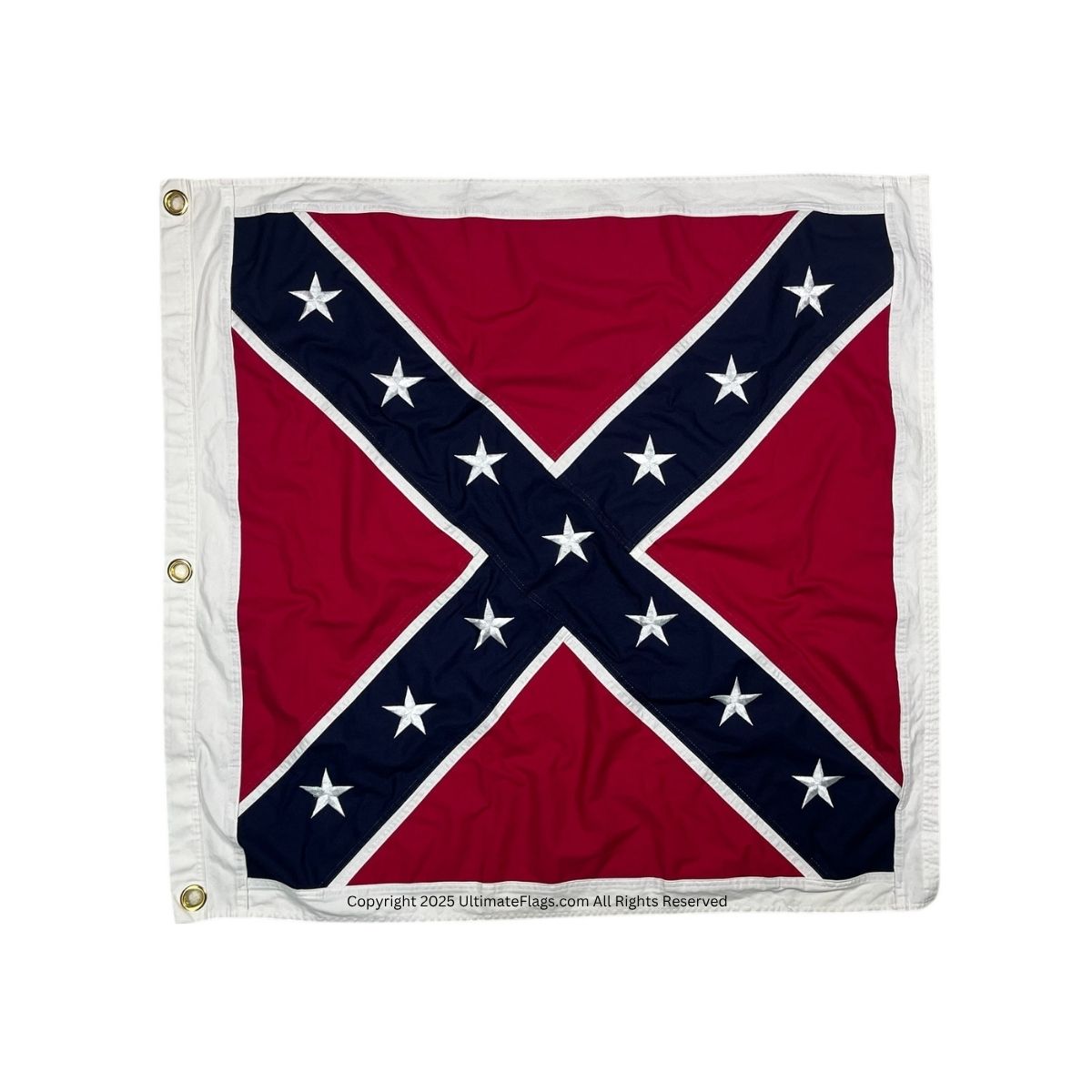
A cotton artillery-format reproduction at the correct 38-inch square, with embroidered stars and the white border trim of the Southern Cross.
The same logic applies to national flags. The Stars and Bars was a rectangular flag at 3×5-scale proportions in period use; the Stainless and Blood-Stained Banners were larger-scale rectangles. If a store sells a "square Stars and Bars," that combination has no period basis.
Verify unit honors before you buy an honors flag
Battle honors are the most collectible feature on a reproduction and the easiest to fake. Real unit flags carried the names of engagements sewn or painted on them, usually in the saltire arms or above and below the cross. The names must match the unit's actual service record.
Take the 4th North Carolina Infantry as a worked example. Its flag carried Williamsburg and Seven Pines honors, and the unit's record supports exactly those: the regiment fought in the attack at Seven Pines, served through the Seven Days battles at Malvern Hill, held the Sunken Road at Antietam, fought all three days at Chancellorsville, was at Gettysburg on July 1, 1863, and went on through Spotsylvania, Petersburg and Appomattox. A flag bearing those two honors in that unit's name is documented. The same two names on a Tennessee regiment's flag would not be.
Two quick checks keep you safe with honors flags:
- Does the honor list match the unit's documented battles? Regiments have published service records; a two-minute search settles it.
- Is the flag attributed to a specific regiment at all? A generic honors flag with famous battle names and no unit attribution is decoration. Some collectors buy those knowingly for display; just do not document it as anything else.

A 52 by 52 inch cotton reproduction of the 4th North Carolina Infantry flag, with its Williamsburg and Seven Pines honors sewn on.
Read the construction, not the sales copy
Construction tells you what a flag is meant for, and it is the one thing you can judge from photos and product pages in 2026 without any special expertise:
- Printed versus sewn. Printed flags have the design dyed or printed into the fabric. Sewn flags have appliquéd stripes and embroidered stars, which read visibly raised in close-up photos. Sewn construction is the documented-reproduction standard.
- Cotton versus nylon. Cotton has the period-correct texture and drape and is the reenactor and ceremonial choice. It should not live outdoors in rain. Nylon and double-nylon flags are the outdoor-grade versions; double-nylon (two-ply) embroidered flags are the heaviest-duty sewn option.
- Mounting. Period infantry flags carried a pole sleeve and ties rather than grommets, because they were carried on a staff, not flown from a halyard. Grommets are the practical choice for a porch pole. Either is fine — but if you want the documented field format, sleeve and ties is it.
- Reverse side. On a properly made sewn flag, the design reads mirror-reversed from the back. That is standard construction, not a defect. A double-sided flag that reads correctly both ways is a modern convenience format, not a period copy.
None of this means one option is better overall. A cotton sleeve-and-ties flag documents a field flag; a double-nylon grommeted flag flies year-round. Match the construction to the purpose you have.
A comparison of reproduction types
| Option | Best for | Key limitation |
|---|---|---|
| Printed nylon battle flag | Casual display, campsite or truck use | Not a documented construction; printed face |
| Sewn cotton, sleeve and ties | Reenactment, museums, indoor memorials | Damaged by outdoor rain and sun |
| Double-nylon embroidered | Outdoor flying on a permanent pole | Heavier and costlier than printed |
| Unit honors cotton reproduction | Collectors documenting a specific regiment | Honors must match the unit's record |
Common mistakes buyers make
- Buying 3×5 feet for everything. If you want a documented ANV format, the square sizes above are the point. A 3×5 rectangle is a display format that simply did not exist for ANV infantry flags.
- Hanging cotton outside. Cotton is a wet-towel problem in the rain. Outdoor display calls for sewn nylon.
- Expecting double-sided text. Mirror-reversed lettering on the reverse is correct construction on sewn flags.
- Confusing national and battle flags. The Stars and Bars and the battle flag are different flags with different histories; most "first Confederate flag" searches actually want the Stars and Bars, while most collector reproductions are battle flags.
- Trusting the word authentic without details. Authentic means nothing by itself. Sizes, dates, honors and construction are the details that either are documented or are not.
Where a documented flag fits in a collection
Collectors usually build around one of two axes: the national-flag sequence (Stars and Bars, Stainless Banner, Blood-Stained Banner) or unit flags of a particular army or state. Documented reproductions work for both, and they pair well with display practices that respect the historical context — a caption with the design's date range and unit attribution turns a wall of flags into an exhibit. Museums handle the same material this way, and the same caption discipline works at home.
If you are comparing documented designs side by side, Ultimate Flags keeps its rebel and Confederate flag collection organized by design and format, with each flag's construction and size listed on its own page. For the outdoor flag itself, the double-nylon embroidered flags are the workhorses; for shelf, office or museum-style display, the cotton sleeve-and-ties formats carry the documented details.
FAQ
What does documented mean for a Confederate flag reproduction?
It means every key detail — design, date, size, honors and construction — can be traced to a historical source such as a surviving original or the official records. A documented flag lists those details for you to check.
What size was the original Confederate battle flag?
The Army of Northern Virginia battle flag was square: about 48-52 inches for infantry, 36-38 inches for artillery, and roughly 30-32 inches for cavalry. Rectangular battle flags belonged to other commands and later periods.
Why did the Confederacy replace its national flag twice?
The Stars and Bars was repeatedly mistaken for the Union flag, so the white-field Stainless Banner was adopted on May 1, 1863. A red bar was added on March 4, 1865 to keep the all-white field from reading as a surrender flag.
Can a cotton reproduction fly outdoors?
Not reliably. Cotton absorbs rain and dries stiff, which shortens its life sharply. Cotton is the indoor, ceremonial and reenactment choice; outdoor display calls for sewn nylon or double-nylon.
What is the difference between the Stars and Bars and the battle flag?
The Stars and Bars was the first national flag, adopted in March 1861 with a circle of stars on three stripes. The battle flag is the square Southern Cross adopted in late 1861 after confusion at First Manassas.
Are unit battle honors on reproductions historically accurate?
They can be, when the honors match the unit’s documented service. For example, the 4th North Carolina Infantry’s flag carried Williamsburg and Seven Pines honors, which the regiment’s record supports. Always check the honors against the unit’s battles.
What should a 2026 buyer check before ordering?
Four things: the design’s date range, the size and shape against the unit type, whether any honors match the unit’s record, and whether the construction — cotton or nylon, sewn or printed, sleeve or grommets — matches how you plan to use it.
Related guides