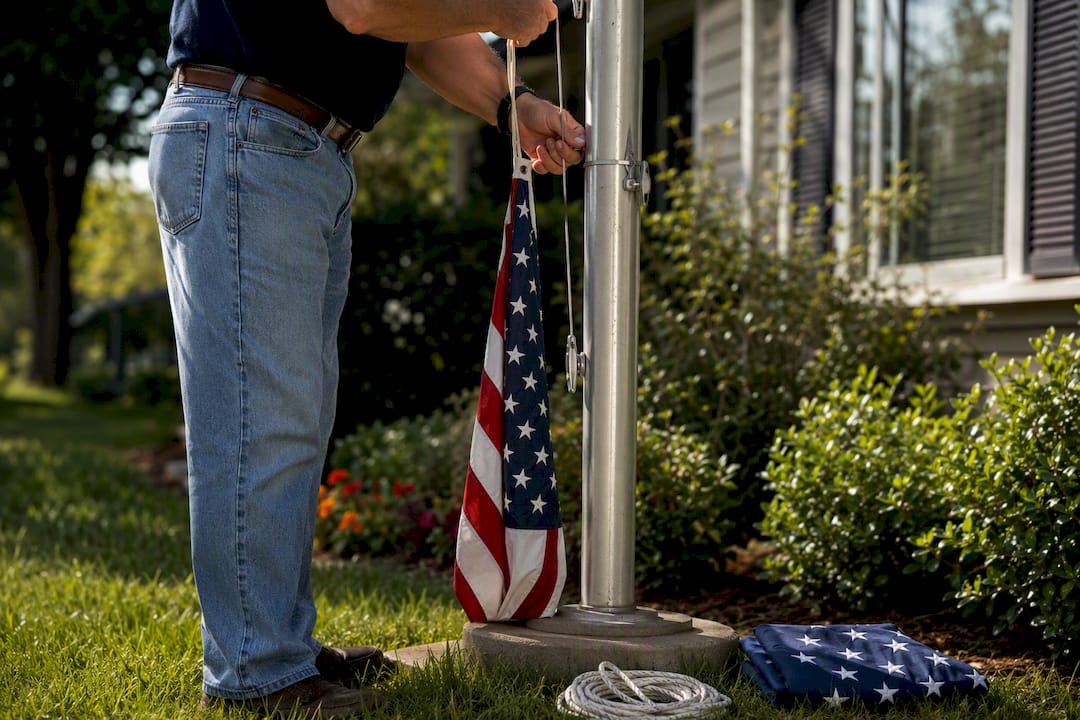
The right flagpole depends on three things: where you’re installing it, how much wind it needs to withstand, and how much control you want over who can raise and lower the flag. Homeowners with a modest yard usually do well with a telescoping or sectional aluminum pole. Coastal properties and busy commercial sites lean toward fiberglass with an internal halyard. Everything else — from footing depth to finish — follows from those two decisions.
TL;DR:
- Aluminum poles are suitable for inland residential and commercial locations due to their affordability and corrosion resistance, while fiberglass is better for coastal or electrical environments.
- External halyards are cheaper and easier to repair but are noisier and more exposed, whereas internal halyards offer better security and lower maintenance at a higher initial cost.
- Footing depth should be at least several feet for 20 to 25-foot poles and even deeper for taller installations, with site-specific adjustments based on soil and wind conditions.
- For suburban yards, a telescoping aluminum pole with an external halyard and ground-sleeve installation is ideal, while beachfront properties benefit from fiberglass poles with reinforced hardware.
- Always check local regulations and utility lines before installation to ensure safety and compliance, especially for taller or more permanent poles.
Table of Contents
- Understanding the Main Flagpole Types
- Aluminum vs. Fiberglass: Matching Material to Site
- Internal vs. External Halyards: Security, Noise, and Upkeep
- Installing Your Pole: Footings, Wall Mounts, and Anchors
- Sizing and Wind Ratings: Getting the Footing Depth Right
- A Quick Checklist for Choosing Your Flagpole
- Keeping Your Flagpole in Good Condition
- Why Ultimate Flags Knows Flagpoles
- How Tall Can Your Flagpole Legally Be?
- Finishes and Coatings That Hold Up Over Time
- Lighting Options for Nighttime Flag Display
- Staying Safe and Code-Compliant
- What I’d Actually Put in My Own Yard
- Find Your Flagpole and Hardware at Ultimate Flags
- Sources
- FAQ
Understanding the Main Flagpole Types
Every flagpole on the market today traces back to a handful of core designs, and recognizing which one you’re looking at tells you almost everything about how it will perform on your property.
Telescoping poles collapse into themselves in stacked sections, so you can lower the whole assembly by hand without tools. They’re a favorite among homeowners who want to bring the flag down before a storm or simply store it over winter without disassembling anything.
Sectional poles come apart into two or three separate pieces that you join with internal sleeves during setup. They cost less to ship and store flat, but once assembled, they typically stay up as a fixed installation rather than telescoping down.
Wall-mounted (outrigger) poles attach directly to a house, garage, or storefront façade at an angle, using a bracket rather than a ground footing. They suit tight lots and rental properties where digging isn’t an option, though they demand a structurally sound wall behind the bracket.
In-ground stationary poles sink into a concrete footing or ground sleeve and stay put year-round. This is the standard choice for larger residential lots, schools, and commercial frontages that want a permanent, formal presence.
Layered on top of all four is the halyard question: internal or external rope-and-pulley system. That distinction matters enough to warrant its own discussion below, but here’s the quick version for now:
- Telescoping and sectional poles almost always use external halyards for simplicity.
- In-ground poles can go either way, with internal halyards common on commercial and public sites.
- Wall-mounted poles are nearly always external, given their smaller scale.
Aluminum vs. Fiberglass: Matching Material to Site
Material choice comes down to one question: is this pole going near salt air or electrical equipment? If yes, fiberglass. If no, aluminum is almost always the smarter buy.

Aluminum dominates the residential market because it strikes a workable balance of strength, corrosion resistance, and price. It’s lighter to maneuver during a DIY install, takes anodized or painted finishes well, and performs reliably in inland climates where salt spray and humidity aren’t daily concerns.
Fiberglass earns its premium in harsher environments. It resists corrosion far better than aluminum in coastal air, it’s non-conductive (a real consideration near power lines or on rooftops with electrical equipment), and it produces less halyard noise slapping against the pole on windy nights, a detail residential buyers often don’t think about until they’ve lived with a clanging pole for a season.
Quick comparison: In side-by-side supplier testing, fiberglass consistently wins on corrosion resistance and noise reduction, while aluminum wins on upfront cost and ease of handling during installation.
Steel shows up mostly in heavy industrial or military-spec installations where extreme load capacity matters more than weight or cost. Wood remains largely decorative or ceremonial today, chosen for historic or colonial-style properties rather than daily wear resistance.
- Choose aluminum for typical suburban yards, most commercial storefronts, and any inland site without unusual exposure.
- Choose fiberglass for beachfront homes, marinas, and any site near overhead power lines or electrical transformers.
- Choose steel for industrial-grade installations requiring maximum structural load capacity.
- Choose wood for period-accurate historic displays where authenticity outweighs practicality.
If you’re already thinking about matching pole material to a flag’s fabric and durability needs, this guide to material selection for outdoor flags covers the fabric side of that equation.
Internal vs. External Halyards: Security, Noise, and Upkeep
The halyard, the rope-and-pulley system that raises and lowers your flag, splits into two designs with genuinely different trade-offs, not just cosmetic ones.
External halyard systems run the rope up the outside of the pole to a cleat near the base. They’re the simplest, most affordable setup, and they’re what most telescoping and sectional residential poles ship with. The trade-off is exposure: anyone can untie the flag, and the rope will slap against the pole in wind unless you add a mechanism to quiet it.
Internal halyard systems run the rope through the hollow core of the pole, connecting to a winch or cam-cleat concealed behind a locking access door. FlagCo’s specification guidance for commercial poles identifies this as the primary split buyers face once they move beyond a backyard install, and internal systems are favored on public, high-traffic sites specifically because they reduce tampering and cut down on maintenance callbacks.
- External halyard: lower cost, easier repairs, but exposed and noisier in wind.
- Internal halyard: locked and quiet, but higher upfront cost and typically requires a taller, hollow-core pole design.
- Reinforced winch variants: built for high-wind commercial sites where a standard cam-cleat might not hold under sustained gusts.
Pro Tip: If you’ve ever lived near a flagpole that clangs all night in a storm, that’s almost always an external halyard without a rubber stopper or halyard cover. A five-dollar noise-reduction sleeve solves it faster than switching poles entirely.
Installing Your Pole: Footings, Wall Mounts, and Anchors
Installation method determines both your upfront cost and how permanent the result feels, so match the method to how long you actually want that pole standing.
- Ground-sleeve installation buries a metal sleeve in a hole packed with gravel and concrete, and the pole simply drops into it. This is the most common residential approach because it lets you remove the pole entirely for storage or replacement without disturbing the footing.
- Cast-in-place concrete footings pour concrete directly around the base of the pole, creating a permanent, immovable installation. Schools, government buildings, and commercial properties favor this method for its stability under constant flag movement.
- Wall-mount brackets bolt into masonry or framing at an angle, and here the deciding factor isn’t the pole at all, it’s whether your wall can handle the load. Check that the mounting surface has solid backing (not just siding) before drilling.
- Telescoping anchors use a shorter ground sleeve since the pole’s collapsible design reduces the leverage a footing needs to resist. Some homeowners use temporary tripod bases for seasonal or event displays instead of a permanent sleeve.
- Before you dig anything, call your local utility locate service and check whether your municipality requires a permit. Local regulations and planning rules vary by jurisdiction, and skipping this step is the single most common regret among first-time installers.
If you’re assembling a pole from a kit rather than hiring an installer, this breakdown of what pole kits typically include is worth a look before you order hardware separately.
Sizing and Wind Ratings: Getting the Footing Depth Right
Here’s the detail most first-time buyers miss entirely: a pole’s wind rating changes the moment you put a flag on it. Manufacturers publish an “unflagged” wind rating and a lower “flagged” rating, because a flying flag adds significant drag load that the bare pole never has to resist on its own.
As a general rule of thumb, and not a substitute for local code, footing depth scales with pole height:
- For 20 foot poles, footing depth guidance suggests several feet deep.
- For 25 foot poles, a somewhat deeper footing is typically recommended, particularly in looser soil.
- For poles 30 feet and taller, even deeper footings with wider diameters are generally advised.
Oversize your flag relative to your pole and you’re effectively lowering its wind rating without realizing it. A 20 foot pole rated for a 4×6 flag at a given wind speed won’t perform the same with a 6×10 flag flying in the same conditions. FlagCo’s commercial specification notes point to reinforced winch and cam-cleat variants as the standard fix for sites with sustained high-wind exposure, and residential buyers in similarly exposed spots (open plains, hilltop lots, coastal bluffs) should consider the same upgrade rather than assuming a standard pole will hold.
A Quick Checklist for Choosing Your Flagpole
Before you buy, run through these questions. They’ll narrow your options faster than browsing a catalog.
- How exposed is the site? Open, windy, or coastal locations push you toward fiberglass and reinforced hardware.
- What’s the tamper risk? Public-facing commercial sites and busy sidewalks favor internal halyards with locking doors.
- How permanent do you want this? A cast-in-place footing is a decades-long commitment; a ground sleeve gives you flexibility later.
- What’s the budget ceiling? External halyard aluminum poles remain the most affordable entry point for most homeowners.
One-line picks for common situations:
- Suburban yard: telescoping aluminum pole, external halyard, ground-sleeve installation.
- Beachfront home: fiberglass in-ground pole, external or internal halyard depending on tamper risk.
- School or municipal site: in-ground aluminum or fiberglass with internal halyard and reinforced winch.
- Storefront: wall-mounted outrigger pole for tight frontage, or a modest in-ground pole where the lot allows.
Keeping Your Flagpole in Good Condition
A flagpole is low-maintenance compared to most outdoor structures, but a few habits extend its life and keep it looking sharp.
Inspect the halyard, pulley, and any moving hardware each season, and tighten hardware after major storms. Watch for chalking on aluminum finishes or hairline cracks near the base of fiberglass poles, both early warning signs worth catching before winter.
- Halyard hardware: replace fraying rope before it snaps mid-season.
- Solar lighting: illuminates the flag after dark without running electrical wiring.
- Ground collars: hide the transition between pole and footing for a cleaner look.
- NeverFurl systems: let the flag rotate freely around the pole instead of wrapping around itself in wind.
Pro Tip: A NeverFurl-style rotating attachment is one of the cheapest upgrades that meaningfully extends flag life. Constant wrapping is what shreds fabric fastest, not sun or rain.
Why Ultimate Flags Knows Flagpoles
Ultimate Flags has operated as America’s oldest online flag store, building a catalog that spans flagpoles, mounting hardware, and pole kits alongside its flag selection. That breadth means the guidance here comes from a business that sells and ships the exact hardware discussed, not a general retailer dabbling in flags. Readers researching pole and hardware pairings can browse Ultimate Flags’ educational library for deeper coverage of flag care, display, and history.
How Tall Can Your Flagpole Legally Be?
Most residential poles fall between 15 and 25 feet, while commercial and municipal installations commonly range from 25 to 50 feet or taller. There’s no single nationwide height standard in the United States the way there is for, say, electrical code, which means your actual ceiling depends entirely on local zoning.
Homeowners’ associations frequently cap residential pole height, sometimes as low as 20 feet, and many municipalities require a permit above a certain threshold regardless of HOA rules. Setback requirements from property lines and overhead utility lines add another layer, especially for taller commercial installations near roadways.
Planning and legislative rules differ significantly by jurisdiction, and what’s permitted on one street can require a variance two blocks over. Before ordering a pole taller than what you see on neighboring properties, a call to your local building or zoning department saves you from a costly removal order later. Commercial buyers should also check whether their site falls under any airport-proximity height restrictions, a detail that surprises more storefront owners than you’d expect.
Finishes and Coatings That Hold Up Over Time
The finish on your pole does more than affect looks; it determines how long the pole resists chalking, pitting, and fading.
Anodized aluminum remains the standard for most residential and commercial poles. The anodizing process bonds a protective oxide layer to the metal itself, rather than sitting on top of it like paint, so it resists scratching and doesn’t peel.
Powder-coated finishes offer more color options than raw anodized aluminum and hold up well against UV fading, though a deep scratch can expose bare metal beneath the coating over time.
Gel-coat finishes on fiberglass poles serve a similar protective role, sealing the fiberglass against moisture intrusion and UV degradation. A quality gel coat is part of why fiberglass poles perform so well in coastal environments long term.
- Anodized aluminum: best overall durability-to-cost ratio for most buyers.
- Powder coating: best for custom colors matching a building’s branding or design.
- Gel coat: essential for fiberglass poles in high-UV or coastal exposure.
- Bronze or brass accents: common on ceremonial or historic-style poles for a traditional look.
Whichever finish you choose, a light annual wash with mild soap and water keeps chalking at bay and extends the interval between refinishing.
Lighting Options for Nighttime Flag Display
Flag etiquette calls for illuminating the flag if it’s flown after dark rather than lowering it at dusk, which makes lighting a functional necessity, not just a decorative add-on.
Solar-powered spotlights clamp near the base of the pole and angle upward, charging during the day with no wiring required. They’re the easiest retrofit for existing poles and the most popular choice among homeowners upgrading an older installation.
Hardwired LED fixtures offer more consistent brightness regardless of weather or season, but they require running conduit to the pole base, ideally planned during the original footing installation rather than added later.
In-ground well lights sit flush with the lawn and uplight the pole from multiple angles, a common choice on commercial properties where aesthetics matter as much as function.
Installation timing matters here: if you’re pouring a concrete footing, running an empty conduit sleeve during that pour costs almost nothing and saves you from trenching later if you upgrade from solar to hardwired lighting down the road.
Staying Safe and Code-Compliant
Beyond height limits, several safety factors deserve attention before installation day arrives.
Overhead clearance from power lines is non-negotiable; a pole falling into a line during a storm is a documented cause of residential electrical fires. Maintain generous horizontal distance from any overhead utility, and if you’re at all uncertain, have the utility company or a licensed electrician assess the site first.
Underground utility locates are equally critical and often required by law before digging a footing. A quick call to your area’s utility locate service, free in most regions, prevents striking gas, water, or electrical lines during excavation.
Wind-related failures usually trace back to undersized footings or flags too large for the pole’s rating, both covered in the sizing section above. Building codes in many jurisdictions also require an engineer’s sign-off for commercial poles above a certain height, so confirm that requirement with your local building department before ordering.
Finally, local legislation and planning permission requirements can affect not just height but also placement relative to property lines and public rights-of-way. Treat that check as step one, not an afterthought once the pole has already arrived.
What I’d Actually Put in My Own Yard
For a standard suburban lot, I’d choose a telescoping aluminum pole with an external halyard every time; it’s affordable, easy to store before storms, and forgiving of a first-time installer’s learning curve. Beachfront or high-exposure properties are where I’d pay the fiberglass premium without hesitation. The one thing I’d never skip: calling before you dig.
— Jonica
Find Your Flagpole and Hardware at Ultimate Flags
Once you know whether you’re after a telescoping aluminum pole for the backyard or a reinforced fiberglass installation for a coastal storefront, the next step is sourcing hardware that won’t leave you guessing about compatibility. Ultimate Flags stocks pole kits and accessories built to pair correctly with the flags it sells, so you’re not left matching mismatched parts from three different suppliers.

Start by browsing the flag and pole category page to see current kit options, or check the pole kit buying guide if you’re still deciding between a starter kit and a full custom install. Larger flags paired with taller poles deserve extra attention to sizing, and the guide to mounting oversized flags walks through that pairing in detail. For anything custom, a call to Ultimate Flags’ support team gets you a straight answer on hardware compatibility before you order.
Sources
- Aluminum vs Fiberglass Flagpoles: Which Material Is Best for Homes? – Stand Flag Poles
- Aluminum vs Fiberglass Flagpoles: Which to Buy
- How to Specify a Commercial Flagpole | FlagCo
- Legislation
FAQ
Which flagpole material withstands the strongest wind?
Fiberglass generally holds up better in sustained high-wind and coastal conditions because it resists the fatigue and corrosion that weaken aluminum over time in salt air, though reinforced aluminum poles with heavier butt sections can also be specified for severe exposure sites.
How deep should a 25-foot flagpole footing be?
As general guidance rather than code, a 25-foot pole typically needs a footing around 5 to 6 feet deep, adjusted for soil type and local wind exposure. Always confirm the exact depth with your pole manufacturer’s spec sheet and local building department.
What is the best flagpole for a typical home?
For most suburban properties, a telescoping or sectional aluminum pole with an external halyard offers the best balance of cost, ease of installation, and low maintenance. Ultimate Flags’ pole kits are built around this same standard configuration for residential buyers.
Is a wood or metal flagpole better?
Metal, specifically aluminum or fiberglass, outperforms wood in nearly every practical category: durability, weather resistance, and long-term maintenance cost. Wood poles remain a niche choice mainly for historic or decorative displays where period authenticity matters more than daily performance.