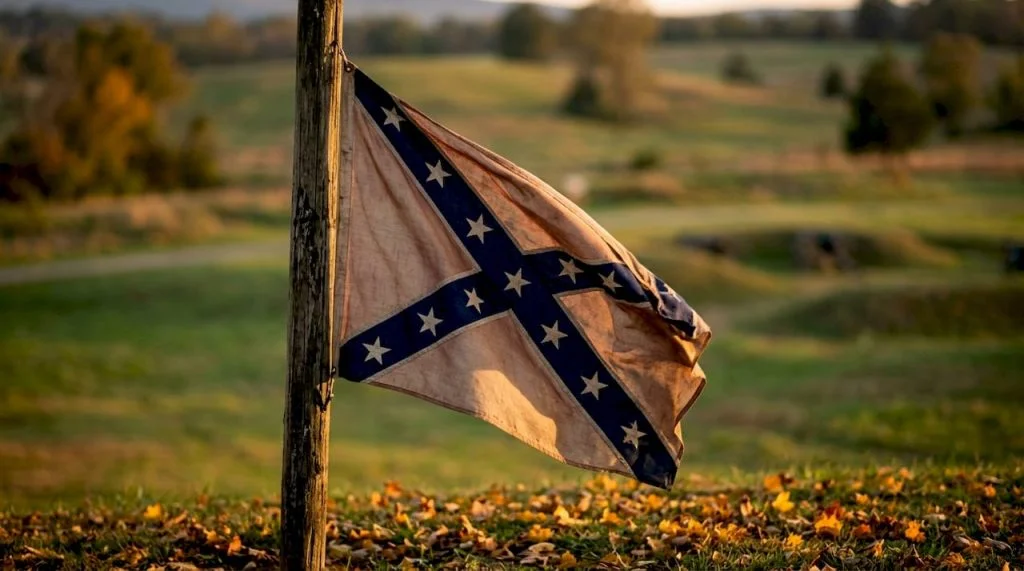
For millions of Americans, the Confederate flag signals regional heritage and family memory. For millions of others, it signals white supremacy and the violent resistance to civil rights. Both readings are historically grounded, and neither one alone tells the full story. The flag’s meaning shifts with who is holding it, where it flies, and what era produced the display, a point museum historians at the American Civil War Museum make explicitly when they call the simple “heritage versus hate” framing a false choice.
You’ll typically see the flag invoked in one of four settings:
- Battlefield memorials and Civil War reenactments honoring ancestors
- Political protest, often tied to states’ rights arguments
- White supremacist and extremist gatherings
- Popular culture, from stock car racing to television
A 2019 YouGov survey reported by National Geographic found 41% of Americans associate the flag primarily with racism, while 34% see it as a symbol of Southern heritage. That split isn’t a poll glitch. It reflects two genuinely different historical threads that the flag has carried since the 1860s.
Key Takeaways
The Confederate flag’s meaning depends on documented history, not just personal interpretation, and the battle flag’s 20th-century political re-adoption is what most sharply divides public opinion today.
| Point | Details |
|---|---|
| Two readings, one history | Heritage and hate associations both trace to real, documented events rather than modern misunderstanding. |
| Battle flag, not the national flag | The Southern Cross was a wartime military banner, never the Confederacy’s sole official flag. |
| 20th-century turn mattered most | Segregationists and the KKK’s mid-1900s adoption reshaped the flag’s public meaning more than the war itself. |
| Public opinion remains split | YouGov found 41% link it to racism and 34% to heritage, showing no clear national consensus. |
| Context determines reading | Location, accompanying symbols, and intent separate memorial use from hate speech. |
Table of Contents
- The Origin of the Confederate Battle Flag Meaning
- Southern Cross vs. Stars and Bars: Clearing Up the Confusion
- From Veterans’ Memorial to Political Weapon
- Why the Flag Sparks Modern Controversy
- How to Read the Flag: A Context Checklist
- What This History Actually Tells Us
- Sources
- FAQ
The Origin of the Confederate Battle Flag Meaning
The flag most people picture when they hear “Confederate flag” was never the Confederacy’s official national banner. It was a battlefield tool, designed to solve a real tactical problem. Early in the Civil War, the Confederacy’s first national flag, the Stars and Bars, looked too similar to the Union’s Stars and Stripes at a distance, causing confusion and friendly fire during the First Battle of Bull Run in 1861.
South Carolina politician William Porcher Miles proposed a new design for the Army of Northern Virginia: a blue saltire, an X shape, on a red field, studded with white stars representing the Confederate states. General P.G.T. Beauregard adopted it as a battle flag rather than a national one. That distinction matters because Confederate armies carried this banner into combat, while separate national flags flew over government buildings.
The battle flag came in specific sizes tied to military function:
- Infantry regiments carried 48-inch square flags
- Cavalry units used smaller 30-inch square versions
- Artillery batteries flew 36-inch square flags
Pro Tip: If you’re researching or collecting reproductions, remember that wartime originals were square, not the rectangular shape sold commercially today. That single detail helps you separate a historically accurate piece from a novelty item. Encyclopedia Virginia’s detailed entry on the battle flag documents these committee debates and dimensions in depth, and readers interested in the soldiers who carried these banners into combat can find more in Ultimate Flags’ account of the color guard who carried the Southern Cross.
Southern Cross vs. Stars and Bars: Clearing Up the Confusion
People routinely call the battle flag the “Stars and Bars,” but that name technically belongs to a different flag entirely. The Stars and Bars was the Confederacy’s first national flag, adopted in 1861, featuring a circle of white stars on a blue canton beside horizontal red and white bars, a design deliberately closer to the American flag than most people realize.
The battle flag, properly called the Southern Cross, is the diagonal blue X on red that dominates modern imagery. Confusion between the two intensified because the Confederacy later folded the battle flag into its second and third national flags:
- The Stainless Banner (1863) placed the Southern Cross in the canton against a white field
- The Blood-Stained Banner (1865) added a red vertical bar to the same design
This layering is exactly why the Britannica entry on Confederate flags stresses that the battle flag was never the Confederacy’s sole national symbol.
From Veterans’ Memorial to Political Weapon
In the decades after Appomattox, the battle flag mostly appeared at veterans’ reunions and on monuments erected by groups promoting the Lost Cause narrative, a romanticized version of the Confederacy that downplayed slavery’s central role in causing the war. That framing shaped Southern textbooks and public memory for generations, but the flag remained largely a memorial object rather than an active political tool.
That changed dramatically in the mid-20th century. As the civil rights movement gained momentum, Dixiecrat politicians and segregationist groups revived the battle flag as a symbol of resistance to federal integration efforts. The Ku Klux Klan adopted it prominently during this same period.
The Confederate battle flag’s modern association with white supremacy grew substantially during the 20th century, as segregationists and the Ku Klux Klan embraced it specifically as a symbol of opposition to civil rights, according to National Geographic’s historical analysis.
A separate cultural thread ran alongside the political one. Stock car racing culture, novelty merchandise, and Southern rock imagery adopted the flag divorced from any explicit political statement, which is part of why some viewers today experience the symbol as regional flavor rather than political messaging. Both threads, the segregationist and the commercial, developed in the same decades and now overlap in how the public reads the image.
Why the Flag Sparks Modern Controversy
The Anti-Defamation League lists the Confederate flag in its Hate Symbols Database as one of the most commonly used symbols among white supremacists today. The ADL is careful to note that context still matters. A flag displayed at a Civil War cemetery carries a different weight than one carried at a rally organized around racial grievance.
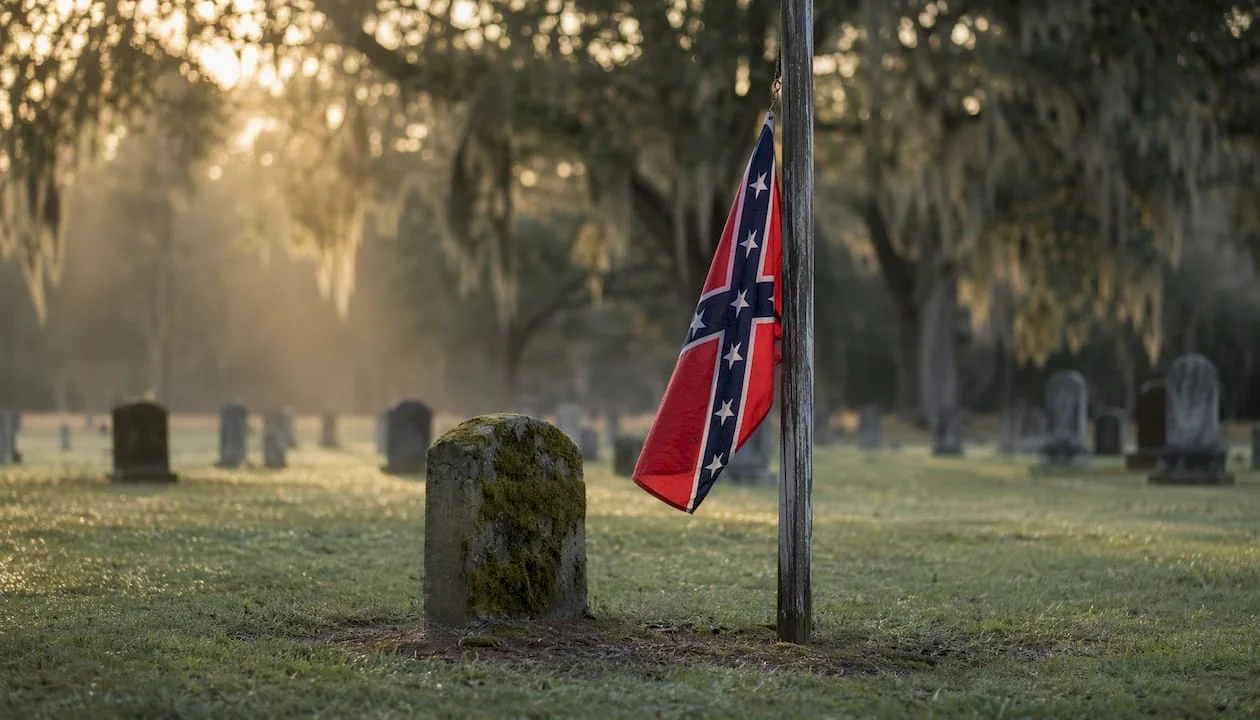
Two events accelerated the flag’s public reckoning more than any others. After the 2015 Charleston church shooting, in which the killer had displayed the flag extensively, South Carolina removed it from its statehouse grounds, and dozens of other governments and retailers followed. The 2017 Charlottesville “Unite the Right” rally, where the flag appeared alongside neo-Nazi imagery, further cemented its association with organized hate for many Americans.
Institutional responses since have been sweeping:
- NASCAR banned the flag from its events and properties in 2020
- Mississippi redesigned its state flag to remove the Confederate emblem
- Numerous military installations dropped the symbol from official use
Yet public opinion hasn’t consolidated around one reading. The YouGov figures showing 41% linking the flag to racism against 34% linking it to heritage reveal a country still genuinely divided, not a settled question with one side simply misinformed.
How to Read the Flag: A Context Checklist
Neither “it’s just heritage” nor “it’s always hate” survives contact with the historical record. The flag’s Lost Cause origins and its documented adoption by segregationists and the Klan are real. So is its continued use at family gravesites and reenactments with no political intent whatsoever.
When you encounter the flag, ask yourself:
- Where is it displayed, a cemetery, a statehouse, a rally?
- What other symbols accompany it?
- Who is displaying it, and what have they said about their intent?
- Does the timing coincide with a political event or protest?
- Is it framed with historical context, or presented without explanation?
Pro Tip: Context rarely lies. A flag folded respectfully beside a soldier’s grave marker tells a different story than one waved at a demonstration with no historical framing attached.
Collecting and Displaying Confederate Flags Responsibly
Ultimate Flags has published historical deep dives on the battle flag’s origins for years, including the story of its birth at the Battle of Manassas, and that experience shapes practical advice for collectors. Look for accurate labeling of era and material, whether cotton reproductions or modern polyester, since material choice affects both authenticity and durability. Historic flags belong in contexts with interpretive framing, a study, a museum display, a reenactment, rather than unexplained public display.
- Verify provenance and era before buying a “vintage” flag
- Store fabric flags away from direct sunlight to prevent fading
- Pair any historical display with a placard or note explaining its context
What This History Actually Tells Us
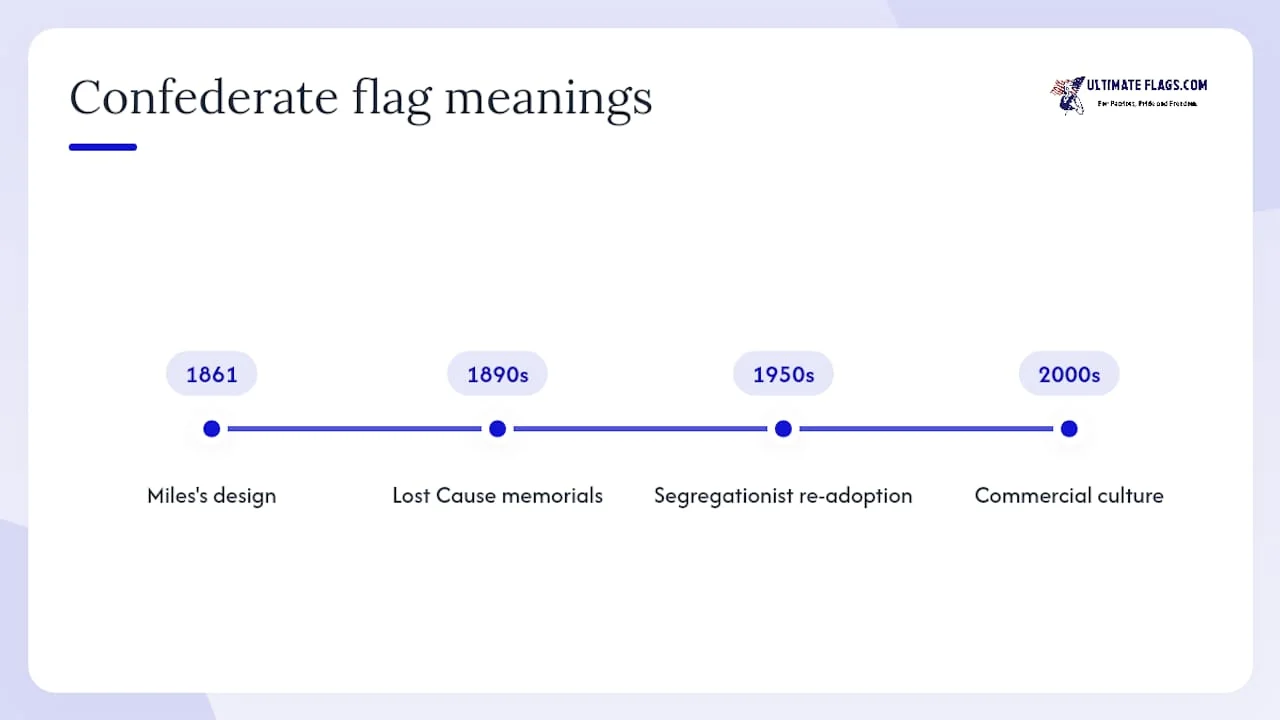
The conventional “heritage or hate” debate treats the Confederate flag as if it has always meant one thing, argued over by two camps who simply disagree. The historical record says otherwise. The flag’s meaning genuinely changed over time, shaped by specific, documented choices: Miles’s design decision in 1861, the Lost Cause memorial movement, the deliberate segregationist re-adoption in the mid-1900s, and the commercial culture that ran parallel to it.
That layered history is why flattening the symbol into a single verdict, either “it’s just heritage” or “it’s always racist”, misrepresents what actually happened. The more useful question isn’t which side is right. It’s what specific historical or political statement a given display is making, and whether the people making it understand which layer of that history they’re invoking.
Readers who want to engage with this history responsibly, whether as collectors, students, or curious observers, should prioritize accuracy over comfort. Know which flag you’re looking at, know which decade shaped its use, and know that context does the real work of interpretation.
Sources
- Myths & Misunderstandings | The Confederate Flag | American Civil War Museum
- How the Confederate battle flag became a symbol of racism | National Geographic
- Confederate Flag | Hate Symbols Database | ADL
- Flag of the Confederate States of America | Britannica
- Confederate battle flag | Encyclopedia Virginia
FAQ
What did the Confederates stand for?
The Confederate States seceded to preserve slavery and states’ rights as they understood them, with slavery’s preservation stated explicitly in several states’ secession declarations.
What does it mean if you fly a Confederate flag?
It depends entirely on context. It can signal Southern heritage, historical remembrance, political defiance, or affiliation with white supremacist ideology, and the ADL notes that surrounding symbols and setting matter for interpretation.
Did the Confederates want slavery?
Yes. Preserving and expanding slavery was the central cause cited by Confederate states in their own secession documents at the time.
Why do people like the Confederate flag?
Many trace it to family history, regional identity, or memorial traditions around Civil War ancestors, while others adopted it later through cultural avenues like stock car racing detached from explicit political meaning.