The American flag traces its official origin to the Flag Resolution of June 14, 1777, when the Continental Congress declared that the United States would be represented by 13 stripes and 13 stars, white on a field of blue. What we know today as Old Glory did not arrive fully formed. It evolved, deliberately and repeatedly, across nearly two centuries of national growth.
The path runs from the Grand Union Flag flown in 1776, through the 1777 resolution, to the 1818 law that fixed the stripes at 13 forever, to the 1912 order that standardized star arrangement, and finally to the 1959 and 1960 additions of Alaska’s and Hawaii’s stars. Each change marked something real: a new state, a new war, a new understanding of what the flag was supposed to say about the country carrying it.
-
1776: Grand Union Flag flies as the first national banner of the united colonies.
-
1777: Continental Congress adopts the Flag Resolution, establishing 13 stripes and 13 stars.
-
1818: Congress locks the stripe count at 13 permanently and adds a star per admitted state.
-
1912: President Taft’s executive order standardizes star arrangement and flag proportions.
-
1959 to 1960: Alaska and Hawaii statehood bring the flag to its current 50 stars.
The 50-star flag became official on July 4, 1960, following Hawaii’s admission to the Union the previous year. It remains the longest-serving version of the flag in American history, and by most historical counts, it is one of roughly two dozen official design changes the flag has undergone since the nation’s founding.
Key Takeaways
The American flag’s design changed officially multiple times between 1777 and 1960, driven almost entirely by new states joining the Union rather than aesthetic preference.
| Point | Details |
|---|---|
| Origin date | The Flag Resolution of June 14, 1777, established 13 stripes and 13 stars but specified no arrangement. |
| Stripe permanence | The 1818 act fixed stripes at 13 forever, adding stars per state instead of stripes. |
| Current flag’s start date | The 50-star flag became official July 4, 1960, following Hawaii’s 1959 statehood. |
| Origin uncertainty | No primary-source document confirms Betsy Ross designed the first flag; Francis Hopkinson has a documented invoice claim. |
| Star logic | Stars represent states, not territories, which is why the flag has never carried 52 stars. |
Ready to bring this history into your own home or hall? Ultimate Flags carries flags rooted in exactly these stories, from historically inspired designs that connect directly to the moments covered here to Civil War era reproductions for collectors and history enthusiasts who want more than a generic banner.
Table of Contents
-
What Was the Grand Union Flag, and Who Designed the First Stars and Stripes?
-
How Did Congress and Presidents Officially Change the Flag’s Design?
-
What Do the Stars, Stripes, and Colors on the Flag Represent?
-
What Do the Stars and Stripes Symbolize Beyond Their Colors?
-
How Has the Flag’s Role in the Military and Government Evolved?
The History of the US Flag: A Timeline of Official Designs
Every version of the American flag reflects a decision Congress or a president made in response to a specific event. The timeline below traces the major turning points.
The story begins before the country had a name for its flag. On January 1, 1776, colonial forces raised the Grand Union Flag, also called the Continental Colors, over Prospect Hill near Boston. It paired 13 red and white stripes with the British Union Jack in the canton, a design that made sense for colonists who still saw themselves as British subjects fighting for their rights rather than founders of a new nation. That changed fast. Independence made the Union Jack an awkward symbol to keep flying, and on June 14, 1777, the Continental Congress adopted the Flag Resolution, replacing the British canton with 13 white stars on blue.
The next major shift came in 1795, when Vermont and Kentucky joined the Union and Congress responded by adding both a stripe and a star, bringing the count to 15 of each. This is the flag that flew over Fort McHenry during the War of 1812, immortalized when Francis Scott Key watched it survive a night of British bombardment and wrote what became “The Star-Spangled Banner.”
By 1818, Congress recognized that adding a stripe for every new state would eventually turn the flag into an unreadable set of pinstripes. Lawmakers fixed the stripes permanently at 13, representing the original colonies, and established that a new star would be added for each admitted state instead.
-
1795: Stripe and star count rises to 15 following Vermont and Kentucky statehood.
-
1818: Stripes locked at 13; star-per-state rule established.
-
1861 to 1865: Civil War drives a surge in public flag display, sometimes called Flagmania.
-
1912: Formal standardization of star arrangement and proportions.
-
1959 to 1960: Final two stars added for Alaska and Hawaii.
The Civil War years mark a cultural turning point as much as a design one. Following the attack on Fort Sumter, private ownership of American flags exploded, a shift historians at Collectors Weekly document as the moment the flag moved from a military and government emblem into a mass civic symbol. The flag stopped being something only soldiers and officials carried and became something ordinary households displayed with pride.
What Was the Grand Union Flag, and Who Designed the First Stars and Stripes?
No individual can be credited with certainty as the sole designer of the Stars and Stripes, and that gap in the record is one of the most persistent sources of confusion in American flag history.
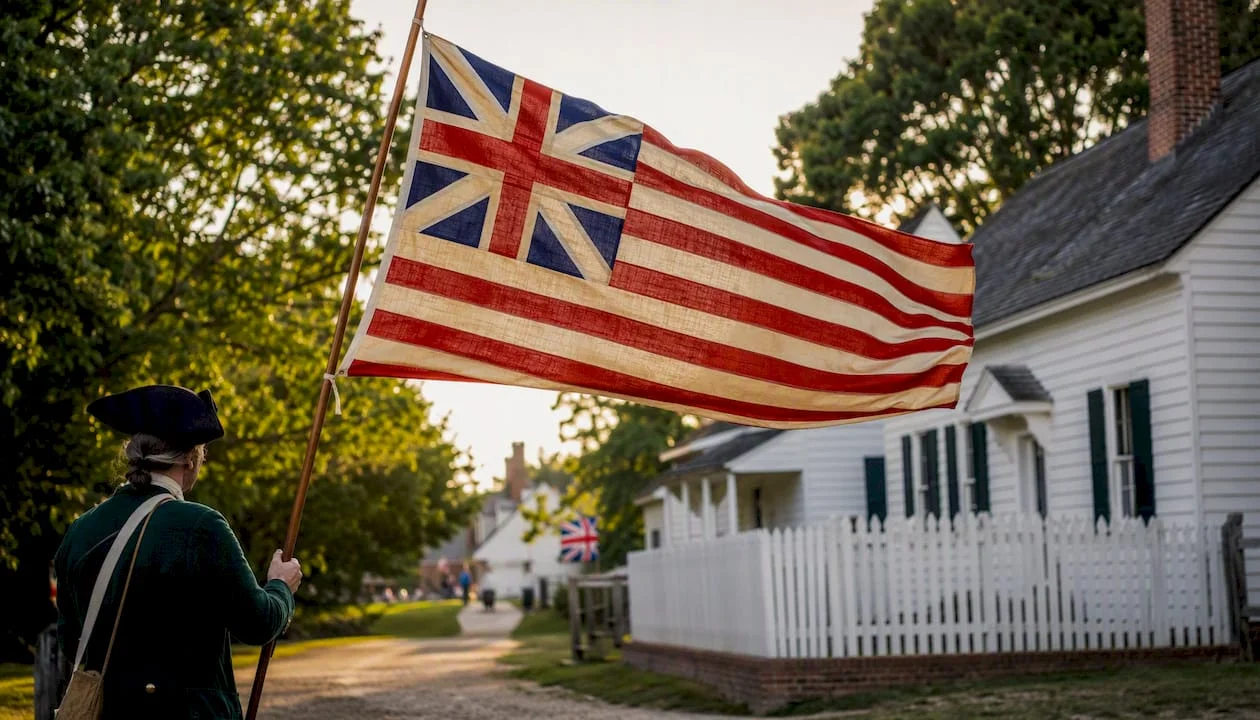
The Grand Union Flag, first raised on January 1, 1776, was the direct visual ancestor of the flag we know now. Its 13 alternating red and white stripes represented the 13 colonies, but its canton still carried the British Union Jack, a design the National Postal Museum notes reflected the colonies’ initial goal of securing rights within the British Empire rather than full independence. Once independence became the actual goal, that British symbol in the corner no longer fit.
The Flag Resolution passed on June 14, 1777, is short enough to quote in full: “Resolved, that the flag of the United States be thirteen stripes, alternate red and white; that the union be thirteen stars, white in a blue field, representing a new constellation.” That is the entire text. It says nothing about how the stars should be arranged, how many points each star should have, or what proportions the flag should follow. Congress solved the “what” and left the “how” to whoever happened to be sewing.
That vacuum is exactly where the Betsy Ross legend took root.
-
The story holds that Ross, a Philadelphia seamstress, sewed the first flag at George Washington’s request in 1776.
-
No contemporary document from the Revolutionary period supports this claim.
-
The story surfaced publicly in 1870, nearly a century later, told by Ross’s grandson, William Canby, based on family recollections.
Historians examining the historical record have found the tale compelling as folklore but thin as documented history. The claim is widely regarded as a 19th-century legend, popularized by family testimony rather than anything written down at the time it supposedly happened.
Francis Hopkinson, a signer of the Declaration of Independence and a member of the Continental Navy Board, has a far stronger paper trail. He submitted invoices to Congress in 1780 requesting payment for designing the flag, along with a naval flag and the Great Seal of the United States. Congress never paid him in full, partly on the grounds that he had help from others, but the correspondence itself is real and dated, which is more than can be said for the Ross account.
Pro Tip: When you read competing origin stories about the flag, ask which claim has a document attached to it versus which one relies only on family memory passed down generations later. That distinction is often the entire difference between history and legend.
For readers who want the fuller Ross narrative, including how the legend spread and why it stuck, Ultimate Flags has traced Betsy Ross’s disputed role in the Revolutionary War in more detail.
How Did Congress and Presidents Officially Change the Flag’s Design?
Design changes to the flag have never happened casually. They came through specific legislative acts and executive orders, each responding to a concrete problem Congress or the president needed to solve.
-
The 1795 Flag Act added a stripe and a star for Vermont and Kentucky, producing the 15-stripe, 15-star flag that flew at Fort McHenry.
-
The 1818 Flag Act reversed course on stripes, fixing them permanently at 13 to honor the original colonies, while establishing that a new star would be added for each new state, effective the July 4 following admission.
-
The 1912 executive order, signed by President William Howard Taft, standardized the exact proportions of the flag and specified how stars should be arranged in even rows, ending decades of inconsistent flag-making.
-
The 1959 executive order, signed by President Eisenhower, added a 49th star for Alaska’s admission.
-
The 1960 executive order, also signed by Eisenhower, added the 50th star for Hawaii, producing the flag flown today.
The 1818 act deserves particular attention because it solved a real design crisis. Between 1795 and 1818, five new states joined the Union, and nobody in Congress had settled on whether the flag should keep adding stripes indefinitely. A flag with 20 or 30 stripes would have been visually chaotic and impossible to recognize at a distance, a serious problem for a symbol meant to be identified on a battlefield or a ship’s mast from far away. Congressman Peter Wendover pushed the fix through, and the star-for-state, stripes-frozen-at-13 formula has held for more than two centuries since.
-
Changes take effect the July 4 following a state’s admission, not the moment the state joins.
-
This rule explains why territories and non-state jurisdictions never get automatic stars.
-
The USHistory.org timeline documents this effective-date pattern across every star addition since 1818.
-
Executive orders, not new acts of Congress, have governed most star additions since the 1818 law set the underlying rule.
That July 4 delay is why, for instance, Arizona and New Mexico joined the Union in early 1912 but the 48-star flag did not officially take effect until July 4 of that year. It is also why the current 50-star flag, despite Hawaii’s August 1959 admission, did not become official until July 4, 1960. The gap gave flag manufacturers time to retool before the new design took hold nationwide.
What Do the Stars, Stripes, and Colors on the Flag Represent?
The flag’s design carries specific, government-defined meaning, not folk interpretation. The 13 stripes represent the original 13 colonies that declared independence in 1776, and they alternate red and white across the flag’s field. The stars in the canton represent the current number of states, one star per state, arranged since 1912 in even horizontal rows against a blue background.
Star counts have changed 27 times since 1777, according to standard historical tallies, each addition tied to a specific state’s admission rather than to population growth or territorial expansion. This is precisely why the flag has never carried 52 stars despite the United States controlling Puerto Rico, Guam, and other territories: star additions follow statehood, not territorial acquisition, and none of those jurisdictions has been admitted as a state.
Before 1912, star arrangements varied wildly. Some flags scattered stars in a circle, others arranged them in a diamond, and manufacturers often improvised their own patterns since Congress had never specified one. Taft’s 1912 order ended that inconsistency, mandating six horizontal rows of stars, alternating between rows of eight and seven, a pattern that shifted again as later star counts required new arrangements.
-
Red symbolizes valor and bravery.
-
White symbolizes purity and innocence.
-
Blue symbolizes vigilance, perseverance, and justice.
That color symbolism comes directly from official U.S. government guidance, not from folklore or private interpretation. It is worth noting how deliberately restrained this symbolism is. The government never assigned meaning to the number of stripes beyond representing the original colonies, nor did it attach mystical significance to the star count beyond simple representation. The gravity of the flag comes less from hidden symbolism and more from what it has witnessed: battles, funerals, moon landings, and the raising of a new star each time the country grew.
How Has the Flag’s Cultural Meaning Changed Over Time?
The flag’s cultural weight shifted dramatically over the decades, moving from a practical military marker to a civic object treated with something close to reverence.
Before the Civil War, the Stars and Stripes functioned mostly as a government and military identifier, and many homeowners incorporated the flag and Americana elements into their interior decor, as shown in timeless interior doors and Americana style. Ordinary citizens rarely flew it outside of forts, ships, and official buildings. That changed almost overnight after Confederate forces fired on Fort Sumter in April 1861. Northern households began displaying the flag in numbers never seen before, a phenomenon historians call Flagmania, and private flag ownership surged as the Union cause turned the Stars and Stripes into a symbol of loyalty rather than mere government property.
The War of 1812 had already given the flag its most famous moment decades earlier. The 15-star, 15-stripe flag that survived the British bombardment of Fort McHenry in 1814 inspired Francis Scott Key’s poem, which eventually became the national anthem in 1931. That garrison flag, massive at 30 by 42 feet when intact, remains one of the most studied textile artifacts in American history.
-
The flag accompanied Union and Confederate forces alike, though the Confederacy adopted its own distinct designs.
-
It flew over the Marines at Iwo Jima in 1945, an image that became one of the most reproduced photographs in American history.
-
Neil Armstrong and Buzz Aldrin planted a version of the flag on the Moon in 1969, extending its symbolism beyond national identity into a marker of human achievement.
-
The Pledge of Allegiance, written in 1892, formalized a daily civic ritual built around the flag that persists in American classrooms today.
By the late 19th century, this growing reverence produced what historians describe as a genuine “cult of the flag.” As commercial use of the flag’s image on everything from cigarette packaging to political advertising increased, reformers pushed back against what they saw as disrespectful commercialization, leading to early flag protection laws and the civic customs that still govern respectful display.
Pro Tip: If you display a flag at home, understanding this history changes how you see the object. It is not decoration. It is the same design lineage that survived a naval bombardment and stood on the lunar surface.
What Are Common Myths About the American Flag?
A handful of persistent myths surround the flag’s history, and separating them from documented fact matters for anyone who wants to understand the real story.
The biggest myth is that Betsy Ross single handedly designed and sewed the first American flag at George Washington’s personal request. As covered earlier, this story has no supporting documentation from the 1770s and first appeared publicly in 1870, nearly a century after the events it describes supposedly took place. That does not mean Ross never sewed flags. Philadelphia records confirm she was a working upholsterer who took flag commissions. It means the specific “first flag” story cannot be verified against any primary source. Readers curious about the full narrative can review Ultimate Flags’ deeper look at the Betsy Ross story.
The second common question is why the flag does not carry 52 stars, given that the United States governs more than 50 states and territories combined. The answer is straightforward: stars represent states, not territories, and territories like Puerto Rico or Guam have never been admitted as states. The 1818 rule ties star additions strictly to statehood, and that rule has never changed.
-
The 48-star flag flew from 1912 to 1959, the longest-serving design before the current 50-star flag.
-
The 49-star flag, representing Alaska alone, flew for exactly one year before Hawaii’s star was added.
-
Confederate battle flags are historically distinct from the official U.S. flag and followed their own separate design lineage during the Civil War.
-
Early American flags occasionally featured unofficial star arrangements, including circular patterns, since no federal standard existed before 1912.
Anyone researching what flag preceded the current design will find it was the 48-star flag, which served the country through two world wars, the Great Depression, and Korea before Alaska’s admission in 1959 finally forced a change after nearly half a century of stability.
How Do Museums Preserve and Verify Historic Flags?
Studying flag history responsibly means separating documented artifacts from oral tradition, and museums do this work through conservation science as much as archival research.
The Smithsonian’s National Museum of American History has run a long-term preservation project on the original 1814 Star-Spangled Banner, involving low-oxygen storage, controlled lighting, and microscopic inspection of individual wool and cotton fibers to understand how the flag was constructed and how it has degraded over two centuries. This kind of multi-year conservation effort sometimes requires partial disassembly just to study stitching patterns invisible to the naked eye.
-
The Flag Resolution text, congressional acts, and executive orders form the paper trail historians rely on for dates and design specifications.
-
The Smithsonian holds the Star-Spangled Banner itself, the single most studied flag artifact in the country.
-
State historical societies and military museums hold Civil War battle flags and early 13-star variants.
-
Provenance research relies on matching physical construction techniques, thread types, and dye chemistry against known manufacturing periods.
Conservators distinguish legend from fact the same way any historian does: by demanding a document, an invoice, a diary entry, or a physical artifact dated to the actual period in question, rather than accepting a story simply because it has been repeated for generations.
What Are the Most Historically Significant American Flags?
A handful of specific physical flags carry outsized historical weight, and knowing where they came from helps ground the broader timeline in real objects rather than abstract dates.
The Star-Spangled Banner, the 15-star, 15-stripe garrison flag that survived the 1814 bombardment of Fort McHenry, remains the centerpiece of the Smithsonian’s flag collection and the namesake of the national anthem. The Grand Union Flag, first raised in 1776, represents the transitional moment between colonial loyalty and full independence, and reproductions are held by several historical societies. Civil War battle flags, including those carried at Manassas and other early engagements, illustrate how quickly flag design proliferated once regiments began commissioning their own banners.
| Flag | Date | Current Location |
|---|---|---|
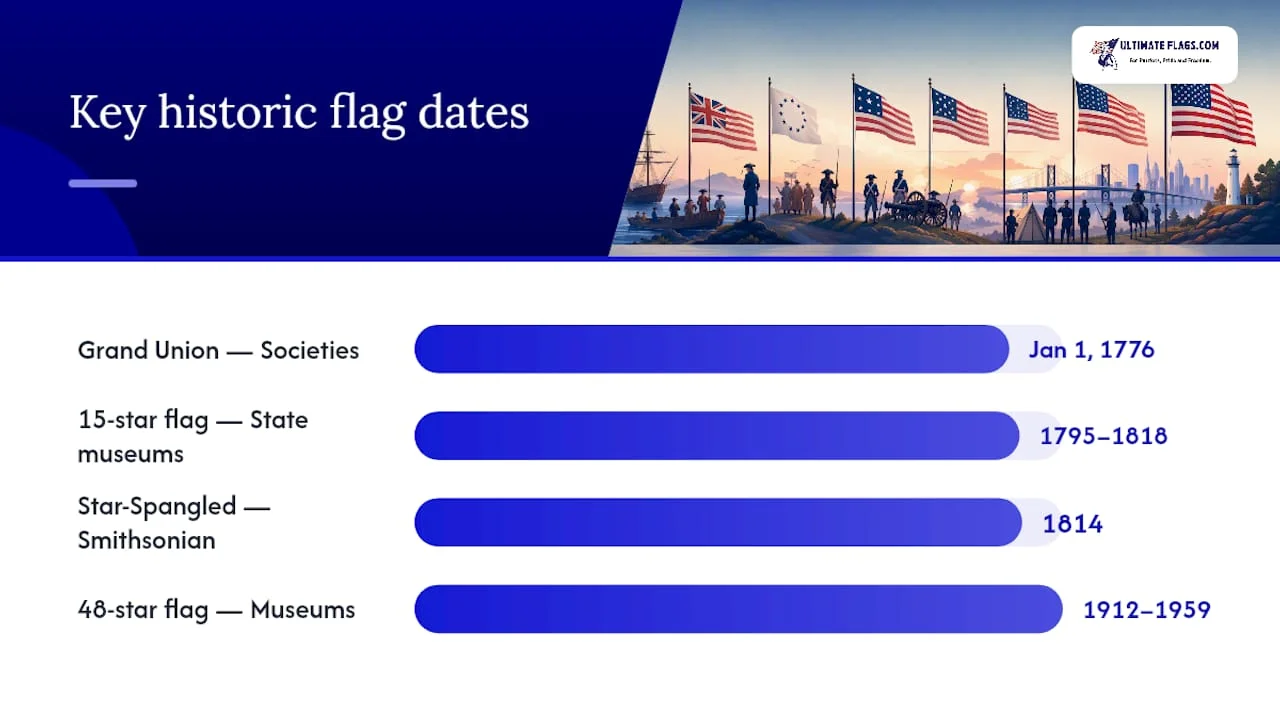
| Grand Union Flag | January 1, 1776 | Reproductions held by historical societies |
| Star-Spangled Banner | 1814 | Smithsonian National Museum of American History |
| 15-star flag (1795 design) | 1795 to 1818 | Various state and military museum collections |
| 48-star flag | 1912 to 1959 | Widely held in museum and private collections |
Ultimate Flags has covered several of these battlefield banners in more depth, including the birth of the Confederate battle flag at Manassas, which illustrates how regional and regimental flags multiplied even as the national flag’s design stayed relatively fixed after 1818.
How Should the Flag Be Displayed and Retired Properly?
The U.S. Flag Code lays out clear customs for displaying, handling, and retiring the flag, and while it carries no criminal penalties for violations, the etiquette it describes reflects two centuries of accumulated civic tradition.
-
Display the flag from sunrise to sunset, unless it is illuminated after dark.
-
Always position the union, the blue field of stars, at the top left when displayed flat or hung vertically.
-
Raise the flag briskly and lower it ceremoniously, never letting it touch the ground.
-
Fly the flag at half staff on specific occasions designated by presidential proclamation, such as the death of a sitting president or a national tragedy.
-
Retire a worn or damaged flag in a dignified manner, traditionally by burning, once it is no longer fit for display.
Half staff protocol follows a specific rhythm: raise the flag briskly to the top of the pole first, then lower it slowly to the half staff position, and reverse the process before taking it down for the day. Retirement ceremonies, often conducted by veterans’ organizations and scout troops, treat a worn flag with the same care you would give a letter from someone you deeply respect, folding it properly before it is finally retired.
Pro Tip: If your flag has faded or frayed beyond a dignified display, most American Legion posts and VFW chapters host retirement ceremonies and will take a worn flag off your hands respectfully. For households transitioning from a worn flag to a new one, Ultimate Flags has practical guidance on what to do once you have your new Red, White and Blue.
What Do the Stars and Stripes Symbolize Beyond Their Colors?
The stripes carry a specific numerical logic that predates statehood entirely. Thirteen stripes will always represent the 13 original colonies, frozen by the 1818 act regardless of how large the country grows. That permanence is intentional: the stripes anchor the flag to its founding moment, while the stars alone carry the story of national expansion.
Stars function differently. Each one represents a state, not a region or population, which means Rhode Island’s star carries the same visual and symbolic weight as California’s. That equality in representation echoes the “one state, two senators” logic built into the Senate, a subtle constitutional idea embedded in cloth. The stars, taken together, are sometimes described in early government language as “a new constellation,” a phrase lifted directly from the 1777 resolution and meant to suggest a new nation charting its own course among established powers.
The number 50 itself carries no independent symbolism. It is simply the current count, destined to change again only if a new state joins the Union. This is part of why the flag has changed so many times: it was designed from the outset to grow, unlike the fixed emblems of most older nations.
How Has the Flag’s Role in the Military and Government Evolved?
The flag began as a purely military and naval identifier, meant to distinguish American ships and forts from British and other foreign vessels during the Revolutionary War. Naval use came first and shaped early design decisions, since a flag needed to be readable from a distance at sea long before it needed to hang outside a courthouse.
By the 19th century, the flag had become standard at every federal building, military installation, and naval vessel, with strict specifications governing its size relative to different types of poles and masts. The military developed its own detailed protocols for flag handling that exceeded civilian etiquette, including specific folding procedures used at funerals and ceremonies honoring fallen service members.
Government use expanded steadily through the 20th century. Executive orders began specifying not just star arrangement but also the exact flags flown at federal buildings, military bases, and diplomatic posts abroad. The flag also became a standard element of presidential inaugurations, state funerals, and joint sessions of Congress, cementing its role as the visual shorthand for federal authority itself. Today, federal law and military regulation govern flag display with more precision than almost any other national symbol, right down to which flags fly at half staff and for how long following a service member’s death.
How Have Flag Manufacturing Materials and Methods Changed?
Early American flags were sewn entirely by hand from wool bunting or cotton, materials chosen for durability against wind and weather rather than any symbolic reason. Seamstresses and small workshops produced most flags individually well into the 19th century, which explains why star arrangements varied so much before the 1912 standardization order gave manufacturers a single pattern to follow.
Industrialization changed everything. Sewing machines, patented in the 1840s and widely adopted by the Civil War era, allowed manufacturers to produce flags at a volume that matched the sudden civilian demand following Fort Sumter. Nylon and polyester emerged in the 20th century as lighter, more weather-resistant alternatives to cotton and wool, extending the outdoor lifespan of flags considerably.
Modern flag production uses durable synthetic fabrics, reinforced stitching at stress points, and printing or embroidery techniques for stars that would have taken a colonial seamstress days to complete by hand. That manufacturing evolution matters for anyone buying a flag today: material choice directly affects how long a flag holds its color and withstands wind before it needs retirement.
How Has the World Viewed the American Flag Through History?
Foreign observers and diplomats have treated the American flag as a barometer of U.S. power and intentions since the earliest days of the republic. European nations recognized the Stars and Stripes diplomatically well before the Revolutionary War ended, with France’s formal alliance in 1778 marking one of the first instances of a foreign power saluting the new flag on equal terms with established European banners.
The flag’s presence abroad expanded steadily through the 19th and 20th centuries as American naval vessels, embassies, and expeditionary forces carried it into new territories. During both World Wars, Allied nations recognized the flag as a symbol of American industrial and military commitment, and its raising over captured territory, most famously at Iwo Jima, carried diplomatic as well as military weight. Embassies and consulates worldwide fly the flag today under strict protocol governing its size and position relative to the host nation’s own flag, a diplomatic courtesy that reflects mutual respect between sovereign nations.
Why Flag History Still Matters Today
Understanding where the flag came from changes how you see it hanging outside a courthouse or folded at a funeral. Every star and stripe traces back to a specific date, a specific act of Congress, and often a specific fight over how much respect a symbol deserves. Ultimate Flags approaches this history the way any serious student of the subject should: by separating documented fact from popular legend, and by treating preservation and respectful display as extensions of the same history this article covers.
Where to Learn More About Flag History
-
The Flag Resolution text provides the original 1777 congressional language.
-
The Smithsonian’s Star-Spangled Banner preservation project documents conservation methods on the 1814 garrison flag.
-
The Library of Congress Flag Day entry covers the June 14 observance and its origins.
-
PBS’s flag history overview offers an accessible public-history summary of major milestones.
Sources
FAQ
What Are Five Facts About the American Flag?
The flag’s design changed officially more than two dozen times since 1777, the 1818 act permanently fixed stripes at 13, the current 50-star version became official July 4, 1960, star arrangement was never specified in the original 1777 resolution, and the Betsy Ross origin story lacks primary-source documentation.
What Does the Black-and-White or Dark Version of the American Flag Mean?
Muted or all-black versions of the flag are not official government designs; they are typically used as commemorative or protest symbols, most commonly associated with law enforcement and military mourning traditions, and they fall outside the Flag Code’s official specifications.
Why Are There Not 52 Stars on the American Flag?
Stars represent admitted states, not territories, so jurisdictions like Puerto Rico and Guam do not receive stars unless Congress admits them as states, a rule established by the 1818 Flag Act.
What Was the U.S. Flag Before 1960?
The 49-star flag, representing Alaska’s 1959 admission, flew for exactly one year before Hawaii’s star was added in 1960; before that, the 48-star flag served from 1912 to 1959, the longest run of any design until the current 50-star flag.
Who Actually Designed the First American Flag?
No one knows with certainty. Francis Hopkinson left a documented invoice claiming credit, while the popular Betsy Ross story surfaced nearly a century later with no supporting contemporary evidence.