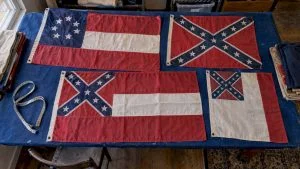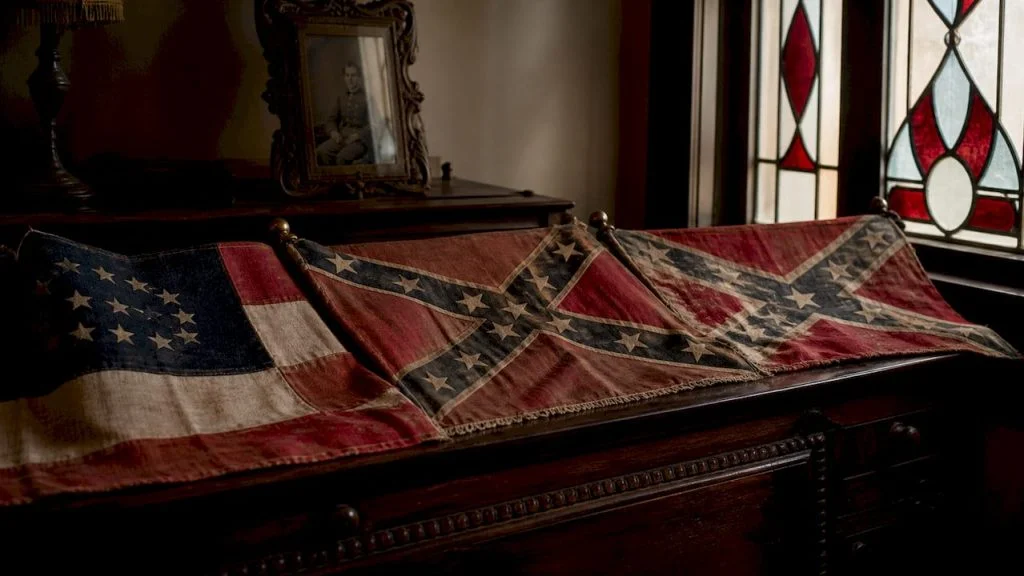
The Confederacy flew three official national flags between 1861 and 1865: the Stars and Bars, the Stainless Banner, and the Blood-Stained Banner. The flag most people picture when they hear “Confederate flag,” the red banner with the blue starred saltire, was never one of them. That design is the Confederate battle flag, sometimes called the Southern Cross, and it never flew as a national symbol at all.
Understanding Confederate flag types starts with that distinction. Beyond the four major designs, researchers and collectors regularly encounter a wider constellation of state secession banners, corps flags, and improvised regimental colors, including the Bonnie Blue Flag, the Van Dorn pattern, and Hardee’s Corps flag. Each carries its own history and its own identification quirks.
- Stars and Bars (First National, 1861 to 1863): three horizontal bars with a blue canton of stars
- Stainless Banner (Second National, 1863 to 1865): white field with the battle flag as canton
- Blood-Stained Banner (Third National, adopted March 4, 1865): the Stainless Banner design plus a red vertical bar
- Confederate battle flag / Southern Cross: a red field with a blue saltire and white stars, never a national flag
Ultimate Flags has spent years cataloging and reproducing these designs for collectors, reenactors, and history buffs, and that archival grounding shapes everything below.
TL;DR:
- The Confederacy used three official national flags during the Civil War, with designs changing mainly for battlefield visibility rather than symbolism.
- The widely recognized “Confederate flag” is actually the battle flag, which was never an official national banner but was incorporated into the later national flags.
- Variations in flag sizes and shapes reflect different branch conventions and practical battlefield needs, not official standards.
- The white field of the Stainless Banner caused confusion with surrender flags, prompting the final Blood-Stained Banner redesign for clarity.
- Accurate reproductions depend on matching specific design details, sizes, and materials, with expert options available for collectors and reenactors.
Table of Contents
- The Three National Flags: Stars and Bars, Stainless Banner, and Blood-Stained Banner
- The Confederate Battle Flag: Origin, Design, and Branch Variants
- State and Unit Banners Worth Knowing
- Why the Design Kept Changing
- Collector and Reproduction Notes for Researchers
- A Quick Timeline for Reference
- Why Getting This Taxonomy Right Matters
- Key Takeaways
- Sources
- FAQ
The Three National Flags: Stars and Bars, Stainless Banner, and Blood-Stained Banner
The Confederacy went through three national flags in four years, and each redesign happened for a practical reason rather than a symbolic one. Smoke, wind, and distance made flags hard to read on a Civil War battlefield, and Confederate officials kept adjusting the design to solve that problem.
1. The Stars and Bars (1861 to 1863)
The First National flag, adopted on March 4, 1861, used three horizontal bars, two red and one white, with a blue canton in the upper corner holding a circle of white stars representing the seceding states, with the star count increasing as more states joined the Confederacy. At a distance, on a smoke-filled field, the Stars and Bars looked almost identical to the United States flag it replaced. Confederate officers reported real confusion during the First Battle of Manassas in July 1861, when troops struggled to tell friend from foe by flag alone.
2. The Stainless Banner (1863 to 1865)
Confederate lawmakers responded to that battlefield confusion by adopting the Second National flag on May 1, 1863. The Stainless Banner placed the battle flag’s saltire design into the canton of a plain white field, which solved the resemblance problem but created a new one. A wide, plain white field, especially when hanging limp with no wind, could be mistaken for a flag of surrender or a truce flag, exactly the wrong message on a battlefield.
3. The Blood-Stained Banner (1865)
The Confederate Congress adopted the Third National flag on March 4, 1865, adding a broad red vertical bar along the fly edge of the Stainless Banner to eliminate the all-white surrender confusion, according to Florida’s Department of State archives. The war ended barely five weeks later, so the Blood-Stained Banner saw very limited use in the field before Confederate surrender.
By the numbers: the Confederacy cycled through three distinct national flag designs in under four years, a redesign roughly every 15 months, driven almost entirely by what soldiers could and couldn’t distinguish at a distance, according to Wikipedia’s summary of the Confederate national flags.
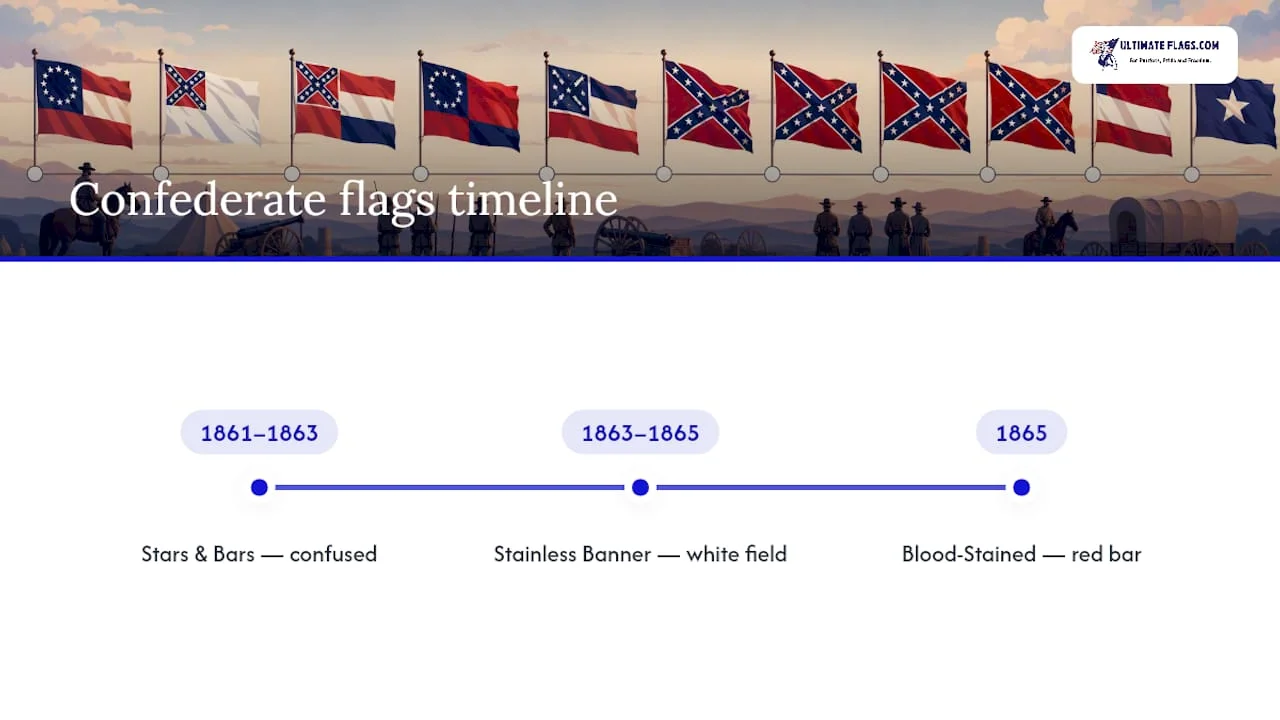
Each shift traces back to the same underlying problem: a flag has to work as a signal first, and as a symbol second. Confederate designers kept learning that lesson the hard way, and Encyclopedia Virginia’s account of the battle flag notes that these operational pressures, not aesthetic preference, drove nearly every redesign decision.
The Confederate Battle Flag: Origin, Design, and Branch Variants
Here’s where most confusion sets in, and it’s worth clearing up carefully: the flag most Americans call “the Confederate flag” was never a national flag at all. It’s the battle flag, commonly nicknamed the Southern Cross, and it was designed specifically to solve the identification problem that plagued the Stars and Bars on the battlefield.
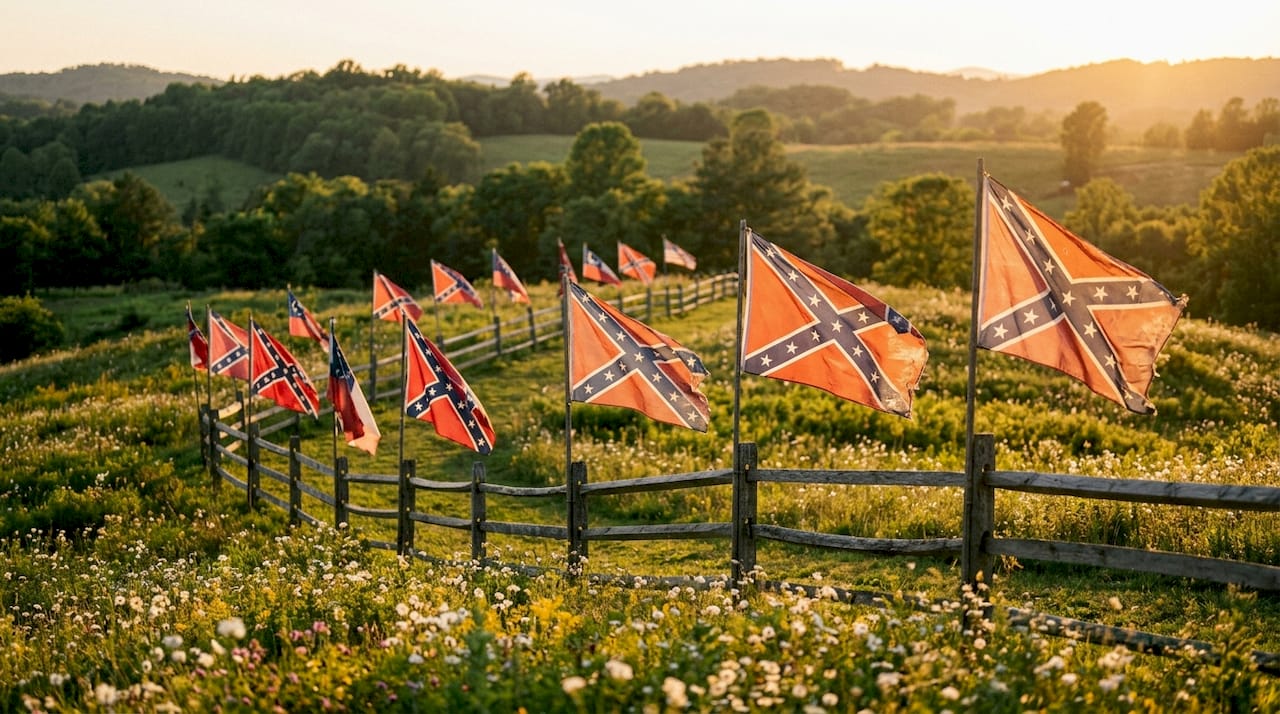
South Carolina congressman William Porcher Miles proposed the saltire design after the confusion at First Manassas convinced Confederate commanders they needed something a soldier could recognize instantly through smoke and dust. Miles had actually pitched a similar saltire pattern earlier, when the national flag was still being debated, but it lost out to the Stars and Bars. After Manassas, generals including Joseph E. Johnston and P.G.T. Beauregard pushed for a distinct battle flag, and the Confederate military adopted Miles’ red field, blue saltire, and white-edged stars for that purpose, a decision documented in Encyclopedia Virginia’s entry on the design. That flag later got folded into the canton of both the Stainless Banner and the Blood-Stained Banner, which is exactly why so many people conflate the battle flag with the national flags.
The battle flag itself wasn’t a single fixed object. It came in shapes and sizes that varied by branch and by army, and that variation is a big part of why collectors run into so many legitimate versions of what looks like “the same flag.”
- Infantry flags ran roughly 48 inches square, the largest of the standard battle flags, built to be seen and rallied around across an open field
- Artillery flags measured around 36 inches square, sized down slightly for units that moved and repositioned more often
- Cavalry flags came in at about 30 inches square, the smallest standard size, built for troopers who needed something light and maneuverable on horseback
- Army of Northern Virginia battle flags were typically square, following Miles’ original proportions
- Army of Tennessee flags adopted a rectangular shape starting around 1863, a regional variation that distinguishes western theater colors from their eastern counterparts
- Confederate Navy Jack used a rectangular format as well, flown from ships rather than carried on foot, and it’s frequently confused with the Army of Northern Virginia’s square battle flag despite the different context and proportions
Those branch conventions, laid out in Britannica’s entry on the Confederate flags, explain why surviving flags in museum collections and private hands come in such a wide range of dimensions. A flag doesn’t have to match a single “correct” size to be authentic; it has to match the conventions of the branch and army that carried it. Units carrying the Confederate battle flag into combat treated their colors as a rallying point, which is part of why size and visibility mattered so much in the field.
Pro Tip: If you’re trying to identify a flag in a collection or at an estate sale, check the shape first. A square flag with a saltire almost always points to the Army of Northern Virginia pattern, while a rectangular version suggests either an Army of Tennessee variant or a naval jack, depending on the hardware and grommets attached.
The naming confusion between “Stars and Bars” and the battle flag isn’t a modern accident. It happened during the war itself, as soldiers and civilians used “Stars and Bars” loosely to describe Confederate flags in general, even though the term technically belongs only to the First National flag. That loose usage stuck, and it’s still the single most common misidentification researchers run into today, a point regional reporting on Confederate flag variants confirms remains a persistent public misconception.
State and Unit Banners Worth Knowing
National and battle flags get most of the attention, but a serious collection or research project eventually runs into a second tier of flags: the state secession banners and unofficial designs that never received congressional sanction but carried real weight on the ground.
The Bonnie Blue Flag is probably the most culturally significant of these. It’s a simple design, a single white star on a solid blue field, and it became an unofficial symbol of Southern independence in the earliest weeks of 1861, well before the Confederacy had settled on any official national flag. Its popularity outlasted its practical use; the song “The Bonnie Blue Flag,” written that same year, kept the image alive in Southern culture for decades.
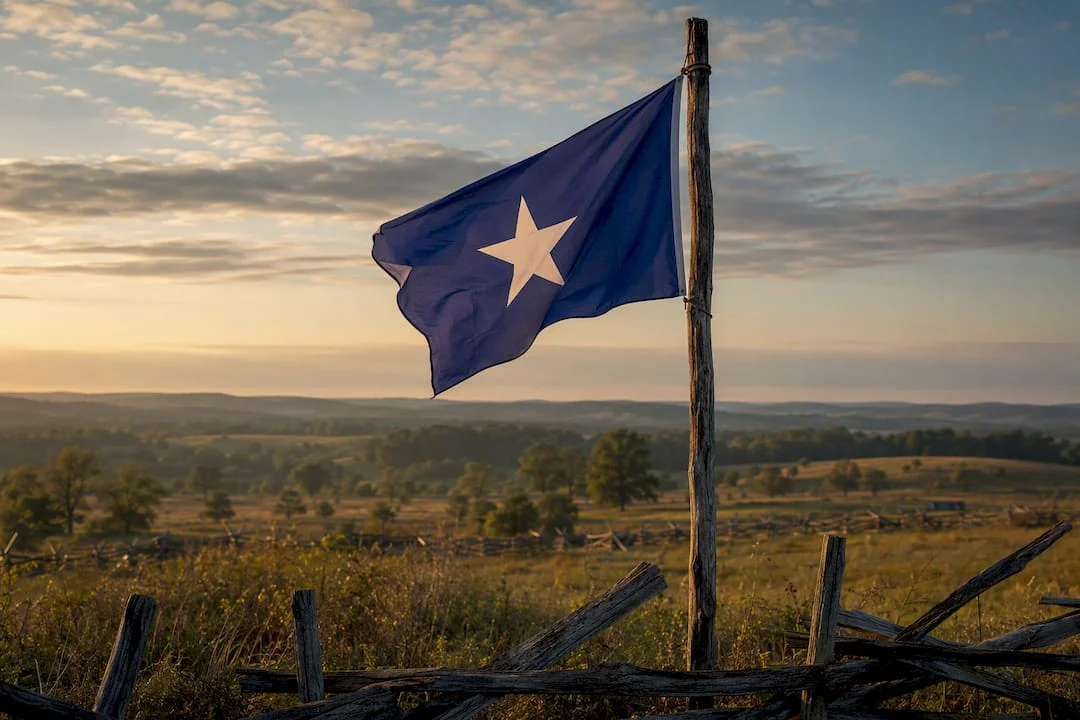
Several seceding states flew their own flags during secession conventions, often before joining the Confederacy formally. These state flags typically borrowed local symbolism, state seals, palmetto trees, pelicans, and lone stars, rather than following any shared Confederate template. If you’re trying to trace a flag’s origin, that kind of local imagery is often your best clue, since it points to a specific state rather than a Confederate-wide design.
Corps and command flags add another layer of complexity:
- The Van Dorn flag, used by Earl Van Dorn’s Army of the West, featured a crescent and stars design distinct from the standard battle flag
- Hardee’s Corps flag, associated with William J. Hardee’s command, used a blue field with a white oval, a pattern that shows up in Army of Tennessee contexts
- Polk’s Corps flag, tied to Leonidas Polk’s command, used its own distinctive cross pattern separate from the Miles saltire
Attribution on these regional and corps flags usually comes down to close reading: inscriptions, unit seals, hand-painted modifications, and stitching style all help narrow down which command a surviving flag likely belonged to. State-specific histories, like the story behind Alabama’s Confederate flag, show how much local variation existed even within a single state’s secession-era banners.
Why the Design Kept Changing
Every major redesign in this history traces back to a heraldic or operational decision, not a stylistic whim. Miles chose a saltire, an X-shaped cross, rather than a St. George’s cross (a plain vertical-horizontal cross) specifically because the diagonal shape read more clearly at a distance and avoided any resemblance to a religious symbol some delegates found politically awkward given the Confederacy’s religious diversity.
Star counts tell their own story about Confederate political ambitions. The original national flag carried seven stars for the founding secessionist states. That count climbed to eleven as more states formally joined, then to thirteen, a number that included Missouri and Kentucky even though neither state ever fully seceded. Confederate leaders added those stars anyway, a symbolic claim on states whose loyalties remained genuinely divided throughout the war.
The white-field problem in the Stainless Banner is one of the clearer examples in military history of design failing to anticipate its own use case.
A flag that can be mistaken for surrender is worse than no flag at all on a battlefield where seconds of confusion get men killed. That single design flaw, an expanse of white large enough to read as a truce signal, forced the Confederacy into its third and final national redesign within two years.
That practical failure, more than any aesthetic reconsideration, is what produced the Blood-Stained Banner in the war’s final weeks.
- Saltire chosen over a St. George’s cross for visibility and to sidestep religious associations
- Star count rose from seven to eleven to thirteen, reflecting political claims on Missouri and Kentucky
- White field in the Stainless Banner created real truce confusion, not just an aesthetic concern
- The battle flag’s cultural meaning expanded well beyond its wartime use during the 20th century, a shift Wikipedia’s overview of the flag’s later history traces separately from its original battlefield purpose
Collector and Reproduction Notes for Researchers
Anyone examining an original Confederate flag, or ordering a museum-accurate reproduction, benefits from knowing what “authentic” actually looked like at the time. Size, material, and stitching all vary depending on where and when a flag was made, and none of that variation is a red flag for authenticity on its own.
Original wartime battle flags followed the branch conventions already discussed, with infantry flags generally the largest, artillery flags medium, and cavalry flags smaller, but presentation and headquarters flags sometimes broke those rules entirely. Hand-stitched silk and fine cotton turn up on flags made for formal presentation or officer use, while field-made and militia copies often show coarser fabric and rougher seams, a distinction Britannica’s flag entry attributes to the practical realities of wartime production.
- Cotton and wool bunting dominate original wartime flags; silk shows up mainly on presentation colors
- Modern polyester reproductions offer durability for outdoor display but lack the drape and texture of period materials
- Hand-sewn stars and stitched (rather than printed) seams are a strong indicator of an older or more carefully made reproduction
- Photographic matching against period regimental photos remains one of the most reliable provenance checks available
Provenance research rewards patience. Regimental and state-made flags were produced locally, often by women’s aid societies, which means stitching techniques and fabric choices differ from unit to unit, a detail Encyclopedia Virginia flags as a common source of misattribution among collectors who expect more uniformity than actually existed.
Pro Tip: Store any textile flag, original or reproduction, away from direct sunlight and high humidity. UV exposure fades dye faster than almost any other factor, and moisture accelerates fiber breakdown in both cotton and silk. For those looking into what a Confederate battle flag reproduction typically costs, material choice is usually the biggest price driver.
A Quick Timeline for Reference
Keeping the dates straight makes cataloging and verification far easier, especially when a flag’s provenance hinges on whether a particular design even existed at a claimed date.
- March 4, 1861: The Confederate Provisional Congress adopts the First National flag, the Stars and Bars, with seven stars in the canton.
- Mid to late 1861: After confusion at First Manassas, the Confederate military adopts Miles’ battle flag design for field use, separate from the national flag.
- May 1, 1863: The Confederate Congress adopts the Second National flag, the Stainless Banner, placing the battle flag in the canton of an all-white field.
- March 4, 1865: The Confederate Congress adopts the Third National flag, the Blood-Stained Banner, adding a red bar to correct the truce-flag resemblance.
- Spring 1865: The Confederacy collapses within weeks of the third flag’s adoption, and the CSS Shenandoah’s eventual surrender later that year marks one of the last formal lowerings of Confederate colors.
Why Getting This Taxonomy Right Matters
Researchers and collectors ask me some version of the same question constantly: which flag is “the real” Confederate flag? The honest answer is that there isn’t one. There were three official national flags and a battle flag that outlived all of them in public memory, and treating any single design as the definitive symbol flattens a history that was genuinely more complicated.
What I find most underappreciated in this topic is how much practical, unglamorous problem-solving shaped these designs. Nobody sat down and decided the battle flag should carry deep symbolic weight for the next century and a half. Confederate officers needed a flag soldiers could recognize through smoke, and that need produced Miles’ saltire almost by accident of circumstance. The Stainless Banner’s white field wasn’t a statement either. It was a design flaw that got corrected within two years because it kept getting mistaken for surrender.
Accuracy matters here precisely because so much cultural weight has attached itself to these designs since the war ended. Museums, archives, and serious collectors owe readers a clear, sourced accounting of what each flag actually was, when it flew, and what it meant to the people who carried it, rather than letting popular shorthand stand in for the real history. That’s the standard I try to hold this kind of research to, and it’s the same standard behind Ultimate Flags’ approach to cataloging and reproducing these designs for people who want to study them, not just display them.
— Jonica
Key Takeaways
The Confederacy’s history includes three official national flags and one unofficial battle flag, and confusing the two accounts for most modern misidentification of Confederate flag types.
| Point | Details |
|---|---|
| Three national flags | Stars and Bars (1861), Stainless Banner (1863), and Blood-Stained Banner (1865) were the only official national designs. |
| Battle flag is separate | The Southern Cross was a military battle flag, never a national flag, though it appeared in the canton of the later two national designs. |
| Sizes vary by branch | Wartime battle flags ran roughly 48 inches for infantry, 36 for artillery, and 30 for cavalry, explaining size differences in surviving examples. |
| Design changes solved real problems | Redesigns addressed battlefield confusion with the U.S. flag and the Stainless Banner’s truce-like white field. |
| Ultimate Flags offers accurate reproductions | Ultimate Flags produces branch-correct sizing and archival-quality materials for collectors and researchers seeking authentic reproductions. |
Sources
If you’ve read this far, you already know that “Confederate flag” covers a lot more ground than most people realize, and getting a reproduction right means matching the specific design, era, and branch convention you’re actually after. Ultimate Flags offers reproductions across cotton and heavyweight materials, built to the branch-specific sizing researchers and reenactors care about rather than one generic dimension.

Whether you’re after a First National Stars and Bars for a display, an infantry-sized battle flag built to the traditional 48 inch standard, or a state secession banner tied to a specific historical moment, bespoke sizing options mean you’re not stuck choosing from whatever happens to be in stock. The Legends of the Stars and Bars collection walks through the design history behind that first national flag in more depth, and Manassas: Birth of the Battle Flag covers the origin story of the Southern Cross design in detail. Readers weighing a larger outdoor display piece might also check the practical guidance on buying a large 5×8 Confederate flag for a barn or pole. If you have a specific provenance question or need a reproduction built to a non-standard size, reach out through Ultimate Flags directly, staff who work with this material daily can usually point you toward the right specification faster than a general search will.
- Flag of the Confederate States of America | Britannica
- Confederate battle flag — Encyclopedia Virginia
- Flags of the Confederate States of America — Wikipedia
- Third National Flag – Florida Department of State
- 6 Confederate flags and how they are different — StarNews
FAQ
Is There a Difference Between the Confederate Flag and the Confederate Battle Flag?
Yes. “The Confederate flag” almost always refers to the battle flag, the Southern Cross, which was never an official national flag, while the Stars and Bars, Stainless Banner, and Blood-Stained Banner were the three actual national flags.
What Does a Blue Confederate Flag Mean?
The Bonnie Blue Flag, a solid blue field with a single white star, was an unofficial symbol of Southern secession that circulated widely in early 1861, before the Confederacy adopted any official national flag.
Is the Confederate Flag Legal to Own?
Private ownership and display of the Confederate battle flag on personal property is generally protected in the United States, though display on public government buildings and grounds is restricted or banned in some states and municipalities, so the legal picture depends heavily on location and context.
Is Dukes of Hazzard Racist?
The show’s use of the battle flag on the “General Lee” car reflects the flag’s mid-20th-century association with Southern identity and stock-car culture rather than an explicit statement about the show’s content, and viewers today read that imagery through a very different cultural lens than audiences did at the time.