Nautical signal flags are a standardized set of colored, patterned flags that vessels use to communicate messages at sea, governed by the International Code of Signals (ICS). Some meanings demand instant recognition, because a life or a rescue can hang on them.
Before anything else, honor these single-flag signals as the ones worth memorizing first:
- Alfa — diver down, keep well clear at slow speed
- Oscar — man overboard
- Bravo — vessel is loading, discharging, or carrying dangerous cargo
- Quebec — my vessel is healthy, requesting free pratique
- Xray — stop your intentions and watch for my signals
- Whiskey — I require medical assistance
- N + C together — the vessel is in distress and needs immediate help
Pro Tip: Always read a hoist from top to bottom, never left to right. The answering pennant hoisted at the “dip” signals readiness to receive a message; raised close-up, it confirms the message was understood.
Key Takeaways
Correct flag sizing, top-to-bottom reading order, and instant recognition of N + C as distress are the three habits that separate a confident signaler from a confused one.
| Point | Details |
|---|---|
| Memorize urgent flags first | Alfa, Oscar, Bravo, Quebec, and the N + C distress hoist matter more than the full alphabet at the start. |
| Read hoists top to bottom | Left-to-right reading is the most common beginner mistake and produces wrong interpretations. |
| Expand substitutes before decoding | The first, second, and third substitute pennants repeat the top, second, and third flag positions in that hoist. |
| Size flags for the distance | Match flag size to mast height and visibility conditions so the signal remains legible from afar. |
| Buy regulation-accurate gear | Ultimate Flags offers correctly sized signal flags and sets for boaters, educators, and collectors who need accuracy, not guesswork. |
Table of Contents
- What Does Each Letter Flag Mean in the International Code of Signals?
- How Are Numbers Signaled With Flags?
- What Are Substitute Pennants Used For?
- What Do Multi-Flag Signals and the Distress Hoist Mean?
- How Do You Properly Hoist and Display Signal Flags?
- How Did the International Code of Signals Come to Be?
- How Does Semaphore Differ From Flag Hoist Signaling?
- How Can You Practice Reading Signal Flags?
- Guidelines for Correct Flag Sizing and Spacing
- Standard Procedures and Timing for Flag Signals
- How Does the Phonetic Alphabet Relate to Flag Signaling?
- Safety Considerations and Legal Regulations for Signal Flags
- A Note on Getting the Signal Right
- Where to Find Authentic Signal Flags and Practice Gear
- Sources
- FAQ
What Does Each Letter Flag Mean in the International Code of Signals?
Every flag in the ICS carries a single-letter meaning that stands on its own, no combination required. This is the backbone of the nautical alphabet flags system, and it rewards memorization because a handful of these flags appear constantly around harbors, dive sites, and naval exercises.
A few mnemonics help the tricky ones stick. Think of Alfa as “A is for Aqua,” since it marks a diver below. Oscar rhymes with “overboard,” which is exactly what it announces. Lima sounds like “limit,” a fitting cue since it means the vessel wants to stop.
| Flag (Phonetic) | Single-Flag Meaning | Practical Note |
|---|---|---|
| A — Alfa | Diver down, keep well clear at slow speed | Common near dive boats and survey vessels |
| B — Bravo | Carrying, loading, or discharging dangerous cargo | Seen on tankers and fuel barges in port |
| C — Charlie | Affirmative, “yes” | Used in quick vessel-to-vessel exchanges |
| D — Delta | Keep clear, I am maneuvering with difficulty | Flown by vessels with limited steering |
| E — Echo | I am altering course to starboard | Common in narrow channels |
| F — Foxtrot | I am disabled, communicate with me | A vessel needing a tow may show this |
| G — Golf | I require a pilot | Frequent near commercial ports |
| H — Hotel | I have a pilot on board | Pairs naturally with Golf |
| I — India | I am altering course to port | Mirror signal to Echo |
| J — Juliett | I am on fire, keep clear, dangerous cargo aboard | A high-urgency safety flag |
| K — Kilo | I wish to communicate with you | Often precedes a longer exchange |
| L — Lima | Stop your vessel instantly | Frequently used by authorities boarding a ship |
| M — Mike | My vessel is stopped, making no way | Signals a vessel dead in the water |
| N — November | Negative, “no” | Pairs with Charlie for quick answers |
| O — Oscar | Man overboard | The universal call for rescue |
| P — Papa (Blue Peter) | About to sail, all persons should report aboard | The historic “Blue Peter,” a departure warning |
| Q — Quebec | Vessel is healthy, requesting free pratique | Common at international arrival |
| R — Romeo | (No single-flag meaning in modern usage) | Used mainly in combinations |
| S — Sierra | I am operating astern propulsion | Warns nearby vessels of reverse motion |
| T — Tango | Keep clear, engaged in pair trawling | Common among fishing fleets |
| U — Uniform | You are running into danger | A collision-avoidance warning |
| V — Victor | I require assistance | Distinct from full distress |
| W — Whiskey | I require medical assistance | Widely recognized emergency flag |
| X — Xray | Stop carrying out your intentions, watch for my signals | A caution flag |
| Y — Yankee | I am dragging my anchor | Warns of drift risk |
| Z — Zulu | I require a tug | Common for disabled vessels |
The Blue Peter (Papa) deserves special mention beyond the table. Historically flown to announce imminent departure, it remains one of the oldest continuously used maritime signal flags in commercial and naval service.
How Are Numbers Signaled With Flags?
Numeral pennants run zero through nine, and each looks distinct from the letter flags to avoid confusion in a hoist. Vessels combine them to signal positions, quantities, times, or bearings, alongside letter flags that establish context.
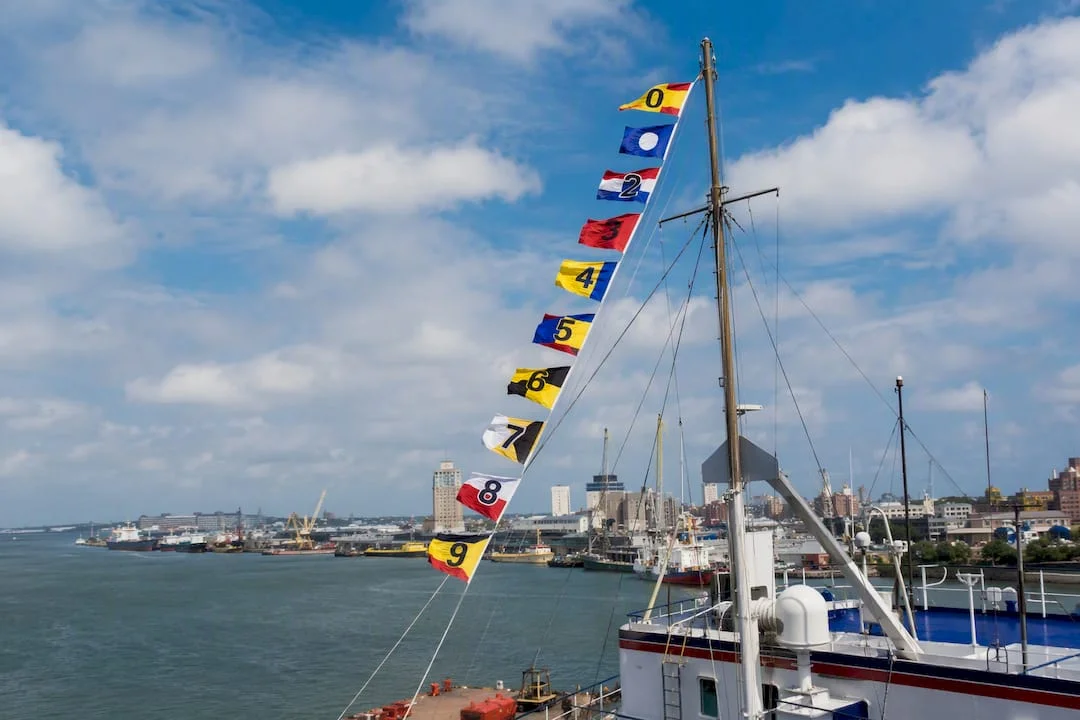
The answering pennant does double duty here. Beyond signaling readiness to receive a message, it marks a decimal point when numeral pennants form a figure like a bearing or a fraction.
| Hoist Example | Meaning |
|---|---|
| Numeral pennants | A number like 5 |
| Numeral, answering pennant, numeral | The number 4.5 |
| Letter flag + numeral pennants | A coded message with a numeric complement (e.g., position or speed) |
A full flag locker includes twenty-six letter flags, ten numeral pennants, three substitutes, and the answering pennant, per Publication 102.
What Are Substitute Pennants Used For?
Ships carry only one flag of each design, so repeated characters in a hoist need a workaround. Three substitute (repeater) pennants solve this: the first substitute repeats whatever flag occupies the top position of that hoist, the second repeats the flag in the second position, and the third repeats the third.
A hoist reading “Alfa, first substitute, Bravo” actually signals “Alfa, Alfa, Bravo.” Always expand every substitute mentally before attempting to interpret the message. Skip that step and the whole signal reads wrong.
What Do Multi-Flag Signals and the Distress Hoist Mean?
Two- and three-flag combinations expand the code well beyond single letters, covering everything from navigation warnings to requests for a tug. Some combinations carry weight no boater should misread.
- N over C — the internationally recognized distress signal, meaning “I am in distress and require immediate assistance”
- AN — combined with numerals, often used to signal specific navigational instructions
- KM — a common request to tow a disabled vessel
The International Code of Signals documents N + C as a formal distress hoist. Any vessel spotting it should treat the situation as an emergency, monitor the distressed vessel’s position, and alert nearby authorities or a coast guard channel immediately.
If you’re uncertain whether a hoist signals distress, treat ambiguity as urgency. Slowing down and observing costs little; ignoring a real emergency costs everything.
How Do You Properly Hoist and Display Signal Flags?
Flags fly from signal halyards, typically rigged to yardarms or the signal mast, with separate lines for port and starboard hoists so multiple messages can fly simultaneously. Read every hoist top to bottom, never side to side, since order determines meaning.
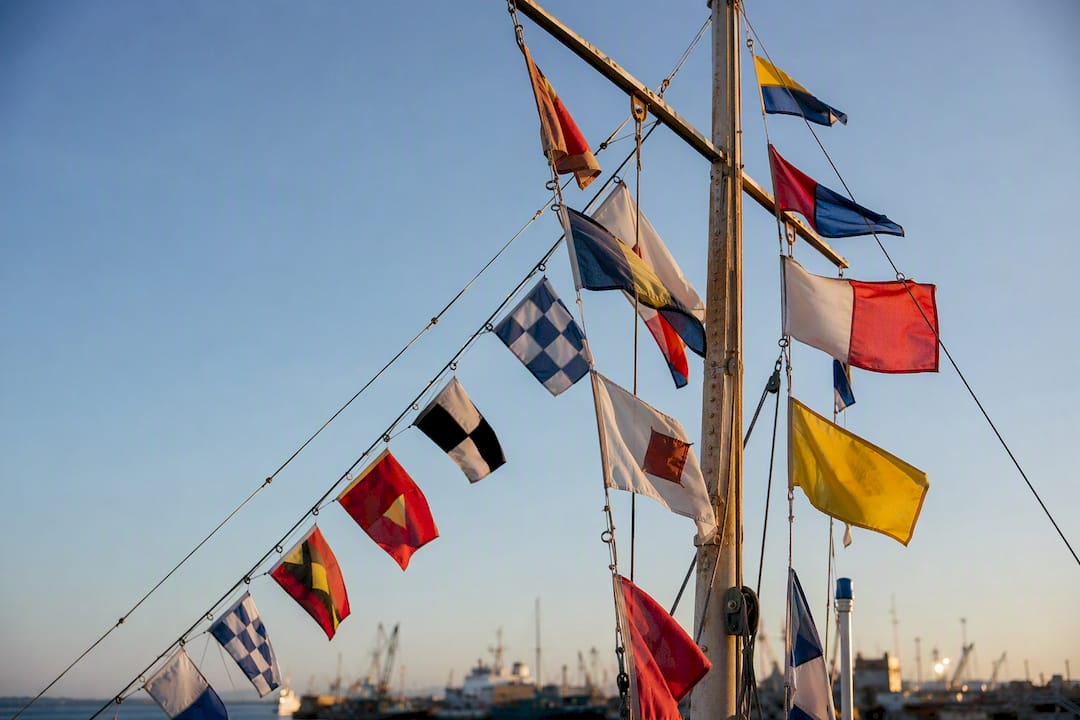
Sizing matters more than most boaters assume. A flag too small for the distance it needs to travel becomes unreadable static, much like hanging a postage-stamp painting on a wall meant for a mural. As a rough guide, flag size should scale with mast height and typical viewing distance, not simply match whatever is already aboard.
Keep signals hoisted long enough for a nearby vessel to notice, read, and acknowledge, generally until the answering pennant or a response confirms receipt. Dressing ship, the festive full-mast flag display used for holidays and ceremonies, is a different practice entirely from signaling. One communicates a specific message; the other celebrates an occasion. Common mistakes include reading a hoist in the wrong direction and forgetting to expand substitute pennants before decoding, both of which turn a clear signal into confusion at the worst possible moment.
How Did the International Code of Signals Come to Be?
Flag signaling predates radio by centuries, evolving from ad hoc naval codes into a codified international system by the 19th century. The modern ICS underwent a major 1969 revision, narrowing its focus toward navigation and safety messaging that works across language barriers.
That single purpose, safety communication regardless of a sailor’s native tongue, still defines the code today. For the complete official reference, consult ICS publications or a national maritime authority.
How Does Semaphore Differ From Flag Hoist Signaling?
Semaphore uses two handheld flags and body positions to spell out letters, a method distinct from flaghoist signaling and still taught for its simplicity when radios fail. Naval and NATO forces sometimes apply different protocols to the same flags; a warship may fly a code/answer flag above a hoist specifically to signal that international ICS meanings apply rather than a naval variant.
How Can You Practice Reading Signal Flags?
Printable A-Z charts and flashcards build recognition fast, especially paired with timed drills like naming ten flags in sixty seconds. Public programs, including those run by the National Park Service, use hands-on hoist exercises to teach this exact skill.
Once single flags feel automatic, move to decoding two-flag hoists. Watch for the two habits that trip up beginners every time: reading a hoist left to right, and forgetting to expand substitute pennants before interpreting the message.
Guidelines for Correct Flag Sizing and Spacing
A signal flag only works if the crew reading it can actually see it. Sizing follows a basic principle: the farther the intended reader, the larger the flag needs to be relative to the vessel’s mast height. A flag scaled for a small sailboat looks like a postage stamp against a container ship’s rigging, and a message that can’t be resolved at a distance defeats its own purpose.
Spacing between flags in a hoist matters just as much as their size. Flags need enough separation along the halyard that each one reads as a distinct symbol rather than blurring into the flag above or below it. Wind conditions complicate this further. Flags bunched too tightly in light wind can wrap around each other, hiding their patterns entirely.
Vessels rigged for serious signaling typically keep multiple flag sizes aboard, choosing the set that matches the day’s visibility and the distance to the intended recipient. Fog, rain, and low light all argue for the larger option even when the message itself is routine. A good rule of thumb treats flag size the way you’d treat text on a highway sign: legible at the distance that matters, not just legible up close.
Spacing also affects how quickly a hoist can be read correctly. Flags crowded together make it easy to misjudge where one flag ends and the next begins, which is exactly how top-to-bottom reading errors happen. Give each flag room to breathe on the halyard, and the entire hoist becomes easier to interpret at a glance.
Standard Procedures and Timing for Flag Signals
Flag signaling follows a rhythm, not just a vocabulary. A hoist typically goes up briskly, all at once, rather than flag by flag, so the receiving vessel can start reading the complete message immediately instead of guessing at a partial one.
Once hoisted, a signal generally stays up until it has been read and acknowledged, which is where the answering pennant does its quiet, essential work. The receiving vessel hoists its own answering pennant “at the dip,” partway up the halyard, to show it has seen the signal and is working to read it. Once fully understood, that same pennant goes all the way up, close to the yardarm, to confirm the message has been received and understood.
There’s no fixed universal duration for how long a hoist must fly. The real standard is functional: a signal stays displayed until acknowledgment happens, or until the situation that prompted it resolves. A distress hoist like N over C stays up as long as the emergency persists, precisely because taking it down early could tell nearby vessels the danger has passed when it hasn’t.
Timing discipline matters more in busy waters. A crowded harbor with multiple vessels signaling at once demands that hoists go up cleanly and get answered quickly, since overlapping or delayed signals create exactly the kind of ambiguity the ICS was built to eliminate.
How Does the Phonetic Alphabet Relate to Flag Signaling?
Every letter flag carries a spoken phonetic name, Alfa, Bravo, Charlie, and so on through Zulu, and that pairing isn’t decorative. The phonetic alphabet exists so that a letter spoken over a noisy radio channel, in wind or through a heavy accent, can’t be confused with a similar-sounding letter the way “B” and “D” or “M” and “N” can over voice alone.
Flag signaling and radiotelephony share this same underlying alphabet by design. Publication 102 lists flaghoist, flashing light, sound, and radiotelephony as parallel signaling methods, all built on the same phonetic and letter foundation. A sailor who learns the phonetic name for Golf also learns to recognize the Golf flag’s black and yellow vertical stripes, because the two are taught as a single unit rather than separate skills.
This overlap is why phonetic fluency pays off even for someone who never expects to hoist a flag. Anyone calling a harbor master, requesting a pilot, or relaying a position over VHF radio uses the identical vocabulary. Learning “Whiskey” as the word for medical assistance reinforces the same flag meaning whether it’s spoken aloud or run up a halyard, and that redundancy is exactly what keeps messages clear when one channel, radio or visual, fails.
Safety Considerations and Legal Regulations for Signal Flags
Signal flags aren’t decorative on a working vessel. Certain hoists, particularly Alfa for diver operations and the N over C distress signal, carry real legal and safety weight, and nearby vessels are expected to respond to them appropriately rather than treat them as scenery.
Displaying the Alfa flag while diving operations are underway signals other vessels to keep well clear at slow speed, and maritime authorities in many jurisdictions expect boaters to recognize and respect that signal as a matter of basic seamanship. Misreading or ignoring it isn’t just a knowledge gap; it’s a collision risk with a diver in the water.
The same logic applies with more force to distress signals. A vessel that spots an N over C hoist, or any credible distress signal, generally has an obligation under long-standing maritime custom and law to render assistance or alert authorities capable of responding, provided doing so doesn’t put their own vessel or crew in danger.
Regulations governing exactly which signals a vessel must carry, and under what circumstances specific flags are legally required, vary by vessel type, size, and flag state. Commercial vessels, in particular, often face more specific carriage requirements than recreational boaters. Anyone operating a vessel that might need to signal distress, dangerous cargo, or diving operations should confirm the applicable requirements with their national maritime authority rather than relying on general guidance alone, since the consequences of getting this wrong involve genuine safety risk, not just a failed inspection.
A Note on Getting the Signal Right
Accuracy in a signal flag isn’t a design preference. It’s the difference between a message that saves a life and one that gets ignored or misread at the worst possible moment. Ultimate Flags sells regulation-accurate flags built to the specifications serious boaters, educators, and collectors actually need, because a flag that fades, distorts, or misrepresents its pattern defeats the entire purpose of the code.
Where to Find Authentic Signal Flags and Practice Gear
Getting your hands on regulation-accurate flags matters more than most new boaters realize, since a distorted pattern or faded color can turn a clear signal into a guessing game. Ultimate Flags carries individually sized nautical flags built to correct proportions, along with complete sets suited to vessels of different lengths.

Whether you’re outfitting a boat for real signaling or building a training kit for a maritime education program, browsing available signal flag options is the fastest way to see sizing and material choices side by side. For sailors who want the full story behind these traditions, Ultimate Flags’ collection of flag history covers the deeper narrative worth knowing before you ever raise a hoist. If your interest extends past nautical use into home styling, this coastal decor guide from a home design partner shows how nautical flags translate into shore-house style. Ready to outfit your vessel or classroom? Visit Ultimate Flags to select the correct sizes for your signaling needs today.
Sources
- Signal flags
- Meanings of International Maritime Signal Flags
- INTERNATIONAL CODE OF SIGNALS — Publication 102 (USCG exam prep copy)
- Signal Flags Activity
- Maritime Signal Flags | Free International Code of Signals Course | Compass Revision Network
FAQ
What Do the Different Nautical Flags Mean?
Each letter flag carries a single-flag meaning under the International Code of Signals, ranging from Alfa’s “diver down” warning to Oscar’s “man overboard” call, with combinations like N + C signaling formal distress.
What Are the Rules for Displaying Nautical Signal Flags?
Hoists should be read top to bottom, sized to remain visible at the intended distance, and kept flying until acknowledged or until the situation they describe resolves; distress hoists like N + C should stay displayed as long as the emergency continues.
What Are Signal Flags Called?
They’re formally known as nautical signal flags or maritime signal flags, standardized under the International Code of Signals, and organized into letter flags, numeral pennants, substitute pennants, and the answering pennant.
Does the Navy Still Use Signal Flags?
Naval forces still use flag signals, sometimes applying NATO-specific protocols, and a warship may fly a code/answer flag above a hoist to indicate that standard international meanings, rather than a naval variant, apply.