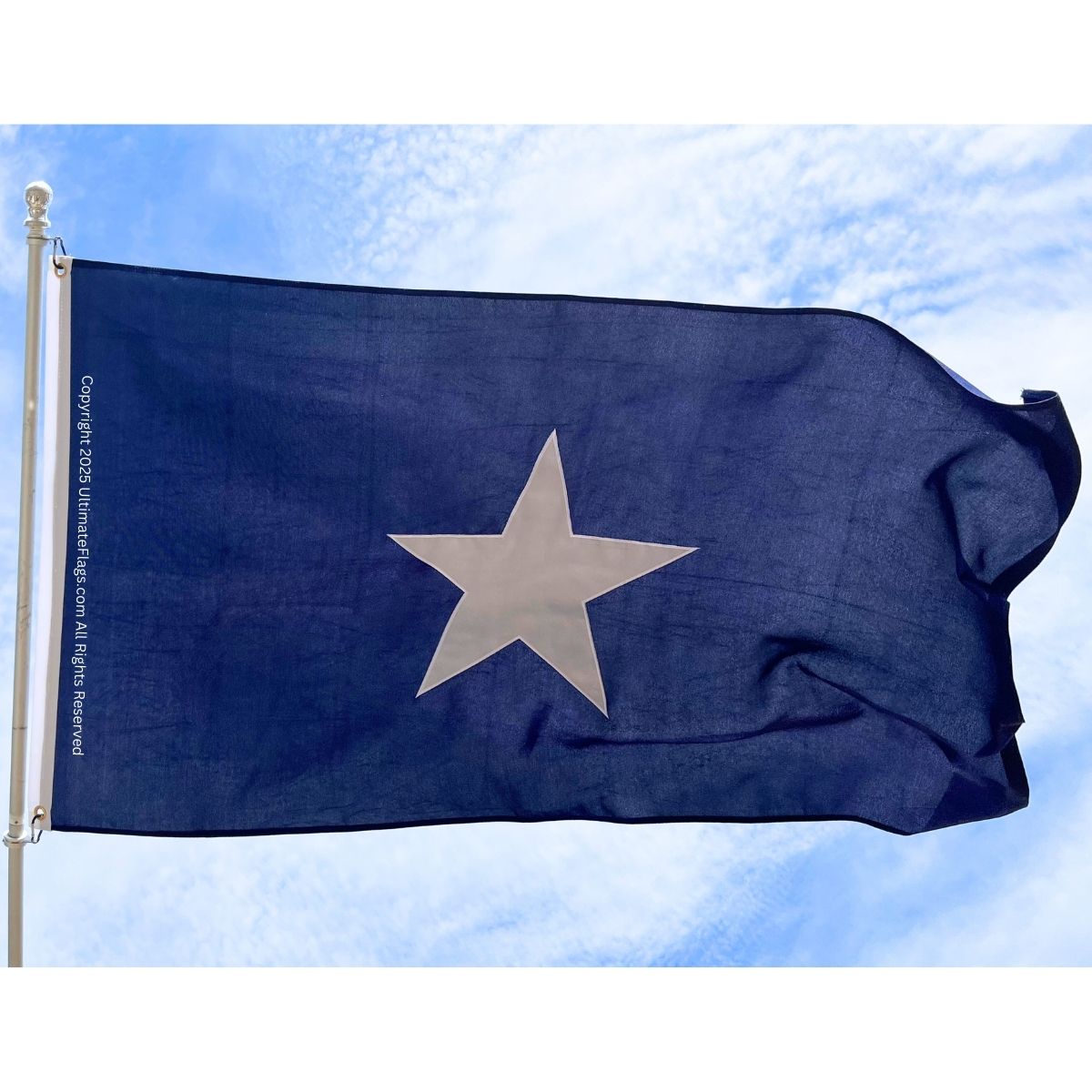
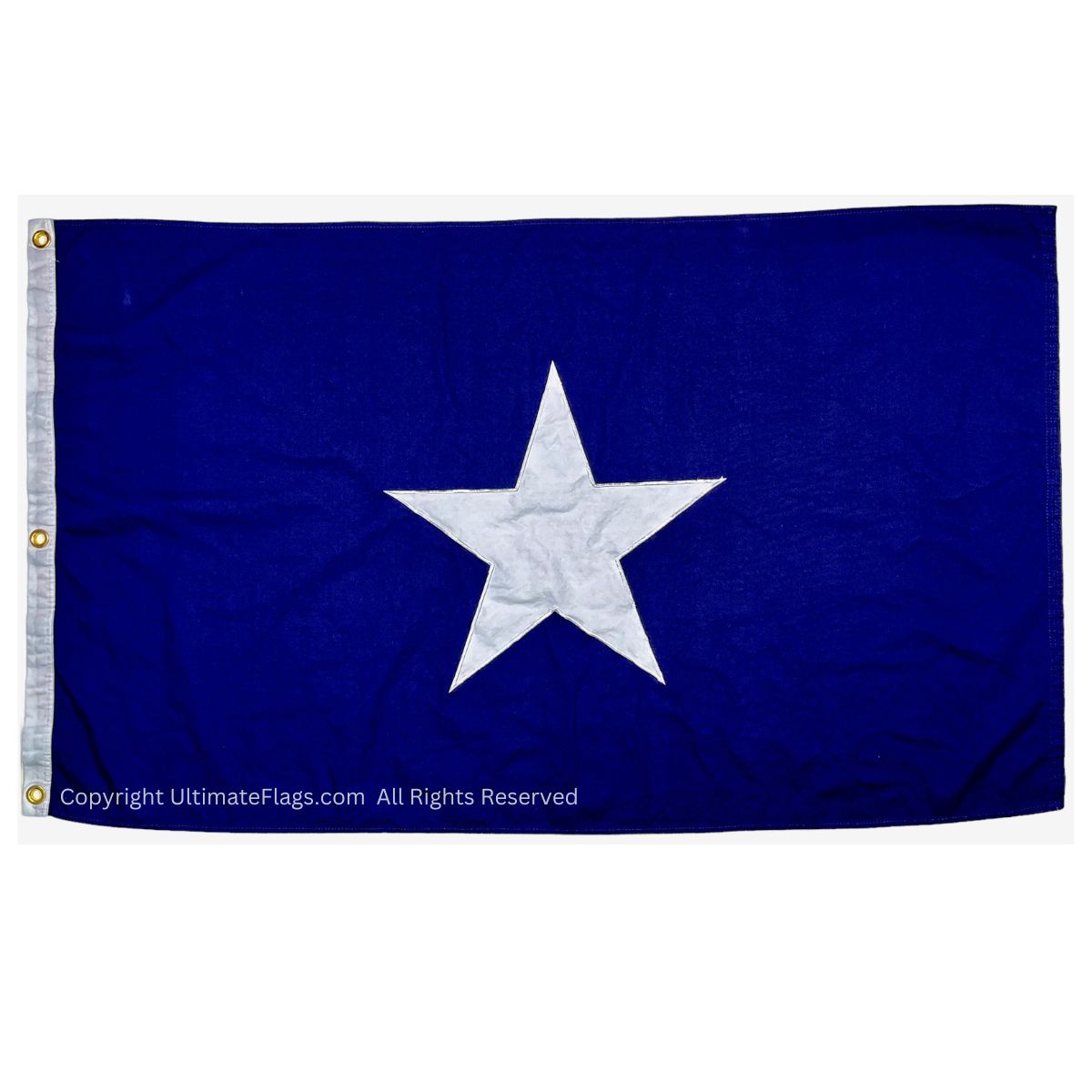
The Bonnie Blue flag is a single white five-pointed star on a solid blue field. It is one of the oldest Southern independence flags, first flown in 1810, and it became an unofficial banner of the South in early 1861. You can buy one today in sewn cotton for a historic display, in nylon embroidered or double nylon for flying outdoors, or in printed nylon and standard polyester for everyday use. This guide covers its history, how to choose the right version, and where to find it. You’ll find the Bonnie Blue alongside our other Confederate flags for sale, and every version is in our Bonnie Blue flag collection.

The history of the Bonnie Blue flag
1810: The Republic of West Florida
The first recorded use of the lone star on blue was in September 1810, when American settlers in Spanish West Florida rebelled, captured the Spanish fort at Baton Rouge and declared the independent Republic of West Florida. The new republic, which covered parts of present-day Louisiana, Mississippi and Alabama, flew a blue flag with a single white star. It lasted less than three months before President James Madison ordered the territory annexed and the U.S. flag replaced it in December 1810. In 2006 Louisiana designated the Bonnie Blue as the official flag of its West Florida historic region.
1836: The Lone Star Republic
Several West Florida veterans later moved to Texas, and the lone star went with them. From 1836 to 1839 the Republic of Texas flew the Burnet flag, a single gold star on a blue field inspired by the West Florida banner. That is why Texas is still called the Lone Star State.
1861: Secession and the song
When Mississippi seceded on January 9, 1861, a blue flag with a single white star was raised over the capitol in Jackson. Harry Macarthy, an Irish-born entertainer who saw the celebrations, wrote the song “The Bonnie Blue Flag,” which became one of the most popular songs in the Confederacy, second only to “Dixie.” The song gave the flag the name it carries today. The Bonnie Blue was used as an unofficial flag across the South in the early months of 1861, and some seceding states worked the white star on blue into their new state flags.
Bonnie Blue flags we carry, compared
| Version | Sizes | Best for |
|---|---|---|
| Double nylon embroidered, sewn | 3×5, 4×6, 5×8, 10×15 ft | Heavy-duty, all-weather outdoor flying |
| Double nylon embroidered with sleeve and ties | 3×5 ft | Parades, color guards and indoor poles |
| Nylon embroidered | 2×3, 3×5, 4×6, 5×8 ft | Everyday outdoor display |
| Nylon fully sewn (USA made) | 3×5 ft | An American-made outdoor flag |
| Cotton sewn | 12×18 in, 16×24 in, 2×3, 3×5, 4×6, 5×8 ft | Historic and indoor displays, reenactors |
| Cotton with sleeve and ties | 3×5 ft | Hand-carried staffs and reenactments |
| Nylon printed | 3×5 ft | Outdoor flying on a budget |
| Standard | 12×18 in, 2×3, 3×5 ft | Occasional use and small displays |
How to choose the right Bonnie Blue flag
- Decide where it will fly. Outdoors every day calls for nylon embroidered or double nylon. A wall, a mantle or a covered porch suits cotton.
- Pick grommets or a sleeve. Grommets clip to a pole halyard or wall hooks. A pole sleeve with ties slides over a hand-held or indoor staff.
- Match the size to the pole. A 3×5 fits most house brackets and 15–20 ft poles; a 5×8 suits 25–30 ft poles. See our large flag sizing guide.
- Pair it with related flags. Collectors often display the Bonnie Blue with the Stars and Bars, the Confederate battle flag and the Burnet Texas flag to tell the story of the lone star.
Bonnie Blue vs. other lone star flags
| Flag | Design | Years |
|---|---|---|
| Republic of West Florida | White star on blue | 1810 |
| Burnet flag (Republic of Texas) | Gold star on blue | 1836–1839 |
| Bonnie Blue flag | White star on blue | 1861 |
| Texas Lone Star flag | White star on a blue bar with white and red stripes | 1839–today |
Frequently Asked Questions
What is the Bonnie Blue flag?
The Bonnie Blue flag is a single white star on a blue field. It was first flown by the Republic of West Florida in 1810 and became an unofficial Southern banner at secession in 1861.
Why is it called the Bonnie Blue?
The name comes from Harry Macarthy’s 1861 song “The Bonnie Blue Flag,” which he wrote after seeing the flag raised in Jackson, Mississippi.
Was the Bonnie Blue an official Confederate flag?
No. It was an unofficial flag used in early 1861. The Confederacy’s first official national flag was the Stars and Bars.
What does the single star on the Bonnie Blue mean?
The lone star stands for independence and a single sovereign state, the same idea behind the Lone Star of Texas.
What is the best Bonnie Blue flag for outdoor use?
The sewn double nylon embroidered Bonnie Blue is the most durable for outdoor flying, in sizes from 3×5 up to 10×15 ft.
Do you sell a USA-made Bonnie Blue flag?
Yes. Our nylon fully sewn 3×5 ft Bonnie Blue flag is made in the USA.
More guides
- Where can I buy an authentic rebel flag online?
- Are rebel flags legal to buy in every state?
- History of the Confederate flag
Want more than the Bonnie Blue? See the other Southern designs in our rebel and Confederate flags collection.