The thin blue line names a simple idea: police officers stand as the barrier between civil order and chaos, with “blue” pointing to the color worn by most American patrol officers. Its flag version, a black-and-white American flag crossed by a single blue stripe, carries two very different readings depending on who is looking at it. Supporters see a solemn tribute to officers killed in the line of duty. Critics see a symbol co-opted by political movements and, at times, displayed alongside extremist imagery.
TL;DR:
- The blue stripe on the flag symbolizes police officers as a barrier between chaos and order, a concept that originated in military history and was adapted by law enforcement.
- Commercial producers created the black-and-white flag with a blue stripe, making it an unofficial symbol that exists outside official flag protocols and the U.S. Flag Code.
- The flag’s display has expanded from private support symbols to public and political use, often appearing at rallies and events linked to extremist groups, fueling controversy.
- Police departments and institutions face legal and policy challenges, with some banning the imagery over extremist associations and others citing free speech rights in court rulings.
- Context matters most when interpreting the flag, as a memorial for a fallen officer is different from a political rally display, and that distinction influences its perception and appropriateness.
Table of Contents
- The History Behind the Thin Blue Line Meaning
- What Does the Thin Blue Line Flag Look Like?
- How the Symbol Gets Used, and Why It Became Contested
- Police Department Policies and Legal Rulings on the Flag
- Ultimate Flags’ View on Historical Symbols and Responsible Display
- Why This Symbol Resists a Simple Verdict
- Choosing a Commemorative Flag You Can Display With Confidence
- Sources
- FAQ
The History Behind the Thin Blue Line Meaning
Every symbol has a lineage, and this one starts on a battlefield far from any American police precinct. During the Crimean War, war correspondents described a British regiment holding formation against a Russian cavalry charge as a “thin red line.” The phrase stuck as shorthand for a small, disciplined force standing between order and disaster.
American policing borrowed the metaphor and changed its color to match the uniform. Early 20th-century police leaders used the phrase in speeches and writing to describe their departments’ role in society. Richard Enright, the New York City police commissioner in the 1920s, is among the earliest documented users. Decades later, LAPD Chief William H. Parker leaned on the same language as part of a broader campaign to professionalize policing and frame officers as society’s last line of defense. According to research on the phrase’s origins, this early usage was rhetorical, not visual. There was no flag, no patch, no bumper sticker. It was a line in a speech.
Popular culture did the rest of the work. Novelist Joseph Wambaugh, a former LAPD sergeant, built a body of crime fiction in the 1970s and 1980s that leaned heavily on the “thin blue line” framing, introducing the phrase to readers who had never set foot in a squad room. Errol Morris then gave it a permanent place in the American vocabulary with his 1988 documentary The Thin Blue Line, which examined a wrongful murder conviction in Texas and used the title as a pointed, layered reference to policing itself.
The migration from spoken metaphor to physical icon happened later, largely through commercial production rather than any official government or police department action. A rough timeline of that shift looks like this:
- 1850s: British press coins “thin red line” during the Crimean War.
- 1920s: NYPD Commissioner Richard Enright applies police-as-barrier language publicly.
- 1950s to 1960s: LAPD Chief William H. Parker popularizes the phrase within American law enforcement culture.
- 1970s to 1980s: Joseph Wambaugh’s novels spread the term to a mass audience.
- 1988: Errol Morris’s documentary cements the phrase in mainstream vocabulary.
- 2010s: The black-and-white flag with a blue stripe appears commercially and spreads through police support communities and, later, broader political circles.
That last jump, from phrase to flag, is where most of today’s confusion and controversy actually begins.
What Does the Thin Blue Line Flag Look Like?
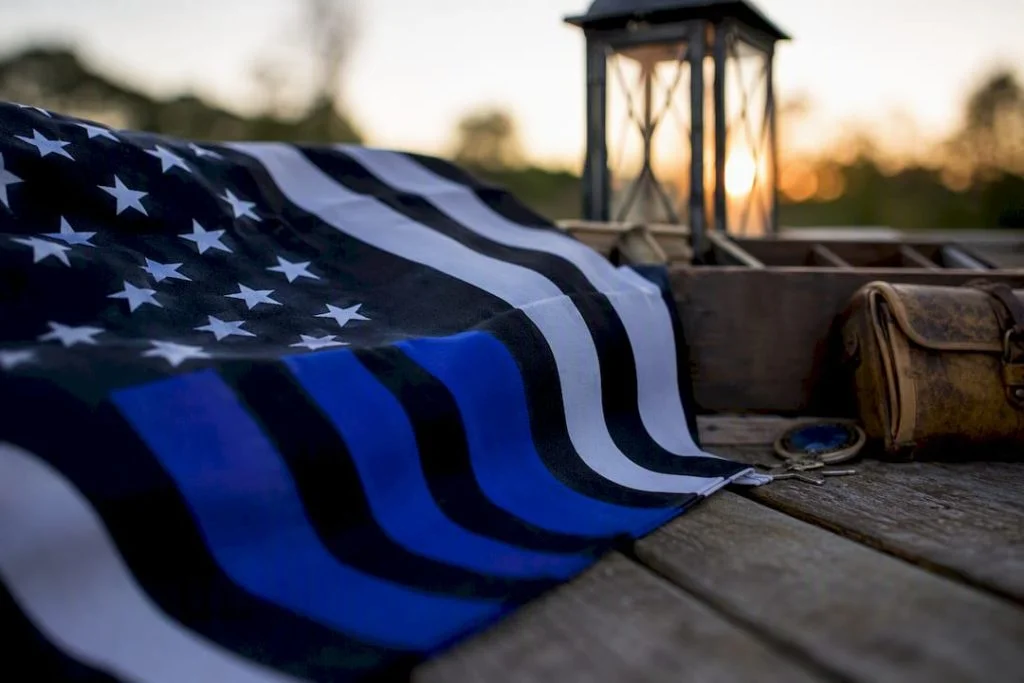
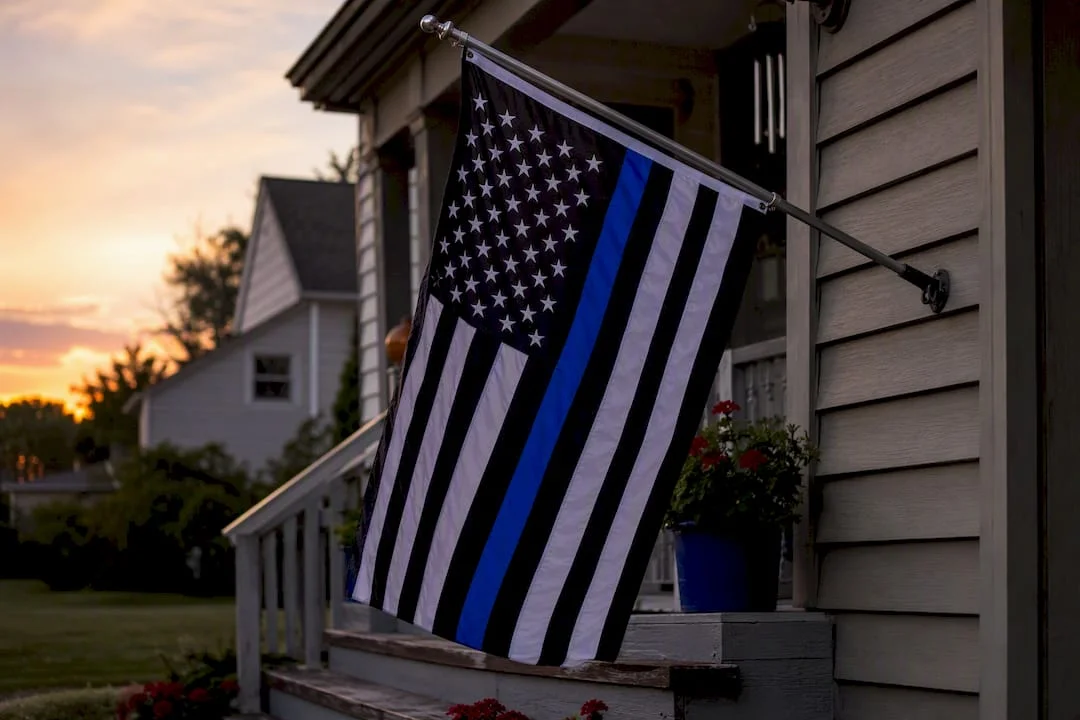
The most recognized version is visually simple: an American flag rendered entirely in black and white, except for one horizontal stripe running through the middle, colored blue. That single stripe is meant to represent officers standing between the “black” of chaos and disorder and the “white” of a lawful, orderly society.
Commercial vendors, not any government body, created and popularized this design. It shows up on vehicle decals, uniform patches, porch flags, coffee mugs, and challenge coins. Because it is a private commercial product rather than an officially recognized national or state flag, it falls outside the U.S. Flag Code entirely, which governs the design and display of the actual American flag. Nobody is violating federal flag etiquette law by flying it incorrectly, because it is not the flag the code addresses.
Several related “thin line” flags exist, each borrowing the same black-and-white, single-stripe format but swapping the color to represent a different group:
- Thin blue line — law enforcement, blue stripe.
- Thin red line — firefighters, red stripe, a direct callback to the original Crimean War phrase.
- Thin green line — often used for military personnel, correctional officers, or conservation and border enforcement officers, depending on the community using it.
- Thin gold line — dispatchers and 911 operators.
- Thin light blue line — a variant with a paler or brighter blue stripe, sometimes used to distinguish it visually from standard navy-blue versions or to represent specific units.
- Thin silver line — corrections officers, in some regional usage.
These are not officially standardized. A retailer in one state may sell a “thin green line” flag marketed toward the military, while a retailer elsewhere markets an identical design toward park rangers. There is no vexillological governing body assigning colors or approving new variants, which is part of why the symbol family has grown so quickly and so unevenly.
Quick fact: The black-and-white American flag with a single blue stripe is not the same design as a mourning badge, the black band traditionally worn over a police badge after an officer’s death. The two symbols are frequently confused but serve different purposes: one is a flag meant for display, the other a temporary mourning marker worn on the body.
The American Legion, which helped draft the original U.S. Flag Code, has never issued an official position on the black-and-white police flag. That silence matters. It means there is no institutional referee weighing in on whether the design is appropriate, respectful, or accurate to the flag’s ideals. It exists in a gray zone between commemorative object and political statement, and different audiences fill that gray zone with very different assumptions.
How the Symbol Gets Used, and Why It Became Contested
Walk through most American towns and you will spot the thin blue line somewhere: a decal in a truck window, a small flag on a porch, a patch on a K9 unit’s vest, a wristband at a memorial service for a fallen officer. For years, that was largely the extent of its public life, a private, community-level gesture of support rather than a fixture of national politics.
That changed as the symbol moved from private display to public rally. Investigative reporting from The Marshall Project traces how the flag’s visibility expanded dramatically after high-profile incidents, including the ambush killing of five Dallas police officers in July 2016, which drove a wave of public purchases and displays as an expression of solidarity. The flag’s presence at political events grew from there, and its meaning grew murkier with each new context it appeared in.
The turning point for many observers came in August 2017, at the “Unite the Right” rally in Charlottesville, Virginia. Photographs from that event show thin blue line flags and imagery displayed near Confederate battle flags and openly white-supremacist symbols. Reporters covering the rally and its aftermath noted this proximity became a reference point that critics have cited ever since when arguing the flag has drifted from its original, narrower meaning as a police tribute into something broader and more politically loaded.
The flag’s own commercial creators and defenders, including specialty retailers that sell exclusively pro-police merchandise, maintain publicly that the design is meant as an apolitical tribute to officer sacrifice and has nothing to do with any political movement. That defense sits uneasily next to the documented instances of the flag appearing at explicitly political and extremist gatherings, which is exactly the tension that makes this symbol so difficult to read at a glance.
The consequences of that tension have not stayed abstract. Workplace and community disputes have followed the flag into schools, offices, and local government buildings:
- Public employees displaying the flag at their desks or on vehicles have triggered internal HR complaints in multiple documented workplace disputes.
- School districts have faced parent and student pushback over students wearing thin blue line apparel to class.
- Community groups have protested its display on municipal flagpoles, arguing a government building should not fly an unofficial, contested symbol.
- Some police unions have pushed back against restrictions, framing bans as a rejection of officer safety concerns rather than a response to co-option.
Criminologists and sociologists studying police culture point to something deeper running underneath all of this. Academic commentary on policing culture has long examined how “us versus them” framing between officers and the communities they serve can calcify into genuine distrust, and the thin blue line metaphor, by design, draws exactly that kind of dividing line. A symbol built around the idea of officers as a barrier against societal chaos can read as reassuring to one observer and alienating to another, often depending on that observer’s own experience with police in their community.
None of this erases the sincere, apolitical intent behind most of the flags flown outside individual homes or attached to a patrol car in memory of a fallen colleague. It does mean the symbol now carries baggage its early 20th-century originators never anticipated, and that baggage is exactly what has pushed the issue into department policy manuals and courtrooms.
Police Department Policies and Legal Rulings on the Flag
Institutions have responded to the controversy in sharply different ways, and the split largely comes down to how much risk a given department is willing to accept around the symbol’s association with extremism versus how much it values the morale boost the flag provides to rank-and-file officers.
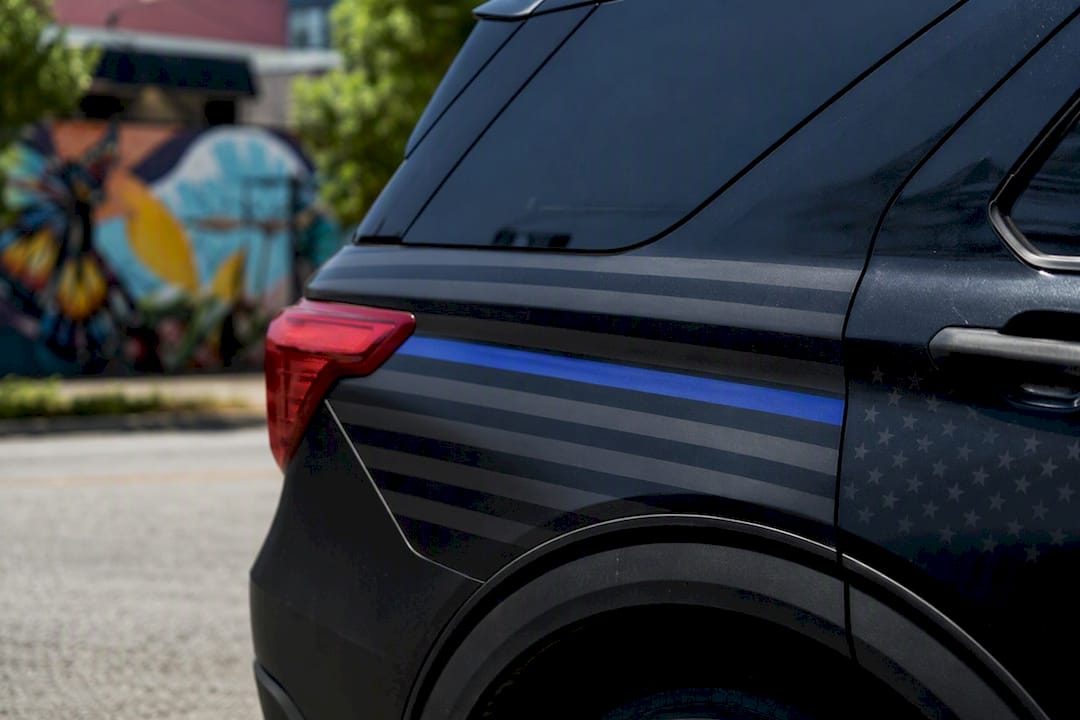
Several police departments and university campus police forces have moved to restrict or fully ban the imagery on uniforms, patrol vehicles, and official equipment. One widely reported case involved a police chief who banned Thin Blue Line imagery outright, stating plainly that the symbol had been co-opted by extremist groups and that continued official use risked undermining community trust the department was actively trying to rebuild. Departments taking this route commonly carve out one exception: memorial displays specifically honoring an officer killed in the line of duty, distinguishing a one-time act of mourning from an everyday uniform or vehicle decoration.
Other institutions have gone the opposite direction, and at least one legal ruling has complicated the picture further. A 2023 federal court decision involving a Pennsylvania township found that a blanket prohibition on displaying the flag on township property was unconstitutional, a ruling that turned on public-employee speech protections rather than any judgment about the flag’s meaning or appropriateness. That case illustrates a genuine legal tension: courts have to balance a public employee’s expressive rights against a government employer’s legitimate interest in maintaining a workplace that reads as neutral and welcoming to every community it serves. The result is that outcomes vary meaningfully by jurisdiction, and a policy that survives legal challenge in one state may not survive it in another.
Key point: Because the thin blue line flag has no official government status, it is legally treated as expressive speech rather than a protected government symbol. That single distinction explains why some employers can restrict its on-duty display without much legal risk, while others find themselves defending that same restriction in federal court.
For anyone encountering this dispute firsthand, whether at a workplace, a homeowners’ association meeting, or a town council session, a few practical patterns show up consistently:
- Public-sector employers generally have more latitude to restrict on-duty or on-property display than private employers realize, but that latitude is not unlimited.
- Memorial exceptions for officers killed in the line of duty are common even in departments with broader bans.
- Disputes over municipal flagpoles tend to move faster to formal complaint or litigation than disputes over an individual’s personal vehicle or home.
- Community pushback is more often about the flag’s association with recent political events than about its original police-support meaning.
Ultimate Flags’ View on Historical Symbols and Responsible Display
Ultimate Flags has spent years as one of America’s longest-running online flag retailers, cataloging everything from Revolutionary War standards to modern service and commemorative designs. That vantage point makes one distinction clear: there is a real difference between an officially recognized flag, governed by protocol and, for the national flag, by the U.S. Flag Code, and a commercially produced commemorative design created to express solidarity with a cause or profession. The thin blue line flag sits firmly in the second category, alongside thin red line and thin green line designs honoring firefighters and military or corrections personnel.
That distinction matters for anyone weighing whether, and how, to fly one. A porch display honoring a family member who served in law enforcement reads very differently from the same flag flown at a contested public rally, even though the object itself is identical. Context does the work that the design alone cannot. Readers who want a deeper grounding in flag etiquette before making that call can review our breakdown of flag etiquette rules that apply to official and commemorative flags alike.
Pro Tip: Before flying any commemorative flag on shared or public property, ask whether the display honors a specific person or event versus making a broader political statement. That single question resolves most of the etiquette gray area on its own.
Why This Symbol Resists a Simple Verdict
The research here supports one honest conclusion: the thin blue line means exactly what its original 1950s framing intended, officers as a barrier against disorder, and it simultaneously means something else entirely to communities who watched it appear next to extremist banners in Charlottesville. Both things are true at once, and pretending otherwise flattens a genuinely complicated symbol into a tribal talking point.
The conventional advice, fly it if you support police, avoid it if you don’t, misses the real variable, which is context, not allegiance. A flag on a porch honoring a specific fallen officer carries a different weight than the same flag waved at a political rally with no connection to any individual’s service or sacrifice. Readers should prioritize that distinction first, before worrying about which side of the broader debate they’re supposed to land on. The symbol’s power was always in the specific act of remembrance it started as. That’s worth protecting, regardless of where the national argument ends up.
— Jonica
Choosing a Commemorative Flag You Can Display With Confidence
Ultimate Flags carries a wide catalog of commemorative and historical designs, including service and honor flags built for exactly the kind of respectful, individual tribute discussed above, so if you’re looking to honor a specific officer, veteran, or family tradition, you have options beyond a generic mass-market decal. Unlike a big-box retailer’s single generic option, our selection lets you match the specific service, branch, or era being honored.

Material matters more than most first-time buyers expect. A flag meant for daily outdoor display needs heavier, weather-resistant fabric and reinforced stitching along the edges, while an indoor or ceremonial flag can use lighter material built for appearance rather than wind resistance. Size matters just as much: a flag that overwhelms a small residential pole looks as out of place as a folded letter stuffed into an envelope too small to hold it. Our guide on flag care and display walks through sizing and material choices in more detail, and for display hardware and mounting options, partners like EZRGB’s patriotic display products offer additional ways to present a flag with the dignity a memorial display deserves.
If you’re ready to choose a design that honors a specific story rather than a generic statement, browse our collection of historical and commemorative flags to find one that fits the tribute you have in mind.
Sources
- Thin blue line — Wikipedia
- The short, fraught history of the ‘Thin Blue Line’ American flag — The Marshall Project
- Police chief bans ‘Thin Blue Line’ imagery, says it’s been ‘co-opted’ by extremists — NBC News
- Newsday report on Pennsylvania thin blue line flag lawsuit — Newsday
FAQ
What is the thin blue line badge controversy?
The controversy centers on police badges or patches redesigned in black and white with a blue stripe, which some departments have banned from official uniforms over concerns that the imagery has been co-opted by extremist groups and could undermine community trust.
What is the symbolic meaning of the blue line?
The blue line represents police officers standing between an orderly society and chaos or lawlessness, with blue chosen because it’s the color worn by most American police uniforms.
What does the thin light blue line mean?
The thin light blue line is a color variant of the standard thin blue line flag, typically using a paler or brighter blue stripe instead of navy, though it carries the same core meaning of police standing as a barrier against disorder.
What is the meaning behind a thin blue line flag?
The flag version takes the original police metaphor and renders it visually: a black-and-white American flag with one blue stripe, meant as a tribute to law enforcement, though it remains unofficial and outside U.S. Flag Code protections, which has fueled ongoing debate over its appropriate use on public and government property.