Posted on

Flag to Pole Ratio: Quick Sizing Guide and Chart

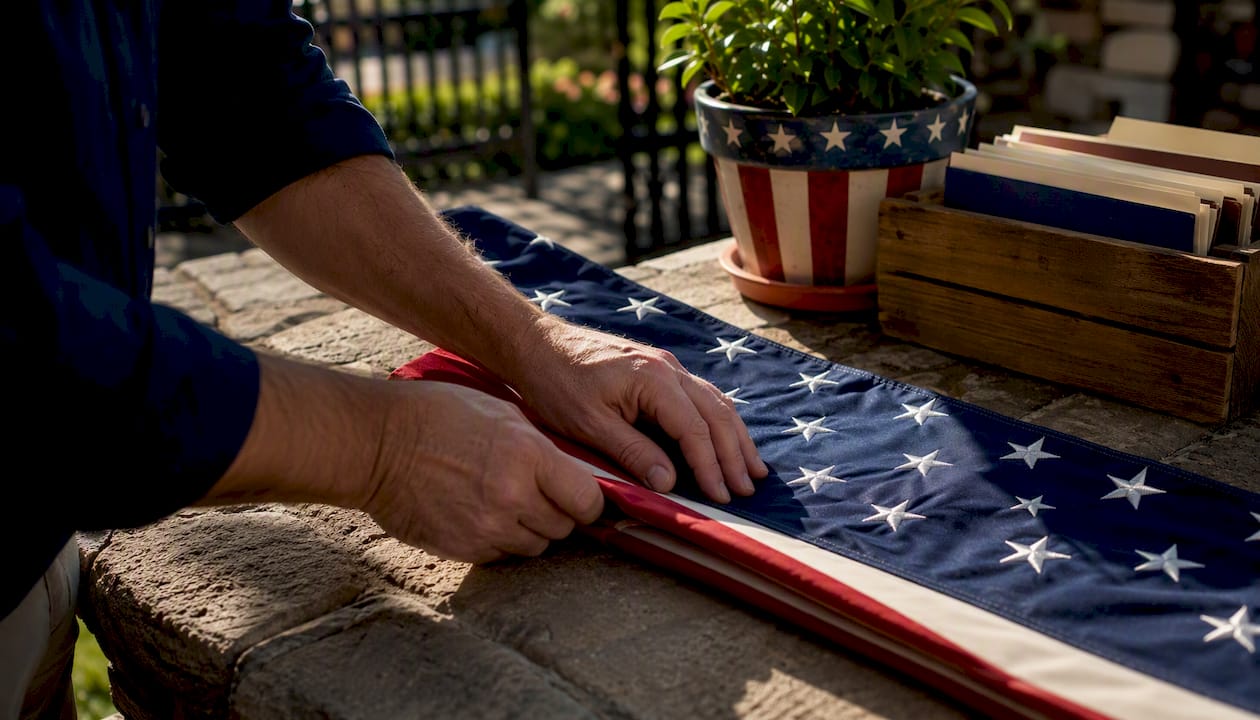
Flag flying on residential flagpole side view

Choose a flag whose fly, meaning its horizontal length, measures about one-quarter of the flagpole’s height. That single rule, a 1:4 flag to pole ratio, governs most residential and many commercial installations across the country, and it is the number every flagpole manufacturer builds its sizing charts around.

A few quick examples make this concrete. A house-mounted pole standing 15 to 20 feet tall calls for a 3’x5’ flag. A 25-foot in-ground pole pairs naturally with a 5’x8’ flag. Step up to a 30-foot pole and a 6’x10’ flag brings the proportions back into balance.

The formula itself is simple: pole height divided by 4 equals the recommended flag length, rounded to the nearest standard size. A 24-foot pole works out to 6 feet of fly, which rounds to a 5’x8’ or 6’x10’ flag depending on how much visual weight you want.

  • Favor a smaller flag-to-pole ratio in tight residential settings, windy regions, or when heavier fabric increases strain on the pole.
  • Favor a larger ratio for ceremonial displays, parade settings, or commercial properties where visibility from a distance is prioritized over potential pole wear.

Pro Tip: Measure your pole’s exposed height, not its total length. A 25-foot flagpole with 4 feet buried in a ground sleeve only has 21 feet of visible height, and your flag size should reflect that number, not the manufacturer’s stated length.

Key Takeaways

A properly sized flag flies at roughly one-quarter of the flagpole’s exposed height, with adjustments made for wind exposure, fabric weight, and mount type.

Point Details
Use the 1:4 rule first Divide pole height by 4 and round to the nearest standard flag size.
Match size to mount type House-mount poles need smaller, proportional flags; in-ground poles can carry larger sizes.
Watch wind and fabric Heavier polyester flags and high-wind sites call for sizing down or choosing nylon.
Confirm foundation depth Check manufacturer drawings for your exact pole height rather than estimating.
Shop matched pairings at Ultimate Flags Ultimate Flags offers standard flag sizes built to pair with common pole heights.

Table of Contents

Understanding the 1:4, 1:5, and 1:3 Ratios

The ratio compares two measurements: the flag’s fly (its horizontal length) against the flagpole’s height above ground. A 1:4 ratio on a 20-foot pole calls for a 5-foot flag length, which is why a 4’x6’ or 5’x8’ flag looks correct on that setup while a 10’x15’ flag would look absurdly oversized and strain the hardware.

Manufacturers gravitate toward the quarter-height rule because it balances three competing needs at once: the flag stays visible from the street, the proportions look right against the pole’s height, and the fabric doesn’t create so much surface area that ordinary wind gusts become a structural problem. Annin’s flag sizing guidance places residential and in-ground poles in a range between one-quarter and one-third of pole height, giving installers room to adjust for local conditions.

A 1:5 ratio suits decorative house mounts and cramped urban lots where a larger flag would overwhelm the property or brush against siding. A 1:3 ratio belongs on flagpoles at courthouses, stadiums, and memorial sites, where the flag itself often serves as the visual centerpiece and the pole was engineered from the start to carry that extra load.

Pro Tip: Before sizing up toward a 1:3 ratio, check your pole manufacturer’s wind-rating documentation. A pole rated for a 1:4 flag at 90 mph may drop well below that threshold once you add the surface area of a 1:3 flag, according to Flagpole Warehouse’s wind-speed lookups.

Flag Size Chart: Matching Pole Height to Flag Dimensions

Here is the quick-reference chart installers and flag retailers use most often, built from standard industry pairings.
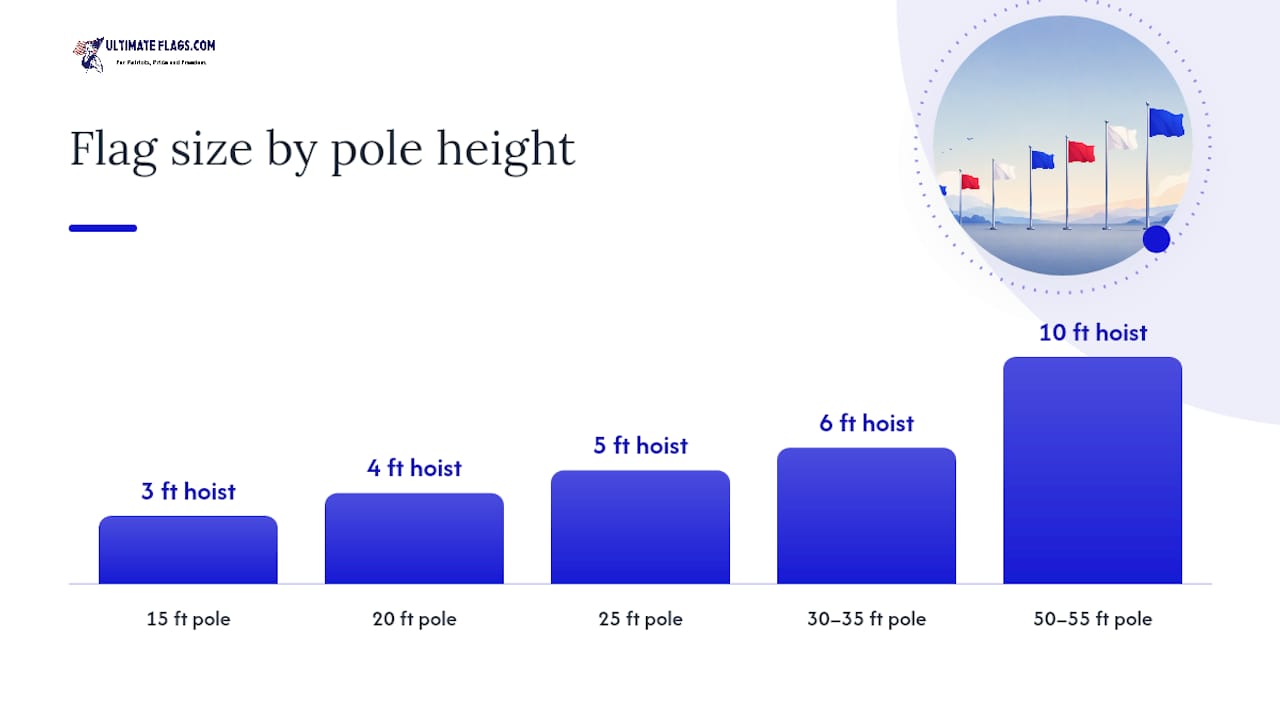
Chart matching flag sizes to pole heights

Pole Height Recommended Flag Size
15 ft 3’ x 5’
20 ft 4’ x 6’
25 ft 5’ x 8’
30–35 ft 6’ x 10’
40–45 ft 8’ x 12’
50–55 ft 10’ x 15’
— 12’ x 15’
— 15’ x 25’

These pairings come from Flagpole Warehouse’s specification generator, which cross-references NAAMM FP-1001 pole ratings with ASCE 7 regional wind-speed data to arrive at safe, proportional sizing.

Here’s how to work out a flag size for a pole height that doesn’t land neatly on the chart.

  1. Take your pole’s exposed height. Say it’s 22 feet.
  2. Divide by 4, following the standard ratio. That gives you 5.5 feet of recommended flag length.
  3. Round to the nearest standard size, which lands you between a 5’x8’ and a 6’x10’ flag.
  4. Choose the smaller size if your site is windy or the pole has a slim butt diameter, and the larger size if visibility and ceremonial presence matter more.

Some manufacturers list a 1:5 ratio as the conservative alternative, so a 22-foot pole under that formula would call for a 4’x6’ flag instead. Treat the chart above as the aggressive, more visible end of the range and the 1:5 formula as the cautious end.

House-Mount vs In-Ground Flagpoles: What Changes

A house-mounted pole and a freestanding in-ground pole are not scaled versions of the same thing. House poles are shorter, project from a wall bracket, and sit close enough to the building that clearance becomes the deciding factor, not just height math.

Annin’s own sizing examples reflect this. A 5-foot house pole pairs with a 2.5’x4’ banner, while a 6-foot house pole suits a standard 3’x5’ flag. Neither comes close to the quarter-ratio math you’d use on a 25-foot in-ground pole, because house mounts prioritize proportion against the building’s facade over raw visibility from a distance.

Before ordering a house-mount flag, walk through this checklist:

  • Measure the pole’s exposed length from the bracket to the tip, not the full pole including the portion inside the mount.
  • Measure how far the pole projects from the wall, since a flag flying at full extension needs to clear gutters, shutters, and roof eaves.
  • Confirm the halyard and clip have enough swing room that the flag won’t wrap around the pole in shifting wind.

Installation notes matter just as much as sizing here. A flag that regularly brushes brick or vinyl siding wears out its fly edge fast, and a pole mounted too close to a roofline invites the flag to snag on shingles during gusts. In-ground poles avoid most of these problems simply by standing clear of structures, which is part of why they can safely carry a larger flag under the same ratio guidance.

Foundation Depth, Installation Safety, and Local Permits

The most common question installers hear is how deep a foundation needs to be for a 20-foot pole. Manufacturer guidance from America First Flagpoles uses tapered foundation examples scaled to height, such as a 25-foot pole calling for a 24-inch diameter foundation dug 4 feet 6 inches deep, and a 30-foot pole requiring 30 inches wide by 5 feet 6 inches deep. A 20-foot pole typically falls just under that 25-foot example, so most manufacturer drawings specify a slightly smaller footing, and you should always confirm the exact dimension against your specific pole’s installation sheet rather than estimating from a neighboring size.

Taller commercial poles often require more than a shovel and a bag of concrete. Installations that exceed certain heights commonly need a wet-stamped engineering drawing to satisfy local permitting, since the structural math changes considerably once you’re supporting 40 or 50 feet of steel in open wind.

Pro Tip: Call your local utility locate service before digging any flagpole foundation, even a residential one. A few feet of unexpected depth is a minor inconvenience; a severed gas or electric line is not.

Wind, Fabric Weight, and When to Adjust Your Ratio

Wind is the variable most homeowners underestimate. A flag isn’t just a decorative sheet of fabric; it’s a sail, and every square foot you add increases the load your pole has to resist. NAAMM FP-1001 and ASCE 7 are the two standards flagpole manufacturers lean on to calculate safe wind ratings, and they factor in both regional wind speed and the flag’s surface area.

Flag fabric fluttering in wind gust

Heavier polyester flags increase that load more than lightweight nylon, which is why Flagpole Warehouse’s cut-sheet builder publishes separate wind-rating tables depending on fabric choice. The same pole that safely handles a nylon flag at a given wind rating may fall below that threshold with a heavier polyester flag of the same dimensions.

Consider sizing down when any of these apply to your site:

  • You live in a coastal or plains region with frequent high winds.
  • Your flag fabric is heavyweight polyester rather than lightweight nylon.
  • Your pole has a slim butt diameter built for residential rather than commercial loads.

Consider sizing up when visibility at a distance genuinely matters, such as a business sign pole along a highway or a ceremonial pole at a public event.

A pole’s wind rating is calculated for a specific flag size and fabric. Swap in a larger or heavier flag, and you are no longer flying within the rating the manufacturer engineered for, whatever the pole’s paperwork claims.

Practical Flag and Pole Pairings Worth Knowing

Retailers who stock both flags and poles tend to repeat the same handful of pairings because they hold up across thousands of installations:

  • 3’x5’ flag pairs with a 15 to 20-foot house or short in-ground pole.
  • 4’x6’ flag suits a standard 20-foot residential pole.
  • 5’x8’ flag is the workhorse size for 25-foot poles.
  • 6’x10’ flag fits 30 to 35-foot poles, often seen at businesses and schools.
  • 8’x12’ flag matches 40 to 45-foot commercial poles.
  • 10’x15’ flag belongs on 50 to 55-foot poles, typically municipal or ceremonial installations.

Material matters within these pairings, too. A nylon flag flies more easily in light wind and dries fast after rain, while a heavier polyester flag holds up better under sustained, harder wind but adds more load to the pole. Always cross-check your chosen size against the pole maker’s NAAMM/ASCE-based wind rating before moving up a size, particularly if you’re pairing a heavier fabric with an already tall pole.

Pro Tip: If you’re unsure which size fits your specific pole, Ultimate Flags’ buying guide for pole kits walks through common pairings for readers assembling a flag and pole set from scratch.

Where the Quarter-Ratio Rule Actually Came From

The quarter-height guideline didn’t emerge from a single decree. It developed gradually through decades of flag manufacturing practice, as pole makers and flag sewers converged on proportions that looked balanced on a pole while staying manageable in ordinary wind. Military and government flag programs formalized certain ratios for official use, but the residential and commercial guidance you see today largely reflects a working consensus among manufacturers rather than a single regulatory standard.

That consensus persists because it works. A flag at roughly one-quarter of pole height reads clearly from the street, doesn’t overwhelm the structure it’s mounted to, and keeps wind loading within a range most standard poles can handle without specialized engineering.

How Ratios Shift for National, Decorative, and Signal Flags

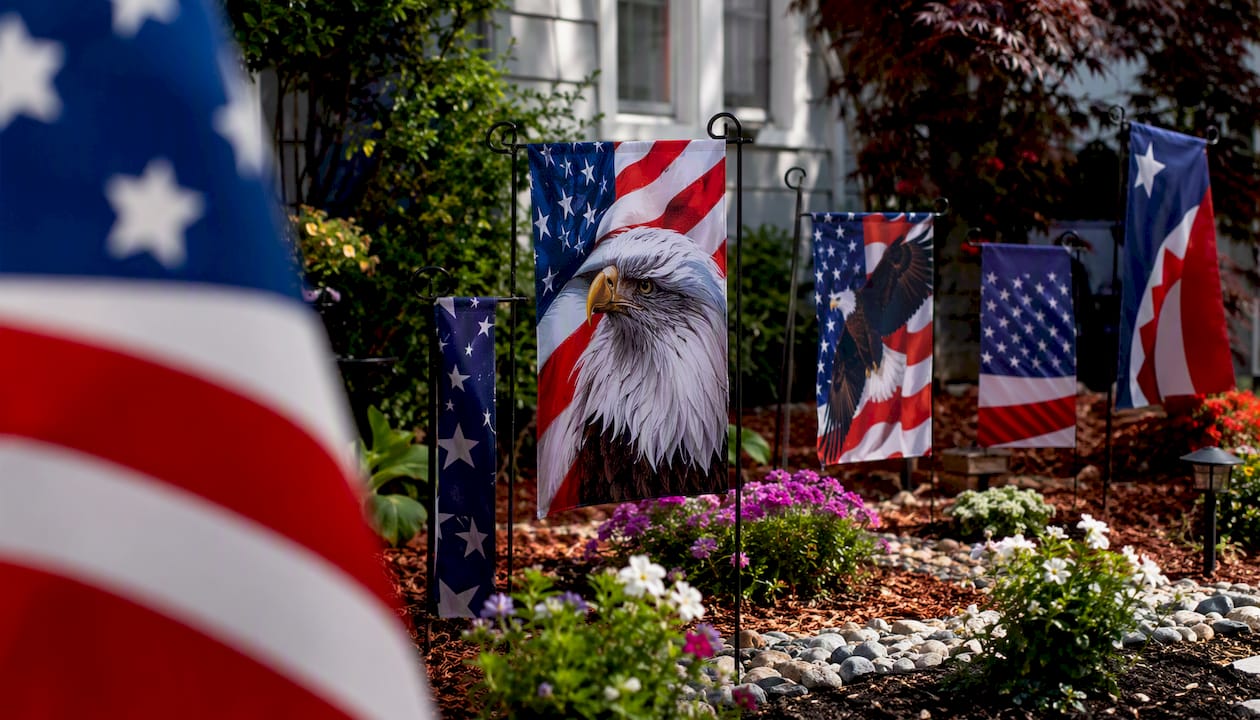
National flags flown on residential and commercial poles follow the 1:4 guidance covered throughout this article. Decorative flags, garden banners, and seasonal designs often run smaller relative to their poles, since they’re meant to be charming accents rather than dominant visual statements, and oversizing them looks cluttered rather than proud.

Signal flags and nautical pennants follow an entirely different logic, built around visibility at sea and standardized shapes rather than pole-height proportion. If you’re flying maritime signal flags, the sizing conventions from nautical flag standards apply instead of the residential ratio guidance in this article.

Regional Habits in Flag Sizing

Sizing preferences shift somewhat by region, largely driven by wind exposure rather than tradition. Coastal areas and open plains states tend to favor the more conservative 1:5 ratio or lean toward nylon fabric, simply because sustained wind is a daily reality rather than an occasional storm. Inland and suburban regions with milder wind patterns have more flexibility to size up toward 1:3 for visual impact, particularly on commercial and ceremonial poles where the property owner wants the flag to command attention.

How Fabric Weight Changes Your Sizing Decision

Nylon and polyester behave differently on a pole, and that difference should influence your sizing choice as much as height math does. Nylon is lighter, catches wind easily even in light breezes, and puts comparatively less strain on a pole’s rated capacity. Polyester is heavier, holds its shape well in sustained wind, but adds meaningfully more load, which is why the same flag dimensions in polyester can push a pole closer to its rated wind limit than the equivalent nylon flag would.

If you’re sizing near the upper end of a pole’s recommended range, choosing nylon over polyester gives you a bit more safety margin without changing the flag’s dimensions at all.

Keeping Flag and Pole Sized Right Over Time

A correctly sized flag still needs regular attention to stay looking sharp and to protect the pole hardware. Flags at the larger end of their pole’s rated range wear faster, since more fabric means more stress on the fly edge with every gust. Rotating a heavily used flag out for a fresh one every few months, especially at the upper end of a size range, keeps fraying from becoming a safety issue where torn fabric wraps around a halyard.

Correct sizing also protects the pole itself. A flag consistently oversized for its pole accelerates wear on the clips, halyard, and even the internal pole components over years of use, while a properly matched flag lets the whole setup last far longer between hardware replacements. Ultimate Flags’ guide to flag care after purchase covers the maintenance habits that extend a flag’s working life once it’s flying at the right size.

A Seller’s Take on the Sizing Mistakes That Keep Repeating

The most common mistake isn’t picking the wrong ratio on paper. It’s picking a flag sized correctly for the pole’s height but ignoring what the pole was actually rated to carry, especially on house mounts where a heavy polyester flag ends up fighting a bracket built for something lighter.

The second mistake is skipping the tape measure. Buyers eyeball a pole’s height from the ground, guess at wall clearance, and end up with a flag that brushes the gutter every time the wind shifts. Walking the site with an actual tape measure, checking exposed pole height and wall projection, and confirming the flag won’t touch the roofline takes ten minutes and prevents most returns.

If there’s one rule worth carrying away from all of this, it’s the same one from the top: size your flag to roughly one-quarter of your pole’s exposed height, and if you’re in a high-wind area, check the pole’s rated capacity before you size up.

Get the Right Flag and Pole Pairing the First Time

Ultimate Flags stocks the standard sizes covered in this chart, from 3’x5’ flags for short house poles up through the larger commercial dimensions, already paired with poles built to carry them.

Ultimate Flags

That means you’re not guessing whether a 5’x8’ flag will overwhelm a 20-foot pole or whether a lightweight nylon option makes more sense for your wind conditions. Browse the flag and pole selection to find a pairing built for your exact pole height, and reach out to customer support if you need help matching a specific measurement to the right size before you order.

Sources

Always confirm final dimensions against your specific pole manufacturer’s installation drawings before digging or ordering, since site conditions and local codes can shift the exact numbers.

FAQ

How deep should a foundation be for a 20-foot flagpole?

Manufacturer templates for a 25-foot pole call for roughly 24 inches in diameter and 4 feet 6 inches deep, so a 20-foot pole typically needs a slightly smaller footing. Always confirm against your specific pole’s installation drawing before digging.

Can you fly a 5’x8’ flag on a 20-foot pole?

A 5’x8’ flag is generally sized for a 25-foot pole under the standard 1:4 ratio, making it slightly large for a 20-foot pole. It can work in low-wind areas with a lightweight nylon flag, but a 4’x6’ flag is the better proportional match.

How big should a flag be on a 30-foot pole?

A 30-foot pole pairs with a 6’x10’ flag under the standard quarter-height ratio used across most residential and commercial installations.

Can I put a 4’x6’ flag on a 20-foot pole?

Yes, a 4’x6’ flag is the standard recommended size for a 20-foot pole, following the widely used pole-to-flag pairing chart from Flagpole Warehouse.
Posted on

What the Betsy Ross Flag Means: History, Symbolism, and Controversy

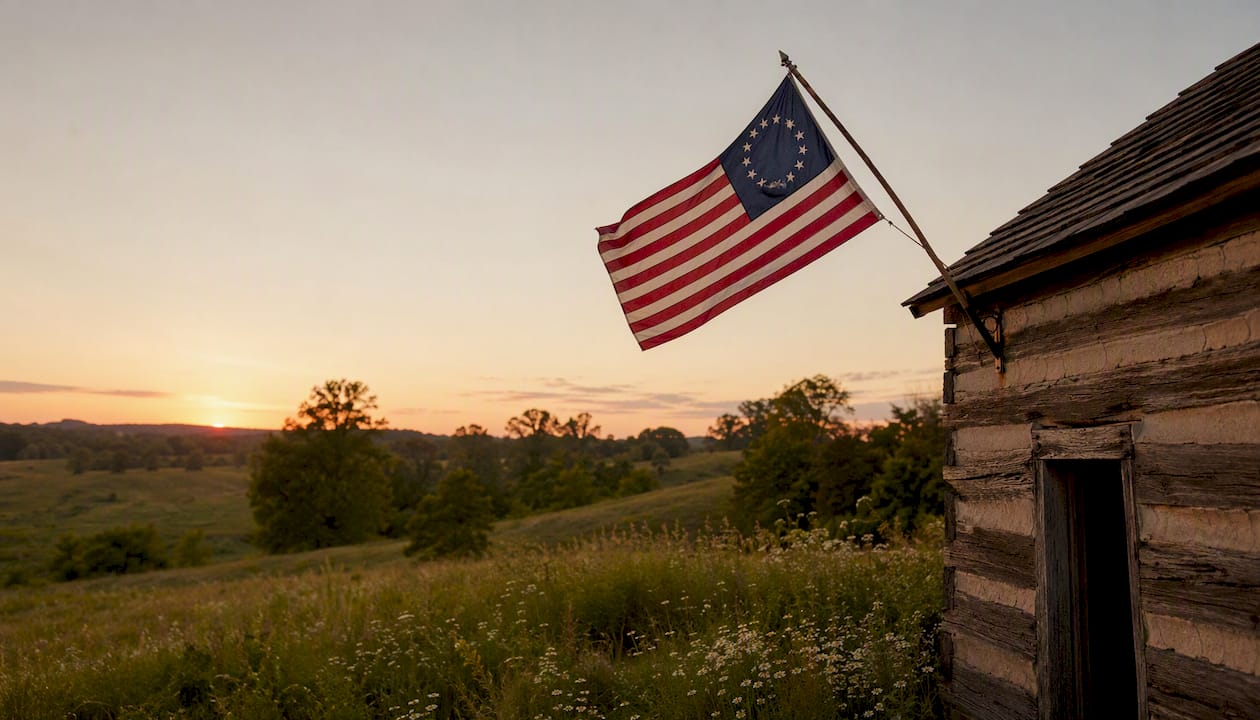
Betsy Ross flag waving on colonial building

The Betsy Ross flag is an early American flag design featuring alternating red and white stripes and a blue canton bearing white five-pointed stars arranged in a circle, named after a Philadelphia upholsterer whose role in creating it remains historically unverified. Most historians treat the story of Betsy Ross sewing the first American flag as a later legend rather than a documented fact, and the Flag Resolution of June 14, 1777 never mandated the circular star arrangement that defines the design today.

The Betsy Ross flag meaning, at its core, is one of Revolutionary-era unity: 13 colonies declaring themselves a nation. The design’s symbolism, from the circle of stars to the red, white, and blue palette, carries layers of meaning accumulated over nearly 250 years. Some of those meanings are grounded in primary sources. Others are retrospective attributions that grew alongside the legend itself.

On the question of controversy, the picture is nuanced. The Anti-Defamation League does not list the Betsy Ross flag as a hate symbol, and ADL researcher Mark Pitcavage has noted that extremist use of the design has been occasional rather than widespread. The flag remains, for most Americans, a patriotic historical emblem. Still, high-profile incidents, including Nike’s 2019 withdrawal of a shoe bearing the circular-star design, have made context a legitimate consideration for anyone displaying it publicly.


Key Takeaways

The Betsy Ross flag is a genuine Revolutionary-era design whose symbolic meaning is well-documented, even though the legend of Betsy Ross sewing it is not.

Point Details
Legend vs. documented fact The Betsy Ross design story originates with an 1870 family account; no contemporary document verifies it.
What the 1777 resolution established The Flag Act mandated 13 stripes and 13 stars but left arrangement and star shape unspecified.
Color symbolism source Red, white, and blue meanings come from the 1782 Great Seal, not the 1777 Flag Resolution.
Modern controversy The ADL does not list the flag as a hate symbol; extremist use has been occasional, not systematic.
Display guidance Context determines meaning: historical and educational display is appropriate; pairing with extremist imagery changes the signal.

Table of Contents

What the Betsy Ross flag meaning is rooted in: origins and legend

The story most Americans know begins with a widow in Philadelphia, a visit from George Washington, and a clever fold of paper to demonstrate a five-pointed star. It is a compelling narrative. It is also almost certainly a later invention.

The account entered public circulation in 1870, when William J. Canby, Betsy Ross’s grandson, presented a paper to the Historical Society of Pennsylvania claiming his grandmother had sewn the first American flag at Washington’s request in 1776. National Geographic and most historians now view that account as unverified and likely apocryphal. The core problem is chronological: Canby’s story surfaced nearly a century after the events it describes, with no contemporary documentation to support it.

What is documented is more modest but still significant. Betsy Ross was a working upholsterer in Philadelphia who made flags, tents, and uniforms for local Continental forces. Her family papers confirm she was a flag maker. They do not include any contemporary proof that she conceived or stitched the circular-star arrangement specifically. The distinction matters: being a flag maker in Revolutionary Philadelphia is a real and honorable historical role. Being the sole designer of the first American flag is a different claim entirely, and one the primary record does not support.

Why did the legend take hold so firmly? Timing offers the clearest answer. The Canby account appeared in 1870, just five years after the Civil War’s end, when the country was actively searching for unifying national symbols. A story placing a humble Philadelphia seamstress at the birth of the American flag served that need very powerfully. Post-war America needed heroes who belonged to everyone, and the Betsy Ross narrative delivered one at precisely the right moment.

For readers who want to explore the flag’s Revolutionary War context in greater depth, the historical record of its battlefield appearances offers a richer picture than the Canby account alone.


The Flag Act of 1777 and what it actually established

The legal foundation for the American flag rests on a single resolution passed by the Continental Congress on June 14, 1777. What that resolution said, and what it deliberately left unsaid, shapes everything that follows.

That is the complete specification. No mention of star arrangement. No mention of how many points each star should have. No mention of the circular pattern that would later define the Betsy Ross design. The resolution established the 13/13 motif as the legal standard and left every other design decision to the makers.

Flag Act of 1777: what it specified and what it left open

Element Specified by the 1777 Resolution Left Unspecified
Number of stripes Yes — 13 No further detail
Stripe colors Yes — alternating red and white No sequence specified
Number of stars Yes — 13 No arrangement required
Star color Yes — white No further detail
Field color Yes — blue No shade specified
Star shape No Five-pointed or six-pointed both used
Star arrangement No Circular, rows, or other patterns all valid

Swatches showing early American flag star patterns

Because the resolution left arrangement open, early American flags varied considerably. Some used six-pointed stars. Some arranged stars in rows. The circular pattern associated with the Betsy Ross design was one popular artistic choice among several, not a legal mandate. Paintings from the period, including John Trumbull’s historical works, show flags with varying star configurations, confirming that no single arrangement dominated in the early years.

Five-pointed stars eventually became the standard partly for practical reasons: they read more clearly at a distance and in maritime conditions than six-pointed stars, which could blur into a hexagonal shape when viewed from a ship’s deck.


What each design element symbolizes

The Betsy Ross flag’s symbolism operates on two levels: what the elements meant to those who created them, and what later generations have read into them. Both layers are worth understanding, because conflating them produces the kind of confident-sounding historical claims that turn out to be retrospective inventions.

Design elements and their symbolic interpretations

Element Documented or Primary-Source Meaning Later or Retrospective Attribution
13 stripes Represent the 13 original colonies Sometimes read as “13 founding principles” — no primary source supports this
13 stars “A new constellation” (1777 resolution’s own phrase) Individual stars sometimes said to represent specific colonies
Circular arrangement Unity and equality among the states (no colony ranked above another) Attributed to artistic convention; no primary document mandates the circle
Five-pointed stars Practical clarity at distance; common in heraldry Later associated with military rank insignia
Red Valor and hardiness (1782 Great Seal description) Not defined in the 1777 Flag Resolution
White Purity and innocence (1782 Great Seal description) Not defined in the 1777 Flag Resolution
Blue Vigilance, perseverance, and justice (1782 Great Seal description) Not defined in the 1777 Flag Resolution

What each design element symbolizes — overview diagram

The color meanings deserve a specific note. The 1782 Great Seal assigned symbolic values to red, white, and blue, and those attributions have been applied to the flag ever since. The 1777 Flag Resolution, however, attached no meaning to the colors at all. The symbolism is real in the sense that it is widely recognized and historically grounded, but it came five years after the flag’s legal establishment and was written for a different object.

The circle of stars carries perhaps the most resonant symbolic claim: that the 13 colonies stood as equals, with no single state occupying a position of precedence. This interpretation appears in period commentary and artistic sources, and it aligns with the political philosophy the founders were articulating. Whether the circle was chosen deliberately for that reason or simply because it was an aesthetically pleasing arrangement is a question the historical record cannot definitively answer.

  • 13 stripes: The most direct symbol in the design, representing the 13 colonies that declared independence. Alternating red and white creates visual rhythm and distinction.
  • 13 stars: The 1777 resolution’s own language, “a new constellation,” frames the stars as a collective rather than individual markers, suggesting national unity over state identity.
  • Five-pointed stars: Practical and heraldic in origin; the five-pointed form was common in European heraldry and easier to cut and sew than six-pointed versions.
  • Circular arrangement: Interpreted as a symbol of equality among the states, with no beginning and no end to the ring. This reading appears in period sources and remains the most widely cited explanation.
  • Red, white, and blue: Meanings drawn from the 1782 Great Seal: valor, purity, and vigilance respectively. These are the standard attributions, though they postdate the flag’s creation.

How the flag is used culturally and politically today

For most of its history, the Betsy Ross flag was an uncontroversial emblem of the nation’s founding. That changed, gradually and then suddenly, as the design became associated with specific political movements and high-profile controversies.

The most widely reported incident came in July 2019, when Nike withdrew its Air Max 1 USA shoe, which featured the circular-star design on the heel, after concerns that the imagery could be seen as celebrating an era when slavery was legal in the United States. The decision sparked a national debate that cut across political lines. Some argued that removing the design amounted to erasing legitimate American history. Others contended that the flag’s association with the founding era, which included the institution of slavery, made it a painful symbol for many Americans regardless of intent.

A 2016 incident at a Michigan high school, where students displayed the Betsy Ross flag at a football game in a context that others found racially charged, illustrated how the same object can carry different meanings depending on who is displaying it and why.

The ADL’s position on all of this is measured and worth quoting precisely. According to PBS NewsHour’s reporting on the Nike episode, Mark Pitcavage and ADL researchers concluded that extremist groups have used the Betsy Ross design occasionally, but that the flag is not an established hate symbol and is most commonly displayed as a patriotic historical emblem. The ADL has not added it to its hate-symbol database.

That distinction matters in practice. A flag that appears occasionally in extremist contexts is not the same as a flag that has been adopted as a primary symbol by those movements. The Confederate battle flag, for example, has a documented and sustained history of appropriation by white nationalist groups. The Betsy Ross flag does not carry that same weight of documented extremist use, though the occasional association is real and should not be dismissed.

For readers interested in how modern flag controversies develop around historic designs, the pattern here is instructive: a symbol’s meaning shifts when its context shifts, and intent alone does not fully control interpretation.


Is it okay to fly a Betsy Ross flag? Display and etiquette

The short answer is yes, in most contexts, displaying the Betsy Ross flag is a legitimate expression of patriotism and historical interest. The longer answer depends on where, how, and alongside what other symbols it appears.

  1. Know your setting. A Betsy Ross flag displayed at a historical reenactment, a museum, or a Fourth of July celebration carries clear educational and patriotic context. The same flag at a political rally where other imagery has been associated with extremist movements may be read differently by observers, regardless of the displayer’s intent.
  2. Consider what accompanies it. A Betsy Ross flag flown alongside the current 50-star flag signals historical continuity and respect for the nation’s founding. Paired with symbols that have documented extremist associations, the context shifts in ways that can be difficult to control.
  3. Label it when education is the goal. In classrooms, museums, or public exhibitions, a brief descriptive label noting the flag’s historical period and the legend surrounding its creation helps viewers engage with it accurately rather than projecting contemporary political meaning onto it.
  4. Apply standard flag etiquette. The same principles that govern display of any American flag apply here: fly it in good condition, illuminate it if displayed at night, and retire it respectfully when it is worn. Practical guidance for flag owners covers these basics in detail.
  5. For institutions and event organizers: A clear written policy stating that the flag is displayed for historical and educational purposes, not as a political statement, provides useful context and reduces the risk of misinterpretation.

Pro Tip: If you are displaying the Betsy Ross flag at a public event, a small placard noting “13 colonies, 1777” gives viewers immediate historical grounding and signals that the display is educational rather than political.


A timeline of key dates and milestones

Year Event
— Betsy Ross born in Philadelphia, Pennsylvania
1777 Continental Congress passes the Flag Resolution on June 14, establishing 13 stripes and 13 stars
— Betsy Ross dies in Philadelphia
1870 William J. Canby presents his account of Betsy Ross and the flag to the Historical Society of Pennsylvania
— The Betsy Ross House in Philadelphia opens as a museum; the legend gains wide popular circulation
— The Betsy Ross stamp issued by the U.S. Postal Service reinforces the legend in national culture
2016 A Michigan high school incident involving the Betsy Ross flag at a football game draws national attention
2019 Nike withdraws the Air Max 1 USA shoe featuring the circular-star design following public controversy

Common myths about Betsy Ross and the flag

Several persistent misconceptions surround the Betsy Ross flag. Each one is worth correcting precisely, because the myth and the documented fact often sit very close together.

  • Myth: Betsy Ross definitely designed the first American flag. Correction: No contemporary document supports this claim. The story originates with her grandson’s 1870 account, nearly a century after the events described. Historians treat it as unverified folklore.
  • Myth: The Flag Act of 1777 mandated the circular star arrangement. Correction: The 1777 resolution specified 13 stars in a blue field but said nothing about arrangement. Multiple configurations were used by early flag makers.
  • Myth: The red, white, and blue colors were given symbolic meanings in 1777. Correction: The 1777 resolution attached no meaning to the colors. The familiar attributions (valor, purity, vigilance) come from the 1782 Great Seal description, applied to the flag retroactively.
  • Myth: The Betsy Ross flag is a recognized hate symbol. Correction: The ADL does not list it as such. Extremist use has been occasional and documented, but the flag is not an established primary symbol of any hate movement.
  • Myth: George Washington personally commissioned Betsy Ross to sew the flag. Correction: This detail comes entirely from the Canby family account. No contemporary record places Washington in Ross’s shop for this purpose.
  • Myth: Five-pointed stars were chosen for symbolic reasons. Correction: Five-pointed stars were preferred primarily for practical reasons: they were easier to cut and sew, and they read more clearly at a distance than six-pointed stars.

What historians and experts actually say

Scholarly consensus on the Betsy Ross flag has been consistent for decades: the legend is likely apocryphal, the flag’s design is historically significant, and the two facts can coexist without diminishing either.

The Smithsonian National Postal Museum frames the Betsy Ross narrative explicitly as American folklore and urges readers to distinguish that legend from what primary archival sources actually document about the period. The Betsy Ross House in Philadelphia, which operates as a museum dedicated to her life and era, similarly acknowledges the gap between the Canby account and verifiable history while honoring Ross’s documented role as a skilled craftsperson and flag maker.

The National Archives holds no document from 1776 or 1777 that names Betsy Ross as the designer of the first flag. That absence is not proof she was uninvolved, but it is the kind of evidentiary gap that historians cannot responsibly paper over with a compelling family story.

On the question of appropriation, USA Today’s reporting on Mark Pitcavage’s analysis is instructive. Pitcavage, an ADL researcher who tracks extremist symbol use, found that the Betsy Ross flag has appeared in some extremist contexts but that the evidence for widespread or systematic appropriation is weak. The flag is not in the same category as symbols that have been comprehensively adopted by hate movements.

For readers and institutions deciding how to engage with the flag in public or educational settings, the practical recommendation from historians is straightforward: display it with historical context, acknowledge the legend as legend rather than fact, and pay attention to the company the flag keeps in any given setting.

Scholars like Marla Miller, who has written on Betsy Ross’s documented life, note that many personal details attributed to Ross, including claims about her views on slavery, remain speculative without primary-source support. The Snopes analysis of Ross’s Quaker background and its relationship to her views on slavery reflects this same evidentiary caution.


A flag worth understanding on its own terms

The Betsy Ross flag has carried the weight of American founding mythology for more than 150 years, and that weight is both its power and its complication. At Ultimate Flags, the view is that flags tell stories, and the most honest way to honor those stories is to tell them accurately.

The flag’s design is genuinely beautiful and historically significant. The 13 stars and 13 stripes represent a real and extraordinary moment: 13 colonies choosing to become a nation. The circular arrangement, whatever its precise origin, has come to stand for equality among those founding states. These meanings are worth preserving and teaching. What does not serve that purpose is treating the Canby legend as established history, or allowing occasional extremist appropriation to define a symbol that the vast majority of Americans display with straightforward patriotic intent.

The flag deserves to be understood on its own terms: as a design rooted in the Revolutionary era, shaped by the Flag Act of 1777, and carried forward by a legend that says more about post-Civil War America than it does about 1776. That understanding does not diminish the flag. It makes it more interesting.


Sources


FAQ

Is it okay to fly a Betsy Ross flag?

Yes, displaying the Betsy Ross flag is appropriate in most patriotic, historical, and educational contexts. The ADL does not classify it as a hate symbol, though displaying it alongside extremist imagery or at politically charged events can shift how observers interpret it.

What does the 1776 flag mean?

The design commonly called the 1776 or Betsy Ross flag represents the 13 original colonies through its 13 stripes and 13 stars, with the circular star arrangement widely interpreted as a symbol of equality among the founding states. The 1777 Flag Resolution formalized the 13/13 motif but did not specify the circular arrangement.

Is the Betsy Ross flag considered a conservative symbol?

The flag has been displayed by conservatives and mainstream patriots alike, and the ADL does not categorize it as a partisan or extremist symbol. Its association with specific political movements has grown in recent years, but it remains most commonly used as a general patriotic and historical emblem.

What is the deeper meaning of the Betsy Ross flag?

Beyond the literal representation of 13 colonies, the flag’s circle of stars has long been interpreted as a statement of equality: no colony ranked above another in the new nation. The colors carry meanings drawn from the 1782 Great Seal, representing valor, purity, and vigilance. Together, the design stands as one of the earliest visual expressions of American national identity.

Posted on

The Come and Take It Flag: Origins, Authorship, and Legacy

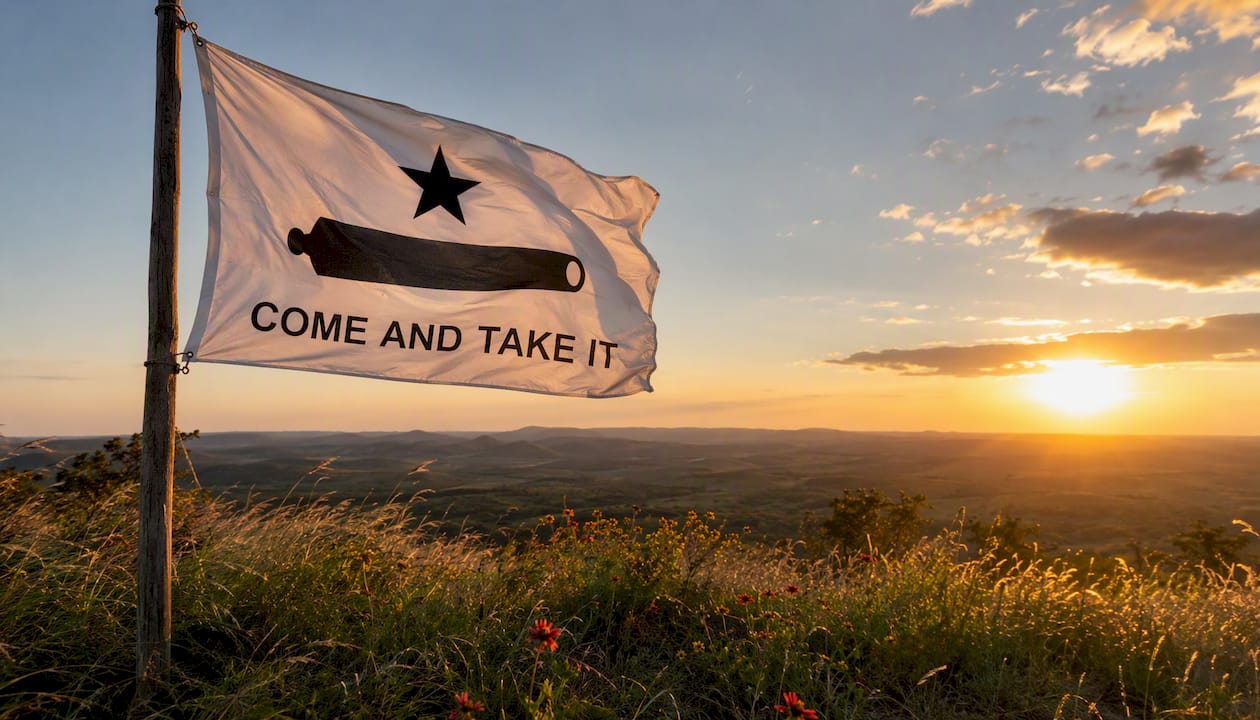
Come and Take It flag flying outdoors

The Come and Take It flag is the battle emblem of the 1835 Texas Revolution, born from a confrontation in Gonzales, Texas, where a small group of settlers refused a Mexican army demand to surrender a loaned cannon. Its white field, black cannon, lone star, and defiant motto form one of the most recognizable symbols in American history. The slogan itself reaches far deeper than 1835: it is an English rendering of molon labe, the ancient Greek phrase attributed to King Leonidas I at the Battle of Thermopylae in 480 BC, and it surfaced in American soil as early as 1778 at Fort Morris, Georgia. What unfolded at Gonzales on October 2, 1835, was a small skirmish by military measure, yet the flag it inspired has endured for nearly two centuries as a shorthand for Texan defiance and individual liberty.

Key facts about the flag at a glance:

  • Origin: Gonzales, Texas, October 1835, during the opening weeks of the Texas Revolution
  • Design: White cotton field, black silhouette of a cannon, a lone star, and the words “COME AND TAKE IT”
  • Makers: Traditionally attributed to Cynthia Burns and Evaline DeWitt, women of Gonzales
  • Phrase lineage: Ancient Greek molon labe (Leonidas, 480 BC) → Fort Morris, Georgia (1778) → Gonzales (1835)
  • Provenance note: The original flag was lost; all surviving versions are reproductions or later copies

Key Takeaways

The Come and Take It flag originated in Gonzales, Texas, in October 1835, was made by women of the town after the skirmish, and carries a phrase whose lineage runs from ancient Sparta through Revolutionary-era America to the founding of the Texas Republic.

Point Details
Ancient phrase, American emblem “Come and Take It” derives from the Greek molon labe, documented in American use as early as 1778 at Fort Morris, Georgia.
Gonzales cannon dispute A Spanish-made six-pounder loaned in 1831 for frontier defense became the object of the October 2, 1835 confrontation that sparked the Texas Revolution.
Post-battle authorship The Texas Historical Commission records that Cynthia Burns and Evaline DeWitt made the flag after the skirmish, not before it.
Original flag is lost No authenticated original survives; all museum and retail versions are reproductions or later copies.
Ultimate Flags Carries quality reproductions of the Gonzales flag and related Texas Revolution designs for collectors, educators, and history enthusiasts.

Table of Contents

Where did the Come and Take It flag’s phrase originate?

The slogan’s roots run through two and a half millennia of recorded defiance. When Persian emissaries demanded that Spartan King Leonidas surrender his weapons at Thermopylae, his reply, molon labe, translates literally as “having come, take” — a grammatically compressed command that English renders as “come and take it.” Scholars connect the English phrase directly to this lineage, though the transmission was cultural and rhetorical rather than a single documented translation event.

That 1778 episode at Fort Morris is the earliest documented American use of the phrase in its English form. Colonel McIntosh commanded a small Georgia garrison and refused a British ultimatum with those exact words, a reply that circulated in Revolutionary-era correspondence and later histories. The phrase carried the same compressed logic as molon labe: an acknowledgment of the demand, a refusal to comply, and an implicit invitation to try force. By the time Texas settlers adopted it in 1835, the slogan already carried the weight of both classical antiquity and American Revolutionary memory.

Close-up of Spartan spear and shield

The Battle of Gonzales and the cannon that started a revolution

The confrontation at Gonzales grew from a practical arrangement made four years before any shots were fired. In 1831, Mexican authorities loaned a Spanish-made six-pounder artillery piece to the settlers of Gonzales for defense against Comanche raids on the frontier, not as a military deployment. The cannon was a tool of survival, not a political statement, at the time of its loan.

By September 1835, relations between Anglo-American colonists and the centralist government of Antonio López de Santa Anna had deteriorated sharply. Mexican Colonel Domingo de Ugartechea sent a detachment to Gonzales to reclaim the cannon. The sequence of events unfolded as follows:

  1. Late September 1835: A small Mexican force arrives at Gonzales and demands the cannon’s return. Local settlers stall, bury the cannon, and send riders to neighboring communities for reinforcements.
  2. October 1–2, 1835: Texian volunteers, numbering roughly 140 to 160 men, assemble. They dig up the cannon, mount it on a makeshift carriage, and advance toward the Mexican position across the Guadalupe River.
  3. October 2, 1835: The skirmish opens before dawn. The Mexican detachment, outnumbered and under orders not to escalate, withdraws after a brief exchange of fire. No fatalities are confirmed on the Texian side; Mexican casualties were minimal.

Participants who later wrote memoirs described carrying a flag bearing the cannon image and the motto, though the precise moment the flag appeared — before, during, or after the skirmish — remains a point of historical debate. What is certain is that the October 2 confrontation became the founding story of the Texas Revolution, and the flag became its emblem.

Who made the Gonzales flag, and what did it look like?

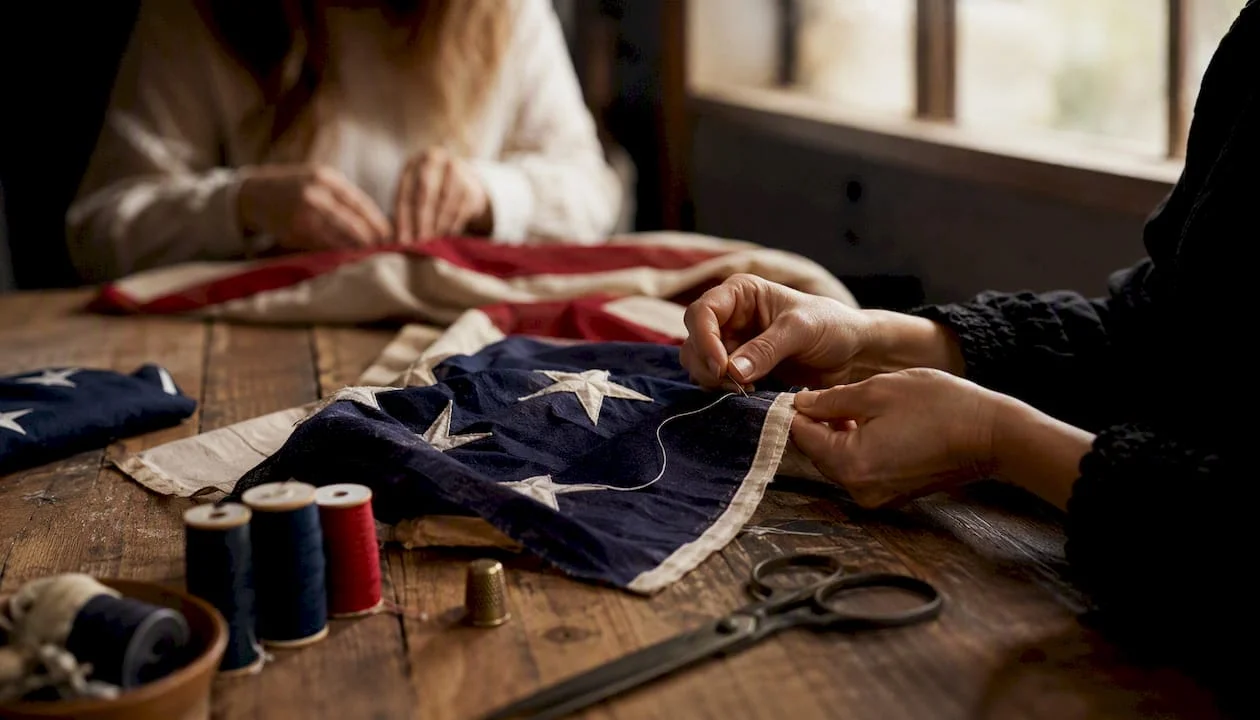
Hands sewing historic flag fabric

The Texas Historical Commission records that the Gonzales flag was designed and painted by women of Gonzales in October 1835. Two names appear consistently in the historical record: Cynthia Burns and Evaline DeWitt (sometimes recorded as Caroline DeWitt or with variant spellings, reflecting the inconsistencies common in 19th-century documentation). Samuel Maverick, a prominent Texas figure who was present in Gonzales during this period, is also cited in some accounts as a witness to or participant in the flag’s creation, though his role was not that of a maker.

Visually, the flag followed a stark, legible design. The field was white cotton, the cannon was rendered in black, a lone star appeared above or near the cannon, and the words “COME AND TAKE IT” ran beneath. Modern SVG representations archived on Wikimedia Commons show the cannon depicted in profile, consistent with how the design has been reproduced across two centuries. The simplicity was not accidental: a flag readable at a distance, with a single image and a short phrase, communicates its message without ambiguity.

The Texas Historical Commission notes that the Gonzales flag was “likely produced after the immediate skirmish” rather than before it, meaning it functioned as a commemorative and rallying object rather than a pre-planned battle standard carried into combat.

One persistent story holds that the white cloth came from a wedding dress, lending the flag a romantic origin. Historians treat this detail with caution. The wedding-dress account appears in later retellings rather than in contemporary documents, and it fits a pattern common to flag lore: a domestic, personal sacrifice woven into a national narrative. The story may be true, partly true, or embellished; the documentary record does not confirm it. What the record does confirm is that the original flag was lost not long after the march from Gonzales, and every version displayed in museums today is a reproduction or a later copy.

How the slogan and flag were reused across two centuries

The phrase and its visual emblem proved too potent to remain confined to a single October morning in 1835. Their reuse across subsequent generations reflects both the slogan’s rhetorical versatility and the enduring power of the Gonzales story.

  • Civil War era: Confederate Texas units invoked the Gonzales precedent in regimental rhetoric, connecting their resistance to the same tradition of armed defiance against a distant authority.
  • 20th-century Texan identity: The phrase entered the vocabulary of Texas pride broadly, appearing on state-issued license plates, murals in public buildings, and the signage of Gonzales itself, which markets the town as the “Birthplace of the Texas Revolution.”
  • Firearms and Second Amendment imagery: From the late 20th century onward, the cannon in the design was frequently replaced with a rifle or handgun silhouette, explicitly linking the motto to contemporary gun-rights advocacy. This substitution is now among the most common modern adaptations.
  • Commercial reproduction: As journalistic coverage confirms, the flag appears on apparel, bumper stickers, tattoos, and merchandise across Texas and beyond, functioning simultaneously as regional pride and political statement depending on the context of display.
  • Museum and institutional use: The Gonzales Memorial Museum holds reproductions and related artifacts, and the Texas State Library and Archives Commission maintains records relevant to the flag’s history. These institutional holdings serve educational rather than commercial purposes.

The flag’s durability rests on a design principle that historians of visual rhetoric recognize: a single, clear pictorial object paired with a short imperative phrase creates a symbol that anyone can reproduce and anyone can reframe for a new cause.

Common misconceptions about the Gonzales flag

Popular accounts of the Come and Take It flag carry several persistent errors, some of them traceable to 19th-century romanticism and others to more recent political framing.

  • Myth: The flag flew during the actual fighting. The evidence, including the Texas Historical Commission’s assessment, suggests the flag was made after the skirmish, not carried into it. It was a commemorative object, not a pre-planned battle standard.
  • Myth: The original flag survives in a museum. The original was lost shortly after the 1835 march. Institutions including the Gonzales Memorial Museum display reproductions. No authenticated original is known to exist.
  • Myth: The original cannon is on display somewhere. The TSHA’s Handbook of Texas notes that the cannon’s provenance trail becomes uncertain after later conflicts. Claims that a specific cannon in a church or museum is the original Gonzales piece have not been verified by archival evidence.
  • Myth: The flag is primarily an Alamo symbol. The Alamo fell in March 1836, five months after Gonzales. The Come and Take It flag belongs to the Gonzales episode specifically; later conflation with the Alamo reflects how Texas Revolution events merged in popular memory.
  • Myth: The wedding-dress origin is documented fact. This detail appears in later retellings, not in contemporary accounts. It may be true, but it has not been confirmed by primary sources.

Later storytelling, including 19th-century paintings and commemorative histories, shaped public perception in ways that sometimes diverged from what eyewitness accounts and muster rolls actually recorded. The community’s desire to honor the event produced vivid narratives that occasionally outpaced the documentary evidence.

How historians and archivists verify claims about the flag

Establishing what is true about an 1835 flag requires working through several layers of evidence, each with its own strengths and limits.

  1. Eyewitness accounts and memoirs: Participants who later wrote about Gonzales provide the closest thing to contemporaneous testimony, though memory is selective and memoirs were often written decades after the fact. The Texas State Library and Archives Commission holds relevant manuscript collections.
  2. Muster rolls and military records: Official lists of men who assembled at Gonzales in October 1835 confirm who was present, which helps evaluate claims about who carried or created the flag.
  3. Contemporary newspapers: Texas and U.S. newspapers from late 1835 reported on the skirmish. These accounts, though sometimes secondhand, predate the mythologizing that came later.
  4. Physical conservation reports: When a textile or artifact is examined by conservators, fiber analysis, dye composition, and construction techniques can establish approximate age and origin, though such analysis requires an authenticated object to examine.
  5. Archival provenance chains: The Texas Historical Commission and the Texas State Historical Association (TSHA), whose Handbook of Texas is the standard scholarly reference, evaluate claims by tracing the documented chain of custody for objects and the sourcing of written accounts.

The TSHA treats the Gonzales flag story with appropriate scholarly caution: it records the traditional attribution to Burns and DeWitt, notes the post-battle timing, and acknowledges the loss of the original. That combination of recording tradition and flagging uncertainty is the model for responsible historical treatment of a story with incomplete documentation.

Pro Tip: When evaluating any claim about a historical flag or artifact, ask three questions: Is the source contemporary (written within a few years of the event)? Is there a documented chain of custody for the physical object? Does the institutional source, such as the TSHA or the Texas Historical Commission, cite primary records or rely on later retellings? Those three filters will separate most credible claims from folklore.

Why the phrase and flag endure as symbols of defiance

A slogan that has survived from ancient Sparta through Revolutionary Georgia to modern Texas license plates possesses something beyond historical accident. The rhetorical power of “Come and Take It” lies in its structure: it is an acknowledgment, a refusal, and a challenge compressed into four words. It requires no explanation of ideology, no lengthy argument. The listener already understands the stakes.

For Texans specifically, the flag carries a layered meaning that connects local pride to a broader tradition of armed self-determination:

  • Regional identity: The Gonzales story positions Texas as a place where ordinary settlers, not professional soldiers, stood against a government demand. That narrative of civilian courage has been central to Texas identity since 1835.
  • Individual liberty: The cannon, as a symbol of the means of self-defense, translates naturally into contemporary debates about the Second Amendment, which explains the flag’s wide adoption in gun-rights contexts.
  • Contested appropriation: The same simplicity that makes the flag easy to reproduce also makes it easy to detach from its historical context. When the cannon is replaced with a modern firearm, the Gonzales story recedes and a contemporary political argument takes its place. Historians and museum professionals note this tension without necessarily resolving it.

Modern display ranges from the solemn, as in museum reproductions and historical reenactments, to the commercial, as in apparel and merchandise, to the explicitly political, as in rally signage. The Houston Public Media feature on the skirmish’s anniversary captures this range well, noting that the flag means different things to different Texans while remaining instantly recognizable to all of them. That breadth of meaning is both the flag’s cultural strength and the source of its occasional controversy.

The Gonzales flag also demonstrates something worth noting about how communities memorialize events: the physical artifact often comes after the moment it commemorates, created to enshrine a narrative and give it a tangible form. The flag likely functioned from the beginning as a rallying object and memorial rather than a combat standard, which makes it no less significant. Flags, like the stories they represent, are made by people who want to remember.

A note on history, commerce, and where they meet

Flags are among the most direct ways a culture preserves its stories. At Ultimate Flags, the commitment is to carry those stories with accuracy and respect, which means being clear about the distinction between a historical artifact and a reproduction. The original Gonzales flag is gone; what survives is the design, the tradition, and the meaning. Reproductions, sold by retailers and displayed in museums alike, serve a legitimate commemorative purpose when they are presented honestly.

Ultimate Flags publishes historical articles, including this one, because understanding a flag’s origins makes owning or displaying it a more meaningful act. The same care that goes into writing about the Betsy Ross flag’s Revolutionary history applies here: commerce and scholarship are separate endeavors, and readers deserve both. For primary artifacts and archival records, the Gonzales Memorial Museum, the Texas State Library and Archives Commission, and the TSHA are the appropriate authorities. For a quality reproduction to display with pride, Ultimate Flags is where to look.

Flags that carry history forward

Ultimate Flags

History deserves to be displayed, not just read about. Ultimate Flags, America’s oldest online flag store, carries a wide selection of historical and Texas Revolution flags for collectors, educators, and anyone who wants to honor the Gonzales story with a quality reproduction. The Come and Take It design, with its stark cannon and four-word challenge, belongs in the same category as the Betsy Ross flag and the Gadsden: a symbol whose origins are specific and whose meaning has grown across generations.

Browse the full catalog at Ultimateflags to find the reproduction that fits your purpose, whether that is a classroom display, a commemorative gift, or a piece of Texas history for your home. Every flag ships with the same commitment to quality that has made Ultimate Flags the trusted name in American flag retail for decades.

Sources

The sources below range from primary institutional references to public-access archives, and knowing which is which matters when you are evaluating a claim.

Primary and scholarly sources:

Journalistic and public-media accounts:

Visual and archival resources:

Institutions holding reproductions and related artifacts:

Note that eyewitness memoirs and muster rolls held in archival collections are primary sources; journalistic features and encyclopedia entries are modern summaries. Both have value, but they answer different questions. Cultural symbols and their commercial reproduction are explored further in this analysis of how imported cultural products circulate in markets, which offers useful context for understanding how regional emblems travel beyond their origins.

FAQ

What does the Come and Take It flag mean?

The flag asserts defiance against a demand to surrender arms, specifically the cannon that Mexican authorities sought to reclaim from Gonzales settlers in 1835. The phrase connects to the ancient Greek molon labe, meaning “come and take” — a refusal that doubles as a challenge.

Was the Come and Take It flag flown at the Alamo?

No. The flag belongs to the Battle of Gonzales on October 2, 1835, not the Alamo, which fell in March 1836. The two events are part of the same Texas Revolution, but the Gonzales flag was not the Alamo’s battle standard. Conflation of the two is a common error rooted in how Texas Revolution events merged in popular memory.

Is “Come and Take It” a political statement today?

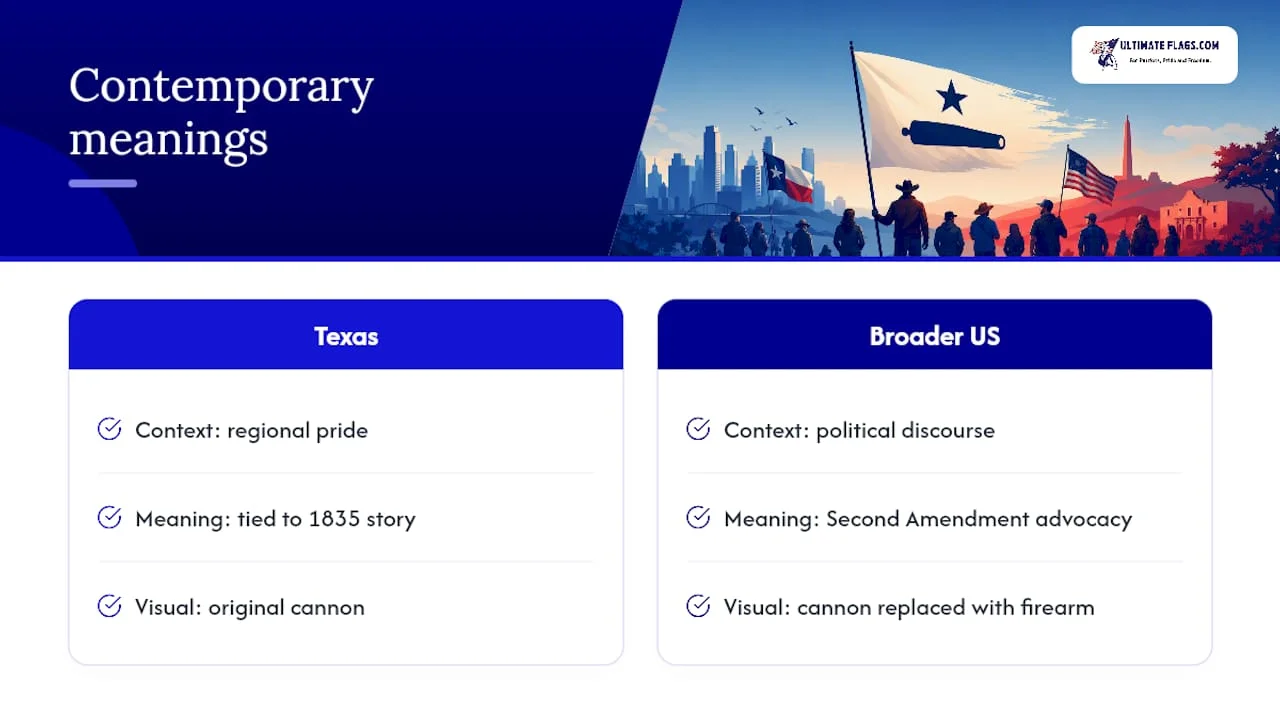
The phrase carries both regional and political meanings depending on context. In Texas, it often functions as an expression of local pride tied to the 1835 story. In broader American political discourse, it is frequently associated with Second Amendment advocacy, particularly when the cannon in the original design is replaced with a firearm silhouette.

Diagram showing phrase origin and modern meanings

Where did the original Come and Take It flag go?

The original Gonzales flag was lost shortly after the October 1835 march, and no authenticated original is known to survive. The Gonzales Memorial Museum and other Texas institutions display reproductions; the Texas Historical Commission and TSHA are the authoritative sources for what is known about the original’s fate.


This article is provided for general historical and educational purposes. For primary records, artifact authentication, or archival research, consult the Texas State Historical Association, the Texas Historical Commission, or the Texas State Library and Archives Commission.

Posted on

Black American Flag Meaning: What It Really Signals

Folded all-black American flag on wood surface

The all-black American flag most commonly signals protest, mourning for perceived national decline, or a militant “no quarter” aesthetic — though the meaning depends almost entirely on context. No single, fixed interpretation governs this symbol.

Two of the most common contemporary uses:

  • Protest and mourning: Flown to express grief over perceived loss of national values or as a solemn act of political dissent.
  • Militant or “no quarter” aesthetic: Displayed to communicate defiance, resolve, or an unwillingness to yield — often at rallies or on merchandise.

Pro Tip: Before drawing any conclusion about what a black flag signals, note the setting, the surrounding symbols, and who is flying it. Context is the only reliable decoder.

Key Takeaways

The all-black American flag carries multiple contested meanings, none of them definitively rooted in Civil War history, and context is the only reliable guide to interpretation.

Point Details
Primary contemporary meanings Protest, mourning for national decline, militant defiance, and fashion/branding.
Civil War origin is a myth Historians and verification journalists find no archival evidence for a Civil War “no quarter” black U.S. flag.
Artistic precedent exists Jasper Johns produced monochrome American-flag art from 1955 onward, predating political use.
Legal to display The U.S. Flag Code does not impose criminal penalties on private citizens for nontraditional flag displays.
Context determines meaning Setting, surrounding symbols, and who is flying the flag are the essential cues for accurate interpretation.

Table of Contents

What does the black American flag mean, and where did it come from?

The story of the all-black American flag begins not in any Civil War battlefield but on the open sea. Eighteenth-century pirates flew dark flags, most famously the Jolly Roger, as maritime signals. A black flag in that tradition meant no mercy would be given — what naval history calls “no quarter.” That pirate flag tradition is centuries older than any American political use of the design and is entirely separate from U.S. flag symbolism.

The artistic lineage of a monochrome American flag runs through mid-20th-century art. Jasper Johns produced monochrome American-flag works beginning in 1955, establishing a precedent for treating the Stars and Stripes in a single color as an artistic statement rather than a military signal. That art-world context matters because it shows the blacked-out flag had a creative, not combative, origin in American culture.

The commercialized political version is almost entirely a 21st-century phenomenon. In the early 2020s, social media circulation and retail vendors began mass-producing blacked-out U.S. flags and attaching “no quarter” language to them, amplifying a militant reading that had no archival grounding in American military history.

Black American flag patch on tactical vest

Era Development
18th century Pirate Jolly Roger: black flag as maritime “no quarter” signal
1955 onward Jasper Johns and monochrome American-flag art establish artistic precedent
Early 2020s Vendors and social media popularize blacked-out U.S. flag as political product

The “no quarter” claim: what history actually shows

“No quarter” is a military and naval phrase meaning a combatant will neither accept surrender nor spare prisoners. In practice, it was most associated with pirate warfare, not American land battles. The phrase carries genuine historical weight — but its connection to an all-black American flag does not.

Historians who have examined the claim find no credible evidence that Union or Confederate forces flew an all-black American flag as a “no quarter” battlefield standard. Verification reporting confirms that modern “no quarter” narratives merge two separate histories — the pirate black-flag tradition and mid-20th-century monochrome art — into a retrospective justification for militant readings of the design.

Key findings from historical review:

  • No documented Civil War-era order, regimental record, or battlefield account references an all-black U.S. flag as a “no quarter” signal.
  • Viral images claiming Civil War origin have been traced to misattributed or provenance-free sources by fact-checking outlets.
  • The pirate “no quarter” tradition is the oldest documented use of a black flag in this sense, predating American nationhood.

How the black American flag is used today

Contemporary use of the all-black U.S. flag spans a wide spectrum, and the same design can carry sharply different meanings depending on who displays it and where. LegalClarity’s analysis describes the flag as communicating finality rather than unity — a deliberate contrast to the tri-color American flag’s traditional message of shared national identity.

Major contemporary uses include:

  • Political protest: Displayed at rallies and demonstrations to signal opposition to government policy or perceived constitutional violations.
  • Mourning for national values: Flown by individuals who believe the country has strayed irreparably from its founding principles.
  • Militant or paramilitary signaling: Used by groups wishing to project resolve, defiance, or a willingness to fight.
  • Merchandising and fashion: Sold on apparel, patches, and accessories as an aesthetic choice with varying degrees of political intent.
  • Artistic statement: Employed by artists and designers as a commentary on national identity, grief, or transformation.

Supporters often describe the flag as an act of defensive patriotism. Critics read the same display as an implicit threat. Neither reading is universally correct; the flag’s communicative effect depends on the full visual and social context surrounding it.

Pro Tip: A blacked-out flag on a social-media profile, a protest banner, and a tactical patch on a vest all carry different weight. Resist collapsing them into one meaning.

Black American flag as protest banner outdoors

Common misconceptions and what you should actually know

Several persistent myths follow the all-black American flag, and sorting them from the evidence protects readers from drawing inaccurate conclusions.

The most common false claims:

  • “It originated in the Civil War.” No archival evidence supports this. Historians and verification journalists have found no documented Civil War use of an all-black U.S. flag as a battlefield signal.
  • “It has one fixed meaning.” The flag carries multiple, contested meanings that shift with context, region, and the intent of the person flying it.
  • “Displaying it automatically signals extremism.” While some extremist groups have adopted the design, so have artists, mourners, and political protesters with no militant intent.
  • “It is the same as the African American Flag.” This conflation erases an important distinction. David Hammons’ African American Flag, held by the Smithsonian National Museum of African American History and Culture, uses red, black, and green Pan-African colors woven into the Stars and Stripes to address Black identity. It is an entirely different artwork with a distinct artistic and political lineage.

Consumer-facing explainers, including WikiHow’s overview, usefully catalog popular interpretations but sometimes repeat contested origin stories without archival support. Treat them as a starting point, not a final authority.

Assuming a single, definitive meaning for the all-black American flag without examining context is the most common interpretive error readers make.

How to interpret an all-black American flag when you see one

Encountering this flag in person or online calls for a measured, evidence-based assessment rather than an instant verdict. Work through these steps in sequence:

  1. Assess the setting. A flag at a political rally carries different weight than one on a private residence or a social-media avatar. Location shapes meaning.
  2. Read the surrounding symbols. Accompanying text, patches, insignia, or other flags often clarify intent. A blacked-out flag next to a thin-blue-line flag signals something different from one paired with anarchist imagery.
  3. Consider who is flying it. A veteran’s household, a protest organization, and a fashion brand each bring distinct contexts to the same design.
  4. Note the flag’s orientation and condition. An inverted flag, a distressed flag, or a flag flown at half-staff each carry additional layers of meaning that modify the base symbolism.
  5. Withhold judgment until you have at least two contextual cues. One symbol alone is rarely sufficient to determine intent.

Pro Tip: Black-and-white thin-line variants (thin blue line, thin red line) are visually related but carry distinct meanings tied to specific professions or causes. Do not conflate them with the monochrome all-black flag.

Flying an all-black American flag is legal for private citizens in the United States. The U.S. Flag Code governs display etiquette for the traditional Stars and Stripes but does not impose criminal penalties on private individuals for displaying nontraditional flag designs. Government employees and military personnel operate under different, stricter standards.

Legal limits that do apply are unrelated to flag design: a display that constitutes a true threat, incitement to imminent lawless action, or trespass on private property may carry legal consequences regardless of what flag is involved. The design itself is protected expression.

Practical etiquette considerations for public-facing organizations and homeowners:

  • Recognize that the all-black flag is widely read as a political statement; flying it in a professional or civic context may draw scrutiny unrelated to your intent.
  • If your goal is to honor service members or express patriotism, the traditional Stars and Stripes or a recognized service flag communicates that message without ambiguity.
  • For state sales regulations on specific flag designs, state-level legal guidance on flag sales offers useful context on how different designs are treated across jurisdictions.

What historians and credible reporting actually confirm

The strongest published evidence points to three conclusions: the Civil War “no quarter” origin is unsupported, the artistic lineage is documented, and the commercial-political version is recent.

Historian-backed findings:

  • Verification journalists at WUSA9 found no credible archival evidence linking an all-black American flag to Civil War battlefield use.
  • Art historians trace monochrome American-flag treatments to Jasper Johns’ mid-20th-century work, not to military practice.
  • Commercial vendors and social-media posts in the early 2020s attached “no quarter” language to the design and drove its mass distribution.
Claim Evidence status Source type
Civil War “no quarter” origin No archival support Historian review, verification journalism
Artistic monochrome precedent (1955) Documented Art history record
Early-2020s commercial spread Documented Retail and social-media record

A note on symbols and the weight we give them

Symbols rarely carry a single, permanent meaning. The all-black American flag is a clear example: its significance shifts depending on who holds it, where it appears, and what surrounds it. Historians have done the careful work of separating documented fact from retrospective myth, and their findings deserve more weight than viral social-media posts or vendor marketing copy.

The honest position is one of measured attention. Acknowledge the flag’s contested history, resist the pull toward instant categorization, and let the full context of an encounter guide your reading. That discipline serves both accuracy and civil discourse.


Ultimate Flags

Flag symbolism carries real weight, and understanding it is part of honoring the history these symbols represent. Explore the silent sentinels of history at Ultimate Flags, where America’s oldest online flag store offers an extensive collection of historical, patriotic, and heritage flags for collectors, educators, and those who believe every flag tells a story worth preserving.


Sources

The following sources informed this article and offer reliable depth for readers who want to verify specific claims:

FAQ

What does flying a black American flag mean?

The all-black American flag most commonly signals protest, mourning for perceived national decline, or a militant “no quarter” posture. Meaning varies by context, and no single interpretation applies universally.

Is the “no quarter” Civil War origin of the black flag real?

No. Historians and verification journalists find no credible archival evidence that an all-black American flag was used as a Civil War “no quarter” battlefield signal. The claim is a modern narrative amplified by social media and commercial vendors in the early 2020s.

Yes. The U.S. Flag Code does not impose criminal penalties on private citizens for displaying nontraditional flag designs. Legal limits tied to threats, incitement, or trespass apply regardless of flag design, not because of it.

What is the difference between the black American flag and the African American Flag?

They are entirely different symbols. David Hammons’ African American Flag, held by the Smithsonian, uses red, black, and green Pan-African colors to address Black identity. The monochrome all-black U.S. flag is a separate design with distinct political and commercial origins.

Posted on

Bennington Flag Meaning: History, Symbolism, and Origins

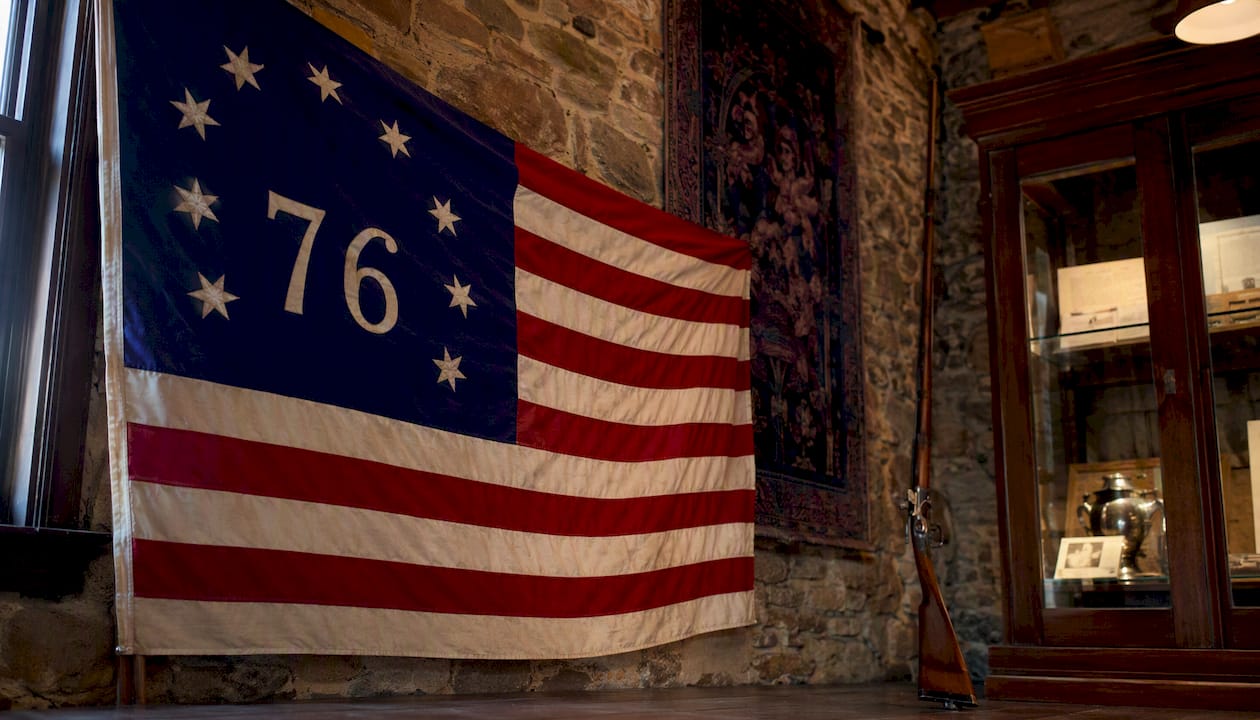
Close-up of Bennington Flag canton with '76' and stars

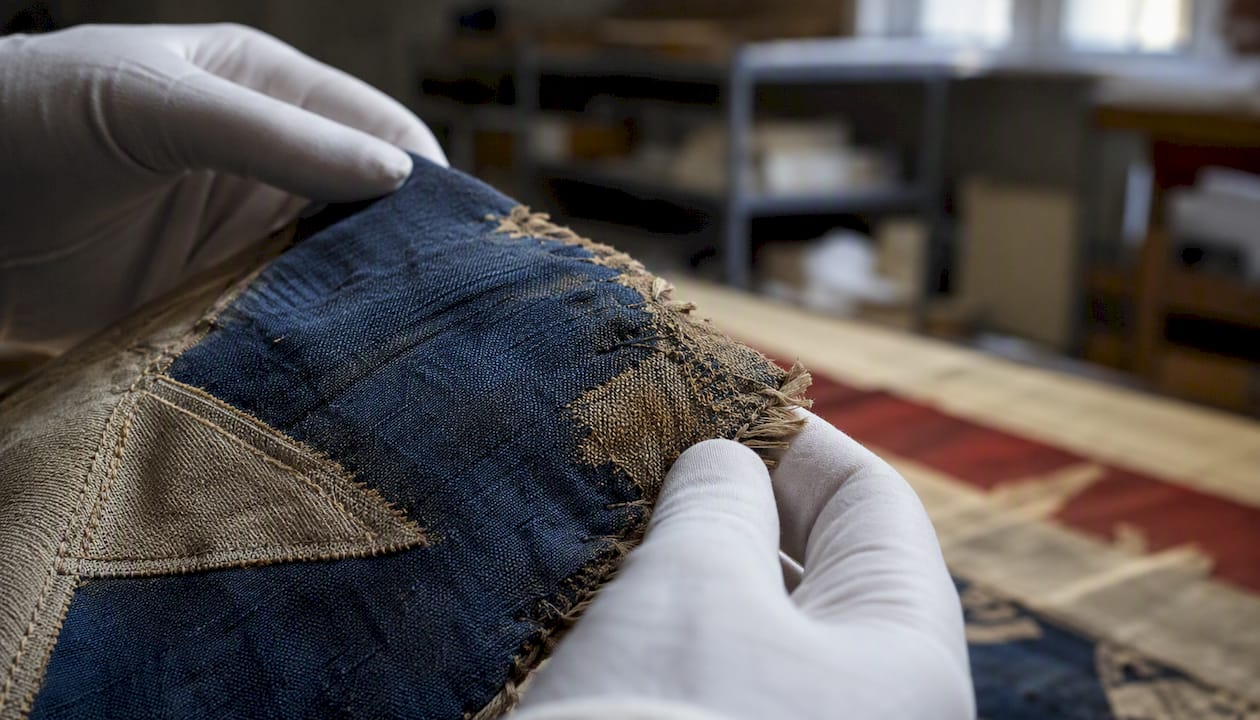
The Bennington Flag is a Spirit of ’76 variant that displays 13 seven-pointed stars, 13 stripes, and a bold ‘76’ in the canton to honor the Declaration of Independence and the 13 original colonies. Its symbolism is well-established and deeply patriotic. Its Revolutionary-era provenance, however, is another matter: conservation records at the Bennington Museum and textile analysis point to early 19th-century manufacture, making battlefield use in 1777 unlikely.

Two things every reader should carry away: The Bennington Flag’s design is a deliberate, layered tribute to 1776 and the founding colonies. Its physical age, as assessed by museum conservators and the Smithsonian repository, places it after the Revolution, not within it.


Key Takeaways

The Bennington Flag’s enduring power rests on its symbolism, not its battlefield legend: the ‘76,’ 13 stars, and 13 stripes together form one of the most direct visual tributes to the Declaration of Independence in American flag history.

Point Details
Core symbolism The ‘76,’ 13 stars, and 13 stripes honor 1776 and the 13 original colonies.
Likely manufacture date Textile and dye analysis point to early 19th-century production, not 1777.
Museum evidence Bennington Museum conservation records cite cotton construction inconsistent with pre-1800 manufacture.
Buying guidance Request provenance documentation and a conservation report; cross-reference Smithsonian catalog images.
Ultimate Flags Carries historically styled Bennington reproductions in outdoor polyester and cotton-blend for display or commemoration.

Table of Contents

What does the Bennington Flag look like?

The Bennington Flag’s visual identity is immediately distinctive, setting it apart from every other American Revolution flag you are likely to encounter.

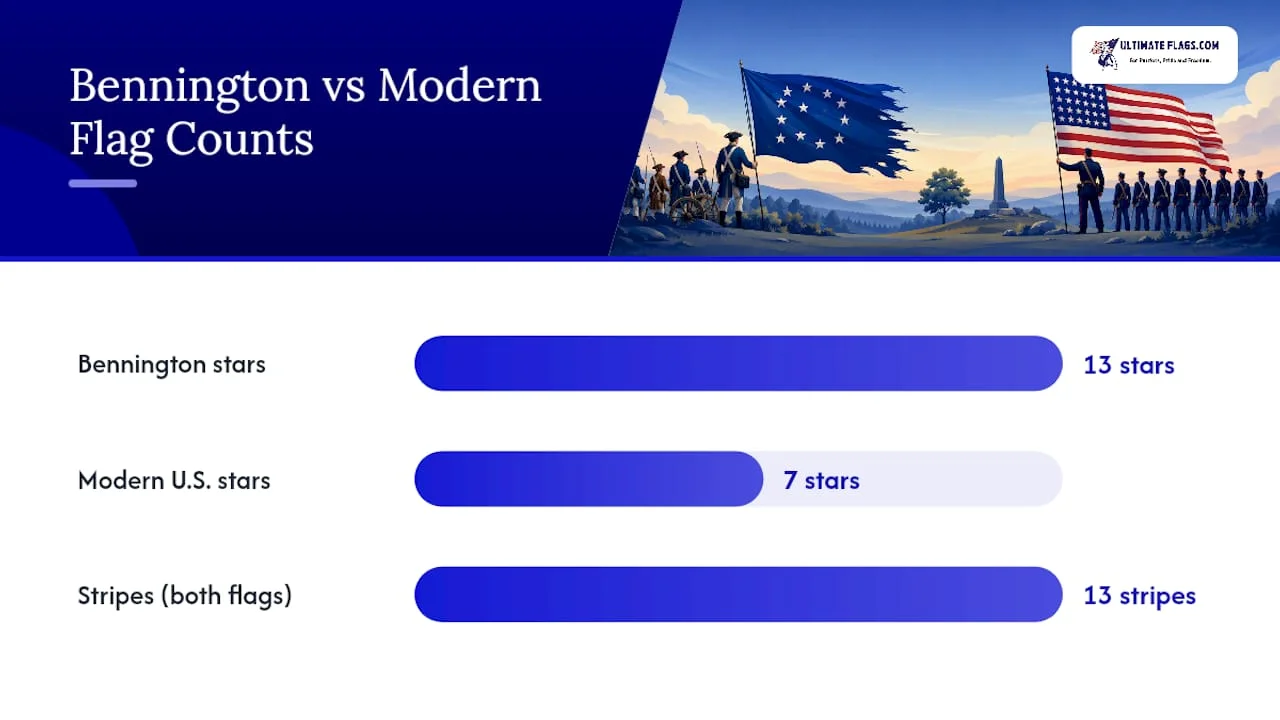
Feature Bennington Flag Modern U.S. Flag
Star count 13 seven-pointed stars 7 seven-pointed stars
Stripe count 13 (alternating red and white) 13
Outermost stripes White Red
Canton content Large ‘76’ plus arch of stars 7-star field only
Canton height Taller than on modern U.S. flags, spanning more stripes than usual Spans all 13 stripes

Diagram comparing Bennington and modern US flags

The stars are arranged in an arch across the top of the canton, with one star placed in each upper corner. The large ‘76’ sits prominently below that arch, occupying space that on any modern flag would hold only stars. White stripes appear on the outer edges rather than red, a reversal of the modern convention. The canton itself is taller in proportion to the fly than its contemporary counterparts, giving the flag a noticeably different silhouette.


What each symbol on the Bennington Flag represents

The Bennington flag’s symbolism is layered and deliberate, each element chosen to anchor the design in the memory of the founding era.

  • The ‘76’ explicitly recalls 1776, the year the Continental Congress signed the Declaration of Independence. No other American flag places this numeral so prominently in the canton, which is why the Bennington design reads as an unambiguous tribute to the birth of the nation.
  • The 13 stars represent the original 13 colonies that declared independence. The arch arrangement echoes the “new constellation” language of the Flag Act of 1777, which authorized stars on a blue field and allowed local variants to take shape.
  • The 13 stripes carry the same colonial meaning found across Revolutionary-era flags, from the Betsy Ross design to the Continental Union Flag, which itself used 13 stripes before stars replaced the British Union in the canton.
  • Seven-pointed stars and white outer stripes read as heraldic choices that distinguish this flag from later standardized designs, reinforcing its identity as a commemorative object rather than an official military standard.

The phrase “Spirit of ’76” captures the flag’s cultural role precisely. It does not merely record history; it celebrates a feeling, the solemn pride of a people who chose independence. Historical display events, including centennial celebrations and early flag raisings, helped cement ‘76’ as a patriotic motif that later generations returned to again and again.

Pro Tip: When displaying the Bennington Flag at a commemoration or historical reenactment, take a moment to explain the ‘76’ to your audience. Most observers recognize the stars and stripes but miss the canton numeral entirely, and that single detail transforms the flag from a decorative piece into a conversation about the Declaration of Independence.

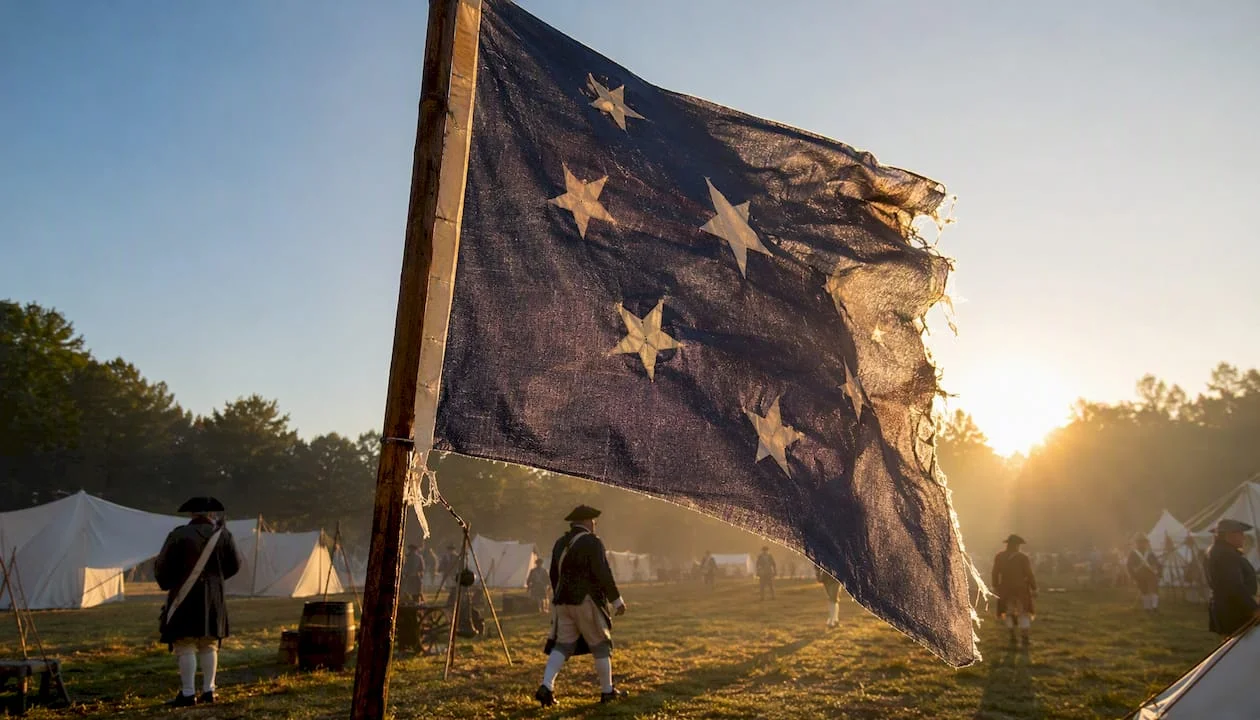
Bennington Flag waving at reenactment


The Battle of Bennington and competing origin stories

The traditional narrative places the Bennington Flag at the 1777 Battle of Bennington, carried by General John Stark’s New Hampshire militia as they routed a Hessian force near present-day Walloomsac, New York. It is a stirring story, and it gave the flag its name. The documented record, however, tells a more complicated tale.

  1. August 16, 1777 — The Battle of Bennington is fought. Tradition holds that a flag matching this description flew with Stark’s troops, though no contemporary written account confirms it.
  2. Late 18th to early 19th century — Textile evidence and construction details suggest the flag was most likely produced during this period, possibly as a commemorative emblem rather than a battlefield standard. Some historians place manufacture as late as the War of 1812 era.
  3. Fillmore family custody — The flag passed through the Fillmore family, with Nathaniel Fillmore and his descendants maintaining it as a family heirloom with a claimed Revolutionary connection. The family provenance narrative became the primary source for the battlefield story.
  4. 1876 — The flag appeared publicly during centennial celebrations, gaining wider recognition as a symbol of Revolutionary memory at a moment when the nation was actively honoring its founding generation.
  5. 1887 — The flag was carried in a Grand Army of the Republic parade, where a souvenir hunter removed one star and part of a stripe, damaging the artifact and complicating later physical assessments.
  6. Early 20th century onward — The Bennington Museum acquired the flag, and subsequent conservation work began to challenge the 1777 origin story on physical grounds.

The Betsy Ross Flag followed a similar arc of legend preceding documentation, as explored in Betsy Ross Flag history. Flags and their origin stories have always been inseparable.


What museum and textile analysis actually reveal

The Bennington Museum’s conservation records are the most authoritative physical evidence available, and their findings are clear: the flag’s cotton thread, stitchwork, and dye evidence are consistent with early 19th-century manufacture, making battlefield use in 1777 unlikely.

The technical details matter here. Cotton single- and double-ply yarns of the type found in the flag were uncommon before 1800, when American cotton milling became more widespread. The dyes identified during conservation, remnants of madder and indigo, are consistent with 19th-century dyeing techniques. Conservation work required encapsulation and strict low-light controls to prevent further fading, which itself speaks to the age and fragility of the textile.

  • Cotton fabric construction inconsistent with pre-1800 manufacture
  • Madder and indigo dye remnants typical of early 19th-century dyeing
  • Stitchwork patterns align with post-Revolutionary textile production
  • Physical damage from the 1887 parade complicates complete fiber analysis
  • Museum encapsulation and light controls confirm advanced age and fragility

Independent flag historians summarize the Fillmore family provenance narrative and note that many scholars now believe the flag was created later than the Revolutionary War, perhaps as a commemorative emblem. The Smithsonian repository holds related catalog entries and archival images that researchers use for side-by-side provenance comparison.

The honest conclusion: the Bennington Flag is almost certainly a product of early 19th-century American patriotism, not a relic carried through musket smoke in 1777. That does not diminish its significance. It may actually deepen it, because the flag represents how a young nation chose to remember its founding.

Close-up of historic flag fabric under examination


How the Bennington Flag is used today

Collectors and reenactors favor the Bennington Flag not because it is a confirmed battlefield standard but because its distinct ‘76’ iconography powerfully evokes Revolutionary memory. That cultural weight has made it one of the most recognized historical American flags in active use today.

The Bennington Flag endures not as a relic of a single battle but as a living emblem of the Spirit of ’76, carried forward by every generation that has chosen to honor the founding of the United States.

Common contexts include Fourth of July displays, museum exhibitions, historical reenactments of the Revolutionary War, and patriotic home décor. Reproductions vary considerably: some use simplified five-pointed stars, others adjust the canton proportions or render the ‘76’ in different typefaces. Outdoor-rated polyester versions are widely available for flagpole display, while cotton reproductions more closely approximate the original’s texture and weight for indoor or ceremonial use.

When flying a Bennington-style flag outdoors, standard American flag etiquette applies: display it from sunrise to sunset unless illuminated, and retire it when weather deteriorates. As a flag with historical significance, it deserves the same respectful handling you would give any national emblem.

Bennington Flag flying outdoors at sunset


How to tell an authentic flag from a reproduction

Verifying whether a Bennington Flag is a genuine antique or a modern reproduction requires methodical inspection. Absolute dating demands laboratory analysis, but documentation and physical checks can take you far.

  1. Examine the fiber. Authentic pre-1850 flags used hand-spun or early machine-spun cotton or wool. Request high-resolution photos of the weave and thread under magnification. Machine-uniform thread is a strong indicator of modern manufacture.
  2. Inspect the stitchwork. Hand-sewn seams show irregular stitch spacing. Machine stitching is perfectly uniform. The Bennington Museum’s conservation records note specific stitchwork patterns consistent with early 19th-century construction.
  3. Check dye condition. Genuine aged dyes fade unevenly, with madder reds shifting toward brown and indigo blues toward gray. Bright, uniform color in a claimed antique is a red flag.
  4. Request provenance documentation. Ask for family records, estate inventories, or museum catalog references. The Fillmore family chain of custody is the documented model; any antique claim without comparable documentation warrants skepticism.
  5. Cross-reference museum catalogs. The Smithsonian repository and Bennington Museum’s online catalog provide publicly accessible images and metadata for comparison.
  6. Ask for a conservation report. Reputable sellers of genuine antiques can provide conservation assessments. Absence of any such report does not disqualify a piece, but its presence adds significant credibility.
  • Uniform machine stitching on a claimed pre-1850 flag is a near-certain sign of modern production.
  • Bright, unfaded color in a claimed antique suggests synthetic dyes, which were not available before the mid-19th century.
  • A seller who cannot name a provenance chain beyond “old family piece” is offering a story, not documentation.

For practical display guidance on caring for historical-style flags once you have acquired one, the flag care and display guide at Ultimate Flags covers outdoor and indoor handling in detail.


Why the Bennington Flag matters beyond its age

The provenance debate around the Bennington Flag is genuinely fascinating, but there is a risk of letting it overshadow what the flag actually does. Whether it was sewn in 1777 or 1815, it carries the same symbolic weight: 13 stars for 13 colonies, 13 stripes for the same, and a bold ‘76’ that refuses to let anyone forget what year the United States chose to exist.

Flags are, at their core, acts of memory. The silent sentinels of history that survive in museum cases and private collections do not merely record the past; they shape how subsequent generations understand it. The Bennington Flag shaped how 19th-century Americans remembered the Revolution, and it continues to shape how we remember it now. That is a form of power that transcends any laboratory dating result.

Responsible display means acknowledging both dimensions: the rich symbolism and the honest provenance. When promoting a flag as an antique, cite the museum record. When displaying a reproduction, say so plainly. The Spirit of ’76 does not need embellishment to be moving.


Fly the Spirit of ’76 with a flag worth the honor

Ultimate Flags carries historically styled American Revolution flags built for both display and commemoration, including Bennington-style reproductions suited to flagpole mounting or indoor exhibition.

Ultimate Flags

Reproductions in the collection are available in outdoor-rated polyester for all-weather flagpole use and in heavier cotton-blend constructions for ceremonial or interior display. Both options feature the correct canton proportions, seven-pointed stars, and the distinctive ‘76’ that defines the design. Every flag ships ready to display, with brass grommets and reinforced fly ends for lasting use.

If you want a Bennington-style flag that honors the design’s historical integrity, browse the Revolutionary War flag collection at Ultimate Flags and choose the construction that fits your display setting.


Sources


FAQ

What does the Bennington Flag mean?

The Bennington Flag symbolizes the Spirit of ’76, using 13 stars and 13 stripes to represent the original colonies and a prominent ‘76’ in the canton to commemorate the Declaration of Independence in 1776.

Why do people fly the Bennington Flag today?

Collectors and patriots fly it because its ‘76’ iconography powerfully evokes Revolutionary memory, making it a popular choice for Fourth of July displays, historical reenactments, and patriotic home décor.

What do the stars on the Bennington Flag mean?

The 13 seven-pointed stars represent the original 13 colonies that declared independence from Britain, arranged in an arch across the canton in a style consistent with Revolutionary-era flag conventions.

Did the Bennington Flag actually fly at the 1777 battle?

Probably not. Bennington Museum conservation records and textile analysis indicate the flag’s cotton construction and dye evidence are consistent with early 19th-century manufacture, making 1777 battlefield use unlikely.

What is the rarest feature of the Bennington Flag’s design?

The large ‘76’ placed directly in the canton is unique among surviving American historical flags, making the Bennington design immediately identifiable and unlike any other flag from the Revolutionary era.

Posted on

Correct House Flag Placement: A Homeowner’s Guide

American flag mounted on angled staff on porch column

The most respectful house flag placement positions the American flag on an angled staff beside the front door, centered over the entry, or mounted on a porch column, balcony, or window — with the union (the blue field of stars) always at the peak of the staff or at the observer’s upper left when displayed vertically. That single rule governs nearly every placement decision a homeowner will face.

Three immediate do/don’ts:

  • Do place the flag in the most prominent, visible position available on your façade, free from obstructions that would prevent it from flying freely.
  • Do keep the flag in clean, undamaged condition; a tattered or faded flag diminishes the dignity of the display.
  • Don’t leave the flag out after dark unless it is properly illuminated by a dedicated light source aimed at the flag.

Before you mount anything, check two things:

  • Your homeowner association (HOA) rules or local ordinances, which may govern bracket placement, pole length, or flag size.
  • The path of any overhead utility lines near your intended mounting location.

Pro Tip: The Federal Flag Protection Act does not preempt HOA rules in all states — verify your CC&Rs before drilling.


Key Takeaways

Correct house flag placement requires the union at the peak of the staff or the observer’s upper left in vertical displays, a position of prominence on the façade, and either illumination or removal after dark.

Point Details
Union placement Always at the peak of an angled staff, or uppermost and to the observer’s left in vertical and window displays.
Position of prominence Choose the most visible, unobstructed spot on the façade; either side of the door is acceptable per Flag Code FAQs.
Lighting or removal at night The flag may remain outdoors after dark only if a dedicated light source illuminates it properly.
Surface-specific hardware Use masonry anchors and a hammer drill for brick; a mounting block for vinyl siding; exterior wood screws for wood.
Ultimate Flags Carries U.S. flags in all common home sizes plus mounting hardware suited to wood, vinyl, and masonry surfaces.

Table of Contents

What does the U.S. Flag Code actually require for home display?

4 U.S.C. § 7 is the governing statute for position and manner of display. Its language is precise, and every homeowner who takes the flag seriously should know what it says.

For angled staff displays, the union must be at the peak of the staff — the end farthest from the building. When the flag is grouped with other flags on adjacent staffs, the U.S. flag occupies the center or the highest point, and it is always hoisted first and lowered last.

One distinction matters here: the Flag Code is federal statute, but it carries no criminal penalties for civilian violations. Courts have consistently held that enforcement against private citizens would conflict with First Amendment protections. The practical effect is that the Code functions as a standard of honor rather than a penal law. Homeowners who follow it do so out of respect, and that is precisely the spirit in which it was written. The National Flag Foundation reinforces this point, noting that the rules exist to preserve the dignity and reverence the flag commands as a national symbol.


Where should you place the flag on your house or porch?

Choosing the right spot comes down to three factors: prominence, visibility from the street, and the flag’s ability to fly without obstruction. The Ushistory make clear that prominence and dignity outweigh any strict left-or-right convention — the flag may be mounted on either side of an entrance depending on which position offers the clearest sightline.

Angled staff beside the front door is the most common residential choice. It places the flag at eye level, close to the home’s main point of entry, and keeps it visible from the street. Either side of the door is acceptable; choose the side with the most open air so the flag can fly freely without catching on trim or a screen door.

Centered over the entry works well on homes with a wide portico or transom. The flag hangs horizontally or at a slight angle above the door, with the union to the observer’s left. This position reads as ceremonious and dignified, much like a banner hung above a formal entrance.

Porch column or railing mount suits homes with a covered front porch. A bracket secured to the column allows the flag to extend outward at roughly 45°, keeping it clear of the roof overhang. Avoid mounting so low that the flag brushes the porch floor.

Balcony display follows the same logic: mount the staff so the flag extends beyond the balcony railing and flies freely. Never drape the flag over the railing as a decorative cloth; the Flag Code reserves that treatment for coffins during funeral honors.

Window display is governed directly by the statute: union to the observer’s left when viewed from the street. A window-mounted flag should be secured so it does not sag or fold against the glass.

Gable mount places the flag high on the house’s end wall, offering excellent visibility from a distance. The union must be uppermost and to the observer’s left.

Yard flagpole is the most formal option. Position it at the front of the property, clear of trees and power lines, where it can be seen from the street without obstruction.

Pro Tip: On brick or stucco façades, drilling into mortar joints rather than the face of the brick reduces the risk of cracking and gives the anchor a more stable grip.


How do you mount a flag bracket safely and correctly?

The hardware you choose matters as much as the location. Standard retail flag kits often include screws intended for wood siding only; homeowners mounting to masonry must purchase masonry anchors or concrete screws and use a hammer drill fitted with masonry bits.

Step-by-step installation:

  1. Select your bracket. Fixed-angle brackets (typically set at 45°) suit most porch applications. Adjustable-angle brackets let you fine-tune the angle to clear overhangs or decorative trim, and they reduce siding damage by distributing load more evenly.
  2. Choose the right fasteners for your surface. Wood siding: exterior-grade wood screws with a weatherproof coating. Vinyl siding: install a mounting block first to prevent water intrusion and warping, then fasten through the block into the structural sheathing. Brick or masonry: use masonry anchors or concrete screws with a hammer drill and masonry bit; drilling into mortar joints is often preferable on older brickwork to avoid cracking the brick face.
  3. Mark and pre-drill pilot holes. Hold the bracket against the wall at the intended height, mark the hole locations with a pencil, and pre-drill to the anchor’s specified depth.
  4. Insert anchors and secure the bracket. For masonry, tap anchors flush with the wall surface before driving screws. Confirm the bracket is level before final tightening.
  5. Set the pole angle. Aim for approximately 45° from the wall. This angle keeps the flag visible from the street, prevents the pole from striking the façade in a breeze, and is the angle most commonly recommended by flag retailers.
  6. Select pole length. For most porches, a 5–7 ft pole suits the scale well. Shorter poles can make even a 3×5 flag look cramped; longer poles may strike overhead trim.
  7. Weatherproof the installation. Apply exterior caulk around the bracket base on wood or vinyl to seal against moisture. Use stainless steel or hot-dipped galvanized fasteners to resist corrosion.

For freestanding yard poles, Home Depot’s flagpole installation guide recommends setting a ground sleeve in concrete with the sleeve positioned two inches above grade and the sleeve plumbed carefully during curing. Poles that are typically manageable for DIY projects are those of moderate height; taller installations may require professional help.

Pro Tip: Before drilling anywhere on the exterior, use a stud finder and a wire-detection tool to confirm there are no electrical lines or plumbing runs behind the wall at your chosen mounting point.


How do you display multiple flags without dishonoring the U.S. flag?

Order of precedence is not a suggestion — it is codified in 4 U.S.C. § 7 and reinforced by Defense Department flag guidelines. The governing principle is straightforward: the U.S. flag always occupies the position of honor.

Two adjacent staffs on a porch: The U.S. flag goes on the observer’s left (the flag’s own right). A state flag, military flag, or decorative flag occupies the right staff. Both staffs should be the same height.

Two flags on equal-height staffs on a porch

Three or more staffs: The U.S. flag stands at the center, with other flags arranged symmetrically on either side. No flag on a flanking staff may be set higher than the U.S. flag.

Hoisting and lowering sequence: Hoist the U.S. flag first, lower it last. This sequence applies whether you are raising it alone or alongside other flags.

Same-pole displays: The U.S. flag must be at the top. Flying another flag above it on the same halyard is a direct violation of the Flag Code, regardless of the occasion.

Decorative flags — seasonal banners, sports flags, garden flags — should be displayed on a separate, lower staff or in a location that does not compete with the U.S. flag’s prominence. Placing a decorative flag on the same bracket or at the same height as the U.S. flag creates visual ambiguity about which flag holds the position of honor.


Can you leave the flag up at night, and how should you light it?

The etiquette is clear: the American flag may be displayed at night only if it is properly illuminated. An unlit flag left out after dark is considered a lapse in the respect the flag deserves, not merely a technicality.

Practical lighting options for homeowners include:

  • Ground-mounted uplights aimed directly at the flag provide the most reliable illumination for yard poles. A focused beam keeps light spill away from neighboring windows.
  • Porch-mounted fixtures can serve a staff-mounted flag if the fixture is positioned to wash the flag with light rather than casting it in shadow. Aim the beam toward the flag, not the wall behind it.
  • Dedicated flag spotlights are low-profile fixtures designed specifically for this purpose; they mount near the base of a yard pole or on a porch post and direct a narrow beam upward.
  • Timers and motion sensors reduce energy use and remove the daily burden of remembering to switch the light on at dusk. A dusk-to-dawn photocell timer is the most reliable option for continuous nighttime display.
  • Weatherproof fixtures rated for outdoor use (IP65 or higher) are necessary for any permanent installation exposed to rain, humidity, or freezing temperatures.

A flag left in darkness is better brought inside for the night than left unlit. Bringing the flag in also protects it from dew, frost, and wind damage that accumulates over repeated overnight exposures.


When and how do you fly the flag at half-staff?

Half-staff observances are proclaimed by the President of the United States or, for state-specific occasions, by a state’s governor. Homeowners who wish to honor these proclamations should check the White House website or their governor’s official page, as dates change and are not fixed on a permanent calendar.

The mechanical steps for a staff-mounted house flag differ slightly from a full flagpole:

  • Fixed angled staff: A flag on a fixed bracket cannot be lowered to a true half-staff position. The respectful alternative is to attach a black mourning ribbon or streamer to the top of the staff, or to remove the flag entirely for the duration of the observance.
  • Removable or adjustable staff: Hoist the flag to the peak of the staff first, then lower it to the midpoint. To return to full display, raise it to the peak again before lowering it fully.
  • Yard flagpole with halyard: Hoist the flag briskly to the top of the pole, then lower it ceremoniously to half-staff — the midpoint between the top and the base. Reverse the sequence when the observance ends: raise to the peak, then lower.

Permanent observance dates — Memorial Day, Pearl Harbor Remembrance Day, Patriot Day — are established by law and do not require a new proclamation each year. For all others, the official proclamation is the authoritative source.


How do you care for a flag and retire it with dignity?

A worn or damaged flag diminishes the honor of the display. The standard for retirement is straightforward: when a flag is no longer in a condition that reflects credit upon the nation, it should be replaced.

Signs that a flag needs replacement:

  • Fraying or unraveling along the fly end (the free edge opposite the hoist)
  • Fading so severe that the colors are no longer distinct
  • Tears, holes, or staining that cannot be cleaned
  • Mildew or structural damage to the fabric

Care and storage basics:

  • Nylon flags dry quickly and resist mildew, making them well suited to humid or rainy climates. Cotton flags carry a traditional appearance but require more careful drying before storage.
  • Fold the flag loosely and store it in a clean, dry container away from direct sunlight when not in use for extended periods.
  • Follow the manufacturer’s care instructions for washing; most nylon and polyester flags tolerate a gentle machine wash in cold water.

Respectful retirement options:

  • Many veteran organizations and American Legion posts accept worn flags for ceremonial retirement, typically by burning in a solemn ceremony.
  • Some municipalities operate flag drop-off programs, particularly around Flag Day (June 14) and Veterans Day.
  • A homeowner who chooses to retire a flag privately may do so by burning it completely in a dignified, respectful manner, ensuring the fire is controlled and the act is treated with solemnity rather than casualness.

The Ultimate Flags guide on respectful flag handling offers additional context on the tradition and meaning behind proper retirement.


What flag size and material should you choose for each placement?

Matching flag size to pole length and porch scale is much like choosing artwork for a wall: a flag that is too small looks lost, while one that is too large overwhelms the space and strains the hardware.

Multiple American flags in varied sizes displayed on a porch

A 3×5 flag is the most common choice for porch and home display, and it pairs well with a 5–6 ft staff on a standard bracket. For homes set back from the street, a 4×6 flag on a longer staff improves visibility at distance without looking disproportionate on the façade.

Material by climate: Nylon is the preferred choice for wet or humid regions because it dries quickly and resists mildew. In high-wind areas, a heavier sewn polyester or a nylon flag with reinforced stitching at the fly end will outlast a lightweight flag by a considerable margin. Cotton flags carry a traditional, full-bodied appearance and are well suited to covered porches where they are protected from direct rain.

Pro Tip: When in doubt about size, stand at the street and hold up a piece of cardboard cut to the flag’s dimensions against the façade. The visual proportion from the curb tells you more than any formula.


Common mistakes homeowners make and a pre-display checklist

Even well-intentioned homeowners repeat the same errors. Knowing them in advance makes the difference between a display that honors the flag and one that inadvertently diminishes it. For a deeper look at rules most people overlook, the Ultimate Flags guide to flag rules is worth reading before you mount anything.

Top eight mistakes:

  • Flying the flag upside down (reserved for a signal of dire distress; never appropriate for routine display)
  • Placing the union on the wrong side in a vertical or window display (must be uppermost and to the observer’s left)
  • Mounting the flag where it strikes a wall, railing, or overhang and cannot fly freely
  • Displaying a visibly worn, faded, or torn flag
  • Grouping a state or decorative flag at the same height or to the left of the U.S. flag
  • Leaving the flag out after dark without illumination
  • Using wood screws on masonry surfaces, which will loosen and fail under wind load
  • Ignoring HOA or local ordinances that restrict pole height, bracket placement, or flag size

Pre-display checklist:

  • Confirm mounting surface type and select appropriate anchors or mounting block
  • Verify no electrical lines or plumbing behind the mounting point
  • Check HOA rules and local ordinances for any restrictions
  • Confirm flag is clean, undamaged, and colors are distinct
  • Set bracket angle to approximately 45° and confirm the flag flies clear of all obstructions
  • Test lighting if the flag will remain up after dark
  • Verify union placement: peak of the staff for angled display, observer’s upper left for vertical

How do seasonal and weather conditions affect flag placement?

Seasonal changes affect both the flag’s material and the wisdom of leaving it in a fixed outdoor position. A flag that performs beautifully through a mild spring can suffer significant damage if left unattended through a summer thunderstorm season or a winter freeze.

Summer and high-wind seasons place the greatest stress on flag fabric. UV exposure fades colors, and sustained winds above 30 mph can fray even a well-made flag within weeks. Nylon handles wind better than cotton because it is lighter and flexes rather than resisting the load. During periods of severe weather, bringing the flag indoors is both respectful and practical.

Winter considerations center on moisture and freeze-thaw cycles. A wet flag that freezes overnight can develop stress fractures in the fabric, particularly along the hems. Metal hardware, including snap hooks and swivels, can seize in cold temperatures; stainless steel hardware resists corrosion and performs more reliably through freeze-thaw cycles than zinc-plated alternatives.

Spring and fall transitions are good times to inspect mounting hardware for corrosion, check that bracket screws remain tight after seasonal expansion and contraction of the wall material, and assess whether the flag itself needs replacement before a new season of display.

For homeowners in coastal regions, salt air accelerates corrosion on both hardware and fabric. Marine-grade stainless steel fasteners and a nylon flag with UV-resistant dye are the most durable combination for that environment. Pairing your Americana-style home display with weather-appropriate hardware keeps the whole presentation looking sharp through every season.


Why correct placement and care reflect something larger than curb appeal

Proper flag display is not merely a matter of following rules. It is a visible expression of the values a homeowner holds and the community they belong to. A flag mounted with care, illuminated at night, and retired with dignity communicates something that no lawn ornament or seasonal decoration can replicate: a sincere, ongoing commitment to the ideals the flag represents.

The Flag Code’s guidance on prominence and union placement exists because the flag’s position in a display carries meaning. Placing it in the highest, most visible spot is not about aesthetics; it is about precedence. The nation it represents takes precedence. That understanding, carried forward by veterans, civic organizations, and ordinary homeowners across generations, is what gives the rules their weight.

At Ultimate Flags, that tradition informs everything from the flags carried in stock to the hardware recommended for mounting them. Correct placement, proper materials, and attentive care are not burdens. They are the minimum the flag deserves.

*— Jonica


Ready to display your flag with confidence?

Ultimate Flags carries an extensive selection of American flags in every size suited to home display, from compact 2×3 window flags to full 4×6 porch flags, alongside mounting brackets, pole kits, and the hardware needed for wood, vinyl, and masonry surfaces. Whether you are mounting your first flag or replacing a worn one, the new flag owner’s guide at Ultimate Flags walks through sizing, accessories, and care in plain language.

Ultimate Flags

Beyond the Stars and Stripes, Ultimate Flags carries military and service flags, state flags, and historically significant designs that honor the full story of American heritage. Every flag in the catalog is selected with the same standard of quality that a dignified outdoor display demands. Browse the full selection and find the right flag, pole, and bracket for your home at Ultimateflags.


Sources

The following authoritative references were consulted for this guide and are recommended for further reading or verification:

For half-staff proclamations: check the White House website (whitehouse.gov) and your state governor’s official page. Observance dates change, and the official proclamation is always the authoritative source. For local rules, contact your municipality directly or review your HOA’s CC&Rs before installation.


FAQ

Should the American flag be on the left or right side of the house?

Either side of the front door is acceptable; the priority is prominence and visibility from the street, not a strict left-or-right rule. USHISTORY.org’s Flag Code FAQs confirm that homeowners should choose whichever side offers the clearest, most unobstructed sightline.

What are the rules for flying a flag at your house?

The U.S. Flag Code (4 U.S.C. § 7) requires the union at the peak of the staff for angled displays, the union uppermost and to the observer’s left for vertical displays, and proper illumination if the flag remains out after dark. No other flag may be placed above or to the right of the U.S. flag.

Where is the best place to hang a flag on a house?

An angled staff bracket beside the front door is the most common and practical choice, placing the flag at a prominent, visible position at the home’s main point of entry. A porch column, centered over the entry, or a yard flagpole are equally dignified alternatives depending on the home’s layout.

What does hanging an American flag outside your house mean?

Displaying the American flag at home is a public expression of patriotism, civic pride, and respect for the nation and those who have served it. Displayed correctly and maintained with care, it signals that the homeowner honors the values and traditions the flag represents.

Posted on

Civil War Flags: Identification, History, and Replica Guide

Close-up of Confederate battle flag fabric outdoors

The term “Civil War flags” encompasses the full set of national, battle, regimental, naval, and state banners carried by Union and Confederate forces between 1861 and 1865. Knowing which flag is which begins with five essential types:

  • Union Stars and Stripes (1861–1865): the familiar red, white, and blue national flag, with star counts increasing as states were added during the war
  • Stars and Bars (Confederate 1st National, March 1861): three horizontal bars of red, white, and red with a blue canton bearing a circle of 7–13 stars
  • Stainless Banner (Confederate 2nd National, May 1863): a white field with the battle flag canton in the upper left corner
  • Blood-Stained Banner (Confederate 3rd National, March 1865): the Stainless Banner with a broad red vertical stripe at the fly end
  • Confederate Battle Flag (Southern Cross, 1861 onward): a red field with a blue saltire bearing 13 white stars, the most widely recognized Confederate emblem in the field
  • Regimental and unit flags: unique banners carried by individual regiments, often hand-sewn and later inscribed with battle honors

The Library of Congress, the National Park Service, the Smithsonian’s National Museum of American History, and Ultimate Flags all serve as authoritative references for identifying, viewing, and acquiring accurate reproductions of these historic banners.

Pro Tip: The Confederate battle flag and the Stars and Bars are two entirely different designs. Confusing them is the single most common error among new collectors. The battle flag was a square or near-square field banner; the Stars and Bars was a rectangular national flag with horizontal stripes.


Key Takeaways

Civil War flags encompass national, battle, regimental, naval, and state banners from both sides, and accurate identification requires knowing the specific design, date, and dimensions of each type.

Point Details
Three Confederate national flags Stars and Bars (1861), Stainless Banner (1863), and Blood-Stained Banner (1865) are distinct designs, not interchangeable names.
Battle flag dimensions by branch Infantry 48", artillery 36", cavalry 30" square; branch-correct sizing is required for accurate reproductions.
Over 460 Medals of Honor tied to flags More than 460 of the 1,522 Civil War Medals of Honor involved flag actions, reflecting the tactical and symbolic weight these objects carried.
Provenance verification Always request accession numbers and donor records; NPS and Smithsonian catalog entries are the standard for authenticating originals.
Ultimate Flags reproductions Ultimate Flags offers branch-correct battle flags, Stars and Bars, and Union variants in materials suited to reenactment, display, and collecting.

Diagram comparing Confederate national and battle flags


Table of Contents

Why Civil War flags mattered on the battlefield and beyond

Flags during the Civil War were not merely decorative. They served as the primary means of unit identification in the smoke and chaos of battle, functioning as rally points, command signals, and records of regimental honor. Losing a flag to the enemy was a profound disgrace; capturing one was among the highest battlefield achievements a soldier could accomplish. A significant portion of the 1,522 Medals of Honor awarded during the Civil War were connected to actions directly involving flags, a figure that speaks to how deeply these objects were woven into the war’s culture of courage and sacrifice.

The timeline of major flag changes reflects the shifting fortunes and politics of both sides.

  • April 12, 1861: Fort Sumter falls; the Union Stars and Stripes becomes a rallying emblem for Northern resolve. The Civil War flags of Fort Sumter carry particular symbolic weight as the war’s opening act.
  • March 4, 1861: The Confederate Provisional Congress adopts the Stars and Bars as the first Confederate national flag.
  • 1861: The Confederate battle flag (Southern Cross) is created for field use after the Stars and Bars proved too easily confused with the Union flag at First Manassas.
  • May 1, 1863: The Stainless Banner replaces the Stars and Bars as the second Confederate national flag.
  • March 4, 1865: The Blood-Stained Banner is adopted as the third Confederate national flag, just weeks before the war’s end.

Many of the flags carried into battle were hand-sewn by women’s groups and local communities, presented to regiments with great ceremony before they departed. As HistoryNet documents, these presentations were acts of civic devotion, and the flags that returned bore the physical evidence of every campaign. The Civil War also transformed the Stars and Stripes into something close to a sacred object. As the Smithsonian’s National Museum of American History records, the flag became a consecrated emblem of Union identity, a transformation that explains why Union veterans’ groups spent decades preserving their regimental colors with such fierce dedication.


Union flags used during the war: Stars and Stripes variants and regimental colors

The Union fielded two primary flag types: the national Stars and Stripes and dark-blue regimental colors bearing the Great Seal of the United States alongside unit inscriptions. Star counts on the national flag changed as states entered the Union, making the star arrangement a reliable dating tool for collectors and reenactors.

Folded Union regimental flags on display table

Flag Variant Approx. Dates Star Count Notes
34-Star Flag 1861 to 1863 fewer stars Oregon’s admission; used at Fort Sumter
34-Star Flag Early 1861 to mid-1863 increased stars Kansas admitted; primary war-opening flag
35-Star Flag Mid-1863 to mid-1865 additional stars West Virginia admitted July 1863
36-Star Flag Began in 1865 more stars Nevada admitted; end-of-war flag

Regimental colors followed a distinct pattern. Infantry regiments typically carried a dark-blue silk flag bearing the national eagle and Great Seal at center, with the regiment’s designation and state name embroidered or painted below. Cavalry units carried smaller swallow-tailed guidons in red and white stripes, while artillery batteries used similar guidons with crossed-cannon insignia. Battle names were frequently added to regimental colors after each engagement, so a flag that survived the full war might carry a dozen or more inscribed campaign names across its face.

For high-resolution images of Union regimental colors, the Library of Congress Prints and Photographs Division holds an extensive photographic record, and the NPS Eastern Trophy Room collection documents many originals with full provenance notes. State historical societies, particularly those of Pennsylvania, New York, and Ohio, maintain large holdings of their own regiments’ surviving colors.

Pro Tip: When buying a Union Stars and Stripes replica for reenactment, specify the correct star count for your event’s date range. A 34-star flag is appropriate for 1861–1863 scenarios; a 35-star flag fits 1863–1865. Many commercially available replicas default to the modern 50-star arrangement, which is historically inaccurate for any Civil War portrayal.


Confederate flags: Stars and Bars, Stainless Banner, Blood-Stained Banner, and the battle flag

There were three official Confederate national flags and a separate battle flag used widely in the field. Britannica’s reference entry on Confederate flags confirms all three national designs and notes that the battle flag remained the Confederacy’s most recognizable field emblem despite never holding national-flag status.

Flag Name Adoption Date Design Summary Proportions / Stars
Stars and Bars (1st National) March 4, 1861 Three horizontal bars (red, white, red); blue canton with circle of stars 1:2 ratio; 7–13 stars
Stainless Banner (2nd National) May 1, 1863 White field; battle-flag canton upper left 1:2 ratio; 13 stars in canton
Blood-Stained Banner (3rd National) March 4, 1865 Stainless Banner + broad red vertical stripe at fly 1:2 ratio; 13 stars in canton
Confederate Battle Flag (Southern Cross) 1861 (field use) Red field; blue saltire with 13 white stars Infantry 48", artillery 36", cavalry 30" square

The battle flag’s branch-specific dimensions are among the most important details for accurate reproduction. Encyclopedia Virginia documents that the infantry battle flag measured 48 inches square, the artillery version 36 inches square, and the cavalry version 30 inches square. These are not interchangeable; displaying an artillery-sized flag as an infantry standard is a visible error to any informed observer.

Pro Tip: The Stars and Bars is frequently misidentified as the battle flag, and vice versa. The Stars and Bars has horizontal stripes and resembles the Union flag at a distance, which is precisely why the battle flag was created after the confusion at First Manassas in July 1861. The birth of the battle flag at Manassas is one of the most consequential design decisions of the war.

For primary-source images of all three national flags, the Smithsonian’s textile conservation records and the Library of Congress both hold photographic documentation. The NPS collections include examples of the Stainless Banner and Blood-Stained Banner with accession numbers that allow provenance verification.


Regimental and unit flags: inscriptions, honors, and where originals survive

Regimental flags were the most personal objects a Civil War unit possessed. They were rarely issued from a central depot; instead, local communities, women’s sewing circles, and civic organizations presented them to departing regiments with formal ceremony. As HistoryNet’s survey of Civil War banners describes, these hand-sewn presentations were later updated with battle inscriptions, meaning a single flag could accumulate the names of a dozen engagements across its face, each addition a layer of living history.

Common features of surviving regimental flags include:

  • The regiment’s numerical designation and state name, usually embroidered or painted in gold lettering
  • The state seal or coat of arms, often rendered in silk appliqué
  • Gold fringe along three sides (top, bottom, and fly)
  • Battle names added in sequence, sometimes crowding the original design
  • Physical evidence of repair: patches, re-stitching, and replaced sections where shot or shell tore the fabric

The NPS Eastern Trophy Room at various battlefield parks holds hundreds of regimental flags donated by veterans’ organizations after the war, each cataloged with donor records and accession numbers. The National Guard Militia Museum of New Jersey maintains a significant collection that includes captured Confederate flags alongside Union regimental colors, offering a rare side-by-side comparison for researchers. State historical societies in Pennsylvania, Virginia, and Georgia hold additional captured flags that changed hands during major campaigns.

Provenance is the single most important factor when evaluating any original flag. A flag without a documented chain of custody, from the presenting organization through veterans’ group donation to museum accession, carries significantly less historical and monetary value than one with a complete record. Accession numbers assigned by the NPS or Smithsonian are the gold standard; they connect a physical object to a paper trail that can be independently verified.

Point Details
Regimental flag origins Hand-sewn by local communities; unit-specific designs with state seals and gold fringe
Battle honor inscriptions Names added after each campaign; a fully inscribed flag may show a dozen engagements
Where originals survive NPS trophy rooms, New Jersey Militia Museum, state historical societies
Provenance verification Accession numbers and donor records are the standard; request them before any purchase

Regional, state, and naval variants you should know

Beyond the national and regimental flags, dozens of regional and naval variants circulated during the war, and many appear in museum collections or as replica products without clear identification. Knowing the most common ones prevents misattribution.

  • Bonnie Blue Flag: a single white star on a blue field, used informally as a Confederate symbol before the Stars and Bars was adopted; multiple slightly different versions exist, so the name alone does not describe a single design
  • Van Dorn Battle Flag: used by Confederate forces in the Trans-Mississippi theater, featuring a blue field with a white border and a central white star; visually distinct from the Army of Northern Virginia battle flag
  • CSS Shenandoah naval ensign: Confederate naval vessels used a variant of the national flag adapted for maritime use; the CSS Shenandoah famously continued flying the Confederate naval ensign after the war had ended, unaware of the surrender
  • State-specific designs: several Confederate states fielded units under their own state flags before standardized battle flags were issued; Alabama, Georgia, and Louisiana each had distinctive early-war designs

A caution on naming: the term “Bonnie Blue” is applied loosely to several related but distinct designs. Before purchasing or displaying a flag under that name, verify the specific design against a primary source such as the Library of Congress or a state historical society catalog. The same caution applies to early-war Confederate state flags, where local variations were common and documentation is sometimes incomplete.


How the meanings of Civil War flags have shifted over 160 years

The meanings carried by Civil War flags have never been static. Union flags, particularly the Stars and Stripes, took on a quality of near-sacred national identity during the war itself. As the Smithsonian documents, the flag became a consecrated emblem of Union identity, and for African American soldiers who served under it, the Stars and Stripes represented a claim to citizenship that carried profound personal weight.

Confederate flag meanings have followed a more contested trajectory. Historian John M. Coski and the American Civil War Museum both emphasize that the Confederate flag’s meaning has never been fixed. It began as a military field symbol, was largely set aside after the war, and then experienced a significant revival in the 20th century, particularly during the civil rights era, when it was adopted by groups opposing desegregation. That layered history means the same object carries different meanings to different communities, a reality that collectors and reenactors must navigate with care.

For those who display Civil War flags in educational, collecting, or reenactment contexts, a few principles apply:

  • Provide historical context whenever a Confederate flag is displayed, whether through signage, documentation, or direct explanation
  • Distinguish clearly between the three national flags and the battle flag, since each carries its own specific history
  • Recognize that venue restrictions and institutional policies vary; some public spaces and private organizations prohibit Confederate flag display regardless of intent
  • The men who carried the Confederate battle flag did so in a specific military context that differs from modern display settings

Pro Tip: Owning a Confederate flag is legal under U.S. law as a matter of private property and First Amendment expression. Display restrictions apply primarily to government buildings and some institutional settings. For specific venue or public-display questions, consult the relevant local ordinances or institutional policies directly rather than relying on general guidance.

Regarding the question of whether Confederate flag display is disrespectful: the answer depends heavily on context, intent, and audience. In a museum, reenactment, or documented historical collection, the same flag that might cause offense in another setting is understood as a historical artifact. Context-aware display, with clear historical framing, is the standard recommended by major museums and heritage organizations.


How to evaluate replicas and originals: a collector’s checklist

To choose an accurate replica or evaluate an original Civil War flag, work through a checklist of provenance, material, construction, dimensions, and documented repairs. Skipping any one of these steps is how collectors end up with artificially aged reproductions sold as originals, or with replicas that look wrong to anyone familiar with period construction.

  1. Verify provenance first. For originals, request the accession number, donor record, and any conservation reports. Cross-reference with NPS or Smithsonian catalog entries. A seller who cannot provide documentation is a warning sign.
  2. Identify the fiber. Period flags were made from wool bunting, silk, or cotton. Polyester did not exist in the 1860s. A fiber test (burn test or laboratory analysis) can distinguish period-appropriate materials from modern synthetics.
  3. Examine the stitching. Hand-sewn flags show irregular stitch lengths and thread tension variations. Machine stitching, which became available during the war but was not universal, shows uniform spacing. Post-war machine stitching on a claimed original is a red flag.
  4. Check the dyes. Period flags used natural or early synthetic dyes; colors tend toward muted tones after aging. Bright, saturated colors on a claimed original suggest modern dyes or artificial aging treatments.
  5. Confirm the dimensions. For Confederate battle flags, branch-specific sizes (48" infantry, 36" artillery, 30" cavalry) are documented. A flag that does not match any standard size requires explanation.
  6. Count the stars and check their arrangement. Star counts and arrangements changed over time for both Union and Confederate flags. An incorrect count for the claimed date is a disqualifying error.
  7. Look for battle damage and repairs. Authentic originals often show shot holes, fraying, and period-appropriate patching. Artificially aged flags may show uniform “distressing” that lacks the irregular pattern of genuine battlefield wear.
  8. Research auction and exhibition history. Major auction houses (Christie’s, Heritage Auctions) maintain records of significant Civil War flag sales. A flag with no auction or exhibition history and a dramatic provenance story deserves extra scrutiny.

For replica buyers, the material choice shapes both appearance and durability. The cotton vs. polyester comparison is the central decision for most reenactors and collectors:

Material Appearance Durability Best Use
Wool bunting Most period-accurate; matte finish, correct drape Moderate; requires careful storage Museum-quality display, serious reenactment
Cotton Good period approximation; softer hand Moderate; fades with UV exposure Indoor display, educational use
Polyester Modern look; brighter colors High; weather-resistant Outdoor display, high-use reenactment

Pro Tip: For outdoor reenactment use, a heavy-duty polyester replica holds up far better than cotton or wool in rain and wind. For a museum-quality reproduction intended for framed display or formal presentation, wool bunting is the period-correct choice. Never use a wool bunting flag outdoors for extended periods; moisture accelerates deterioration.

For pricing context, the cost of a Confederate battle flag replica varies considerably by material, size, and construction quality. USA-made reproductions, which you can find through domestic flag retailers, generally command a premium over imported alternatives and tend to use better materials and stitching.


Where to see originals and find authoritative images

The best places for authoritative originals and high-resolution images are the Library of Congress, the National Park Service collections, the Smithsonian’s National Museum of American History, state historical societies, and the National Guard Militia Museum of New Jersey.

  • Library of Congress Prints and Photographs Division: holds an extensive photographic record of Civil War flags, including high-resolution scans accessible online through the LOC digital catalog; search by regiment or flag type
  • NPS Eastern Trophy Room collections: documented with accession numbers and provenance notes, these holdings include regimental colors from both sides donated by veterans’ organizations; contact individual battlefield parks for viewing appointments
  • Smithsonian National Museum of American History: textile conservation records and catalog entries for major Union and Confederate flags; the NMAH’s online collections portal allows keyword searches by flag type and regiment
  • National Guard Militia Museum of New Jersey: maintains Civil War regimental flags including captured Confederate examples, with rotating displays and research access
  • State historical societies: Pennsylvania, Virginia, Georgia, and New York hold particularly strong collections; many have digitized portions of their holdings and offer online catalog access
  • American Battlefield Trust: the Flags of the Civil War video provides a concise visual introduction to the major flag types and their battlefield use, useful as a starting point before deeper archival research

When using any of these collections for provenance verification, request the accession number and the donor record. Conservation-grade images and condition reports are available from the NPS and Smithsonian for researchers with documented scholarly or legal need. For general research, the online digital catalogs at the Library of Congress and Smithsonian provide sufficient resolution for identification purposes.


Accuracy and reverence: why getting the details right matters

Accurate reproductions are not merely a matter of aesthetics. When a reenactor carries a 34-star Union flag at a Gettysburg event, or a collector displays a correctly proportioned infantry battle flag, they are participating in a form of historical testimony. The flag becomes a document, not a decoration. Conversely, a flag with the wrong star count, the wrong proportions, or the wrong material tells a false story, however unintentionally.

At Ultimate Flags, the commitment to historically grounded reproductions reflects a belief that these objects deserve the same respect as the history they represent. Displaying a Civil War flag, whether Union or Confederate, carries an obligation to understand what it meant to the people who made it, carried it, and sometimes died for it. That understanding begins with getting the details right, and it extends to the context in which the flag is displayed.


Authentic Civil War flag reproductions from Ultimate Flags

Ultimate Flags carries a range of historically grounded Civil War flag reproductions suited to collectors, reenactors, and educators who need accurate materials without the fragility of museum originals.

Ultimate Flags

The selection includes Confederate battle flags in branch-correct sizes (infantry, artillery, and cavalry dimensions), Stars and Bars reproductions in period-accurate proportions, and Union Stars and Stripes variants with correct star counts for specific war-era date ranges. Heavy-duty polyester options serve outdoor reenactment use; cotton and wool-bunting reproductions are available for display and formal presentation. Flag poles, mounts, and conservation storage supplies round out the accessories catalog. The Legends of the Stars and Bars page offers additional context on Confederate national flag reproductions for collectors seeking the full set of national designs.

A respectful note: every Civil War flag, Union or Confederate, represents lives lived and lost in one of history’s most consequential conflicts. Display them with the historical context they deserve.


Sources

These collections and reference works offer authoritative documentation for identification, provenance research, and deeper historical study:


FAQ

What is the difference between the Confederate battle flag and the Stars and Bars?

The Stars and Bars was the first Confederate national flag, featuring three horizontal bars (red, white, red) and a blue canton with a circle of stars. The Confederate battle flag (Southern Cross) was a separate square field banner with a blue saltire on a red field, created specifically for battlefield use after the Stars and Bars was confused with the Union flag at First Manassas in 1861.

Is it illegal to own a Confederate flag in the United States?

Private ownership of a Confederate flag is legal under U.S. law as a matter of property rights and First Amendment expression. Display restrictions apply to some government buildings and institutional settings; for specific venue or public-display questions, consult the relevant local ordinances or institutional policies.

Is displaying a Confederate flag considered disrespectful?

Context determines perception. In a museum, reenactment, or documented historical collection, the flag is generally understood as a historical artifact. Outside those contexts, many people regard Confederate flag display as disrespectful given its association with opposition to civil rights in the 20th century. Historians including John M. Coski note that the flag’s meaning has shifted considerably since the Civil War, making context-aware display with clear historical framing the standard recommended by major heritage organizations.

How do I identify which Confederate national flag I am looking at?

The Stars and Bars has three horizontal stripes and a blue canton with stars. The Stainless Banner is predominantly white with the battle-flag canton in the upper left corner. The Blood-Stained Banner adds a broad red vertical stripe at the fly end of the Stainless Banner. Britannica’s reference entry on Confederate flags provides a concise visual summary of all three.

Where can I find high-resolution images of original Civil War flags?

The Library of Congress Prints and Photographs Division, the Smithsonian National Museum of American History’s online collections portal, and the NPS Eastern Trophy Room pages all offer catalog-level documentation and, in many cases, downloadable high-resolution images. The American Battlefield Trust’s Flags of the Civil War video provides a useful visual orientation before deeper archival research.

Posted on

POW/MIA Flag Meaning: History, Symbolism and Display Rules

POW/MIA flag waving outdoors on flagpole

The POW/MIA flag is a national symbol that reminds Americans of service members held as prisoners of war or still missing in action, and it expresses the nation’s solemn commitment to account for every one of them. Recognized by Public Law 101-355 in 1990, it is the only flag other than the U.S. flag ever authorized to fly over the White House. Its presence at federal buildings, military installations, and veterans’ cemeteries is not ceremonial habit — it is a legal mandate.

Key anchors that give the flag its authority:

  • The National League of Families originated the concept and first distributed the flag nationally.
  • Newt Heisley designed the iconic silhouette and imagery.
  • Public Law 101-355 (1990) granted it formal federal recognition.
  • National POW/MIA Recognition Day, observed annually on the third Friday of September, is one of six congressionally mandated display occasions.

Key Takeaways

The POW/MIA flag is a federally recognized national symbol, legally mandated for display at major federal sites on six national observances, with its design and purpose rooted in a 1971 commitment to account for every missing American service member.

Point Details
Core definition The flag symbolizes the nation’s commitment to account for Americans still prisoner, missing, or unaccounted for.
Origin and designer Conceived by Mary (Mrs.) Michael Hoff and designed by Newt Heisley for the National League of Families in 1971.
Legal recognition Public Law 101-355 (1990) granted federal designation; P.L. 105-85 (1998) expanded mandated display sites and days.
Six mandated display days National POW/MIA Recognition Day, Armed Forces Day, Memorial Day, Flag Day, Independence Day, and Veterans Day.
Current accounting source DPAA (dpaa.mil) maintains live case counts; the VA publishes historical and legal summaries.

Table of Contents

What is the POW/MIA flag’s origin and history?

The flag’s story begins in 1971, when the National League of Families of American Prisoners and Missing in Southeast Asia commissioned a visual symbol to keep public attention on unresolved cases. Mary (Mrs.) Michael Hoff, a League member, is credited with the original concept. She brought the idea to graphic artist Newt Heisley, a World War II veteran who translated her vision into the stark black-and-white design the world now recognizes. According to the VA’s official POW/MIA summary, the League formally adopted the flag in 1972 and began distributing it to chapters and supporters across the country.

The milestones that followed reflect a steady, bipartisan effort to institutionalize the symbol:

  • 1972 — National League of Families adopts the flag and begins national distribution.
  • 1979 — The flag is flown over the White House for the first time on National POW/MIA Recognition Day.
  • 1982 — Congress formally recognizes the League’s flag as the official POW/MIA symbol.
  • 1990 — Public Law 101-355 designates the flag as a national symbol and specifies display requirements.
  • 1998 — The Defense Authorization Act (P.L. 105-85) expands mandated display days and locations.

That figure, cited in VA historical records, explains why the flag’s adoption moved so quickly from a grassroots emblem to a federally recognized symbol. Families needed a visible, unified voice, and the flag gave them one.

What do the flag’s design elements symbolize?

Every element of the POW/MIA flag was chosen deliberately. The National League of Families’ protocol guidance and the National Park Service’s history of the flag both describe the imagery as a unified statement about captivity and moral obligation.

The core visual elements and their meanings:

  • The black field — Represents the darkness of captivity and the grief of families left without answers.
  • The gaunt silhouette — A bowed head in profile, conveying suffering and endurance. Oral tradition holds that Heisley modeled the figure on his own son’s profile, though primary photographic evidence for this is limited; the anecdote is widely repeated as origin lore.
  • The guard tower — Signals the watchfulness of captors and the confined reality of imprisonment.
  • The barbed wire — Reinforces the imagery of confinement and the physical barrier between prisoner and freedom.
  • “POW/MIA” and “YOU ARE NOT FORGOTTEN” — The text frames the entire image as a promise: these individuals have not been abandoned by their country.

The white-on-black color scheme was chosen for maximum contrast and visibility, ensuring the symbol reads clearly at a distance on a flagpole or in a crowd.

Pro Tip: The NPS notes that historical variations in color and wording exist across different manufacturers and eras, but historians and custodians treat those differences as secondary. The symbol’s continued public visibility matters far more than minor design variants.

How does U.S. law officially recognize the POW/MIA flag?

The flag’s legal standing is specific and substantial. Public Law 101-355 defines it in statute as:

That language is precise: the law names Southeast Asia as the original scope, reflecting the flag’s Vietnam-era origins. The 1998 Defense Authorization Act (P.L. 105-85) then expanded the mandate, specifying which federal locations must display the flag and on which days.

Federal sites required by law to display the flag include the White House, the U.S. Capitol, the Korean War Veterans Memorial, the Vietnam Veterans Memorial, the offices of the Secretaries of State, Defense, and Veterans Affairs, the Selective Service System, major military installations, all U.S. post offices, VA medical centers, and national cemeteries.

Diagram of federal locations displaying POW/MIA flag

When displayed alongside the U.S. flag on the same pole, the POW/MIA flag flies directly below it and must be no larger than the U.S. flag. On separate poles, the U.S. flag is positioned to the right (the observer’s left), holding the position of honor.

How should you fly the POW/MIA flag correctly?

Proper display honors the flag’s meaning and respects the order of precedence established by federal law and DoD guidance. The rules are straightforward.

On the same pole:

  1. The U.S. flag flies at the top, in the position of highest honor.
  2. The POW/MIA flag flies directly below it.
  3. The POW/MIA flag must not exceed the size of the U.S. flag.

On separate poles:

  1. The U.S. flag is placed to the right (the observer’s left), the traditional position of honor.
  2. The POW/MIA flag is placed to the left of the U.S. flag from the observer’s perspective.

The six national observances on which Congress mandates display at designated federal sites are:

  • National POW/MIA Recognition Day (third Friday of September)
  • Armed Forces Day (third Saturday of May)
  • Memorial Day (last Monday of May)
  • Flag Day (June 14)
  • Independence Day (July 4)
  • Veterans Day (November 11)

For private citizens and organizations, display on any or all of these days is a fitting act of remembrance. VA medical centers and national cemeteries are directed to fly the flag year-round, not only on the six mandated days. Handle the flag with the same care and reverence due the U.S. flag: never let it touch the ground, and retire it with dignity when it becomes worn.

Does the POW/MIA flag honor only Vietnam-era service members?

The flag was born from Vietnam-era urgency, but its meaning has grown well beyond that conflict. The National League of Families originally focused on American POWs and MIAs in Southeast Asia, which is why Public Law 101-355 references that region specifically. Over time, however, federal practice and public use have extended the flag’s symbolic reach to honor POW/MIA personnel from all U.S. conflicts, including World War II, Korea, and later engagements.

The Defense POW/MIA Accounting Agency (DPAA), established under the Department of Defense, now handles accounting efforts across all conflicts, from World War I through the present. Its mandate reflects the same expansive understanding: no era of service is excluded from the nation’s obligation to account for its missing.

Where can you find current counts of unaccounted-for service members?

The authoritative source for current figures is the Defense POW/MIA Accounting Agency (DPAA), which maintains regularly updated counts and case-status information. The Department of Veterans Affairs (VA) also publishes POW/MIA resources and historical summaries. The Department of Defense provides broader policy and recognition context through its official communications.

Key points about how counts are tracked and why they change:

  • DPAA classifies cases into categories such as “further pursuit,” “no further pursuit,” and “deferred,” based on the likelihood and feasibility of recovery.
  • Numbers shift as remains are identified through forensic analysis, archival research, and diplomatic cooperation with foreign governments.
  • Identifications are announced publicly by DPAA, and each one represents a family finally receiving an answer.

For the most current figures, visit dpaa.mil directly. The VA’s published resources, including the VA’s POW/MIA summary, provide historical context and legal background, while DPAA holds the live accounting data.

Why is the POW/MIA flag still flown when no verified recent POWs exist?

This is one of the most common and sincere questions people ask about the flag. The answer rests on three distinct foundations: legal mandate, institutional practice, and enduring moral obligation.

First, the legal mandate is clear. Public Law 101-355 and P.L. 105-85 require display at specific federal sites on specific days regardless of the current status of any individual case. Congress has not repealed or weakened those requirements.

Second, the DoD’s own position, reflected in defense.gov guidance, acknowledges that there has not been a verified living American POW in Southeast Asia since 1979. Yet thousands of cases from Vietnam, Korea, and World War II remain unresolved in the sense that remains have not been identified or recovered. The flag speaks to those unresolved cases, not only to the question of living captives.

Third, the flag carries a ceremonial and communal function that transcends any single case. It is a visible reminder that the nation has not closed the books on its missing.

Pro Tip: DPAA’s website provides a running count of identifications made each fiscal year. Checking it before a memorial observance gives you a concrete, current sense of the accounting work still underway.

Why is the POW/MIA flag still flown when no verified recent POWs exist? — overview diagram

What the flag means to communities and families

The POW/MIA flag carries a weight that statistics and statutes alone cannot fully convey. For families who never received a final answer about a father, brother, or son, the flag is not an abstraction — it is a public acknowledgment that their grief is legitimate and their wait is recognized. Seeing it fly at a post office or a veterans’ cemetery is a reminder that the country has not moved on simply because the conflict ended. That kind of institutional memory, written into law and displayed in stone and fabric, is rare. It deserves the reverence it receives.

Sources

For readers who want to verify the primary documents or find current accounting data, these official sources are the most reliable:

The DPAA site is the only one in this list that provides live, updated counts. All others are historical or legal documents.


For those who want to display the POW/MIA flag with the same care and knowledge it deserves, Ultimate Flags carries a full selection of flags that honor American history and military service. Every flag is a story worth telling.

Ultimate Flags


FAQ

Is it okay to fly the POW/MIA flag?

Flying the POW/MIA flag is not only acceptable — it is encouraged. Congress has mandated its display at federal sites on six national observances, and private citizens may fly it at any time as an act of remembrance and respect.

Why do we still fly the POW/MIA flag?

The flag remains in use because of active legal mandates under Public Law 101-355 and P.L. 105-85, thousands of unresolved cases across multiple conflicts, and the flag’s ceremonial role as a public promise that missing service members have not been forgotten.

Is the POW/MIA flag only for Vietnam-era service members?

No. Although the flag originated from Vietnam-era advocacy by the National League of Families, its use has expanded to honor POW/MIA personnel from all U.S. conflicts, and the Defense POW/MIA Accounting Agency handles accounting across every era of American military service.

How many U.S. service members are still unaccounted for?

The Defense POW/MIA Accounting Agency (DPAA) maintains the current, regularly updated count at dpaa.mil. Numbers change as remains are identified through forensic analysis and diplomatic cooperation, so DPAA’s site is the only reliable source for a current figure.

Posted on

How to Store an American Flag: Preserve It with Care

Hands folding American flag for storage

To store an American flag respectfully, follow these five steps: clean and dry the flag completely, fold or roll it using the proper method, wrap it in archival tissue, place it in an acid-free box or presentation case, and keep it in a cool, dark, dry location off the floor. Ultimate Flags recommends this sequence for every flag, from a well-worn outdoor nylon to a burial flag folded in ceremony.

Start here — do this now:

  1. Inspect the flag for soil, stains, or damage before storing.
  2. Wash or spot-clean if soiled; let it dry completely before folding.
  3. Fold using the traditional triangular method (or roll fragile flags on an acid-free tube).
  4. Place in an acid-free archival box with unbuffered tissue; add a silica gel packet.
  5. Store on a shelf in a cool, dark, dry interior room, away from exterior walls and attic spaces.

If the flag is dirty, address that first. A clean, dry flag stored with care will hold its dignity for generations.

Key Takeaways

Proper flag storage combines respectful handling with the right archival materials and a stable environment, and those three elements together determine how long a flag retains its dignity and condition.

Point Details
Clean and dry first Never store a soiled or damp flag; wash fabric-appropriately and dry completely before folding.
Use the triangular fold The traditional triangular fold is correct for most flags; roll fragile or historic flags on an acid-free tube instead.
Choose archival materials An acid-free box with unbuffered tissue and a silica gel packet protects against acid migration, moisture, and pests.
Store cool, dark, and dry Interior shelves away from attics, basements, and exterior walls keep temperature and humidity stable.
Inspect twice yearly Check in spring and fall for stains, odors, insect damage, and seam separation; consult a conservator for historic flags.
Ultimate Flags Ultimate Flags offers archival boxes, display cases, and storage accessories matched to everyday, ceremonial, and historic flags.

Table of Contents

Why storing a flag correctly preserves its dignity and lifespan

Proper storage is not merely a housekeeping task. Under the U.S. Flag Code, the flag deserves respectful handling at all times, including when it is not on display. The American Legion and veteran organizations extend that principle to storage: a flag kept clean and protected is a flag treated with honor.

Three specific threats shorten a flag’s life when it is stored carelessly. Light, even indirect light through a window, fades dyes and weakens synthetic fibers over months. Moisture encourages mold and mildew on cotton and wool, and once mold takes hold in folded fabric, it is nearly impossible to remove without professional conservation. Pests, particularly moths, are drawn to natural fibers like wool bunting; physical abrasion from being stuffed into a box with hard objects frays edges and loosens stitching.

Diagram showing light, moisture, and pests threats to flags

Treating the flag with the same reverence in storage as on the pole is part of what the flag etiquette rules every owner should know describe as dignified stewardship. Respect and conservation are not separate concerns; they reinforce each other.

When should you take a flag down and store it?

Remove the flag for storage when any of the following conditions apply: the flag is visibly soiled or damaged, severe weather is forecast, the flag will not be illuminated at night, or you are preparing for seasonal or long-term storage. VA display guidance confirms that a flag displayed at night must be properly illuminated; without adequate lighting, bringing it inside is the respectful choice.

A common misconception is that storage is only for worn or damaged flags. Any flag deserves protection when it is not actively displayed, whether that means a burial flag after a ceremony, a parade flag after a holiday, or a historic flag between exhibitions.

Quick decision checklist:

  • Damaged or frayed edges? Bring it in.
  • Rain, high winds, or ice expected? Bring it in.
  • No illumination after dark? Bring it in.
  • Seasonal storage or extended absence? Bring it in.
  • Flag clean, dry, and properly lit? It may remain displayed.

Half-staff observances follow a separate protocol. The half-staff calendar lists official mourning dates so you can plan display and temporary storage around those observances.

How to prepare a flag for storage

Clean and dry the flag before storage whenever it is safe to do so. Storing a soiled flag traps stains, accelerates fabric breakdown, and can transfer odors and biological matter to the storage container.

Fabric-specific guidance:

  • Nylon and polyester (most modern outdoor flags): Machine-wash on a gentle cycle in cold water with a mild detergent; tumble dry on low or air-dry flat. These synthetics tolerate gentle machine washing well.
  • Cotton: Hand-wash in cool water or use a gentle machine cycle; avoid wringing. Lay flat to dry to prevent distortion.
  • Wool bunting (older and ceremonial flags): Hand-wash only in cool water with a wool-safe detergent, or consult a professional cleaner. Wool shrinks and felts under heat and agitation. Antique flags made from wool bunting are also vulnerable to moth damage, so inspect carefully before storage.
  • Weighted silk (historic flags): Do not wash at home. Mineral salts used in the weighting process can cause the fabric to shatter when wet; these flags require a textile conservator.

Avoid: bleach, high-heat drying, harsh scrubbing, and sealing a damp flag in any container. Trapped moisture is one of the most common causes of mold and fabric damage in stored textiles.

Before folding, remove all hardware: grommets, snap hooks, clips, and any pole attachments. Fold the cloth away from metal edges so the fabric does not rest against hardware during storage.

Pro Tip: If a flag carries biological stains (blood, mildew, or oil-based residue) or if the fabric feels brittle, contact a textile conservator before attempting any cleaning. The American Institute for Conservation maintains a directory of conservators searchable by specialty.

How to fold an American flag for storage

The traditional triangular fold is the correct method for most flags and the one recognized by veteran organizations and the VA as the ceremonially appropriate form. Think of it as folding a formal letter before placing it in an envelope meant for someone you deeply respect.

Triangular fold — step by step:

  1. Hold the flag waist-high with another person, keeping it parallel to the ground and taut.
  2. Fold the lower half of the striped section lengthwise over the blue union field.
  3. Fold the flag lengthwise again so the union is on the outside.
  4. Starting at the striped end, make a triangular fold by bringing the corner up to meet the opposite edge.
  5. Continue folding in triangles toward the union end, keeping the folds tight and even.
  6. Tuck the remaining edge into the pocket of the last fold so the union faces outward.

The finished bundle should show only the blue field with white stars. If you are working alone with a smaller flag, lay it on a clean flat surface and follow the same sequence.

For very large flags (10×19 feet or larger) or flags with multiple people involved, a two-person fold keeps the fabric off the floor and maintains even tension throughout. Rolling is the preferred alternative for fragile or historic flags; see the special-flags section below for that method.

Pro Tip: Label the folded bundle with a small acid-free tag noting the date stored, the flag’s size, and any condition notes. Six months from now, that information will matter.

What containers and materials should you use?

An acid-free archival box with unbuffered archival tissue is the best choice for long-term storage. Acid in standard cardboard and most tissue paper migrates into fabric over time, yellowing fibers and weakening the weave. Unbuffered tissue (not alkaline-buffered) is preferred for protein fibers like silk and wool; buffered tissue suits cotton and synthetics.

Archival storage materials on table

Container type Light protection Moisture control Insect risk Best suited for
Acid-free archival box Excellent Good with desiccant Low with cedar or lavender Historic and everyday flags
Presentation/display case Good (UV glass) Moderate Low Ceremonial and burial flags
Cotton muslin bag Moderate Good (breathable) Moderate Short-term, clean flags
Sealed plastic bag Poor (no UV filter) Poor without desiccant Low Short-term only, dry flags

Supportive materials to include:

  • Silica gel packets to absorb ambient moisture
  • Unbuffered archival tissue for interleaving folds
  • A cotton muslin outer wrap to protect the box exterior
  • Acid-free storage labels for identification

Sealed plastic bags deserve a specific caution. Short-term use is acceptable when the flag is clean and thoroughly dry and a desiccant packet is included. For long-term storage, plastic traps any residual moisture and creates conditions where mold can develop. Vacuum sealing is generally not recommended for textiles; the compression stresses fibers and seams in ways that are difficult to reverse.

Where in your home should you store a flag?

Store flags in a cool, dark, dry interior room, on a shelf off the floor, and away from exterior walls. Attics and garages are the two most common mistakes: both experience wide temperature swings and humidity fluctuations that accelerate fiber breakdown. Basements carry moisture risk from ground seepage and flooding.

An interior closet shelf, a cedar chest in a climate-controlled bedroom, or a dedicated archival cabinet are all sound choices. The goal is an environment where temperature and humidity stay relatively stable year-round.

Practical placement notes:

  • Keep boxes at least a few inches off the floor to protect against minor flooding and pests.
  • Store away from water pipes, heating vents, and air conditioning ducts.
  • Do not stack heavy objects on top of flag boxes; compression damages folded fabric.
  • Keep flags separate from cleaning chemicals, food storage, and anything with a strong odor.

For owners in humid climates (the Gulf Coast, Pacific Northwest, or Florida), silica gel packets inside the storage box are especially useful. Replace or recharge them annually; most silica gel packets change color when saturated.

Special handling for military, state, or historic flags

For historic or fragile flags, the standard triangular fold can cause irreparable damage. Brittle fibers crack along fold lines, and weighted silk can shatter at a crease. The guidance from Smithsonian research on historic flags is clear: rolling on an acid-free tube with interleaving tissue is the preferred method for fragile textiles, as it eliminates the stress points that folding creates.

Special-case flags and what they need:

  • Heavy wool bunting (Civil War era and earlier): Roll on a wide-diameter acid-free tube; interleave with unbuffered tissue. Inspect for moth damage before storage.
  • Weighted silk (late 19th and early 20th century): Handle minimally; consult a textile conservator before any cleaning or storage decision. Mineral salts in the weighting compound make these fabrics extremely fragile.
  • Hand-sewn antique flags: Support seams during any movement; do not pull on loose threads. Lay flat in an oversized archival box rather than rolling if seams are separating.
  • Military burial flags: These are often already folded in the ceremonial triangle; store in a presentation case or an acid-free box without refolding unless necessary.

Before storage, document the flag’s provenance: photograph both sides, note any inscriptions, star count, and visible construction details. Tools like Flag Detective and resources at WorthPoint can help you determine whether a flag is modern or historic, which directly affects whether you need a conservator. For flags that may be antique, a professional appraisal before storage is worth the investment.

When should a flag be retired, and how?

Retire a flag when it is no longer a fitting emblem of the nation: when it is torn beyond repair, faded beyond recognition, or so worn that continued display would be disrespectful rather than honorable. The U.S. Flag Code does not prescribe a specific retirement ceremony, but tradition and American Legion guidance hold that the preferred method is dignified burning.

Organizations that accept worn flags for retirement:

  • Veterans of Foreign Wars (VFW) posts
  • American Legion chapters
  • Boy Scouts of America troops
  • Some fire departments and municipal offices

Contact your local chapter before dropping off a flag; practices vary by location. Many posts hold public Flag Day retirement ceremonies on June 14, which is a meaningful way to honor a flag that has served its purpose. Some organizations also accept flags for recycling programs that handle respectful destruction.

If you conduct a private ceremony, follow local fire ordinances and burn only natural-fiber flags in a controlled, safe setting. Synthetic flags (nylon, polyester) release toxic fumes when burned; for these, contact a local organization that has the proper equipment and permits to handle the process correctly.

How often should you inspect stored flags?

Check stored flags at least twice a year, ideally in spring and fall when you are already rotating seasonal items. After a major move or a period of unusual weather, inspect sooner.

Inspection checklist:

  • New stains or discoloration since last inspection
  • Musty or chemical odors (signs of mold or off-gassing from the container)
  • Insect holes or frass (moth or beetle activity)
  • Frayed edges or new tears
  • Seam separation or loose stitching
  • Silica gel packet saturation (replace if color-indicator shows saturation)

If you find mold, isolate the flag immediately, gently air it in indirect light, and consult a conservator before attempting any treatment. For everyday flags with minor fraying, small tears can often be repaired with a needle and matching thread; reinforce hems with a whip stitch before the damage spreads. Photograph any damage before and after any repair attempt.

What does Ultimate Flags recommend for storage?

Ultimate Flags recommends matching the storage solution to the flag’s purpose and material. An everyday outdoor nylon flag needs different care than a burial flag or a hand-sewn antique.

Recommended storage by flag type:

  • Everyday outdoor flags (nylon, polyester): Acid-free archival box with silica gel; clean before storing; inspect twice yearly.
  • Burial and ceremonial flags: Presentation display case with UV-protective glass or acrylic; keeps the triangular fold intact and visible while protecting from light and dust.
  • Historic or antique flags: Acid-free tube for rolling, unbuffered tissue interleaving, flat archival box; consult a conservator for anything pre-1900 or made from weighted silk or wool bunting.

When choosing an archival box, size matters: the flag should fit without being compressed or folded against the box walls. A box that is too small forces extra folds; one that is too large allows the flag to shift and abrade against the interior. Ultimate Flags offers guidance on matching box size to flag dimensions, and the new flag owner resource on the site walks through display and storage options in practical terms.

For flags that are stained by oils, biological matter, or unknown substances, a conservator referral is a better first step than a DIY cleaning attempt. Jonica, a contributor at Ultimate Flags, covers flag care and etiquette topics across the site’s educational library; readers can find additional guidance there on handling, display, and preservation.

Why careful storage reflects the flag’s true meaning

There is a tendency to think of storage as the passive end of flag ownership, the thing you do when the flag is not in use. That framing misses something. The way a flag is stored says as much about the owner’s respect for what it represents as the way it is flown. A burial flag stuffed into a plastic grocery bag is not a storage failure; it is a failure of reverence.

The flag rules most Americans overlook include several that apply directly to storage: the flag should never touch the ground, never be stored in a way that allows it to be soiled, and never be treated as an ordinary object. These are not bureaucratic technicalities. They reflect a long tradition of treating the flag as a living symbol of the nation’s ideals, one that deserves dignity even when it is folded and placed on a shelf.

What often gets lost in the practical conversation about archival boxes and silica gel is the reason those materials exist: to give the flag the longest possible life so that it can continue to carry meaning. A flag stored with care can outlast its owner and become a family heirloom, a piece of living history. That is worth the extra effort.

Find the right storage solutions at Ultimate Flags

Ultimate Flags has served patriotic Americans as one of the country’s longest-established online flag retailers, and that experience extends to knowing exactly what a flag needs after it comes down from the pole.

Ultimate Flags

For everyday outdoor flags, burial flags, and historic textiles, Ultimate Flags carries archival storage boxes, presentation display cases, and the accessories, including silica gel desiccants and acid-free materials, that make long-term preservation practical. Every product category is matched to a specific use case, so you are not guessing at compatibility. If you own a flag that falls outside standard dimensions or needs a custom storage solution, the team can help you find the right fit.

Start with the new flag owner guide for a full overview of display and storage options, or browse the main storefront at Ultimateflags to find the storage accessories that match your flag’s size, material, and purpose.

Sources

These vetted references cover flag etiquette, conservation guidance, and identification resources for further reading.

Contact your local VFW post or American Legion chapter for flag retirement and disposal services in your area.

FAQ

What is the proper way to store an American flag?

Clean and dry the flag completely, fold it using the traditional triangular method, wrap it in unbuffered archival tissue, and place it in an acid-free box with a silica gel packet. Store the box in a cool, dark, dry interior room off the floor.

Where is the best place to buy an American flag?

Ultimate Flags is one of the country’s longest-established online flag retailers, offering American flags in a range of sizes, materials, and styles alongside storage accessories and display cases at Ultimateflags.

What are the rules for owning and displaying an American flag?

The U.S. Flag Code outlines the core rules: the flag should be displayed on a staff or halyard, never allowed to touch the ground, illuminated if flown at night, and stored or retired with dignity when no longer fit for display. The American Legion publishes a plain-language summary of these rules for everyday owners.

How do you know if an old flag needs special storage care?

Check the star count, fabric type, and construction method. Flags made before the mid-20th century often used wool bunting, weighted silk, or hand-sewn construction, all of which require rolling rather than folding and may need a textile conservator. Resources like WorthPoint’s identification guide and Flag Detective can help you date a flag before deciding on a storage approach.

Posted on

Garden Flag Sizes: What to Buy and Why

Various garden flags displayed in flower bed

The standard garden flag size is 12×18 inches, and for most yards and standard two-prong stakes, that dimension is the right choice. Close variants slightly larger than 12×18 inches are also widely available and fit the same hardware without issue. These compact dimensions suit flower beds, front walkways, and seasonal displays where viewers pass within a few feet of the flag. For displays visible from the street or mounted on a porch bracket, larger house and porch flag sizes step in:

  • Standard garden flag: 12×18 in (most common), 12.5×18 in, 13×18.5 in
  • House / porch flag: 28×40 in, 28×44 in
  • Large yard / barn display: 36×54 in and up

One-sentence recommendation: choose 12×18 for any standard garden stake; step up to 28×40 or larger only when the flag must be readable from the street or mounted on a porch bracket at height.


Key Takeaways

The standard 12×18-inch garden flag fits the widest range of hardware and viewing distances, making it the right starting point for most buyers.

Point Details
Standard size 12×18 in is the most common garden flag size; variants 12.5×18 and 13×18.5 also fit standard stakes.
Viewing distance rule Allow roughly 1 inch of letter height per 10 feet of viewing distance to keep text legible.
Sleeve length A sleeve of at least 2 inches is recommended for 12×18 flags to reduce stress and prevent tearing.
Custom orders Provide trimmed size, sleeve specs, bleed-ready artwork, and file format before production begins.
Ultimate Flags Offers ready-made 12×18 garden flags and custom sizing with hardware compatibility checks.

Table of Contents

What are the most common garden flag sizes?

Common garden flag dimensions typically range from 12×18 inches to 13×18.5 inches, with 12×18 being the size you will encounter most often in retail listings and hardware kits.

Flag Type Common Dimensions Typical Use Hardware
Standard garden flag 12×18 in Flower beds, walkways, close-up display Two-prong ground stake, 39" iron pole
Garden flag variant 12.5×18 in Same as standard; slight extra width Standard garden stake
Garden flag variant 13×18.5 in Slightly larger print area Standard garden stake
House / porch flag 28×40 in Porch bracket, street-level visibility Wall-mount bracket, heavier pole
House / porch flag 28×44 in Wider porch display Wall-mount bracket
Large yard / barn 36×54 in Long-distance visibility, barn walls Heavy-duty pole or bracket

Key hardware notes:

  • The 12×18, 12.5×18, and 13×18.5 sizes all fit standard two-prong ground stakes and 39-inch iron poles without modification.
  • House and porch flags at 28×40 or 28×44 require wall-mount porch brackets; a garden stake will not support their weight or surface area in wind.
  • Flags at 36×54 and above need robust mounting hardware, such as a heavy-duty flagpole or barn-wall bracket, to prevent sleeve stress and pole flex.

Retailers often package a 12×18 flag with a compatible pole and two-prong ground stake. Always confirm whether a listed flag includes hardware or whether the pole is sold separately before completing a purchase.


How do you choose the right garden flag size for your space?

Start with viewing distance. A 12×18 flag reads clearly from about 5–10 feet, which covers most garden-bed and walkway placements. If the flag needs to be legible from the street — typically 20 feet or more — a 28×40 house flag or larger is the more dignified choice.

Design detail matters as much as distance. A flag carrying fine script or a detailed illustration needs more surface area to remain legible. Bold, simple graphics work well at 12×18; multi-line text or intricate artwork benefits from the extra inches a 13×18.5 or larger format provides.

Environmental factors to weigh:

  • Wind exposure: Smaller flags put less stress on sleeves and poles. In consistently windy yards, a 12×18 flag on a standard stake will outlast a larger flag on the same hardware.
  • Seasonal rotation: Flags swapped frequently for holidays or seasons are easier to store and handle at the standard 12×18 size.
  • Bed or border width: A narrow flower border looks proportionate with a 12×18 flag; a wide front bed or corner planting can carry a 13×18.5 without looking crowded.

Quick selection checklist:

  1. Measure the distance from the flag’s intended position to the nearest viewing point.
  2. Note the pole or stake diameter and length you already own.
  3. Confirm the sleeve opening on any flag you are considering matches that pole diameter.
  4. Choose the smallest size that keeps your design legible at the measured distance.

Pro Tip: To estimate readable distance for text on a flag, allow roughly 1 inch of letter height for every 10 feet of viewing distance. A flag with 1.5-inch letters is comfortable to read at about 15 feet — well within the range of a standard 12×18 garden flag placed near a walkway.


How do materials and construction affect flag size and durability?

Material choice shapes how a flag behaves at any given dimension, and the difference becomes more pronounced as size increases.

  • Nylon: Lightweight and quick-drying, nylon performs well at the standard 12×18 size. It catches even a light breeze, which keeps the design visible without straining the sleeve or stake. For outdoor flag durability, nylon is a reliable choice in moderate climates.
  • Polyester: Heavier and more resistant to UV fading, polyester supports larger print areas without distortion. It is the preferred fabric for house and porch flags at 28×40 and above, where the extra weight helps the flag hang flat and display the design clearly.
  • Burlap: A decorative fabric used for rustic or seasonal themes. Burlap is best reserved for sheltered placements; it absorbs moisture and degrades faster than synthetic fabrics in prolonged outdoor exposure.

Single-sided vs. double-sided printing is a practical distinction that affects visible design space. Single-sided flags show a mirror image on the reverse, which is acceptable for symmetrical designs but problematic for text or directional artwork. Double-sided flags use two fabric layers with a liner between them, so the design reads correctly from both sides. The liner adds slight thickness and weight, which can reduce how freely the flag moves in a light breeze at the 12×18 size.

Construction details also reduce the usable display area slightly. A standard hem and seam allowance of roughly 0.5 inches on each edge means the visible print area on a 12×18 flag is closer to 11×17 inches. Artwork templates should account for this margin so no critical design element sits too close to the edge.

Detailed view of flag hem and seam


Garden flag vs. house flag: which one do you actually need?

The distinction is straightforward: garden flags are small, stake-mounted displays for close-up viewing, while house and porch flags are larger, bracket-mounted banners designed for street-level visibility.

  • A 12×18 garden flag on a two-prong ground stake belongs in a flower bed or along a front walk, where it greets visitors at arm’s length.
  • A 28×40 or 28×44 house or porch flag mounts on a wall bracket beside the front door or on a porch post, where it is visible from the sidewalk or street.

Mounting hardware drives the decision as much as size does. Garden stakes are lightweight and portable; porch brackets are fixed and require a more durable flag construction to handle wind loading at height. A garden flag hung on a porch bracket will look undersized and may flutter erratically. A house flag forced onto a garden stake will overwhelm the hardware and risk bending the pole.

Quick selection guide:

  • Choose a garden flag when the display is within 10 feet of viewers, the mounting point is a ground stake, and the setting is a garden bed or walkway.
  • Choose a house or porch flag when visibility from the street matters, the mounting point is a wall bracket or porch post, and the design carries fine detail that needs a larger canvas.

How do pole sleeves and hardware affect which flag size fits?

Always match the flag’s sleeve diameter and length to the pole or stake specifications before purchasing. A sleeve that is too narrow will not slide onto the pole; one that is too wide will allow the flag to tilt and spin rather than display flat.

Common hardware and the sizes they support:

  • Two-prong ground stake with 39-inch iron pole: The standard pairing for 12×18, 12.5×18, and 13×18.5 garden flags. The pole diameter is typically 3/8 inch, and the flag sleeve should accommodate that diameter with a small amount of clearance.
  • Porch wall-mount bracket: Designed for house and porch flags at 28×40 and 28×44. These brackets use a heavier pole, often 1/2 inch or larger in diameter, and the flag sleeve must match.
  • Heavy-duty yard or barn pole: Required for flags at 36×54 and above. These poles are significantly thicker and often anchored in a ground sleeve or bracket for stability.

Product imagery from retailers frequently shows flags bundled with matching hardware, illustrating how sleeve placement and stake fit work together as a system.

Sleeve length also matters for stability. A sleeve that is too short concentrates stress at a single point on the flag edge, accelerating wear. For standard 12×18 flags, a sleeve length of at least 2 inches distributes the load more evenly and reduces the risk of tearing at the seam.

Hardware compatibility checklist:

  1. Measure the pole or stake diameter you plan to use.
  2. Check the flag’s listed sleeve inner diameter against that measurement.
  3. Confirm sleeve length is at least 2 inches for a 12×18 flag.
  4. For larger flags, verify the pole is rated for the flag’s surface area and local wind conditions.

Pro Tip: When buying a flag and pole separately, bring the pole to a flag display or measure its diameter precisely with calipers. A 1/16-inch mismatch between pole and sleeve can make a flag impossible to mount or cause it to rotate freely rather than display properly.


How to measure a flag and prepare artwork before ordering

Accurate measurement before ordering prevents the most common sizing mistakes: a flag that does not fit the hardware or artwork that bleeds into the seam.

Measurement checklist:

  1. Lay the flag flat on a clean surface without stretching the fabric.
  2. Measure the full width from outer edge to outer edge, then the full height from top hem to bottom hem.
  3. Note the sleeve position (top or side) and measure its length and inner opening diameter separately.
  4. Record seam allowances: standard construction uses approximately 0.5 inches on each edge.

For custom orders, the usable print area on a 12×18 flag is approximately 11×17 inches after accounting for hems. Artwork files should be sized to the full 12×18 dimension with a bleed of at least 0.25 inches beyond the trim line on all non-sleeve edges. This prevents white borders from appearing if the fabric shifts slightly during cutting.

A sleeve length of at least 2 inches is the standard recommendation for 12×18 flags, providing adequate support and reducing stress concentration at the flag edge. For larger formats, sleeve length should scale proportionally.

Hands fitting flag sleeve onto garden stake

Pro Tip: Ask your vendor to confirm the exact sleeve inner diameter and length before finalizing artwork. Some manufacturers use a slightly narrower sleeve on decorative flags than on utility flags of the same nominal size, and that difference can affect pole compatibility.


How do you care for garden flags of different sizes and fabrics?

Smaller nylon flags at 12×18 need the lightest maintenance. Hand-washing in cool water with mild detergent, then air-drying flat or on the pole, preserves color and fabric integrity. Avoid machine-drying nylon, as heat can distort the weave and cause the flag to hang unevenly.

Larger polyester flags tolerate more outdoor exposure but benefit from periodic cleaning to prevent mildew, especially in humid climates. A gentle machine wash on a cold, delicate cycle is generally safe for polyester; always check the manufacturer’s care label first.

Care actions by situation:

  • Frayed seam: Trim loose threads and apply a small amount of fabric sealant to the frayed edge. A seam that is left unaddressed will continue to unravel, eventually compromising the sleeve.
  • Torn sleeve: A sleeve tear near the pole opening is the most common failure point. Reinforce it with a fabric patch or iron-on hem tape before the tear extends across the full sleeve width.
  • Seasonal storage: Fold flags loosely, place them in a breathable fabric bag, and store in a cool, dry location. Tight folding along the same crease repeatedly will weaken the fabric at that line over time.

Take flags down before severe storms regardless of size. Even a well-constructed 12×18 nylon flag can sustain sleeve damage in sustained high winds, and a larger polyester flag on a porch bracket can stress the bracket mounting points. For respectful flag handling and storage, treating each flag with care honors both the display and the tradition it represents.


What specs do you need to give a vendor for a custom flag order?

Clear communication with a vendor before production prevents costly reprints. Provide these details in writing for every custom order:

Custom order checklist:

  • Final trimmed size (width × height in inches, e.g., 12×18)
  • Sleeve position (top or side), sleeve length, and sleeve inner diameter
  • Whether the design is single-sided or double-sided
  • Full-size artwork file at the correct dimensions with at least 0.25-inch bleed on all non-sleeve edges
  • File format: high-resolution PDF or TIFF at 150 DPI minimum at final flag size; vector formats (AI, EPS) are preferred for text-heavy designs
  • Color mode: CMYK for print accuracy

Design detail scales directly with flag size. A logo or text block that reads clearly on a 28×40 flag may become illegible if the same artwork is reduced to 12×18 without adjusting font size and element spacing. Always review a scaled proof before approving production.

Panel dimensions determine artwork templates, and templates vary by manufacturer, so request the vendor’s own template file rather than building artwork to generic dimensions.

Pro Tip: For nonstandard sizes, ask the vendor to confirm hardware fit in writing before production begins. A flag built to an unusual sleeve diameter or length may display beautifully but fit no standard pole on the market.


How Ultimate Flags approaches size guidance and custom work

Ultimate Flags recommends the 12×18 format as the standard for garden display, recognizing it as the size that balances visibility, hardware compatibility, and ease of seasonal rotation. For displays that demand greater presence, custom sizing is available to match specific viewing distances and mounting configurations.

  • Size guidance grounded in hardware compatibility, not just aesthetics
  • Custom production support for nonstandard dimensions and sleeve specifications
  • Hardware compatibility checks to confirm pole and sleeve fit before an order is finalized
  • A catalog spanning ready-made garden flags to large-format display banners, so the right size is always within reach

Ready to find the right flag for your display?

Ultimate Flags carries ready-made 12×18 garden flags across dozens of patriotic, historical, and seasonal designs, along with custom sizing options for buyers who need a specific dimension or sleeve configuration. Whether the display is a modest flower-bed stake or a prominent porch bracket, the selection reflects a commitment to quality and hardware compatibility that has defined the store since its founding as America’s oldest online flag retailer.

Ultimate Flags

To move forward: browse the flag catalog at Ultimate Flags for standard 12×18 garden flags and house-flag sizes, or contact the team directly with your trimmed dimensions, sleeve specs, and artwork format for a custom quote. For sleeve and pole questions, the support team can confirm compatibility before production begins, sparing you the cost of a reprint.


Sources

The following sources support the size recommendations, hardware compatibility notes, and measurement guidance in this article:


FAQ

What is the standard size for a garden flag?

The standard garden flag size is 12×18 inches. Close variants such as 12.5×18 and 13×18.5 inches are also common and fit the same two-prong ground stakes and 39-inch iron poles.

Is a 2×3 flag too small for a garden display?

A 2×3 foot (24×36 inch) flag is larger than a standard garden flag and is better suited to a porch bracket or light pole than a garden stake. For a typical flower-bed or walkway display, the 12×18-inch format is the more proportionate choice.

Is a 5×8 flag too big for a garden setting?

Yes, a 5×8 foot flag is a large-format display banner intended for tall flagpoles or barn walls, not garden stakes. Mounting a flag that size on standard garden hardware would stress the sleeve and pole beyond their design limits.

What are the different types of garden flags?

Garden flags are typically made from nylon, polyester, or burlap and are available in single-sided or double-sided printing. They cover seasonal, patriotic, holiday, and decorative themes, and are designed to mount on lightweight two-prong ground stakes at the standard 12×18-inch dimension.

How do I know if a garden flag will fit my existing pole?

Measure the pole’s outer diameter and compare it to the flag’s listed sleeve inner diameter. For a 12×18 garden flag, the sleeve should accommodate a pole of approximately 3/8 inch in diameter, and the sleeve length should be at least 2 inches for stable display.

Posted on

Patriotic Porch Decor: A Starter Guide for Front Porches

American flag waving on patriotic front porch

A festive patriotic porch starts with three things: a durable outdoor American flag, layered red, white, and blue textiles, and one strong focal piece such as a wreath or a large planter. Get those three elements right, and everything else is an accent. The U.S. Flag Code governs how the flag is displayed with dignity, so the flag you choose deserves the same care as the hardware you use to mount it. For the quickest start, buy a nylon or polyester outdoor-rated flag, a rust-resistant bracket, one patriotic wreath, a strand of weather-rated bunting, and two outdoor throw pillows in red, white, and blue. That five-item bundle covers any porch from a narrow city stoop to a wide wraparound, and it can be assembled in under an hour.

Your quick-start checklist:

  • Outdoor-rated American flag (nylon or polyester, UV-treated) in the right size for your porch
  • Rust-resistant wall bracket or pole mount with brass grommets
  • One patriotic wreath for the front door
  • Red, white, and blue bunting or fabric pennant garland
  • Two all-weather outdoor throw pillows
  • One large planter or window box for seasonal flowers

Key Takeaways

A patriotic porch built around one durable flag, layered red, white, and blue textiles, and a single strong focal piece delivers more visual impact than a porch crowded with small themed accents.

Point Details
Start with three anchors A durable outdoor flag, layered textiles, and one focal piece (wreath or planter) cover any porch size.
Match flag size to porch width Use 2×3 ft. for stoops, 3×5 ft. for medium porches, and 4×6 ft. for large or wraparound porches.
Spend on flags and hardware Nylon or polyester with double-stitched hems and brass grommets outlast cheap alternatives by multiple seasons.
Use LED lighting only Battery-operated LED tealights and string lights eliminate fire risk on wood porches during evening displays.
Ultimateflags for durable flags Ultimateflags offers outdoor-rated flags in multiple sizes with full material and hardware specifications.

Table of Contents

What patriotic porch decor starter kit fits your porch size?

The right bundle depends on how much space you are working with. A narrow stoop calls for restraint; a wraparound porch can carry more layers. Simple DIYs like wreaths, flag-filled planters, and bunting can create high-impact looks on modest budgets, so every size has an affordable path to a polished result.

Small entry or stoop (under 6 feet wide)

A compact entry benefits from vertical emphasis and one strong focal point rather than many small items competing for attention.

  1. One 2×3 ft. American flag on a flush-mount wall bracket beside the door
  2. One patriotic wreath (16–18 inches) centered on the door
  3. One medium planter (12–14 inches) with red geraniums or white petunias flanking the step
  4. A short strand of bunting draped across the door frame

Placement note: Mount the flag at shoulder height or above, union (blue field) at the peak. Keep the planter tight to the step so foot traffic flows freely.

Medium porch (6–12 feet wide)

A medium porch can support a layered look: a large flag, textile accents, and a small seating vignette.

  • One 3×5 ft. American flag on a 5–6 ft. pole or angled wall bracket
  • A couple of outdoor throw pillows in red and navy on a bench or chairs
  • Two matching planters (14–16 inches) with geraniums and trailing white verbena
  • Bunting strung along the porch railing
  • One small welcome mat in a stars-and-stripes or solid navy pattern

Sizing note: A 3×5 flag is the standard residential choice. It reads clearly from the street without overwhelming a mid-size porch, much like hanging a medium-scale print in a room with 9-foot ceilings.

Large or wraparound porch (over 12 feet wide)

A large porch rewards scale. One oversized flag, multiple textile layers, and a coordinated planter grouping keep the space from feeling sparse.

  • One 4×6 ft. American flag on a heavy-duty bracket or freestanding pole
  • Several outdoor throw pillows across two seating areas
  • Several planters in graduated sizes grouped at porch corners
  • Full railing bunting (12–20 feet) plus a secondary flag or banner at the far end
  • A patriotic outdoor rug (at least 4×6 ft.) to anchor the seating area

Pro Tip: Mix one store-bought bundle with a single DIY accent, such as a hand-assembled wreath or painted luminary jars, to give a large porch personality without the cost of buying everything custom.

When shopping, look for double-stitched hems, brass grommets, and UV-treated fabric on any flag. These three features separate flags that last multiple seasons from those that fray after one summer storm.

Which styling direction suits your porch and personality?

Choosing a visual direction before you shop prevents the scattered look that comes from mixing too many themes. The four approaches below each use the red, white, and blue palette but interpret it differently in texture, scale, and tone. Layering pillows, planters, and a tray vignette within a coordinated palette produces a cohesive look that reads intentional rather than assembled piece by piece.

Style Best for Watch out for
Classic Americana Traditional homes, wide porches Can feel busy if every item is flag-printed
Rustic/Farmhouse Cottage, craftsman, or wood-sided homes Weathered finishes need sealing outdoors
Modern Minimal Contemporary or brick-front homes Too few items can look unfinished
Family/Party Homes that host gatherings, large porches Paper and foil accents degrade quickly outside

Classic Americana leans into bold primary tones: true red, bright white, and navy. Hero items are a 3×5 or 4×6 American flag, a stars-and-stripes wreath, and a striped outdoor rug. Support those with red geraniums in white planters and a navy bench pillow. Place the flag at the highest visible point and the rug centered under the seating area.

Classic Americana porch decor with flag and planters

Rustic/Farmhouse softens the palette to cream, barn red, and faded navy. Swap bright white for natural burlap bunting, use galvanized metal planters, and choose a grapevine wreath base with red and white ribbon. A weathered wood sign with a simple star motif works as a secondary focal piece. Keep the flag itself crisp and properly mounted; the rustic elements surround it rather than compete with it.

Rustic farmhouse porch with grapevine wreath and flag

Modern Minimal uses restraint. One large flag, two identically sized white planters with red salvia, and a single navy luminary strand along the railing. No bunting, no multiple wreaths. The flag does the patriotic work; the planters and lighting provide quiet support.

Family/Party goes full celebration: multiple mini flags in every planter, paper star garlands strung under the eave, red-and-white striped pillows on every seat, and a bold welcome sign. This look is designed for the day of the holiday rather than the whole summer, so budget for items you will store or replace annually.

For a palette that extends beyond the holiday, consider muted red, cream, and coastal navy. Many decorators keep patriotic accents up all summer by choosing slightly muted or coastal palettes so pieces don’t clash with everyday decor after the holiday. That subtle shift lets a wreath or a planter arrangement stay on the porch through Labor Day without looking out of place.

Three DIY patriotic projects you can finish in under an hour

Last-minute porch styling can be done with items already on hand, and inexpensive accents like painted rocks, paper fans, and mini flags in planters can transform an entry quickly. The three projects below each take 30–60 minutes and require no special tools.

Hands crafting patriotic grapevine wreath

Project 1: Patriotic grapevine wreath (~30–45 minutes)

Materials: 12-inch grapevine wreath base, 3 yards each of red and white ribbon (1.5-inch width), small artificial star picks or berry sprigs in red and blue, hot glue gun, outdoor-rated floral wire, door hook rated for outdoor use.

  1. Lay the wreath flat on a work surface.
  2. Cut red ribbon into 8-inch loops and attach them around the wreath with floral wire, spacing evenly.
  3. Repeat with white ribbon, filling gaps between red loops.
  4. Cluster three to five-star picks at the 10 o’clock position and secure with hot glue.
  5. Add blue berry sprigs between the star picks for color contrast.
  6. Tie a 12-inch red ribbon bow at the top and attach the door hook through the back.
  7. Mist lightly with clear acrylic spray to help resist moisture.

Safety note: Use a door hook rated for outdoor use; standard indoor hooks corrode and can drop the wreath unexpectedly.

Pro Tip: Grapevine bases are porous and absorb moisture. Store the wreath in a sealed plastic bin between seasons to prevent mold and keep the ribbon colors from bleeding.

Project 2: Flag luminary jars (~20–30 minutes)

Materials: Four to six clean glass mason jars (pint or quart size), red and blue tissue paper or paint, Mod Podge (outdoor formula), foam brush, LED tealights (battery-operated).

  1. Cut tissue paper into strips or star shapes.
  2. Brush a thin layer of Mod Podge onto the outside of each jar.
  3. Press tissue paper pieces onto the jar, alternating red and blue with white gaps.
  4. Apply a second coat of Mod Podge over the tissue paper to seal.
  5. Let dry completely (at least 20 minutes).
  6. Place one LED tealight inside each jar.
  7. Arrange jars in a cluster on porch steps or along the railing.

Safety note: Use only battery-operated LED tealights in these jars. Real candles inside glass jars on a wooden porch create a fire risk, particularly on windy evenings.

Project 3: Fabric bunting pennants (~20–30 minutes)

Materials: Red, white, and blue cotton or outdoor-rated fabric (quarter-yard cuts), scissors or rotary cutter, twine or jute rope (10–15 feet), hot glue gun or sewing clips.

  1. Cut fabric into triangles approximately 6 inches wide at the base and 8 inches tall.
  2. Fold the top edge of each triangle over the twine by about half an inch.
  3. Secure the fold with hot glue or a sewing clip, alternating colors: red, white, blue, repeat.
  4. Space pennants about 2 inches apart along the twine.
  5. Hang the finished strand along the porch railing, under the eave, or across the door frame.

For best visual impact, hang bunting at eye level or just above, so the pennants move gently in the breeze rather than sitting flat against a wall.

Pro Tip: Outdoor-rated fabric (look for “UV-resistant” or “solution-dyed acrylic” on the bolt) holds color through rain and sun far longer than standard quilting cotton, which fades noticeably after two or three weeks of direct exposure.

How do you choose flags and hardware that hold up outdoors?

Material choice is where most homeowners make a costly mistake. A flag that looks beautiful at the store can shred in a single thunderstorm if it is made from the wrong fabric or hung on inadequate hardware.

Flag materials compared:

  • Nylon: The most popular outdoor choice. Lightweight, dries quickly, and flies in light breezes. UV-treated nylon holds color well through a full summer season and beyond.
  • Polyester: Heavier and more durable in high-wind areas. Slower to dry after rain, but the weave resists tearing better than nylon in sustained wind. A good choice for exposed porches with no overhead cover.
  • Cotton blends: Best for indoor display or sheltered porches. Cotton absorbs moisture and fades faster outdoors; reserve it for decorative bunting or pillows under a covered porch roof.

Hardware checklist:

  • Wall bracket: choose powder-coated aluminum or stainless steel to prevent rust staining on siding
  • Pole: fiberglass or aluminum over wood, which warps and splinters in wet conditions
  • Mounting screws: stainless steel or coated deck screws rated for exterior use
  • Grommets: brass grommets on the flag itself resist corrosion; avoid plain steel

Durability signals to look for when buying:

  • Double-stitched hems on all four sides
  • Reinforced corner patches where grommets are set
  • UV-treated or solution-dyed fabric (not surface-printed only)
  • Canvas header (the white strip at the hoist end) for sleeve-mount flags

Proper care extends flag life significantly. Wash nylon and polyester flags in cold water on a gentle cycle and air-dry flat. The U.S. Flag Code and practical flag-care guidance from Ultimateflags both advise retiring a worn or tattered flag respectfully rather than discarding it in the trash. Many American Legion posts and VFW chapters accept worn flags for proper retirement ceremonies.

Pro Tip: When mounting a flag on a wall bracket, position the union (the blue field of stars) at the peak of the staff. On a flat wall with no staff, the union should be at the top left from the viewer’s perspective, per the U.S. Flag Code.

What should you buy, and where should you save vs. spend?

A focused shopping list prevents impulse purchases that clutter the porch without adding visual weight. Group your purchases by category, then decide where quality pays off and where budget options serve just as well.

Shopping checklist by category:

  • Flags: outdoor-rated American flag in the correct size for your porch; rust-resistant bracket or pole
  • Textiles: two to four outdoor throw pillows (or pillow covers); bunting or pennant garland; one outdoor rug if the porch has a seating area
  • Planters and plants: one to three planters sized to your porch; geraniums, petunias, salvia, or verbena matched to your sun or shade conditions
  • Lighting: LED string lights or LED tealights for luminaries; battery-operated preferred for safety on wood porches
  • Hardware: mounting screws, wall anchors if needed, and a door hook for the wreath
  • Safety items: outdoor-rated extension cord if using plug-in lights; GFCI outlet adapter for any plug-in electrical decor on an exposed porch

Where to spend vs. save:

Inexpensive accents like painted rocks, paper fans, and repurposed pots can fill gaps without straining the budget, so reserve the larger investment for the flag and hardware that will carry the display season after season.

For durable flags specifically, a specialty flag retailer offers advantages that a general home-goods store cannot: precise material specifications, a wider range of sizes (2×3 through 4×6 and beyond), and hardware designed to work with flag grommets and sleeves. Ultimateflags carries flags, poles, brackets, and accessories with the product detail needed to match the right size and material to your porch.

Timing and storage: Patriotic decor goes on sale in the weeks following Independence Day and Memorial Day. Buying replacement flags or extra bunting at that point and storing them in labeled bins means next season’s setup takes minutes rather than hours. Storing seasonal items together in labeled bins and choosing pillow covers over full pillows dramatically reduces storage space and speeds up the next refresh.

Matching plants to your porch’s sun or shade conditions keeps planters looking full through summer without constant replacement. Geraniums and salvia thrive in full sun; impatiens and begonias hold color in shade.

Why a flag and a few well-chosen accents outperform a crowded porch

There is a temptation, particularly around Independence Day, to fill every surface with themed decor. Painted rocks here, paper fans there, mini flags in every pot, and a banner on every post. The result often reads as festive effort rather than festive design.

The most memorable patriotic porches tend to follow a different logic: one dominant element that commands attention from the street, two or three medium-scale accents that reinforce the palette, and small picks or flags that add texture without noise. That three-level hierarchy, large focal piece to medium accent to small detail, is the same principle a skilled decorator applies to any seasonal display.

A flag hung with care and the right hardware does more for a porch’s dignity than a dozen paper decorations. Many patriotic accents, including bunting, wreaths, and painted pots, are subtle enough to remain on the porch all summer, which means the investment in quality items pays off across Memorial Day, Independence Day, and Labor Day in a single season. Choosing a slightly muted palette, cream instead of stark white, coastal navy instead of bright royal blue, extends that lifespan further.

Ultimateflags is the source worth trusting for the flag itself. The flag is the one item on the porch that carries both aesthetic and symbolic weight, and it deserves the material quality and proper sizing that a specialty retailer can provide.

Ultimateflags carries the flags and hardware your porch deserves

Ultimateflags

Ultimateflags has served patriotic Americans as one of the country’s longest-standing online flag retailers, offering outdoor-rated American flags in sizes from 2×3 through 4×6 and beyond, along with the brackets, poles, and mounting hardware to display them properly. Every flag in the catalog is specified by material (nylon or polyester), finish, and construction detail, so you can match the right flag to your porch’s exposure and wind conditions before you buy.

For display guidance, care tips, and accessory selection after your purchase, the flag care and display guide on the Ultimateflags site walks through mounting options, storage, and retirement. Browse the full flag and accessories storefront to find the size, material, and hardware combination that fits your porch, and order in time for your next patriotic holiday.

Sources

The following sources informed the styling guidance, DIY projects, planter recommendations, and flag etiquette notes in this article.

For product dimensions, material specifications, and hardware options, visit the Ultimateflags storefront directly, where each flag listing includes size, fabric type, and compatible mounting accessories.

Article generated by BabyLoveGrowth