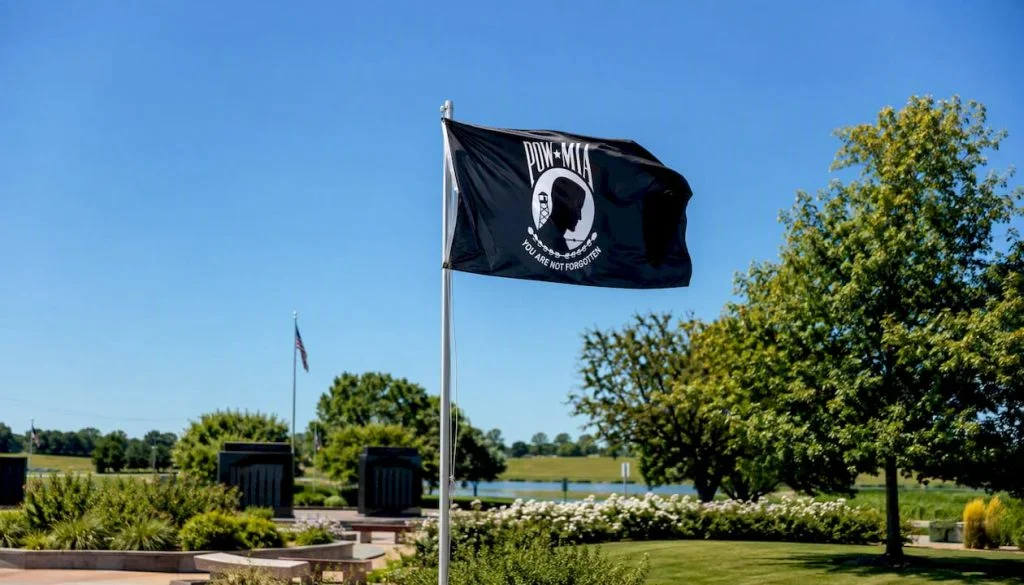
The POW/MIA flag is a national symbol that reminds Americans of service members held as prisoners of war or still missing in action, and it expresses the nation’s solemn commitment to account for every one of them. Recognized by Public Law 101-355 in 1990, it is the only flag other than the U.S. flag ever authorized to fly over the White House. Its presence at federal buildings, military installations, and veterans’ cemeteries is not ceremonial habit — it is a legal mandate.
Key anchors that give the flag its authority:
- The National League of Families originated the concept and first distributed the flag nationally.
- Newt Heisley designed the iconic silhouette and imagery.
- Public Law 101-355 (1990) granted it formal federal recognition.
- National POW/MIA Recognition Day, observed annually on the third Friday of September, is one of six congressionally mandated display occasions.
Key Takeaways
The POW/MIA flag is a federally recognized national symbol, legally mandated for display at major federal sites on six national observances, with its design and purpose rooted in a 1971 commitment to account for every missing American service member.
| Point | Details |
|---|---|
| Core definition | The flag symbolizes the nation’s commitment to account for Americans still prisoner, missing, or unaccounted for. |
| Origin and designer | Conceived by Mary (Mrs.) Michael Hoff and designed by Newt Heisley for the National League of Families in 1971. |
| Legal recognition | Public Law 101-355 (1990) granted federal designation; P.L. 105-85 (1998) expanded mandated display sites and days. |
| Six mandated display days | National POW/MIA Recognition Day, Armed Forces Day, Memorial Day, Flag Day, Independence Day, and Veterans Day. |
| Current accounting source | DPAA (dpaa.mil) maintains live case counts; the VA publishes historical and legal summaries. |
Table of Contents
- What is the POW/MIA flag’s origin and history?
- What do the flag’s design elements symbolize?
- How does U.S. law officially recognize the POW/MIA flag?
- How should you fly the POW/MIA flag correctly?
- Does the POW/MIA flag honor only Vietnam-era service members?
- Where can you find current counts of unaccounted-for service members?
- Why is the POW/MIA flag still flown when no verified recent POWs exist?
- Sources
- FAQ
What is the POW/MIA flag’s origin and history?
The flag’s story begins in 1971, when the National League of Families of American Prisoners and Missing in Southeast Asia commissioned a visual symbol to keep public attention on unresolved cases. Mary (Mrs.) Michael Hoff, a League member, is credited with the original concept. She brought the idea to graphic artist Newt Heisley, a World War II veteran who translated her vision into the stark black-and-white design the world now recognizes. According to the VA’s official POW/MIA summary, the League formally adopted the flag in 1972 and began distributing it to chapters and supporters across the country.
The milestones that followed reflect a steady, bipartisan effort to institutionalize the symbol:
- 1972 — National League of Families adopts the flag and begins national distribution.
- 1979 — The flag is flown over the White House for the first time on National POW/MIA Recognition Day.
- 1982 — Congress formally recognizes the League’s flag as the official POW/MIA symbol.
- 1990 — Public Law 101-355 designates the flag as a national symbol and specifies display requirements.
- 1998 — The Defense Authorization Act (P.L. 105-85) expands mandated display days and locations.
That figure, cited in VA historical records, explains why the flag’s adoption moved so quickly from a grassroots emblem to a federally recognized symbol. Families needed a visible, unified voice, and the flag gave them one.
What do the flag’s design elements symbolize?
Every element of the POW/MIA flag was chosen deliberately. The National League of Families’ protocol guidance and the National Park Service’s history of the flag both describe the imagery as a unified statement about captivity and moral obligation.
The core visual elements and their meanings:
- The black field — Represents the darkness of captivity and the grief of families left without answers.
- The gaunt silhouette — A bowed head in profile, conveying suffering and endurance. Oral tradition holds that Heisley modeled the figure on his own son’s profile, though primary photographic evidence for this is limited; the anecdote is widely repeated as origin lore.
- The guard tower — Signals the watchfulness of captors and the confined reality of imprisonment.
- The barbed wire — Reinforces the imagery of confinement and the physical barrier between prisoner and freedom.
- “POW/MIA” and “YOU ARE NOT FORGOTTEN” — The text frames the entire image as a promise: these individuals have not been abandoned by their country.
The white-on-black color scheme was chosen for maximum contrast and visibility, ensuring the symbol reads clearly at a distance on a flagpole or in a crowd.
Pro Tip: The NPS notes that historical variations in color and wording exist across different manufacturers and eras, but historians and custodians treat those differences as secondary. The symbol’s continued public visibility matters far more than minor design variants.
How does U.S. law officially recognize the POW/MIA flag?
The flag’s legal standing is specific and substantial. Public Law 101-355 defines it in statute as:
That language is precise: the law names Southeast Asia as the original scope, reflecting the flag’s Vietnam-era origins. The 1998 Defense Authorization Act (P.L. 105-85) then expanded the mandate, specifying which federal locations must display the flag and on which days.
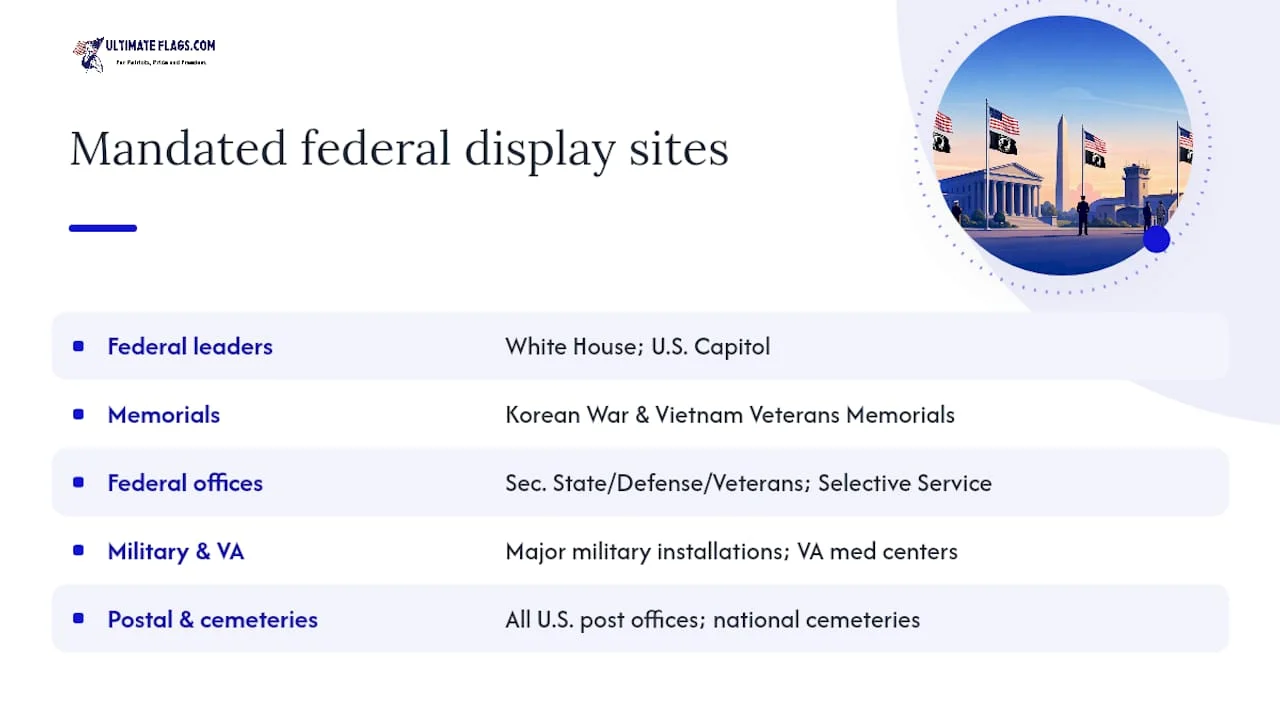
Federal sites required by law to display the flag include the White House, the U.S. Capitol, the Korean War Veterans Memorial, the Vietnam Veterans Memorial, the offices of the Secretaries of State, Defense, and Veterans Affairs, the Selective Service System, major military installations, all U.S. post offices, VA medical centers, and national cemeteries.
When displayed alongside the U.S. flag on the same pole, the POW/MIA flag flies directly below it and must be no larger than the U.S. flag. On separate poles, the U.S. flag is positioned to the right (the observer’s left), holding the position of honor.
How should you fly the POW/MIA flag correctly?
Proper display honors the flag’s meaning and respects the order of precedence established by federal law and DoD guidance. The rules are straightforward.
On the same pole:
- The U.S. flag flies at the top, in the position of highest honor.
- The POW/MIA flag flies directly below it.
- The POW/MIA flag must not exceed the size of the U.S. flag.
On separate poles:
- The U.S. flag is placed to the right (the observer’s left), the traditional position of honor.
- The POW/MIA flag is placed to the left of the U.S. flag from the observer’s perspective.
The six national observances on which Congress mandates display at designated federal sites are:
- National POW/MIA Recognition Day (third Friday of September)
- Armed Forces Day (third Saturday of May)
- Memorial Day (last Monday of May)
- Flag Day (June 14)
- Independence Day (July 4)
- Veterans Day (November 11)
For private citizens and organizations, display on any or all of these days is a fitting act of remembrance. VA medical centers and national cemeteries are directed to fly the flag year-round, not only on the six mandated days. Handle the flag with the same care and reverence due the U.S. flag: never let it touch the ground, and retire it with dignity when it becomes worn.
Does the POW/MIA flag honor only Vietnam-era service members?
The flag was born from Vietnam-era urgency, but its meaning has grown well beyond that conflict. The National League of Families originally focused on American POWs and MIAs in Southeast Asia, which is why Public Law 101-355 references that region specifically. Over time, however, federal practice and public use have extended the flag’s symbolic reach to honor POW/MIA personnel from all U.S. conflicts, including World War II, Korea, and later engagements.
The Defense POW/MIA Accounting Agency (DPAA), established under the Department of Defense, now handles accounting efforts across all conflicts, from World War I through the present. Its mandate reflects the same expansive understanding: no era of service is excluded from the nation’s obligation to account for its missing.
Where can you find current counts of unaccounted-for service members?
The authoritative source for current figures is the Defense POW/MIA Accounting Agency (DPAA), which maintains regularly updated counts and case-status information. The Department of Veterans Affairs (VA) also publishes POW/MIA resources and historical summaries. The Department of Defense provides broader policy and recognition context through its official communications.
Key points about how counts are tracked and why they change:
- DPAA classifies cases into categories such as “further pursuit,” “no further pursuit,” and “deferred,” based on the likelihood and feasibility of recovery.
- Numbers shift as remains are identified through forensic analysis, archival research, and diplomatic cooperation with foreign governments.
- Identifications are announced publicly by DPAA, and each one represents a family finally receiving an answer.
For the most current figures, visit dpaa.mil directly. The VA’s published resources, including the VA’s POW/MIA summary, provide historical context and legal background, while DPAA holds the live accounting data.
Why is the POW/MIA flag still flown when no verified recent POWs exist?
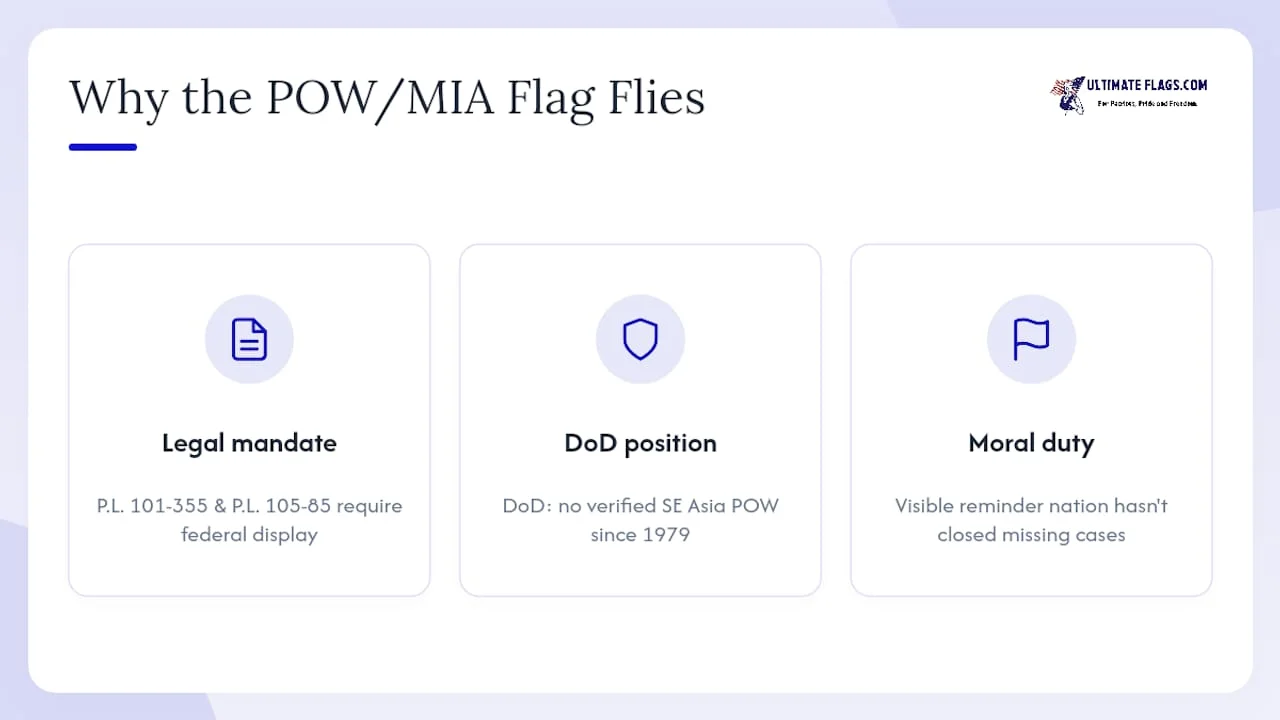
This is one of the most common and sincere questions people ask about the flag. The answer rests on three distinct foundations: legal mandate, institutional practice, and enduring moral obligation.
First, the legal mandate is clear. Public Law 101-355 and P.L. 105-85 require display at specific federal sites on specific days regardless of the current status of any individual case. Congress has not repealed or weakened those requirements.
Second, the DoD’s own position, reflected in defense.gov guidance, acknowledges that there has not been a verified living American POW in Southeast Asia since 1979. Yet thousands of cases from Vietnam, Korea, and World War II remain unresolved in the sense that remains have not been identified or recovered. The flag speaks to those unresolved cases, not only to the question of living captives.
Third, the flag carries a ceremonial and communal function that transcends any single case. It is a visible reminder that the nation has not closed the books on its missing.
Pro Tip: DPAA’s website provides a running count of identifications made each fiscal year. Checking it before a memorial observance gives you a concrete, current sense of the accounting work still underway.
What the flag means to communities and families
The POW/MIA flag carries a weight that statistics and statutes alone cannot fully convey. For families who never received a final answer about a father, brother, or son, the flag is not an abstraction — it is a public acknowledgment that their grief is legitimate and their wait is recognized. Seeing it fly at a post office or a veterans’ cemetery is a reminder that the country has not moved on simply because the conflict ended. That kind of institutional memory, written into law and displayed in stone and fabric, is rare. It deserves the reverence it receives.
Sources
For readers who want to verify the primary documents or find current accounting data, these official sources are the most reliable:
The DPAA site is the only one in this list that provides live, updated counts. All others are historical or legal documents.
For those who want to display the POW/MIA flag with the same care and knowledge it deserves, Ultimate Flags carries a full selection of flags that honor American history and military service. Every flag is a story worth telling.

FAQ
Is it okay to fly the POW/MIA flag?
Flying the POW/MIA flag is not only acceptable — it is encouraged. Congress has mandated its display at federal sites on six national observances, and private citizens may fly it at any time as an act of remembrance and respect.
Why do we still fly the POW/MIA flag?
The flag remains in use because of active legal mandates under Public Law 101-355 and P.L. 105-85, thousands of unresolved cases across multiple conflicts, and the flag’s ceremonial role as a public promise that missing service members have not been forgotten.
Is the POW/MIA flag only for Vietnam-era service members?
No. Although the flag originated from Vietnam-era advocacy by the National League of Families, its use has expanded to honor POW/MIA personnel from all U.S. conflicts, and the Defense POW/MIA Accounting Agency handles accounting across every era of American military service.
How many U.S. service members are still unaccounted for?
The Defense POW/MIA Accounting Agency (DPAA) maintains the current, regularly updated count at dpaa.mil. Numbers change as remains are identified through forensic analysis and diplomatic cooperation, so DPAA’s site is the only reliable source for a current figure.