The Bennington Flag is a Spirit of ’76 variant that displays 13 seven-pointed stars, 13 stripes, and a bold ‘76’ in the canton to honor the Declaration of Independence and the 13 original colonies. Its symbolism is well-established and deeply patriotic. Its Revolutionary-era provenance, however, is another matter: conservation records at the Bennington Museum and textile analysis point to early 19th-century manufacture, making battlefield use in 1777 unlikely.
Two things every reader should carry away: The Bennington Flag’s design is a deliberate, layered tribute to 1776 and the founding colonies. Its physical age, as assessed by museum conservators and the Smithsonian repository, places it after the Revolution, not within it.
Key Takeaways
The Bennington Flag’s enduring power rests on its symbolism, not its battlefield legend: the ‘76,’ 13 stars, and 13 stripes together form one of the most direct visual tributes to the Declaration of Independence in American flag history.
| Point | Details |
|---|---|
| Core symbolism | The ‘76,’ 13 stars, and 13 stripes honor 1776 and the 13 original colonies. |
| Likely manufacture date | Textile and dye analysis point to early 19th-century production, not 1777. |
| Museum evidence | Bennington Museum conservation records cite cotton construction inconsistent with pre-1800 manufacture. |
| Buying guidance | Request provenance documentation and a conservation report; cross-reference Smithsonian catalog images. |
| Ultimate Flags | Carries historically styled Bennington reproductions in outdoor polyester and cotton-blend for display or commemoration. |
Table of Contents
- What does the Bennington Flag look like?
- What each symbol on the Bennington Flag represents
- The Battle of Bennington and competing origin stories
- What museum and textile analysis actually reveal
- How the Bennington Flag is used today
- How to tell an authentic flag from a reproduction
- Why the Bennington Flag matters beyond its age
- Fly the Spirit of ’76 with a flag worth the honor
- Sources
- FAQ
What does the Bennington Flag look like?
The Bennington Flag’s visual identity is immediately distinctive, setting it apart from every other American Revolution flag you are likely to encounter.
| Feature | Bennington Flag | Modern U.S. Flag |
|---|---|---|
| Star count | 13 seven-pointed stars | 7 seven-pointed stars |
| Stripe count | 13 (alternating red and white) | 13 |
| Outermost stripes | White | Red |
| Canton content | Large ‘76’ plus arch of stars | 7-star field only |
| Canton height | Taller than on modern U.S. flags, spanning more stripes than usual | Spans all 13 stripes |
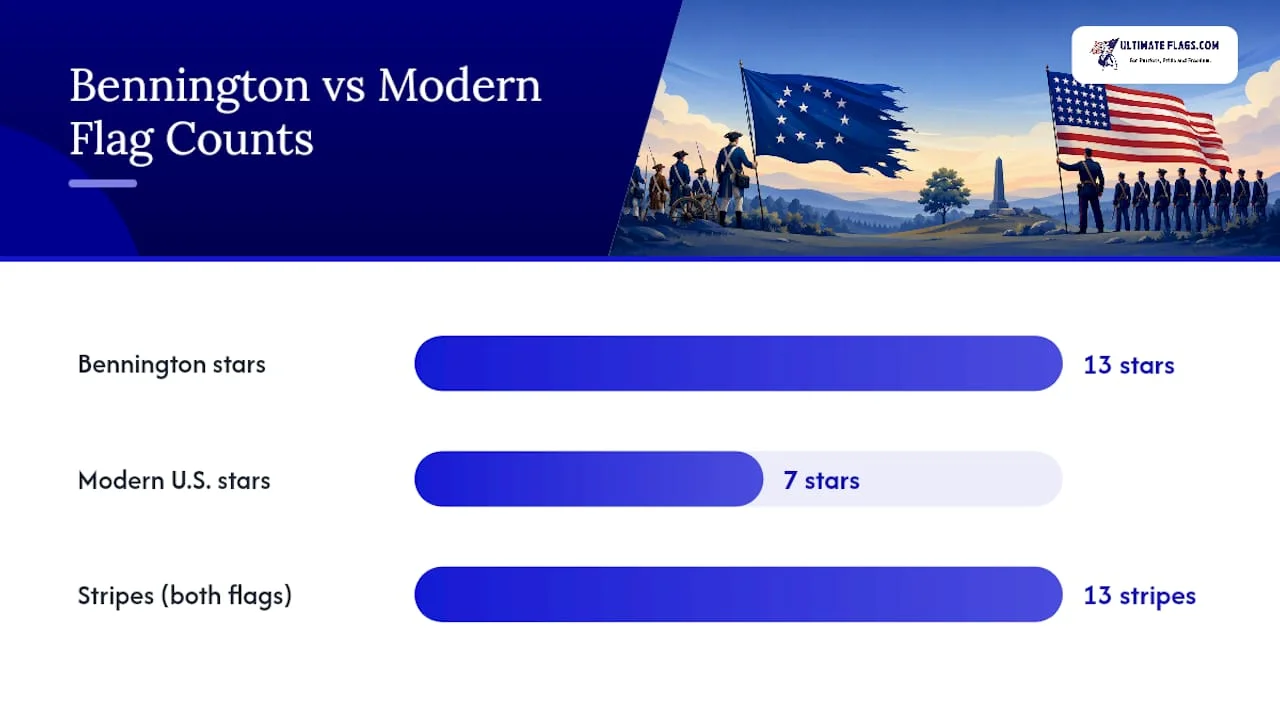
The stars are arranged in an arch across the top of the canton, with one star placed in each upper corner. The large ‘76’ sits prominently below that arch, occupying space that on any modern flag would hold only stars. White stripes appear on the outer edges rather than red, a reversal of the modern convention. The canton itself is taller in proportion to the fly than its contemporary counterparts, giving the flag a noticeably different silhouette.
What each symbol on the Bennington Flag represents
The Bennington flag’s symbolism is layered and deliberate, each element chosen to anchor the design in the memory of the founding era.
- The ‘76’ explicitly recalls 1776, the year the Continental Congress signed the Declaration of Independence. No other American flag places this numeral so prominently in the canton, which is why the Bennington design reads as an unambiguous tribute to the birth of the nation.
- The 13 stars represent the original 13 colonies that declared independence. The arch arrangement echoes the “new constellation” language of the Flag Act of 1777, which authorized stars on a blue field and allowed local variants to take shape.
- The 13 stripes carry the same colonial meaning found across Revolutionary-era flags, from the Betsy Ross design to the Continental Union Flag, which itself used 13 stripes before stars replaced the British Union in the canton.
- Seven-pointed stars and white outer stripes read as heraldic choices that distinguish this flag from later standardized designs, reinforcing its identity as a commemorative object rather than an official military standard.
The phrase “Spirit of ’76” captures the flag’s cultural role precisely. It does not merely record history; it celebrates a feeling, the solemn pride of a people who chose independence. Historical display events, including centennial celebrations and early flag raisings, helped cement ‘76’ as a patriotic motif that later generations returned to again and again.
Pro Tip: When displaying the Bennington Flag at a commemoration or historical reenactment, take a moment to explain the ‘76’ to your audience. Most observers recognize the stars and stripes but miss the canton numeral entirely, and that single detail transforms the flag from a decorative piece into a conversation about the Declaration of Independence.
The Battle of Bennington and competing origin stories
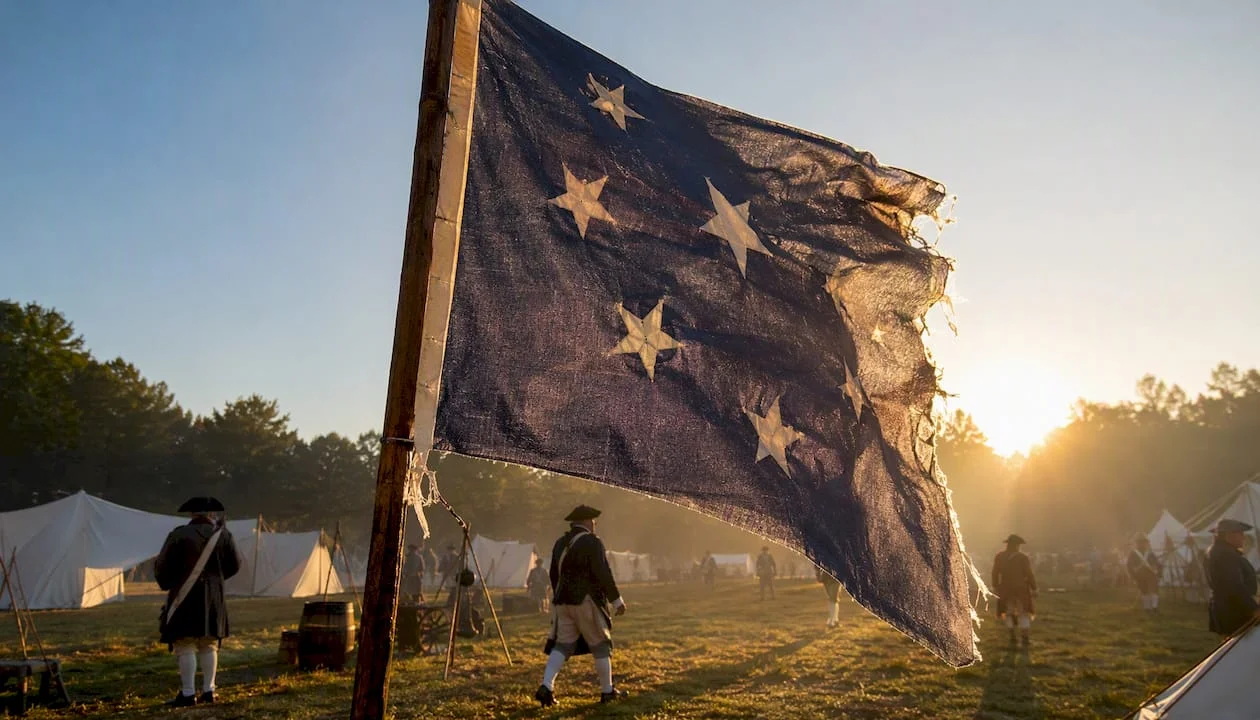
The traditional narrative places the Bennington Flag at the 1777 Battle of Bennington, carried by General John Stark’s New Hampshire militia as they routed a Hessian force near present-day Walloomsac, New York. It is a stirring story, and it gave the flag its name. The documented record, however, tells a more complicated tale.
- August 16, 1777 — The Battle of Bennington is fought. Tradition holds that a flag matching this description flew with Stark’s troops, though no contemporary written account confirms it.
- Late 18th to early 19th century — Textile evidence and construction details suggest the flag was most likely produced during this period, possibly as a commemorative emblem rather than a battlefield standard. Some historians place manufacture as late as the War of 1812 era.
- Fillmore family custody — The flag passed through the Fillmore family, with Nathaniel Fillmore and his descendants maintaining it as a family heirloom with a claimed Revolutionary connection. The family provenance narrative became the primary source for the battlefield story.
- 1876 — The flag appeared publicly during centennial celebrations, gaining wider recognition as a symbol of Revolutionary memory at a moment when the nation was actively honoring its founding generation.
- 1887 — The flag was carried in a Grand Army of the Republic parade, where a souvenir hunter removed one star and part of a stripe, damaging the artifact and complicating later physical assessments.
- Early 20th century onward — The Bennington Museum acquired the flag, and subsequent conservation work began to challenge the 1777 origin story on physical grounds.
The Betsy Ross Flag followed a similar arc of legend preceding documentation, as explored in Betsy Ross Flag history. Flags and their origin stories have always been inseparable.
What museum and textile analysis actually reveal
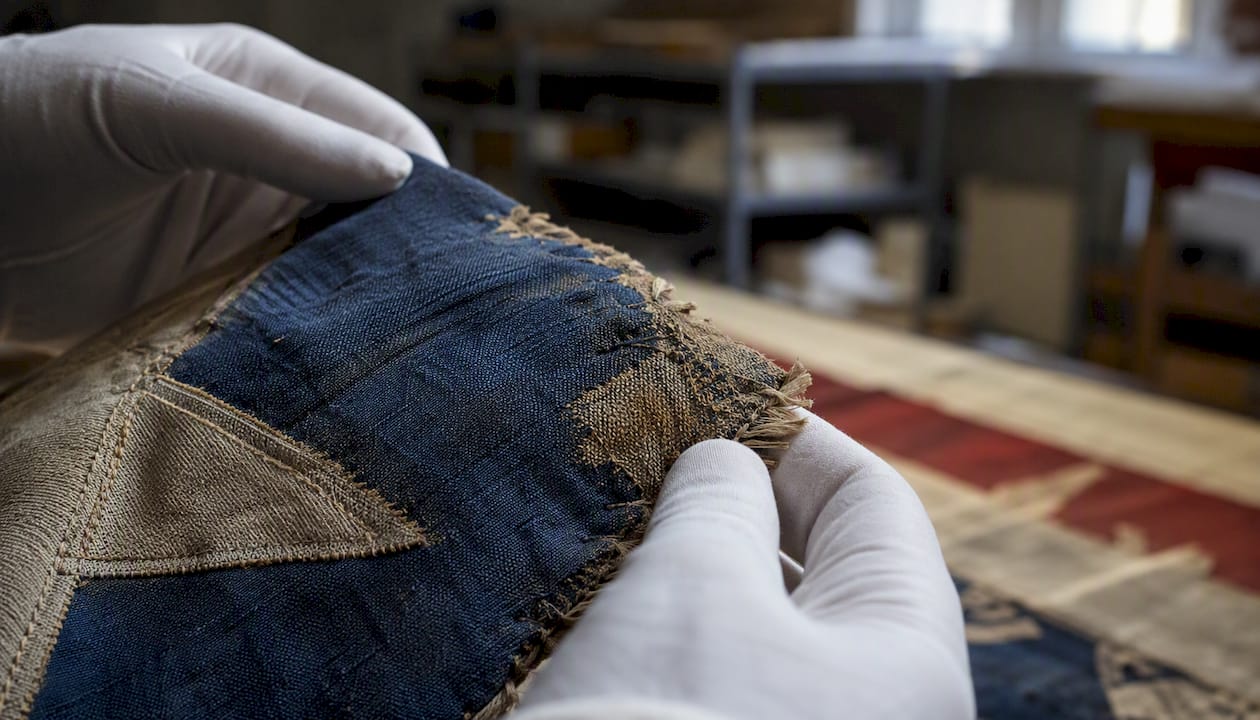
The Bennington Museum’s conservation records are the most authoritative physical evidence available, and their findings are clear: the flag’s cotton thread, stitchwork, and dye evidence are consistent with early 19th-century manufacture, making battlefield use in 1777 unlikely.
The technical details matter here. Cotton single- and double-ply yarns of the type found in the flag were uncommon before 1800, when American cotton milling became more widespread. The dyes identified during conservation, remnants of madder and indigo, are consistent with 19th-century dyeing techniques. Conservation work required encapsulation and strict low-light controls to prevent further fading, which itself speaks to the age and fragility of the textile.
- Cotton fabric construction inconsistent with pre-1800 manufacture
- Madder and indigo dye remnants typical of early 19th-century dyeing
- Stitchwork patterns align with post-Revolutionary textile production
- Physical damage from the 1887 parade complicates complete fiber analysis
- Museum encapsulation and light controls confirm advanced age and fragility
Independent flag historians summarize the Fillmore family provenance narrative and note that many scholars now believe the flag was created later than the Revolutionary War, perhaps as a commemorative emblem. The Smithsonian repository holds related catalog entries and archival images that researchers use for side-by-side provenance comparison.
The honest conclusion: the Bennington Flag is almost certainly a product of early 19th-century American patriotism, not a relic carried through musket smoke in 1777. That does not diminish its significance. It may actually deepen it, because the flag represents how a young nation chose to remember its founding.
How the Bennington Flag is used today
Collectors and reenactors favor the Bennington Flag not because it is a confirmed battlefield standard but because its distinct ‘76’ iconography powerfully evokes Revolutionary memory. That cultural weight has made it one of the most recognized historical American flags in active use today.
The Bennington Flag endures not as a relic of a single battle but as a living emblem of the Spirit of ’76, carried forward by every generation that has chosen to honor the founding of the United States.
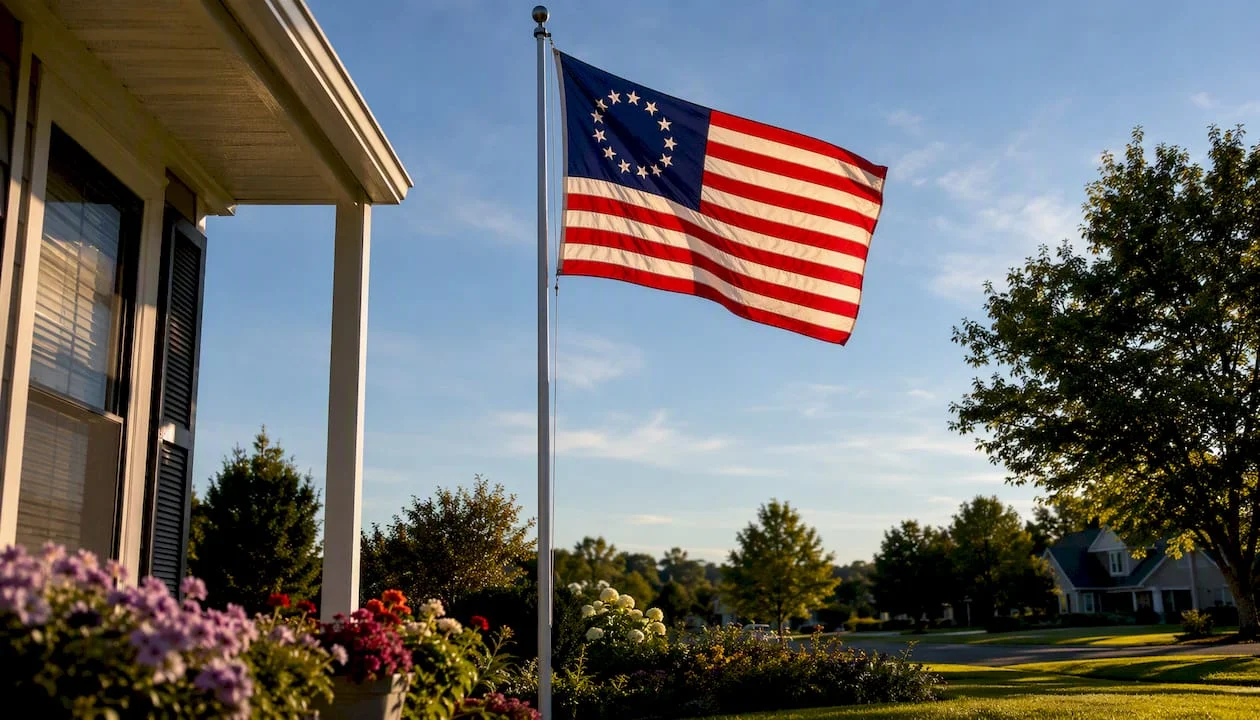
Common contexts include Fourth of July displays, museum exhibitions, historical reenactments of the Revolutionary War, and patriotic home décor. Reproductions vary considerably: some use simplified five-pointed stars, others adjust the canton proportions or render the ‘76’ in different typefaces. Outdoor-rated polyester versions are widely available for flagpole display, while cotton reproductions more closely approximate the original’s texture and weight for indoor or ceremonial use.
When flying a Bennington-style flag outdoors, standard American flag etiquette applies: display it from sunrise to sunset unless illuminated, and retire it when weather deteriorates. As a flag with historical significance, it deserves the same respectful handling you would give any national emblem.
How to tell an authentic flag from a reproduction
Verifying whether a Bennington Flag is a genuine antique or a modern reproduction requires methodical inspection. Absolute dating demands laboratory analysis, but documentation and physical checks can take you far.
- Examine the fiber. Authentic pre-1850 flags used hand-spun or early machine-spun cotton or wool. Request high-resolution photos of the weave and thread under magnification. Machine-uniform thread is a strong indicator of modern manufacture.
- Inspect the stitchwork. Hand-sewn seams show irregular stitch spacing. Machine stitching is perfectly uniform. The Bennington Museum’s conservation records note specific stitchwork patterns consistent with early 19th-century construction.
- Check dye condition. Genuine aged dyes fade unevenly, with madder reds shifting toward brown and indigo blues toward gray. Bright, uniform color in a claimed antique is a red flag.
- Request provenance documentation. Ask for family records, estate inventories, or museum catalog references. The Fillmore family chain of custody is the documented model; any antique claim without comparable documentation warrants skepticism.
- Cross-reference museum catalogs. The Smithsonian repository and Bennington Museum’s online catalog provide publicly accessible images and metadata for comparison.
- Ask for a conservation report. Reputable sellers of genuine antiques can provide conservation assessments. Absence of any such report does not disqualify a piece, but its presence adds significant credibility.
- Uniform machine stitching on a claimed pre-1850 flag is a near-certain sign of modern production.
- Bright, unfaded color in a claimed antique suggests synthetic dyes, which were not available before the mid-19th century.
- A seller who cannot name a provenance chain beyond “old family piece” is offering a story, not documentation.
For practical display guidance on caring for historical-style flags once you have acquired one, the flag care and display guide at Ultimate Flags covers outdoor and indoor handling in detail.
Why the Bennington Flag matters beyond its age
The provenance debate around the Bennington Flag is genuinely fascinating, but there is a risk of letting it overshadow what the flag actually does. Whether it was sewn in 1777 or 1815, it carries the same symbolic weight: 13 stars for 13 colonies, 13 stripes for the same, and a bold ‘76’ that refuses to let anyone forget what year the United States chose to exist.
Flags are, at their core, acts of memory. The silent sentinels of history that survive in museum cases and private collections do not merely record the past; they shape how subsequent generations understand it. The Bennington Flag shaped how 19th-century Americans remembered the Revolution, and it continues to shape how we remember it now. That is a form of power that transcends any laboratory dating result.
Responsible display means acknowledging both dimensions: the rich symbolism and the honest provenance. When promoting a flag as an antique, cite the museum record. When displaying a reproduction, say so plainly. The Spirit of ’76 does not need embellishment to be moving.
Fly the Spirit of ’76 with a flag worth the honor
Ultimate Flags carries historically styled American Revolution flags built for both display and commemoration, including Bennington-style reproductions suited to flagpole mounting or indoor exhibition.

Reproductions in the collection are available in outdoor-rated polyester for all-weather flagpole use and in heavier cotton-blend constructions for ceremonial or interior display. Both options feature the correct canton proportions, seven-pointed stars, and the distinctive ‘76’ that defines the design. Every flag ships ready to display, with brass grommets and reinforced fly ends for lasting use.
If you want a Bennington-style flag that honors the design’s historical integrity, browse the Revolutionary War flag collection at Ultimate Flags and choose the construction that fits your display setting.
Sources
FAQ
What does the Bennington Flag mean?
The Bennington Flag symbolizes the Spirit of ’76, using 13 stars and 13 stripes to represent the original colonies and a prominent ‘76’ in the canton to commemorate the Declaration of Independence in 1776.
Why do people fly the Bennington Flag today?
Collectors and patriots fly it because its ‘76’ iconography powerfully evokes Revolutionary memory, making it a popular choice for Fourth of July displays, historical reenactments, and patriotic home décor.
What do the stars on the Bennington Flag mean?
The 13 seven-pointed stars represent the original 13 colonies that declared independence from Britain, arranged in an arch across the canton in a style consistent with Revolutionary-era flag conventions.
Did the Bennington Flag actually fly at the 1777 battle?
Probably not. Bennington Museum conservation records and textile analysis indicate the flag’s cotton construction and dye evidence are consistent with early 19th-century manufacture, making 1777 battlefield use unlikely.
What is the rarest feature of the Bennington Flag’s design?
The large ‘76’ placed directly in the canton is unique among surviving American historical flags, making the Bennington design immediately identifiable and unlike any other flag from the Revolutionary era.
Recommended
- Betsy Ross Flag: Unveiling Its Revolutionary History – Ultimate Flags
- Wars and Battles of the Betsy Ross Flag in American History – Ultimate Flags
- Declaration of Independence: The Betsy Ross Flag in Revolutionary War Battles – Ultimate Flags
- Manassas: Birth of the Battle Flag, Part I – Ultimate Flags