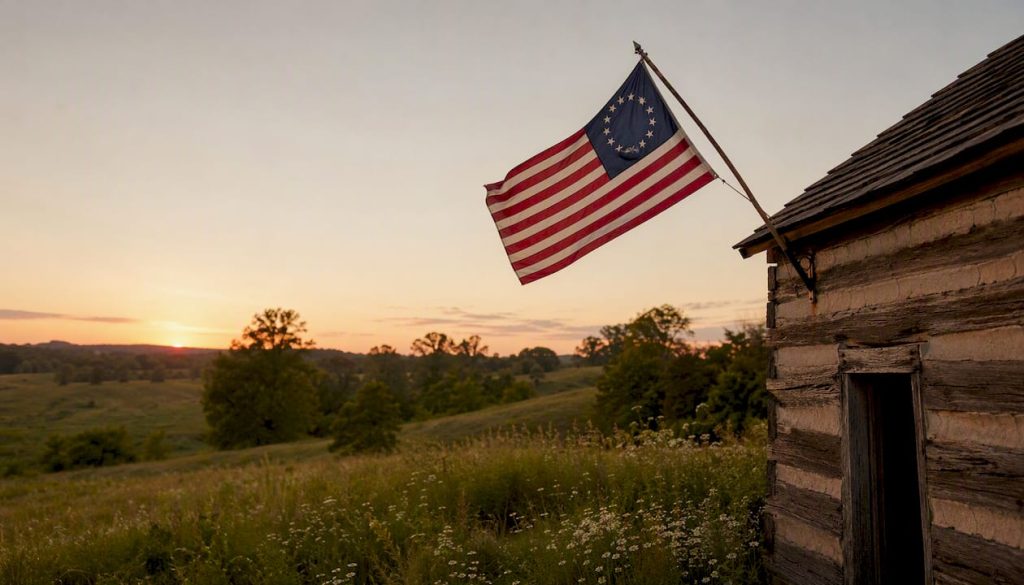
The Betsy Ross flag is an early American flag design featuring alternating red and white stripes and a blue canton bearing white five-pointed stars arranged in a circle, named after a Philadelphia upholsterer whose role in creating it remains historically unverified. Most historians treat the story of Betsy Ross sewing the first American flag as a later legend rather than a documented fact, and the Flag Resolution of June 14, 1777 never mandated the circular star arrangement that defines the design today.
The Betsy Ross flag meaning, at its core, is one of Revolutionary-era unity: 13 colonies declaring themselves a nation. The design’s symbolism, from the circle of stars to the red, white, and blue palette, carries layers of meaning accumulated over nearly 250 years. Some of those meanings are grounded in primary sources. Others are retrospective attributions that grew alongside the legend itself.
On the question of controversy, the picture is nuanced. The Anti-Defamation League does not list the Betsy Ross flag as a hate symbol, and ADL researcher Mark Pitcavage has noted that extremist use of the design has been occasional rather than widespread. The flag remains, for most Americans, a patriotic historical emblem. Still, high-profile incidents, including Nike’s 2019 withdrawal of a shoe bearing the circular-star design, have made context a legitimate consideration for anyone displaying it publicly.
Key Takeaways
The Betsy Ross flag is a genuine Revolutionary-era design whose symbolic meaning is well-documented, even though the legend of Betsy Ross sewing it is not.
| Point | Details |
|---|---|
| Legend vs. documented fact | The Betsy Ross design story originates with an 1870 family account; no contemporary document verifies it. |
| What the 1777 resolution established | The Flag Act mandated 13 stripes and 13 stars but left arrangement and star shape unspecified. |
| Color symbolism source | Red, white, and blue meanings come from the 1782 Great Seal, not the 1777 Flag Resolution. |
| Modern controversy | The ADL does not list the flag as a hate symbol; extremist use has been occasional, not systematic. |
| Display guidance | Context determines meaning: historical and educational display is appropriate; pairing with extremist imagery changes the signal. |
Table of Contents
- What the Betsy Ross flag meaning is rooted in: origins and legend
- The Flag Act of 1777 and what it actually established
- What each design element symbolizes
- How the flag is used culturally and politically today
- Is it okay to fly a Betsy Ross flag? Display and etiquette
- A timeline of key dates and milestones
- Common myths about Betsy Ross and the flag
- What historians and experts actually say
- A flag worth understanding on its own terms
- Sources
- FAQ
What the Betsy Ross flag meaning is rooted in: origins and legend
The story most Americans know begins with a widow in Philadelphia, a visit from George Washington, and a clever fold of paper to demonstrate a five-pointed star. It is a compelling narrative. It is also almost certainly a later invention.
The account entered public circulation in 1870, when William J. Canby, Betsy Ross’s grandson, presented a paper to the Historical Society of Pennsylvania claiming his grandmother had sewn the first American flag at Washington’s request in 1776. National Geographic and most historians now view that account as unverified and likely apocryphal. The core problem is chronological: Canby’s story surfaced nearly a century after the events it describes, with no contemporary documentation to support it.
What is documented is more modest but still significant. Betsy Ross was a working upholsterer in Philadelphia who made flags, tents, and uniforms for local Continental forces. Her family papers confirm she was a flag maker. They do not include any contemporary proof that she conceived or stitched the circular-star arrangement specifically. The distinction matters: being a flag maker in Revolutionary Philadelphia is a real and honorable historical role. Being the sole designer of the first American flag is a different claim entirely, and one the primary record does not support.
Why did the legend take hold so firmly? Timing offers the clearest answer. The Canby account appeared in 1870, just five years after the Civil War’s end, when the country was actively searching for unifying national symbols. A story placing a humble Philadelphia seamstress at the birth of the American flag served that need very powerfully. Post-war America needed heroes who belonged to everyone, and the Betsy Ross narrative delivered one at precisely the right moment.
For readers who want to explore the flag’s Revolutionary War context in greater depth, the historical record of its battlefield appearances offers a richer picture than the Canby account alone.
The Flag Act of 1777 and what it actually established
The legal foundation for the American flag rests on a single resolution passed by the Continental Congress on June 14, 1777. What that resolution said, and what it deliberately left unsaid, shapes everything that follows.
That is the complete specification. No mention of star arrangement. No mention of how many points each star should have. No mention of the circular pattern that would later define the Betsy Ross design. The resolution established the 13/13 motif as the legal standard and left every other design decision to the makers.
Flag Act of 1777: what it specified and what it left open
| Element | Specified by the 1777 Resolution | Left Unspecified |
|---|---|---|
| Number of stripes | Yes — 13 | No further detail |
| Stripe colors | Yes — alternating red and white | No sequence specified |
| Number of stars | Yes — 13 | No arrangement required |
| Star color | Yes — white | No further detail |
| Field color | Yes — blue | No shade specified |
| Star shape | No | Five-pointed or six-pointed both used |
| Star arrangement | No | Circular, rows, or other patterns all valid |

Because the resolution left arrangement open, early American flags varied considerably. Some used six-pointed stars. Some arranged stars in rows. The circular pattern associated with the Betsy Ross design was one popular artistic choice among several, not a legal mandate. Paintings from the period, including John Trumbull’s historical works, show flags with varying star configurations, confirming that no single arrangement dominated in the early years.
Five-pointed stars eventually became the standard partly for practical reasons: they read more clearly at a distance and in maritime conditions than six-pointed stars, which could blur into a hexagonal shape when viewed from a ship’s deck.
What each design element symbolizes
The Betsy Ross flag’s symbolism operates on two levels: what the elements meant to those who created them, and what later generations have read into them. Both layers are worth understanding, because conflating them produces the kind of confident-sounding historical claims that turn out to be retrospective inventions.
Design elements and their symbolic interpretations
| Element | Documented or Primary-Source Meaning | Later or Retrospective Attribution |
|---|---|---|
| 13 stripes | Represent the 13 original colonies | Sometimes read as “13 founding principles” — no primary source supports this |
| 13 stars | “A new constellation” (1777 resolution’s own phrase) | Individual stars sometimes said to represent specific colonies |
| Circular arrangement | Unity and equality among the states (no colony ranked above another) | Attributed to artistic convention; no primary document mandates the circle |
| Five-pointed stars | Practical clarity at distance; common in heraldry | Later associated with military rank insignia |
| Red | Valor and hardiness (1782 Great Seal description) | Not defined in the 1777 Flag Resolution |
| White | Purity and innocence (1782 Great Seal description) | Not defined in the 1777 Flag Resolution |
| Blue | Vigilance, perseverance, and justice (1782 Great Seal description) | Not defined in the 1777 Flag Resolution |
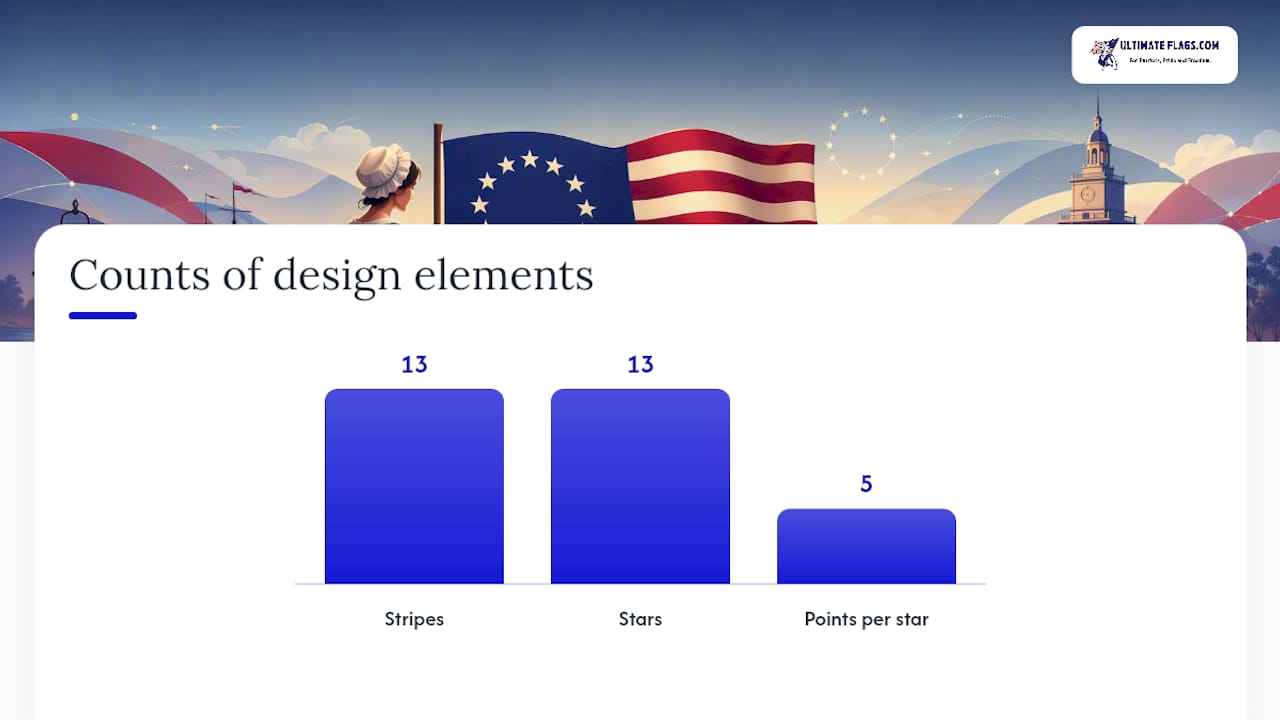
The color meanings deserve a specific note. The 1782 Great Seal assigned symbolic values to red, white, and blue, and those attributions have been applied to the flag ever since. The 1777 Flag Resolution, however, attached no meaning to the colors at all. The symbolism is real in the sense that it is widely recognized and historically grounded, but it came five years after the flag’s legal establishment and was written for a different object.
The circle of stars carries perhaps the most resonant symbolic claim: that the 13 colonies stood as equals, with no single state occupying a position of precedence. This interpretation appears in period commentary and artistic sources, and it aligns with the political philosophy the founders were articulating. Whether the circle was chosen deliberately for that reason or simply because it was an aesthetically pleasing arrangement is a question the historical record cannot definitively answer.
- 13 stripes: The most direct symbol in the design, representing the 13 colonies that declared independence. Alternating red and white creates visual rhythm and distinction.
- 13 stars: The 1777 resolution’s own language, “a new constellation,” frames the stars as a collective rather than individual markers, suggesting national unity over state identity.
- Five-pointed stars: Practical and heraldic in origin; the five-pointed form was common in European heraldry and easier to cut and sew than six-pointed versions.
- Circular arrangement: Interpreted as a symbol of equality among the states, with no beginning and no end to the ring. This reading appears in period sources and remains the most widely cited explanation.
- Red, white, and blue: Meanings drawn from the 1782 Great Seal: valor, purity, and vigilance respectively. These are the standard attributions, though they postdate the flag’s creation.
How the flag is used culturally and politically today
For most of its history, the Betsy Ross flag was an uncontroversial emblem of the nation’s founding. That changed, gradually and then suddenly, as the design became associated with specific political movements and high-profile controversies.
The most widely reported incident came in July 2019, when Nike withdrew its Air Max 1 USA shoe, which featured the circular-star design on the heel, after concerns that the imagery could be seen as celebrating an era when slavery was legal in the United States. The decision sparked a national debate that cut across political lines. Some argued that removing the design amounted to erasing legitimate American history. Others contended that the flag’s association with the founding era, which included the institution of slavery, made it a painful symbol for many Americans regardless of intent.
A 2016 incident at a Michigan high school, where students displayed the Betsy Ross flag at a football game in a context that others found racially charged, illustrated how the same object can carry different meanings depending on who is displaying it and why.
The ADL’s position on all of this is measured and worth quoting precisely. According to PBS NewsHour’s reporting on the Nike episode, Mark Pitcavage and ADL researchers concluded that extremist groups have used the Betsy Ross design occasionally, but that the flag is not an established hate symbol and is most commonly displayed as a patriotic historical emblem. The ADL has not added it to its hate-symbol database.
That distinction matters in practice. A flag that appears occasionally in extremist contexts is not the same as a flag that has been adopted as a primary symbol by those movements. The Confederate battle flag, for example, has a documented and sustained history of appropriation by white nationalist groups. The Betsy Ross flag does not carry that same weight of documented extremist use, though the occasional association is real and should not be dismissed.
For readers interested in how modern flag controversies develop around historic designs, the pattern here is instructive: a symbol’s meaning shifts when its context shifts, and intent alone does not fully control interpretation.
Is it okay to fly a Betsy Ross flag? Display and etiquette
The short answer is yes, in most contexts, displaying the Betsy Ross flag is a legitimate expression of patriotism and historical interest. The longer answer depends on where, how, and alongside what other symbols it appears.
- Know your setting. A Betsy Ross flag displayed at a historical reenactment, a museum, or a Fourth of July celebration carries clear educational and patriotic context. The same flag at a political rally where other imagery has been associated with extremist movements may be read differently by observers, regardless of the displayer’s intent.
- Consider what accompanies it. A Betsy Ross flag flown alongside the current 50-star flag signals historical continuity and respect for the nation’s founding. Paired with symbols that have documented extremist associations, the context shifts in ways that can be difficult to control.
- Label it when education is the goal. In classrooms, museums, or public exhibitions, a brief descriptive label noting the flag’s historical period and the legend surrounding its creation helps viewers engage with it accurately rather than projecting contemporary political meaning onto it.
- Apply standard flag etiquette. The same principles that govern display of any American flag apply here: fly it in good condition, illuminate it if displayed at night, and retire it respectfully when it is worn. Practical guidance for flag owners covers these basics in detail.
- For institutions and event organizers: A clear written policy stating that the flag is displayed for historical and educational purposes, not as a political statement, provides useful context and reduces the risk of misinterpretation.
Pro Tip: If you are displaying the Betsy Ross flag at a public event, a small placard noting “13 colonies, 1777” gives viewers immediate historical grounding and signals that the display is educational rather than political.
A timeline of key dates and milestones
| Year | Event |
|---|---|
| — | Betsy Ross born in Philadelphia, Pennsylvania |
| 1777 | Continental Congress passes the Flag Resolution on June 14, establishing 13 stripes and 13 stars |
| — | Betsy Ross dies in Philadelphia |
| 1870 | William J. Canby presents his account of Betsy Ross and the flag to the Historical Society of Pennsylvania |
| — | The Betsy Ross House in Philadelphia opens as a museum; the legend gains wide popular circulation |
| — | The Betsy Ross stamp issued by the U.S. Postal Service reinforces the legend in national culture |
| 2016 | A Michigan high school incident involving the Betsy Ross flag at a football game draws national attention |
| 2019 | Nike withdraws the Air Max 1 USA shoe featuring the circular-star design following public controversy |
Common myths about Betsy Ross and the flag
Several persistent misconceptions surround the Betsy Ross flag. Each one is worth correcting precisely, because the myth and the documented fact often sit very close together.
- Myth: Betsy Ross definitely designed the first American flag. Correction: No contemporary document supports this claim. The story originates with her grandson’s 1870 account, nearly a century after the events described. Historians treat it as unverified folklore.
- Myth: The Flag Act of 1777 mandated the circular star arrangement. Correction: The 1777 resolution specified 13 stars in a blue field but said nothing about arrangement. Multiple configurations were used by early flag makers.
- Myth: The red, white, and blue colors were given symbolic meanings in 1777. Correction: The 1777 resolution attached no meaning to the colors. The familiar attributions (valor, purity, vigilance) come from the 1782 Great Seal description, applied to the flag retroactively.
- Myth: The Betsy Ross flag is a recognized hate symbol. Correction: The ADL does not list it as such. Extremist use has been occasional and documented, but the flag is not an established primary symbol of any hate movement.
- Myth: George Washington personally commissioned Betsy Ross to sew the flag. Correction: This detail comes entirely from the Canby family account. No contemporary record places Washington in Ross’s shop for this purpose.
- Myth: Five-pointed stars were chosen for symbolic reasons. Correction: Five-pointed stars were preferred primarily for practical reasons: they were easier to cut and sew, and they read more clearly at a distance than six-pointed stars.
What historians and experts actually say
Scholarly consensus on the Betsy Ross flag has been consistent for decades: the legend is likely apocryphal, the flag’s design is historically significant, and the two facts can coexist without diminishing either.
The Smithsonian National Postal Museum frames the Betsy Ross narrative explicitly as American folklore and urges readers to distinguish that legend from what primary archival sources actually document about the period. The Betsy Ross House in Philadelphia, which operates as a museum dedicated to her life and era, similarly acknowledges the gap between the Canby account and verifiable history while honoring Ross’s documented role as a skilled craftsperson and flag maker.
The National Archives holds no document from 1776 or 1777 that names Betsy Ross as the designer of the first flag. That absence is not proof she was uninvolved, but it is the kind of evidentiary gap that historians cannot responsibly paper over with a compelling family story.
On the question of appropriation, USA Today’s reporting on Mark Pitcavage’s analysis is instructive. Pitcavage, an ADL researcher who tracks extremist symbol use, found that the Betsy Ross flag has appeared in some extremist contexts but that the evidence for widespread or systematic appropriation is weak. The flag is not in the same category as symbols that have been comprehensively adopted by hate movements.
For readers and institutions deciding how to engage with the flag in public or educational settings, the practical recommendation from historians is straightforward: display it with historical context, acknowledge the legend as legend rather than fact, and pay attention to the company the flag keeps in any given setting.
Scholars like Marla Miller, who has written on Betsy Ross’s documented life, note that many personal details attributed to Ross, including claims about her views on slavery, remain speculative without primary-source support. The Snopes analysis of Ross’s Quaker background and its relationship to her views on slavery reflects this same evidentiary caution.
A flag worth understanding on its own terms
The Betsy Ross flag has carried the weight of American founding mythology for more than 150 years, and that weight is both its power and its complication. At Ultimate Flags, the view is that flags tell stories, and the most honest way to honor those stories is to tell them accurately.
The flag’s design is genuinely beautiful and historically significant. The 13 stars and 13 stripes represent a real and extraordinary moment: 13 colonies choosing to become a nation. The circular arrangement, whatever its precise origin, has come to stand for equality among those founding states. These meanings are worth preserving and teaching. What does not serve that purpose is treating the Canby legend as established history, or allowing occasional extremist appropriation to define a symbol that the vast majority of Americans display with straightforward patriotic intent.
The flag deserves to be understood on its own terms: as a design rooted in the Revolutionary era, shaped by the Flag Act of 1777, and carried forward by a legend that says more about post-Civil War America than it does about 1776. That understanding does not diminish the flag. It makes it more interesting.
Sources
- Betsy Ross likely didn’t sew the first US flag – National Geographic
- Betsy Ross flag – Wikipedia
- The legend of Betsy Ross – Smithsonian National Postal Museum
- Why Nike pulled ‘Betsy Ross flag’ shoes after Kaepernick criticism | PBS NewsHour
- Nike Pulls Shoes Featuring Betsy Ross Flag Over Concerns About Racist Symbolism : NPR
FAQ
Is it okay to fly a Betsy Ross flag?
Yes, displaying the Betsy Ross flag is appropriate in most patriotic, historical, and educational contexts. The ADL does not classify it as a hate symbol, though displaying it alongside extremist imagery or at politically charged events can shift how observers interpret it.
What does the 1776 flag mean?
The design commonly called the 1776 or Betsy Ross flag represents the 13 original colonies through its 13 stripes and 13 stars, with the circular star arrangement widely interpreted as a symbol of equality among the founding states. The 1777 Flag Resolution formalized the 13/13 motif but did not specify the circular arrangement.
Is the Betsy Ross flag considered a conservative symbol?
The flag has been displayed by conservatives and mainstream patriots alike, and the ADL does not categorize it as a partisan or extremist symbol. Its association with specific political movements has grown in recent years, but it remains most commonly used as a general patriotic and historical emblem.
What is the deeper meaning of the Betsy Ross flag?
Beyond the literal representation of 13 colonies, the flag’s circle of stars has long been interpreted as a statement of equality: no colony ranked above another in the new nation. The colors carry meanings drawn from the 1782 Great Seal, representing valor, purity, and vigilance. Together, the design stands as one of the earliest visual expressions of American national identity.
Recommended
- Betsy Ross Flag: Unveiling Its Revolutionary History – Ultimate Flags
- Betsy Ross Flags Role in the Revolutionary War: Battle of Bunker Hill Revealed – Ultimate Flags
- Wars and Battles of the Betsy Ross Flag in American History – Ultimate Flags
- Declaration of Independence: The Betsy Ross Flag in Revolutionary War Battles – Ultimate Flags