The Come and Take It flag is the battle emblem of the 1835 Texas Revolution, born from a confrontation in Gonzales, Texas, where a small group of settlers refused a Mexican army demand to surrender a loaned cannon. Its white field, black cannon, lone star, and defiant motto form one of the most recognizable symbols in American history. The slogan itself reaches far deeper than 1835: it is an English rendering of molon labe, the ancient Greek phrase attributed to King Leonidas I at the Battle of Thermopylae in 480 BC, and it surfaced in American soil as early as 1778 at Fort Morris, Georgia. What unfolded at Gonzales on October 2, 1835, was a small skirmish by military measure, yet the flag it inspired has endured for nearly two centuries as a shorthand for Texan defiance and individual liberty.
Key facts about the flag at a glance:
- Origin: Gonzales, Texas, October 1835, during the opening weeks of the Texas Revolution
- Design: White cotton field, black silhouette of a cannon, a lone star, and the words “COME AND TAKE IT”
- Makers: Traditionally attributed to Cynthia Burns and Evaline DeWitt, women of Gonzales
- Phrase lineage: Ancient Greek molon labe (Leonidas, 480 BC) → Fort Morris, Georgia (1778) → Gonzales (1835)
- Provenance note: The original flag was lost; all surviving versions are reproductions or later copies
Key Takeaways
The Come and Take It flag originated in Gonzales, Texas, in October 1835, was made by women of the town after the skirmish, and carries a phrase whose lineage runs from ancient Sparta through Revolutionary-era America to the founding of the Texas Republic.
| Point | Details |
|---|---|
| Ancient phrase, American emblem | “Come and Take It” derives from the Greek molon labe, documented in American use as early as 1778 at Fort Morris, Georgia. |
| Gonzales cannon dispute | A Spanish-made six-pounder loaned in 1831 for frontier defense became the object of the October 2, 1835 confrontation that sparked the Texas Revolution. |
| Post-battle authorship | The Texas Historical Commission records that Cynthia Burns and Evaline DeWitt made the flag after the skirmish, not before it. |
| Original flag is lost | No authenticated original survives; all museum and retail versions are reproductions or later copies. |
| Ultimate Flags | Carries quality reproductions of the Gonzales flag and related Texas Revolution designs for collectors, educators, and history enthusiasts. |
Table of Contents
- Where did the Come and Take It flag’s phrase originate?
- The Battle of Gonzales and the cannon that started a revolution
- Who made the Gonzales flag, and what did it look like?
- How the slogan and flag were reused across two centuries
- Common misconceptions about the Gonzales flag
- How historians and archivists verify claims about the flag
- Why the phrase and flag endure as symbols of defiance
- A note on history, commerce, and where they meet
- Flags that carry history forward
- Sources
- FAQ
Where did the Come and Take It flag’s phrase originate?
The slogan’s roots run through two and a half millennia of recorded defiance. When Persian emissaries demanded that Spartan King Leonidas surrender his weapons at Thermopylae, his reply, molon labe, translates literally as “having come, take” — a grammatically compressed command that English renders as “come and take it.” Scholars connect the English phrase directly to this lineage, though the transmission was cultural and rhetorical rather than a single documented translation event.
That 1778 episode at Fort Morris is the earliest documented American use of the phrase in its English form. Colonel McIntosh commanded a small Georgia garrison and refused a British ultimatum with those exact words, a reply that circulated in Revolutionary-era correspondence and later histories. The phrase carried the same compressed logic as molon labe: an acknowledgment of the demand, a refusal to comply, and an implicit invitation to try force. By the time Texas settlers adopted it in 1835, the slogan already carried the weight of both classical antiquity and American Revolutionary memory.
The Battle of Gonzales and the cannon that started a revolution
The confrontation at Gonzales grew from a practical arrangement made four years before any shots were fired. In 1831, Mexican authorities loaned a Spanish-made six-pounder artillery piece to the settlers of Gonzales for defense against Comanche raids on the frontier, not as a military deployment. The cannon was a tool of survival, not a political statement, at the time of its loan.
By September 1835, relations between Anglo-American colonists and the centralist government of Antonio López de Santa Anna had deteriorated sharply. Mexican Colonel Domingo de Ugartechea sent a detachment to Gonzales to reclaim the cannon. The sequence of events unfolded as follows:
- Late September 1835: A small Mexican force arrives at Gonzales and demands the cannon’s return. Local settlers stall, bury the cannon, and send riders to neighboring communities for reinforcements.
- October 1–2, 1835: Texian volunteers, numbering roughly 140 to 160 men, assemble. They dig up the cannon, mount it on a makeshift carriage, and advance toward the Mexican position across the Guadalupe River.
- October 2, 1835: The skirmish opens before dawn. The Mexican detachment, outnumbered and under orders not to escalate, withdraws after a brief exchange of fire. No fatalities are confirmed on the Texian side; Mexican casualties were minimal.
Participants who later wrote memoirs described carrying a flag bearing the cannon image and the motto, though the precise moment the flag appeared — before, during, or after the skirmish — remains a point of historical debate. What is certain is that the October 2 confrontation became the founding story of the Texas Revolution, and the flag became its emblem.
Who made the Gonzales flag, and what did it look like?
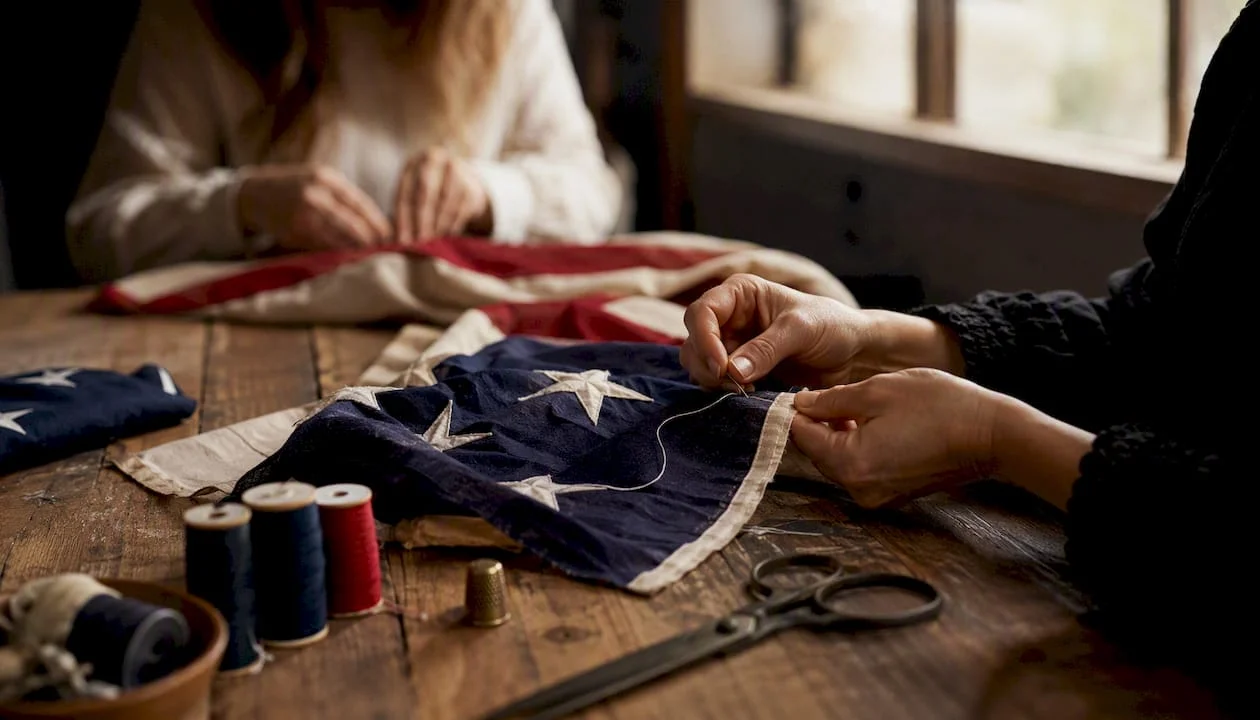
The Texas Historical Commission records that the Gonzales flag was designed and painted by women of Gonzales in October 1835. Two names appear consistently in the historical record: Cynthia Burns and Evaline DeWitt (sometimes recorded as Caroline DeWitt or with variant spellings, reflecting the inconsistencies common in 19th-century documentation). Samuel Maverick, a prominent Texas figure who was present in Gonzales during this period, is also cited in some accounts as a witness to or participant in the flag’s creation, though his role was not that of a maker.
Visually, the flag followed a stark, legible design. The field was white cotton, the cannon was rendered in black, a lone star appeared above or near the cannon, and the words “COME AND TAKE IT” ran beneath. Modern SVG representations archived on Wikimedia Commons show the cannon depicted in profile, consistent with how the design has been reproduced across two centuries. The simplicity was not accidental: a flag readable at a distance, with a single image and a short phrase, communicates its message without ambiguity.
The Texas Historical Commission notes that the Gonzales flag was “likely produced after the immediate skirmish” rather than before it, meaning it functioned as a commemorative and rallying object rather than a pre-planned battle standard carried into combat.
One persistent story holds that the white cloth came from a wedding dress, lending the flag a romantic origin. Historians treat this detail with caution. The wedding-dress account appears in later retellings rather than in contemporary documents, and it fits a pattern common to flag lore: a domestic, personal sacrifice woven into a national narrative. The story may be true, partly true, or embellished; the documentary record does not confirm it. What the record does confirm is that the original flag was lost not long after the march from Gonzales, and every version displayed in museums today is a reproduction or a later copy.
How the slogan and flag were reused across two centuries
The phrase and its visual emblem proved too potent to remain confined to a single October morning in 1835. Their reuse across subsequent generations reflects both the slogan’s rhetorical versatility and the enduring power of the Gonzales story.
- Civil War era: Confederate Texas units invoked the Gonzales precedent in regimental rhetoric, connecting their resistance to the same tradition of armed defiance against a distant authority.
- 20th-century Texan identity: The phrase entered the vocabulary of Texas pride broadly, appearing on state-issued license plates, murals in public buildings, and the signage of Gonzales itself, which markets the town as the “Birthplace of the Texas Revolution.”
- Firearms and Second Amendment imagery: From the late 20th century onward, the cannon in the design was frequently replaced with a rifle or handgun silhouette, explicitly linking the motto to contemporary gun-rights advocacy. This substitution is now among the most common modern adaptations.
- Commercial reproduction: As journalistic coverage confirms, the flag appears on apparel, bumper stickers, tattoos, and merchandise across Texas and beyond, functioning simultaneously as regional pride and political statement depending on the context of display.
- Museum and institutional use: The Gonzales Memorial Museum holds reproductions and related artifacts, and the Texas State Library and Archives Commission maintains records relevant to the flag’s history. These institutional holdings serve educational rather than commercial purposes.
The flag’s durability rests on a design principle that historians of visual rhetoric recognize: a single, clear pictorial object paired with a short imperative phrase creates a symbol that anyone can reproduce and anyone can reframe for a new cause.
Common misconceptions about the Gonzales flag
Popular accounts of the Come and Take It flag carry several persistent errors, some of them traceable to 19th-century romanticism and others to more recent political framing.
- Myth: The flag flew during the actual fighting. The evidence, including the Texas Historical Commission’s assessment, suggests the flag was made after the skirmish, not carried into it. It was a commemorative object, not a pre-planned battle standard.
- Myth: The original flag survives in a museum. The original was lost shortly after the 1835 march. Institutions including the Gonzales Memorial Museum display reproductions. No authenticated original is known to exist.
- Myth: The original cannon is on display somewhere. The TSHA’s Handbook of Texas notes that the cannon’s provenance trail becomes uncertain after later conflicts. Claims that a specific cannon in a church or museum is the original Gonzales piece have not been verified by archival evidence.
- Myth: The flag is primarily an Alamo symbol. The Alamo fell in March 1836, five months after Gonzales. The Come and Take It flag belongs to the Gonzales episode specifically; later conflation with the Alamo reflects how Texas Revolution events merged in popular memory.
- Myth: The wedding-dress origin is documented fact. This detail appears in later retellings, not in contemporary accounts. It may be true, but it has not been confirmed by primary sources.
Later storytelling, including 19th-century paintings and commemorative histories, shaped public perception in ways that sometimes diverged from what eyewitness accounts and muster rolls actually recorded. The community’s desire to honor the event produced vivid narratives that occasionally outpaced the documentary evidence.
How historians and archivists verify claims about the flag
Establishing what is true about an 1835 flag requires working through several layers of evidence, each with its own strengths and limits.
- Eyewitness accounts and memoirs: Participants who later wrote about Gonzales provide the closest thing to contemporaneous testimony, though memory is selective and memoirs were often written decades after the fact. The Texas State Library and Archives Commission holds relevant manuscript collections.
- Muster rolls and military records: Official lists of men who assembled at Gonzales in October 1835 confirm who was present, which helps evaluate claims about who carried or created the flag.
- Contemporary newspapers: Texas and U.S. newspapers from late 1835 reported on the skirmish. These accounts, though sometimes secondhand, predate the mythologizing that came later.
- Physical conservation reports: When a textile or artifact is examined by conservators, fiber analysis, dye composition, and construction techniques can establish approximate age and origin, though such analysis requires an authenticated object to examine.
- Archival provenance chains: The Texas Historical Commission and the Texas State Historical Association (TSHA), whose Handbook of Texas is the standard scholarly reference, evaluate claims by tracing the documented chain of custody for objects and the sourcing of written accounts.
The TSHA treats the Gonzales flag story with appropriate scholarly caution: it records the traditional attribution to Burns and DeWitt, notes the post-battle timing, and acknowledges the loss of the original. That combination of recording tradition and flagging uncertainty is the model for responsible historical treatment of a story with incomplete documentation.
Pro Tip: When evaluating any claim about a historical flag or artifact, ask three questions: Is the source contemporary (written within a few years of the event)? Is there a documented chain of custody for the physical object? Does the institutional source, such as the TSHA or the Texas Historical Commission, cite primary records or rely on later retellings? Those three filters will separate most credible claims from folklore.
Why the phrase and flag endure as symbols of defiance
A slogan that has survived from ancient Sparta through Revolutionary Georgia to modern Texas license plates possesses something beyond historical accident. The rhetorical power of “Come and Take It” lies in its structure: it is an acknowledgment, a refusal, and a challenge compressed into four words. It requires no explanation of ideology, no lengthy argument. The listener already understands the stakes.
For Texans specifically, the flag carries a layered meaning that connects local pride to a broader tradition of armed self-determination:
- Regional identity: The Gonzales story positions Texas as a place where ordinary settlers, not professional soldiers, stood against a government demand. That narrative of civilian courage has been central to Texas identity since 1835.
- Individual liberty: The cannon, as a symbol of the means of self-defense, translates naturally into contemporary debates about the Second Amendment, which explains the flag’s wide adoption in gun-rights contexts.
- Contested appropriation: The same simplicity that makes the flag easy to reproduce also makes it easy to detach from its historical context. When the cannon is replaced with a modern firearm, the Gonzales story recedes and a contemporary political argument takes its place. Historians and museum professionals note this tension without necessarily resolving it.
Modern display ranges from the solemn, as in museum reproductions and historical reenactments, to the commercial, as in apparel and merchandise, to the explicitly political, as in rally signage. The Houston Public Media feature on the skirmish’s anniversary captures this range well, noting that the flag means different things to different Texans while remaining instantly recognizable to all of them. That breadth of meaning is both the flag’s cultural strength and the source of its occasional controversy.
The Gonzales flag also demonstrates something worth noting about how communities memorialize events: the physical artifact often comes after the moment it commemorates, created to enshrine a narrative and give it a tangible form. The flag likely functioned from the beginning as a rallying object and memorial rather than a combat standard, which makes it no less significant. Flags, like the stories they represent, are made by people who want to remember.
A note on history, commerce, and where they meet
Flags are among the most direct ways a culture preserves its stories. At Ultimate Flags, the commitment is to carry those stories with accuracy and respect, which means being clear about the distinction between a historical artifact and a reproduction. The original Gonzales flag is gone; what survives is the design, the tradition, and the meaning. Reproductions, sold by retailers and displayed in museums alike, serve a legitimate commemorative purpose when they are presented honestly.
Ultimate Flags publishes historical articles, including this one, because understanding a flag’s origins makes owning or displaying it a more meaningful act. The same care that goes into writing about the Betsy Ross flag’s Revolutionary history applies here: commerce and scholarship are separate endeavors, and readers deserve both. For primary artifacts and archival records, the Gonzales Memorial Museum, the Texas State Library and Archives Commission, and the TSHA are the appropriate authorities. For a quality reproduction to display with pride, Ultimate Flags is where to look.
Flags that carry history forward

History deserves to be displayed, not just read about. Ultimate Flags, America’s oldest online flag store, carries a wide selection of historical and Texas Revolution flags for collectors, educators, and anyone who wants to honor the Gonzales story with a quality reproduction. The Come and Take It design, with its stark cannon and four-word challenge, belongs in the same category as the Betsy Ross flag and the Gadsden: a symbol whose origins are specific and whose meaning has grown across generations.
Browse the full catalog at Ultimateflags to find the reproduction that fits your purpose, whether that is a classroom display, a commemorative gift, or a piece of Texas history for your home. Every flag ships with the same commitment to quality that has made Ultimate Flags the trusted name in American flag retail for decades.
Sources
The sources below range from primary institutional references to public-access archives, and knowing which is which matters when you are evaluating a claim.
Primary and scholarly sources:
- Come and take it
- The story behind Texas’ world-famous ‘Come and Take It’ flag
- Gonzales Come and Take It Cannon
- Flags of the Texas Revolution
- Come And Take It: The Skirmish That Inspired A Texas …
Journalistic and public-media accounts:
Visual and archival resources:
Institutions holding reproductions and related artifacts:
Note that eyewitness memoirs and muster rolls held in archival collections are primary sources; journalistic features and encyclopedia entries are modern summaries. Both have value, but they answer different questions. Cultural symbols and their commercial reproduction are explored further in this analysis of how imported cultural products circulate in markets, which offers useful context for understanding how regional emblems travel beyond their origins.
FAQ
What does the Come and Take It flag mean?
The flag asserts defiance against a demand to surrender arms, specifically the cannon that Mexican authorities sought to reclaim from Gonzales settlers in 1835. The phrase connects to the ancient Greek molon labe, meaning “come and take” — a refusal that doubles as a challenge.
Was the Come and Take It flag flown at the Alamo?
No. The flag belongs to the Battle of Gonzales on October 2, 1835, not the Alamo, which fell in March 1836. The two events are part of the same Texas Revolution, but the Gonzales flag was not the Alamo’s battle standard. Conflation of the two is a common error rooted in how Texas Revolution events merged in popular memory.
Is “Come and Take It” a political statement today?
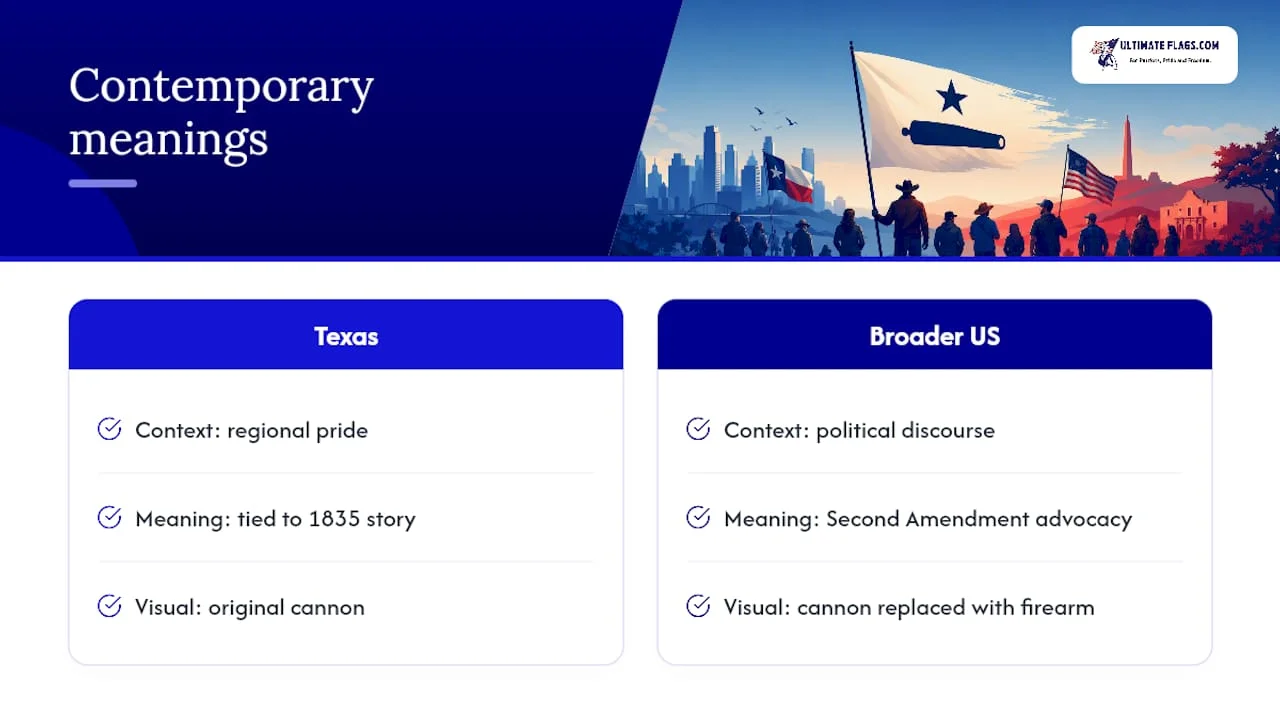
The phrase carries both regional and political meanings depending on context. In Texas, it often functions as an expression of local pride tied to the 1835 story. In broader American political discourse, it is frequently associated with Second Amendment advocacy, particularly when the cannon in the original design is replaced with a firearm silhouette.
Where did the original Come and Take It flag go?
The original Gonzales flag was lost shortly after the October 1835 march, and no authenticated original is known to survive. The Gonzales Memorial Museum and other Texas institutions display reproductions; the Texas Historical Commission and TSHA are the authoritative sources for what is known about the original’s fate.
This article is provided for general historical and educational purposes. For primary records, artifact authentication, or archival research, consult the Texas State Historical Association, the Texas Historical Commission, or the Texas State Library and Archives Commission.