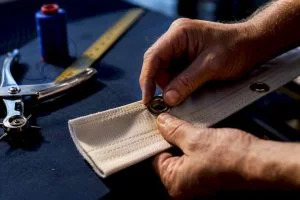
The standard garden flag size is 12×18 inches, and for most yards and standard two-prong stakes, that dimension is the right choice. Close variants slightly larger than 12×18 inches are also widely available and fit the same hardware without issue. These compact dimensions suit flower beds, front walkways, and seasonal displays where viewers pass within a few feet of the flag. For displays visible from the street or mounted on a porch bracket, larger house and porch flag sizes step in:
- Standard garden flag: 12×18 in (most common), 12.5×18 in, 13×18.5 in
- House / porch flag: 28×40 in, 28×44 in
- Large yard / barn display: 36×54 in and up
One-sentence recommendation: choose 12×18 for any standard garden stake; step up to 28×40 or larger only when the flag must be readable from the street or mounted on a porch bracket at height.
Key Takeaways
The standard 12×18-inch garden flag fits the widest range of hardware and viewing distances, making it the right starting point for most buyers.
| Point | Details |
|---|---|
| Standard size | 12×18 in is the most common garden flag size; variants 12.5×18 and 13×18.5 also fit standard stakes. |
| Viewing distance rule | Allow roughly 1 inch of letter height per 10 feet of viewing distance to keep text legible. |
| Sleeve length | A sleeve of at least 2 inches is recommended for 12×18 flags to reduce stress and prevent tearing. |
| Custom orders | Provide trimmed size, sleeve specs, bleed-ready artwork, and file format before production begins. |
| Ultimate Flags | Offers ready-made 12×18 garden flags and custom sizing with hardware compatibility checks. |
Table of Contents
- What are the most common garden flag sizes?
- How do you choose the right garden flag size for your space?
- How do materials and construction affect flag size and durability?
- Garden flag vs. house flag: which one do you actually need?
- How do pole sleeves and hardware affect which flag size fits?
- How to measure a flag and prepare artwork before ordering
- How do you care for garden flags of different sizes and fabrics?
- What specs do you need to give a vendor for a custom flag order?
- How Ultimate Flags approaches size guidance and custom work
- Ready to find the right flag for your display?
- Sources
- FAQ
What are the most common garden flag sizes?
Common garden flag dimensions typically range from 12×18 inches to 13×18.5 inches, with 12×18 being the size you will encounter most often in retail listings and hardware kits.
| Flag Type | Common Dimensions | Typical Use | Hardware |
|---|---|---|---|
| Standard garden flag | 12×18 in | Flower beds, walkways, close-up display | Two-prong ground stake, 39" iron pole |
| Garden flag variant | 12.5×18 in | Same as standard; slight extra width | Standard garden stake |
| Garden flag variant | 13×18.5 in | Slightly larger print area | Standard garden stake |
| House / porch flag | 28×40 in | Porch bracket, street-level visibility | Wall-mount bracket, heavier pole |
| House / porch flag | 28×44 in | Wider porch display | Wall-mount bracket |
| Large yard / barn | 36×54 in | Long-distance visibility, barn walls | Heavy-duty pole or bracket |
Key hardware notes:
- The 12×18, 12.5×18, and 13×18.5 sizes all fit standard two-prong ground stakes and 39-inch iron poles without modification.
- House and porch flags at 28×40 or 28×44 require wall-mount porch brackets; a garden stake will not support their weight or surface area in wind.
- Flags at 36×54 and above need robust mounting hardware, such as a heavy-duty flagpole or barn-wall bracket, to prevent sleeve stress and pole flex.
Retailers often package a 12×18 flag with a compatible pole and two-prong ground stake. Always confirm whether a listed flag includes hardware or whether the pole is sold separately before completing a purchase.
How do you choose the right garden flag size for your space?
Start with viewing distance. A 12×18 flag reads clearly from about 5–10 feet, which covers most garden-bed and walkway placements. If the flag needs to be legible from the street — typically 20 feet or more — a 28×40 house flag or larger is the more dignified choice.
Design detail matters as much as distance. A flag carrying fine script or a detailed illustration needs more surface area to remain legible. Bold, simple graphics work well at 12×18; multi-line text or intricate artwork benefits from the extra inches a 13×18.5 or larger format provides.
Environmental factors to weigh:
- Wind exposure: Smaller flags put less stress on sleeves and poles. In consistently windy yards, a 12×18 flag on a standard stake will outlast a larger flag on the same hardware.
- Seasonal rotation: Flags swapped frequently for holidays or seasons are easier to store and handle at the standard 12×18 size.
- Bed or border width: A narrow flower border looks proportionate with a 12×18 flag; a wide front bed or corner planting can carry a 13×18.5 without looking crowded.
Quick selection checklist:
- Measure the distance from the flag’s intended position to the nearest viewing point.
- Note the pole or stake diameter and length you already own.
- Confirm the sleeve opening on any flag you are considering matches that pole diameter.
- Choose the smallest size that keeps your design legible at the measured distance.
Pro Tip: To estimate readable distance for text on a flag, allow roughly 1 inch of letter height for every 10 feet of viewing distance. A flag with 1.5-inch letters is comfortable to read at about 15 feet — well within the range of a standard 12×18 garden flag placed near a walkway.
How do materials and construction affect flag size and durability?
Material choice shapes how a flag behaves at any given dimension, and the difference becomes more pronounced as size increases.
- Nylon: Lightweight and quick-drying, nylon performs well at the standard 12×18 size. It catches even a light breeze, which keeps the design visible without straining the sleeve or stake. For outdoor flag durability, nylon is a reliable choice in moderate climates.
- Polyester: Heavier and more resistant to UV fading, polyester supports larger print areas without distortion. It is the preferred fabric for house and porch flags at 28×40 and above, where the extra weight helps the flag hang flat and display the design clearly.
- Burlap: A decorative fabric used for rustic or seasonal themes. Burlap is best reserved for sheltered placements; it absorbs moisture and degrades faster than synthetic fabrics in prolonged outdoor exposure.
Single-sided vs. double-sided printing is a practical distinction that affects visible design space. Single-sided flags show a mirror image on the reverse, which is acceptable for symmetrical designs but problematic for text or directional artwork. Double-sided flags use two fabric layers with a liner between them, so the design reads correctly from both sides. The liner adds slight thickness and weight, which can reduce how freely the flag moves in a light breeze at the 12×18 size.
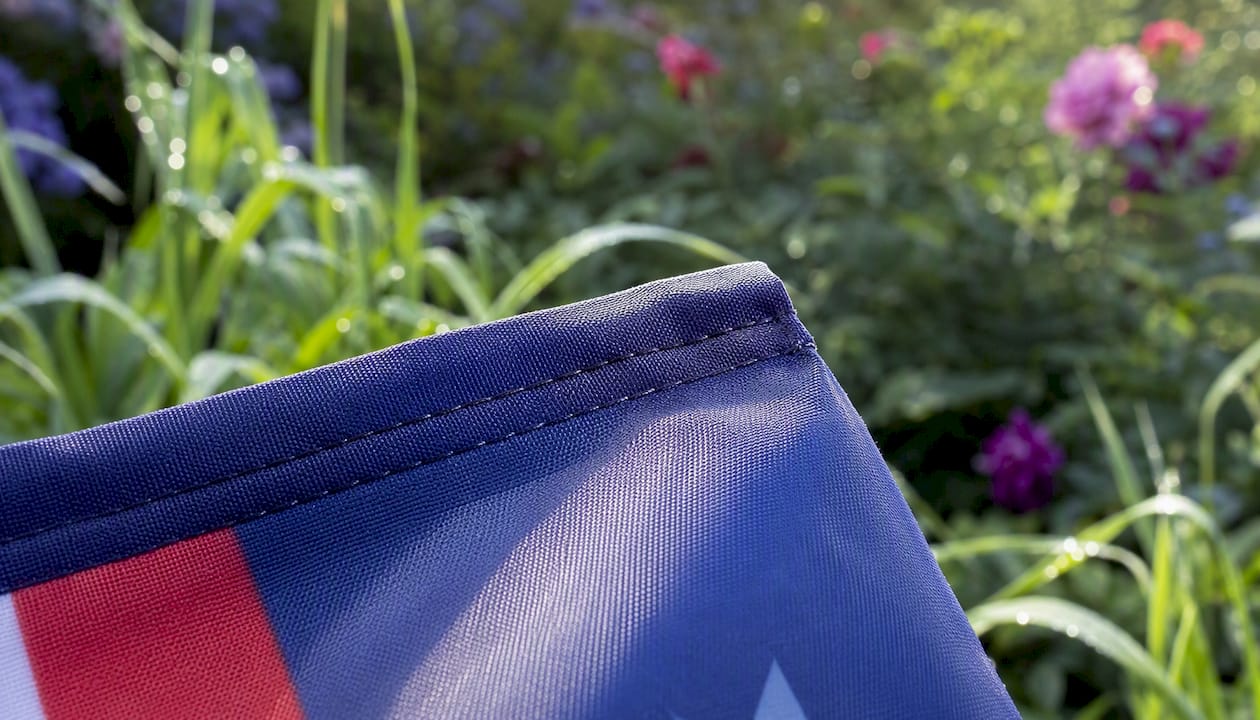
Construction details also reduce the usable display area slightly. A standard hem and seam allowance of roughly 0.5 inches on each edge means the visible print area on a 12×18 flag is closer to 11×17 inches. Artwork templates should account for this margin so no critical design element sits too close to the edge.
Garden flag vs. house flag: which one do you actually need?
The distinction is straightforward: garden flags are small, stake-mounted displays for close-up viewing, while house and porch flags are larger, bracket-mounted banners designed for street-level visibility.
- A 12×18 garden flag on a two-prong ground stake belongs in a flower bed or along a front walk, where it greets visitors at arm’s length.
- A 28×40 or 28×44 house or porch flag mounts on a wall bracket beside the front door or on a porch post, where it is visible from the sidewalk or street.
Mounting hardware drives the decision as much as size does. Garden stakes are lightweight and portable; porch brackets are fixed and require a more durable flag construction to handle wind loading at height. A garden flag hung on a porch bracket will look undersized and may flutter erratically. A house flag forced onto a garden stake will overwhelm the hardware and risk bending the pole.
Quick selection guide:
- Choose a garden flag when the display is within 10 feet of viewers, the mounting point is a ground stake, and the setting is a garden bed or walkway.
- Choose a house or porch flag when visibility from the street matters, the mounting point is a wall bracket or porch post, and the design carries fine detail that needs a larger canvas.
How do pole sleeves and hardware affect which flag size fits?
Always match the flag’s sleeve diameter and length to the pole or stake specifications before purchasing. A sleeve that is too narrow will not slide onto the pole; one that is too wide will allow the flag to tilt and spin rather than display flat.
Common hardware and the sizes they support:
- Two-prong ground stake with 39-inch iron pole: The standard pairing for 12×18, 12.5×18, and 13×18.5 garden flags. The pole diameter is typically 3/8 inch, and the flag sleeve should accommodate that diameter with a small amount of clearance.
- Porch wall-mount bracket: Designed for house and porch flags at 28×40 and 28×44. These brackets use a heavier pole, often 1/2 inch or larger in diameter, and the flag sleeve must match.
- Heavy-duty yard or barn pole: Required for flags at 36×54 and above. These poles are significantly thicker and often anchored in a ground sleeve or bracket for stability.
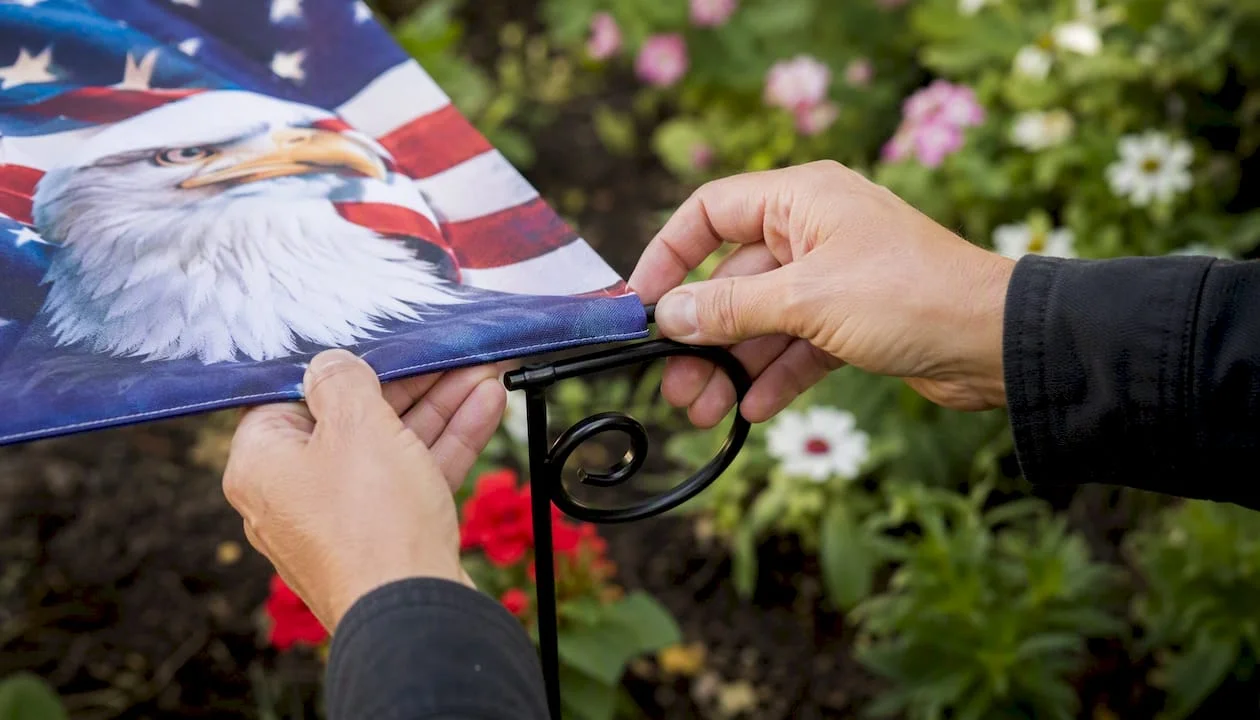
Product imagery from retailers frequently shows flags bundled with matching hardware, illustrating how sleeve placement and stake fit work together as a system.
Sleeve length also matters for stability. A sleeve that is too short concentrates stress at a single point on the flag edge, accelerating wear. For standard 12×18 flags, a sleeve length of at least 2 inches distributes the load more evenly and reduces the risk of tearing at the seam.
Hardware compatibility checklist:
- Measure the pole or stake diameter you plan to use.
- Check the flag’s listed sleeve inner diameter against that measurement.
- Confirm sleeve length is at least 2 inches for a 12×18 flag.
- For larger flags, verify the pole is rated for the flag’s surface area and local wind conditions.
Pro Tip: When buying a flag and pole separately, bring the pole to a flag display or measure its diameter precisely with calipers. A 1/16-inch mismatch between pole and sleeve can make a flag impossible to mount or cause it to rotate freely rather than display properly.
How to measure a flag and prepare artwork before ordering
Accurate measurement before ordering prevents the most common sizing mistakes: a flag that does not fit the hardware or artwork that bleeds into the seam.
Measurement checklist:
- Lay the flag flat on a clean surface without stretching the fabric.
- Measure the full width from outer edge to outer edge, then the full height from top hem to bottom hem.
- Note the sleeve position (top or side) and measure its length and inner opening diameter separately.
- Record seam allowances: standard construction uses approximately 0.5 inches on each edge.
For custom orders, the usable print area on a 12×18 flag is approximately 11×17 inches after accounting for hems. Artwork files should be sized to the full 12×18 dimension with a bleed of at least 0.25 inches beyond the trim line on all non-sleeve edges. This prevents white borders from appearing if the fabric shifts slightly during cutting.
A sleeve length of at least 2 inches is the standard recommendation for 12×18 flags, providing adequate support and reducing stress concentration at the flag edge. For larger formats, sleeve length should scale proportionally.
Pro Tip: Ask your vendor to confirm the exact sleeve inner diameter and length before finalizing artwork. Some manufacturers use a slightly narrower sleeve on decorative flags than on utility flags of the same nominal size, and that difference can affect pole compatibility.
How do you care for garden flags of different sizes and fabrics?
Smaller nylon flags at 12×18 need the lightest maintenance. Hand-washing in cool water with mild detergent, then air-drying flat or on the pole, preserves color and fabric integrity. Avoid machine-drying nylon, as heat can distort the weave and cause the flag to hang unevenly.
Larger polyester flags tolerate more outdoor exposure but benefit from periodic cleaning to prevent mildew, especially in humid climates. A gentle machine wash on a cold, delicate cycle is generally safe for polyester; always check the manufacturer’s care label first.
Care actions by situation:
- Frayed seam: Trim loose threads and apply a small amount of fabric sealant to the frayed edge. A seam that is left unaddressed will continue to unravel, eventually compromising the sleeve.
- Torn sleeve: A sleeve tear near the pole opening is the most common failure point. Reinforce it with a fabric patch or iron-on hem tape before the tear extends across the full sleeve width.
- Seasonal storage: Fold flags loosely, place them in a breathable fabric bag, and store in a cool, dry location. Tight folding along the same crease repeatedly will weaken the fabric at that line over time.
Take flags down before severe storms regardless of size. Even a well-constructed 12×18 nylon flag can sustain sleeve damage in sustained high winds, and a larger polyester flag on a porch bracket can stress the bracket mounting points. For respectful flag handling and storage, treating each flag with care honors both the display and the tradition it represents.
What specs do you need to give a vendor for a custom flag order?
Clear communication with a vendor before production prevents costly reprints. Provide these details in writing for every custom order:
Custom order checklist:
- Final trimmed size (width × height in inches, e.g., 12×18)
- Sleeve position (top or side), sleeve length, and sleeve inner diameter
- Whether the design is single-sided or double-sided
- Full-size artwork file at the correct dimensions with at least 0.25-inch bleed on all non-sleeve edges
- File format: high-resolution PDF or TIFF at 150 DPI minimum at final flag size; vector formats (AI, EPS) are preferred for text-heavy designs
- Color mode: CMYK for print accuracy
Design detail scales directly with flag size. A logo or text block that reads clearly on a 28×40 flag may become illegible if the same artwork is reduced to 12×18 without adjusting font size and element spacing. Always review a scaled proof before approving production.
Panel dimensions determine artwork templates, and templates vary by manufacturer, so request the vendor’s own template file rather than building artwork to generic dimensions.
Pro Tip: For nonstandard sizes, ask the vendor to confirm hardware fit in writing before production begins. A flag built to an unusual sleeve diameter or length may display beautifully but fit no standard pole on the market.
How Ultimate Flags approaches size guidance and custom work
Ultimate Flags recommends the 12×18 format as the standard for garden display, recognizing it as the size that balances visibility, hardware compatibility, and ease of seasonal rotation. For displays that demand greater presence, custom sizing is available to match specific viewing distances and mounting configurations.
- Size guidance grounded in hardware compatibility, not just aesthetics
- Custom production support for nonstandard dimensions and sleeve specifications
- Hardware compatibility checks to confirm pole and sleeve fit before an order is finalized
- A catalog spanning ready-made garden flags to large-format display banners, so the right size is always within reach
Ready to find the right flag for your display?
Ultimate Flags carries ready-made 12×18 garden flags across dozens of patriotic, historical, and seasonal designs, along with custom sizing options for buyers who need a specific dimension or sleeve configuration. Whether the display is a modest flower-bed stake or a prominent porch bracket, the selection reflects a commitment to quality and hardware compatibility that has defined the store since its founding as America’s oldest online flag retailer.

To move forward: browse the flag catalog at Ultimate Flags for standard 12×18 garden flags and house-flag sizes, or contact the team directly with your trimmed dimensions, sleeve specs, and artwork format for a custom quote. For sleeve and pole questions, the support team can confirm compatibility before production begins, sparing you the cost of a reprint.
Sources
The following sources support the size recommendations, hardware compatibility notes, and measurement guidance in this article:
FAQ
What is the standard size for a garden flag?
The standard garden flag size is 12×18 inches. Close variants such as 12.5×18 and 13×18.5 inches are also common and fit the same two-prong ground stakes and 39-inch iron poles.
Is a 2×3 flag too small for a garden display?
A 2×3 foot (24×36 inch) flag is larger than a standard garden flag and is better suited to a porch bracket or light pole than a garden stake. For a typical flower-bed or walkway display, the 12×18-inch format is the more proportionate choice.
Is a 5×8 flag too big for a garden setting?
Yes, a 5×8 foot flag is a large-format display banner intended for tall flagpoles or barn walls, not garden stakes. Mounting a flag that size on standard garden hardware would stress the sleeve and pole beyond their design limits.
What are the different types of garden flags?
Garden flags are typically made from nylon, polyester, or burlap and are available in single-sided or double-sided printing. They cover seasonal, patriotic, holiday, and decorative themes, and are designed to mount on lightweight two-prong ground stakes at the standard 12×18-inch dimension.
How do I know if a garden flag will fit my existing pole?
Measure the pole’s outer diameter and compare it to the flag’s listed sleeve inner diameter. For a 12×18 garden flag, the sleeve should accommodate a pole of approximately 3/8 inch in diameter, and the sleeve length should be at least 2 inches for stable display.