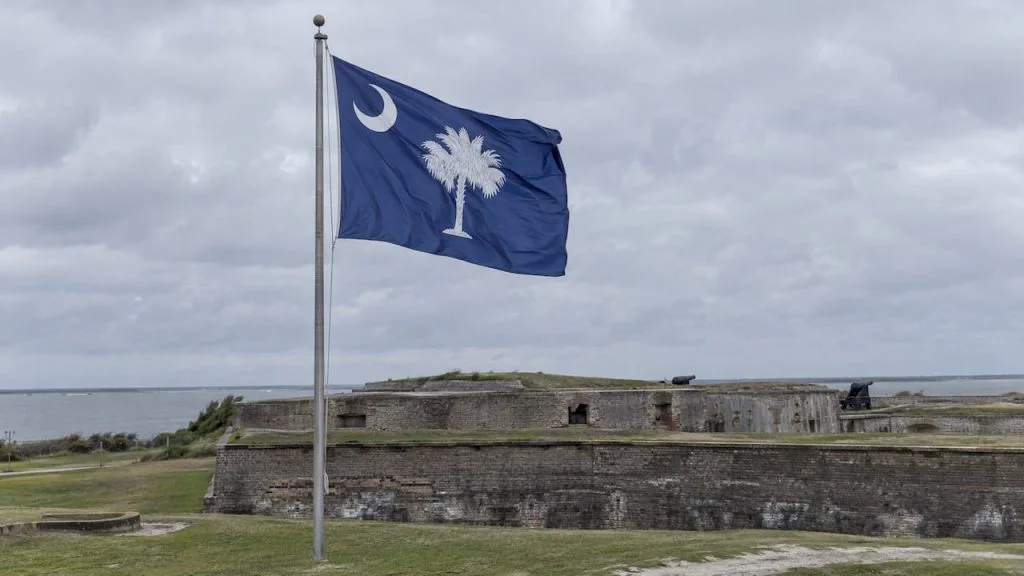
The South Carolina flag began as a practical signal banner for Revolutionary troops in 1775 and 1776, gained its palmetto when the legislature adopted it as the state flag on January 28, 1861, and took its present tilted crescent in 1910. Few state flags carry so much in so little: a blue field, a white crescent and a palmetto tree, each answering to a moment when the people of the state stood their ground. Here is how it came to be, what its symbols mean, and how to tell the versions apart.
TL;DR
- The flag descends from a dark-blue banner with a white crescent, designed for South Carolina troops in the Revolutionary War and flown at Fort Moultrie on June 28, 1776.
- The palmetto honors the palmetto-log fort that withstood British naval fire. It was added to the flag when the legislature adopted the state flag on January 28, 1861.
- The crescent was first drawn with its points facing up. In 1910 it was moved toward the staff and tilted, and that design was codified in 1932.
- The tree is the sabal, or cabbage, palmetto, which is why South Carolina is the Palmetto State.
Table of Contents
- A blue banner for the troops, 1775 to 1776
- Why blue, and why a crescent?
- How the palmetto won its place
- 1861: The state flag is adopted
- 1910 and 1932: the crescent turns
- Timeline at a glance
- What the symbols mean
- Bring the history home
- FAQ
- Sources
A blue banner for the troops, 1775 to 1776
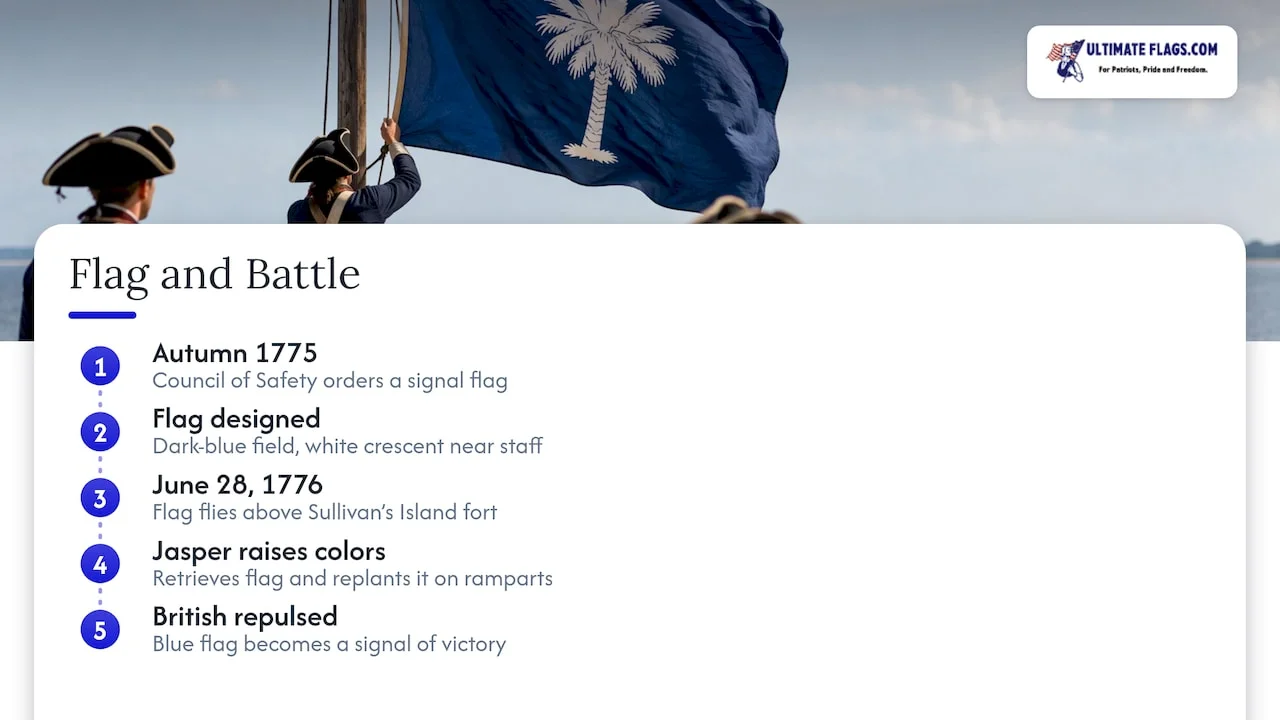
The story starts in the tense autumn of 1775, when South Carolina’s Revolutionary leadership needed a flag its soldiers could rally around. According to the South Carolina Encyclopedia, the Council of Safety ordered Colonel William Moultrie to create a practical signal flag. Moultrie answered with a dark-blue field and a white crescent in the upper corner nearest the staff, a design the National Park Service describes in just those terms.
That banner became the colors of the Second South Carolina Regiment. On June 28, 1776, a British fleet attacked the unfinished fort on Sullivan’s Island, and the flag flew above its palmetto-log walls. When British artillery shot away the flagstaff, Sergeant William Jasper retrieved the colors, tied them to a staff and planted them again on the ramparts. It is the kind of moment that turns a piece of cloth into a legend: a banner that would not stay down while the guns were firing.
The British fleet was repulsed. For Charleston, the blue flag with its crescent became a signal of victory.
Why blue, and why a crescent?
Moultrie’s own reasoning was simple and soldierly. In his memoir, as quoted by the South Carolina Encyclopedia, he made a large blue flag because South Carolina troops wore blue, and he added a crescent like the silver crescent worn on their caps. The South Carolina State Library likewise explains the blue as the color of the uniforms worn by the state’s troops.
The crescent is the part people argue about. Most viewers take it for a moon, while others believe it represents a gorget, the small silver ornament worn on a soldier’s cap. State sources recognize both readings, and its precise original meaning remains debated. That open question is part of the charm: the flag whispers its origin rather than spelling it out.
How the palmetto won its place
Here is the detail that surprises many readers: the palmetto was not on Moultrie’s original flag. The fort at Sullivan’s Island was built from palmetto logs, which the National Park Service notes were flexible and resilient against incoming British fire. The soft, fibrous wood absorbed cannonballs that might have shattered sturdier timber, and the defenders’ triumph made the tree a emblem of Carolina endurance.
According to the South Carolina Encyclopedia, the palmetto did not go onto the Revolutionary flag but became part of the state seal. Meanwhile, as the Charleston County Public Library recounts, South Carolinians apparently began placing an upright palmetto at the center of the blue field, creating an unofficial “palmetto flag.” The tree entered popular heraldry well before it entered the law.
The pattern continued through the decades. The Encyclopedia notes that the Palmetto Regiment, raised for Mexican War service in 1846, carried a blue banner, and its veterans’ medal later showed a palmetto at the center of an oval. Earlier still, Governor Robert Hayne presented the state militia with a flag in April 1833 bearing a palmetto and the words “Liberty it…” in large gold letters, a banner collectors still seek out in reproduction.
1861: The state flag is adopted
After South Carolina seceded in December 1860, its legislators needed a flag for the new situation. The South Carolina Encyclopedia records that they weighed alternatives, among them a white flag with a green palmetto and a blue union with a white crescent, before Robert Barnwell Rhett Jr. proposed the simpler design: a blue field with a white palmetto and a white crescent.
The legislature adopted that flag on January 28, 1861. The National Park Service quotes the January 29, 1861 Charleston Mercury as describing a crescent whose points faced upward. The palmetto, in the Park Service’s account of the period, also took on a new meaning in 1860 and 1861, as politicians linked the Revolutionary victory symbol to their effort to establish independence. The same tree could therefore stand for Revolutionary resistance first and for secession-era independence afterward, while its older Revolutionary meaning remains central in modern interpretation.
For history enthusiasts, this layering is the heart of the subject. A flag is rarely one story, and the South Carolina flag carries at least two.
1910 and 1932: the crescent turns
The design most Americans picture today is not quite the 1861 original. The Encyclopedia reports that in 1910 the crescent was moved nearer the staff and its horns turned toward it. The National Park Service adds that the crescent was not turned diagonally until 1910.
The South Carolina State Flag Study Committee identifies exactly two legislatively approved versions: the 1861 flag with the upward-pointing crescent, and the 1910 version, codified in 1932, with the crescent tilted toward the upper corner. The committee also says the 1910 design used artwork supplied by the Charleston artist and librarian Ellen Heyward Jervey, including the palmetto drawing that influenced the standardized tree.
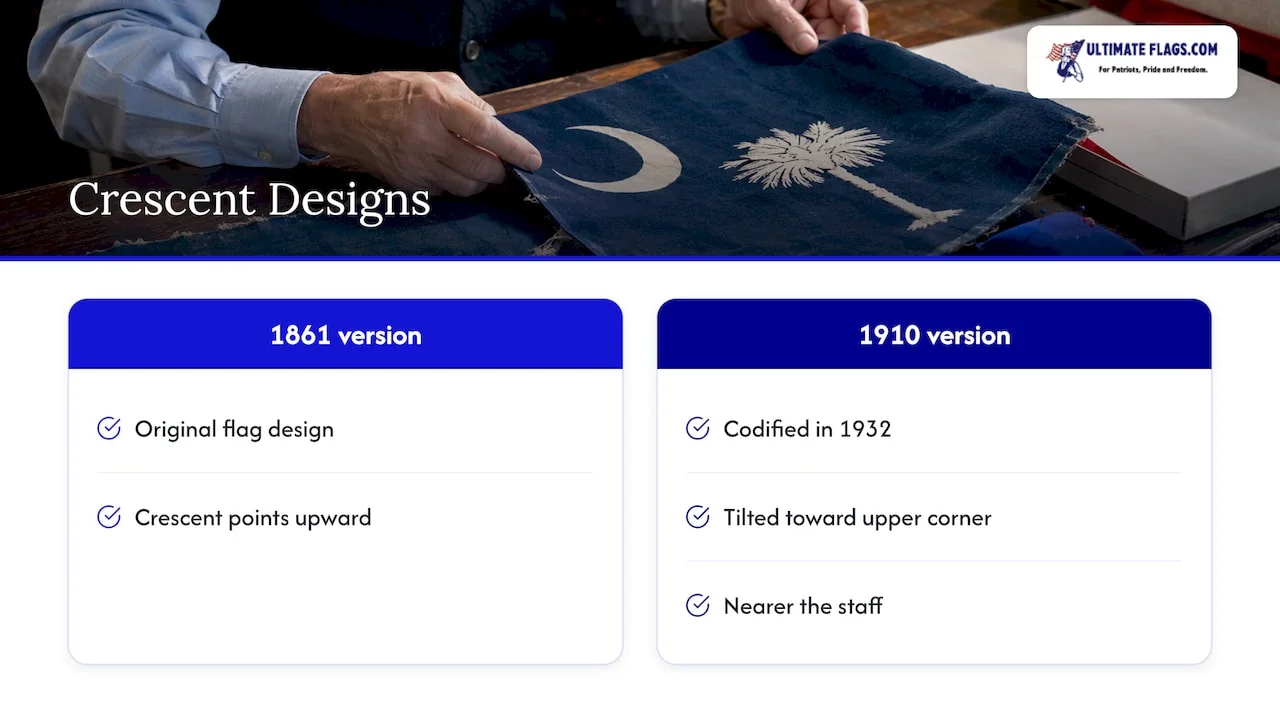
If you are dating an old flag, the crescent is your first clue. An upright, upward-pointing crescent suggests the 1861 pattern, while a tilted one near the staff follows the 1910 and 1932 standard.
Timeline at a glance
| Year | Event |
|---|---|
| 1775 | Moultrie designs a blue flag with a white crescent for South Carolina troops |
| June 28, 1776 | The flag flies over the palmetto-log fort on Sullivan’s Island; Sergeant Jasper replants it |
| 1833 | Governor Hayne presents the militia with a palmetto flag |
| 1846 | The Palmetto Regiment carries a blue banner in the Mexican War |
| January 28, 1861 | The legislature adopts the blue flag with a white palmetto and crescent |
| 1910 | The crescent is moved toward the staff and turned |
| 1932 | The tilted-crescent design is codified |
What the symbols mean
The blue field recalls the uniforms of the state’s Revolutionary troops.
The palmetto commemorates the resilient palmetto-log fort and the Patriot victory at Sullivan’s Island. The species is the sabal palmetto, also called the cabbage palmetto, and South Carolina law designates the palmetto as the state tree, shown on both the flag and the seal.
The crescent is read as a moon by most, and as the silver gorget of Revolutionary caps by others.
The tree also gives the state its official nickname: according to the Public Service Commission, South Carolina is “The Palmetto State,” a reference to the palmetto on its flag and seal.
Our View: Why These Flags Deserve to Be Flown
At Ultimate Flags, we believe the South Carolina flag is among the finest lessons in American history ever stitched into cloth. It began as a soldier’s answer to a practical question, how to signal across a battlefield, and became the emblem of a people who held a palmetto fort against the Royal Navy. Its design is spare, its meaning deep, and its story rewards anyone willing to look closely.
That is why we care about the details collectors care about: the right crescent angle, the right proportions, the right period. We are America’s oldest online flag store, and our catalog spans state flags, Revolutionary War flags and historic war flags because we believe history is best understood when you can hold it, raise it and pass it on. A flag on a pole is a story told every morning.
Whether you honor the Revolutionary banner of 1776, the state flag of today or another chapter of Carolina history, there is a flag that tells it faithfully.
John Hough
Bring the history home
The Carolina story is easy to display. For the Revolutionary chapter, we carry the Fort Moultrie Liberty flag in sewn cotton, a fitting tribute to the banner at Sullivan’s Island. For the state flag itself, browse our full South Carolina flag collection, which includes a cotton sewn 4 x 6 ft. flag and a 3 x 5 ft. outdoor nylon embroidered version.
Readers interested in the secession era will also find the South Carolina Sovereignty flag in cotton among our historical flags. If you are building a wider display, our US state flags and the full flag collections cover flagpoles and hardware too.

For a broader look at how states encode their stories, see our guide to state flag meanings, and for the era that followed secession, our article on Civil War flag meanings.
FAQ
What tree is on the South Carolina flag?
It is the sabal palmetto, also called the cabbage palmetto. South Carolina law names the palmetto the official state tree, and it appears on the state flag and seal. The tree honors the palmetto-log fort on Sullivan’s Island.
What does the crescent on the South Carolina flag mean?
Most people see a moon, but state sources also identify it with the silver gorget worn on Revolutionary soldiers’ caps. Moultrie’s memoir mentions a crescent like the one on his troops’ caps. Its precise original meaning remains debated.
When was the South Carolina flag adopted?
The legislature adopted the blue flag with a white palmetto and crescent on January 28, 1861. The version flown today, with the crescent moved toward the staff and tilted, dates to 1910 and was codified in 1932.
Why is South Carolina called the Palmetto State?
The nickname refers to the sabal palmetto on the state flag and seal. The tree became a popular symbol after the palmetto-log fort repulsed the British fleet in June 1776.
Sources
- Sesquicentennial of the South Carolina Flag, National Park Service
- State Flag, South Carolina Encyclopedia
- Moultrie Flag, South Carolina Encyclopedia
- SC250 Activity Booklet, South Carolina State Library
- The Palmetto Guard Flag, National Park Service
- The State Flag of South Carolina, Charleston County Public Library
- South Carolina State Flag Study Committee Final Report
- South Carolina Legislative Manual 2020
- Typography, South Carolina Public Service Commission