The most respectful house flag placement positions the American flag on an angled staff beside the front door, centered over the entry, or mounted on a porch column, balcony, or window — with the union (the blue field of stars) always at the peak of the staff or at the observer’s upper left when displayed vertically. That single rule governs nearly every placement decision a homeowner will face.
Three immediate do/don’ts:
- Do place the flag in the most prominent, visible position available on your façade, free from obstructions that would prevent it from flying freely.
- Do keep the flag in clean, undamaged condition; a tattered or faded flag diminishes the dignity of the display.
- Don’t leave the flag out after dark unless it is properly illuminated by a dedicated light source aimed at the flag.
Before you mount anything, check two things:
- Your homeowner association (HOA) rules or local ordinances, which may govern bracket placement, pole length, or flag size.
- The path of any overhead utility lines near your intended mounting location.
Pro Tip: The Federal Flag Protection Act does not preempt HOA rules in all states — verify your CC&Rs before drilling.
Key Takeaways
Correct house flag placement requires the union at the peak of the staff or the observer’s upper left in vertical displays, a position of prominence on the façade, and either illumination or removal after dark.
| Point | Details |
|---|---|
| Union placement | Always at the peak of an angled staff, or uppermost and to the observer’s left in vertical and window displays. |
| Position of prominence | Choose the most visible, unobstructed spot on the façade; either side of the door is acceptable per Flag Code FAQs. |
| Lighting or removal at night | The flag may remain outdoors after dark only if a dedicated light source illuminates it properly. |
| Surface-specific hardware | Use masonry anchors and a hammer drill for brick; a mounting block for vinyl siding; exterior wood screws for wood. |
| Ultimate Flags | Carries U.S. flags in all common home sizes plus mounting hardware suited to wood, vinyl, and masonry surfaces. |
Table of Contents
- What does the U.S. Flag Code actually require for home display?
- Where should you place the flag on your house or porch?
- How do you mount a flag bracket safely and correctly?
- How do you display multiple flags without dishonoring the U.S. flag?
- Can you leave the flag up at night, and how should you light it?
- When and how do you fly the flag at half-staff?
- How do you care for a flag and retire it with dignity?
- What flag size and material should you choose for each placement?
- Common mistakes homeowners make and a pre-display checklist
- How do seasonal and weather conditions affect flag placement?
- Why correct placement and care reflect something larger than curb appeal
- Sources
- FAQ
What does the U.S. Flag Code actually require for home display?
4 U.S.C. § 7 is the governing statute for position and manner of display. Its language is precise, and every homeowner who takes the flag seriously should know what it says.
For angled staff displays, the union must be at the peak of the staff — the end farthest from the building. When the flag is grouped with other flags on adjacent staffs, the U.S. flag occupies the center or the highest point, and it is always hoisted first and lowered last.
One distinction matters here: the Flag Code is federal statute, but it carries no criminal penalties for civilian violations. Courts have consistently held that enforcement against private citizens would conflict with First Amendment protections. The practical effect is that the Code functions as a standard of honor rather than a penal law. Homeowners who follow it do so out of respect, and that is precisely the spirit in which it was written. The National Flag Foundation reinforces this point, noting that the rules exist to preserve the dignity and reverence the flag commands as a national symbol.
Where should you place the flag on your house or porch?
Choosing the right spot comes down to three factors: prominence, visibility from the street, and the flag’s ability to fly without obstruction. The Ushistory make clear that prominence and dignity outweigh any strict left-or-right convention — the flag may be mounted on either side of an entrance depending on which position offers the clearest sightline.
Angled staff beside the front door is the most common residential choice. It places the flag at eye level, close to the home’s main point of entry, and keeps it visible from the street. Either side of the door is acceptable; choose the side with the most open air so the flag can fly freely without catching on trim or a screen door.
Centered over the entry works well on homes with a wide portico or transom. The flag hangs horizontally or at a slight angle above the door, with the union to the observer’s left. This position reads as ceremonious and dignified, much like a banner hung above a formal entrance.
Porch column or railing mount suits homes with a covered front porch. A bracket secured to the column allows the flag to extend outward at roughly 45°, keeping it clear of the roof overhang. Avoid mounting so low that the flag brushes the porch floor.
Balcony display follows the same logic: mount the staff so the flag extends beyond the balcony railing and flies freely. Never drape the flag over the railing as a decorative cloth; the Flag Code reserves that treatment for coffins during funeral honors.
Window display is governed directly by the statute: union to the observer’s left when viewed from the street. A window-mounted flag should be secured so it does not sag or fold against the glass.
Gable mount places the flag high on the house’s end wall, offering excellent visibility from a distance. The union must be uppermost and to the observer’s left.
Yard flagpole is the most formal option. Position it at the front of the property, clear of trees and power lines, where it can be seen from the street without obstruction.
Pro Tip: On brick or stucco façades, drilling into mortar joints rather than the face of the brick reduces the risk of cracking and gives the anchor a more stable grip.
How do you mount a flag bracket safely and correctly?
The hardware you choose matters as much as the location. Standard retail flag kits often include screws intended for wood siding only; homeowners mounting to masonry must purchase masonry anchors or concrete screws and use a hammer drill fitted with masonry bits.
Step-by-step installation:
- Select your bracket. Fixed-angle brackets (typically set at 45°) suit most porch applications. Adjustable-angle brackets let you fine-tune the angle to clear overhangs or decorative trim, and they reduce siding damage by distributing load more evenly.
- Choose the right fasteners for your surface. Wood siding: exterior-grade wood screws with a weatherproof coating. Vinyl siding: install a mounting block first to prevent water intrusion and warping, then fasten through the block into the structural sheathing. Brick or masonry: use masonry anchors or concrete screws with a hammer drill and masonry bit; drilling into mortar joints is often preferable on older brickwork to avoid cracking the brick face.
- Mark and pre-drill pilot holes. Hold the bracket against the wall at the intended height, mark the hole locations with a pencil, and pre-drill to the anchor’s specified depth.
- Insert anchors and secure the bracket. For masonry, tap anchors flush with the wall surface before driving screws. Confirm the bracket is level before final tightening.
- Set the pole angle. Aim for approximately 45° from the wall. This angle keeps the flag visible from the street, prevents the pole from striking the façade in a breeze, and is the angle most commonly recommended by flag retailers.
- Select pole length. For most porches, a 5–7 ft pole suits the scale well. Shorter poles can make even a 3×5 flag look cramped; longer poles may strike overhead trim.
- Weatherproof the installation. Apply exterior caulk around the bracket base on wood or vinyl to seal against moisture. Use stainless steel or hot-dipped galvanized fasteners to resist corrosion.
For freestanding yard poles, Home Depot’s flagpole installation guide recommends setting a ground sleeve in concrete with the sleeve positioned two inches above grade and the sleeve plumbed carefully during curing. Poles that are typically manageable for DIY projects are those of moderate height; taller installations may require professional help.
Pro Tip: Before drilling anywhere on the exterior, use a stud finder and a wire-detection tool to confirm there are no electrical lines or plumbing runs behind the wall at your chosen mounting point.
How do you display multiple flags without dishonoring the U.S. flag?
Order of precedence is not a suggestion — it is codified in 4 U.S.C. § 7 and reinforced by Defense Department flag guidelines. The governing principle is straightforward: the U.S. flag always occupies the position of honor.
Two adjacent staffs on a porch: The U.S. flag goes on the observer’s left (the flag’s own right). A state flag, military flag, or decorative flag occupies the right staff. Both staffs should be the same height.
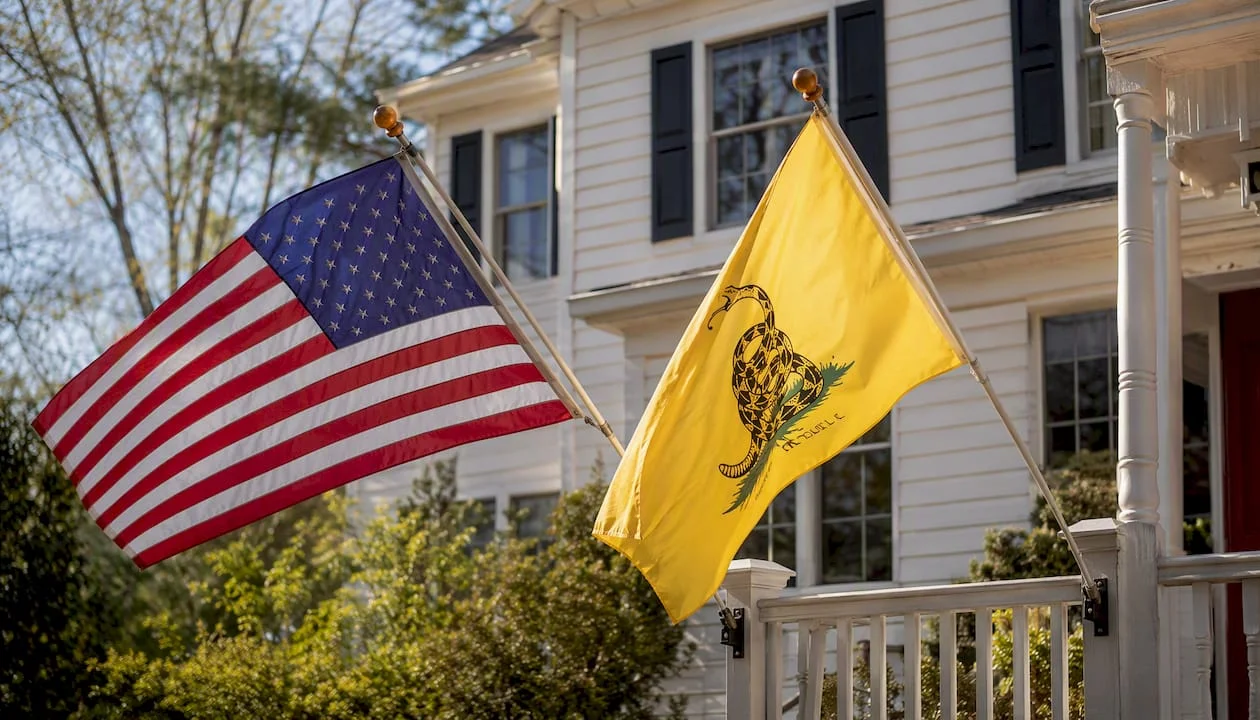
Three or more staffs: The U.S. flag stands at the center, with other flags arranged symmetrically on either side. No flag on a flanking staff may be set higher than the U.S. flag.
Hoisting and lowering sequence: Hoist the U.S. flag first, lower it last. This sequence applies whether you are raising it alone or alongside other flags.
Same-pole displays: The U.S. flag must be at the top. Flying another flag above it on the same halyard is a direct violation of the Flag Code, regardless of the occasion.
Decorative flags — seasonal banners, sports flags, garden flags — should be displayed on a separate, lower staff or in a location that does not compete with the U.S. flag’s prominence. Placing a decorative flag on the same bracket or at the same height as the U.S. flag creates visual ambiguity about which flag holds the position of honor.
Can you leave the flag up at night, and how should you light it?
The etiquette is clear: the American flag may be displayed at night only if it is properly illuminated. An unlit flag left out after dark is considered a lapse in the respect the flag deserves, not merely a technicality.
Practical lighting options for homeowners include:
- Ground-mounted uplights aimed directly at the flag provide the most reliable illumination for yard poles. A focused beam keeps light spill away from neighboring windows.
- Porch-mounted fixtures can serve a staff-mounted flag if the fixture is positioned to wash the flag with light rather than casting it in shadow. Aim the beam toward the flag, not the wall behind it.
- Dedicated flag spotlights are low-profile fixtures designed specifically for this purpose; they mount near the base of a yard pole or on a porch post and direct a narrow beam upward.
- Timers and motion sensors reduce energy use and remove the daily burden of remembering to switch the light on at dusk. A dusk-to-dawn photocell timer is the most reliable option for continuous nighttime display.
- Weatherproof fixtures rated for outdoor use (IP65 or higher) are necessary for any permanent installation exposed to rain, humidity, or freezing temperatures.
A flag left in darkness is better brought inside for the night than left unlit. Bringing the flag in also protects it from dew, frost, and wind damage that accumulates over repeated overnight exposures.
When and how do you fly the flag at half-staff?
Half-staff observances are proclaimed by the President of the United States or, for state-specific occasions, by a state’s governor. Homeowners who wish to honor these proclamations should check the White House website or their governor’s official page, as dates change and are not fixed on a permanent calendar.
The mechanical steps for a staff-mounted house flag differ slightly from a full flagpole:
- Fixed angled staff: A flag on a fixed bracket cannot be lowered to a true half-staff position. The respectful alternative is to attach a black mourning ribbon or streamer to the top of the staff, or to remove the flag entirely for the duration of the observance.
- Removable or adjustable staff: Hoist the flag to the peak of the staff first, then lower it to the midpoint. To return to full display, raise it to the peak again before lowering it fully.
- Yard flagpole with halyard: Hoist the flag briskly to the top of the pole, then lower it ceremoniously to half-staff — the midpoint between the top and the base. Reverse the sequence when the observance ends: raise to the peak, then lower.
Permanent observance dates — Memorial Day, Pearl Harbor Remembrance Day, Patriot Day — are established by law and do not require a new proclamation each year. For all others, the official proclamation is the authoritative source.
How do you care for a flag and retire it with dignity?
A worn or damaged flag diminishes the honor of the display. The standard for retirement is straightforward: when a flag is no longer in a condition that reflects credit upon the nation, it should be replaced.
Signs that a flag needs replacement:
- Fraying or unraveling along the fly end (the free edge opposite the hoist)
- Fading so severe that the colors are no longer distinct
- Tears, holes, or staining that cannot be cleaned
- Mildew or structural damage to the fabric
Care and storage basics:
- Nylon flags dry quickly and resist mildew, making them well suited to humid or rainy climates. Cotton flags carry a traditional appearance but require more careful drying before storage.
- Fold the flag loosely and store it in a clean, dry container away from direct sunlight when not in use for extended periods.
- Follow the manufacturer’s care instructions for washing; most nylon and polyester flags tolerate a gentle machine wash in cold water.
Respectful retirement options:
- Many veteran organizations and American Legion posts accept worn flags for ceremonial retirement, typically by burning in a solemn ceremony.
- Some municipalities operate flag drop-off programs, particularly around Flag Day (June 14) and Veterans Day.
- A homeowner who chooses to retire a flag privately may do so by burning it completely in a dignified, respectful manner, ensuring the fire is controlled and the act is treated with solemnity rather than casualness.
The Ultimate Flags guide on respectful flag handling offers additional context on the tradition and meaning behind proper retirement.
What flag size and material should you choose for each placement?
Matching flag size to pole length and porch scale is much like choosing artwork for a wall: a flag that is too small looks lost, while one that is too large overwhelms the space and strains the hardware.
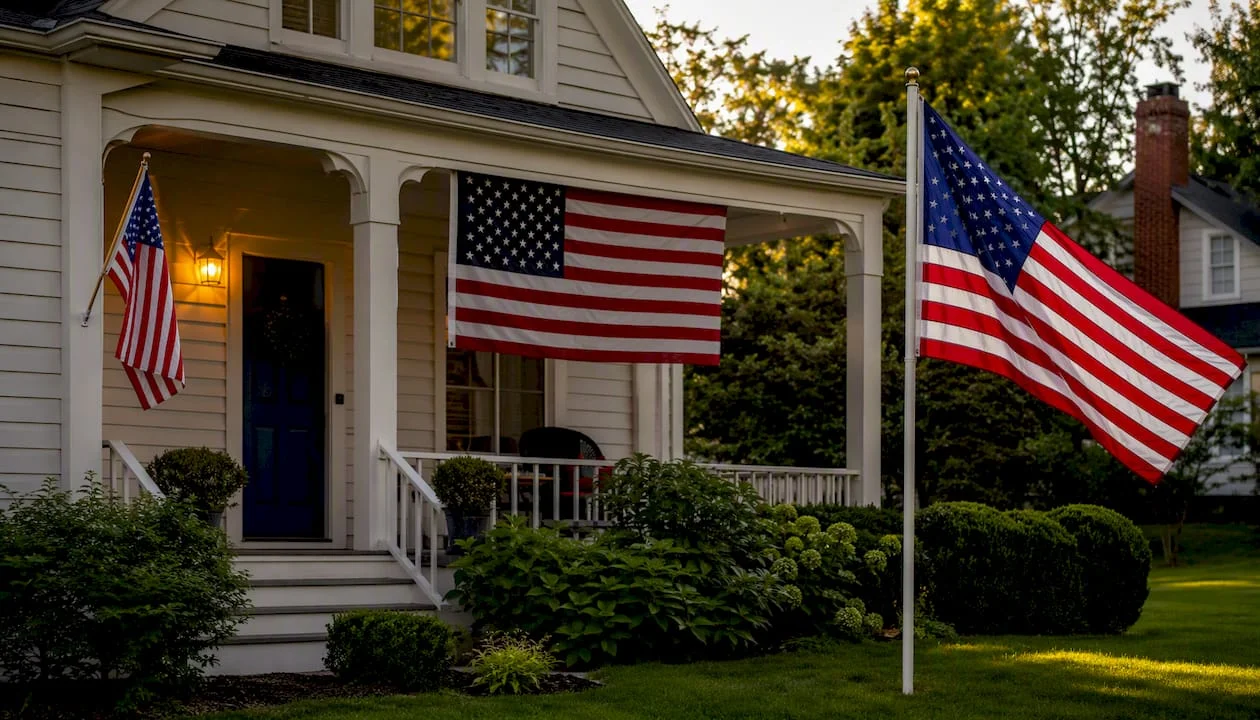
A 3×5 flag is the most common choice for porch and home display, and it pairs well with a 5–6 ft staff on a standard bracket. For homes set back from the street, a 4×6 flag on a longer staff improves visibility at distance without looking disproportionate on the façade.
Material by climate: Nylon is the preferred choice for wet or humid regions because it dries quickly and resists mildew. In high-wind areas, a heavier sewn polyester or a nylon flag with reinforced stitching at the fly end will outlast a lightweight flag by a considerable margin. Cotton flags carry a traditional, full-bodied appearance and are well suited to covered porches where they are protected from direct rain.
Pro Tip: When in doubt about size, stand at the street and hold up a piece of cardboard cut to the flag’s dimensions against the façade. The visual proportion from the curb tells you more than any formula.
Common mistakes homeowners make and a pre-display checklist
Even well-intentioned homeowners repeat the same errors. Knowing them in advance makes the difference between a display that honors the flag and one that inadvertently diminishes it. For a deeper look at rules most people overlook, the Ultimate Flags guide to flag rules is worth reading before you mount anything.
Top eight mistakes:
- Flying the flag upside down (reserved for a signal of dire distress; never appropriate for routine display)
- Placing the union on the wrong side in a vertical or window display (must be uppermost and to the observer’s left)
- Mounting the flag where it strikes a wall, railing, or overhang and cannot fly freely
- Displaying a visibly worn, faded, or torn flag
- Grouping a state or decorative flag at the same height or to the left of the U.S. flag
- Leaving the flag out after dark without illumination
- Using wood screws on masonry surfaces, which will loosen and fail under wind load
- Ignoring HOA or local ordinances that restrict pole height, bracket placement, or flag size
Pre-display checklist:
- Confirm mounting surface type and select appropriate anchors or mounting block
- Verify no electrical lines or plumbing behind the mounting point
- Check HOA rules and local ordinances for any restrictions
- Confirm flag is clean, undamaged, and colors are distinct
- Set bracket angle to approximately 45° and confirm the flag flies clear of all obstructions
- Test lighting if the flag will remain up after dark
- Verify union placement: peak of the staff for angled display, observer’s upper left for vertical
How do seasonal and weather conditions affect flag placement?
Seasonal changes affect both the flag’s material and the wisdom of leaving it in a fixed outdoor position. A flag that performs beautifully through a mild spring can suffer significant damage if left unattended through a summer thunderstorm season or a winter freeze.
Summer and high-wind seasons place the greatest stress on flag fabric. UV exposure fades colors, and sustained winds above 30 mph can fray even a well-made flag within weeks. Nylon handles wind better than cotton because it is lighter and flexes rather than resisting the load. During periods of severe weather, bringing the flag indoors is both respectful and practical.
Winter considerations center on moisture and freeze-thaw cycles. A wet flag that freezes overnight can develop stress fractures in the fabric, particularly along the hems. Metal hardware, including snap hooks and swivels, can seize in cold temperatures; stainless steel hardware resists corrosion and performs more reliably through freeze-thaw cycles than zinc-plated alternatives.
Spring and fall transitions are good times to inspect mounting hardware for corrosion, check that bracket screws remain tight after seasonal expansion and contraction of the wall material, and assess whether the flag itself needs replacement before a new season of display.
For homeowners in coastal regions, salt air accelerates corrosion on both hardware and fabric. Marine-grade stainless steel fasteners and a nylon flag with UV-resistant dye are the most durable combination for that environment. Pairing your Americana-style home display with weather-appropriate hardware keeps the whole presentation looking sharp through every season.
Why correct placement and care reflect something larger than curb appeal
Proper flag display is not merely a matter of following rules. It is a visible expression of the values a homeowner holds and the community they belong to. A flag mounted with care, illuminated at night, and retired with dignity communicates something that no lawn ornament or seasonal decoration can replicate: a sincere, ongoing commitment to the ideals the flag represents.
The Flag Code’s guidance on prominence and union placement exists because the flag’s position in a display carries meaning. Placing it in the highest, most visible spot is not about aesthetics; it is about precedence. The nation it represents takes precedence. That understanding, carried forward by veterans, civic organizations, and ordinary homeowners across generations, is what gives the rules their weight.
At Ultimate Flags, that tradition informs everything from the flags carried in stock to the hardware recommended for mounting them. Correct placement, proper materials, and attentive care are not burdens. They are the minimum the flag deserves.
*— Jonica
Ready to display your flag with confidence?
Ultimate Flags carries an extensive selection of American flags in every size suited to home display, from compact 2×3 window flags to full 4×6 porch flags, alongside mounting brackets, pole kits, and the hardware needed for wood, vinyl, and masonry surfaces. Whether you are mounting your first flag or replacing a worn one, the new flag owner’s guide at Ultimate Flags walks through sizing, accessories, and care in plain language.

Beyond the Stars and Stripes, Ultimate Flags carries military and service flags, state flags, and historically significant designs that honor the full story of American heritage. Every flag in the catalog is selected with the same standard of quality that a dignified outdoor display demands. Browse the full selection and find the right flag, pole, and bracket for your home at Ultimateflags.
Sources
The following authoritative references were consulted for this guide and are recommended for further reading or verification:
- 4 U.S.C. § 7 | Position and manner of display
- Ushistory
- Flagpole Installation (Home Depot)
- American Flag History & Flag Etiquette (National Flag Foundation)
For half-staff proclamations: check the White House website (whitehouse.gov) and your state governor’s official page. Observance dates change, and the official proclamation is always the authoritative source. For local rules, contact your municipality directly or review your HOA’s CC&Rs before installation.
FAQ
Should the American flag be on the left or right side of the house?
Either side of the front door is acceptable; the priority is prominence and visibility from the street, not a strict left-or-right rule. USHISTORY.org’s Flag Code FAQs confirm that homeowners should choose whichever side offers the clearest, most unobstructed sightline.
What are the rules for flying a flag at your house?
The U.S. Flag Code (4 U.S.C. § 7) requires the union at the peak of the staff for angled displays, the union uppermost and to the observer’s left for vertical displays, and proper illumination if the flag remains out after dark. No other flag may be placed above or to the right of the U.S. flag.
Where is the best place to hang a flag on a house?
An angled staff bracket beside the front door is the most common and practical choice, placing the flag at a prominent, visible position at the home’s main point of entry. A porch column, centered over the entry, or a yard flagpole are equally dignified alternatives depending on the home’s layout.
What does hanging an American flag outside your house mean?
Displaying the American flag at home is a public expression of patriotism, civic pride, and respect for the nation and those who have served it. Displayed correctly and maintained with care, it signals that the homeowner honors the values and traditions the flag represents.