Choose a flag whose fly, meaning its horizontal length, measures about one-quarter of the flagpole’s height. That single rule, a 1:4 flag to pole ratio, governs most residential and many commercial installations across the country, and it is the number every flagpole manufacturer builds its sizing charts around.
A few quick examples make this concrete. A house-mounted pole standing 15 to 20 feet tall calls for a 3’x5’ flag. A 25-foot in-ground pole pairs naturally with a 5’x8’ flag. Step up to a 30-foot pole and a 6’x10’ flag brings the proportions back into balance.
The formula itself is simple: pole height divided by 4 equals the recommended flag length, rounded to the nearest standard size. A 24-foot pole works out to 6 feet of fly, which rounds to a 5’x8’ or 6’x10’ flag depending on how much visual weight you want.
- Favor a smaller flag-to-pole ratio in tight residential settings, windy regions, or when heavier fabric increases strain on the pole.
- Favor a larger ratio for ceremonial displays, parade settings, or commercial properties where visibility from a distance is prioritized over potential pole wear.
Pro Tip: Measure your pole’s exposed height, not its total length. A 25-foot flagpole with 4 feet buried in a ground sleeve only has 21 feet of visible height, and your flag size should reflect that number, not the manufacturer’s stated length.
Key Takeaways
A properly sized flag flies at roughly one-quarter of the flagpole’s exposed height, with adjustments made for wind exposure, fabric weight, and mount type.
| Point | Details |
|---|---|
| Use the 1:4 rule first | Divide pole height by 4 and round to the nearest standard flag size. |
| Match size to mount type | House-mount poles need smaller, proportional flags; in-ground poles can carry larger sizes. |
| Watch wind and fabric | Heavier polyester flags and high-wind sites call for sizing down or choosing nylon. |
| Confirm foundation depth | Check manufacturer drawings for your exact pole height rather than estimating. |
| Shop matched pairings at Ultimate Flags | Ultimate Flags offers standard flag sizes built to pair with common pole heights. |
Table of Contents
- Understanding the 1:4, 1:5, and 1:3 Ratios
- Flag Size Chart: Matching Pole Height to Flag Dimensions
- House-Mount vs In-Ground Flagpoles: What Changes
- Foundation Depth, Installation Safety, and Local Permits
- Wind, Fabric Weight, and When to Adjust Your Ratio
- Practical Flag and Pole Pairings Worth Knowing
- Where the Quarter-Ratio Rule Actually Came From
- How Ratios Shift for National, Decorative, and Signal Flags
- Regional Habits in Flag Sizing
- How Fabric Weight Changes Your Sizing Decision
- Keeping Flag and Pole Sized Right Over Time
- Sources
- FAQ
Understanding the 1:4, 1:5, and 1:3 Ratios
The ratio compares two measurements: the flag’s fly (its horizontal length) against the flagpole’s height above ground. A 1:4 ratio on a 20-foot pole calls for a 5-foot flag length, which is why a 4’x6’ or 5’x8’ flag looks correct on that setup while a 10’x15’ flag would look absurdly oversized and strain the hardware.
Manufacturers gravitate toward the quarter-height rule because it balances three competing needs at once: the flag stays visible from the street, the proportions look right against the pole’s height, and the fabric doesn’t create so much surface area that ordinary wind gusts become a structural problem. Annin’s flag sizing guidance places residential and in-ground poles in a range between one-quarter and one-third of pole height, giving installers room to adjust for local conditions.
A 1:5 ratio suits decorative house mounts and cramped urban lots where a larger flag would overwhelm the property or brush against siding. A 1:3 ratio belongs on flagpoles at courthouses, stadiums, and memorial sites, where the flag itself often serves as the visual centerpiece and the pole was engineered from the start to carry that extra load.
Pro Tip: Before sizing up toward a 1:3 ratio, check your pole manufacturer’s wind-rating documentation. A pole rated for a 1:4 flag at 90 mph may drop well below that threshold once you add the surface area of a 1:3 flag, according to Flagpole Warehouse’s wind-speed lookups.
Flag Size Chart: Matching Pole Height to Flag Dimensions
Here is the quick-reference chart installers and flag retailers use most often, built from standard industry pairings.
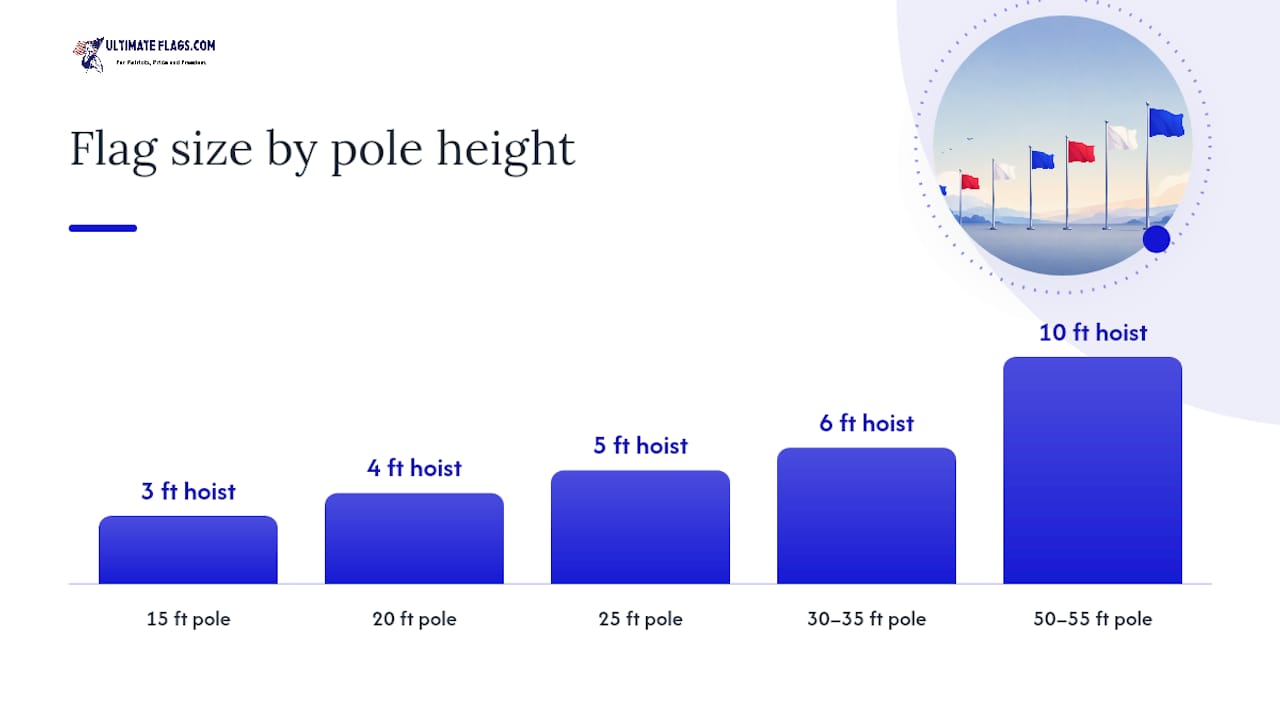
| Pole Height | Recommended Flag Size |
|---|---|
| 15 ft | 3’ x 5’ |
| 20 ft | 4’ x 6’ |
| 25 ft | 5’ x 8’ |
| 30–35 ft | 6’ x 10’ |
| 40–45 ft | 8’ x 12’ |
| 50–55 ft | 10’ x 15’ |
| — | 12’ x 15’ |
| — | 15’ x 25’ |
These pairings come from Flagpole Warehouse’s specification generator, which cross-references NAAMM FP-1001 pole ratings with ASCE 7 regional wind-speed data to arrive at safe, proportional sizing.
Here’s how to work out a flag size for a pole height that doesn’t land neatly on the chart.
- Take your pole’s exposed height. Say it’s 22 feet.
- Divide by 4, following the standard ratio. That gives you 5.5 feet of recommended flag length.
- Round to the nearest standard size, which lands you between a 5’x8’ and a 6’x10’ flag.
- Choose the smaller size if your site is windy or the pole has a slim butt diameter, and the larger size if visibility and ceremonial presence matter more.
Some manufacturers list a 1:5 ratio as the conservative alternative, so a 22-foot pole under that formula would call for a 4’x6’ flag instead. Treat the chart above as the aggressive, more visible end of the range and the 1:5 formula as the cautious end.
House-Mount vs In-Ground Flagpoles: What Changes
A house-mounted pole and a freestanding in-ground pole are not scaled versions of the same thing. House poles are shorter, project from a wall bracket, and sit close enough to the building that clearance becomes the deciding factor, not just height math.
Annin’s own sizing examples reflect this. A 5-foot house pole pairs with a 2.5’x4’ banner, while a 6-foot house pole suits a standard 3’x5’ flag. Neither comes close to the quarter-ratio math you’d use on a 25-foot in-ground pole, because house mounts prioritize proportion against the building’s facade over raw visibility from a distance.
Before ordering a house-mount flag, walk through this checklist:
- Measure the pole’s exposed length from the bracket to the tip, not the full pole including the portion inside the mount.
- Measure how far the pole projects from the wall, since a flag flying at full extension needs to clear gutters, shutters, and roof eaves.
- Confirm the halyard and clip have enough swing room that the flag won’t wrap around the pole in shifting wind.
Installation notes matter just as much as sizing here. A flag that regularly brushes brick or vinyl siding wears out its fly edge fast, and a pole mounted too close to a roofline invites the flag to snag on shingles during gusts. In-ground poles avoid most of these problems simply by standing clear of structures, which is part of why they can safely carry a larger flag under the same ratio guidance.
Foundation Depth, Installation Safety, and Local Permits
The most common question installers hear is how deep a foundation needs to be for a 20-foot pole. Manufacturer guidance from America First Flagpoles uses tapered foundation examples scaled to height, such as a 25-foot pole calling for a 24-inch diameter foundation dug 4 feet 6 inches deep, and a 30-foot pole requiring 30 inches wide by 5 feet 6 inches deep. A 20-foot pole typically falls just under that 25-foot example, so most manufacturer drawings specify a slightly smaller footing, and you should always confirm the exact dimension against your specific pole’s installation sheet rather than estimating from a neighboring size.
Taller commercial poles often require more than a shovel and a bag of concrete. Installations that exceed certain heights commonly need a wet-stamped engineering drawing to satisfy local permitting, since the structural math changes considerably once you’re supporting 40 or 50 feet of steel in open wind.
Pro Tip: Call your local utility locate service before digging any flagpole foundation, even a residential one. A few feet of unexpected depth is a minor inconvenience; a severed gas or electric line is not.
Wind, Fabric Weight, and When to Adjust Your Ratio
Wind is the variable most homeowners underestimate. A flag isn’t just a decorative sheet of fabric; it’s a sail, and every square foot you add increases the load your pole has to resist. NAAMM FP-1001 and ASCE 7 are the two standards flagpole manufacturers lean on to calculate safe wind ratings, and they factor in both regional wind speed and the flag’s surface area.

Heavier polyester flags increase that load more than lightweight nylon, which is why Flagpole Warehouse’s cut-sheet builder publishes separate wind-rating tables depending on fabric choice. The same pole that safely handles a nylon flag at a given wind rating may fall below that threshold with a heavier polyester flag of the same dimensions.
Consider sizing down when any of these apply to your site:
- You live in a coastal or plains region with frequent high winds.
- Your flag fabric is heavyweight polyester rather than lightweight nylon.
- Your pole has a slim butt diameter built for residential rather than commercial loads.
Consider sizing up when visibility at a distance genuinely matters, such as a business sign pole along a highway or a ceremonial pole at a public event.
A pole’s wind rating is calculated for a specific flag size and fabric. Swap in a larger or heavier flag, and you are no longer flying within the rating the manufacturer engineered for, whatever the pole’s paperwork claims.
Practical Flag and Pole Pairings Worth Knowing
Retailers who stock both flags and poles tend to repeat the same handful of pairings because they hold up across thousands of installations:
- 3’x5’ flag pairs with a 15 to 20-foot house or short in-ground pole.
- 4’x6’ flag suits a standard 20-foot residential pole.
- 5’x8’ flag is the workhorse size for 25-foot poles.
- 6’x10’ flag fits 30 to 35-foot poles, often seen at businesses and schools.
- 8’x12’ flag matches 40 to 45-foot commercial poles.
- 10’x15’ flag belongs on 50 to 55-foot poles, typically municipal or ceremonial installations.
Material matters within these pairings, too. A nylon flag flies more easily in light wind and dries fast after rain, while a heavier polyester flag holds up better under sustained, harder wind but adds more load to the pole. Always cross-check your chosen size against the pole maker’s NAAMM/ASCE-based wind rating before moving up a size, particularly if you’re pairing a heavier fabric with an already tall pole.
Pro Tip: If you’re unsure which size fits your specific pole, Ultimate Flags’ buying guide for pole kits walks through common pairings for readers assembling a flag and pole set from scratch.
Where the Quarter-Ratio Rule Actually Came From
The quarter-height guideline didn’t emerge from a single decree. It developed gradually through decades of flag manufacturing practice, as pole makers and flag sewers converged on proportions that looked balanced on a pole while staying manageable in ordinary wind. Military and government flag programs formalized certain ratios for official use, but the residential and commercial guidance you see today largely reflects a working consensus among manufacturers rather than a single regulatory standard.
That consensus persists because it works. A flag at roughly one-quarter of pole height reads clearly from the street, doesn’t overwhelm the structure it’s mounted to, and keeps wind loading within a range most standard poles can handle without specialized engineering.
How Ratios Shift for National, Decorative, and Signal Flags
National flags flown on residential and commercial poles follow the 1:4 guidance covered throughout this article. Decorative flags, garden banners, and seasonal designs often run smaller relative to their poles, since they’re meant to be charming accents rather than dominant visual statements, and oversizing them looks cluttered rather than proud.
Signal flags and nautical pennants follow an entirely different logic, built around visibility at sea and standardized shapes rather than pole-height proportion. If you’re flying maritime signal flags, the sizing conventions from nautical flag standards apply instead of the residential ratio guidance in this article.
Regional Habits in Flag Sizing
Sizing preferences shift somewhat by region, largely driven by wind exposure rather than tradition. Coastal areas and open plains states tend to favor the more conservative 1:5 ratio or lean toward nylon fabric, simply because sustained wind is a daily reality rather than an occasional storm. Inland and suburban regions with milder wind patterns have more flexibility to size up toward 1:3 for visual impact, particularly on commercial and ceremonial poles where the property owner wants the flag to command attention.
How Fabric Weight Changes Your Sizing Decision
Nylon and polyester behave differently on a pole, and that difference should influence your sizing choice as much as height math does. Nylon is lighter, catches wind easily even in light breezes, and puts comparatively less strain on a pole’s rated capacity. Polyester is heavier, holds its shape well in sustained wind, but adds meaningfully more load, which is why the same flag dimensions in polyester can push a pole closer to its rated wind limit than the equivalent nylon flag would.
If you’re sizing near the upper end of a pole’s recommended range, choosing nylon over polyester gives you a bit more safety margin without changing the flag’s dimensions at all.
Keeping Flag and Pole Sized Right Over Time
A correctly sized flag still needs regular attention to stay looking sharp and to protect the pole hardware. Flags at the larger end of their pole’s rated range wear faster, since more fabric means more stress on the fly edge with every gust. Rotating a heavily used flag out for a fresh one every few months, especially at the upper end of a size range, keeps fraying from becoming a safety issue where torn fabric wraps around a halyard.
Correct sizing also protects the pole itself. A flag consistently oversized for its pole accelerates wear on the clips, halyard, and even the internal pole components over years of use, while a properly matched flag lets the whole setup last far longer between hardware replacements. Ultimate Flags’ guide to flag care after purchase covers the maintenance habits that extend a flag’s working life once it’s flying at the right size.
A Seller’s Take on the Sizing Mistakes That Keep Repeating
The most common mistake isn’t picking the wrong ratio on paper. It’s picking a flag sized correctly for the pole’s height but ignoring what the pole was actually rated to carry, especially on house mounts where a heavy polyester flag ends up fighting a bracket built for something lighter.
The second mistake is skipping the tape measure. Buyers eyeball a pole’s height from the ground, guess at wall clearance, and end up with a flag that brushes the gutter every time the wind shifts. Walking the site with an actual tape measure, checking exposed pole height and wall projection, and confirming the flag won’t touch the roofline takes ten minutes and prevents most returns.
If there’s one rule worth carrying away from all of this, it’s the same one from the top: size your flag to roughly one-quarter of your pole’s exposed height, and if you’re in a high-wind area, check the pole’s rated capacity before you size up.
Get the Right Flag and Pole Pairing the First Time
Ultimate Flags stocks the standard sizes covered in this chart, from 3’x5’ flags for short house poles up through the larger commercial dimensions, already paired with poles built to carry them.

That means you’re not guessing whether a 5’x8’ flag will overwhelm a 20-foot pole or whether a lightweight nylon option makes more sense for your wind conditions. Browse the flag and pole selection to find a pairing built for your exact pole height, and reach out to customer support if you need help matching a specific measurement to the right size before you order.
Sources
- Flagpole Warehouse Specification Generator | CSI Section 107500
- For Your Flag Pole (Annin flag size chart PDF)
Always confirm final dimensions against your specific pole manufacturer’s installation drawings before digging or ordering, since site conditions and local codes can shift the exact numbers.
FAQ
How deep should a foundation be for a 20-foot flagpole?
Manufacturer templates for a 25-foot pole call for roughly 24 inches in diameter and 4 feet 6 inches deep, so a 20-foot pole typically needs a slightly smaller footing. Always confirm against your specific pole’s installation drawing before digging.
Can you fly a 5’x8’ flag on a 20-foot pole?
A 5’x8’ flag is generally sized for a 25-foot pole under the standard 1:4 ratio, making it slightly large for a 20-foot pole. It can work in low-wind areas with a lightweight nylon flag, but a 4’x6’ flag is the better proportional match.
How big should a flag be on a 30-foot pole?
A 30-foot pole pairs with a 6’x10’ flag under the standard quarter-height ratio used across most residential and commercial installations.
Can I put a 4’x6’ flag on a 20-foot pole?
Yes, a 4’x6’ flag is the standard recommended size for a 20-foot pole, following the widely used pole-to-flag pairing chart from Flagpole Warehouse.