BLUF: your flag’s length should run about one-quarter to one-third of your flagpole’s height. A 20-foot pole calls for a flag about one-quarter to one-third of that height. For the great majority of American homes, that math lands squarely on the classic 3×5 foot flag, which is why it remains the most common size sold for residential display.
Here is the trade-off in one breath: sizing toward one-quarter keeps the flag graceful and easy on the fabric in gusty conditions, while sizing toward one-third gives you a bolder, more commanding presence on a calm, sheltered lot.
- Standard residential default: 3×5 ft on poles of 15 to 25 feet.
- Exception, very tall pole: 25 to 30 ft poles usually call for a 5×8 ft flag.
- Exception, high wind: favor the lower end of the ratio and a tougher fabric.
Pole diameter, and whether your flag has a sleeve or grommets, decides whether that perfect-looking flag actually fits your hardware. We will get to the tape measure in a moment.
Key Takeaways
The right flag size comes from matching flag length to one-quarter or one-third of pole height, then confirming pole diameter and hardware type before ordering.
| Point | Details |
|---|---|
| Core sizing rule | Flag length should equal one-quarter to one-third of total pole height. |
| Most common residential size | 3×5 ft fits poles between 15 and 25 feet, the standard American default. |
| Measure before you buy | Use the string-and-pi method to find pole diameter, then check sleeve clearance. |
| Match material to wind | Choose polyester over nylon for consistently windy or commercial locations. |
| Where to order a properly sized flag | Ultimate Flags stocks standard sizes from 2×3 through 8×12 with hardware guidance included. |
Table of Contents
- Flag Size Chart by Pole Height
- How Do You Measure Your Pole and Flag Correctly?
- Which Material Handles Wind Best at Larger Sizes?
- Sleeve vs. Grommet: Which Attachment Fits Your Pole?
- Standard Sizes Across Different Flag Types
- Are There Rules for Flag Size at Government Buildings or Schools?
- How Far Away Will Your Flag Be Seen?
- Does Flag Size Change What It Communicates?
- The Real Judgment Call Behind Flag Sizing
- Get the Right Flag Fit From Ultimate Flags
- Sources
- FAQ
Flag Size Chart by Pole Height
Matching a flag to a pole isn’t guesswork once you see the numbers laid out. Manufacturers have refined this pairing for decades, and the industry-standard sizing charts converge on a fairly consistent set of recommendations.
| Pole Height | Recommended Flag Size | Metric Equivalent | Typical Setting |
|---|---|---|---|
| 15–20 ft | 3×5 ft | 90×150 cm | Residential yard, porch mount |
| 20–25 ft | 4×6 ft | 120×180 cm | Larger residential, small business |
| 25–30 ft | 5×8 ft | 150×240 cm | Commercial storefront, church, school |
| 30–40 ft | 6×10 ft | 180×300 cm | Large commercial, municipal |
| 40 ft | 8×12 ft or larger | 240×300 cm | Civic plazas, stadiums, monuments |
Notice that the width-to-length ratio isn’t identical across every row. Retail flags typically use one of three ratios: 1.5 (as in a 2×3 or 3×5), 1.6 (2.5×4 or 5×8), or 1.667 (3×5 or 6×10). None of these match the exact 1:1.9 hoist-to-fly proportion set by federal G‑spec standards for government flags, and that’s by design. Retail manufacturers favor slightly fuller proportions because they display better and wear more evenly on the poles most households actually own.
A quick way to keep the metric conversions straight:
- 3×5 ft = 90×150 cm
- 4×6 ft = 120×180 cm
- 5×8 ft = 150×240 cm
- 6×10 ft = 180×300 cm
If your pole height falls between two bands, size down rather than up. A flag that’s slightly conservative for its pole reads as intentional and tailored. One that’s oversized looks like it’s fighting the pole, and in a stiff wind, it will fight the fabric too.
How Do You Measure Your Pole and Flag Correctly?
Getting the numbers right takes ten minutes and a tape measure. Skip this step and even the best size chart won’t save you from an awkward fit.
- Measure pole height from the ground up, not from the sleeve or mounting bracket. Use a tape measure for shorter residential poles; for anything above 20 feet, estimate using the pole’s stated specification from its installer or manufacturer rather than eyeballing it from below.
- Find the pole’s outer diameter using the string method. Wrap a piece of string snugly around the pole, mark where it overlaps, then lay the string flat and measure its length. Divide that number by pi (3.14159). A string that measures 6.28 inches around gives you a 2-inch diameter pole.
- Measure hoist and fly on any existing flag. The hoist is the edge attached to the pole (the vertical measurement on a wall-mounted flag, or the shorter side on a pole-flown flag). The fly is the length that extends outward. Retail listings state size as width by length, so a “3×5” flag has a 3-foot hoist and a 5-foot fly.
- Photograph the pole’s top attachment point before you order, and note whether it takes a sleeve, grommets, or a clip system.
Pro Tip: Keep a small note on your phone with your pole’s diameter and height. You’ll need both numbers again the next time you replace a worn flag, and it saves a second trip outside with the tape measure.
Which Material Handles Wind Best at Larger Sizes?
Size and material decisions are joined at the hip, and treating them separately is where most buyers go wrong. A flag that looks perfect on a chart can still shred itself in six months if the fabric doesn’t match the wind.

Nylon is lightweight, catches even a light breeze, and produces the vivid, glossy color that looks striking against a blue sky. It’s the right call for low-to-moderate wind areas where visual impact matters more than raw durability.
Polyester, especially two-ply construction, carries more weight and resists tearing far better than nylon. It’s the standard recommendation for windy coastal properties, commercial flagpoles, or any site where the flag flies daily rather than occasionally.
Coastal and plains locations with sustained high wind should lean toward the smaller end of the one-quarter to one-third range and pair it with a heavier fabric. Manufacturers are candid on this point: a smaller flag in stronger material outperforms an oversized flag in fragile fabric, both in longevity and in how the flag actually looks after a few weeks of real weather.
- Nylon: bright color, light wind, decorative emphasis
- Polyester or two-ply: heavier, tear-resistant, built for constant flying
- High-wind sites: size down, fabric up
One more thing worth flagging (no pun intended): feather flags and other vertical banners follow entirely different sizing logic. Those systems are measured by total pole-and-base height, commonly 8, 11, 14, or 17 feet, with the fabric panel itself much shorter than the system. Don’t try to apply the horizontal one-quarter to one-third rule to a vertical feather flag; the math simply doesn’t transfer.
Sleeve vs. Grommet: Which Attachment Fits Your Pole?
Even a perfectly sized flag will disappoint you if the attachment hardware doesn’t match your pole. This is where most ordering mistakes actually happen, and it’s often a bigger source of frustration than an inch or two of size error.
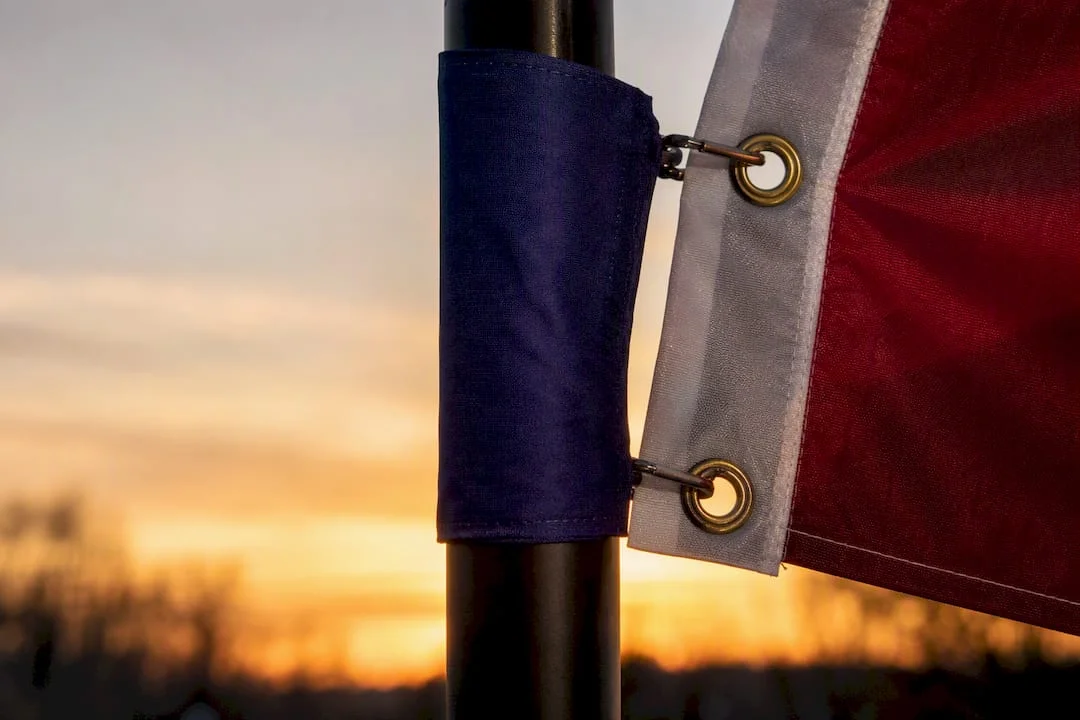
Sleeve, or tunnel, flags slide directly over the pole through a fabric channel sewn along the hoist edge. They’re common on residential and outrigger poles because they eliminate visible hardware and spin freely with the wind. Grommet flags have metal or plastic rings along the hoist edge and attach via clips, snaps, or a halyard and pulley system. Grommets suit taller commercial poles where a full halyard system raises and lowers the flag.
The clearance rule for a sleeve flag: inner diameter should run about half an inch to a full inch larger than your pole’s outer diameter. A 1-inch pole wants roughly a 1.5-inch sleeve. A 2-inch pole wants 2.5 to 3 inches. Too tight and the flag binds; too loose and it spins excessively and wears at the seams.
- Sleeve/tunnel: best for residential poles, no visible hardware
- Grommets with clips or carabiners: best for poles with a halyard system
- Signs of a bad fit: flag binds when raised, spins constantly, or hangs limp because it’s too small to be seen from the street
Pro Tip: If your current flag spins wildly in normal wind, the sleeve is too loose, not the flag too small. Check the diameter math before you buy a bigger flag.
Why Trust This Guidance on Flag Sizing?
Ultimate Flags has operated as America’s oldest online flag store, building deep, hands-on familiarity with sizing charts, hardware compatibility, and the practical headaches that come with mounting flags on everything from porch brackets to 40-foot commercial poles.
Getting the size right the first time saves a customer money, saves a flag from premature wear, and saves the frustration of a second order. That is the standard we write toward.
- If you’re unsure about your pole’s fit, send a photo and the diameter measurement before ordering.
- Sizing recommendations here reflect established industry sizing charts and hardware-fit standards, not guesswork.
Standard Sizes Across Different Flag Types
Not every flag follows the same sizing logic, and lumping them together is a common source of confusion. National flags, the kind flown on residential and commercial poles, dominate the market in 3×5, 4×6, 5×8, and 6×10 configurations, all built on the retail ratios discussed above.
Signal flags, used in nautical and maritime contexts, follow an entirely different tradition rooted in visibility at sea rather than proportion on a pole. These tend to run smaller and squarer, prioritizing quick recognition of shape and color pattern over the elongated look of a national flag.
Decorative and garden flags are a different animal altogether. Garden flags typically measure around 12×18 inches and mount on short garden poles at porch or flowerbed height, never subject to the quarter-to-third rule because their entire purpose is close-range charm rather than distance visibility.
Military and service flags, including many of the historical and honor flags Ultimate Flags carries, generally follow the same 3×5 or 4×6 conventions as national flags when pole-mounted, though ceremonial and indoor display versions (often finished with gold fringe and a pole sleeve) run smaller, commonly 3×5 for indoor stands.
The throughline across all of these: match the flag’s traditional use case to its size category first, then apply pole-ratio math only when the flag is actually meant for horizontal outdoor display on a standing pole.
Are There Rules for Flag Size at Government Buildings or Schools?
Government buildings operate under a different rulebook than your front porch. Executive Order 10834 and Title 4 of the U.S. Code establish exact G‑spec proportions, a 1:1.9 hoist-to-fly ratio, and a defined table of authorized sizes for federal use, ranging from massive 20×38 foot flags for large installations down to a 3×5 foot post flag.
Schools generally aren’t bound by federal G‑spec sizing, but most follow the same practical logic as any commercial property: match flag size to pole height using the one-quarter to one-third ratio, and choose durable polyester given how often a schoolyard flag flies through all kinds of weather. Many state education codes address flag display requirements, such as daily flying during school sessions, without dictating exact dimensions.
Military installations tend to hew closer to G‑spec proportions, particularly for ceremonial and base-flagpole flags, since uniformity across bases matters for both protocol and visual consistency. If you’re outfitting a private flagpole and want that same crisp, official proportion rather than the fuller retail look, it’s worth knowing you’re choosing an aesthetic, not a legal requirement, since private citizens aren’t obligated to fly G‑spec dimensions.
How Far Away Will Your Flag Be Seen?
Viewing distance should drive your size decision as much as pole height does. A flag mounted on a wraparound porch bracket sits close to daily foot traffic, so a 3×5 remains legible and proportionate even at arm’s length. Move that same flag to a 30-foot pole at the edge of a large property line, and a 3×5 shrinks to a postage stamp against the sky.
Think about the sightline the way you’d think about hanging artwork in a room. A small painting looks intimate and detailed up close but disappears on a cavernous wall. A flag works the same way: the farther your typical viewer stands, whether that’s a passing car, a neighbor across the street, or a customer approaching a storefront, the larger the flag needs to be to register clearly at that distance.
For roadside visibility, most guidance for outdoor signage recommends sizing up specifically to compensate for driver sightlines and speed, a principle that applies just as directly to flags as it does to yard signs. A business flag meant to catch highway traffic needs to be dramatically larger than one meant for a quiet cul-de-sac.
Location matters too. A flag nestled among trees or mounted low against a building facade needs more size to compensate for visual competition, while a flag on an open, elevated pole with clear sky behind it can afford to run smaller and still command attention.
Does Flag Size Change What It Communicates?
Size carries meaning whether we consciously register it or not. A modest 3×5 flag on a porch bracket reads as personal, everyday devotion, the kind of quiet, consistent patriotism woven into daily life rather than performed for an audience. It’s dignified in its restraint.
A 6×10 or 8×12 flag commanding a tall pole in front of a business or civic building communicates something different: presence, permanence, and public commitment. Scale itself becomes part of the message, the same way a monument’s size shapes how visitors experience it before they read a single word carved into it.
This is precisely why undersizing feels like a missed opportunity and oversizing can feel almost theatrical if the setting doesn’t call for it. A 3×5 flag on a 40-foot commercial pole looks lost, as though the property forgot to finish the job. An 8×12 flag on a 15-foot residential pole overwhelms the house it’s meant to honor. Matching size to setting isn’t just a hardware decision. It’s how you make sure the flag’s symbolism lands the way you intend it to, whether that intent is quiet daily pride or a bold public statement.
The Real Judgment Call Behind Flag Sizing
The one-quarter to one-third rule gets repeated everywhere, but most guides stop there and leave you to guess the rest. That’s backwards. The rule is the easy part. The judgment calls that actually determine whether your flag looks right and lasts are wind exposure, sightline distance, and hardware fit, and those three get almost no attention anywhere else.
Conventional advice treats sizing as a single lookup: pole height in, flag size out. But two 20-foot poles in different yards can call for different decisions if one sits in an open, windy field and the other is tucked against a sheltered porch. The chart gets you in the right neighborhood. Your specific site gets you the right final answer.
If I had to rank priorities for a first-time buyer, hardware fit would come before size. An ill-fitting sleeve or the wrong grommet setup will ruin even a perfectly chosen flag faster than a size that’s slightly off. Measure the pole diameter before you fall in love with a flag size.
Get the Right Flag Fit From Ultimate Flags
Sizing charts only get you so far when your pole, your wind conditions, and your porch bracket are all a little different from the next house. Ultimate Flags built its catalog around that reality, stocking every standard size from 2×3 up through 8×12 in both nylon and heavier polyester, so you’re choosing the right combination for your specific setup instead of settling for whatever fits closest.

If your pole or bracket doesn’t match a standard configuration, Ultimate Flags can help you work through the sizing and hardware questions before you order rather than after a flag arrives that doesn’t fit. Browse the current selection, check your pole measurements against the sizes offered, and place an order sized specifically for your setup.
Sources
- U.S.C. Title 4 – FLAG AND SEAL, SEAT OF GOVERNMENT, AND THE STATES
- Flag of the United States – Wikipedia
- Flag Size Chart – Custom Branded Flag Dimensions Guide
- Flagpole Compatibility: Which Flag Fits Your Pole? (Size Chart Included) – Custom Flag Supply
FAQ
What is a standard size for a flag?
The most common standard is 3×5 feet, sized for residential poles between 15 and 25 feet tall. Larger properties and commercial poles typically move up to 4×6 or 5×8.
Should I get a 3×5 or 4×6 flag?
Choose 3×5 for poles up to about 20 feet or for standard porch brackets, and 4×6 for poles in the 20 to 25 foot range or when you want a bolder presence. Pole height and wind exposure should decide it, not personal preference alone.
Is a 2×3 flag too small?
A 2×3 flag works well for hand-holding, small brackets, or short poles under 10 feet, but it disappears against a full-size residential flagpole of 15 feet or more. Match it to close-range settings rather than a standing pole.
Is a 5×8 flag too big?
Not for its intended use. A 5×8 flag is proportioned for poles between 25 and 30 feet, and Ultimate Flags carries it in durable polyester for exactly that commercial or larger residential setting. It would look oversized on anything shorter than 20 feet, though.