Posted on

Sunrise to Noon: Exact Steps for U.S. Memorial Day Flag Etiquette

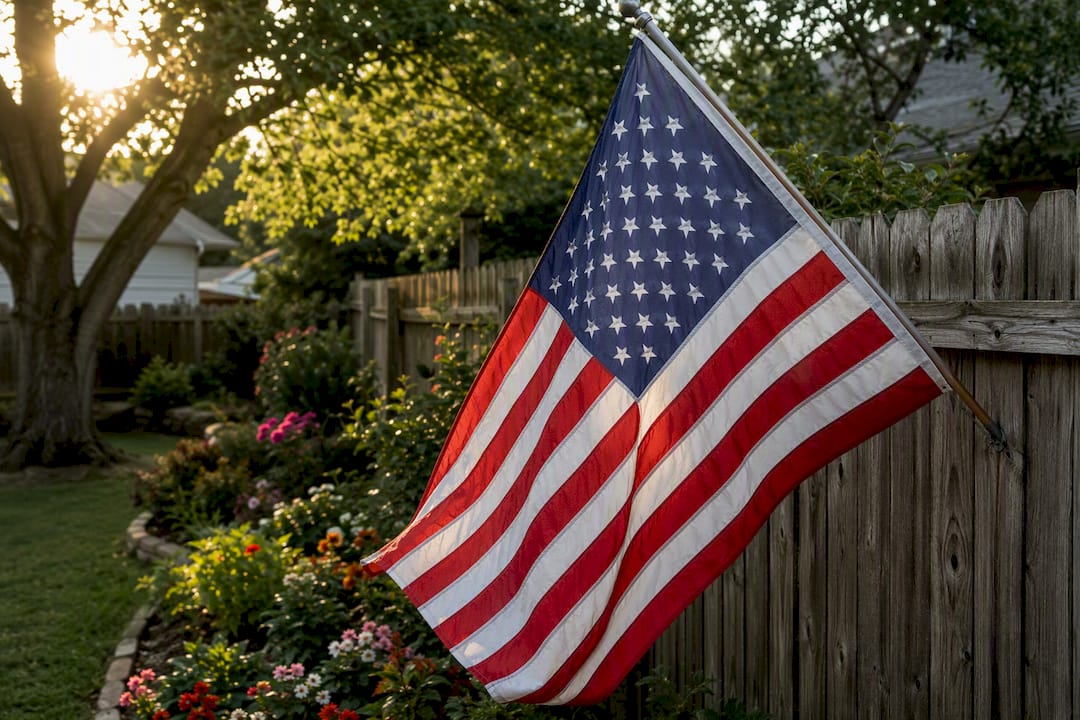
Hands raising a flag at sunrise

On Memorial Day, fly the U.S. flag at half-staff from sunrise until noon, then raise it briskly to full-staff for the remainder of the day. This sequence is set out in the U.S. Flag Code, and while the statute technically governs federal displays, private citizens are encouraged to observe the same custom as a mark of remembrance for the nation’s fallen.


TL;DR:

  • The flag must be hoisted to the peak at sunrise, then lowered slowly to half-staff, remaining there until noon, before being raised again to full-staff.
  • Proper flag placement at cemeteries involves placing small flags a few inches in front of headstones, with large-scale placements often coordinated by volunteer programs like the Honor Project.
  • A flag displayed overnight on Memorial Day should be properly illuminated; if not, it must be taken down at sunset to adhere to Flag Code etiquette.
  • The most common flag mistakes include skipping the initial full-staff raise, touching the ground during lowering, and displaying unlit flags after sunset.
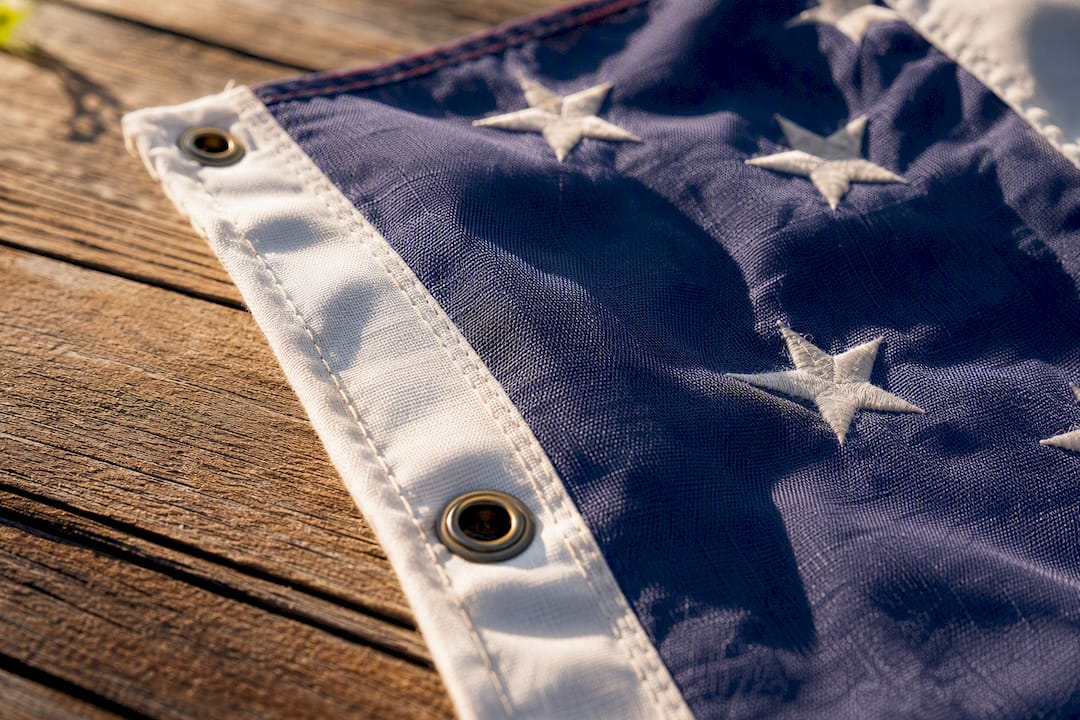
  • For the best Memorial Day display, use heavy-duty, weather-resistant flags with reinforced stitching and brass grommets, practicing the sequence beforehand.

Ultimate Flags
Find a Flag for Memorial Day
Explore American, military, service honoring, and historical flags for commemorative displays, personal use, and patriotic settings.

Explore the flag collection

Table of Contents

What Is the Official Memorial Day Flag Etiquette?

The half-staff rule for Memorial Day comes straight from federal law, not tradition alone. 4 U.S.C. § 7 designates Memorial Day as one of the specific days the flag flies at half-staff until noon, a distinction shared with almost no other holiday on the American calendar. Independence Day gets full-staff all day. Veterans Day gets full-staff all day. Memorial Day gets a morning of mourning followed by an afternoon of resolve, and that split is deliberate. The morning half-staff honors the dead. The noon rise to full-staff signals that their sacrifice was not in vain, that the nation they died for still stands.

4 U.S.C. § 6 governs the broader question of when the flag should fly at all, and it works alongside the Memorial Day rule rather than against it. Presidents and governors can also issue proclamations ordering half-staff display for other reasons, national tragedies, the death of a public figure, but Memorial Day’s half-staff period is a fixed, annual observance that doesn’t require a new order each year. The presidential Memorial Day proclamation typically reaffirms the custom and calls for participation nationwide.

Who is actually bound by this rule? Federal buildings, military installations, and government offices must comply. Private citizens are under no legal obligation, yet the overwhelming majority follow the same protocol out of respect. Consider it a shared civic gesture:

  • Federal and state government buildings observe the half-staff to full-staff transition by law.
  • Schools, businesses, and private residences are encouraged, not required, to follow suit.
  • Veteran organizations like the American Legion actively promote civilian participation as an act of collective remembrance.
  • Flags at cemeteries and memorial sites almost universally follow the same sunrise-to-noon-to-full-staff pattern.

How Do You Properly Hoist and Lower the Flag on Memorial Day?

Getting the sequence right takes less than a minute, but the order matters. Skipping a step, or rushing the ceremonial pause, undercuts the entire point of the gesture. Here’s the exact procedure, drawn from VA guidance on half-staff display:

  1. At sunrise, hoist the flag briskly all the way to the peak of the pole. Do not stop halfway. It must reach the top first.
  2. Immediately after reaching the peak, lower the flag slowly and ceremonially to the half-staff position.
  3. Half-staff means the midpoint between the top and bottom of the pole, not an eyeballed “somewhere lower” guess. On a standard residential pole, that’s roughly the flag’s own height below the peak.
  4. Leave the flag at half-staff from sunrise until noon.
  5. At noon, raise the flag briskly back to the peak, where it remains until sunset (or until you take it down for the day).
  6. Lower the flag ceremonially at sunset if you’re not equipped for illuminated overnight display.

The two directional cues matter as much as the timing: raises are brisk, almost martial; lowerings are slow and deliberate. That contrast is what gives the ceremony its weight.

If you’re managing a pole alone, don’t fight gravity or wind on a bad day. Wrap the halyard around the cleat before letting go, and never allow the rope to run free. Check that grommets are intact and the halyard isn’t frayed, a snapped line halfway through a hoist is an embarrassing and entirely avoidable failure. A properly installed flagpole with a good cleat and smooth-running halyard makes this whole sequence far less of a wrestling match.

Pro Tip: Practice the half-staff measurement once in daylight before Memorial Day morning. Mark the halyard at the correct height with a piece of tape so you’re not eyeballing it in a rush before work.

Where Should You Place Flags at Gravesites and Cemeteries?

The tradition of decorating soldiers’ graves predates the modern federal holiday by decades. Communities across the country held informal “Decoration Days” after the Civil War, placing flowers and small flags on the graves of the fallen, long before Congress consolidated the observance into the Memorial Day we know today. That lineage is why cemetery flag placement still feels like the emotional core of the holiday, even though the legal half-staff rule technically applies to poles, not headstones.

Large-scale placements at national cemeteries are almost never a solo effort. The VA coordinates volunteer placement through programs like the Honor Project, which organizes teams to set small flags at every marked grave ahead of the holiday. If you want to participate:

  • Check with your local national or veterans cemetery for scheduled placement dates, most happen the weekend before Memorial Day.
  • Confirm whether flags should be removed after the holiday; many cemeteries have a designated collection date and reuse the flags the following year.
  • Place flags a uniform distance from the headstone, typically centered and a few inches in front, matching however the coordinating group has instructed.
  • Never remove a flag from another grave to reposition it. If something looks wrong, ask a cemetery staff member rather than fixing it yourself.

Local family cemeteries and private plots follow looser customs, but the same respect applies. A small flag placed at a relative’s grave should stay upright, clear of mower blades, and should come down before it turns into a faded, weather-shredded scrap.

Can You Fly the Flag at Night on Memorial Day?

Yes, but only under specific conditions. The Flag Code’s default custom is sunrise to sunset display, with 24-hour display permitted when the flag is properly illuminated throughout the hours of darkness. There’s no federal law banning unlit nighttime display outright, but the accepted etiquette treats an unlit flag left up after dark as a lapse, not a crime.

Proper illumination means a dedicated light source, a spotlight or downlight, positioned so the entire flag, including the union, remains clearly visible from a distance. A porch light that happens to cast some glow in the flag’s direction doesn’t meet the spirit of the rule.

Spotlight illuminating a flag at dusk

If a storm rolls in, take the flag down regardless of the time of day. An all-weather nylon flag with reinforced stitching holds up better to wind and rain, but heavy weather still shortens any flag’s lifespan and a dignified display shouldn’t include a flag whipping itself to shreds in a thunderstorm.

What Are the Most Common Memorial Day Flag Mistakes?

Most errors come from good intentions executed carelessly, not disrespect. Recognizing them is half the battle.

  • Skipping the peak before lowering. Going straight to half-staff without first raising the flag to the top defeats the entire ceremonial point of the gesture.
  • Letting the flag touch the ground. This happens most often during a fumbled lowering. If it happens, don’t panic, but do reset and refold properly rather than leaving it crumpled.
  • Dipping the flag as a salute. The U.S. flag is never dipped to any person or object, a rule that surprises people who’ve seen other nations’ flags dipped in ceremony.
  • Displaying an unlit flag after dark. Without illumination, bring it down at sunset instead of leaving it flying blind.
  • Treating the flag as decoration or apparel. Printing it on napkins, disposable products, or clothing runs against the spirit of the Flag Code, even where it isn’t strictly illegal. Bunting with the flag’s colors, arranged so the design doesn’t mimic the flag itself, is the traditional festive alternative.

A quick self-check works better than memorizing every rule: would this display make a veteran wince? If the answer is yes, fix it before Memorial Day morning arrives.

How Should You Fold, Store, and Retire an American Flag?

The triangular fold isn’t just tradition for its own sake. Twelve folds compress the flag into a compact, stable shape, evoking the tricorn hats of the Revolutionary War, ending with only the star field visible, no red or white stripe exposed. That final blue triangle is what gets handed to a grieving family at a military funeral, so getting the fold right isn’t a minor detail.

  1. Fold the flag in half lengthwise twice, stripes facing out, so only the blue field and stars show on top.
  2. Start folding from the striped end into a triangle, continuing edge over edge in a repeating triangular pattern.
  3. Finish with a neat triangle showing only stars, tucking any loose fabric into the folds.

A flag showing frayed edges, significant fading, or soiling that won’t wash out has reached the end of its service. The National Flag Foundation recommends retirement rather than continued display once damage becomes visible from a normal viewing distance. Most American Legion posts and VFW chapters hold retirement ceremonies, typically a respectful burning, and will accept flags dropped off year round, not just around the holidays.

Between uses, dry a flag completely before folding it away. Storing a damp flag invites mildew and permanent staining that no amount of careful folding can fix later. Minor repairs, a loose stitch, a small tear along a seam, are worth doing yourself; anything beyond that usually means it’s time to retire the flag rather than patch it. For guidance on caring for a flag from the day you unbox it, Ultimate Flags’ primer on flag care walks through the basics.

What Is the National Moment of Remembrance?

At 3:00 p.m. local time on Memorial Day, Americans across every time zone are asked to pause for one minute of silence. Congress established the National Moment of Remembrance to make sure the holiday’s deeper meaning doesn’t get lost in cookouts and long weekends, and the tradition has quietly grown since.

During that minute, whether you’re at home, at a ballgame, or driving, stopping matters more than the setting. If you’re at a formal ceremony or a flag is actively being raised or lowered nearby, remove your hat and place your hand over your heart, the same posture expected during the national anthem or a passing parade color guard.

Organizing something in your neighborhood doesn’t require a permit or a program. A short gathering at a local memorial, a moment of silence at a community picnic, or simply pausing together as a family at 3:00 p.m. all satisfy the spirit of the observance.

Neighbors observing a moment of silence

Quick Memorial Day Flag Checklist

Print this or screenshot it before the holiday arrives.

Time Action
Sunrise Hoist to peak, then lower ceremonially to half-staff
Sunrise to noon Flag remains at half-staff
Noon Raise briskly to full-staff
Noon to sunset Flag remains at full-staff
Sunset Lower and fold, or leave up only with proper illumination
3:00 p.m. Pause for the National Moment of Remembrance
  • Confirm your flag isn’t torn, faded, or soiled before hoisting it.
  • Check the weather forecast; take an unprotected flag down ahead of storms.
  • Verify your illumination source works if you’re planning overnight display.
  • Have a cemetery’s placement schedule handy if you’re volunteering that weekend.

Why Correct Memorial Day Flag Protocol Matters

Etiquette can sound like a fussy word for something that carries real weight. Every fold, every pause at the peak of the pole, every minute of silence at 3:00 p.m. exists because someone didn’t come home, and the family that raised them is still living with that absence. Many flag retailers have spent years supplying the flags that fly over homes, veterans’ halls, and gravesites on this exact holiday, and that vantage point makes one thing clear: the people who care most about getting the protocol right are almost always the ones with the most personal stake in it.

Getting the half-staff timing correct, volunteering an hour at a local cemetery, standing still for one minute at 3:00 p.m., none of it demands much. But small, correct actions repeated by millions of households are exactly what keep a national observance from fading into just another day off. Do it right this year, and consider doing it again next year without needing a reminder.

— John Hough

Where to Find a Flag Built for Proper Memorial Day Display

If your current flag is faded, frayed, or too lightweight to survive a full day of wind without looking ragged by noon, Memorial Day is exactly the moment that shows it. Ultimate Flags has outfitted patriotic households and veteran organizations for years, and the difference between a flag that holds its color through a season of storms and one that shreds by August usually comes down to fabric weight, reinforced stitching, and solid brass grommets.

Ultimate Flags

When you’re shopping for a Memorial Day flag, look for heavyweight all-weather nylon or polyester, double or triple stitching along the fly end, and brass grommets rather than plastic. If you’re planning overnight illuminated display, pair your flag with a dedicated spotlight kit and check your halyard for wear before the holiday, not after it snaps mid-hoist. Ultimate Flags carries flags and heritage pieces built for exactly this kind of continual, respectful display. Order early enough to inspect your setup and practice the half-staff sequence before Memorial Day morning arrives.

Sources

For readers who want the rules straight from the source: the U.S. Flag Code sets the legal framework, Usa offers a plain-language summary, and the American Legion provides practical ceremonial guidance. The VA’s half-staff procedure guide and the VA’s cemetery volunteer program round out the essentials for gravesite observance.

FAQ

What Should You Avoid Doing on Memorial Day?

Avoid flying the flag at full-staff all morning, letting it touch the ground, dipping it as a salute, or treating the holiday purely as a shopping event without acknowledging its purpose. Skipping the sunrise-to-noon half-staff period is the most common and most visible error.

Is It Illegal to Fly a Flag at Night Without a Light?

No, it isn’t illegal, but it goes against Flag Code etiquette. The Flag Code allows 24-hour display only when the flag is properly illuminated after dark; otherwise, custom calls for lowering it at sunset.

What Are the Basic Rules of Flag Etiquette?

Core rules include never letting the flag touch the ground, always hoisting it briskly and lowering it ceremonially, never dipping it to any person or object, displaying it only from sunrise to sunset unless illuminated, keeping the union at the top-left when displayed flat, and retiring a flag respectfully once it’s damaged or faded.

Whose Graves Get Flags on Memorial Day?

Traditionally, small flags are placed on the graves of military service members and veterans, a practice rooted in the Civil War era Decoration Day custom. Volunteer groups coordinated through programs like the VA’s Honor Project handle large-scale placement at national cemeteries each year.

Do Private Citizens Have to Follow Memorial Day Flag Rules?

Private citizens aren’t legally required to follow the half-staff schedule, since 4 U.S.C. § 7 primarily governs government display. Most households and businesses follow it anyway as a shared act of remembrance.

Posted on

Union at Top Left: Vertical Flag Rules for U.S., Canada, and More

Partial U.S. flag union at upper left

When you hang the American flag vertically, the union of stars must sit at the top, positioned to the observer’s left. Canada’s rule differs in mechanics but not in spirit: the maple leaf’s stem points down and the canton stays fixed in the upper left. A flag flown union down signals distress, never decoration. Every nation writes its own code, so confirm the specific guidance for the flag you’re raising before you nail a bracket to the wall, as federal code provides etiquette but no penalties and states may have their own rules.


TL;DR:

  • The American flag must display the union at the top left from the observer’s perspective when hung vertically, regardless of mounting method.
  • When suspending a Canadian flag vertically, the maple leaf’s tip should point left, aligning with the same compass logic used in American street displays.
  • Union down signals distress and should never be used for decoration; incorrect orientation is almost always due to mounting errors rather than intentional messaging.
  • Proper hardware, such as halyards and swivel hangers, is essential to ensure the flag hangs correctly without bunching or twisting, especially outdoors.
  • Always verify official display rules for each country, considering symbols and canton placement, before mounting a flag to maintain respectful etiquette.

Ultimate Flags
Find Flags for Your Display
Explore national, historical, military, and specialty flags, plus poles and hardware for personal, educational, or commemorative displays.

Explore Ultimate Flags

Table of Contents

Vertical Flag Rules for the United States: What the Flag Code Actually Says

The statute is short, and it is precise. Under 4 U.S.C. § 7, when the American flag is displayed vertically against a wall, in a window, or from a staff projecting horizontally, the union must be uppermost and to the flag’s own right, which is the observer’s left as they face it. Picture yourself standing on the sidewalk looking at a flag hung flat against a storefront window. The blue field of stars belongs in the top left corner from where you’re standing, not the top right.

That single clause governs nearly every vertical display scenario you’ll encounter: a flag draped down a porch column, one mounted flush against a brick facade, or a banner-style flag clipped to a vertical pole bracket. The rule never changes based on the mounting method. Only the orientation of the union matters.

Here’s where it gets more interesting for civic buildings and commercial lobbies. When a flag is suspended over the middle of a street, the union should face north on an east-west street, or east on a north-south street, according to government display guidance. In a building with one main entrance, hang the flag vertically with the union to the observer’s left as they walk in. Buildings with multiple entrances follow the same compass logic used for street suspensions.

None of this carries criminal penalties at the federal level. The Department of Veterans Affairs treats the Flag Code as etiquette rather than enforceable law, though individual states can and do write their own display statutes, some with real penalties attached. Treat the federal code as the baseline standard of respect, then check your state’s specific rules if you’re mounting a flag on public or commercial property.

Quick vertical placement checklist for U.S. displays:

  • Union (stars) at the top, observer’s left, every time
  • Suspended over a street: union faces north on east-west streets, east on north-south streets
  • Single-entrance lobby: union to the observer’s left upon entry
  • Never let the union end up at the bottom unless you intend a distress signal

Pro Tip: Stand where the flag’s most common viewer will stand, not where you’re mounting it from. Orientation is judged from the observer’s position, not the installer’s.

Section 8 of the code adds one more critical point: displaying the flag with the union down is reserved as a signal of dire distress, not a design choice or a political statement, according to 4 U.S.C. § 8. That single fact resolves most of the confused or angry messages neighbors leave for each other about “upside-down” flags.

Canada’s National Flag: Getting the Maple Leaf Orientation Right

Canada’s vertical rule centers on the maple leaf, not a union of stars, but the underlying logic is nearly identical to the American standard. Canadian Heritage specifies that when the National Flag of Canada is displayed vertically, the upper part of the maple leaf must point to the observer’s left, which keeps the canton, the red vertical bar that anchors the leaf, in the upper left position of honor.

This is where most people get tripped up, and it’s worth walking through slowly.

Take a flag lying flat on a table with the leaf pointing straight up, exactly as it flies on a horizontal pole. To hang it vertically the correct way, you rotate the entire flag 90 degrees counterclockwise. The leaf, which pointed up, now points left. The red bar that was on the flag’s right side is now on top. That’s a flip along the flag’s own vertical axis relative to its original orientation, and it’s the only method that keeps the canton properly placed.

Now imagine someone instead rotates the same flag 90 degrees clockwise. The leaf ends up pointing right, and the red bar that should sit at the top now sits at the bottom. Visually, the maple leaf still looks upright and correctly shaped, which is exactly why this mistake is so common and so hard to catch at a glance. The symbol reads fine. The composition is backwards.

If you’re staring at a Canadian flag hung vertically and something feels off, check which direction the leaf’s tip points before anything else. Left tip, correct. Right tip, rotated the wrong way.

Rules for street and corridor suspension in Canada:

  • The government’s flags booklet recommends orienting the upper part of the leaf to face north on east-west streets and east on north-south streets
  • This mirrors the compass logic used for American street displays, so if you manage both flags for a bilingual civic event, the mounting principle carries over
  • Confirm the axis of the street or corridor before mounting hardware, since guessing from a building’s front facade is a frequent source of error

Other Countries Follow Similar Canton Logic, But Never Assume

Most Commonwealth nations that carry a Union Jack canton, or any asymmetric national symbol, follow the same upper-left convention that governs the United States and Canada. Australia’s Department of the Prime Minister and Cabinet publishes a flags booklet that walks through nearly identical vertical positioning for the Australian flag’s canton. The pattern holds broadly: if a flag has a fixed emblem in one corner, that emblem almost always belongs upper left to the observer when the flag hangs vertically.

Broad patterns are not a substitute for checking. Flags without an asymmetric canton, such as many tricolors, may have no meaningful “wrong” vertical orientation at all, while others carry a specific hoist-side rule that has nothing to do with a canton.

Run through this short checklist before you hang any national flag you’re unfamiliar with:

  • Does the flag have an asymmetric symbol, seal, or canton? If yes, positioning matters and you need the specific rule.
  • Is there a national heritage office, embassy, or consulate that publishes official display guidance?
  • Does a state or provincial flag within that country carry its own separate rule?
  • If you can’t find clear guidance in ten minutes, treat the flag as decoration only and use bunting instead of the flag itself for draping or festooning.

When official guidance is thin or contradictory, defer to the government or heritage source over a retailer’s blog post or a forum thread. Confusing folklore for statute is how bad habits spread.

How to Hang a Flag Vertically: Step-by-Step for Walls, Windows, and Streets

Getting a vertical display right comes down to sequence: confirm the rule, confirm the orientation, then mount.

  1. Identify the flag’s home country and locate its official vertical display rule before you touch a bracket. For the American flag, that means the union at top left. For Canada, the maple leaf tip points left.
  2. Lay the flag flat and identify the canton or asymmetric emblem. Rotate the entire flag 90 degrees in the direction that places that emblem in the upper left corner as viewed by an observer, never in the corner that happens to look symmetrical.
  3. Mount using a halyard, spring clip, or swivel hanger that lets the fabric hang straight down under its own weight. Fabric bunched against a wall bracket or twisted around a single point violates basic display etiquette even when the orientation is correct.
  4. For window displays, hang from the interior so the union or canton appears in the top left as seen from the street, not from inside the room.
  5. For street suspension, determine the street’s compass axis first. Orient the union or canton to face north on an east-west street, east on a north-south street, and secure the halyard with enough tension that wind doesn’t wrap the flag around itself.
  6. For lobby or corridor suspension with a single main entrance, hang the union or canton to the observer’s left as people walk in through the primary doors.

Pro Tip: Before you drill a single hole, dry-fit the flag against the wall or window with painter’s tape. It costs you five minutes and saves you from mounting hardware around a flag that’s oriented backward.

Special Situations: Half-Staff, Crossed Staffs, and Windows

Half-staff display keeps its vertical orientation rules intact. The union or canton still belongs in the same upper-left position, whether the flag flies at full height or lowered in mourning on days like Memorial Day. What changes is height on the pole, not left-right or top-bottom orientation of the fabric itself.

Crossed staffs, common at podiums, war memorials, and civic stages, follow a position-of-honor rule: when the American flag crosses with another flag, the American flag’s staff should be in front, and positioned to its own right, which again reads as the observer’s left. The same upper-left canton logic applies to each flag individually within the crossed arrangement.

Window displays follow the wall-mount rule exactly: canton or union to the observer’s left, viewed from outside looking in.

  • Half-staff: same top left orientation, lowered position on the staff only
  • Crossed staffs: the flag of higher precedence takes the position of honor, staff crossing in front
  • Windows: orient for the exterior observer, not the person inside taping it up
  • For draping tables, stages, or entryways purely for decoration, use bunting rather than the flag itself, since federal guidance treats the flag as a symbol to be flown, not fabric to be festooned

Common Vertical Flag Mistakes and How to Fix Them

The single most common error is confusing a rotated flag with a flipped one. A flag rotated the wrong direction around its center can look perfectly normal at a glance, stripes running the right way, stars visible, nothing screaming “wrong.” But the canton ends up on the bottom or the right side instead of the top left, and that’s a real etiquette failure even if nobody driving past notices immediately.

The second most common source of confused or angry neighbors: someone sees a flag with the union at the bottom and assumes it’s a deliberate insult or protest statement. Union down is reserved specifically as a distress signal under the Flag Code, not a customary decorative variant, so an upside-down flag is almost always a mounting mistake rather than a message.

Quick fixes for the errors you’ll actually encounter:

  • Canton in the wrong corner: unmount and rotate the entire flag 90 degrees in the opposite direction, don’t just flip it front to back
  • Flag bunched against a wall bracket: switch to a halyard or swivel clip that lets fabric hang under its own weight
  • Flag displayed during a storm: remove it unless it’s rated as an all-weather flag, since government guidance recommends against exposing standard fabric to rain, snow, or high wind
  • Flag left up after dark with no light on it: either bring it in at sunset or add illumination, per the same federal guidance

Materials and Hardware That Keep a Vertical Display Correct

An all-weather flag, typically a heavier nylon or polyester blend treated for UV and moisture resistance, is the right choice for any outdoor vertical mount that will stay up through changing weather. Indoor displays give you more flexibility, and a lighter cotton or polyester blend drapes better against a wall or in a window.

Hardware matters as much as fabric. A halyard system, spring clip pole, or swivel wall hanger lets the flag fall free under gravity, which is exactly what federal display guidance calls for. Avoid any mount that pins fabric flat in multiple spots or forces it into folds, since a bunched flag reads as poorly maintained even when the orientation is technically correct. If you’re setting a permanent outdoor pole rather than a wall bracket, the footing and pole type you choose will affect how cleanly the flag hangs, which our flagpole types and footing guide covers in more depth.

  • Choose an all-weather nylon or polyester blend for any outdoor vertical mount
  • Use halyards, spring clips, or swivel hangers, never flat pins or tacks that bunch fabric
  • Never let the flag touch the ground during mounting, removal, or storage
  • Retire a soiled or badly worn flag respectfully rather than continuing to display it
  • Reach for bunting, not the flag itself, for draping tables, stages, or storefronts purely for decoration

Pro Tip: If you’re mounting a flag that will face direct afternoon sun for years, spend the extra money on a UV-treated all-weather flag. Standard fabric fades and frays fast under sustained sun exposure, and a faded flag is its own quiet etiquette problem.

Why Ultimate Flags Is a Trusted Source on Vertical Display

Ultimate Flags offers a wide selection of national, state, military, and historical flags, alongside poles and hardware to help with proper mounting.

Our companion guide on the 8 American flag rules every American should know expands on the horizontal display standards that pair naturally with everything covered here about vertical orientation. If you want to see how often these rules get quietly broken in everyday settings, 9 rules about American flags most people aren’t following is worth a read. The material and hardware you choose, weight, weave, clip type, pole footing, directly determines whether a correctly oriented flag actually hangs the way the code intends.

A Note on Protocol, Pride, and Personal Expression

Flag etiquette exists to communicate respect, but respect isn’t the same as rigidity. Following the official orientation for the flag you’re flying, whether that’s the American union at top left or the Canadian maple leaf pointing left, signals that you understand what the symbol means to the people around you, including neighbors who may read it very differently than you do.

Where communities disagree is usually about what to fly, not how. That’s a separate conversation from vertical display mechanics. When you’re unsure how a local ordinance or homeowners association treats flag display, check the official guidance first, and lean on bunting or approved alternatives for pure decoration rather than guessing with the flag itself.

— John Hough

Get the Right Flag and Hardware for a Correct Vertical Display

Getting the orientation right only matters if the flag itself is built to hang cleanly, and that starts with the right material and hardware, not just the right rule. Some retailers carry all-weather fabrics, halyard systems, and swivel hangers that let a flag fall free instead of bunching against a wall bracket, plus a range of national, state, and historical flags sized for vertical mounting.

Ultimate Flags

If you’re outfitting a storefront, lobby, or home entrance, start by matching flag size to your mounting space. An oversized flag on a short bracket bunches no matter how well you orient the canton. From there, pick hardware rated for the flag’s weight so it hangs straight rather than twisting in wind or against glass. Browse the full Ultimate Flags catalog to compare sizes and materials, or read through they told him to take his flagpole down for a real look at how display disputes play out in practice. When you’ve settled on a flag, check current sizing and hardware options and place your order so it arrives before your next flag day or dedication.

Sources

FAQ

What are the rules for hanging a flag vertically?

For the American flag, the union of stars must be at the top and to the observer’s left. Canada’s flag follows the same logic in reverse mechanics: the maple leaf’s tip points left so the canton stays upper left.

Where do the stars go when you hang a flag vertically?

The stars, or union, belong in the top left corner as seen by someone standing in front of the flag, per 4 U.S.C. § 7. That position never changes regardless of the mounting method.

Why is my neighbor’s flag upside down?

It’s almost always an accidental mounting error, often a 90 degree rotation in the wrong direction rather than a deliberate flip, since union down is specifically reserved as a distress signal and not a customary display choice.

What are the 7 rules of flag etiquette?

There’s no single official numbered list called “the 7 rules,” and sources vary on which points they highlight, but the core standards consistently include union placement, never letting the flag touch the ground, allowing it to fall free rather than bunching, avoiding display in bad weather unless the flag is all-weather rated, illuminating it after dark, retiring worn flags respectfully, and reserving union-down for genuine distress signals only.

Posted on

10,000 Marchers to Mattresses: What American Labor Day Honors

Historic workers marching in New York parade

Labor Day honors the American worker and the hard-won victories of the labor movement, from the eight-hour day to the end of unchecked child labor. The holiday began not with a proclamation but with a defiant march of roughly 10,000 workers through New York City on September 5, 1882, and it became a federal holiday in 1894. The September date was chosen, in part, to steer clear of a rival workers’ holiday associated with violence.


TL;DR:

  • Labor Day was recognized by states like Oregon, Colorado, Massachusetts, and New York between 1887 and 1894, ahead of federal acknowledgment.
  • The holiday’s September date was deliberately chosen to distance itself from May Day’s associations with violence and socialist politics.
  • The first Labor Day parade in 1882 involved approximately 10,000 workers marching from City Hall to a festival, blending protest and celebration.
  • Early observances focused on union-led protests and worker rights, but modern celebrations are dominated by commercial sales and leisure activities.
  • The holiday remains connected to its origins through occasional labor protests and union activities, despite its mainstream shift to civic and seasonal marker.

Ultimate Flags
Explore Flags That Tell History
Discover historical, military, and commemorative flags that help preserve stories of American heritage, service, and civic life.

Table of Contents

The Meaning Behind the Labor Day Holiday’s Origins

Every national holiday has a founding moment, a spark that historians can point to and say, “there, that’s where it started.” For Labor Day, that spark was struck on a Tuesday morning in Manhattan, when members of the Central Labor Union walked off their jobs, unpaid, to march for a cause bigger than any single trade.

The first Labor Day parade stepped off on September 5, 1882, organized by the Central Labor Union of New York. An estimated 10,000 workers, carpenters, cigar makers, printers, and dozens of other trades, marched from City Hall up to a park where the parade dissolved into a festival. Speeches followed. So did picnics, fireworks, and beer. It was equal parts protest and celebration, a template that would define the holiday’s character for the next century.

Who actually proposed the idea remains genuinely unsettled, and that ambiguity says something important about how labor history gets recorded. Credit is typically split between two men: Peter J. McGuire, a carpenters’ union leader, and Matthew Maguire, a machinist. Britannica notes that historians have never definitively resolved the McGuire versus Maguire debate, largely because early union meeting records from that era are incomplete or lost entirely. It’s a small but telling reminder that the workers who built this holiday weren’t exactly running a modern press office. They were organizing on lunch breaks and writing minutes by hand, and posterity simply didn’t preserve everything.

What is not in dispute is what happened next. The idea caught fire well beyond New York, and state legislatures started acting on it years before Washington did.

  • 1887: Oregon becomes the first state to pass a law recognizing Labor Day.
  • 1887, same year: Colorado, Massachusetts, New Jersey, and New York follow with their own state observances.
  • By 1894: roughly half the states in the country had already adopted some form of Labor Day recognition on their own, well ahead of any federal mandate.

That grassroots momentum is what eventually forced Congress’s hand. By the time federal lawmakers took up the question, Labor Day wasn’t a new idea they were inventing. It was a movement they were catching up to.

Why September, Not May 1st?

If you know your labor history, the September date might strike you as an odd choice. May 1st, May Day, is the internationally recognized workers’ holiday in dozens of countries. So why did the United States deliberately go a different direction?

The answer traces back to Chicago in 1886, when a labor rally at Haymarket Square turned deadly after a bomb was thrown at police, sparking gunfire that killed both officers and civilians. The Haymarket Affair became a flashpoint for the eight-hour-day movement, and three years later, international socialist organizations formally declared May 1st a global workers’ holiday in tribute to the men executed in Haymarket’s aftermath.

That association was precisely the problem for American lawmakers. A date tied to a bombing and to international socialist politics was not one Grover Cleveland or a cautious Congress wanted to enshrine as a national celebration. Choosing September let legislators honor labor’s contributions while distancing the holiday from radical protest and foreign political movements.

A few key threads explain the decision:

  • Haymarket’s shadow: May Day’s global meaning was permanently linked to violence and revolutionary politics that made mainstream lawmakers uneasy.
  • Political safety: A September date let Congress celebrate workers without appearing to endorse the socialist movements that had claimed May 1st internationally.
  • Practical scheduling: Some of the holiday’s founders reportedly favored the first Monday in September simply because it fell conveniently between Independence Day and Thanksgiving, with no deeper symbolism attached.
  • Urgency of 1894: Federal passage that June came fast, partly as a response to the Pullman Strike, a national rail boycott that had paralyzed commerce and pushed Congress to act.

The result is a holiday with a curiously split identity: symbolically about labor, but scheduled to avoid labor’s most confrontational associations.

The Worker Protections Labor Day Actually Commemorates

Strip away the barbecues and the three-day weekend, and Labor Day exists to mark real, hard-fought legal victories. These weren’t handed down. Workers organized, struck, and in some cases died to secure them.

The movement’s central campaigns focused on a short list of demands that sound modest today and were once considered radical:

  1. The eight-hour workday, replacing shifts that often stretched to twelve or fourteen hours.
  2. The five-day workweek, which gave workers something previously unheard of: a genuine weekend.
  3. Child labor restrictions, pulling children out of factories and mines and into schools.
  4. Workplace safety standards, born from a string of industrial disasters that killed workers with no legal recourse for their families.
  5. Workers’ compensation systems, guaranteeing some financial protection when a job injury ended a career.

Pro Tip: If you want to see how directly these campaigns shaped modern law, look up the Fair Labor Standards Act of 1938. It codified the 40-hour workweek and child labor limits into federal statute, decades after the first Labor Day parade demanded exactly that.

There’s a spiritual dimension to this history that’s often overlooked. In 1909, the American Federation of Labor established Labor Sunday, the day before Labor Day, specifically to highlight the movement’s “educational and spiritual” significance rather than its purely political one. Unions wanted a moment for reflection, not just recreation. That impulse, treating the holiday as a statement of values rather than a simple day off, is easy to lose sight of when the loudest cultural signal is a mattress sale.

Historians studying the 1894 law also point out something worth sitting with: federal recognition offered mostly symbolic reassurance at the time. According to HISTORY’s account of the period, the substantive legal protections workers actually wanted, minimum wage, overtime pay, collective bargaining rights, mostly arrived decades later through New Deal legislation. Labor Day, in its earliest federal form, was a gesture. The teeth came afterward.

From Union Halls to Backyard Grills: How Labor Day’s Traditions Evolved

The earliest Labor Day observances followed a predictable rhythm: a parade through the streets, a shift into a park or fairground for a festival, and speeches that reminded the crowd exactly why they were there. It was civic theater with a clear political message, staged by unions for union members and their families.

That framing didn’t survive the twentieth century intact. As union density in the American workforce declined, so did the holiday’s built-in audience for labor-focused programming. Britannica traces this shift directly: as organized labor’s public influence receded, Labor Day’s popular meaning broadened into something closer to a civic and seasonal marker than a protest movement’s annual rally.

What filled the vacuum is familiar to anyone who has shopped a Labor Day mattress sale or grilled in a backyard on the holiday Monday:

  • Retail sales events tied specifically to the long weekend.
  • Cookouts, barbecues, and family gatherings with little connection to labor themes.
  • Athletic events and season openers, particularly in college football.
  • The informal but widely observed “end of summer” cue, marking the close of white clothing season and outdoor social calendars.

Regional differences persist, though. Some cities, particularly those with strong union histories like Pittsburgh and Detroit, still stage labor-focused parades and rallies that echo the 1882 original far more closely than a suburban cookout does. The Smithsonian’s archives, which preserve labor songs, photographs, and commemorative materials from across generations, document just how staged and symbolic those early observances were, and how far the holiday has drifted from that template in most of the country.

Pro Tip: If your community still holds a Labor Day parade, look for the union locals marching with their own banners rather than the commercial floats. That’s the tradition’s original DNA, still visible if you know where to look.

Does Labor Day Still Mean What It Used To?

There’s a real tension underneath the modern Labor Day weekend, and it’s worth naming directly: does this holiday still function as a tribute to labor, or has it fully become a seasonal marker that happens to share a name with one?

Union membership in the United States has fallen sharply since its mid-twentieth-century peak, and that decline has real consequences for public memory. When fewer Americans belong to a union, fewer households pass down the holiday’s original context. The parade-and-speech model that defined 1882 simply doesn’t scale to a workforce where organized labor represents a smaller share of employment than it once did.

Commercialization has filled that gap, and not subtly. Mattress sales, appliance discounts, and back-to-school promotions dominate Labor Day advertising far more than any messaging about workplace rights. The “end of summer” narrative, reinforced by school calendars and fashion conventions, has become the holiday’s dominant cultural frame for most Americans who never march in a parade or attend a union rally, often inspiring seasonal home updates like timeless interior doors that embody Americana style.

Yet the labor-rights dimension hasn’t vanished. It resurfaces, often loudly, whenever high-profile labor disputes make national news, autoworker strikes, writers’ guild walkouts, warehouse organizing campaigns. Each of these moments briefly reconnects the holiday to its founding purpose, reminding the public that the eight-hour day and workplace protections were never guaranteed. They were won, and in some industries, they’re still being contested.

  • Union decline has weakened the holiday’s built-in audience for labor-focused programming.
  • Commercial framing now dominates most Americans’ experience of the day.
  • Renewed activism, when it makes headlines, briefly restores the holiday’s original meaning for a wider public.

A Publisher’s Perspective on Public Commemoration

Flags and banners often show up at parades, memorials, and civic gatherings across the country, including labor rallies that carry Labor Day’s original spirit forward. Flags have always played a functional role in these events: leading a march, marking a stage, signaling which union hall or community group is present. That tradition runs alongside the same etiquette questions we cover in our guide to flag display rules, since a Labor Day parade deserves the same respect for proper handling as any other civic occasion.

We think flags earn their place at these events precisely because they carry historical weight beyond decoration. A banner at a labor rally isn’t background noise. It’s a visible link to a movement that organized, marched, and legislated its way into the American calendar.

Where to Verify This History Yourself

For readers who want primary documentation rather than secondhand summary, the U.S. Department of Labor’s official history is the authoritative federal source. Britannica and National Geographic offer scholarly context on the McGuire/Maguire debate and the Haymarket connection, while the Smithsonian’s archives preserve the photographs and songbooks that document how early observances actually looked.

Why This History Still Matters More Than the Barbecue

The conventional take on Labor Day treats its history as trivia, a fun fact to mention before flipping burgers. That undersells what actually happened. A holiday born from an unpaid march by 10,000 workers, deliberately scheduled to dodge association with a bombing, and passed into federal law partly to calm a national rail strike, is not a soft story. It’s a record of how contested basic workplace dignity once was.

What gets lost in most retellings is the split identity built into the holiday from day one: symbolically pro-labor, but politically engineered to avoid confrontation. That tension never resolved. It just faded from view as union membership declined and commercial framing took over the calendar slot.

If you take one thing from this history, let it be this: the eight-hour day and the weekend you’re spending grilling didn’t arrive by default. They were negotiated, marched for, and eventually legislated, and that origin deserves more than a passing mention between sales flyers.

— John Hough

Sources

FAQ

What is the spiritual meaning of Labor Day?

Beyond its political origins, Labor Day carries an educational and reflective dimension that unions formalized in 1909 with Labor Sunday, a day set aside to consider the labor movement’s deeper social and moral significance rather than just its recreational side.

What is the true story behind Labor Day?

The holiday began with a march of roughly 10,000 workers through New York City on September 5, 1882, organized by the Central Labor Union, and became a federal holiday in 1894 after President Grover Cleveland signed it into law, partly to ease tensions following the Pullman Strike.

Why was September chosen for Labor Day instead of May 1st?

Lawmakers avoided May 1st because of its ties to the 1886 Haymarket Affair and international socialist May Day observances; September offered a politically safer date with no revolutionary associations.

What are three facts about Labor Day?

The first parade drew an estimated 10,000 participants in 1882, roughly half of U.S. states had already adopted the holiday before federal recognition in 1894, and its founder is still debated between Peter J. McGuire and Matthew Maguire due to incomplete early union records.

Posted on

Respectfully Clean Your American Flag With a 10–30 Minute Soak

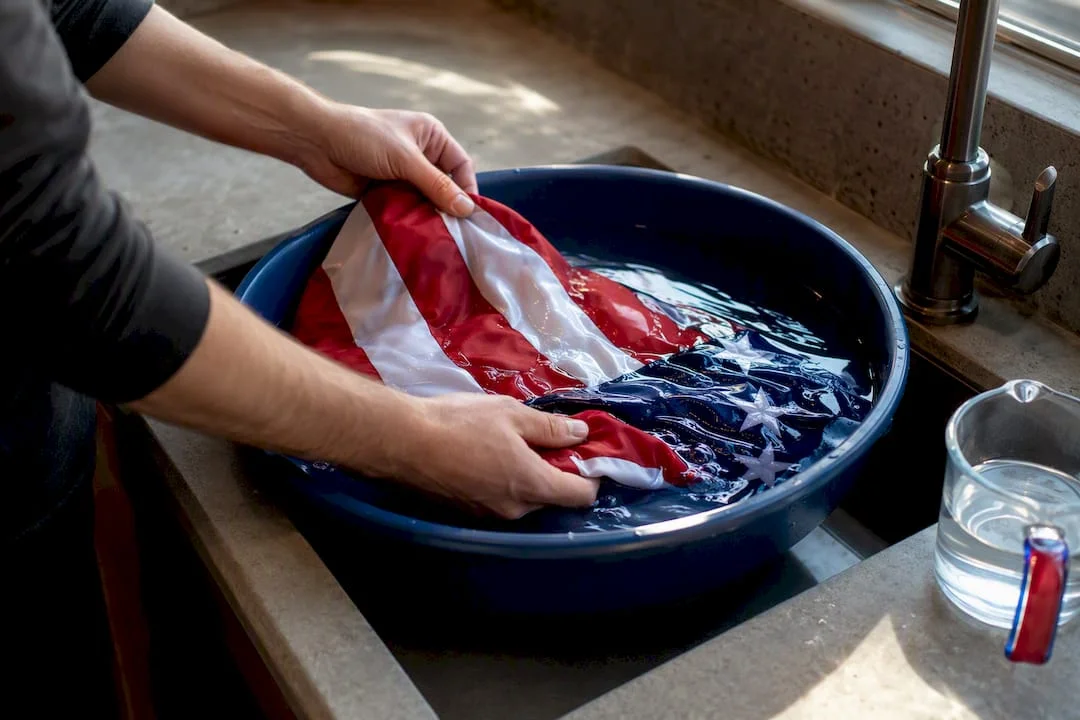
Hands soaking a flag textile in cool water

Yes, the American flag can be washed. The U.S. Flag Code places no ban on washing or dry-cleaning, and a soiled flag that’s kept clean and fit for display honors the colors far more than one left dingy in the wind. Match your method to the fabric, use cold water and mild detergent, strip away metal grommets first, skip the bleach and fabric softener, and let it air-dry. If the fabric is torn beyond repair or badly sun-bleached, retirement, not the washer, is the respectful move.


TL;DR:

  • Polyester flags are safe to machine wash on a delicate cycle with cold water and mild detergent, and should be air-dried immediately afterward.
  • Nylon and cotton flags require gentle hand-washing, preferably in cool water with mild detergent, and should not be wrung or twisted to prevent damage.
  • Always remove metal grommets and check for loose stitching or colorfastness before washing to prevent tearing or staining.
  • For stains or mildew, use specific treatments like dish soap for grease or vinegar solutions for mold, but avoid soaking flags with bleeding colors.
  • Severely damaged flags with missing stars, fraying, or major color loss should be retired, not repaired, and properly disposed of in a flag retirement ceremony.

Table of Contents

Can You Wash a Flag? What the Material Tells You First

Before any water touches the fabric, look closely at what you’re holding. There are no provisions in the Flag Code that prohibit washing or dry-cleaning, but the right technique depends entirely on the material in your hands, not on a single universal rule.

Polyester flags feel smooth and lightweight, often with the design dyed straight into the fibers through sublimation rather than sewn on. Nylon flags are similarly light but carry a faint sheen and typically have stripes sewn together in panels rather than printed. Cotton flags run heavier, feel more like fabric than plastic, and are common in older or ceremonial pieces. Burlap, linen, and other vintage or antique flags demand the most caution of all.

  • Polyester: machine-washable with care; holds dye well if kept away from heat and harsh chemicals.
  • Nylon: tolerates gentle handling but is best hand-washed to avoid surface abrasion.
  • Cotton: absorbs water heavily and can shrink or fade; hand-wash unless the label says otherwise.
  • Burlap, linen, vintage: treat as fragile; consider professional textile care before attempting a home wash.

Always check the manufacturer’s care label first. It overrides every rule of thumb here, because dye processes and thread types vary between makers.

What to Check Before You Wash Any Flag

Skipping prep work is how a good flag turns into a damaged one. Run through this sequence every single time, regardless of fabric:

  1. Remove grommets, clips, or any metal hardware. Left in place, they can rust, stain, or tear the seams during agitation.
  2. Inspect stitching along the stripes and stars for loose threads that washing could pull apart.
  3. Test colorfastness by dabbing a damp white cloth on a hidden hem corner. If color transfers heavily, hand-wash instead of machine-wash.
  4. Set your washer to cold water on a delicate cycle, or prepare a cool basin soak, and use a mild liquid detergent sparingly.

A monthly visual check keeps small problems small. Wash whenever the flag looks visibly soiled or after a storm has driven dirt and pollen into the weave.

Pro Tip: Keep a small basin dedicated to flag care. It takes the guesswork out of “is this cool enough water” and keeps you from grabbing dish soap loaded with dyes or fragrance additives that can cloud synthetic fabric over time.

How Do You Machine-Wash an American Flag?

Hands placing flag textile in washing machine

Machine washing works well for outdoor polyester flags and other machine-safe synthetics, but it’s the wrong call for anything embroidered, cotton, or antique. When in doubt, hand-wash instead.

For flags that can handle the machine, washing polyester on a delicate cycle in cold water inside a mesh laundry bag protects both the fabric and the dye-sublimated print. Here’s the full setup:

  • Set the washer to delicate or hand-wash, water below 80°F (27°C).
  • Choose a low or no-spin setting to reduce stress on seams and grommet holes.
  • Place the flag inside a mesh bag or a clean pillowcase before it goes in.
  • Use a small amount of mild detergent, and skip chlorine bleach, fabric softener, and any detergent with optical brighteners, which coat fibers and dull color over time.
  • Pull the flag out the moment the cycle ends and move straight to air-drying.

Hand-Washing: The Safer Route for Nylon, Cotton, and Vintage Flags

Nylon flags, cotton flags, and anything with sewn or embroidered detail deserve a gentler hand than any machine can offer. Hand-washing is the safest approach for nylon, since the fabric’s sheen and stitched panels are prone to surface abrasion under agitation.

  1. Fill a clean basin or bathtub with cool water and a small amount of mild detergent.
  2. Submerge the flag fully and let it soak for 10 to 30 minutes.
  3. Gently swish the fabric by hand. For soiled spots, rub fabric against fabric rather than scrubbing directly, especially around embroidered stars or sewn stripes.
  4. Drain the tub and rinse repeatedly with clean, cool water until no suds remain.
  5. Press the water out between two dry towels. Never wring or twist the fabric, since twisting stresses seams and sets permanent creases into the weave.

How Do You Get Stains and Mildew Out of a Flag?

Not every mark comes out with a simple soak, and different stains call for different fixes.

  • Grease or oil: dab a single drop of dish soap directly onto the dry stain, let it sit for a few minutes, then wash as usual. The same gentle pre-treatment approach used on stubborn workwear stains applies just as well to flag fabric.
  • Mold or mildew: pre-soak in a cool water and white vinegar solution mixed roughly one to one, then wash gently. A vinegar soak lifts mildew without bleaching the colors, and you can repeat it if the smell or spotting lingers.
  • Red dye bleeding: don’t let a bleeding flag soak long. Test a hidden corner first, and rinse immediately if you see color running. Heavy, uncontrollable bleeding usually means it’s time to retire the flag rather than keep chasing the stain.

If a stain resists two rounds of treatment, a professional cleaner is worth the cost, particularly on flags with sentimental or historical weight.

How Should a Flag Be Dried and Stored?

How you dry a flag matters almost as much as how you wash it. Air-drying wet fabric in direct, harsh sunlight can accelerate fading, so lay or hang the flag in shade with good airflow instead.

  • Never tumble-dry on high heat. If you must use a dryer, choose a no-heat or air-fluff setting only.
  • Avoid ironing when possible; a garment steamer relaxes wrinkles without direct heat contact.
  • If ironing is unavoidable, use the synthetic setting and place a thick cotton towel between the iron and the flag.
  • Once fully dry, fold or roll the flag loosely rather than cramming it into a tight space, and store it somewhere cool and dry, away from humidity.

Pro Tip: Custom Flag Supply’s care guidance notes that cold water washes paired with air-drying do more to preserve dye-sublimated color than any post-wash treatment you can apply. Get the wash and dry right, and you’ve done most of the work already.

When Should a Flag Be Repaired Instead of Retired?

Some damage is fixable. Some isn’t, and pretending otherwise does the flag no favors.

A small tear along a hem or a loose seam is usually worth repairing, either by hand or through a tailor familiar with outdoor fabric. But once a flag shows severe fraying along the fly edge, missing stars, major color loss, or seams that have failed structurally in multiple places, it’s no longer fit for dignified display.

  • Severe fraying or holes beyond simple hemwork
  • Missing or torn-away stars
  • Faded colors that no longer read clearly as red, white, and blue
  • Multiple structural seam failures

Retirement is the respectful answer here, not the trash bin. The American Legion, VFW posts, and Scout troops regularly hold flag retirement ceremonies, and most welcome flags brought in by community members. For readers building or replacing a display, understanding the etiquette rules most people overlook makes the whole process feel less like guesswork and more like tradition carried forward correctly.

Where Ultimate Flags Fits Into Flag Care

The store presenting itself as an experienced online flag retailer, and that history comes with an obligation to get the details right, not just the products. Beyond selling flags, the site carries educational material on flag etiquette and the rules most owners never learned, built for readers who want to display and care for their flags correctly, not just decoratively.

If you’re unsure how your specific flag was constructed, check the manufacturer’s product page for material and care details before you commit to a wash method. New flag owners looking for a fuller next-steps guide can also find it in Ultimate Flags’ owner’s guide.

Editorial Perspective: Respect Isn’t a Feeling, It’s a Process

Most advice on cleaning a flag treats the Flag Code like a technicality to get past, a quick “yes you can wash it” before jumping to detergent brands. That framing undersells what the Code is actually telling you: washing a soiled flag is itself an act of respect, not a workaround to one. A flag left dirty because someone was afraid to “disrespect” it by cleaning it has that backward.

Editorial Perspective: Respect Isn't a Feeling, It's a Process — overview diagram

Where the conventional advice usually falls short is treating all flags as one fabric. A polyester banner off a front porch and a cotton flag passed down from a grandparent’s funeral are not the same cleaning problem, and generic “just toss it in the wash” advice ignores that entirely. Material identification isn’t a footnote here. It’s the first decision that determines every step after it.

If you take one thing from this guide, prioritize the fabric test over the stain. A stubborn mark on a flag you can safely machine-wash is a minor inconvenience. That same mark on a fragile cotton or vintage piece calls for patience, cool water, and possibly a professional’s hands instead of your own. Slow down on the identification step, and the rest of the process gets a lot less risky.

— Jonica

Sources

FAQ

What Should You Do If a Flag Gets Dirty?

Identify the fabric first, then wash it using cold water and mild detergent, either by machine for durable synthetics or by hand for nylon, cotton, and vintage flags. Skip bleach and fabric softener, and air-dry away from direct harsh sun.

Is It Okay for the American Flag to Get Wet?

Yes. Getting wet from rain or washing doesn’t violate flag etiquette; what matters is drying it properly afterward and not leaving it damp or crumpled for extended periods, which can encourage mildew.

Are Flags Supposed to Be Washed?

Washing is allowed and encouraged when a flag becomes soiled, since neither the Flag Code nor American Legion guidance bans washing or dry-cleaning. A clean flag is considered more fitting for display than a dirty one.

Can You Wash a 100% Polyester Flag?

Yes, polyester flags generally tolerate machine washing on a delicate, cold-water cycle inside a mesh bag, using mild detergent with no bleach or fabric softener. Air-dry immediately after the cycle ends to protect the dye.

Posted on

$40–$600: What Your 48 Star Flag Is Worth to Collectors

Aged 48-star flag under appraisal

A 48-star American flag typically sells for $40 to $300, with exceptional examples reaching $600 or more at auction. The two forces that decide where your flag lands on that spectrum are condition and provenance. A flag with intact stitching, minimal staining, and a documented military or manufacturer origin can command multiples of what an unmarked, moth-eaten example brings in.


TL;DR:

  • Flags with proven military or civic organization markings and documented history can significantly increase in value, sometimes reaching over $600.
  • The flag’s condition, including fabric integrity, stitching, and minimal staining, usually outweighs age in determining market price, especially for flags from later years.
  • Sale prices vary widely by channel, with auction houses and specialized collectors offering higher prices for flags with clear provenance, while general marketplaces often undervalue them.
  • Oversized flags and those made from wool bunting are rarer and tend to fetch higher prices, especially if well-preserved and tied to historic events.
  • Proper preservation, thorough documentation, and strategic selling or donation can maximize a flag’s value and historic significance.

Table of Contents

Understanding 48 Star Flag Value: Price Bands and Real Sale Examples

Every 48-star flag carries the same basic story: forty-eight stars, thirteen stripes, stitched sometime between 1912 and 1959. What separates a $50 flag from a $500 flag is everything that happened to it after it left the factory or the sewing circle.

Pro Tip: Before you assume your flag is rare, remember that 45, 46, and 48-star flags are among the most common variants in the antique flag market. Abundance keeps baseline prices modest unless provenance changes the equation.

Here is how the market breaks down:

  • Low band ($40–$100): Cotton or synthetic-blend flags with visible wear, faded color, missing grommets, or no identifying marks. Most estate-sale and thrift-store finds fall here.
  • Typical band ($100–$300): Well-preserved wool or cotton flags, often with visible manufacturer tags, correct star pattern, and solid seams. Several price guides place the bulk of clean, mid-size examples squarely in this range.
  • High band ($300–$600+): Flags with confirmed military service, YMCA or civic organization stamps, or a documented link to a historic event. Auction house records show lots in this territory when provenance is airtight and condition backs it up.

Sale channel matters as much as the flag itself. A flag listed on a general marketplace with a vague description routinely undersells the same flag consigned to a specialty militaria auction with full photographs and a written provenance statement. Format counts too: a timed online auction with competing bidders often outperforms a fixed “buy it now” listing, simply because bidding wars push prices past what a single buyer would offer upfront. Conservative appraisal estimates still cluster near that $40 to $300 midpoint for flags lacking documentation, which is the reality most owners should expect before hunting for the exception.

Assessing Condition: A Step-by-Step Inspection Checklist

Condition drives value more than most owners realize. A flag from 1917 in rough shape can sell for less than a cleaner flag from 1945, because collectors buy what they can display and preserve, not just what is oldest.

Work through your flag methodically:

  1. Measure it. Record exact dimensions in inches and note the fabric (cotton, wool bunting, or synthetic blend).
  2. Count and inspect the stars. Confirm all 48 are present and check whether they’re arranged in the standard 6×8 grid or an irregular pattern.
  3. Examine the stitching. Machine-stitched seams, hand-finished edges, and reinforced corners all tell you something about age and manufacturer.
  4. Check for damage. Look for moth holes, water staining, sun fading, tears near the fly end, and any prior repairs.
  5. Photograph everything. Capture the full flag, close-ups of damage, and especially the canvas hoist, where markings often hide.
  6. Document your findings in writing before you list the flag or approach an appraiser.

Moth holes and heavy fraying can cut value by half or more, especially when they touch the star field. Staining is less punishing if it’s confined to the edges, but a repair done with modern thread or a mismatched patch tells buyers the flag has been altered, which almost always drags the price down rather than up. For a broader sense of what collectors weigh when judging authenticity and rarity, Ultimate Flags’ collector notes go deeper into how wear patterns get read by serious buyers.

Provenance and Markings: What Turns an Old Flag Into a Collectible

An unmarked 48-star flag is a commodity. A marked one is a story, and stories are what collectors pay for.

Start your search for markings at the canvas hoist, the reinforced strip sewn along the edge closest to the pole. Manufacturers frequently stamped their name, a patent date, or a size number here. Sewn-in labels and tape along the same edge sometimes carry military unit designations, government contract numbers, or civic organization names.

Documentary provenance matters just as much as physical stamps:

  • Photographs showing the flag in use, whether at a parade, a funeral, a courthouse, or a military post
  • Receipts or bills of sale tying the flag to a specific purchaser or organization
  • Unit logs or muster records referencing flag issue or retirement
  • Institutional records from a church, school, VFW post, or YMCA chapter that once owned the flag

Original manufacturer stamps or military markings on the hoist are among the strongest value drivers a 48-star flag can carry, often lifting a flag from the low band straight into high-band territory. A flag tied to a named regiment, a specific YMCA chapter, or a documented civic event routinely outsells an identical, unmarked flag by a wide margin. If you inherited a flag with any paper trail attached, that paperwork is worth more to a buyer than an extra decade of age.

Where to Sell or Donate Your 48-Star Flag

Choosing a sales channel is really a choice between reach, cost, and control.

  • National militaria or Americana auction houses offer the widest pool of serious collectors and the best shot at a high-band price, but they typically take a commission and may reject flags without documented interest.
  • Niche flag or antique auctions draw a smaller but more knowledgeable audience, often producing fair prices with lower fees than the big houses.
  • Online marketplaces like eBay or Etsy give you full control and no gatekeeping, but buyer trust is lower without third-party verification, which can suppress final prices.
  • Local consignment shops work for quick, low-effort sales, usually at the lower end of the value range.
  • Museums and historical societies rarely pay top dollar, but they’re the right call when your flag’s provenance ties directly to that institution or its community. A flag flown at a local courthouse belongs, in spirit and often in value, with the local historical society rather than a stranger’s living room.

Whichever route you choose, prepare a packet first: clear photographs, exact measurements, a written condition report, and copies of any provenance documents. Sellers who show up with that packet consistently field better offers than those who show up with just a flag and a guess.

Preserving Your Flag Without Losing Value

Careless care ruins more flags than time ever does. Cotton fibers in particular are vulnerable to pests, humidity swings, and prolonged light exposure, all of which accelerate deterioration in ways that are hard to reverse.

For display, keep these guardrails in mind:

  • Use UV-filtered glass or acrylic in any frame or case
  • Keep the display area away from direct sunlight and away from vents that cause temperature swings
  • Maintain stable humidity rather than a dry or damp extreme

For storage, acid-free tissue and flat storage boxes beat folding a flag into a drawer, which creases fibers permanently along the fold lines. Pest control matters too, since moths and carpet beetles target the same natural fibers that make a flag valuable in the first place.

Pro Tip: Never attempt home dry-cleaning or a do-it-yourself patch repair on an antique flag. Conservators consistently find that spot treatments and modern-fabric patches strip away historical integrity, and buyers can spot the difference immediately.

How Flag Size and Material Affect Resale Price

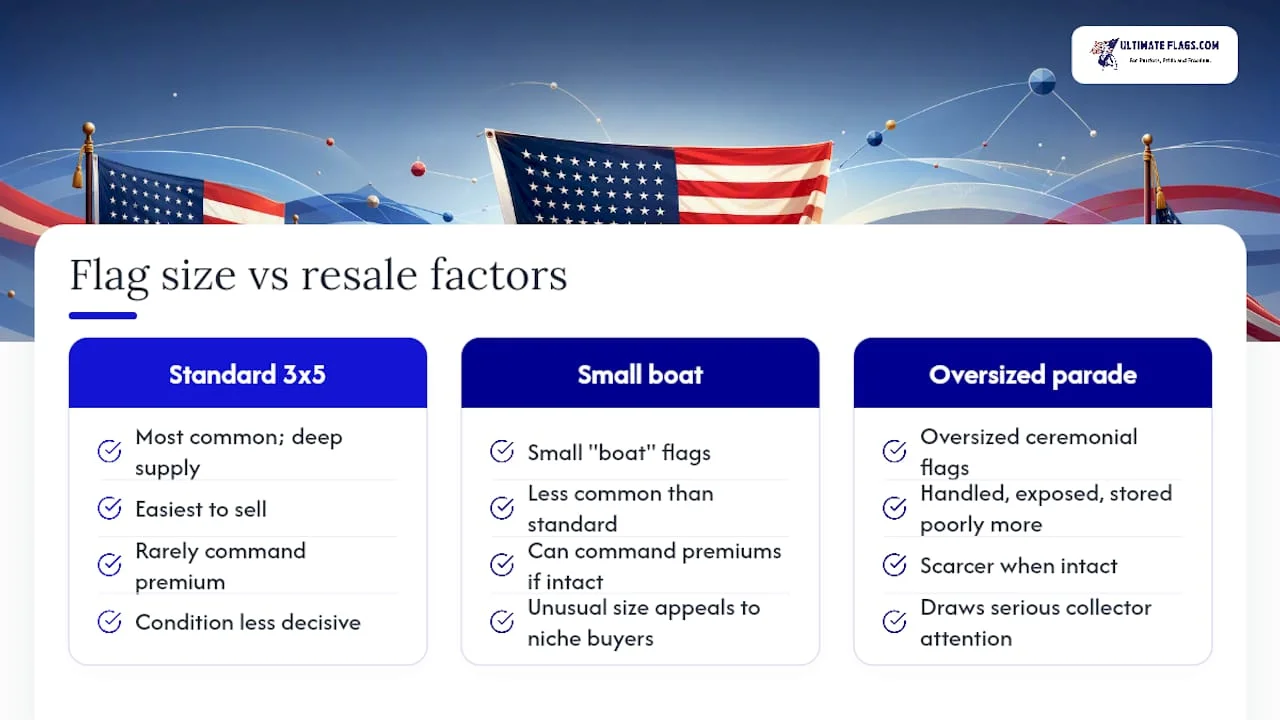
Size and fabric shift value in ways that surprise a lot of first-time sellers. A massive ceremonial flag, the kind once flown over a government building or a ship’s stern, draws serious collector attention simply because so few survive in good condition. Oversized flags were handled more, exposed to weather more, and stored poorly more often, so a large 48-star flag that survived intact is genuinely scarcer than a small one.

Flag size categories and resale implications

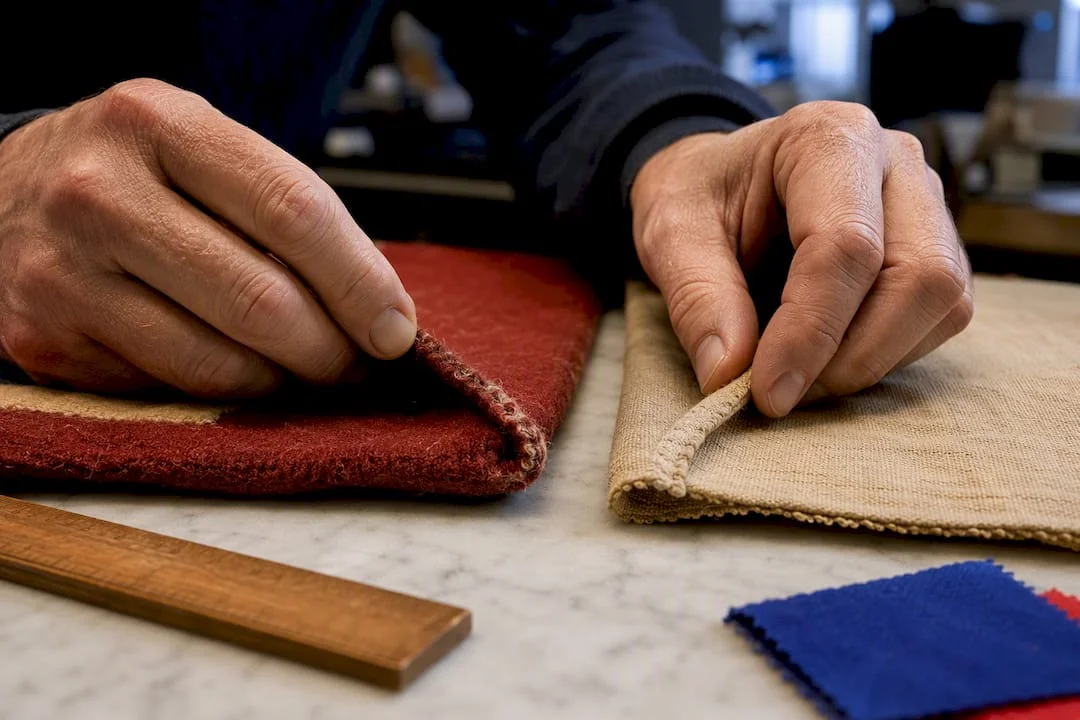
Material tells its own story. Wool bunting flags, common through the early and mid-20th century, tend to hold up better structurally than cotton, which is more prone to yellowing, mildew, and insect damage. Synthetic blends that crept into flag manufacturing later in the 48-star era are generally viewed as less desirable by serious collectors, since they lack the hand-finished character of earlier wool and cotton construction.

Standard household sizes, roughly 3×5 feet, are the most common and the easiest to sell but rarely command premium prices simply because supply is so deep. Unusual sizes, whether very small “boat flags” or oversized parade and ceremonial flags, tend to move the needle more, provided condition holds up. A flag’s weight in the hand is often a quick clue: wool bunting has a distinct heft and texture that synthetic reproductions can’t quite replicate, which matters when you’re trying to confirm authenticity before you even get to the stamps and stitching.

Hands comparing wool and cotton flag fabric

Why the Flag Changed and What It Means for Collectors Today

The 48-star flag flew as the official flag of the United States from 1912 to 1959, the longest run of any American flag design up to that point. It carried the nation through both World Wars, the Great Depression, and the early Cold War, which is part of why it resonates so strongly with collectors of military and civic history.

The flag’s retirement wasn’t dramatic. Alaska’s admission to the Union in January 1959, followed by Hawaii’s admission that August, simply made a 48-star design outdated by law. The Flag Code requires the star count to match the number of states, so a 49-star flag briefly replaced it before the 50-star version we know today took over in 1960.

That short, mandated lifespan is exactly why the 48-star flag holds steady collector interest decades later. It’s the last flag design tied to a pre-Alaska, pre-Hawaii America, a visual marker of the country before its final two states joined. Flags surviving from World War II specifically carry extra weight with collectors, since so many were flown, folded for coffins, or raised over military installations during the war years covered in Ultimate Flags’ historical archives.

Selling, Donating, or Keeping: A Publisher’s Take

Sell when your flag has no personal or institutional tie and solid documentation exists to support a fair price. Donate when the flag’s story belongs to a specific place, a church, a VFW post, a local courthouse, since institutions tied to the flag’s origin often value it more than any buyer will. Conserve first, always, before you do either.

Photograph the flag, gather whatever paperwork exists, and get a real appraisal before you commit to a path. A rushed decision costs more than a week of patience.

— Jonica

Protecting or Replacing Your Flag With Ultimate Flags

If your 48-star flag is too fragile to display safely, you don’t have to choose between honoring its history and risking further damage. Some retailers carry reproduction historical flags built for everyday display, so your original can stay safely stored while a faithful reproduction does the flying.

Ultimate Flags

Ultimate Flags also stocks preservation-minded accessories, from display-ready hardware to flagpole options, for owners who want to show their flag’s story without exposing the original fabric to sun and humidity. If your interest runs toward decorative display pieces beyond flags, the Gulf of America 12-inch world globe makes a fitting companion piece for a history-focused display shelf. And if your flag’s real home is a local historical society rather than a display case, Historical storytelling, including pieces like Flag: Silent Sentinels of History?, can help you frame that donation with the context it deserves. Browse online collections today to find reproductions or accessories that fit your next step.

Sources

FAQ

Are Flags With 48 Stars Valuable?

Most sell for $40 to $300, with strong provenance or verified military history pushing exceptional examples to $600 or more.

Is It Illegal to Fly a 48-Star Flag?

No federal law bans owning or flying a retired 48-star flag; the Flag Code sets etiquette guidelines, not criminal penalties, for displaying historical versions.

How Old Is a Flag With Only 48 Stars?

A 48-star flag dates to between 1912 and 1959, the period when the design was the official flag of the United States.

Is a Flag With 49 Stars Worth Anything?

Yes, 49-star flags are collectible too, since they represent an even shorter official run (1959 to 1960) than the 48-star flag, though pricing follows the same condition and provenance rules.

Posted on

Texas Flag Meaning Since 1839: Why One Star and 2:3 Ratio Matter

Close-up of Texas flag star and stripes

The Lone Star on the Texas flag stands for the unity of one people under God, State, and Country, and it’s the reason the emblem has outlasted every fashion and fad in state symbolism. Texas law assigns each color a virtue: blue for loyalty, white for purity, and red for bravery. The design itself is no accident of taste. It’s the surviving national flag of a republic that fought for its own independence, adopted January 25, 1839, and carried into statehood in 1845.


TL;DR:

  • The star’s five points are culturally interpreted to symbolize virtues like fortitude, loyalty, righteousness, prudence, and broadmindedness, beyond the legal meaning of unity.
  • Texas law specifies that the flag’s proportions, colors, and star size must follow precise standards, but manufacturing tolerances can cause slight variations.
  • The Texas flag was first adopted as the national banner of the Republic of Texas in 1839, and it transitioned seamlessly into the state flag upon annexation in 1845.
  • When displayed vertically, the blue field with the star should be on the upper left from the viewer’s perspective, with proper respect for U.S. flag precedence.
  • The flag’s colors are legislated to match the same standards as the U.S. flag, and the lone star has historically symbolized Texas unity even before official adoption.

Table of Contents

Texas Flag Meaning: The Official Answer

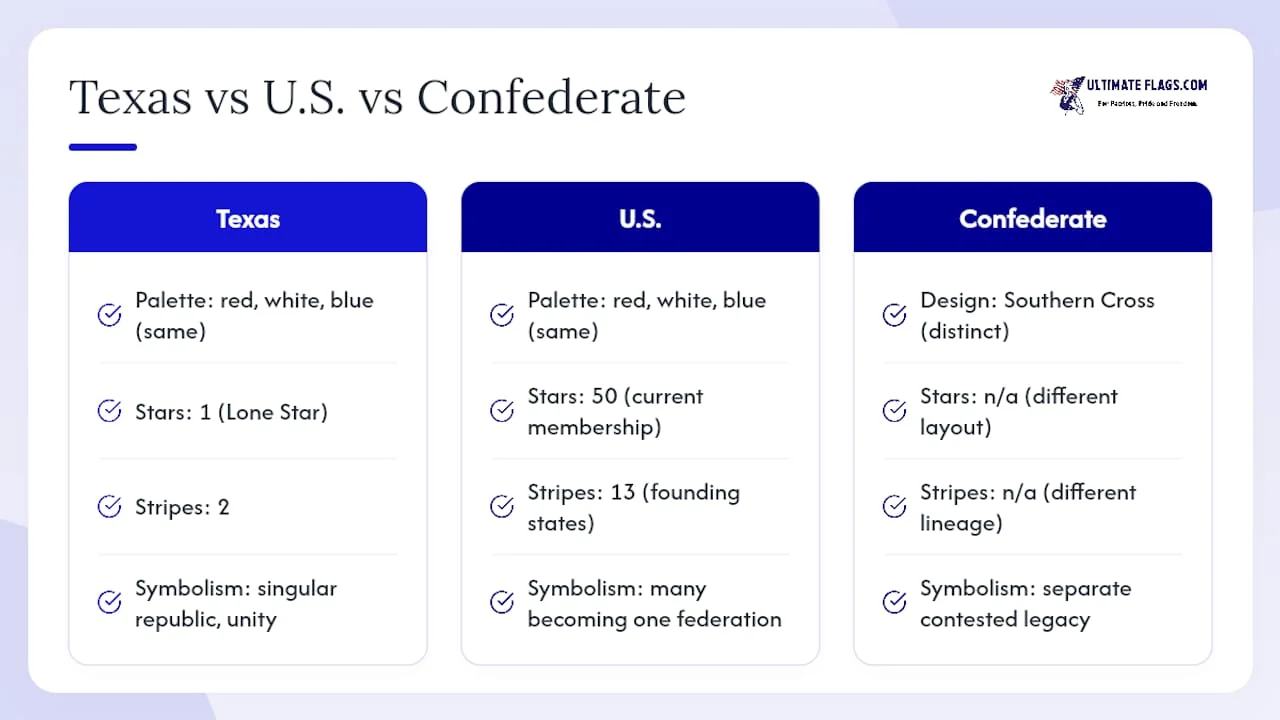
Ask any Texan what the star means, and you’ll likely hear some version of the same story: one star, one state, standing whole and unbroken. That instinct is backed by statute, not just sentiment. The Texas State Library’s official description confirms the five-pointed star symbolizes the unity of Texas as one for God, State, and Country, a phrase that has echoed through Texas classrooms and courthouses for generations.

The color coding isn’t folklore, either. It’s written into Chapter 3100 of the Texas Statutes, which spells out the flag’s proportions and assigns blue to loyalty, white to purity, and red to bravery. That’s the legal skeleton beneath everything Texans feel when they see the flag snap in a Gulf Coast wind or hang still over a courthouse lawn in the Hill Country. The meaning was never left to guesswork. It was legislated, and it has held for nearly two centuries.

What makes the Texas flag genuinely rare among American state flags is its double life. Before it ever flew as a state banner, it flew as a national one, the official flag of the Republic of Texas, a sovereign country that existed for almost a decade before joining the United States. According to Britannica, Texas and Hawaii are the only two U.S. states whose flags once represented fully independent nations. That’s not a minor historical footnote. It’s the reason the Lone Star carries a weight that other state emblems simply don’t.

Official Design and Measurements of the Lone Star Flag

Texas doesn’t leave the flag’s construction to interpretation, and that precision matters if you’re buying, sewing, or displaying one that’s actually correct.

The statute lays out a 2:3 ratio between width and length, a proportion that keeps the flag from looking stretched or squat regardless of size. The hoist side, the vertical strip nearest the pole, takes up exactly one third of the flag’s length and is solid blue. The remaining two thirds splits into two horizontal stripes of equal width: white on top, red on the bottom. Centered in the blue field sits a single white five-pointed star, sized so its diameter equals three fourths the width of the blue stripe, always oriented with one point straight up.

Here’s how the specifications break down:

Element Official Specification
Overall ratio 2:3 (width to length)
Blue hoist stripe One third of total flag length
White horizontal stripe Top half of remaining two thirds
Red horizontal stripe Bottom half of remaining two thirds
Star diameter Three fourths the width of the blue stripe
Star orientation Single point facing upward
Star color White, five-pointed

Texas red and blue are tied by statute to the same reference standards used for the U.S. flag, often called “Old Glory” red and blue, according to historical summaries from the Texas State Historical Association. That link wasn’t accidental. Lawmakers wanted the Texas flag to visually harmonize with the national flag it would fly alongside, not clash with it.

If you’ve ever noticed that two Texas flags from different manufacturers look slightly different side by side, you’re not imagining it. Commercial production allows for reasonable tolerance in dye lots, stitching, and fabric weight, so:

  • Nylon flags for outdoor use often run lighter and more translucent than cotton or polyester versions meant for indoor display.
  • Star placement can vary by a fraction of an inch on mass-produced flags without violating the spirit of the code.
  • Grommet versus pole-sleeve construction changes the flag’s overall look but not its legal proportions.

Pro Tip: When buying a Texas flag for permanent outdoor display, look for one made specifically for the elements. A flag cut to the correct 2:3 ratio in a durable nylon or heavyweight polyester will hold its color and shape through Texas heat and wind far longer than a decorative indoor version pressed into outdoor service.

What the Colors, Lone Star, and Star Points Symbolize

The official meaning is short, but the cultural meaning has grown into something much larger, and both deserve equal attention.

Start with what the law actually says. The Texas Flag Code assigns blue to loyalty, white to purity, and red to bravery. The same statute, echoed in the Texas State Library’s description, states that the lone star represents “all of Texas” united as one, not a collection of counties or regions competing for attention, but a single people bound together.

The five-pointed star symbolizes the unity of Texas as one for God, State, and Country.

That single sentence has anchored more civic pride than almost any other piece of state legislation on the books.

Beyond the statute, though, generations of Texans have layered additional meaning onto the star’s five points, and this is where things get genuinely interesting. In 1948, writer Adina de Zavala, publishing through the Frontier Times, suggested the star’s five points each stand for a civic virtue: fortitude, loyalty, righteousness, prudence, and broadmindedness, according to the Texas State Library’s own account of the flag’s symbolism. It’s worth being precise here: this interpretation is cultural tradition, not statutory law. The legislature never codified those five virtues into the Flag Code. But the reading stuck because it fit. Texans wanted their star to mean something layered, not just legally tidy, and de Zavala’s version gave the emblem a moral vocabulary that classrooms and civic groups still teach today.

The star’s role as a unifying symbol predates the 1839 flag by years. During the independence movement of the mid-1830s, Texian settlers and soldiers used lone stars on improvised banners and cockades well before any legislature formalized a design. Scholars note that the star functioned as a solidarity marker among a scattered, often outgunned population fighting for self-rule, according to the Texas State Library. It wasn’t invented for the flag. The flag adopted a symbol that was already doing emotional work on the ground.

A quick way to hold the two layers of meaning apart:

  • Legally defined: blue (loyalty), white (purity), red (bravery), and the single star representing unity of all Texas.
  • Culturally layered: the star’s five points are traditionally said to represent civic virtues like fortitude, loyalty, righteousness, prudence, and broadmindedness, but this reading is not codified in law.
  • Historically rooted: the lone star has long been used as a symbol of solidarity among independence fighters before 1839.

That combination, hard legal definition wrapped in soft cultural tradition, is exactly why the Texas flag resonates the way it does. It gives skeptics a statute to point to and romantics a legend to repeat, and somehow both crowds walk away satisfied.

How the Lone Star Flag Was Created and Evolved

The flag Texans fly today didn’t spring into existence fully formed. It’s the product of a scramble, a committee, and at least one design that history has never fully credited to a single hand.

Here’s the sequence, condensed to what actually happened:

  1. Pre-1839 experiments. Early Texian flags borrowed heavily from the U.S. design, sometimes modifying the stars and stripes pattern down to a single star over altered stripes. The Burnet Flag, adopted in 1836, put a single gold star on a blue field and served as the Republic’s first official national flag.
  2. The push for a new design. By 1838, Republic leaders wanted a flag that felt distinctly Texan rather than a variation on someone else’s design. Legislators, including William H. Wharton, pushed the issue through committee.
  3. Peter Krag’s drawing. The design that became law was drawn by Peter Krag, and it’s his rendering that the Texas State Library’s historic flags collection credits with giving the Lone Star its final proportions and layout.
  4. Legal adoption, January 25, 1839. The Republic of Texas Congress formally adopted the design as the national flag on that date, a milestone the Texas State Historical Association and Wikipedia’s flag history both treat as the flag’s true birthday.
  5. Annexation and continuity, 1845. When Texas joined the United States, the Republic’s flag didn’t get retired. It simply transitioned into the new state flag, a continuity almost no other former nation-turned-state can claim.
  6. The 1879 statutory gap. Texas law briefly lapsed on an official flag description after an earlier repeal, leaving the flag’s legal status murkier than most Texans realized at the time.
  7. 1933 codification. Lawmakers moved to formally codify the flag’s design and proportions, closing gaps left by decades of informal use.
  8. 1993 clarifications. A later legislative pass refined the color references, tying Texas red and blue more explicitly to the U.S. flag’s own color standards, according to the Texas State Historical Association.

The designer question deserves its own honest mention, because it’s frequently oversimplified. Popular retellings sometimes name a single heroic designer and leave it there. The historical record is messier. Wikipedia’s flag history entry notes that historians consider the flag’s ultimate designer unknown in any definitive sense, and that attributions made during anniversary celebrations were later revisited once records got a second look. Peter Krag drew the version that became law, but “drew the official rendering” and “originated the design” aren’t necessarily the same claim, and careful historians treat them separately.

That gap between a legend and a legal record is where most flag mythology lives, and it’s worth remembering the next time someone tells you the Texas flag’s origin story as though it were settled beyond question.

Flag Etiquette and Texas Display Rules

Knowing what the flag means is only half the job. Flying it correctly, respectfully, and lawfully is the other half, and Texas statute gives clearer guidance here than most people assume.

The Texas Flag Code establishes precedence rules that mirror federal flag etiquette. When displayed with the U.S. flag, the American flag takes the position of greater honor, and the Texas flag is flown alongside it, not above it or in a way that suggests equal or superior rank. The code also references the flag in connection with the state pledge, and it addresses finial guidance, meaning the ornamental piece atop a flagpole, for formal display situations.

Vertical display trips up more people than any other rule, mostly because most folks have never had to think about it. When a flag is displayed vertically, such as hanging from a building facade or over an entrance, the rule of thumb is that the blue field with the star should end up in the upper left as viewed by someone facing the display, effectively rotating the flag ninety degrees counterclockwise from its normal horizontal orientation. Some display situations, like buildings with multiple entrances facing different directions, call for judgment calls that the statute doesn’t spell out in granular detail, which is where customary flag etiquette fills the gap rather than hard law.

A short checklist that covers most real situations:

  • Fly the Texas flag no higher than or level with the U.S. flag, never above it, on a shared pole arrangement.
  • Illuminate the flag if it flies after dark, or bring it in at sunset if lighting isn’t available.
  • Retire a Texas flag that’s torn, badly faded, or otherwise unfit for display rather than continuing to fly it in poor condition.
  • Orient a vertically hung flag so the star sits in the upper left from the viewer’s perspective.
  • Rinse salt air or heavy pollen off outdoor flags periodically to protect the color-fastness of the dye.

Pro Tip: Homeowners and small organizations often get tripped up on the vertical orientation rule because it feels counterintuitive. Picture the flag flying normally on a horizontal pole, then physically rotate it counterclockwise until the hoist side is on top. That’s your vertical orientation, every time. For readers assembling flags and hardware for a display, Ultimate Flags’ guide on what to do once you have your flag walks through practical next steps.

Debunking Common Urban Legends About the Flag

A handful of persistent myths follow the Texas flag around, and most of them collapse the moment you check the primary sources.

Myth: We know exactly who designed the flag. Popular retellings sometimes credit a single named individual as the flag’s sole designer, often during anniversary celebrations when a tidy story sounds better than a complicated one. The truth, per Wikipedia’s flag history entry, is that the designer remains formally unknown, and earlier legislative attributions were corrected once historians reexamined the record. Peter Krag produced the official drawing that Congress adopted, which is documented and solid, but that’s a narrower claim than “designed the flag” as popularly told.

Myth: The star’s five virtues are official state law. The fortitude, loyalty, righteousness, prudence, and broadmindedness reading is a real and meaningful tradition traced to a 1948 Frontier Times piece, but it was never written into the Flag Code. It’s cultural interpretation layered onto a statute that only defines unity, not virtue.

Myth: Texas never formally recognized its own flag. This one gets repeated because of a real 1879 statutory gap, when an earlier repeal left the flag’s legal description briefly unclear. That gap got closed through the 1933 codification and refined again in 1993, so the flag has had a clear legal foundation for nearly a century straight.

How the Lone Star Functions in Civic Life Today

The Lone Star shows up everywhere in Texas civic life, and its uses stretch well past the flagpole outside a courthouse.

Veteran observances lean on it heavily. Memorial Day and Veterans Day ceremonies across the state routinely pair the Texas flag with the U.S. flag during honor guard displays, folding ceremonies, and cemetery rededications, a tradition Ultimate Flags has covered in its own historical coverage of memorial events. Parades, from small county festivals to major city celebrations, treat the Lone Star as a visual shorthand for Texan identity that needs no explanation.

Commercially, the star shows up on everything from belt buckles to barbecue joints, a reflection of how deeply the symbol has embedded itself into everyday branding. Collectors and serious buyers, meanwhile, care about details casual shoppers skip past:

  • Fabric weight and weave, since nylon and polyester behave very differently in wind and sun.
  • Color accuracy against the statutory red and blue references, not just a close visual match.
  • Star size and stripe proportion staying within the 2:3 ratio rather than a stretched novelty design.

Political and contested uses of the flag do occur, and intent shapes public reaction more than the symbol itself, as discussed in the history of contested flag symbolism. A flag flown at a civic ceremony reads very differently from the same design used to signal a narrower political stance, and Texans generally judge context first.

Ultimate Flags’ Historical Archive on the Lone Star

Ultimate Flags has spent years documenting the flags that carried Texans through their fights for independence and identity, and that archival work runs deeper than the state flag alone. Coverage of the Lone Star and Bars flag of the Texas “Bloody 5th” Regiment traces how the Lone Star motif appeared on Civil War era banners distinct from the state flag itself, a detail collectors need when assessing provenance.

Archived Texas military banner fabric detail

This article was written by Jonica, drawing on primary statutory sources, the Texas State Library’s historic flags collection, and the Texas State Historical Association’s institutional record. Readers chasing more Texan military history can find further context in Ultimate Flags’ coverage of Texans in combat, which connects battlefield history to the symbols Texans carried into it.

How the Texas Flag Compares to the U.S. and Confederate Flags

Set the Texas flag next to the U.S. flag and the family resemblance is deliberate, not coincidental. Both use the same red, white, and blue palette, and Texas statute explicitly ties its colors to the same reference standards as “Old Glory.” But where the U.S. flag uses thirteen stripes and fifty stars to represent founding states and current membership, the Texas flag simplifies everything to one star and two stripes, a design built around singularity rather than accumulation. The U.S. flag tells a story of many becoming one federation; the Texas flag tells a story of one republic standing whole.

Comparison of Texas, U.S., and Confederate flags

The comparison to the Confederate battle flag is trickier, and worth handling honestly. The two flags are historically distinct: the Lone Star flag predates the Confederacy by more than two decades and represents the Republic of Texas and later the state itself, not the Confederate States of America. The Confederate battle flag, often called the Southern Cross, carries its own separate design lineage and its own contested modern legacy. Texas did fly under Confederate colors during the Civil War, and that period is part of the state’s full history, but the Lone Star flag itself was never a Confederate creation. It’s older, it’s a state symbol under federal law today, and its legal meaning, loyalty, purity, and bravery, was fixed in Republic-era statute years before secession was ever debated.

A Personal Reflection on the Lone Star’s Endurance

What strikes me most about the Lone Star isn’t the statute or even the history. It’s that a design drawn in 1839 for a struggling young republic still means the same thing to Texans nearly two centuries later: one people, standing together. Flags fade, get retired, and get replaced, but the meaning behind this one hasn’t budged an inch. Fly yours correctly, retire it with respect when it wears out, and pass the story along accurately, myths and all, because that’s how a symbol earns two hundred years of loyalty.

— Jonica

Where to Find a Historically Accurate Texas Flag

Reading the statute is one thing. Flying a flag that actually matches it, correct ratio, true colors, properly sized star, is another, and that’s where Ultimate Flags comes in as America’s oldest online flag store. Ultimate Flags builds its Texas flags to the same proportions and color standards laid out in the state’s own Flag Code, so what flies over your porch or property matches what the legislature actually defined in 1839.

Ultimate Flags

Beyond the flag itself, Ultimate Flags’ archive of historical storytelling gives Texas flag owners something most retailers never bother offering: context. Pieces like Legends of the Stars and Bars and Flag: Silent Sentinels of History? connect the hardware you’re buying to the history it represents. If you’re ready to fly a Lone Star flag that’s built to the real specifications rather than a stretched novelty version, browse Ultimate Flags’ state flag selection and get one on your pole this week.

Sources

FAQ

What Do the Five Points on the Texas Star Mean?

Officially, the star’s five points simply reinforce the single meaning of unity under one star. A popular 1948 interpretation by Adina de Zavala assigns each point a virtue, fortitude, loyalty, righteousness, prudence, and broadmindedness, but that reading is cultural tradition, not statutory law.

What Does the Lone Star Mean in Texas?

The Lone Star represents the unity of Texas as one for God, State, and Country, a meaning written directly into the state’s Flag Code and reinforced by the Texas State Library’s official description.

Why Can the Texas Flag Be Flown?

Texans can fly the state flag freely as a matter of state pride and law, subject to the same respectful display rules that govern the U.S. flag, including proper precedence and orientation. Ultimate Flags builds its flags to match the statutory ratio and color standards so what you fly reflects the official design.

Why Is There Only One Star on the Texas Flag?

A single star reflects the flag’s original purpose as the national emblem of the Republic of Texas, a solitary, independent nation rather than a union of multiple territories. That one star carried into statehood in 1845 and has represented unified Texas identity ever since.

Posted on

Pick the Right American Flagpole Finial: Meaning, Size, and Etiquette

Flagpole finials silhouetted against twilight sky

A flagpole finial, sometimes called a topper, is the decorative cap fixed to the very peak of the pole. The three styles that dominate American flagpoles each carry their own weight: the gold ball speaks to unity and wholeness, the eagle to patriotic strength and service, and the spear or spire to vigilance and defense. Understanding which one belongs on your pole is part history lesson, part practical decision.


TL;DR:

  • The size and threading of the finial must match your pole’s spindle exactly to ensure proper installation and function.
  • Weather-resistant materials like aluminum or UV composites are recommended based on your climate, especially for outdoor poles exposed to salt or intense sun.
  • The shape of the finial signals the property’s purpose: balls represent unity, eagles symbolize patriotism, and spears or crosses convey tradition or religion.
  • Finials primarily serve a practical role by sealing moisture and debris from the pulley mechanism, with shape influencing flag wear and wind resistance.
  • Cost varies widely depending on size, material, and craftsmanship, and buying from specialized vendors ensures proper fit and durable materials.

Table of Contents

What Is a Flagpole Finial, and Where Does It Mount?

The word “finial” comes from architecture, where it has long marked the crowning ornament atop a spire, gatepost, or staircase newel. Applied to a flagpole, a finial is the ornament that caps the very top, threading onto a spindle mounted at the truck, the fitted assembly that also houses the pulley and halyard system.

That positioning is not accidental. The truck sits above the working hardware, so the finial functions as a crown sitting directly over the mechanism that raises and lowers the flag. Builders have dressed the tops of poles and standards this way for centuries, long before the American flag existed, which is part of why the gold ball feels so instantly recognizable even to people who never learned its name.

A few terms worth knowing before you go shopping:

  • Truck: the cap assembly at the top of the pole that houses the pulley
  • Halyard: the rope or cable used to raise and lower the flag
  • Spindle: the threaded post protruding from the truck, where the finial screws on

What Do the Different Finial Styles Symbolize?

Three shapes dominate the American market, and each one signals something different about the property beneath it. According to industry guides on common flagpole toppers, the gold ball remains the most widely used, followed by the spread-wing eagle and the spear or spire.

The gold ball is the default choice for homes, schools, and municipal buildings across the country. Its round, unbroken form has long stood for unity, wholeness, and continuity, an idea old enough to predate the flag it now sits above. Practically speaking, the smooth surface sheds rain and snags nothing when the flag whips around in a strong wind, which is part of why it became the standard rather than an afterthought.

The eagle carries an unmistakable charge of patriotic strength and national service. It shows up most often on government buildings, veteran memorials, and ceremonial flagpoles where the symbolism needs to do real work. Etiquette guidance from flag specialists recommends orienting the eagle to face forward or outward when it’s mounted near a building, so the bird appears to be looking toward whoever approaches, not turned away in retreat. That small detail matters to veterans and civic groups who take the display seriously, and it’s an easy thing to get wrong if you install the topper without checking which way the eagle should face.

The spear or spire traces back to military and institutional tradition, where a pointed tip signaled readiness and vigilance long before it became decorative. You’ll still find it on courthouses, historic sites, and properties with a martial or heritage bent, standing in quiet contrast to the softer roundness of the ball.

Beyond the big three, a handful of other shapes fill specific niches:

  • Cross: churches, religious schools, and memorial sites, signaling faith and remembrance
  • Torch: educational institutions and some civic buildings, standing for knowledge and enlightenment
  • Star: often paired with military or patriotic displays, sometimes custom ordered to match a unit insignia
  • Custom shapes: state symbols, mascots, or organizational emblems for properties that want something distinctly their own

The setting usually decides the shape before the homeowner does. Residential poles most often default to the ball, ceremonial and government sites tend to choose the eagle, and memorial or heritage properties generally use the spear or cross to match the gravity of what they’re honoring.

Do Flagpole Finials Serve a Real Function, or Are They Just Decoration?

Finials earn their place beyond looks. Mounted directly over the truck, a finial caps the spindle and keeps rain, dust, and debris from working their way into the pulley mechanism below. Vendor documentation on the gold ball’s design confirms this dual role: decorative crown on top, functional seal underneath.

Hands fitting finial onto flagpole truck

Shape affects flag wear more than most owners realize. A smooth, rounded ball gives the fabric nothing to catch on as it snaps in the wind, while a pointed spear or the outstretched wings of an eagle can occasionally nick or tear a flag that whips too close on a gusty day. If you fly your flag daily in an exposed, windy location, that’s worth weighing against the look you want.

Now for the myth that refuses to die: no, the gold ball does not contain a Bible, a match, and a bullet meant to help a lone defender survive a siege. That story has circulated for generations, but no installer, manufacturer, or historical record backs it up. Experienced pole installers point instead to the ball’s real job, capping the spindle and sealing out moisture, which is a far less dramatic story but the true one.

Pro Tip: If someone tells you the ball on their flagpole is hollow and full of survival gear, ask to see it opened. In decades of installations, nobody ever has.

How Do You Choose and Size the Right Finial?

Getting the fit right matters more than picking the prettiest shape, since a finial that doesn’t thread onto your spindle is useless no matter how good it looks in the catalog photo. Here’s how to approach it step by step:

  1. Measure your spindle. Check the threading on the post protruding from your truck, or pull the specification sheet that came with your pole, since thread size varies by manufacturer.
  2. Match diameter to pole height. Sizing guidance from flagpole specialists recommends scaling ornament diameter to pole height, larger poles need proportionally larger toppers, or the finial looks lost against the mast.
  3. Pick a material suited to your climate. Aluminum resists corrosion and stays lightweight, brass offers a richer look but needs more upkeep, and UV-resistant composites hold color better in intense sun than cheaper plated metals.
  4. Confirm orientation before installing an eagle. Mount it facing forward or outward if it’s near a building entrance, following the same etiquette civic and veteran groups favor.

A quick etiquette note worth settling before you buy: the U.S. Flag Code governs how the flag itself is displayed and handled, but it says nothing about which finial style you choose. Ball, eagle, spear, cross, they’re all equally proper under the Code. Indoor display poles often favor smaller, lighter finials since wind resistance isn’t a factor, while outdoor poles benefit from sturdier, weather-rated materials.

Before you check out, run through this list:

  • Thread size matches your spindle exactly
  • Diameter suits your pole height
  • Finish is rated for your climate (coastal properties need extra corrosion resistance)
  • Warranty and return policy are clearly stated in case the fit is off

Mismatched threading is, by a wide margin, the most common reason flagpole toppers get returned, so double check that measurement before you commit to a purchase.

What Does a Flagpole Finial Cost, and Where Should You Buy One?

Price climbs with size, material, and craftsmanship. A small residential ball finial in aluminum typically sits at the low end of the range, while a large eagle or a custom spear in solid brass runs considerably more, and custom shapes built to match a specific emblem or insignia cost more still.

Where you buy matters almost as much as what you buy. Mass-market retailers tend to stock basic ball finials at lower prices, fine for a standard residential setup where fit tolerances are forgiving. Specialty flag vendors, on the other hand, carry larger sizes, custom fabrication, and detailed thread guides, which matters if your pole is older, imported, or simply nonstandard.

Before you hand over payment, run through a short checklist:

  • Confirm the thread size in writing, not just in a product photo
  • Ask directly about finish and whether a warranty covers corrosion or fading
  • Verify the return policy in case the fit doesn’t match your spindle

A few extra minutes on these questions saves the hassle of shipping a mismatched finial back across the country.

How Do Flagpole Finial Traditions Differ Around the World?

American flagpole tradition leans heavily on the gold ball, eagle, and spear, but the crowning ornament tells a different story depending on where in the world you look. British flagpoles historically favored the simple ball or a plain finial with far less symbolic weight attached, reflecting a monarchy and heraldic tradition where the flag itself, not the topper, carries the meaning. French civic poles often go bare or use a modest ball, keeping the visual focus on the tricolor rather than the ornament above it.

Nations with strong martial or imperial histories tend toward more elaborate toppers. Some Asian and Middle Eastern traditions incorporate crescents, stars, or national emblems directly into the finial rather than defaulting to a generic shape, turning the topper itself into a piece of national iconography rather than a neutral cap. Vatican and religious state flagpoles frequently use cross finials as a matter of course, an extension of the same logic that puts crosses atop American church poles.

The common thread across every tradition is that the finial reflects what a nation or institution wants to say before anyone reads the flag itself. Americans gravitate toward the eagle because it says strength and independence in a single silhouette. Other cultures reach for crescents, crosses, or national emblems for the same reason: the topper is often the first thing a passerby notices, well before the details of the flag below register.

How Do Flagpole Finial Traditions Differ Around the World? — overview diagram

What’s the Right Finial for Your Flagpole?

Ultimate Flags has spent decades helping Americans display their flags with pride, and the finial question comes up more often than you’d expect. Our take is straightforward: match the topper to the setting, not the trend. Residential poles do best with a gold ball, civic and ceremonial installations call for the eagle, and memorial or heritage properties often look right with a spear or cross.

Whatever you choose, measure your spindle first, confirm the thread matches, and pick a finish rated for your climate. For guidance on matching pole types to footing and hardware, our flagpole types and footing guide walks through the details. And if the eagle’s story speaks to you, our piece on Cher Ami, the heroic bird of war, captures why that symbol carries so much weight. Browse our collection, including pieces like The Patriot Marksman, for flags and accessories built to stand up to the elements.

CTA: Shop flagpole finials and toppers at Ultimate Flags

Sources

FAQ

What is the ball at the end of a flagpole called?

It’s called a finial or topper, and the gold ball design is the most common style used on residential and municipal flagpoles across the country.

What does the gold ball on top of a flagpole mean?

The gold ball traditionally symbolizes unity and wholeness, and it also serves a practical purpose by capping the spindle to keep moisture and debris out of the pulley mechanism below.

Is it illegal to fly a flag at night without a light?

The U.S. Flag Code recommends flying the flag only during daylight unless it’s illuminated at night, but this is guidance rather than a federally enforced law in most circumstances; local ordinances vary, so check with your municipality if you plan to fly around the clock.

What does “flagpole” mean in slang?

In some regional slang, “flagpole” or “flagpoling” refers to a brief errand or trip across a border and back, unrelated to the physical pole; in everyday use, though, it simply means the pole that flies a flag.

Editorial Perspective: Choosing Symbolism That Fits Your Purpose

Most guides on this topic treat finial selection like a fashion choice, pick whatever looks sharp against your roofline. That undersells what’s actually happening when someone chooses an eagle over a ball, or a spear over a cross. The finial is the one part of the display a passerby notices before they even register the flag’s design, which means it’s doing symbolic work the flag itself can’t do alone.

I’d push back gently on the instinct to default to the eagle just because it feels like the “most patriotic” option. A gold ball on a well-maintained residential pole, flown properly and cared for, communicates plenty of pride without trying to make a ceremonial statement it doesn’t need to make. Save the eagle for the settings where its orientation and gravity actually matter: memorials, government buildings, veteran properties. Overusing it dilutes the very weight that makes it meaningful in the first place.

The myths around the gold ball also deserve a harder look than most articles give them. The survival kit story persists not because anyone has evidence for it, but because a sealed metal sphere sitting unreachable at the top of a pole practically invites speculation. That’s a lesson in how symbolism and mystery feed each other, even when the actual explanation, keeping water out of a pulley, is almost aggressively mundane by comparison.

— Jonica

Posted on

7 Steps to Place a Military Flag Order Like a Specialist

Hands comparing anonymous military flag fabric samples

Confirm the branch or service first, then pick your size, then decide between nylon and polyester for indoor or outdoor duty. That single sequence, followed at Ultimate Flags, America’s oldest online flag store, prevents the wrong-flag headaches that plague rushed orders. Finish by locking in finishing details (grommets, sleeve, or fringe), requesting a proof if you’re customizing anything, and completing checkout with your production and shipping dates in hand.


TL;DR:

  • Nylon flags are best suited for light to moderate wind conditions and offer vivid coloring, making them ideal for most home and ceremonial displays.
  • Polyester flags are heavier and more resistant to fraying, which makes them suitable for high-wind areas, coastal regions, or daily flying needs.
  • Matching fabric to your environment significantly extends flag lifespan, with outdoor flags in harsh climates needing more frequent replacement.
  • For residential poles, a 3×5 foot flag is standard, while larger sizes like 4×6 or 5×8 are recommended for institutional or commercial poles over 25 feet.
  • Ordering all service flags for a display in one transaction ensures color consistency, matching fabric weight, and dye lots across the set.

Table of Contents

Your Military Flag Order Checklist: What to Select and When

Ordering a service flag isn’t complicated, but the sequence matters. Skip a step and you risk the wrong emblem, a size that swallows your pole, or a fabric that fades by July. Here’s the order that keeps you out of trouble.

  1. Confirm the branch and design. Army, Navy, Marine Corps, Air Force, Coast Guard, or Space Force each carries its own seal, colors, and proportions. Double-check wording or emblem requirements before adding to cart, especially for commemorative or unit-specific designs.
  2. Decide indoor or outdoor use. This single choice determines everything downstream, from fabric to finishing.
  3. Pick your size. Residential poles typically run flags in the 3×5 foot range, institutional and commercial poles call for 4×6 or 5×8, and table or casket flags follow fixed ceremonial dimensions rather than pole-based sizing.
  4. Choose material and finish. Nylon, polyester, and cotton each serve a different purpose, covered in detail below.
  5. Select finishing and accessories. Grommets, heading, sleeve, or fringe, plus any staff, stand, or case you’ll need on delivery day.
  6. Set quantity and request a proof if customizing. Multi-flag orders for color guard or precedence displays should ship together for consistent color and registration, a practice recommended by buying guides for military flags.
  7. Complete payment and save your order number, along with the estimated production and ship dates shown at checkout.

Pro Tip: If you’re building a full precedence display with multiple service flags, order the entire set in one transaction. Batching production keeps the fabric dye lots and stitching consistent across every flag, which matters more than most buyers expect when flags fly side by side.

Nylon, Polyester, or Cotton: Which Material Actually Holds Up?

Material choice is the single biggest factor in how long your flag looks presentable, and it depends far more on your climate than your budget. Buyers who choose by price alone often replace their flag twice as often as buyers who choose by wind exposure and sun intensity.

  • Nylon flies beautifully in light to moderate wind and shows vivid color even on calm days, making it the standard pick for most home and ceremonial displays.
  • Polyester is heavier and more resistant to fraying, which makes it the better choice for coastal properties, high-wind regions, or any flagpole that flies a flag daily rather than occasionally.
  • Cotton belongs indoors or in ceremonial settings, such as presentation flags, funeral flags, or display cases, where wind and rain never enter the equation.

Matching fabric to your actual environment, not just your preference, is the biggest lever you have over flag longevity, according to guidance on outdoor flag materials. Before you check out, ask the seller about construction details that predict how the flag will age: multiple rows of lock-stitching on the fly end, a reinforced heading, and UV-rated inks that resist fading. The fly end is almost always the first place a flag fails, so that stitching detail alone tells you more about durability than the fabric name ever will.

Flag lifespan tracks directly with your local weather. A flag flown daily in a high-UV, high-wind coastal zone will wear out considerably faster than the same flag flown occasionally in a sheltered inland yard, a pattern confirmed by durability research on outdoor American flags. Know your environment before you know your fabric.

Which Size and Finishing Fit Your Pole or Display?

Getting the dimensions right the first time saves you a return and a second wait for production. Size and finishing depend entirely on how the flag will be mounted.

  • Residential poles (typically 20 to 25 feet) pair well with 3×5 foot flags in nylon or polyester.
  • Institutional and commercial poles (25 feet and taller) call for 4×6 or 5×8 foot flags for proportion and visibility.
  • Indoor and ceremonial displays, including offices, VFW halls, and presentation settings, usually run 3×5 with a pole hem and gold fringe.
  • Table and casket flags follow fixed ceremonial sizing rather than pole ratios. Casket flags are a standard 5×9.5 feet.
  • Color guard sets should match size and fabric weight across every flag in the set for a uniform look when carried together.

For finishing, grommets suit any flag raised and lowered on a halyard, a sleeve fits flagpoles with a fixed arm or bracket, and a pole hem with fringe is standard for indoor presentation flags. Confirm your pole’s diameter before ordering a sleeve, since a mismatch is one of the most common return reasons.

Accessories Worth Adding to Your Order

A flag alone doesn’t finish the job. A few accessories, added at checkout rather than as an afterthought, save you a second shipping wait later.

  • Poles and mounting brackets sized to match your flag’s grommets or sleeve.
  • Indoor stands and staffs for presentation, funeral, or ceremonial flags.
  • Storage cases to protect folded flags between uses.
  • Reinforced stitching or heavier heading, worth requesting if the flag will fly continuously rather than occasionally.
  • A spare flag, particularly for weddings, memorial services, or dedication ceremonies where a backup isn’t optional if something goes wrong.

Event organizers especially benefit from ordering a spare. A flag that arrives with a shipping crease or minor flaw is rarely noticeable at home, but it’s glaring at a public ceremony.

Production Timelines, Proofs, Shipping, and Returns

Once you’ve placed your military flag order, here’s what happens next.

  1. Stock flags ship faster than custom work, since there’s no proofing step involved.
  2. Custom flags require a digital proof before production begins. Confirm your file format and resolution requirements upfront, since mismatched files are the most common cause of reprints and delays.
  3. Rush production is often available for time-sensitive events, but confirm availability before your ceremony date, not after.
  4. Domestic shipments typically include tracking from the moment the order leaves the warehouse; international orders take longer and should be planned for well ahead of any deadline.
  5. Damaged or incorrect items should be reported immediately. A reputable retailer replaces manufacturing defects or shipping errors at no cost, so keep your order number and any packaging photos on hand.

Caring for Your Flag After It Arrives

A flag that’s ordered correctly still needs upkeep to stay presentable. Build a simple habit around it.

  • Inspect monthly for fraying at the fly end, loose stitching, fading, and worn grommets or heading.
  • Take it down in severe weather. Industry guidance generally points to removing flags in sustained winds above 50 mph to meaningfully extend service life.
  • Clean by material. Nylon and polyester typically tolerate a gentle hand wash with mild detergent; cotton ceremonial flags should be cleaned far more conservatively, often by a specialist.
  • Store folded and dry to prevent mildew and creasing between uses.

Pro Tip: Keep a spare flag on hand if your display runs full time or if an upcoming event matters. Replacing a worn flag the week before a dedication ceremony is a scramble; replacing it two months early from a shelf isn’t. This kind of forward planning is echoed in durability guidance for outdoor flags, which frames replacement as a schedule to plan, not a surprise to react to.

Why Trust Ultimate Flags With Your Order

Ultimate Flags has operated as America’s oldest online flag store, and that longevity shows in how the shop handles service and military flag orders: custom work gets real proofing, and questions get answered by people who know the difference between a Marine Corps seal and an Army seal on sight. Jonica, who has authored historical pieces on flag heritage including the origins of the battle flag, brings that same attention to detail to how this guide was built, treating precedence, fabric, and finishing as facts worth getting right rather than details to gloss over.

Custom orders here aren’t an afterthought. Dedicated support walks buyers through emblem accuracy, sizing against existing hardware, and proof approval before production starts, which matters most on ceremonial or ordered sets, where consistency across flags counts as much as the flags themselves.

Why Trust Ultimate Flags With Your Order — overview diagram

Ready to Order Your Military or Service Flag?

You already know the sequence: branch, size, material, finishing, proof if needed, checkout. Ultimate Flags built its catalog around exactly that flow, with sizing options that match standard residential and institutional poles and fabric choices suited to whatever climate you’re flying in.

Ultimate Flags

Browse the full military and service flag catalog to start your order, and reach out directly if you need a rush turnaround or a bulk quote for a color guard set or dedication ceremony. Proofs are available for any customized work, so nothing goes to production until you’ve signed off on the design. Place your order today and get a confirmed production date before you check out.

Sources

FAQ

What Size Flag Should I Order for a Standard Residential Pole?

A 3×5 foot flag fits most residential poles between 20 and 25 feet, in either nylon for light wind or polyester for tougher conditions.

How Long Does a Custom Military Flag Order Take?

Custom orders require a digital proof before production begins, so expect additional time compared to stock flags. Confirm rush options at checkout if your event date is close.

Should I Choose Nylon or Polyester for Outdoor Display?

Choose nylon for light to moderate wind and vivid color, and polyester for high-wind, coastal, or daily-use conditions where durability matters more than appearance.

What Happens if My Flag Arrives Damaged?

Report damaged or incorrect items immediately with your order number and photos. A reputable retailer like Ultimate Flags replaces manufacturing defects or shipping errors at no cost.

Do I Need to Order Service Flags as a Set?

If you’re building a precedence or color guard display, order all flags together in one transaction to keep dye lots and construction consistent across the set.

Posted on

Avoid Costly Mistakes: 4 Steps to Choose a Flag or Banner

Flag on pole and banner on wall outdoors

A flag is a cloth symbol designed to fly on a pole and signal identity from a distance; a banner is a flat display surface, mounted or hung, built to carry a larger and more detailed message. The banner vs flag distinction comes down to movement and purpose: one is meant to move with the wind, the other to stay still and be read. Everything else, from fabric to hardware to where you hang it, follows from that single difference.


TL;DR:

  • Flags are designed to move with the wind and are mounted along their fly side, typically with sleeves or grommets for pole attachment.
  • Banners are meant to stay flat for easy reading and hang from the top or grommets, often with reinforced hems for durability.
  • The size and shape of banners allow for detailed messages, while flags feature simplified designs suitable for recognition from a distance.
  • Proper selection depends on whether the display needs to be seen from afar or read up close, with flags suited for identity and ceremonies, and banners for messaging.
  • Material choices vary: nylon and polyester for flags, vinyl and mesh for outdoor banners, with durability and environment exposure guiding the decision.

Table of Contents

Look at how the cloth attaches, and the answer usually reveals itself before you even read what’s printed on it. A flag mounts along its fly side, either through a pole sleeve or a header fitted with grommets, and that side-attachment is what lets it catch the wind and ripple. A banner, by contrast, typically hangs from a top sleeve or a row of grommets across the top edge, sometimes with a second row at the bottom to keep it flat and taut against a wall, fence, or stage backdrop.

Shape tells its own story too. National and state flags tend toward a compact rectangle, close to a 3:5 or 2:3 ratio, built for a bold emblem that reads clearly even in motion. Banners run longer and often narrower, shaped to fit a storefront window, a lamppost, or a fence line, because they need to fit copy a flag was never designed to hold. According to FlagWorld’s comparison of flag and banner design, flags favor movement and identity while banners favor a flat, readable surface.

A quick test that rarely fails:

  • Does it need to catch wind and ripple to look right? That’s a flag.
  • Does it need to stay flat so someone can read a paragraph of text? That’s a banner.
  • Is it fixed at all four corners, or held tight by a frame? Almost certainly a banner.

Construction and Hardware Built for Each Job

Flags are made to move, so their fabric has to be light. Nylon and woven polyester dominate the flag market because both dry quickly and catch even a modest breeze without sagging into a limp heap on the pole. Swirling Silks notes that flags typically use a fly-side sleeve specifically so they can move freely, while banners rely on grommets or a top sleeve meant to hold the fabric still.

Close-up of flag fabric and pole sleeve hardware

Banners answer to a different set of demands. Vinyl dominates outdoor advertising because it resists rain and UV fading and keeps printed graphics sharp at a distance. Mesh banners solve a related problem: full vinyl acts like a sail in high wind, so mesh lets air pass through while keeping the message intact, a detail that matters far more than most first-time buyers expect. Fabric banners, meanwhile, show up indoors and at trade shows, where wrinkle resistance and a soft, professional look matter more than weatherproofing.

Vinyl and mesh banner fabric close-up outdoor

Hardware follows the fabric. Flags need a proper pole, whether that’s a residential mount, a boat rail bracket, or an in-ground pole with a topper. Banners depend on grommet spacing, sturdy brackets for street or lamppost mounting, and reinforced hems, often with bar-tack stitching at stress points, to survive wind gusts without tearing loose. Whichever you choose, plan to hose off dirt periodically and store the piece dry. UV exposure, not routine handling, is what shortens the life of either one.

Flags vs Banners: When Each One Actually Works

The right choice depends less on which word sounds fancier and more on three practical questions: how far away will people be standing, how much text do you need to show, and does the piece need to travel or stay put? FlagWorld’s guidance puts it plainly: decide where the piece will sit and how people will view it before deciding what to buy.

Flags earn their keep in identity and ceremony. A national flag outside a courthouse, a state flag at a fairground entrance, a military flag at a memorial service. All of these rely on instant recognition from a distance, not fine print, which is why flag designs stay simple: a few bold shapes, a limited palette, nothing that gets lost in the flutter.

Banners earn their keep wherever a message needs to be read, not just recognized. A few situations where a banner clearly outperforms a flag:

  • Storefront promotion. A sale announcement with pricing and dates needs a flat surface people can actually read while walking past.
  • Event entrances. A welcome banner with sponsor logos and event details works better hung across an archway than fluttering on a pole.
  • Civic ceremonies. Here the two swap roles: flags represent nations, states, and branches of service, while a printed banner might announce the program or honor a specific unit.

If you’re standing at the shelf trying to decide, ask yourself whether a stranger fifty feet away needs to recognize what you’re showing in a glance, or read three sentences of copy. The first calls for a flag. The second calls for a banner.

How Size and Shape Change What You Can Show

A flag’s small, fixed proportions force restraint. Cram a paragraph onto a 3-foot by 5-foot flag and it becomes unreadable the moment wind moves it, so flag design sticks to a symbol, a few colors, and minimal text, if any at all.

Banners scale to the message. Street and lamppost banners run narrow and tall, built to clear pedestrian sightlines while announcing a season or event. Fence and wall banners stretch wide, ideal for sponsor logos or a storefront sale. Pull-up banners, the retractable kind you see at trade shows and registration tables, trade outdoor durability for portability and a quick setup indoors. FlagWorld identifies these as distinct subtypes precisely because each solves a different placement problem.

Diagram of banner types and suitable uses

As a rule, figure that readable body text needs roughly one inch of letter height for every ten feet of viewing distance. For exact dimensions and printable area by banner type, Tekton LA’s banner size guide walks through the numbers in more depth than a quick rule of thumb can offer.

Ceremonial and Symbolic Distinctions Worth Knowing

Not every “banner” is a piece of advertising. In heraldry, a banner of arms displays the design from a coat of arms and carries institutional or family significance, distinct entirely from a vinyl sign outside a shop. Wikipedia’s entry on banners defines the term broadly as any flag or cloth bearing a symbol or message, but heraldic banners of arms occupy their own ceremonial category with rules that predate modern advertising by centuries.

Flags and standards carry similar weight in protocol. A regimental standard, a presidential flag, a state flag lowered to half-staff, each follows conventions tied to honor and remembrance rather than commerce. For museums, historical reenactment groups, and anyone handling official reproductions, that distinction is not academic. Calling a banner of arms a “banner” in the retail sense, or treating a ceremonial standard as interchangeable with a promotional flag, misrepresents what the object actually stands for.

A Buying and Display Checklist That Prevents Costly Mistakes

Before you order anything, walk through this sequence:

  1. Measure your viewing distance. This determines both size and how much text you can realistically include.
  2. Match material to environment. Nylon or polyester for flags that need to fly; vinyl or mesh for banners facing wind and rain; fabric for indoor use.
  3. Choose mounting hardware first, not last. A pole sleeve, a set of grommets, and street banner brackets are not interchangeable, and ordering the wrong one means a resized or reprinted order.
  4. Plan for wind exposure. Mesh vents a banner that would otherwise tear or bow; flags need enough breeze to fly without a stiff enough gust to fray the fly side.

On design: keep contrast high, keep fonts large enough to read at your measured distance, and place logos where they won’t fold into a grommet line. Dense paragraphs belong on a banner, never on a flag.

Pro Tip: If your display site sees strong, steady wind, a lighter woven flag or a vented mesh banner will outlast a heavier, solid-vinyl piece by a wide margin, even though the solid vinyl looks sharper on day one.

Why Ultimate Flags’ Experience Matters Here

Ultimate Flags has operated as one of the longest-running online flag retailers in the country, building a catalog that spans national flags, state flags, military and service flags, and historical reproductions built for accuracy, not just decoration. That range matters when the difference between a flag and a banner is not academic but a real purchasing decision.

For readers weighing material choices on a Confederate flag or another historical reproduction meant for years of outdoor display, Ultimate Flags’ guide to outdoor flag materials covers the fabric tradeoffs in more depth. The Ultimate Flags blog also carries a running collection of historical pieces for readers researching ceremonial context before buying a reproduction.

What the Research Actually Tells Us About Choosing Right

Most confusion between these two formats doesn’t come from ignorance. It comes from vendors who use “flag” and “banner” loosely enough that shoppers start treating the words as synonyms rather than functional categories. That habit costs money: order a flag-weight nylon piece for a storefront banner application, or a stiff vinyl panel for a flagpole, and you’ll have wasted the purchase before it ever goes up.

The stronger approach, and the one this guide leans on, is to ignore the product name entirely and start with the physics. Does the piece need to move, or does it need to sit flat and stay legible? That question resolves nearly every edge case faster than reading a dozen product descriptions.

Where conventional advice tends to undersell the reader is on ceremonial terminology. A banner of arms is not a marketing term, and treating it as one, in a museum label or a reenactment display, gets the history wrong in a way that matters to the people who take it seriously. Precision here isn’t pedantry. It’s respect for what the object represents.

— Jonica

Find the Right Flag or Banner for Your Display

Ultimate Flags carries what most general signage shops don’t: a genuinely deep catalog of national, state, military, and historical flags built by people who understand why a fly-side sleeve matters and why a Confederate reproduction needs a different fabric than a backyard novelty piece. Whether you’re flying a flag for identity and ceremony or need a flat banner for an event or storefront, the material and hardware guidance above points to real products, not generic advice.

Ultimate Flags

Readers drawn to the history behind these designs will find that story told in depth on the flag history and heritage page, where decades of American flag tradition are covered alongside the products themselves. If you already know which material and mounting style fits your space, browse the full flag and banner catalog and get the right piece ordered before your next event, ceremony, or storefront refresh.

Sources

FAQ

Is a banner the same as a flag?

No. A flag attaches on its fly side and is built to move in the wind, while a banner typically hangs flat from a top sleeve or grommets and is meant to be read rather than watched flutter.

Is a standard a flag or a banner?

A standard is a type of flag, historically carried by military units or mounted on a pole for ceremonial display, and it follows flag conventions rather than banner conventions.

Is the American flag a flag or a banner?

The American flag is a flag in every functional sense: it mounts on a pole sleeve, flies in the wind, and represents national identity, none of which describes a commercial banner.

Why is it called a banner?

The term traces to any cloth bearing a symbol or message, a definition broad enough to cover both heraldic banners of arms and modern advertising banners, which is part of why the word gets used loosely today.

What’s the difference between a banner and a pennant?

A pennant is typically a small, tapered or triangular flag used for sports, decoration, or signaling, while a banner is a larger flat surface built to carry text or graphics rather than a simple symbol.

Posted on

Gold Fringe on American Flags: 2½ Inch Trim Is Ceremonial, Not Legal

Gold fringe on a ceremonial American flag

The gold fringe on an American flag is a decorative “honorable enrichment,” not a legal marker of any kind. It does not alter the flag’s meaning, shrink or expand a court’s authority, or signal martial law. The U.S. Army Institute of Heraldry has said as much for decades, and federal courts have rejected the opposite claim every time it has surfaced. What follows traces where the practice began, what the regulations actually say, and why the conspiracy theory persists despite losing in court again and again.


TL;DR:

  • Gold fringe on American flags is purely ornamental, mainly used for indoor displays, with no legal or jurisdictional significance.
  • The practice of adding fringe dates back to at least 1835 and was formalized for military colors in 1895, always for ceremonial purposes.
  • Courts have repeatedly dismissed claims that fringe signals martial or maritime law, emphasizing that jurisdiction derives solely from law, not flag decorations.
  • Fringe is appropriate in settings like courtrooms, congressional offices, and ceremonies but is unsuitable for outdoor or battlefield displays.
  • The myth that fringe signals legal or constitutional anomalies persists despite extensive court rulings, fueled by conspiracy theories exploiting the law’s silence on the matter.

Table of Contents

Gold Fringe Flag Meaning: What the Symbolism Actually Signals

Strip away the internet rumors, and the gold fringe flag meaning boils down to a single word: enrichment. The Army’s own heraldic authority calls it an “honorable enrichment,” a phrase that places fringe in the same category as tassels, cords, and finials. It dresses up a flag for indoor and ceremonial settings. It carries no statutory weight of its own.

That distinction between ceremony and law matters, because it’s precisely where the myth takes root. A flag displayed in a courtroom or a congressional office looks more formal with fringe, and that formality gets mistaken for legal significance. Civic organizations like the American Legion treat fringe the same way most military branches do: as a matter of tradition and presentation, fully optional and left to the discretion of whoever is displaying the flag.

A few things stay true no matter where you encounter a fringed flag:

  • Fringe is ornamental, added for indoor and ceremonial display.
  • Neither the Army nor civic groups treat it as mandatory.
  • It signals formality and respect, not a change in the flag’s constitutional status.
  • Courts have never recognized fringe as altering jurisdiction in any documented ruling.

The History Behind Fringe Flag Symbolism and Military Regulation

Fringe flag symbolism has a documented paper trail, and it starts well before anyone imagined it as a legal loophole. Records show fringe appearing on American flags as early as 1835, decades before any formal regulation addressed it. The Army made it official policy for regimental colors in 1895, cementing a practice that had already spread through ceremonial and military circles on its own.

The History Behind Fringe Flag Symbolism and Military Regulation — overview diagram

Pro Tip: If you’re trying to date an antique flag, fringe alone won’t tell you much. Pair it with fabric, star count, and construction details for a real estimate.

The legal side of the story is quieter than the myth suggests. Consider what the record actually shows:

  1. 4 U.S.C. § 1 defines the flag’s thirteen stripes and the union of stars. It says nothing about fringe.
  2. Executive Order 10834, which fills in the Flag Code’s finer points, is equally silent on the subject.
  3. A 1925 opinion from the Attorney General addressed fringe directly and found no legal consequence tied to its presence.
  4. Army Regulation 840-10 fills the practical gap, specifying a 2½-inch golden yellow fringe for certain indoor and ceremonial flags, with a narrower fringe reserved for automobile flags.

The statute and the Flag Code never mention fringe at all — every rule governing it comes from military regulation and tradition, not federal law. That gap between silence and speculation is exactly where the myth found room to grow.

Where You’ll Actually See a Gold-Fringed Flag

Fringe shows up almost exclusively indoors, and that’s not an accident. Courtrooms, congressional offices, the Oval Office, military assembly halls, and formal ceremonies are the settings where a fringed flag belongs. You won’t find fringe on a flag flying over a courthouse lawn, because outdoor conditions would shred it within weeks.

The practical reasoning is straightforward:

  • Indoor flags carry fringe because it adds visual weight and formality to a stationary display.
  • Outdoor flags skip fringe because wind, rain, and sun damage delicate trim almost immediately.
  • Materials matter: indoor ceremonial flags typically use nylon or rayon with rayon or metallic fringe, while outdoor flags favor tougher, weather-resistant fabric.
  • Civilians, veterans’ groups, and civic organizations remain free to display fringed flags for ceremonial purposes without any special permission.

Pro Tip: If you’re setting up a display for a ceremony, banquet, or color guard event, a fringed flag on an indoor pole set signals the occasion is formal. Save the plain outdoor flag for the flagpole outside.

Common Myths About Fringe and What the Courts Actually Ruled

The admiralty and martial-law theory tied to gold fringe traces back to sovereign-citizen legal arguments that started circulating decades ago and never went away. The claim holds that a gold-fringed flag in a courtroom signals the room is operating under maritime or military law rather than the Constitution, and that this somehow strips the court of its authority over the person standing in it. Multiple federal courts have heard this argument and dismissed it outright.

“The court finds this argument to be without merit.” That’s the essence of how federal judges have responded to fringe-based jurisdiction claims, and McCann v. Greenway went further, calling the theory both frivolous and preposterous.

McCann isn’t alone. Courts have rejected the same argument in cases like Felix v. Arizona and Riezinger v. Barr, treating it as settled law rather than an open question. The reasoning is consistent across every ruling:

  • Jurisdiction comes from statutes and the Constitution, including provisions like 28 U.S.C. § 1333 governing admiralty cases specifically, not from room decor.
  • A decorative trim cannot create, expand, or revoke a court’s authority under any recognized legal doctrine.
  • Fact-checking organizations including PolitiFact and Lead Stories have both independently rated the claim false.
  • Because the statute and Flag Code stay silent on fringe, the theory exploits that gap, but silence in the law isn’t evidence of a secret meaning.

Courts emphasize that legal authority derives from law, never from what’s hanging on the wall behind the bench.

How to Interpret a Gold-Fringed Flag in Real Life

If you spot fringe on a flag, treat it as decoration and nothing more. Here’s how to handle it in the situations where it actually comes up:

  1. In a courtroom or government office: Recognize the fringe as ceremonial. It has no bearing on the proceedings or the court’s authority over you.
  2. If someone raises the admiralty or martial-law argument against you: Don’t rely on symbolic claims. Lean on actual statute and, when the stakes are real, a licensed attorney.
  3. If you’re buying a flag for ceremonial display: Choose an indoor flag built for the purpose, typically with a 2½-inch fringe in rayon or metallic gold, and store it away from sunlight and humidity to keep the trim intact.

Fringe tells you a flag was built for formal indoor use. It tells you nothing about the law.

Ultimate Flags on Fringe, Ceremony, and Getting the Details Right

Flags are often outfitted for color guards, veterans’ halls, and civic events in ceremonial settings where fringe is used, and that experience shapes how people talk about it. Fringe is a mark of occasion, not a legal statement, and we’d rather you walk away informed than convinced of something a courtroom has already dismissed as frivolous. If you’re staging a formal display or outfitting a hall, our guide on indoor ceremonial flag presentation is a solid next stop, and our piece on caring for a flag once you own one rounds out the practical side. For readers drawn to the stories behind American symbols, our storytelling collection digs into the history that makes these traditions worth preserving.

Why the Fringe Myth Won’t Die, Even With Courts Settled on It

The strangest part of this whole topic isn’t the fringe itself. It’s how many times a claim needs to lose in federal court before people stop repeating it. McCann v. Greenway settled this in 1997. Felix v. Arizona and Riezinger v. Barr settled it again. PolitiFact and Lead Stories settled it a third time for anyone who trusts fact-checkers over case law. And still, the theory resurfaces every few years wearing a slightly different costume.

Timeline of rulings rejecting fringe legal claims

Here’s what I think is really going on: the myth survives because the statute’s silence feels suspicious to people primed to distrust institutions, and a gap in the law is fertile ground for anyone willing to fill it with a story. But silence isn’t a secret code. Congress didn’t mention fringe in 4 U.S.C. § 1 for the same reason it didn’t legislate flagpole finials or the thread count of the stripes. Some details just aren’t Congress’s job. The Army picked up that slack in 1895 for entirely aesthetic reasons, and nothing about that history supports a jurisdictional reading.

What’s actually underrated here is how boring the true answer is compared to the myth, and that’s exactly why the myth wins attention it doesn’t deserve. A decorative trim will never be as interesting as a secret government plot. But if you’re looking for the version that holds up in front of a judge, boring and accurate beats dramatic and false every time.

— Jonica

Sources

FAQ

When did gold fringe first appear on American flags?

Fringe shows up on flag records as early as 1835, though the Army didn’t formally adopt it for regimental colors until 1895.

What does gold trim on an American flag mean?

Gold trim, or fringe, is a decorative “honorable enrichment” used mostly on indoor and ceremonial flags. It carries no legal or jurisdictional meaning.

What is the rarest U.S. flag?

Rarity depends on factors like star count, production era, and surviving condition rather than fringe. Fringe itself has no bearing on a flag’s rarity or value.

What does an American flag with a yellow ribbon mean?

A yellow ribbon displayed alongside a flag traditionally signals support for deployed troops or hope for a service member’s safe return. It’s a separate tradition from gold fringe and carries its own distinct symbolism.

Can civilians legally display a gold-fringed flag?

Yes. Fringe is optional and available to anyone displaying a flag for ceremonial purposes, with no restriction under 4 U.S.C. § 1 or the Flag Code.

Posted on

General Lee Flag Meaning: Lee’s HQ Banner vs Army Battle Flag

Historic flag textiles in museum conservation

The General Lee flag is a rectangular blue saltire studded with white stars on a red field, born in 1861 as a battle banner for the Army of Northern Virginia and later carried into American living rooms on the roof of an orange Dodge Charger. Its meaning was never fixed. It shifted from a soldier’s rallying mark to a Lost Cause memorial symbol, then to a segregationist countermovement flag in the 1950s and 1960s, and finally into a pop-culture artifact that Warner Bros. itself distanced from once the weight of that history caught up with a television prop.


TL;DR:

  • The Confederate battle flag was originally designed in 1861 for practical battlefield recognition, representing the seceded states and military identity rather than ideology.
  • Robert E. Lee used a different personal headquarters flag during the war, which is often confused with the combat banner, complicating historical identification.
  • The flag’s meaning shifted from a military symbol to a memorial of Southern heritage, then to a political tool opposing civil rights starting around 1948.
  • Major institutional actions against it began after the 2015 Charleston shooting, leading to bans on merchandise and public display, though private use remains common in the South.
  • Its contemporary interpretation varies widely, from regional pride and ancestry to white supremacy, heavily depending on context and surrounding signals.

Table of Contents

General Lee Flag Meaning: Origin and Design of the Confederate Battle Flag

Understanding what the flag on the General Lee car actually represents starts with a design decision made in the chaos after the First Battle of Manassas in July 1861. Confederate officers realized their national flag, the Stars and Bars, looked too much like the Union’s Stars and Stripes from a distance on a smoke-filled battlefield. Soldiers needed something they could recognize in an instant, and that recognition problem is what produced the flag now stitched onto Hazzard County’s most famous car roof.

General Lee Flag Meaning: Origin and Design of the Confederate Battle Flag — overview diagram

South Carolina politician William Porcher Miles had proposed a saltire design for the Confederate national flag itself, but the committee rejected it. Miles didn’t abandon the idea. He pushed it forward as a battle flag instead, and General P.G.T. Beauregard adopted it for troops under his command that fall. The design that emerged, according to Encyclopedia Virginia’s entry on the Confederate battle flag, was deliberately distinct from the national banner Confederate diplomats and officials used.

The visual elements carried specific, practical meaning in 1861 and 1862:

  • The blue saltire (diagonal cross): Borrowed from Scottish heraldry via Miles’s own design sensibilities, it created a shape soldiers could distinguish at a distance, unlike the horizontal stripes of the national flag.
  • Thirteen white stars: Represented the eleven seceded states plus Kentucky and Missouri, whose loyalties were contested and often claimed by both sides.
  • The red field: Signaled martial identity, echoing older military banner traditions rather than any specific ideological statement at the time of adoption.
  • The rectangular shape: Distinguished the Army of Northern Virginia’s battle flag from the square variants used by some Western Confederate armies, a detail collectors and historians still use to date and authenticate period flags.

Robert E. Lee didn’t design this flag, and he wasn’t the officer who first fielded it. But once he took command of the Army of Northern Virginia in June 1862, the battle flag became inseparable from his army’s identity. Units carried it into Antietam, Gettysburg, and dozens of smaller engagements, and that battlefield association is precisely why later generations attached Lee’s name to a flag he neither invented nor formally commissioned.

Robert E. Lee’s Headquarters Flags Versus the Rectangular Battle Flag

Here’s where a huge amount of public confusion sets in, and where museum curators spend considerable time correcting visitors. Lee himself used at least one distinct headquarters banner during the war, separate from the rectangular saltire flag that flew over his troops in combat.

Between 1862 and 1863, Lee’s personal command flag followed a different pattern sometimes called the “Bread of Life” design by collectors, referencing its layout and the religious symbolism period soldiers occasionally read into Confederate banners more broadly. This headquarters flag served an administrative function, marking Lee’s command post and signaling his presence to staff and couriers, rather than serving as a rallying point for infantry under fire.

  • Battle flag: Rectangular, carried by individual regiments, meant to be seen and followed across a battlefield.
  • Headquarters banner: A separate personal or command marker, tied to Lee individually rather than to any regiment or the army as a whole.
  • Public memory: Collapsed these distinct objects into a single generic image, which is largely why “the Confederate flag” functions today as shorthand for several different historical banners.

Encyclopedia Virginia’s cataloging draws a clear line between these flags based on primary-source descriptions and surviving artifacts, and that distinction matters enormously for anyone trying to accurately date or identify a historic piece.

Pro Tip: If you’re examining a flag advertised as a “Robert E. Lee flag,” ask specifically whether it reproduces the Army of Northern Virginia battle flag pattern or a headquarters banner design. The two are visually different, and sellers sometimes use Lee’s name loosely to describe the more common rectangular battle flag.

Symbolism During the Civil War

Soldiers who carried the battle flag into combat weren’t thinking about future political controversies. They were thinking about staying alive and staying with their unit, and the flag served that immediate, tactical purpose first. Color-bearers held one of the most dangerous and most honored positions in a regiment, since losing the flag in battle carried genuine shame while capturing an enemy’s flag carried genuine glory.

Regimental pride ran through how soldiers wrote about their flags in letters home. Religious language often crept into these descriptions too, since many Confederate soldiers understood their cause in explicitly providential terms, framing battlefield banners as symbols blessed by a righteous fight. That framing would later become central to how veterans’ organizations remembered the war, but during the fighting itself, the flag’s meaning stayed rooted in unit cohesion and battlefield survival.

That kind of language, common in veteran memoirs written decades after the fact, reveals how quickly wartime experience got layered with retrospective meaning. Contemporary accounts from 1862 and 1863 focused more narrowly on tactical function, but even then, soldiers described the flag in terms that went beyond simple military hardware. It represented home units, hometown honor, and often literal blood shed defending a specific piece of cloth on a specific hillside. Readers curious about the men who carried these banners into fire can find deeper coverage in Ultimate Flags’ history of the color guard, which traces individual units and the extraordinary risk color-bearers accepted.

Postwar Revival and the Lost Cause

The battle flag mostly disappeared from public life for roughly two decades after Appomattox. Its dramatic return came through organized memory work, not spontaneous popular sentiment, and understanding that organized effort is essential to understanding what the flag came to mean by 1900.

Veterans’ organizations and the United Daughters of the Confederacy, founded in 1894, led a coordinated campaign to reshape how Americans remembered the war. Their version, historians call the Lost Cause, recast the Confederacy’s defeat as a noble, doomed defense of states’ rights and Southern honor rather than a war fought to preserve slavery. The American Civil War Museum’s analysis of Confederate flag mythology documents how thoroughly this narrative de-emphasized slavery’s central role in secession, despite the plain language of state secession declarations from 1860 and 1861.

The Lost Cause campaign worked through several coordinated channels:

  1. Monument building. Confederate memorial statues surged in two distinct waves, one around 1900 to 1920 and another during the civil rights era of the 1950s and 1960s, timing that historians treat as significant rather than coincidental.
  2. Institutional naming. Schools, streets, and military bases across the South took Confederate leaders’ names during this same memorial period, cementing Lost Cause figures into everyday civic geography.
  3. Ceremonial revival. Memorial Day observances, veteran reunions, and battlefield dedications gave the flag formal, respectable venues to reappear in public life.
  4. Textbook influence. UDC-backed history curricula shaped how generations of Southern schoolchildren learned about secession’s causes, often stripping slavery from the explanation entirely.

This revival gave the battle flag a second life as a solemn memorial emblem, carried at veteran funerals and displayed at monument dedications. That memorial framing is genuinely part of the flag’s history, and readers exploring flag heritage more broadly can find further archival essays through Ultimate Flags’ history of the battle flag’s field debut. But the same decades that memorialized the flag also began attaching it to something considerably more pointed than grief.

20th-Century Revival: Civil-Rights-Era Adoption and Politicization

The flag’s transformation into an explicit political weapon has a traceable, well-documented timeline, and it’s the single most important inflection point for understanding why the flag remains so contested today. This wasn’t organic drift. It was a deliberate political choice made by specific actors at a specific moment.

In 1948, the States’ Rights Democratic Party, popularly known as the Dixiecrats, broke from the national Democratic Party specifically to oppose federal civil rights proposals. They adopted the Confederate battle flag as a visible protest symbol, and that convention marked one of the first times the flag appeared explicitly as a segregationist political emblem rather than a memorial or heritage object.

The pattern accelerated through the following decade. Segregationist governors and legislators displayed the flag prominently as federal courts and the federal government pushed school desegregation forward, most visibly during standoffs like the 1963 confrontation at the University of Alabama. State legislatures in Georgia and South Carolina incorporated Confederate battle flag imagery into official state flags or raised it over state capitols during this same period, timed directly to resistance against integration and the broader civil rights movement.

Period Political context Flag’s role
1948 Dixiecrat revolt against national Democratic civil rights platform Adopted as a protest symbol at party conventions
1950s Georgia redesigns state flag Incorporates the battle flag into official state imagery
1950s and 1960s School desegregation standoffs Displayed by segregationist officials and crowds resisting court orders
1950s and 1960s South Carolina raises the flag over its capitol Timed to the Civil War centennial and to civil rights tension
1960s onward Klan and white-supremacist rallies Flag used explicitly to signal racial intimidation

The Wikipedia entry on the modern display of the Confederate battle flag documents this trajectory in detail, and the pattern is consistent: each major escalation in the flag’s use as a political symbol tracks almost exactly with a corresponding escalation in resistance to civil rights advances. That correlation is why historians treat the mid-20th century, not the Civil War itself, as the period that hardened the flag’s association with white supremacy in the American public imagination.

The General Lee Car and Pop-Culture Amplification

By the time The Dukes of Hazzard premiered on CBS in January 1979, the battle flag already carried decades of contested political weight, yet the show’s producers put it on the roof of a 1969 Dodge Charger without, by most accounts, weighing that history very carefully.

The car itself traces back to a 1975 film called Moonrunners, an earlier project from the same creative team that eventually became The Dukes of Hazzard. Producers renamed the vehicle from “Traveller,” a nod to Lee’s actual wartime horse, to the more recognizable “General Lee,” betting that the name carried instant Southern cultural resonance for a mass television audience. The roof decal followed that same logic: a fast, loud visual shorthand for rebellious, good-natured Southern identity, aimed squarely at prime-time entertainment rather than political statement.

  • The car appeared in nearly every episode across the series, making the flag image widely recognizable.
  • Toy manufacturers licensed die-cast and remote-control replicas, extending the image beyond television into homes, with many fans also purchasing related Gulf of America Hats, Shirts and Globes to show their regional pride.
  • Syndicated reruns kept the image circulating continuously for decades after the original broadcast run ended.
  • A dedicated collector market for General Lee memorabilia sustained demand for the image long after the show left first-run television.

Cast members have consistently defended the car’s imagery as regional pride rather than racial messaging. As Inside Edition’s coverage of cast and producer reactions documented, several actors framed the flag as an innocent piece of 1980s family entertainment rather than a deliberate political statement.

The show’s defenders have long maintained the roof decal was meant to signal fast-driving, rule-breaking Southern charm, a shorthand for character rather than ideology, and that framing still shapes how many longtime fans understand the car today.

That defense reflects a genuinely held viewpoint among many viewers, particularly those who watched the show as straightforward action comedy decades before the flag’s political history became a mainstream conversation. It doesn’t erase the flag’s other histories. It simply adds one more layer to an already layered symbol, one where a 1980s television prop and a 1948 political protest emblem occupy the same physical design.

Modern Controversy and Institutional Responses

The 2015 murder of nine Black churchgoers at Emanuel African Methodist Episcopal Church in Charleston, South Carolina, functioned as the clearest modern turning point for how American institutions handle this flag. The shooter’s documented affinity for the Confederate battle flag triggered rapid, concrete corporate and governmental reassessments that had been building for years but hadn’t previously reached critical mass.

Warner Bros. halted licensing and sales of General Lee toy replicas following the shooting, citing concerns about the flag’s associations. That decision, detailed in the College of Charleston’s digital exhibit on institutional responses, marked one of the most visible corporate reversals tied to Confederate imagery in recent memory.

  • South Carolina’s legislature voted to remove the battle flag from its capitol grounds after the Charleston shooting, ending a longstanding display.
  • Several major retailers pulled Confederate flag merchandise from shelves nationally, a shift that reshaped where and how these flags could be legally purchased.
  • Private owners of General Lee replica cars publicly repainted or removed roof decals, choosing to modify personal property rather than continue displaying the image unchanged.
  • Museums intensified debate over whether Confederate flags belong in unlabeled display versus fully contextualized historical exhibits.

A shift in public sentiment followed a clear, documented trajectory. National polling after 2015 showed declining support for official government display of the flag, though regional attitudes remained notably divided, with many Southern respondents continuing to describe the flag as heritage rather than hate even as institutional displays declined nationally.

That regional divide hasn’t closed. National institutions moved decisively toward removal and reassessment, while private display, particularly on vehicles, clothing, and personal property in parts of the South, persists largely unchanged. The flag’s modern story isn’t one of universal resolution. It’s one of sharply split trajectories running in parallel.

How People Interpret the Flag Today

No single interpretation of this flag is objectively correct for every context, and pretending otherwise does a disservice to the genuine complexity historians and museum curators wrestle with daily. What the flag communicates depends heavily on who’s displaying it, where, and alongside what other signals.

  1. Heritage and ancestral memory. Some display the flag specifically to honor documented Confederate ancestors, often alongside genealogical research and Civil War reenactment activity rather than any contemporary political statement.
  2. Regional identity. Others use it as loose shorthand for Southern culture broadly, separated in their own minds from both the Civil War and the civil rights era entirely.
  3. Rebellion and countercultural defiance. A segment of display, particularly among younger owners, treats the flag as a general “anti-establishment” symbol disconnected from specific Southern or Confederate history.
  4. White-supremacist signaling. In contexts involving hate groups, intimidation, or explicit racial messaging, the flag functions exactly as it did during the civil rights era, as a deliberate symbol of racial hierarchy and threat.

Context does most of the interpretive work. A flag displayed at a marked Civil War battlefield alongside interpretive signage reads entirely differently than the same flag flown alone at a political rally, or stitched onto a car roof at a classic auto show. The American Civil War Museum’s guidance on Confederate flag interpretation stresses that provenance and surrounding context, not the fabric itself, usually carry the real interpretive weight.

Pro Tip: When you encounter this flag in a museum setting, look for interpretive labeling that explains provenance and historical use. A flag displayed without any context invites viewers to project whatever meaning they already hold, while a properly labeled exhibit does the harder work of explaining what that specific object actually represented to the people who made and carried it.

Ultimate Flags Resources for Responsible Collecting and Display

Ultimate Flags has operated as one of America’s longest-running online flag retailers, and that longevity comes with a responsibility to handle contested historical symbols with accuracy rather than shortcuts. The Confederate and Southern heritage flag category sits alongside Revolutionary War, Civil War, and military flag collections, each treated as a distinct historical artifact rather than an undifferentiated novelty item.

Collectors weighing a purchase should think through material and provenance before display. Ultimate Flags’ guide on cotton versus polyester construction helps buyers match fabric choice to intended use, whether that’s a reenactment prop meant for outdoor weathering or an indoor collector’s piece meant to last decades. Budget-conscious buyers can review current battle flag pricing before committing, and anyone concerned about regional sales restrictions should check state-level rules on Confederate flag sales before ordering.

Display carries community weight that a simple purchase transaction doesn’t capture. A flag flown thoughtlessly in a mixed neighborhood communicates something very different than the same flag preserved in a labeled home archive alongside genealogical documentation. Sourcing matters too. Buyers seeking authentic American manufacturing can review where to find USA-made reproductions rather than importing unlabeled overseas stock of uncertain origin.

Why This History Still Matters

I’ve spent a good portion of my career at Ultimate Flags handling symbols that carry more weight than most people expect from a piece of fabric on a pole. The Confederate battle flag, and by extension the General Lee car’s roof decal, sits near the top of that list. It’s tempting to want a clean, single-sentence verdict on what this flag means, and I understand the appeal of that simplicity. But the honest answer is that the flag means several genuinely different things depending on who’s holding it and why, and any account that flattens that complexity into a single story is doing history a disservice.

What frustrates me most about how this topic usually gets covered is the rush to either total condemnation or total defense, when the actual historical record supports neither extreme cleanly. The flag’s Lost Cause revival was real heritage work for grieving families, and it was also, demonstrably, a project that erased slavery from the story of secession. The 1948 Dixiecrat adoption was real political calculation, not accidental symbolism. Both things are true, and pretending otherwise flattens a genuinely complicated American story into something more comfortable but less accurate.

Ultimate Flags covers this history because avoiding it doesn’t make the flag less present in American life. It just leaves that presence unexplained. If you’re weighing a purchase, a display decision, or simply trying to understand a symbol you’ve encountered, Ultimate Flags’ longer essays on flag history offer the fuller archival context this subject deserves.

— Jonica

Sources

FAQ

Did Robert E. Lee Actually Have His Own Confederate Flag?

Yes. Lee used a personal headquarters banner between 1862 and 1863, sometimes called the “Bread of Life” pattern, which was visually distinct from the rectangular Army of Northern Virginia battle flag his troops carried into combat.

What Is the Flag on Top of the General Lee Car?

It’s a reproduction of the Confederate battle flag, the blue saltire with white stars on a red field originally used by the Army of Northern Virginia, chosen by Dukes of Hazzard producers for its recognizable Southern imagery.

Why Do Some People Say the Confederate Flag Isn’t Racist?

Many who display it point to family heritage, regional identity, or the flag’s original 1861 battlefield function as evidence of non-racist intent, while historians note the same flag was deliberately adopted as a segregationist political symbol starting in 1948, which is why its meaning remains genuinely contested rather than settled.

What Did Robert E. Lee Say About the Confederate Flag After the War?

Lee generally discouraged displaying Confederate flags and symbols publicly after the war, favoring reconciliation over continued military symbolism, though he left no single definitive statement addressing the battle flag specifically that historians treat as conclusive.

Why Did Warner Bros. Stop Selling General Lee Toys?

Warner Bros. halted licensing and sales of General Lee replica toys shortly after the 2015 Charleston church shooting, citing the flag’s documented associations with slavery and hate-group use as the reason for the reversal.

Posted on

Double Sided Flags: The Complete Buyer’s Guide

Close-up of double-sided flag edge with layers

A true double-sided flag consists of two separately printed panels sewn back-to-back, typically with a blockout liner between them, so the design reads correctly and with full color fidelity from both sides. If your flag carries a logo, text, or asymmetrical imagery, a true two-panel construction is the right choice. For large outdoor fly flags viewed from a distance, or for temporary and budget-conscious displays, a single-sided flag with bleed-through print is often sufficient.

When a true double-sided flag is the right choice:

  • Your design includes text, a directional crest, or a logo that would appear mirrored on the reverse of a single-sided flag
  • The flag will hang vertically or be displayed where both faces are equally visible at close range
  • You need premium color fidelity for a storefront, ceremonial display, or long-term installation

The main tradeoffs to weigh:

  • True double-sided construction costs more, weighs more, and places greater stress on pole hardware and mounting points
  • Single-sided bleed-through flags are lighter, less expensive, and perfectly serviceable for many outdoor applications

For custom sizing, U.S. production, and pre-production proofs, Ultimateflags is a trusted starting point.


Key Takeaways

True double-sided flags require two separately printed panels with a blockout liner, and that construction decision should be made before artwork is finalized, not after.

Point Details
When to choose true double-sided Any design with text, a logo, or asymmetrical imagery needs two-panel construction with a blockout liner.
Material selection 200-denier or heavier polyester with UV-resistant inks is the correct specification for prolonged outdoor exposure.
Finishing and hardware Match grommets, headers, and pole hardware to the heavier weight of double-sided construction, especially at 3’ x 5’ and above.
Ordering checklist Submit vector files in CMYK, include bleed, and always approve a proof showing both panel faces before production begins.
Ultimateflags A long-standing U.S. flag retailer offering custom double-sided flags with pre-production proofs, custom sizing, and U.S. production.

Table of Contents

What are double sided flags and how are they built?

Most commercial flags are produced as single-sided prints because it is cheaper and simpler. Commercial printers commonly default to single-sided sublimation, where ink migrates through the fabric so a faint mirror image appears on the reverse. That approach works for symmetrical designs, but it fails the moment your artwork includes readable text or a one-directional crest.

A true double-sided flag solves this with a three-layer construction: an outer printed panel, a blockout liner in the center, and a second printed panel on the inside face. The blockout layer, typically a woven opaque fabric, prevents each panel’s colors from showing through to the other side. Both panels are then sewn together along all four edges, with reinforced hems at the fly end and a finished heading or canvas header at the hoist.

An alternative approach omits the blockout liner entirely and sews two panels directly back-to-back. This reduces weight slightly but allows some color bleed between layers in bright sunlight. For most outdoor applications where color accuracy matters, the three-layer blockout construction is the more reliable choice.

A specialty category worth knowing: patented reversible flag designs join two panels into a pouch that can be turned inside-out to display alternative artwork on demand. These are engineered for rally or handheld flags and are not the same as a standard sewn outdoor double-sided flag.

Pro Tip: Ask your supplier whether the blockout liner is sewn as a separate layer or bonded. A sewn-in liner holds up far better through repeated washing and extended outdoor exposure than a bonded or glued version.


Which materials and printing methods work best for your flag?

The fabric you choose shapes how long your flag lasts and how vivid it looks after months of outdoor exposure.

Nylon is the traditional choice for outdoor flags. It is lighter than polyester, dries quickly, and produces exceptionally vivid color saturation because dye-sublimation ink bonds deeply into nylon fibers. Its main vulnerability is abrasion: nylon frays faster than polyester in high-wind environments.

Vibrant nylon flag fluttering outdoors

Polyester offers greater abrasion resistance and holds its shape better in sustained winds. A 200-denier polyester is standard for house and garden flags; heavier 300-denier or 600-denier weaves are used for large outdoor flags expected to fly continuously. Denier is simply the weight of the fiber per unit length — a higher number means a denser, more durable weave.

For printing, the options break down as follows:

  • Single-sided dye sublimation pushes ink through the fabric, creating a mirror bleed on the reverse. Acceptable for symmetrical designs; not suitable for text or logos.
  • Double-sided printed panels with blockout liner prints each panel separately, then assembles the three-layer construction. This is the standard for true two-sided promotional flags and ceremonial pieces.
  • UV-resistant and water-resistant inks are applied during the sublimation or direct-print process and are the correct specification for any flag intended for prolonged outdoor exposure.

For coastal or high-UV environments, specify 200-denier or heavier polyester with UV-certified inks. Indoor displays tolerate lighter nylon with standard sublimation. Vexillology resources confirm that cost and manufacturing complexity are the primary reasons most flags default to single-sided production, which reinforces why specifying the right material from the start matters for any custom order.


How do size and finishing choices affect your display?

Size and finish are not independent decisions. The heavier construction of a double-sided flag changes what hardware and mounting you need.

Heavy-duty flagpole hardware supporting flag

Flag size Common use Recommended finish Hardware note
Garden stake, decorative Pole pocket or sleeve Lightweight garden pole
2’ x 3’ House flag, porch display Canvas header with grommets Standard pole
3’ x 5’ Outdoor residential, event Reinforced canvas header, brass grommets Heavy-duty 1" pole recommended
4’ x 6’ Storefront, ceremonial Double-stitched header, large brass grommets Commercial flagpole, weighted base
Custom banner Trade show, vertical display Pole pocket top and bottom Tension or banner stand

Double-sided construction adds meaningful weight compared to a single-panel flag of the same size. A 3’ x 5’ three-layer flag can weigh significantly more than its single-sided equivalent, which places real stress on snap hooks, halyards, and pole hardware. Reinforced headings, bar-tacked grommets, and a pole rated for the added load are not optional at sizes of 4’ x 6’ and above.

For very large custom double-sided banners, wind load is the critical variable. Flags above 4’ x 6’ in a sustained-wind environment benefit from a perforated or mesh blockout liner, which reduces wind resistance without sacrificing the opacity needed to prevent bleed-through.


What lifespan and colorfastness should you expect?

Outdoor lifespan for a well-constructed double-sided flag depends primarily on UV exposure, wind frequency, and proximity to salt air. A quality 200-denier polyester flag with UV-certified inks, flown in a moderate-wind inland environment, typically lasts considerably longer than a lightweight nylon flag in a coastal or high-wind setting. No manufacturer can guarantee a specific number of months because environmental variables differ so widely.

The factors that shorten life most quickly are continuous flying in high winds, salt spray, and direct UV without UV-resistant ink. The following steps extend useful life significantly:

  1. Specify UV-resistant and water-resistant inks at the time of order, not as an afterthought.
  2. Choose reinforced double-stitched hems on all four edges, with bar-tacked corners.
  3. Match pole hardware to the flag’s weight; an undersized snap hook is the most common failure point.
  4. Bring the flag indoors during severe weather, ice storms, and sustained winds above 30 mph.
  5. Inspect seams and hems monthly; catching a loose stitch early prevents a full tear.
  6. Wash the flag every few months to remove abrasive particulate that accelerates fiber wear.

Warranty coverage from reputable suppliers typically covers manufacturing defects, seam failure at delivery, and color accuracy against the approved proof. It does not cover normal weathering, fading from UV exposure over time, or damage from improper mounting. The Oregon state flag is a well-known U.S. example of a two-sided official flag, with different imagery on each face, and it illustrates why production quality matters: a flag meant to carry distinct, readable designs on both sides demands precise construction from the start.


Which use cases call for true double-sided construction?

The decision between true double-sided and single-sided bleed-through comes down to three factors: visibility distance, design complexity, and display orientation.

True two-panel construction with blockout liner is the right choice when:

The flag carries text, a directional logo, or a crest that would appear reversed on the back of a single-sided print. Vertical hanging is another clear trigger: a flag displayed lengthwise on a building face or trade show banner stand is read from both sides at close range, and a mirror image on one face undermines the entire display. Premium storefront signage and ceremonial flags also belong in this category, where color fidelity and professional appearance justify the added cost.

Single-sided bleed-through is acceptable when:

The design is symmetrical, the flag flies horizontally at a height where the reverse is rarely scrutinized, or the application is temporary. Large outdoor fly flags for festivals, budget promotional events, or short-term campaigns often work well with single-sided sublimation. The color on the reverse will be a faded mirror image, but at 20 feet in the air, most viewers will not notice.

Double-sided garden flags occupy a middle ground. A decorative seasonal garden flag with a symmetrical floral or holiday design reads acceptably as a single-sided print. A garden flag with a family name or house number, however, genuinely needs two-panel construction so the text reads correctly from the street.


How to care for and maintain your double-sided flag

Proper care is straightforward, but a few specific practices make a meaningful difference in how long a double-sided flag holds its color and structural integrity.

Washing and drying:

  • Hand wash in cold water with a mild, non-bleach detergent for best results; machine wash on a gentle cycle if hand washing is impractical.
  • Never use bleach, fabric softener, or hot water, as these degrade both the blockout liner and the sublimated ink.
  • Air dry flat or hang loosely; never put a flag in a dryer, as heat distorts the blockout layer and weakens seam adhesion.

Storage:

  • Store clean and completely dry; moisture trapped in the blockout layer promotes mildew and weakens the liner over time.
  • Roll rather than fold for long-term storage to avoid permanent crease lines across the printed panels.
  • Keep stored flags away from direct sunlight and heat sources.

Pro Tip: Before storing a flag for the season, inspect every corner and hem under good light. A fraying corner caught early can be re-stitched in minutes; the same corner ignored for another season often means replacing the entire flag.

Replacement indicators: persistent color fading that no longer represents the original design, fraying along more than one hem edge, or visible separation between the two panels at any seam. When a flag reaches this point, retiring it with dignity and replacing it honors both the display and the message it carries.


How does ordering a custom double-sided flag work?

The ordering flow for a custom two-sided flag follows a clear sequence: upload artwork, receive a digital proof, approve production, then ship. Lead times for custom double-sided flags vary by supplier and order volume, but a standard custom order typically requires several business days for production after proof approval, plus shipping time.

Artwork requirements to prepare before you order:

  • Vector files (AI, EPS, PDF) are preferred; high-resolution raster files (300 DPI at print size) are acceptable for photographic designs.
  • Submit files in CMYK color mode, not RGB, to ensure accurate color matching in production.
  • Include a bleed of at least 0.25" beyond the finished edge on all sides.
  • Keep critical text and logos within a safe zone at least 0.5" from any finished edge.
  • Confirm that any text is converted to outlines so font substitution cannot occur during production.

Pricing for custom double-sided flags is driven by size, material choice, number of layers (two panels plus blockout versus two panels only), finishing options such as grommets or pole pockets, order quantity, and any rush production fees. Larger sizes and lower quantities carry the highest per-unit cost. Shipping weight also increases with double-sided construction, so factor freight into your total budget, particularly for large or heavy orders.

Always request a digital proof before approving production. A proof confirms color placement, text orientation, and sizing before any fabric is cut. Price calculators or quote request forms let you model cost scenarios before committing to an order.


What to know about warranties, returns, and delivery inspection

Warranty coverage for double-sided flags from reputable U.S. suppliers generally addresses manufacturing defects: incorrect sizing, seam failure present at delivery, and color output that deviates materially from the approved proof. Normal weathering, gradual UV fading, and damage from improper mounting or extreme weather are standard exclusions.

On delivery, inspect your order for:

  • Correct finished dimensions against your order confirmation
  • Artwork accuracy and color match against your approved proof
  • Visible defects in stitching, hems, or the blockout layer
  • Correct finishing hardware (grommets, pole pocket, canvas header) as specified
  • Any damage from shipping, including creasing that affects the blockout liner

Report any defects or discrepancies to the supplier within the window specified in their return policy, typically within a few days of delivery. Photograph defects immediately; clear documentation speeds resolution.

For heavy or oversized flags, rolled packaging in a tube protects the blockout liner better than folded packaging. If you are ordering multiple large flags, confirm with the supplier whether the shipment qualifies for freight rather than standard parcel service, and consider adding shipping insurance for high-value custom orders.


How Ultimateflags approaches quality for custom orders

Ultimateflags is one of America’s longest-standing online flag retailers, with a catalog spanning national, state, military, historical, and custom flags. That depth of experience across flag categories translates directly into production knowledge: understanding how a Civil War regimental flag differs in construction from a modern promotional banner, for instance, informs material selection and finishing decisions for every custom order.

Quality assurance in custom flag production covers material sourcing to specification, stitch and hem inspection before shipment, color proof review against submitted artwork, and sample checks for large runs. Pre-production proofs are provided before any fabric is cut, giving buyers the opportunity to confirm color, placement, and text orientation.

Pro Tip: Request that your proof be reviewed against both the obverse and reverse panel layouts simultaneously. A proof that shows only one face can miss orientation errors on the second panel, which only become visible after production.


An honest perspective on buying double-sided flags

The detail most buyers overlook until it’s too late

The single most common mistake in ordering custom two-sided promotional flags is approving a proof without verifying the reverse panel orientation independently. A proof image that looks correct for the front face can still carry a mirrored or misaligned design on the back panel, and that error only becomes visible when the finished flag arrives. The fix costs nothing at the proof stage; it costs the full order price after production.

On the question of balancing budget and durability: the temptation to save money by ordering a single-sided bleed-through flag for a display that genuinely needs two-panel construction is one of the more reliable ways to waste the entire budget. A flag with a reversed logo on the back face does not serve its purpose at half price. Spend the difference on proper construction, specify UV-resistant inks, and match the pole hardware to the flag’s weight. Those three decisions account for the majority of the gap between a flag that lasts a season and one that lasts several years.


Ultimateflags makes custom double-sided flags straightforward

Ordering a custom double-sided flag through Ultimateflags means working with a U.S.-based retailer that has spent decades understanding what makes a flag worthy of display. The process is direct: upload your artwork, receive a pre-production proof for both panel faces, confirm the design, and move to production with full transparency on lead time.

Ultimateflags

Ultimateflags supports custom sizing, a range of finishing options including grommets and pole pockets, and U.S. production with material specifications suited to outdoor durability. Whether you need a single ceremonial flag or a run of two-sided promotional flags for an event, the quote and ordering process is designed to give you confidence before a single yard of fabric is cut. Visit Ultimateflags to explore the full range of flag options and request a custom quote.


Sources

Article generated by BabyLoveGrowth