The General Lee flag is a rectangular blue saltire studded with white stars on a red field, born in 1861 as a battle banner for the Army of Northern Virginia and later carried into American living rooms on the roof of an orange Dodge Charger. Its meaning was never fixed. It shifted from a soldier’s rallying mark to a Lost Cause memorial symbol, then to a segregationist countermovement flag in the 1950s and 1960s, and finally into a pop-culture artifact that Warner Bros. itself distanced from once the weight of that history caught up with a television prop.
TL;DR:
- The Confederate battle flag was originally designed in 1861 for practical battlefield recognition, representing the seceded states and military identity rather than ideology.
- Robert E. Lee used a different personal headquarters flag during the war, which is often confused with the combat banner, complicating historical identification.
- The flag’s meaning shifted from a military symbol to a memorial of Southern heritage, then to a political tool opposing civil rights starting around 1948.
- Major institutional actions against it began after the 2015 Charleston shooting, leading to bans on merchandise and public display, though private use remains common in the South.
- Its contemporary interpretation varies widely, from regional pride and ancestry to white supremacy, heavily depending on context and surrounding signals.
Table of Contents
- General Lee Flag Meaning: Origin and Design of the Confederate Battle Flag
- Robert E. Lee’s Headquarters Flags Versus the Rectangular Battle Flag
- Symbolism During the Civil War
- Postwar Revival and the Lost Cause
- 20th-Century Revival: Civil-Rights-Era Adoption and Politicization
- The General Lee Car and Pop-Culture Amplification
- Modern Controversy and Institutional Responses
- How People Interpret the Flag Today
- Ultimate Flags Resources for Responsible Collecting and Display
- Why This History Still Matters
- Sources
- FAQ
General Lee Flag Meaning: Origin and Design of the Confederate Battle Flag
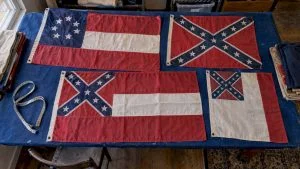
Understanding what the flag on the General Lee car actually represents starts with a design decision made in the chaos after the First Battle of Manassas in July 1861. Confederate officers realized their national flag, the Stars and Bars, looked too much like the Union’s Stars and Stripes from a distance on a smoke-filled battlefield. Soldiers needed something they could recognize in an instant, and that recognition problem is what produced the flag now stitched onto Hazzard County’s most famous car roof.
South Carolina politician William Porcher Miles had proposed a saltire design for the Confederate national flag itself, but the committee rejected it. Miles didn’t abandon the idea. He pushed it forward as a battle flag instead, and General P.G.T. Beauregard adopted it for troops under his command that fall. The design that emerged, according to Encyclopedia Virginia’s entry on the Confederate battle flag, was deliberately distinct from the national banner Confederate diplomats and officials used.
The visual elements carried specific, practical meaning in 1861 and 1862:
- The blue saltire (diagonal cross): Borrowed from Scottish heraldry via Miles’s own design sensibilities, it created a shape soldiers could distinguish at a distance, unlike the horizontal stripes of the national flag.
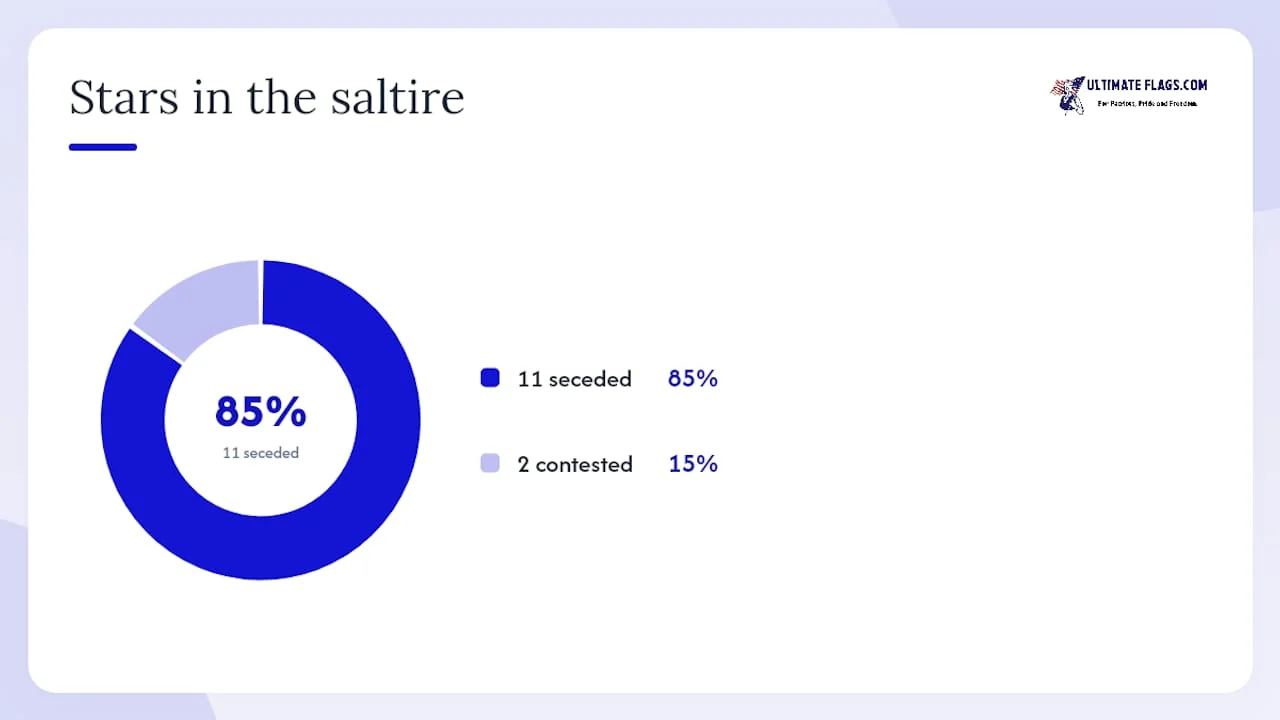
- Thirteen white stars: Represented the eleven seceded states plus Kentucky and Missouri, whose loyalties were contested and often claimed by both sides.
- The red field: Signaled martial identity, echoing older military banner traditions rather than any specific ideological statement at the time of adoption.
- The rectangular shape: Distinguished the Army of Northern Virginia’s battle flag from the square variants used by some Western Confederate armies, a detail collectors and historians still use to date and authenticate period flags.
Robert E. Lee didn’t design this flag, and he wasn’t the officer who first fielded it. But once he took command of the Army of Northern Virginia in June 1862, the battle flag became inseparable from his army’s identity. Units carried it into Antietam, Gettysburg, and dozens of smaller engagements, and that battlefield association is precisely why later generations attached Lee’s name to a flag he neither invented nor formally commissioned.
Robert E. Lee’s Headquarters Flags Versus the Rectangular Battle Flag
Here’s where a huge amount of public confusion sets in, and where museum curators spend considerable time correcting visitors. Lee himself used at least one distinct headquarters banner during the war, separate from the rectangular saltire flag that flew over his troops in combat.
Between 1862 and 1863, Lee’s personal command flag followed a different pattern sometimes called the “Bread of Life” design by collectors, referencing its layout and the religious symbolism period soldiers occasionally read into Confederate banners more broadly. This headquarters flag served an administrative function, marking Lee’s command post and signaling his presence to staff and couriers, rather than serving as a rallying point for infantry under fire.
- Battle flag: Rectangular, carried by individual regiments, meant to be seen and followed across a battlefield.
- Headquarters banner: A separate personal or command marker, tied to Lee individually rather than to any regiment or the army as a whole.
- Public memory: Collapsed these distinct objects into a single generic image, which is largely why “the Confederate flag” functions today as shorthand for several different historical banners.
Encyclopedia Virginia’s cataloging draws a clear line between these flags based on primary-source descriptions and surviving artifacts, and that distinction matters enormously for anyone trying to accurately date or identify a historic piece.
Pro Tip: If you’re examining a flag advertised as a “Robert E. Lee flag,” ask specifically whether it reproduces the Army of Northern Virginia battle flag pattern or a headquarters banner design. The two are visually different, and sellers sometimes use Lee’s name loosely to describe the more common rectangular battle flag.
Symbolism During the Civil War
Soldiers who carried the battle flag into combat weren’t thinking about future political controversies. They were thinking about staying alive and staying with their unit, and the flag served that immediate, tactical purpose first. Color-bearers held one of the most dangerous and most honored positions in a regiment, since losing the flag in battle carried genuine shame while capturing an enemy’s flag carried genuine glory.
Regimental pride ran through how soldiers wrote about their flags in letters home. Religious language often crept into these descriptions too, since many Confederate soldiers understood their cause in explicitly providential terms, framing battlefield banners as symbols blessed by a righteous fight. That framing would later become central to how veterans’ organizations remembered the war, but during the fighting itself, the flag’s meaning stayed rooted in unit cohesion and battlefield survival.
That kind of language, common in veteran memoirs written decades after the fact, reveals how quickly wartime experience got layered with retrospective meaning. Contemporary accounts from 1862 and 1863 focused more narrowly on tactical function, but even then, soldiers described the flag in terms that went beyond simple military hardware. It represented home units, hometown honor, and often literal blood shed defending a specific piece of cloth on a specific hillside. Readers curious about the men who carried these banners into fire can find deeper coverage in Ultimate Flags’ history of the color guard, which traces individual units and the extraordinary risk color-bearers accepted.
Postwar Revival and the Lost Cause
The battle flag mostly disappeared from public life for roughly two decades after Appomattox. Its dramatic return came through organized memory work, not spontaneous popular sentiment, and understanding that organized effort is essential to understanding what the flag came to mean by 1900.
Veterans’ organizations and the United Daughters of the Confederacy, founded in 1894, led a coordinated campaign to reshape how Americans remembered the war. Their version, historians call the Lost Cause, recast the Confederacy’s defeat as a noble, doomed defense of states’ rights and Southern honor rather than a war fought to preserve slavery. The American Civil War Museum’s analysis of Confederate flag mythology documents how thoroughly this narrative de-emphasized slavery’s central role in secession, despite the plain language of state secession declarations from 1860 and 1861.
The Lost Cause campaign worked through several coordinated channels:
- Monument building. Confederate memorial statues surged in two distinct waves, one around 1900 to 1920 and another during the civil rights era of the 1950s and 1960s, timing that historians treat as significant rather than coincidental.
- Institutional naming. Schools, streets, and military bases across the South took Confederate leaders’ names during this same memorial period, cementing Lost Cause figures into everyday civic geography.
- Ceremonial revival. Memorial Day observances, veteran reunions, and battlefield dedications gave the flag formal, respectable venues to reappear in public life.
- Textbook influence. UDC-backed history curricula shaped how generations of Southern schoolchildren learned about secession’s causes, often stripping slavery from the explanation entirely.
This revival gave the battle flag a second life as a solemn memorial emblem, carried at veteran funerals and displayed at monument dedications. That memorial framing is genuinely part of the flag’s history, and readers exploring flag heritage more broadly can find further archival essays through Ultimate Flags’ history of the battle flag’s field debut. But the same decades that memorialized the flag also began attaching it to something considerably more pointed than grief.
20th-Century Revival: Civil-Rights-Era Adoption and Politicization
The flag’s transformation into an explicit political weapon has a traceable, well-documented timeline, and it’s the single most important inflection point for understanding why the flag remains so contested today. This wasn’t organic drift. It was a deliberate political choice made by specific actors at a specific moment.
In 1948, the States’ Rights Democratic Party, popularly known as the Dixiecrats, broke from the national Democratic Party specifically to oppose federal civil rights proposals. They adopted the Confederate battle flag as a visible protest symbol, and that convention marked one of the first times the flag appeared explicitly as a segregationist political emblem rather than a memorial or heritage object.
The pattern accelerated through the following decade. Segregationist governors and legislators displayed the flag prominently as federal courts and the federal government pushed school desegregation forward, most visibly during standoffs like the 1963 confrontation at the University of Alabama. State legislatures in Georgia and South Carolina incorporated Confederate battle flag imagery into official state flags or raised it over state capitols during this same period, timed directly to resistance against integration and the broader civil rights movement.
| Period | Political context | Flag’s role |
|---|---|---|
| 1948 | Dixiecrat revolt against national Democratic civil rights platform | Adopted as a protest symbol at party conventions |
| 1950s | Georgia redesigns state flag | Incorporates the battle flag into official state imagery |
| 1950s and 1960s | School desegregation standoffs | Displayed by segregationist officials and crowds resisting court orders |
| 1950s and 1960s | South Carolina raises the flag over its capitol | Timed to the Civil War centennial and to civil rights tension |
| 1960s onward | Klan and white-supremacist rallies | Flag used explicitly to signal racial intimidation |
The Wikipedia entry on the modern display of the Confederate battle flag documents this trajectory in detail, and the pattern is consistent: each major escalation in the flag’s use as a political symbol tracks almost exactly with a corresponding escalation in resistance to civil rights advances. That correlation is why historians treat the mid-20th century, not the Civil War itself, as the period that hardened the flag’s association with white supremacy in the American public imagination.
The General Lee Car and Pop-Culture Amplification
By the time The Dukes of Hazzard premiered on CBS in January 1979, the battle flag already carried decades of contested political weight, yet the show’s producers put it on the roof of a 1969 Dodge Charger without, by most accounts, weighing that history very carefully.
The car itself traces back to a 1975 film called Moonrunners, an earlier project from the same creative team that eventually became The Dukes of Hazzard. Producers renamed the vehicle from “Traveller,” a nod to Lee’s actual wartime horse, to the more recognizable “General Lee,” betting that the name carried instant Southern cultural resonance for a mass television audience. The roof decal followed that same logic: a fast, loud visual shorthand for rebellious, good-natured Southern identity, aimed squarely at prime-time entertainment rather than political statement.
- The car appeared in nearly every episode across the series, making the flag image widely recognizable.
- Toy manufacturers licensed die-cast and remote-control replicas, extending the image beyond television into homes, with many fans also purchasing related Gulf of America Hats, Shirts and Globes to show their regional pride.
- Syndicated reruns kept the image circulating continuously for decades after the original broadcast run ended.
- A dedicated collector market for General Lee memorabilia sustained demand for the image long after the show left first-run television.
Cast members have consistently defended the car’s imagery as regional pride rather than racial messaging. As Inside Edition’s coverage of cast and producer reactions documented, several actors framed the flag as an innocent piece of 1980s family entertainment rather than a deliberate political statement.
The show’s defenders have long maintained the roof decal was meant to signal fast-driving, rule-breaking Southern charm, a shorthand for character rather than ideology, and that framing still shapes how many longtime fans understand the car today.
That defense reflects a genuinely held viewpoint among many viewers, particularly those who watched the show as straightforward action comedy decades before the flag’s political history became a mainstream conversation. It doesn’t erase the flag’s other histories. It simply adds one more layer to an already layered symbol, one where a 1980s television prop and a 1948 political protest emblem occupy the same physical design.
Modern Controversy and Institutional Responses
The 2015 murder of nine Black churchgoers at Emanuel African Methodist Episcopal Church in Charleston, South Carolina, functioned as the clearest modern turning point for how American institutions handle this flag. The shooter’s documented affinity for the Confederate battle flag triggered rapid, concrete corporate and governmental reassessments that had been building for years but hadn’t previously reached critical mass.
Warner Bros. halted licensing and sales of General Lee toy replicas following the shooting, citing concerns about the flag’s associations. That decision, detailed in the College of Charleston’s digital exhibit on institutional responses, marked one of the most visible corporate reversals tied to Confederate imagery in recent memory.
- South Carolina’s legislature voted to remove the battle flag from its capitol grounds after the Charleston shooting, ending a longstanding display.
- Several major retailers pulled Confederate flag merchandise from shelves nationally, a shift that reshaped where and how these flags could be legally purchased.
- Private owners of General Lee replica cars publicly repainted or removed roof decals, choosing to modify personal property rather than continue displaying the image unchanged.
- Museums intensified debate over whether Confederate flags belong in unlabeled display versus fully contextualized historical exhibits.
A shift in public sentiment followed a clear, documented trajectory. National polling after 2015 showed declining support for official government display of the flag, though regional attitudes remained notably divided, with many Southern respondents continuing to describe the flag as heritage rather than hate even as institutional displays declined nationally.
That regional divide hasn’t closed. National institutions moved decisively toward removal and reassessment, while private display, particularly on vehicles, clothing, and personal property in parts of the South, persists largely unchanged. The flag’s modern story isn’t one of universal resolution. It’s one of sharply split trajectories running in parallel.
How People Interpret the Flag Today
No single interpretation of this flag is objectively correct for every context, and pretending otherwise does a disservice to the genuine complexity historians and museum curators wrestle with daily. What the flag communicates depends heavily on who’s displaying it, where, and alongside what other signals.
- Heritage and ancestral memory. Some display the flag specifically to honor documented Confederate ancestors, often alongside genealogical research and Civil War reenactment activity rather than any contemporary political statement.
- Regional identity. Others use it as loose shorthand for Southern culture broadly, separated in their own minds from both the Civil War and the civil rights era entirely.
- Rebellion and countercultural defiance. A segment of display, particularly among younger owners, treats the flag as a general “anti-establishment” symbol disconnected from specific Southern or Confederate history.
- White-supremacist signaling. In contexts involving hate groups, intimidation, or explicit racial messaging, the flag functions exactly as it did during the civil rights era, as a deliberate symbol of racial hierarchy and threat.
Context does most of the interpretive work. A flag displayed at a marked Civil War battlefield alongside interpretive signage reads entirely differently than the same flag flown alone at a political rally, or stitched onto a car roof at a classic auto show. The American Civil War Museum’s guidance on Confederate flag interpretation stresses that provenance and surrounding context, not the fabric itself, usually carry the real interpretive weight.
Pro Tip: When you encounter this flag in a museum setting, look for interpretive labeling that explains provenance and historical use. A flag displayed without any context invites viewers to project whatever meaning they already hold, while a properly labeled exhibit does the harder work of explaining what that specific object actually represented to the people who made and carried it.
Ultimate Flags Resources for Responsible Collecting and Display
Ultimate Flags has operated as one of America’s longest-running online flag retailers, and that longevity comes with a responsibility to handle contested historical symbols with accuracy rather than shortcuts. The Confederate and Southern heritage flag category sits alongside Revolutionary War, Civil War, and military flag collections, each treated as a distinct historical artifact rather than an undifferentiated novelty item.
Collectors weighing a purchase should think through material and provenance before display. Ultimate Flags’ guide on cotton versus polyester construction helps buyers match fabric choice to intended use, whether that’s a reenactment prop meant for outdoor weathering or an indoor collector’s piece meant to last decades. Budget-conscious buyers can review current battle flag pricing before committing, and anyone concerned about regional sales restrictions should check state-level rules on Confederate flag sales before ordering.
Display carries community weight that a simple purchase transaction doesn’t capture. A flag flown thoughtlessly in a mixed neighborhood communicates something very different than the same flag preserved in a labeled home archive alongside genealogical documentation. Sourcing matters too. Buyers seeking authentic American manufacturing can review where to find USA-made reproductions rather than importing unlabeled overseas stock of uncertain origin.
Why This History Still Matters
I’ve spent a good portion of my career at Ultimate Flags handling symbols that carry more weight than most people expect from a piece of fabric on a pole. The Confederate battle flag, and by extension the General Lee car’s roof decal, sits near the top of that list. It’s tempting to want a clean, single-sentence verdict on what this flag means, and I understand the appeal of that simplicity. But the honest answer is that the flag means several genuinely different things depending on who’s holding it and why, and any account that flattens that complexity into a single story is doing history a disservice.
What frustrates me most about how this topic usually gets covered is the rush to either total condemnation or total defense, when the actual historical record supports neither extreme cleanly. The flag’s Lost Cause revival was real heritage work for grieving families, and it was also, demonstrably, a project that erased slavery from the story of secession. The 1948 Dixiecrat adoption was real political calculation, not accidental symbolism. Both things are true, and pretending otherwise flattens a genuinely complicated American story into something more comfortable but less accurate.
Ultimate Flags covers this history because avoiding it doesn’t make the flag less present in American life. It just leaves that presence unexplained. If you’re weighing a purchase, a display decision, or simply trying to understand a symbol you’ve encountered, Ultimate Flags’ longer essays on flag history offer the fuller archival context this subject deserves.
— Jonica
Sources
- Confederate Battle Flag – Encyclopedia Virginia
- Responses to challenging symbols (College of Charleston Digital Exhibit)
- Myths & Misunderstandings | The Confederate Flag – American Civil War Museum
- Modern display of the Confederate battle flag – Wikipedia
FAQ
Did Robert E. Lee Actually Have His Own Confederate Flag?
Yes. Lee used a personal headquarters banner between 1862 and 1863, sometimes called the “Bread of Life” pattern, which was visually distinct from the rectangular Army of Northern Virginia battle flag his troops carried into combat.
What Is the Flag on Top of the General Lee Car?
It’s a reproduction of the Confederate battle flag, the blue saltire with white stars on a red field originally used by the Army of Northern Virginia, chosen by Dukes of Hazzard producers for its recognizable Southern imagery.
Why Do Some People Say the Confederate Flag Isn’t Racist?
Many who display it point to family heritage, regional identity, or the flag’s original 1861 battlefield function as evidence of non-racist intent, while historians note the same flag was deliberately adopted as a segregationist political symbol starting in 1948, which is why its meaning remains genuinely contested rather than settled.
What Did Robert E. Lee Say About the Confederate Flag After the War?
Lee generally discouraged displaying Confederate flags and symbols publicly after the war, favoring reconciliation over continued military symbolism, though he left no single definitive statement addressing the battle flag specifically that historians treat as conclusive.
Why Did Warner Bros. Stop Selling General Lee Toys?
Warner Bros. halted licensing and sales of General Lee replica toys shortly after the 2015 Charleston church shooting, citing the flag’s documented associations with slavery and hate-group use as the reason for the reversal.