The Lone Star on the Texas flag stands for the unity of one people under God, State, and Country, and it’s the reason the emblem has outlasted every fashion and fad in state symbolism. Texas law assigns each color a virtue: blue for loyalty, white for purity, and red for bravery. The design itself is no accident of taste. It’s the surviving national flag of a republic that fought for its own independence, adopted January 25, 1839, and carried into statehood in 1845.
TL;DR:
- The star’s five points are culturally interpreted to symbolize virtues like fortitude, loyalty, righteousness, prudence, and broadmindedness, beyond the legal meaning of unity.
- Texas law specifies that the flag’s proportions, colors, and star size must follow precise standards, but manufacturing tolerances can cause slight variations.
- The Texas flag was first adopted as the national banner of the Republic of Texas in 1839, and it transitioned seamlessly into the state flag upon annexation in 1845.
- When displayed vertically, the blue field with the star should be on the upper left from the viewer’s perspective, with proper respect for U.S. flag precedence.
- The flag’s colors are legislated to match the same standards as the U.S. flag, and the lone star has historically symbolized Texas unity even before official adoption.
Table of Contents
- Texas Flag Meaning: The Official Answer
- Official Design and Measurements of the Lone Star Flag
- What the Colors, Lone Star, and Star Points Symbolize
- How the Lone Star Flag Was Created and Evolved
- Flag Etiquette and Texas Display Rules
- Debunking Common Urban Legends About the Flag
- How the Lone Star Functions in Civic Life Today
- Ultimate Flags’ Historical Archive on the Lone Star
- How the Texas Flag Compares to the U.S. and Confederate Flags
- A Personal Reflection on the Lone Star’s Endurance
- Where to Find a Historically Accurate Texas Flag
- Sources
- FAQ
Texas Flag Meaning: The Official Answer
Ask any Texan what the star means, and you’ll likely hear some version of the same story: one star, one state, standing whole and unbroken. That instinct is backed by statute, not just sentiment. The Texas State Library’s official description confirms the five-pointed star symbolizes the unity of Texas as one for God, State, and Country, a phrase that has echoed through Texas classrooms and courthouses for generations.
The color coding isn’t folklore, either. It’s written into Chapter 3100 of the Texas Statutes, which spells out the flag’s proportions and assigns blue to loyalty, white to purity, and red to bravery. That’s the legal skeleton beneath everything Texans feel when they see the flag snap in a Gulf Coast wind or hang still over a courthouse lawn in the Hill Country. The meaning was never left to guesswork. It was legislated, and it has held for nearly two centuries.
What makes the Texas flag genuinely rare among American state flags is its double life. Before it ever flew as a state banner, it flew as a national one, the official flag of the Republic of Texas, a sovereign country that existed for almost a decade before joining the United States. According to Britannica, Texas and Hawaii are the only two U.S. states whose flags once represented fully independent nations. That’s not a minor historical footnote. It’s the reason the Lone Star carries a weight that other state emblems simply don’t.
Official Design and Measurements of the Lone Star Flag
Texas doesn’t leave the flag’s construction to interpretation, and that precision matters if you’re buying, sewing, or displaying one that’s actually correct.
The statute lays out a 2:3 ratio between width and length, a proportion that keeps the flag from looking stretched or squat regardless of size. The hoist side, the vertical strip nearest the pole, takes up exactly one third of the flag’s length and is solid blue. The remaining two thirds splits into two horizontal stripes of equal width: white on top, red on the bottom. Centered in the blue field sits a single white five-pointed star, sized so its diameter equals three fourths the width of the blue stripe, always oriented with one point straight up.
Here’s how the specifications break down:
| Element | Official Specification |
|---|---|
| Overall ratio | 2:3 (width to length) |
| Blue hoist stripe | One third of total flag length |
| White horizontal stripe | Top half of remaining two thirds |
| Red horizontal stripe | Bottom half of remaining two thirds |
| Star diameter | Three fourths the width of the blue stripe |
| Star orientation | Single point facing upward |
| Star color | White, five-pointed |
Texas red and blue are tied by statute to the same reference standards used for the U.S. flag, often called “Old Glory” red and blue, according to historical summaries from the Texas State Historical Association. That link wasn’t accidental. Lawmakers wanted the Texas flag to visually harmonize with the national flag it would fly alongside, not clash with it.
If you’ve ever noticed that two Texas flags from different manufacturers look slightly different side by side, you’re not imagining it. Commercial production allows for reasonable tolerance in dye lots, stitching, and fabric weight, so:
- Nylon flags for outdoor use often run lighter and more translucent than cotton or polyester versions meant for indoor display.
- Star placement can vary by a fraction of an inch on mass-produced flags without violating the spirit of the code.
- Grommet versus pole-sleeve construction changes the flag’s overall look but not its legal proportions.
Pro Tip: When buying a Texas flag for permanent outdoor display, look for one made specifically for the elements. A flag cut to the correct 2:3 ratio in a durable nylon or heavyweight polyester will hold its color and shape through Texas heat and wind far longer than a decorative indoor version pressed into outdoor service.
What the Colors, Lone Star, and Star Points Symbolize
The official meaning is short, but the cultural meaning has grown into something much larger, and both deserve equal attention.
Start with what the law actually says. The Texas Flag Code assigns blue to loyalty, white to purity, and red to bravery. The same statute, echoed in the Texas State Library’s description, states that the lone star represents “all of Texas” united as one, not a collection of counties or regions competing for attention, but a single people bound together.
The five-pointed star symbolizes the unity of Texas as one for God, State, and Country.
That single sentence has anchored more civic pride than almost any other piece of state legislation on the books.
Beyond the statute, though, generations of Texans have layered additional meaning onto the star’s five points, and this is where things get genuinely interesting. In 1948, writer Adina de Zavala, publishing through the Frontier Times, suggested the star’s five points each stand for a civic virtue: fortitude, loyalty, righteousness, prudence, and broadmindedness, according to the Texas State Library’s own account of the flag’s symbolism. It’s worth being precise here: this interpretation is cultural tradition, not statutory law. The legislature never codified those five virtues into the Flag Code. But the reading stuck because it fit. Texans wanted their star to mean something layered, not just legally tidy, and de Zavala’s version gave the emblem a moral vocabulary that classrooms and civic groups still teach today.
The star’s role as a unifying symbol predates the 1839 flag by years. During the independence movement of the mid-1830s, Texian settlers and soldiers used lone stars on improvised banners and cockades well before any legislature formalized a design. Scholars note that the star functioned as a solidarity marker among a scattered, often outgunned population fighting for self-rule, according to the Texas State Library. It wasn’t invented for the flag. The flag adopted a symbol that was already doing emotional work on the ground.
A quick way to hold the two layers of meaning apart:
- Legally defined: blue (loyalty), white (purity), red (bravery), and the single star representing unity of all Texas.
- Culturally layered: the star’s five points are traditionally said to represent civic virtues like fortitude, loyalty, righteousness, prudence, and broadmindedness, but this reading is not codified in law.
- Historically rooted: the lone star has long been used as a symbol of solidarity among independence fighters before 1839.
That combination, hard legal definition wrapped in soft cultural tradition, is exactly why the Texas flag resonates the way it does. It gives skeptics a statute to point to and romantics a legend to repeat, and somehow both crowds walk away satisfied.
How the Lone Star Flag Was Created and Evolved
The flag Texans fly today didn’t spring into existence fully formed. It’s the product of a scramble, a committee, and at least one design that history has never fully credited to a single hand.
Here’s the sequence, condensed to what actually happened:
- Pre-1839 experiments. Early Texian flags borrowed heavily from the U.S. design, sometimes modifying the stars and stripes pattern down to a single star over altered stripes. The Burnet Flag, adopted in 1836, put a single gold star on a blue field and served as the Republic’s first official national flag.
- The push for a new design. By 1838, Republic leaders wanted a flag that felt distinctly Texan rather than a variation on someone else’s design. Legislators, including William H. Wharton, pushed the issue through committee.
- Peter Krag’s drawing. The design that became law was drawn by Peter Krag, and it’s his rendering that the Texas State Library’s historic flags collection credits with giving the Lone Star its final proportions and layout.
- Legal adoption, January 25, 1839. The Republic of Texas Congress formally adopted the design as the national flag on that date, a milestone the Texas State Historical Association and Wikipedia’s flag history both treat as the flag’s true birthday.
- Annexation and continuity, 1845. When Texas joined the United States, the Republic’s flag didn’t get retired. It simply transitioned into the new state flag, a continuity almost no other former nation-turned-state can claim.
- The 1879 statutory gap. Texas law briefly lapsed on an official flag description after an earlier repeal, leaving the flag’s legal status murkier than most Texans realized at the time.
- 1933 codification. Lawmakers moved to formally codify the flag’s design and proportions, closing gaps left by decades of informal use.
- 1993 clarifications. A later legislative pass refined the color references, tying Texas red and blue more explicitly to the U.S. flag’s own color standards, according to the Texas State Historical Association.
The designer question deserves its own honest mention, because it’s frequently oversimplified. Popular retellings sometimes name a single heroic designer and leave it there. The historical record is messier. Wikipedia’s flag history entry notes that historians consider the flag’s ultimate designer unknown in any definitive sense, and that attributions made during anniversary celebrations were later revisited once records got a second look. Peter Krag drew the version that became law, but “drew the official rendering” and “originated the design” aren’t necessarily the same claim, and careful historians treat them separately.
That gap between a legend and a legal record is where most flag mythology lives, and it’s worth remembering the next time someone tells you the Texas flag’s origin story as though it were settled beyond question.
Flag Etiquette and Texas Display Rules
Knowing what the flag means is only half the job. Flying it correctly, respectfully, and lawfully is the other half, and Texas statute gives clearer guidance here than most people assume.
The Texas Flag Code establishes precedence rules that mirror federal flag etiquette. When displayed with the U.S. flag, the American flag takes the position of greater honor, and the Texas flag is flown alongside it, not above it or in a way that suggests equal or superior rank. The code also references the flag in connection with the state pledge, and it addresses finial guidance, meaning the ornamental piece atop a flagpole, for formal display situations.
Vertical display trips up more people than any other rule, mostly because most folks have never had to think about it. When a flag is displayed vertically, such as hanging from a building facade or over an entrance, the rule of thumb is that the blue field with the star should end up in the upper left as viewed by someone facing the display, effectively rotating the flag ninety degrees counterclockwise from its normal horizontal orientation. Some display situations, like buildings with multiple entrances facing different directions, call for judgment calls that the statute doesn’t spell out in granular detail, which is where customary flag etiquette fills the gap rather than hard law.
A short checklist that covers most real situations:
- Fly the Texas flag no higher than or level with the U.S. flag, never above it, on a shared pole arrangement.
- Illuminate the flag if it flies after dark, or bring it in at sunset if lighting isn’t available.
- Retire a Texas flag that’s torn, badly faded, or otherwise unfit for display rather than continuing to fly it in poor condition.
- Orient a vertically hung flag so the star sits in the upper left from the viewer’s perspective.
- Rinse salt air or heavy pollen off outdoor flags periodically to protect the color-fastness of the dye.
Pro Tip: Homeowners and small organizations often get tripped up on the vertical orientation rule because it feels counterintuitive. Picture the flag flying normally on a horizontal pole, then physically rotate it counterclockwise until the hoist side is on top. That’s your vertical orientation, every time. For readers assembling flags and hardware for a display, Ultimate Flags’ guide on what to do once you have your flag walks through practical next steps.
Debunking Common Urban Legends About the Flag
A handful of persistent myths follow the Texas flag around, and most of them collapse the moment you check the primary sources.
Myth: We know exactly who designed the flag. Popular retellings sometimes credit a single named individual as the flag’s sole designer, often during anniversary celebrations when a tidy story sounds better than a complicated one. The truth, per Wikipedia’s flag history entry, is that the designer remains formally unknown, and earlier legislative attributions were corrected once historians reexamined the record. Peter Krag produced the official drawing that Congress adopted, which is documented and solid, but that’s a narrower claim than “designed the flag” as popularly told.
Myth: The star’s five virtues are official state law. The fortitude, loyalty, righteousness, prudence, and broadmindedness reading is a real and meaningful tradition traced to a 1948 Frontier Times piece, but it was never written into the Flag Code. It’s cultural interpretation layered onto a statute that only defines unity, not virtue.
Myth: Texas never formally recognized its own flag. This one gets repeated because of a real 1879 statutory gap, when an earlier repeal left the flag’s legal description briefly unclear. That gap got closed through the 1933 codification and refined again in 1993, so the flag has had a clear legal foundation for nearly a century straight.
How the Lone Star Functions in Civic Life Today
The Lone Star shows up everywhere in Texas civic life, and its uses stretch well past the flagpole outside a courthouse.
Veteran observances lean on it heavily. Memorial Day and Veterans Day ceremonies across the state routinely pair the Texas flag with the U.S. flag during honor guard displays, folding ceremonies, and cemetery rededications, a tradition Ultimate Flags has covered in its own historical coverage of memorial events. Parades, from small county festivals to major city celebrations, treat the Lone Star as a visual shorthand for Texan identity that needs no explanation.
Commercially, the star shows up on everything from belt buckles to barbecue joints, a reflection of how deeply the symbol has embedded itself into everyday branding. Collectors and serious buyers, meanwhile, care about details casual shoppers skip past:
- Fabric weight and weave, since nylon and polyester behave very differently in wind and sun.
- Color accuracy against the statutory red and blue references, not just a close visual match.
- Star size and stripe proportion staying within the 2:3 ratio rather than a stretched novelty design.
Political and contested uses of the flag do occur, and intent shapes public reaction more than the symbol itself, as discussed in the history of contested flag symbolism. A flag flown at a civic ceremony reads very differently from the same design used to signal a narrower political stance, and Texans generally judge context first.
Ultimate Flags’ Historical Archive on the Lone Star
Ultimate Flags has spent years documenting the flags that carried Texans through their fights for independence and identity, and that archival work runs deeper than the state flag alone. Coverage of the Lone Star and Bars flag of the Texas “Bloody 5th” Regiment traces how the Lone Star motif appeared on Civil War era banners distinct from the state flag itself, a detail collectors need when assessing provenance.
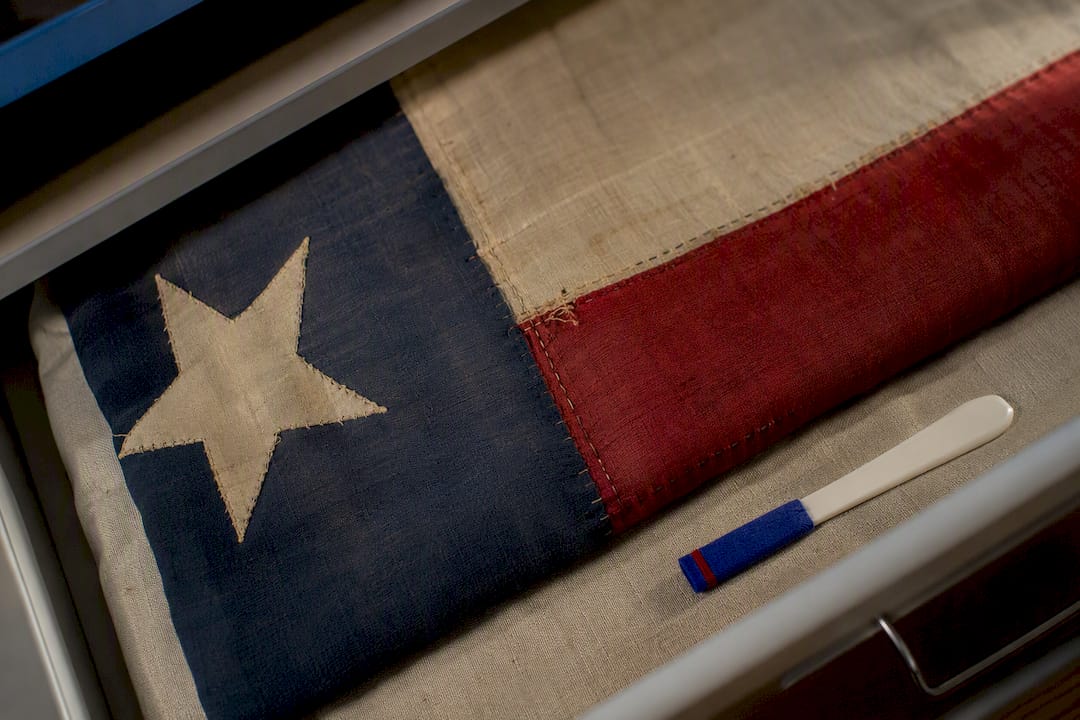
This article was written by Jonica, drawing on primary statutory sources, the Texas State Library’s historic flags collection, and the Texas State Historical Association’s institutional record. Readers chasing more Texan military history can find further context in Ultimate Flags’ coverage of Texans in combat, which connects battlefield history to the symbols Texans carried into it.
How the Texas Flag Compares to the U.S. and Confederate Flags
Set the Texas flag next to the U.S. flag and the family resemblance is deliberate, not coincidental. Both use the same red, white, and blue palette, and Texas statute explicitly ties its colors to the same reference standards as “Old Glory.” But where the U.S. flag uses thirteen stripes and fifty stars to represent founding states and current membership, the Texas flag simplifies everything to one star and two stripes, a design built around singularity rather than accumulation. The U.S. flag tells a story of many becoming one federation; the Texas flag tells a story of one republic standing whole.
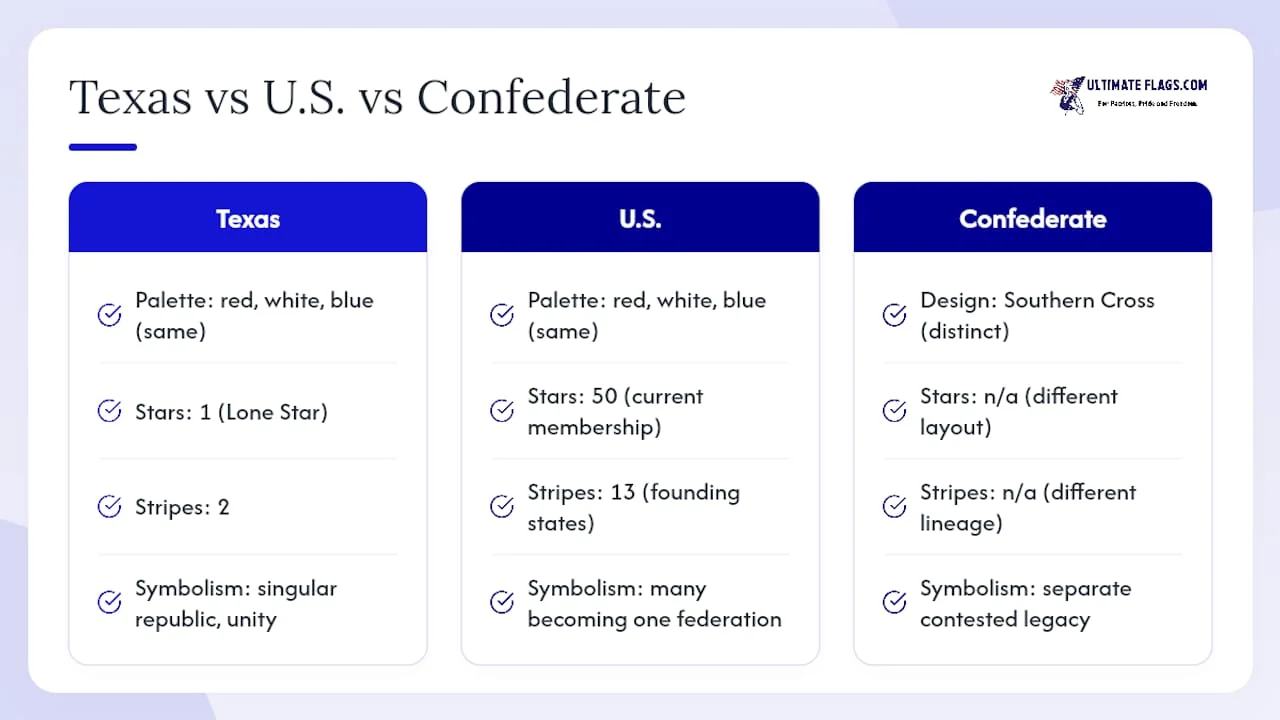
The comparison to the Confederate battle flag is trickier, and worth handling honestly. The two flags are historically distinct: the Lone Star flag predates the Confederacy by more than two decades and represents the Republic of Texas and later the state itself, not the Confederate States of America. The Confederate battle flag, often called the Southern Cross, carries its own separate design lineage and its own contested modern legacy. Texas did fly under Confederate colors during the Civil War, and that period is part of the state’s full history, but the Lone Star flag itself was never a Confederate creation. It’s older, it’s a state symbol under federal law today, and its legal meaning, loyalty, purity, and bravery, was fixed in Republic-era statute years before secession was ever debated.
A Personal Reflection on the Lone Star’s Endurance
What strikes me most about the Lone Star isn’t the statute or even the history. It’s that a design drawn in 1839 for a struggling young republic still means the same thing to Texans nearly two centuries later: one people, standing together. Flags fade, get retired, and get replaced, but the meaning behind this one hasn’t budged an inch. Fly yours correctly, retire it with respect when it wears out, and pass the story along accurately, myths and all, because that’s how a symbol earns two hundred years of loyalty.
— Jonica
Where to Find a Historically Accurate Texas Flag
Reading the statute is one thing. Flying a flag that actually matches it, correct ratio, true colors, properly sized star, is another, and that’s where Ultimate Flags comes in as America’s oldest online flag store. Ultimate Flags builds its Texas flags to the same proportions and color standards laid out in the state’s own Flag Code, so what flies over your porch or property matches what the legislature actually defined in 1839.

Beyond the flag itself, Ultimate Flags’ archive of historical storytelling gives Texas flag owners something most retailers never bother offering: context. Pieces like Legends of the Stars and Bars and Flag: Silent Sentinels of History? connect the hardware you’re buying to the history it represents. If you’re ready to fly a Lone Star flag that’s built to the real specifications rather than a stretched novelty version, browse Ultimate Flags’ state flag selection and get one on your pole this week.
Sources
- Texas State Library — State Flag Description
- Texas Statutes (archived) — Chapter 3100: State flag
- Texas State Library — The Lone Star flag of Texas (historic flags page)
- Texas State Historical Association — Flags of Texas
- Wikipedia — Flag of Texas
FAQ
What Do the Five Points on the Texas Star Mean?
Officially, the star’s five points simply reinforce the single meaning of unity under one star. A popular 1948 interpretation by Adina de Zavala assigns each point a virtue, fortitude, loyalty, righteousness, prudence, and broadmindedness, but that reading is cultural tradition, not statutory law.
What Does the Lone Star Mean in Texas?
The Lone Star represents the unity of Texas as one for God, State, and Country, a meaning written directly into the state’s Flag Code and reinforced by the Texas State Library’s official description.
Why Can the Texas Flag Be Flown?
Texans can fly the state flag freely as a matter of state pride and law, subject to the same respectful display rules that govern the U.S. flag, including proper precedence and orientation. Ultimate Flags builds its flags to match the statutory ratio and color standards so what you fly reflects the official design.
Why Is There Only One Star on the Texas Flag?
A single star reflects the flag’s original purpose as the national emblem of the Republic of Texas, a solitary, independent nation rather than a union of multiple territories. That one star carried into statehood in 1845 and has represented unified Texas identity ever since.