The right flag for a Civil War reenactment is the one your unit would actually have carried: a Union national or regimental color, or a Confederate national flag or army battle flag, in the right pattern for the year and the theater you portray. Get that right and the whole line of battle changes. Cloth that once told soldiers where to dress, where to rally and whether the fight was being won or lost does the same work for your audience today.
This guide walks through what each side carried, how to match a flag to your impression, what to check on a reproduction, and how to display these banners with the context and care they deserve.
TL;DR
- Union infantry carried two flags, a national color and a regimental color. Confederate regiments carried a single flag, so your side and year decide what you need.
- Confederate designs changed during the war: the Stars and Bars (1861), the Stainless Banner (1863) and the Third National Flag (1865), plus army battle flags that varied by command.
- Check star count, fabric, size and unit markings before you buy. For a display piece, a well-made reproduction is the practical choice.
- The National Park Service accepts Confederate flags in reenactments and interpretive programs when they carry historical context, so pair yours with a story.
- Handle every flag as you would any national color: keep it off the ground and retire it respectfully when it wears out.
Table of Contents
- Why a flag matters on the field
- What the Union carried
- What the Confederacy carried
- Matching a flag to your unit and year
- What the surviving flags teach us about construction
- Reproduction versus original
- Displaying Civil War flags with context
- Our perspective
- Where to find your flags
- FAQ
- Sources
Why a flag matters on the field
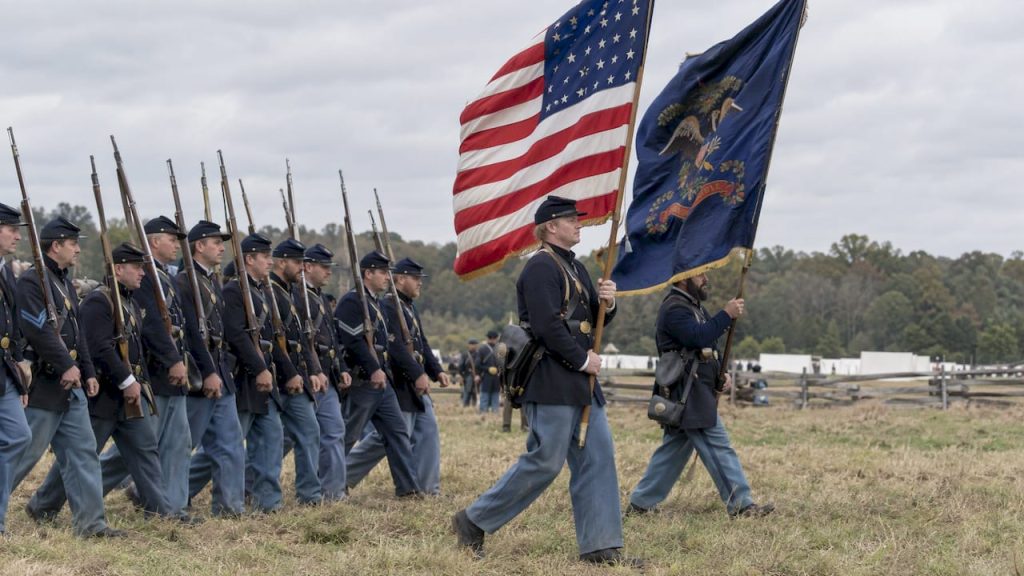
Before a flag was a decoration, it was a tool. According to the National Park Service, Civil War flags guided units through the smoke, stood for the unit itself and served as rallying points, and at least one flag led each unit from the center front of the regiment. They also symbolized country, comrades and home, which is why men fought and died to keep them aloft.
Historian Greg Biggs, quoted by the American Battlefield Trust, describes battle flags as essential for unit identification and for judging progress on smoke-filled battlefields, the “steering wheel” of a regiment in line of battle. Both armies also used small general guide flags, or guidons, on the flanks of each line.
That is the standard to hold in your mind when you shop. A reenactment flag whispers a regiment’s story back to the crowd. If it is the wrong pattern, it tells the wrong story.
What the Union carried
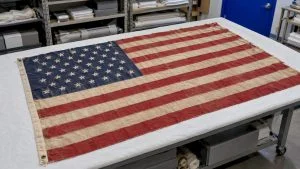
Union infantry regiments carried two flags: the national colors and a regimental color. The national flag changed as states were admitted, so the star count dates your impression. The American Battlefield Trust notes that Union forces used 33-, 34-, 35- and 36-star national flags over the course of the war. A reenactor portraying 1861 would not carry the same canton as one portraying the final campaigns of 1865.
A few practical points follow from that:
- Pick the star count for your year. If your event portrays early war, a 33-star flag is a defensible choice, and our 33 star USA flags page gathers them in one place.
- Remember the second flag. A Union infantry impression is more complete with a regimental color alongside the national flag. Browse our civil war regiment flag and civil war infantry flag collections for unit-style designs.
- Expect variety. Volunteer units often added state and regional touches, and star arrangements were not rigidly fixed. Surviving flags show rows, circles and ovals, so a pattern that looks “unusual” may be perfectly period.
- Do not forget the Irish regiments. Some units carried distinctive green colors, and our civil war irish flag selection covers that tradition.
What the Confederacy carried
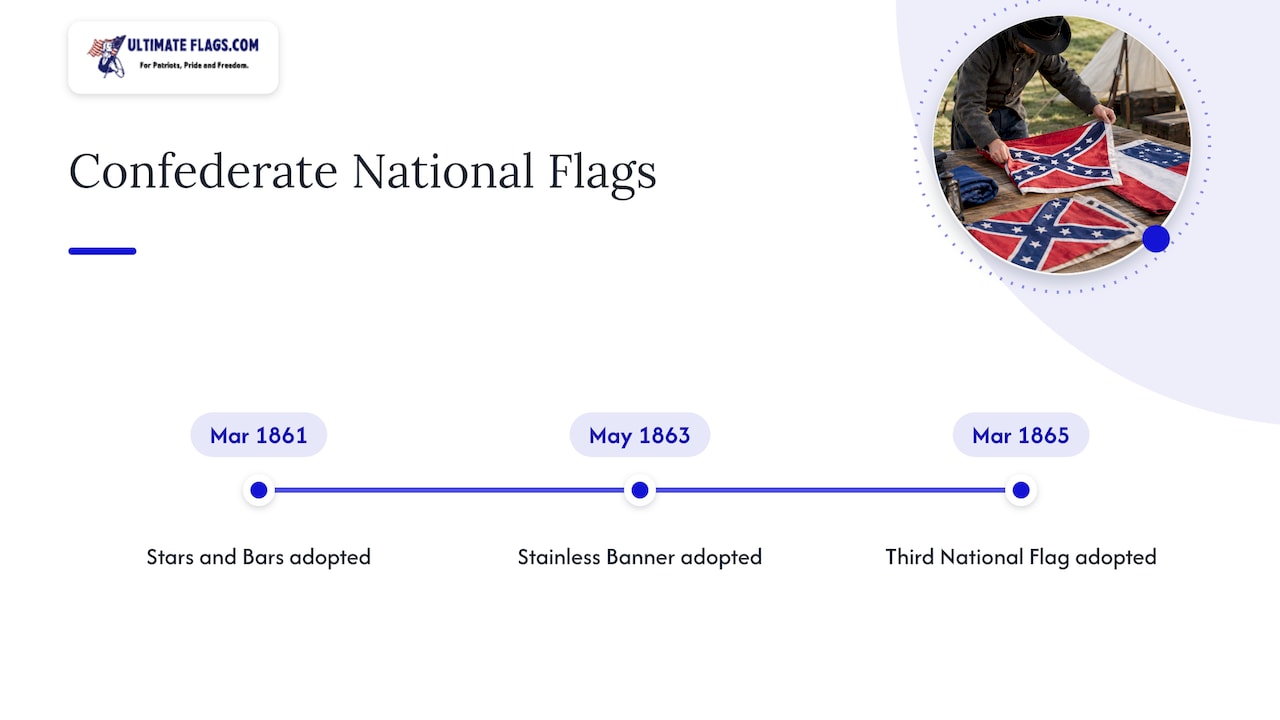
The Confederate story is more tangled, and it rewards a careful reader. A Confederate regiment carried one flag, and the design shifted as the war went on. The American Battlefield Trust’s flag guide records that the Confederacy adopted the Stars and Bars in March 1861, the Stainless Banner in May 1863, and a Third National Flag in March 1865. The Stainless Banner was meant to cut down battlefield confusion, and the third pattern followed after the second could be mistaken for a flag of truce.
The Stars and Bars and the battle flag
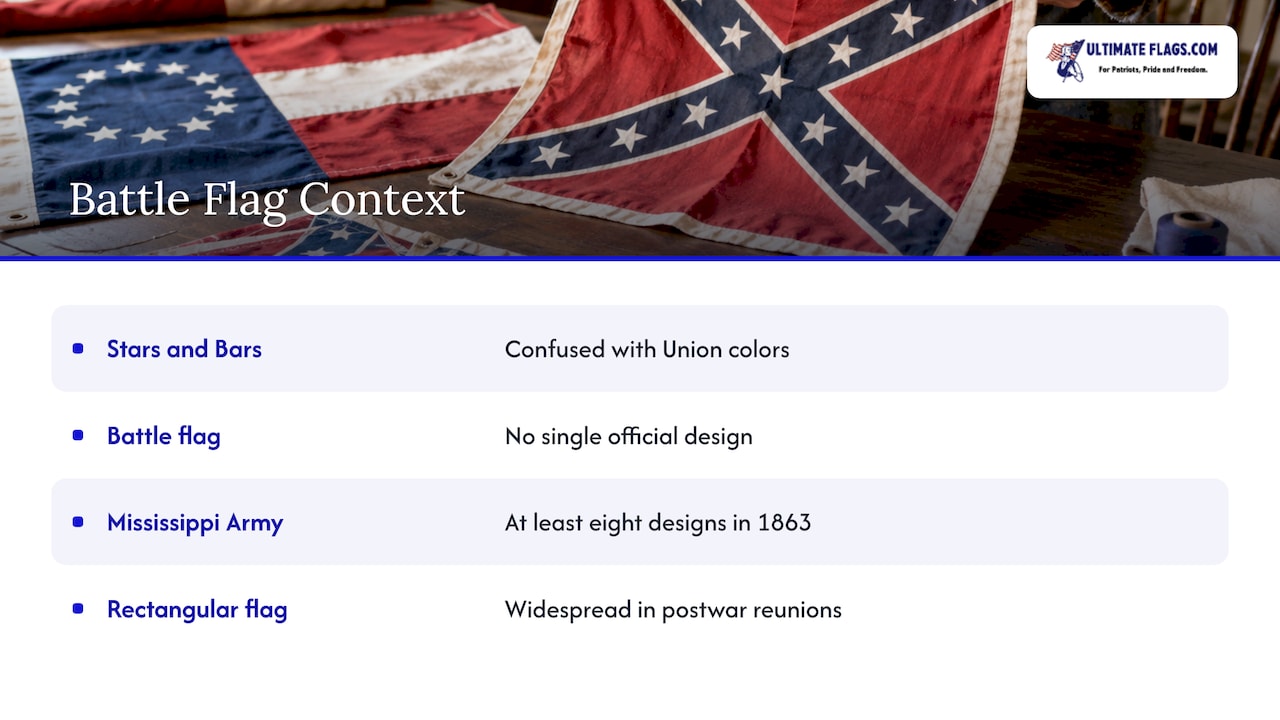
The first national flag looked too much like the Union’s under fire. The National Park Service explains that the Stars and Bars was confused with Union colors, which prompted a more distinguishable battle flag: a red square with a blue St. Andrew’s Cross and thirteen stars, issued to the Army of Northern Virginia in the spring of 1862.
Here is the nuance reenactors should know. The Park Service’s Pea Ridge page states that the Confederate Army never had a single official battle flag. Each army or corps had its own designated flag, and the Army of the Mississippi alone had at least eight designs in use at one time in 1863. The rectangular flag we now call “the” battle flag became widespread in veterans’ reunions after the war, largely because rectangles were easier for manufacturers to mass produce.
So if you portray the Western Theater, the familiar Northern Virginia pattern may not be your flag at all. Our army of northern virginia battle flags page is the right stop for Eastern impressions, while the Civil War flags collection shows the broader range.
Matching a flag to your unit and year
Start with three questions, in this order:
- Which side, and which theater? This narrows you to Union colors or the right Confederate family of flags.
- Which year? Star counts and national patterns changed, so a date eliminates half the options immediately.
- Which unit? Regimental and state designs separate a generic impression from a specific one.
The North American Vexillological Association stresses that identifying an accurate flag means cross-referencing primary-source drawings and published reconstructions, and its secretary, Ted Kaye, points out that even a central charge can be misread when a source drawing is poorly reproduced. Treat that as a working habit: find a documented example from your unit’s state or army, then choose the reproduction that follows it.
Our own reenactor’s reproduction checklist goes through this process step by step, and our piece on documenting historical reproductions shows how to keep a paper trail for the flags you display.
What the surviving flags teach us about construction
Surviving flags are the best teachers. The Minnesota Historical Society records that the Twenty-eighth Virginia’s battle flag measures 44½ by 48 inches and is wool, apart from its white cotton stars and filets, carrying thirteen white stars on a white-edged blue cross against a red field. That is a useful reminder: battle flags were not oversized banners. They were nearly square, and a flag around four feet on a side is a good benchmark for an infantry impression.
Use a few simple rules when you compare reproductions:
| What to check | What to look for |
|---|---|
| Shape | Confederate infantry battle flags were often close to square; many rectangular versions are postwar or commemorative styles |
| Size | Compare against documented examples, such as the roughly 44½ by 48 inch Twenty-eighth Virginia flag |
| Star count | Match the national flag to your year; 33 to 36 stars for the Union |
| Colors and layout | Red field, blue cross, white edging and thirteen stars for the Army of Northern Virginia pattern |
| Markings | Regimental colors carry a unit designation; research what your unit’s flag actually said |
Materials matter to the eye, even from a distance. Period flags were made of silk, wool bunting and cotton, depending on the year, the army and the available supply. A modern printed or sewn polyester reproduction will not match them, but it will fly well, survive a weekend in the field and give your audience the right silhouette and colors. For an event flag you plan to carry, that trade is usually the sensible one.
Reproduction versus original
Most reenactors want a faithful reproduction, not an antique, and that is a good thing. Originals are rare, fragile and expensive, and a reproduction lets you carry the pattern into the field without risking a museum-grade object.
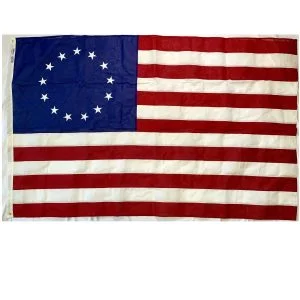
If you ever do consider an antique, remember how easy it is to be fooled. On Antiques Roadshow, an appraiser identified a Bonnie Blue Flag-pattern piece as a reproduction by its cotton cloth and the absence of any ties or nail marks that would show it had once been flown. A genuine flag of that kind, the appraiser said, could be worth $40,000 to $60,000, while reproduction display pieces typically cost from a couple of hundred dollars to $300 (figures from a 2009 appraisal).
The lesson is encouraging. A reproduction is an honest object when it is sold and displayed for what it is, and it gives you the look of the original at a sensible cost. Our guide on telling a 48 star replica from an antique shows the same eye for detail applied to another era.
Displaying Civil War flags with context
These flags carry real weight, and the best reenactors know it. The National Park Service’s volunteer guidance, reproduced in the Newcomer House manual, allows Confederate flags in books, exhibits, reenactments and interpretive programs when they supply historical context, such as showing where troops stood or how they moved. The same guidance encourages thoughtful, factual discussion of the flags’ history and of the contested memory around them.
In practice, that means:
- Put the flag in a story. A camp, a color guard, a living-history talk or a sign about the regiment turns cloth into history.
- Name the unit and the year. “This is the flag of a specific regiment at a specific battle” is stronger than a flag standing alone.
- Welcome questions. The best interpretation invites conversation instead of ending it.
A Virginia reenactment association takes the same line in its flag etiquette guidelines: its members state that Confederate flags should be handled as American flags are, kept off the ground, and replaced when faded or worn, with respectful incineration as the preferred disposal, and shown with educational context wherever the public can see them.
If you present Union and Confederate colors together, or mix eras in a larger display, our guide to displaying multiple flags covers poles, staffs and order.
Our perspective
We have spent our years in this trade convinced of one thing: a flag is history you can hold in your hands. The Civil War generation understood that better than anyone. They carried cloth into fire because it meant home, comrades and cause, and they carried it with a discipline we should honor.
That is why we describe ourselves as America’s oldest online flag store, and why our shelves reach from the Revolutionary War and the Civil War through the world wars. Reenactors and collectors come to us because they care about getting the story right, and we want the flag in your hands to deserve the regiment it recalls.
Our advice is simple. Decide your side, your year and your unit first. Choose a reproduction that follows a documented pattern. Then display it with the story beside it, because a banner that rallied troops should never stand mute. Whatever your viewpoint, a well-chosen flag, shown with care and context, is how the next generation learns what these colors meant.
John Hough
Where to find your flags
When you are ready to equip a color guard or finish a display, start with our Civil War flags collection. It brings together Union and Confederate designs, and the collection page lists a mix-and-match offer, so check it for the current terms. For flagpoles, staffs and hardware, or to browse the wider catalog of historic war, state, military and USA flags, visit our full flag collections.

If you are building a Revolutionary War display alongside your Civil War impression, our guide to which Revolutionary War flags belong in a reenactment display will help. And if you are thinking about the people who will carry these traditions forward, read the next generation of Civil War reenactors.
FAQ
How many flags did a Civil War regiment carry?
Union infantry regiments carried two flags, the national colors and a regimental color. Confederate regiments carried a single flag, according to historian Greg Biggs. Both sides also used small guidon-style guide flags along the flanks of the line of battle.
Which Confederate flag should I carry for my impression?
It depends on your year and your army. The Stars and Bars dates to March 1861, the Stainless Banner to May 1863 and the Third National Flag to March 1865. Battle flags varied by command, so research your army before choosing a pattern.
Is the red and blue Confederate battle flag the official flag of the whole army?
No. The National Park Service states that the Confederate Army never had one official battle flag, and each army or corps used its own design. The rectangular version became common mostly through postwar reunions.
Can I display Confederate flags at a reenactment?
The National Park Service guidance accepts them in reenactments and interpretive programs when they provide historical context. Show the flag with a unit, a date and an explanation so visitors understand what they are seeing.
How do I know a reproduction is historically accurate?
Compare it against documented examples for your unit, checking star count, proportions, colors and markings. Vexillology experts recommend cross-referencing primary-source drawings and published reconstructions rather than relying on a single image.
Sources
- Flags at Antietam, Antietam National Battlefield (National Park Service)
- Battle Flags of New Market Heights: History and Conservation (American Battlefield Trust)
- The Flags of the Union, Flag Guide (American Battlefield Trust)
- Southern Battle Flags, Pea Ridge National Military Park (National Park Service)
- FQ&A: Flag Identification and Their Histories (North American Vexillological Association)
- Twenty-eighth Virginia Infantry Regimental Battle Flag (MNopedia, Minnesota Historical Society)
- Civil War Bonnie Blue Flag reproduction appraisal (Antiques Roadshow, PBS)
- Newcomer House Volunteer Manual, 2025
- Flag Etiquette (Southern Virginia Civil War Reenactment Association)