Posted on

Not Just Another Pretty Face – Abigail Adams

There were plenty of courageous and intelligent women who served and fought for independence during the American Revolutionary War. These” Daughters of Liberty” did more than their share to help win America’s freedom. Here’s a story of another who played a significant role.

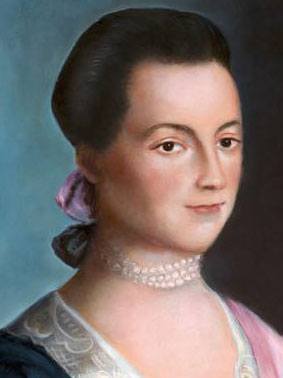
Abigail Adams is best known as the wife of our second President of the United States John Adams, the mother of John Quincy Adams, the sixth president, and for for her extensive correspondence.  

Abigail Adams was the wife of American Patriot and Founding Father John Adams. John Adams was known to be cranky, ill-tempered, and just plain grumpy at times.  But he probably would have been a lot grumpier without the care and support of Abigail, his wife of fifty-four years, who he called his “Portia”. (If you’ve ever read William Shakespeare’s The Merchant of Venice, then you know that Portia is the beautiful and smart heroine of the play.)

In 1775 the Massachusetts Colony General Court appointed Abigail Adams, Mercy Warren, and the governor’s wife, Hannah Winthrop, to question fellow Massachusetts women who pledged by their word or deed to remain loyal to the British crown and worked against the independence movement.  

John Adams wrote to his wife saying, “you are now a politician and now elected into important office, that of judges of Tory ladies…As the Second Continental Congress was debating the Declaration of Independence, Abigail wrote in her letters to John her argument that now, with the a new form of government, it was the perfect time to start the effort to make the legal status of women equal to that of men.Abigail remained in Braintree to manage the farm and household and raise their children while John carried on his work as statesman and leading advocate for American independence. At that time women did not normally handle business affairs, but Abigail kept everything going at home. She traded livestock, hired help, bought land, oversaw construction, and supervised the planting and harvesting, no small tasks for anyone.

She once wrote, “I hope in time to have the reputation of being as good a Farmess as my partner has of being a good Statesman.”

Abigail served as unofficial advisor to John throughout his entire career. Their letters to each other clearly show how he sought her counsel on many issues, including his aspirations to be President. Thankfully, their extensive collection of correspondence allows us to learn what an extraordinary woman Abigail Adams was.Two of Abigail Adams’ more notable quotes are:

“Great necessities call out great virtues.”

“If we mean to have heroes, statesmen and philosophers, we should have learned women.”


Thanks for reading! We hope you enjoyed our post. Please share with all your fellow patriots. Brought to you by: Ultimate Flags
Posted on

The Seven – Eleven – Thirteen Rebel States

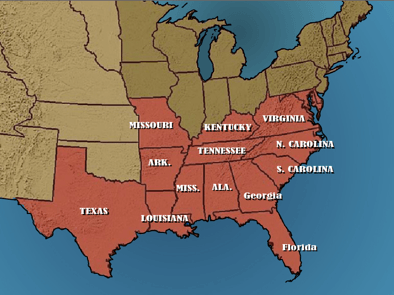
The Confederate Battle Flag has 13 stars for 13 states.  South Carolina seceded in December 1860, followed by five more states: Mississippi, Florida, Alabama, Georgia, and Louisiana  in January, and then Texas on the 1st of February.  

These seven states met a few days later in Montgomery, Alabama, and formed the Confederate States of America.  Jefferson Davis was elected President on February 9th, almost a month before Lincoln was inaugurated in March. By the middle of May, four more states had seceded and joined the Confederacy: Virginia, Arkansas, Tennessee, and North Carolina for a total of 11 Confederate States.  Four slave states – Delaware, Kentucky, Maryland, and Missouri – remained in the Union. Missouri and Kentucky proclaimed they were neutral in the war, but that ended in Missouri when Union troops arrested the Missouri State Guard and imprisoned them.  The State government went into exile, and a war began between the Missouri State Guard and the Union forces.  The state government voted to secede in October, and was admitted to the Confederacy. It was kind of the opposite in Kentucky.  Confederate General Polk advanced into Kentucky one day before Union General Grant moved his army into the state. The Kentucky legislature had promised its citizens it would remain neutral unless it was impossible, and to join the South if necessary. But with neutrality broken, the legislature decided to join with the North because Polk had been the first to enter the state. Many Kentucky citizens were very mad about this, and a new legislature was formed and it declared independence, joining the Confederacy. This made a total of 13 Confederate states.In short, Missouri and Kentucky were claimed by both North and South, and had representatives in both Congresses.

Thanks for reading. Please share our posts with your friends and family so they too can learn more about Southern Heritage and History.

Brought to you by: Ultimate Flags

Posted on

“…All Hell Broke Loose.”

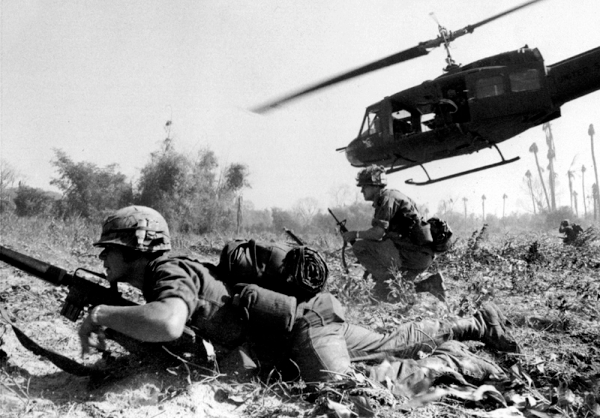
“As soon as the sun came up, all hell broke loose…. it seemed impossible for anyone to survive.”  

This is how Specialist LaTeague described the beginning of the Battle of Ia Drang Valley in Vietnam, where American soldiers of the the 1st Cavalry found themselves outnumbered five to one.Sergeant Major Plumley calmly said, “Gentlemen, prepare to defend yourselves,” as he yanked out his .45 pistol and jacked a round into the chamber. Plumley was a grizzled veteran of WW II and Korea, including glider assaults in Europe with the 82nd Airborne, and plenty of action with the 101st Airborne, including Porkchop Hill.

By the time he retired, Plumley had over 3 dozen medals for gallantry in five different nations, including multiple Silver stars and Purple Hearts.Courage was everywhere at Ia Drang. When 2nd Lieutenant Marm’s platoon came under fire from an entrenched machine gun, Marm assaulted the gun himself. He took it out, despite multiple wounds. Twelve enemy soldiers were found dead in the nest the next day.

Marm earned the Medal of Honor.Charlie Company was taking fire from advances on three sides of their position. Specialist Parish used all of his ammo fighting back. More than 100 enemy troops were found dead around his foxhole after the battle.  

Parish earned a Silver Star.These stories were repeated again and again as the 7th Cavalry held out until reinforcements could arrive.


Thanks for reading! We hope you enjoyed our post. Please share with all your fellow patriots. Brought to you by: Ultimate Flags
Posted on

Ghosts of Gettysburg

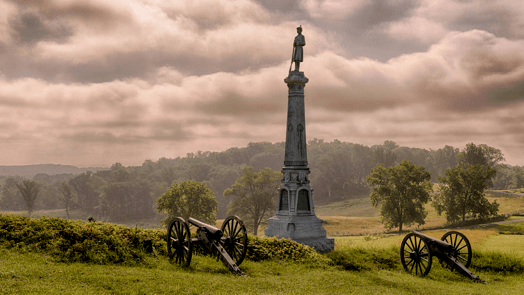
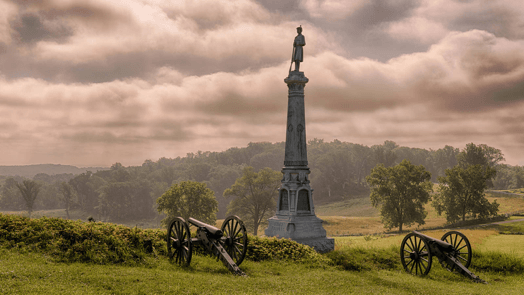
It is said that Gettysburg is one of the most haunted places in America. Don’t believe in ghosts? Well, here is a story that may just change your mind.An old man approached some extras sitting at Little Round Top during filming of the movie Gettysburg. He wore a torn and scorched uniform, and smelled of gunpowder.The old man talked about the fury of battle, passed out rounds of ammunition and left.The extras figured he was one of the people in the film, but in looking more closely at the  ammunition, they noticed it looked odd. They took the rounds to the man in charge of those props. But he said they were not from him – they were actual Civil War rounds.For years at Gettysburg a barefoot man dressed in a shirt and hat matching the uniform of a Texas unit has been approaching the tourists. The man always says, “What you’re looking for is over there.”  He points to Plum Run and vanishes.Plum Run is a stream between Little Round Top and Devil’s Den, the center of the heaviest fighting of the battle of Gettysburg.The oldest building at Gettysburg College served as a field hospital during the battle. One night in the 1980’s two college administrators got onto the elevator on the 4th floor, and pushed the 1st floor button. But the elevator skipped the 1st floor and went straight to the basement level.When the doors opened, the men gazed out at a ghastly sight. They blood-covered doctors and orderlies bent over wounded and dying men. Amputated limbs lay in one corner. The scene was eerily silent. When one of the orderlies looked directly at them, the two men pounded the elevator buttons to get away.

Many witnesses saw the same things, so not everyone could be wrong. So, unbelievers, what do you say now?


Thanks for reading! We hope you enjoyed our post. Please share with all your fellow patriots. Brought to you by: Ultimate Flags
Posted on

“We want none but Texans.”

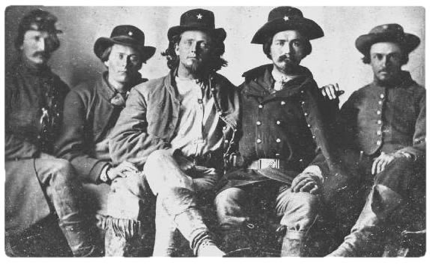
When the Civil War started it was hard to get a Texan to join other than a cavalry unit.  British Lt. Col. Fremantle visited Texas, and observed that “it was found very difficult to raise infantry in Texas as no Texan walks a yard if he can help it.” The 8th Texas Cavalry, commonly known as Terry’s Texas Rangers, pictured above, fought 275 battles across seven states. A Union Colonel described one Ranger attack this way: “With lightning speed, under infernal yelling, great numbers of Texas Rangers rushed upon our whole force. They advanced as near as fifteen or twenty yards to our lines, some of them even between them, and then opened fire with rifles and revolvers.” Fierce in battle, the Texans knew honor. During one engagement, a Union regiment managed to kill the Rangers’ beloved colonel.  A year later the Rangers captured the Union commander of that regiment, now a general in charge of a Brigade. Wounded, the general received kind treatment, and was later quoted as saying he would “rather be a private in the Texas Rangers than a general in the Federal army.” The Rangers were mighty sure of themselves, as well. Their chaplain wrote,

“Colonel Wharton has authorized me to say that he will not admit amateur fighters into the Regiment…. We want none but Texans.” Well, I don’t suppose a Texan is a Texan if he isn’t just a bit cocky. In any case, the Rangers’ right to swagger had been earned.

Thanks for reading. Please share our posts with your friends and family so they too can learn more about Southern Heritage and History.

Brought to you by: Ultimate Flags

Posted on

Veteran’s Day November 11th

Millions of Americans are preparing to celebrate Veteran’s Day on the 11th of November.  On the 11th hour of the 11th day of the 11th month in 1918, an armistice was declared, effectively ending “The Great War” – World War I.This day has been marked ever since, with parades and special ceremonies all across America.

In November 1919, President Wilson proclaimed November 11 as the first commemoration of Armistice Day with the following words:

“To us in America, the reflections of Armistice Day will be filled with solemn pride in the heroism of those who died in the country’s service and with gratitude for the victory, both because of the thing from which it has freed us and because of the opportunity it has given America to show her sympathy with peace and justice in the councils of the nations…”

On November 11, 1921, an unidentified American soldier killed in World War I was buried at Arlington National Cemetery. We call his resting place  the Tomb of the Unknown Soldier. Every year the President of the United States places a wreath of flowers at the site.

The United States Congress passed a  resolution on June 4, 1926, with these words:

Whereas it is fitting that the recurring anniversary of this date should be commemorated with thanksgiving and prayer and exercises designed to perpetuate peace through good will and mutual understanding between nations; and

Whereas the legislatures of twenty-seven of our States have already declared November 11 to be a legal holiday: Therefore be it Resolved by the Senate (the House of Representatives concurring), that the President of the United States is requested to issue a proclamation calling upon the officials to display the flag of the United States on all Government buildings on November 11 and inviting the people of the United States to observe the day in schools and churches, or other suitable places, with appropriate ceremonies of friendly relations with all other peoples.

Everyday Americans turn out for local parades, thank the military veterans they know who served in the Army, Navy, Air Force, Marines, and Coast Guard, fly the Stars and Stripes, and stand proud with hands over hearts when the American anthem, the Star Spangled Banner, plays.

It’s reported that President George Washington once said:

“The willingness with which our young people are likely to serve in any war, no matter how justified, shall be directly proportional to how they perceive the Veterans of earlier wars were treated and appreciated by their nation.”With millions showing disrespect for our flag and to those who bravely fought and gave the ultimate sacrifice, their lives, to protect the citizens of the United States and  freedoms, it is now more important than ever that we celebrate our veterans and we fly our flags proudly.


Thanks for reading! We hope you enjoyed our post. Please share with all your fellow patriots. Brought to you by: Ultimate Flags
Posted on

The Ghosts of Gettysburg  

3 inch rifle

It is said that Gettysburg is one of the most haunted places in America. Don’t believe in ghosts? Well, here is a story that may just change your mind.An old man approached some extras sitting at Little Round Top during filming of the movie Gettysburg. He wore a torn and scorched uniform, and smelled of gunpowder.The old man talked about the fury of battle, passed out rounds of ammunition and left.The extras figured he was one of the people in the film, but in looking more closely at the  ammunition, they noticed it looked odd. They took the rounds to the man in charge of those props. But he said they were not from him – they were actual Civil War rounds.For years at Gettysburg a barefoot man dressed in a shirt and hat matching the uniform of a Texas unit has been approaching the tourists. The man always says, “What you’re looking for is over there.”  He points to Plum Run and vanishes.Plum Run is a stream between Little Round Top and Devil’s Den, the center of the heaviest fighting of the battle of Gettysburg.The oldest building at Gettysburg College served as a field hospital during the battle. One night in the 1980’s two college administrators got onto the elevator on the 4th floor, and pushed the 1st floor button. But the elevator skipped the 1st floor and went straight to the basement level.When the doors opened, the men gazed out at a ghastly sight. They blood-covered doctors and orderlies bent over wounded and dying men. Amputated limbs lay in one corner. The scene was eerily silent. When one of the orderlies looked directly at them, the two men pounded the elevator buttons to get away.Many witnesses saw the same things, so not everyone could be wrong. So, unbelievers, what do you say now?

Thanks for reading. Please share our posts with your friends and family so they too can learn more about Southern Heritage and History.

Brought to you by: Ultimate Flags

Posted on

Texans: “blazing, fighting mad”

In 1833 Santa Anna became President of Mexico. An elitist, he feared and thought little of the common man. Ignoring Mexico’s constitution, he dissolved congress, ordered the civil militia disarmed, and established his own dictatorship.  The Americans who had legally settled in Texas, a Mexican state, were not happy about this, to say the least. Texas and many other Mexican states openly rebelled.  Santa Anna then ordered that all foreigners caught under arms on Mexican soil would be treated as pirates and shot. Foreigners made up the great majority of the Texas Army. We all know what happened next at the Alamo, but weeks later a massacre occurred that turned Texan resolve into steel.

In March 1836, 400 Texans were near Goliad when a Mexican army of 1400 caught up with them.  The Texans fought, but the situation seemed hopeless, so they surrendered. Mexican General Urrea treated the prisoners well, and urged Santa Anna to show leniency “after a hotly contested engagement”. But Santa Anna would have none of it, and sent an aide to enforce a brutal order: Execute the nearly 350 prisoners, including the wounded.

Santa Anna made a bad mistake. The staunch Texans were furious!

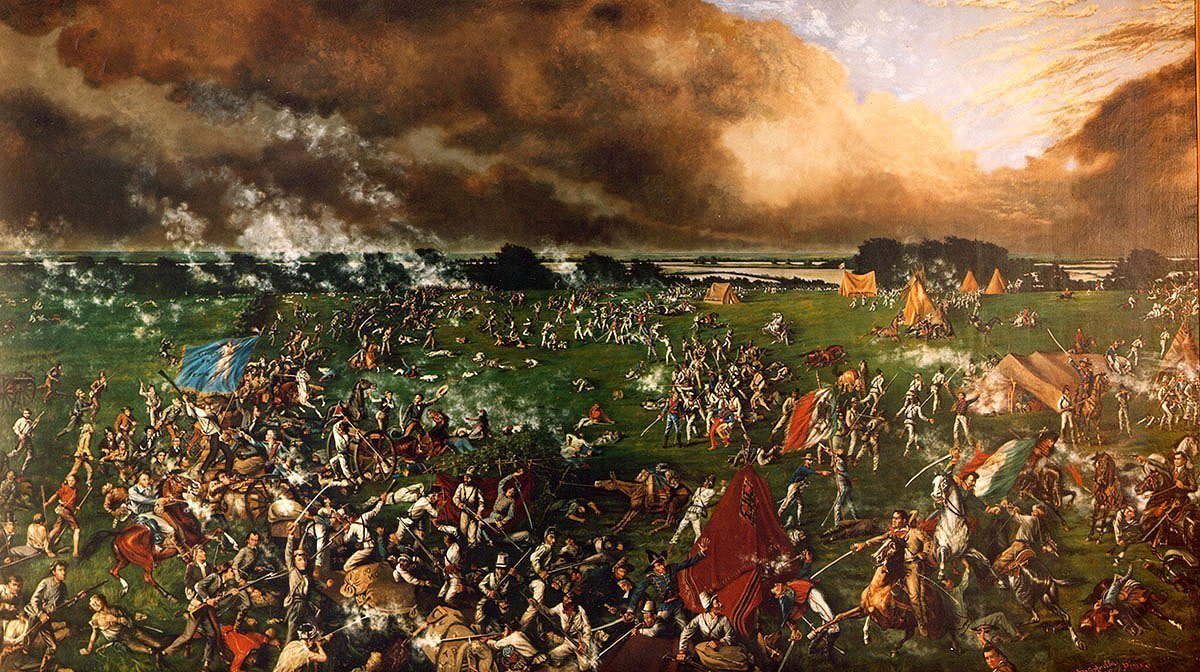
About three weeks later, Sam Houston’s army was set to charge across the San Jacinto plain. At four o’clock in the afternoon, while the Mexican camp slept, the Texan army opened fire with two six-pound cannons. The entire Texan line surged forward shouting “Remember the Alamo!” “Remember Goliad!”

The Texans were so “blazing, fighting mad” General Houston, commander of the Texan army, did not want the Tejanos, Mexicans who sided with the Texans, to fight fearing the Texans would not distinguish between friend and foe during the battle. But the Tejanos wanted to fight and went into battle wearing cardboard signs in their hats to show that they were on the Texan side  

The fighting was intense. In the eighteen minutes of battle, the fighting became so fast and furious that all the Mexican soldiers could do was drop on their knees and shout their surrender.   

Santa Anna had disappeared during the battle. General Houston ordered a thorough search of the area.  A Texan fighter caught a Mexican dressed as a common soldier trying to escape. When the Mexican was brought back to camp the other Mexican prisoners shouted, “El Presidente!” to reveal Santa Anna’s identity.

So, Santa Anna was forced to surrender to General Houston, and Texas had won its independence. Texas was now free! Sometimes it pays to get “blazing, fighting mad!”


Thanks for reading! We hope you enjoyed our post. Please share with all your fellow patriots. Brought to you by: Ultimate Flags
Posted on

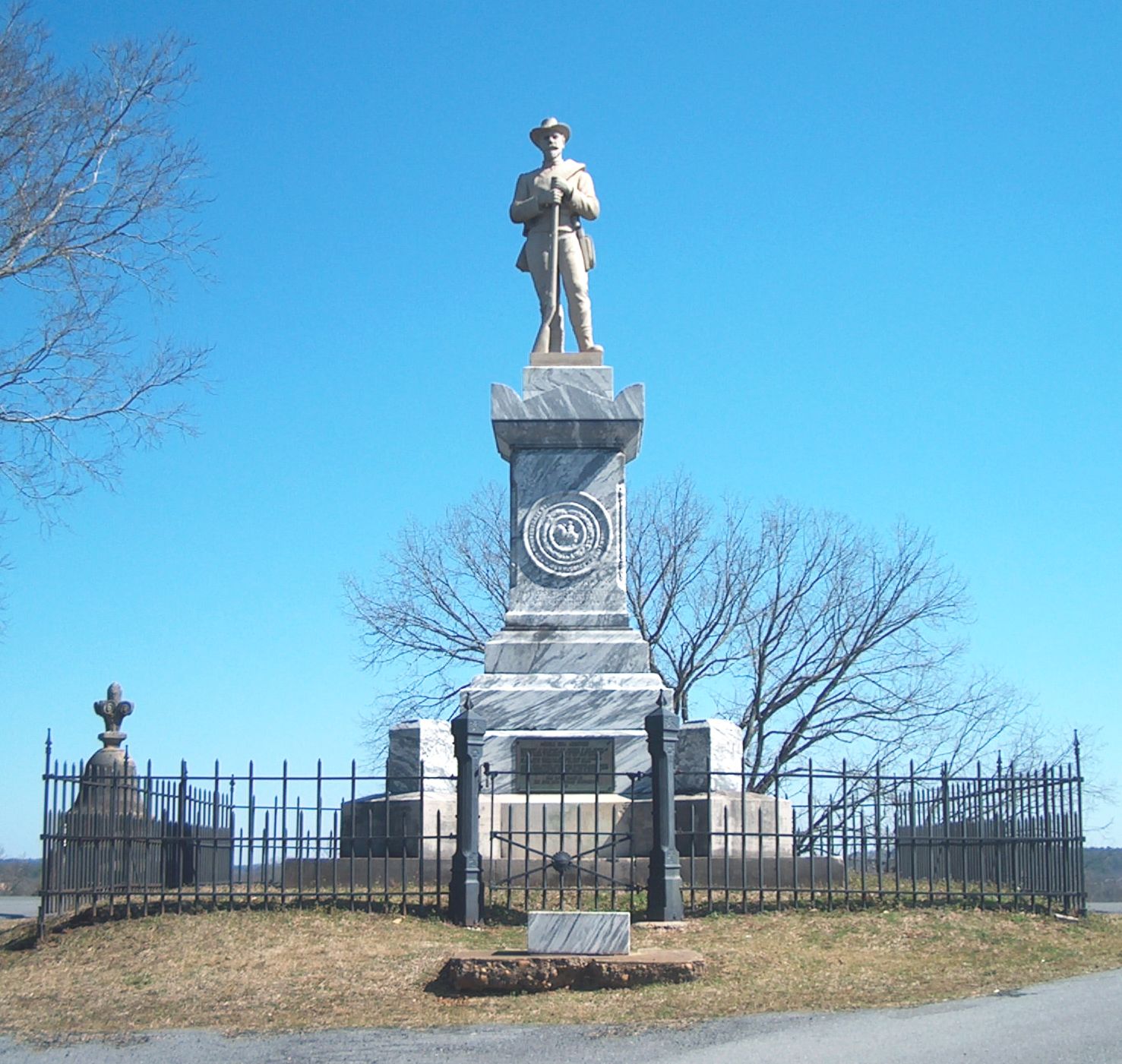
Historic cemetery rededicated in Hancock County

A historic cemetery was recently rededicated in Hancock County. There was a special ceremony to honor one man in the Confederate Army. Family members said that he was a prisoner of war as well as a soldier for the Confederacy. Victor Ladner played an important part in American history. He played a historical role in the history of Hancock County as well.

Historic cemetery rededicated in Hancock County

Thanks for reading. Please share our posts with your friends and family so they too can learn more about Southern Heritage and History.

Brought to you by: Ultimate Flags

Posted on

Blueskin and Old Nelson

Thomas Jefferson once referred to George Washington as:

“the best horseman of his age, and the most graceful figure that could be seen on horseback.”

Washington’s friend, the Marquis de Chastellux, a French national, also observed that Washington:

“is a very excellent and bold horseman, leaping the highest fences, and going extremely quick, without standing upon his stirrups, bearing on the bridle, or letting his horse run wild.”

Jefferson knew a good horseman when he saw one, and this was the age when being an accomplished horseman was taken as a mark of a true gentleman.

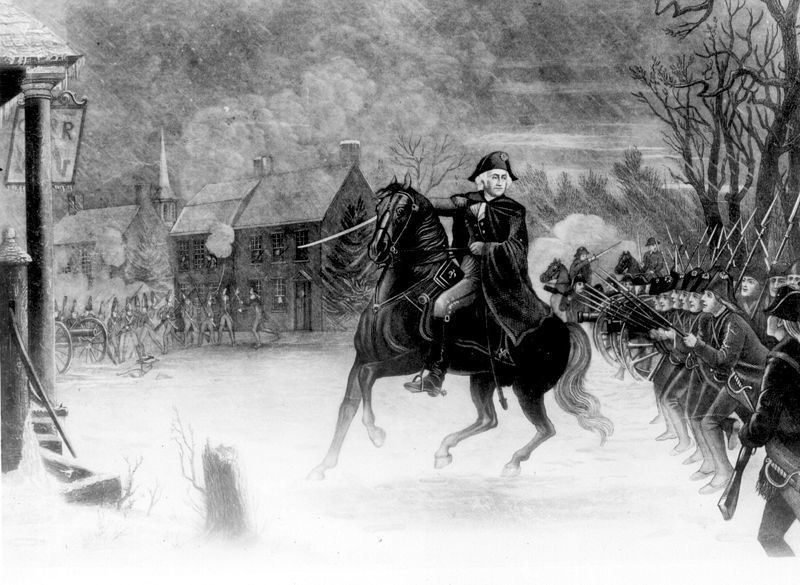
A good horseman needs a good horse, and Washington had many magnificent ones to ride. During the American Revolutionary War, the two horses prominently connected to him were Blueskin, and “Old Nelson.”

Blueskin was a dashing stallion “of a dark iron-gray color, approaching to blue.”He was a spirited animal, known for his endurance during a long chase.  Blueskin was a gift to Washington from Colonel Benjamin Tasker Dulany of Maryland.

“Old Nelson” was a chestnut with a white blaze and white feet. He was described as a “splendid charger,” standing sixteen hands high.  He was a gift from Thomas Nelson, Jr., a signer of the Declaration of Independence and later governor of Virginia.

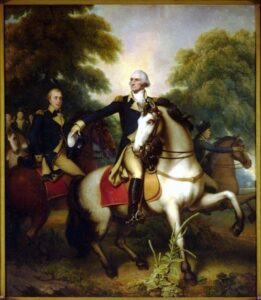
Old Nelson proved to be Washington’s favorite horse to ride into war because he was less skittish during cannon fire and the startling sounds of battle. Blueskin was his favorite hunting horse. Due to his near white hair coat, he was the horse most often portrayed in artwork showing Washington on horseback.

Washington on Blueskin

Washington chose to ride Nelson on the day the British army under the direction of Lord Cornwallis surrendered at Yorktown, Virginia in 1781

Both horses served Washington well during the 8 1/2 years of the American Revolutionary War. Nelson and Blueskin survived intact and were retired to Washington’s stables in Mount Vernon to live a life of ease and celebrity.Washington always displayed great respect and affection for his horses, and it was clear that the horses loved him, too. It was reported that Washington would walk around the grounds of the estate, and stop at Nelson’s paddock, “when the old war-horse would run, neighing, to the fence, proud to be caressed by the great master’s hands.”

Blueskin lived at Mount Vernon until Washington returned him to to Mrs. Dulany in November 1785, with along with a letter of gratitude. “Old Nelson” died at the estate in 1790 at about the age of 27, quite old for a horse in that era.

Great men carry the honor and privilege of having great horses.


Thanks for reading! We hope you enjoyed our post. Please share with all your fellow patriots. Brought to you by: Ultimate Flags
Posted on

Wheat’s Tigers: Rebels in Arms

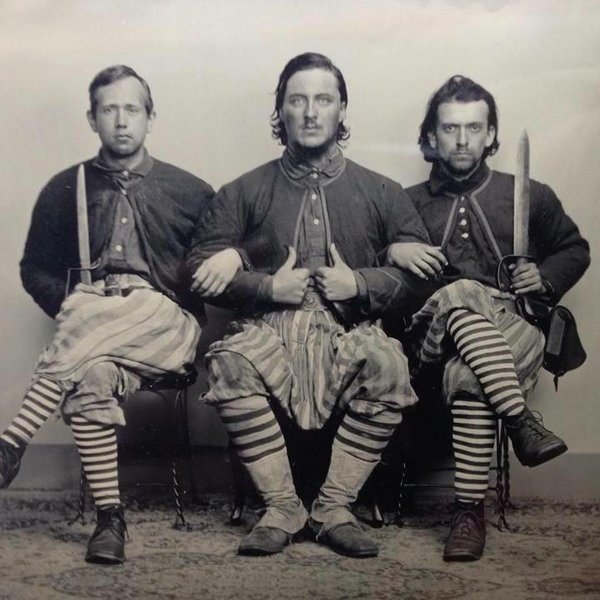
“Wheat’s Tigers” was the nickname of a Louisiana Battalion formed from the rougher sections of New Orleans, men described as “thieves, and outcasts…and bad characters generally.”

Of all the units that took the field at the First Battle of Manassas in July 1861, none exceeded the flair and intensity of the 1st Louisiana Special Battalion.  Raised from the dregs of New Orleans, they were primarily Irish immigrant dockworkers, tough and gutsy as their combative commander, Major Roberdeau Wheat.

Although the Tigers were known for their drinking, card playing, fighting and general mischief, they proved themselves fearless and effective at the Battle of First Manassas.

The Tigers dressed in colorful uniforms like the North African “Zouaves” then in the service of the French Army, and became known as one of the South’s best and most fearsome units.

Known as Bull Run to the Federals, Manassas was the first major battle of the war.  Even before the main fight began, the Louisiana Tigers made a charge. Lieutenant Adrian of Company B fell with a leg wound. As he lay on the ground bleeding, he shouted:“Tigers, go in once more, go in my sons, I’ll be great gloriously God damned if the sons of bitches can ever whip the Tigers!”One of the Rebels later said, “Our blood was on fire. Life was valueless.”

One of the Yankees later said the charge “seemed to me to be the most terrible moment of this terrific contest.”By dusk of that day, the Union army was driven from the field and retreated all the way back to Washington. General Beauregard reported that the Tigers displayed “dauntless courage and imperturbable coolness,” and that these men could stand tall and say, “We were of that band who fought the first hour of the battle of Manassas.”

Major Roberdeau Wheat, leader of the Tigers

Thanks for reading. Please share our posts with your friends and family so they too can learn more about Southern Heritage and History.

Brought to you by: Ultimate Flags
Posted on

Confederate Cherokee Bravery

During the Civil War, the Cherokee Nation had 3,000 men serving as Confederate soldiers.

The Cherokee, by nature a peaceful people, were exceptionally skilled at protecting themselves.  They were naturals at close-quarters fighting, and adept at the irregular tactics of guerrilla warfare.

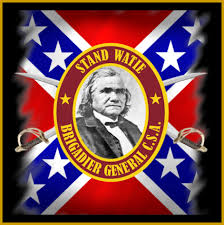
A leader of the Cherokee, Stand Watie, was eager to join the Confederate cause. In June 1861, he began recruiting for an army to assist the Southern cause. He was elected Chief of the newly declared Southern Cherokee Nation

Stand Watie’s birth name was Tak-er-taw-ker, meaning “Stands Firm.”  He combined parts of his Cherokee name and his father’s name, Oo-wat-ie, to call himself Stand Watie in English..

In March of 1862 Stand Watie caught the attention of senior officers when he captured a Union artillery battery. He then led a skilled rear guard action to protect a retreating Confederate army to prevent a disastrous defeat.

Watie’s courage, tactics and leadership led to his assignment to a command position. Watie rose to the rank of Brigadier General. One of the units under Watie’s command was the Cherokee Mounted Rifles.  His unit was active in cutting Union supply lines and disrupting the enemy’s operations in the Western Theater of the Civil War.

He kept on fighting until June 23rd, 1863, months after Appomattox, and longer than any other Confederate General.

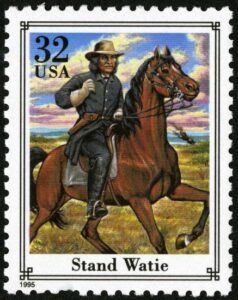
The U.S. Postal Service commemorative stamp issued on June 29, 1995.

Thanks for reading. Please share our posts with your friends and family so they too can learn more about Southern Heritage and History.

Brought to you by: Ultimate Flags