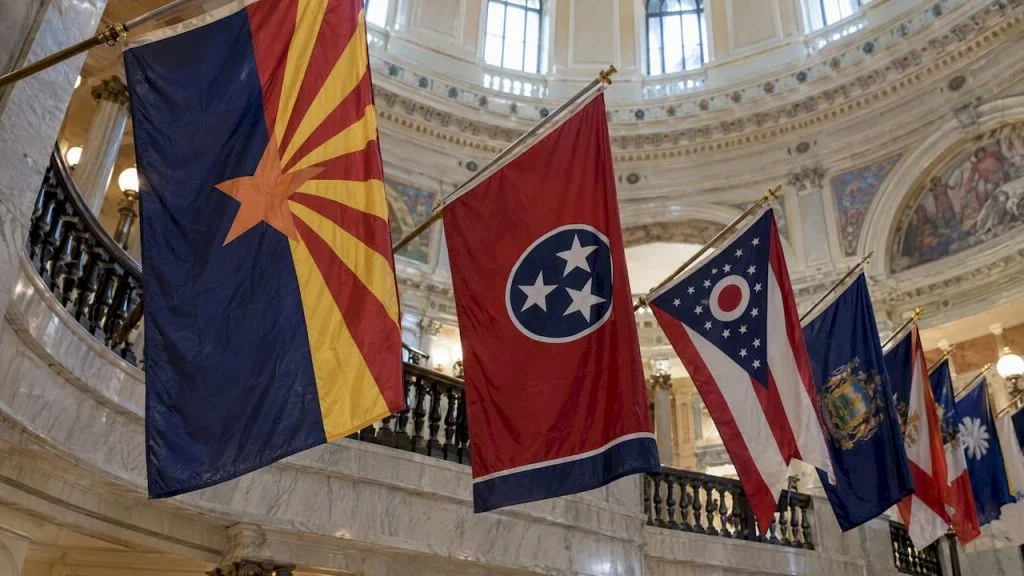
A state flag is a small piece of cloth carrying a large argument: this is who we are, what we built, and what we will not forget. Every one of the 50 state flags answers that argument in its own visual language, through stars that count divisions or admission order, colors that mirror the land, and seals that compress a state’s founding into a few inches of thread. This guide shows you how to read those symbols, walks through the clearest official explanations we could find, and flags the common mistakes that turn a good story into a half-truth.
TL;DR
- Most state flags are built from four ingredients: a seal or emblem, stars with a specific count, colors tied to land or loyalty, and a motto or date.
- The most reliable meaning always comes from the state’s own official source, not from a generic color chart. Tennessee’s three stars, for example, stand for its three Grand Divisions, not for abstract ideals.
- Oregon is the only state whose flag carries different artwork on each side, so a one-sided reproduction is never the full banner.
- The modern wave of state flags traces back to the 1893 World’s Columbian Exposition in Chicago, though a handful of states carry older traditions.
- Collectors should match the official current design, not an older variant or a lookalike.
Table of Contents
- Why states have flags at all
- How to read any state flag
- Arizona: a sunset with a longer memory
- Tennessee: three stars, three Grand Divisions
- Colorado and Missouri: land and order
- Ohio: the only swallowtail
- Oregon: the flag with two faces
- Washington: the president on the flag
- Quick reference table
- Perspective: why we read flags the way we do
- Telling the official design from the lookalike
- Choosing and displaying a state flag
- FAQ
- Sources
Why states have flags at all
The idea of a flag for every state is younger than most Americans assume. According to Ballotpedia’s overview of state flags, the concept dates to the 1890s, when states wanted distinctive symbols to display at the 1893 World’s Columbian Exposition in Chicago. States such as California, Texas, Maryland, Massachusetts and South Carolina already had older flag traditions, which is why their stories reach back further into the Revolution, the Republic era and the colonial period.
That timeline explains something you notice at a glance. Many state flags look alike: a blue field with a seal in the middle. They were designed in a burst of civic enthusiasm, often by committees, and often with an emblem pulled straight from the state seal. The seal is where the real story usually lives.
If you want to see how one of the older traditions unfolded, our history of the Texas flag follows a banner that stood for a republic before it stood for a state.
How to read any state flag
Before we go state by state, here is the method we use at the desk when a customer asks what a flag means. It works on all fifty.
- Start with the seal or central emblem. Seals are usually older than the flag and carry the densest meaning: occupations, landscapes, dates, mottos.
- Count the stars. A star count is rarely decoration. It may mark the order of admission, a set of regions, or the original colonies.
- Match colors to the land first. Many states tie their colors to sunshine, sky, snow, soil or copper before they tie them to abstract virtues.
- Check the date. Adoption dates and later redesigns tell you which version is the official one.
- Go to the primary source. A secretary of state, state library or legislature will state the intended meaning plainly. Popular summaries drift.
That last step matters more than it sounds. The national flag has a well-documented color code: USAGov lists red as valor and bravery, white as purity and innocence, and blue as vigilance, perseverance and justice. Those are meanings of the Stars and Stripes. They do not automatically transfer to the same colors on a state banner, and a good reading always sources each state on its own terms.
Arizona: a sunset with a longer memory
Arizona’s flag is often described as a sunset and left there. The state’s own materials say more. The Governor’s office explains that the alternating red and yellow rays represent the 13 original colonies and the western setting sun, and that the red and yellow are based on the colors of the Spanish flag Coronado carried into the region. At the center, the copper star identifies Arizona’s copper industry, and the blue below matches the blue of the U.S. flag.

So one flag holds three layers: the founding colonies, the Spanish exploration of the Southwest, and the mines that shaped the state’s economy. The Arizona State Library confirms the same palette: copper, blue, yellow and red, with blue and gold as the state colors.
Tennessee: three stars, three Grand Divisions
Tennessee’s tricolor is one of the easiest flags to recognize and one of the most commonly misread. The three white stars in the blue circle are not a generic nod to ideals. According to the Tennessee Secretary of State, the flag was designed by LeRoy Reeves of the Third Regiment, Tennessee Infantry, and the stars stand for the state’s three Grand Divisions: East, Middle and West Tennessee. The same office records that the General Assembly adopted the flag in an act approved April 17, 1905.
This is exactly why primary sources matter. A color chart would tell you that white means purity. The state’s own record tells you that these stars describe geography and a shared compact among three distinct regions.
Colorado and Missouri: land and order
Some flags read like a landscape painting. National Postal Museum material on the state-flag commemorative stamps describes Colorado’s symbolism in environmental terms: gold for abundant sunshine, blue for clear skies, white for snow-capped mountains and red for the state’s soil. Few flags so plainly say: look around you.
Missouri takes another route. The same source describes its red, white and blue stripes as valor, purity, vigilance and justice, and its 23 smaller stars and one larger star as marking Missouri as the 24th state. Here the stars are arithmetic: a count of the Union, with Missouri standing a little taller within it.
Ohio: the only swallowtail
Ohio’s flag does not even pretend to be a rectangle. Ohio’s flag, known as the Ohio Burgee, was adopted May 9, 1902, and its triangular swallowtail shape sets it apart from every other state flag. Its elements symbolize the state’s natural features and its order of admission, and the large disc at the hoist suggests the letter O. The statute calls for seventeen white stars in the blue triangle, a nod to Ohio’s place in the Union. Ohio is the best example of why you should look at the shape and proportions of a flag, not only at its emblem.

Oregon: the flag with two faces
Oregon is the one state that cannot be captured in a single image. According to the Oregon Legislature’s fact sheet, the front displays the state seal with 33 stars for Oregon’s admission as the 33rd state in 1859, while the reverse carries a beaver, the state animal. The fact sheet also gives the colors as Oregon’s blue and gold, and notes the flag was officially adopted in 1925.
For a flag lover, this raises a practical point. Before you mount an Oregon flag, confirm which face is the obverse and whether your flag is truly two-sided. A single-sided reproduction with the seal alone shows only half of the official banner.
Washington: the president on the flag
Among the questions readers ask most is which state flag has a president on it. The honest answer depends on wording. As the overview of U.S. state and territorial flags describes it, Washington’s flag features George Washington in the portrait on its state seal, which makes it the state most associated with a president-bearing flag. Missouri’s seal, by contrast, shows an eagle rather than a president. Keep one distinction in mind: a portrait inside a seal is not the same as a portrait dominating the flag. Before you buy a flag as a gift, check how the portrait is rendered, because the quality of the seal is often where reproductions differ.
Quick reference table
| State | Key symbol | What it stands for | Source type |
|---|---|---|---|
| Arizona | 13 red and yellow rays, copper star | Original colonies, western sunset, Spanish colors, copper industry | Governor’s office, State Library |
| Tennessee | Three white stars | East, Middle and West Tennessee | Secretary of State |
| Colorado | Gold, blue, white, red | Sunshine, sky, snow-capped mountains, soil | National Postal Museum |
| Missouri | 24 stars, three stripe colors | 24th state; valor, purity, vigilance, justice | National Postal Museum |
| Ohio | Swallowtail shape, 17 stars | Natural features, order of admission | Statute as summarized by Wikipedia |
| Oregon | Seal with 33 stars; beaver on reverse | 33rd state in 1859; state animal | Oregon Legislature |
| Washington | Seal with portrait of George Washington | State named for the first president | Overview of state flags |
Perspective: why we read flags the way we do
We have sold flags for a long time, and the question we hear most is not how much a flag costs but what it means. People are rarely after trivia. They want to know whether the banner on their porch, in their classroom or in their reenactment camp tells the truth about the place it represents.
Our view is simple. A flag is a story told in cloth, and it deserves to be told accurately. That means respecting the official design, noting the date it was adopted, and being honest that a symbol can mean different things to different people. The same banner may speak of heritage to one person, of identity to another, and of contested history to a third. A political symbol compresses a great deal into a recognizable signal, which is why the study of political symbolism treats the same flag as capable of communicating different things to different audiences. We would rather explain the origin and the usage than pretend a flag carries one permanent meaning.
So when you choose a state flag, learn its seal, count its stars, and read the state’s own account. Then fly it with the pride of someone who knows the story behind it. For the longer arc of how American banners came to be, our history of the American flag and our look at the evolution of American flags are good companions.
— John Hough
Telling the official design from the lookalike
A flag’s design can be standardized by law, and then change. The Smithsonian’s flag facts show how details of the national flag were fixed over time by executive action, and state flags have their own histories of revision. For collectors, the practical lesson is to separate four things:
- The current official design, as set by the state.
- Historical variants, which may be beautiful and collectible but are not what the state flies today.
- Maker-specific proportions, where different manufacturers interpret the legal description slightly differently.
- Earlier arrangements, such as a previous star count or an older seal.
Alabama and Florida make good case studies. Our articles on the Alabama flag’s unsettled origins and the Florida flag’s law, seal fix and ongoing debate show how a flag can carry a legal adoption date and still be argued over for generations.
Choosing and displaying a state flag
Once you know what the flag says, the next question is how to fly it well.
- Match material to use. An outdoor flag that faces weather needs a different build than a display piece for a den or classroom. Our flag qualities and uses guide explains the differences.
- Size the pole to the house. Our guide to house flagpole size gives sensible heights for one- and two-story homes, and our overview of flagpole types and footing rules covers the installation side.
- Plan for several flags. If you fly a state flag beside the national flag, read about displaying multiple flags before you hoist.
If you are ready to shop, you can browse our US State Flags and the rest of our flag collections or add the right hardware and flagpoles for your display. We have been presenting American flags online for a long time, and we are glad to help you find the banner that fits your story.
FAQ
What is a state flag?
A state flag is the official banner a U.S. state adopts to represent itself. Ballotpedia notes that the modern wave of state flags began around the 1893 World’s Columbian Exposition. Washington, D.C. and the territories have their own flags, which should be labeled separately from the 50 state flags.
Which state flag has a president on it?
Washington’s flag is the one most associated with a president, because its state seal carries a portrait of George Washington. The portrait sits inside the seal rather than filling the whole flag, so the answer depends on how strictly you read the question.
Which state flag is different on both sides?
Oregon. Its legislature’s fact sheet describes a seal side with 33 stars and a reverse showing a beaver. It is the only state flag with different artwork on each side.
Do the colors on state flags mean the same as the colors on the American flag?
Not automatically. USAGov lists the national flag’s color meanings of valor, purity and vigilance, but each state assigns its own symbolism. Colorado ties its colors to sun, sky, snow and soil, so always check the state’s own explanation.
Sources
- List of US state flags and territories, Ballotpedia
- Arizona Facts, Office of the Arizona Governor
- State Flag, Arizona State Library
- Tennessee State Symbols, Tennessee Secretary of State
- State Flags AL-MO, National Postal Museum
- Oregon Fun Facts, Oregon Legislature
- Flag of Ohio, Wikipedia
- Flags of the U.S. states and territories, Wikipedia
- The American flag and other national symbols, USAGov
- Flag facts, Smithsonian Institution
- Political symbolism, Wikipedia