The Florida state flag is a white field crossed by a red saltire with the Great Seal centered at its heart, a design adopted by voters on November 6, 1900. The seal itself was standardized in 1985, its imagery corrected to better honor the people it depicts. Both elements rest on statutory footing, yet the deeper story of why that red cross exists remains a subject historians still debate.
TL;DR:
- The 1900 red saltire was added primarily to increase visibility and prevent the flag from being mistaken for a surrender banner during public displays.
- The saltire’s design may have been influenced by Alabama’s 1895 flag or older Spanish Burgundian crosses, though definitive evidence remains inconclusive.
- Florida’s flag dimensions are legally specified, with the seal’s diameter set at half the hoist and red bars each occupying one-fifth the hoist width.
- The current seal, revised in 1985, now accurately depicts a Seminole woman, a palm tree, and geographic details true to Florida.
- Historical flags include provisional banners from the Civil War era and a segment of overlapping colonial claims, complicating the state’s true flag heritage.
Table of Contents
- Colonial banners and the myth of five flags over Florida
- The 1845 inauguration flag and Florida’s unsettled early standards
- Secession-era banners and the Civil War’s visual legacy
- Decades under a bare seal on white (1868 to 1900)
- Adding the red saltire: the 1899 resolution and 1900 vote
- The Great Seal’s long road to historical accuracy
- What the red saltire really means, and what historians still debate
- Official dimensions and specifications under Florida law
- Why historical accuracy in flag reproduction matters
- Finding an accurate Florida flag for your collection or display
- Where to verify the facts yourself
- Sources
- FAQ
Colonial banners and the myth of five flags over Florida
Long before Florida raised its current banner, a procession of colonial powers claimed its soil, each planting a standard as proof of dominion. Spain’s early standards often carried the Burgundian saltire, a red diagonal cross that echoes, at least visually, in Florida’s modern flag. France and Great Britain each flew their own colors during their respective claims on the territory, and regional variation meant no single banner represented the whole peninsula at any one time.
Tourism boards and history markers often compress this tangle into a tidy phrase, the five flags over Florida narrative, listing Spain, France, Great Britain, the United States, and the Confederate States. It makes for a clean timeline, but historians caution that it flattens a far messier reality of overlapping claims, contested borders, and banners that never flew uniformly across the region.
- Spanish colonial standards frequently bore the Burgundian saltire, a visual ancestor some trace to Florida’s own red cross.
- French and British colors marked shorter, more contested periods of control.
- The “five flags” phrase simplifies decades of overlapping and disputed sovereignty into a single, marketable sequence.
The 1845 inauguration flag and Florida’s unsettled early standards
When Florida entered the Union in 1845, the moment called for a flag, and one was raised at the inauguration ceremony marking statehood. Yet the record surrounding that banner is far from tidy. Archival documentation held by Florida Memory shows that the House and Senate approached the flag’s adoption through different resolution types, leaving historians to describe the 1845 flag as displayed publicly but never fully codified into law.
That irregularity set a pattern. For decades, Florida operated without a single, stable, legislatively secured flag design, relying instead on provisional banners that came and went with little formal permanence.
- The 1845 flag was raised at the inauguration but lacked uniform legislative adoption across both chambers.
- Florida Memory’s archival records document the inconsistency between House and Senate action on the design.
- The absence of a settled standard meant multiple provisional flags circulated through the 19th century, none carrying lasting statutory weight.
Secession-era banners and the Civil War’s visual legacy
Florida’s departure from the Union in 1861 brought a burst of provisional emblems, among them the so called Chase Flag, raised amid the fervor of secession and quickly joined by other short-lived designs meant to signal the state’s new allegiance. As the war deepened, Florida units and citizens often flew the Confederate national flags of the period, and regional variants like the Bonnie Blue Flag or Lone Star banners occasionally appeared in local displays of defiance.
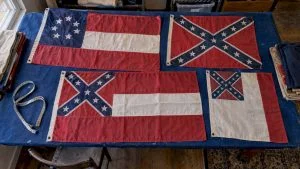
These wartime banners did more than mark a moment. They built a visual vocabulary, diagonal crosses, stars, and bold fields of color, that would echo decades later when Florida’s lawmakers reached for a design to modify the plain seal-on-white flag then in use. For readers curious about the era’s iconic imagery more broadly, the history of the Confederate flag traces how these Civil War symbols took shape and spread.
- The Chase Flag and similar provisional emblems marked Florida’s 1861 secession before a settled state design existed.
- Confederate national flags saw regular use, alongside occasional Bonnie Blue or Lone Star variants.
- The saltire and diagonal-cross motifs from this era resurfaced in later debates over Florida’s own flag design.
Decades under a bare seal on white (1868 to 1900)
After the Civil War, Florida settled, at least by statute, on a flag consisting simply of the state seal centered on a plain white field, a design fixed into law by an 1868 statute. For over thirty years, that was Florida’s flag: no color, no border, just the seal floating on white cloth.

The trouble was practical as much as symbolic. A plain white flag, seal or no seal, bore an unfortunate resemblance to a flag of surrender, particularly at a distance or in low wind when the seal’s detail blurred into the fabric. That visual weakness lingered for decades before anyone in Tallahassee moved to address it, and when the change finally came, it arrived through a deliberate act of the legislature rather than gradual custom.
Adding the red saltire: the 1899 resolution and 1900 vote
The fix, when it came, moved through the legislature with striking speed. Senator Thomas Palmer introduced a resolution in 1899 proposing red bars diagonally across the white field, an addition the legislature published as Resolution No. 4 in that year’s Laws of Florida. The measure passed without meaningful opposition, then went before Florida’s voters as a constitutional amendment.
- Senator Thomas Palmer’s 1899 resolution proposed red diagonal bars across the existing white and seal design.
- The legislature approved the measure and published it as Resolution No. 4 in the 1899 Laws of Florida.
- Voters ratified the amendment on November 6, 1900, formally adding the red saltire that stretches from each corner toward the centered seal.
The visible result was immediate and unmistakable. Where the old flag had offered only a pale seal against an empty field, the new design gave Florida a flag with presence, a bold red cross reaching outward from the state’s emblem, visible at distance and unmistakable in a stiff breeze.
The Great Seal’s long road to historical accuracy
Florida’s seal predates its saltire by three decades, first adopted in 1868 under statutory mandate as the emblem meant to represent the state’s identity and authority. Over the following century, lawmakers revisited its details more than once. In 1970, the legislature corrected the depicted palm tree from a generic “cocoa” palm to the sabal palmetto, the species that actually grows across Florida and now serves as the state tree.
The most consequential revision came in 1985, when Secretary of State George Firestone led an effort to correct errors that had crept into the seal’s imagery over generations of reproduction.
- The generic Indian figure in earlier seal versions was replaced with a depiction of a Seminole woman.
- A bird not native to Florida was removed from the design entirely.
- Mountainous background imagery, geographically inaccurate for a state with no such highlands, was eliminated.
The 1985 revision remains the seal’s most recent substantive correction, as of 2026, and it stands as the Department of State’s own record of the effort to align Florida’s official imagery with historical and geographic fact.
What the red saltire really means, and what historians still debate
Ask why Florida added a red cross in 1900, and you will get more than one answer. The most common account credits Governor Francis P. Fleming with pushing the change for practical reasons, giving the flag enough visual weight that it would never again be mistaken for a surrender banner. Other historians point to the timing itself, noting the amendment passed during the same political era that saw Jim Crow laws and disenfranchisement measures spread across the South, and argue the saltire’s resemblance to Confederate battle imagery was no accident of the Lost Cause period.
A third theory looks westward, noting the visual kinship between Florida’s 1900 design and Alabama’s flag, adopted five years earlier in 1895 with its own red saltire, or backward to the Burgundian cross carried by early Spanish standards. No single document definitively settles which explanation carried the day in the legislature’s actual deliberations.
- The practical account ties the change to Governor Fleming and the surrender-flag resemblance problem.
- The historiographical account links the timing to Lost Cause symbolism and the broader Jim Crow political climate.
- The comparative account points to Alabama’s 1895 saltire or older Spanish Burgundian crosses as possible visual inspiration.
Pro Tip: Weigh each theory by its evidence, not its popularity. The practical explanation rests on secondary-source attribution, while the political and comparative theories remain informed conjecture rather than settled fact.
Official dimensions and specifications under Florida law
Anyone reproducing the flag with precision, whether for a classroom, a courthouse, or a private collection, should turn to the statute itself rather than guesswork. Florida Statute §15.012 fixes the proportions with exacting clarity.
| Specification | Measurement |
|---|---|
| Seal diameter | One half the hoist |
| Red bar width | One fifth the hoist |
| Seal placement | Centered on a white field |
These figures matter beyond bureaucratic tidiness. A flag with an undersized seal or thin red bars technically departs from the design Florida law actually describes, a detail worth checking before purchase or manufacture.
Why historical accuracy in flag reproduction matters
I have spent years tracing how symbols age, how a seal’s bird or a saltire’s width shifts across a century of reproduction. Florida’s flag carries real statutory precision behind it, and historical flags are best approached with respect for the record. Check the statute and the archival image before you hang one on your wall.
— John Hough
Finding an accurate Florida flag for your collection or display
Getting the details right honors the history behind them, and Ultimate Flags’ flag collections carry state flag reproductions built for exactly that kind of accuracy. Whether you are outfitting a classroom, a veterans’ hall, or your own front porch, matching your purchase to the proportions set out in Florida Statute §15.012 keeps your flag true to the design lawmakers actually enshrined.

- Browse state flag options through Ultimate Flags’ flag collections page.
- Check seal diameter and red bar width against the statutory proportions before buying.
- Once your flag arrives, see flagpole types and footing rules for proper outdoor display.
Where to verify the facts yourself
For readers who want to check every date and specification firsthand, a handful of sources anchor this entire history.
- The Florida Department of State’s flag page for official dates and design description.
- Florida Statute §15.012 for legal dimensions and specifications.
- The Department of State’s seal page for the 1985 revision record.
- Wikipedia’s Flag of Florida entry for broader chronology and theory synthesis.
Sources
- Florida’s Historic Flags — State Flag (Florida Department of State)
- Florida House Statutes — 15.012 State flag
- State Seal – Florida Department of State
- Flag of Florida — Wikipedia
FAQ
Who is the woman on the Florida flag?
The seal at the center of Florida’s flag depicts a Seminole woman, an image added during the 1985 revision that replaced an earlier, more generic Indian figure. That change aimed to make the seal’s imagery more historically and culturally accurate.
What US state has the oldest flag?
Claims of the “oldest state flag” get complicated fast, since some states kept one continuous design for generations while others, including Florida, cycled through provisional and unofficial banners before settling on a permanent one. Florida’s current design dates to 1900, though earlier unofficial flags flew for decades before that.
What was the flag of Florida before 1900?
From 1868 until 1900, Florida’s flag consisted simply of the state seal centered on a plain white field, with no border or additional color. Before that, the state had no single stable design, relying on Civil War-era provisional banners and the irregularly adopted 1845 inauguration flag.
What are the five flags that flew over Florida?
The popular “five flags” narrative lists Spain, France, Great Britain, the United States, and the Confederate States as the powers whose banners flew over Florida territory. Historians note this framing, used often in tourism materials, simplifies a much more layered and contested colonial history.
Why does Florida’s flag have a red X on it?
The red saltire was added after voters ratified a 1900 amendment following a legislative resolution the previous year. The most cited explanation is practical, avoiding confusion with a surrender flag, though historians also debate political and comparative influences from the same era.