To frame a flag, measure it flat or folded, choose a frame or shadow box with room to spare, keep acid-free materials against the fabric, put glass or acrylic in front of it, and hang it on hardware rated for the weight. Do those five things and the cloth that once rode a pole, draped a casket or hung in a grandfather’s den can live on a wall for decades. A flag carries a story. A good frame lets that story be read, day after day, without costing the fabric a single thread.
Whether you hold a 3×5 USA flag, a 48 star treasure from a family attic, a folded memorial flag or a small Revolutionary War banner, the principles below are the same. Here is how to do it well, and how to avoid the quiet mistakes that yellow, fade and strain the cloth.
TL;DR
- Decide first whether your flag will be displayed flat (open, in a frame or shadow box) or folded (in a triangular case). The choice sets every measurement.
- Leave breathing room: about half an inch on each side of a flat flag, and enough depth for the fabric’s texture.
- Keep acid-free tissue, foam core or matboard against the flag, and use glass or acrylic for some UV protection. Never glue, pin or stitch an heirloom.
- Hang with D-rings, cleats or wall anchors rather than a wire when the case is heavy, tilt it slightly, and keep it away from windows, radiators and damp walls.
- Building your own case? Plan from the flag’s real measurements and fit the glass slightly loose.
Table of Contents
- Flat or Folded: Choose the Display Style First
- Measure Before You Buy or Build
- Materials That Protect the Cloth
- How to Frame a Flat Flag, Step by Step
- A DIY Flag Shadow Box: Building a Triangular Case
- Our Perspective
- Hanging a Framed Flag Securely
- Caring for a Framed Flag Over the Years
- Choosing a Flag Worth Framing
- Find Your Flag at Ultimate Flags
- FAQ
- Sources
Flat or Folded: Choose the Display Style First
Every flag framing project starts with one question: do you want to see the whole flag, or the tradition of the fold?
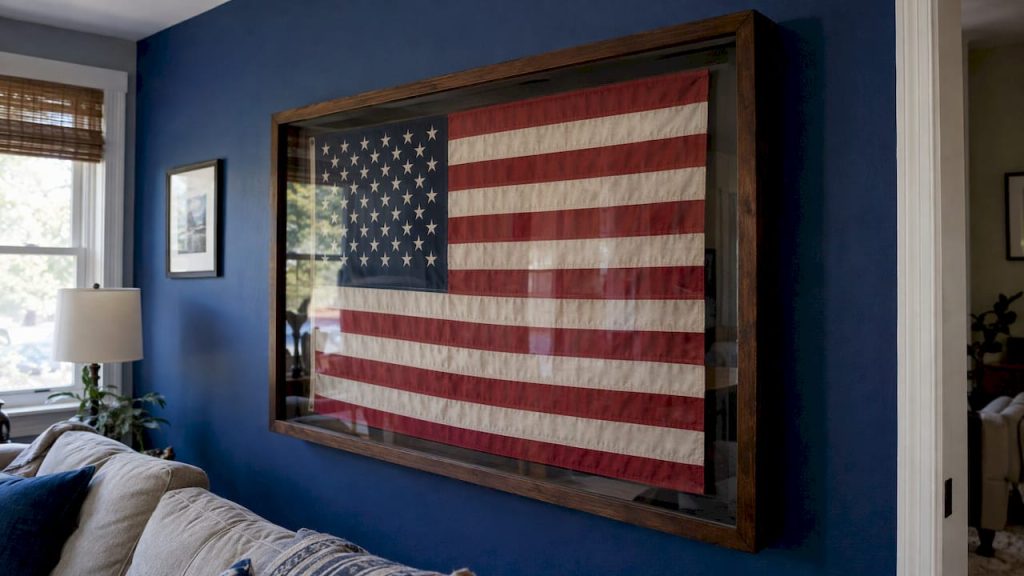
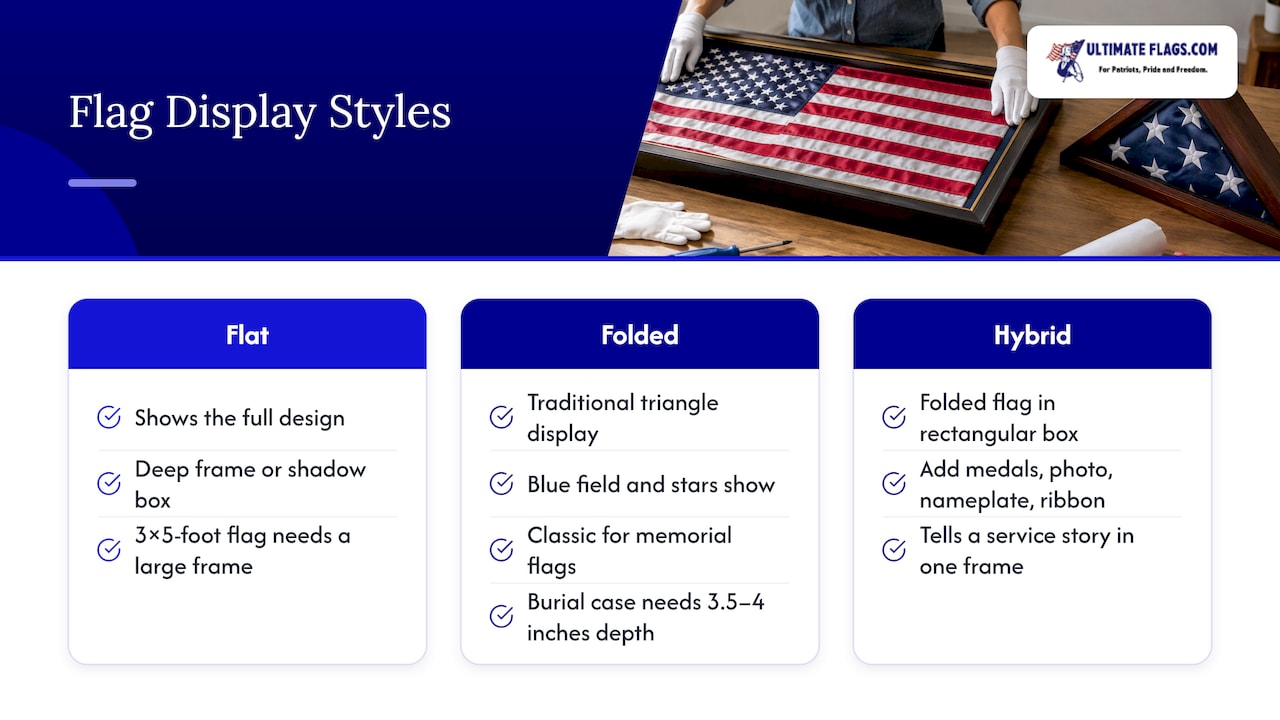
Flat display. The flag is laid out open, held behind glass in a deep frame or shadow box. It shows the full design: the canton of stars, the stripes, the lettering on a historic banner. This suits small flags, vintage cotton flags, golf and sports pennants, and any flag whose design is the point. A 3×5-foot flag can also be shown flat, but it needs a large, deep frame, so many owners prefer to fold it.
Folded display. The flag is folded into the traditional triangle, with only the blue field and its stars showing, and set in a triangular case. This is the classic choice for memorial and burial flags, presented to families in honor of service. If that is your flag, our guide to flag case size and the 3.5 to 4 inches of depth burial flags need will help you shop or build to the right dimensions.
Hybrid options. Some people frame a folded flag in a rectangular shadow box alongside medals, a photograph, a nameplate and a ribbon. It is a fitting way to tell a whole life of service in one frame.
If you are not sure how your flag should be folded or rolled before it goes into any case, the notes in our flag storage tips walk through folding, rolling and protecting the cloth.
Measure Before You Buy or Build
More framing disappointments come from a bad measurement than from any other cause. Take a few minutes and do it properly.
Measuring a flat flag
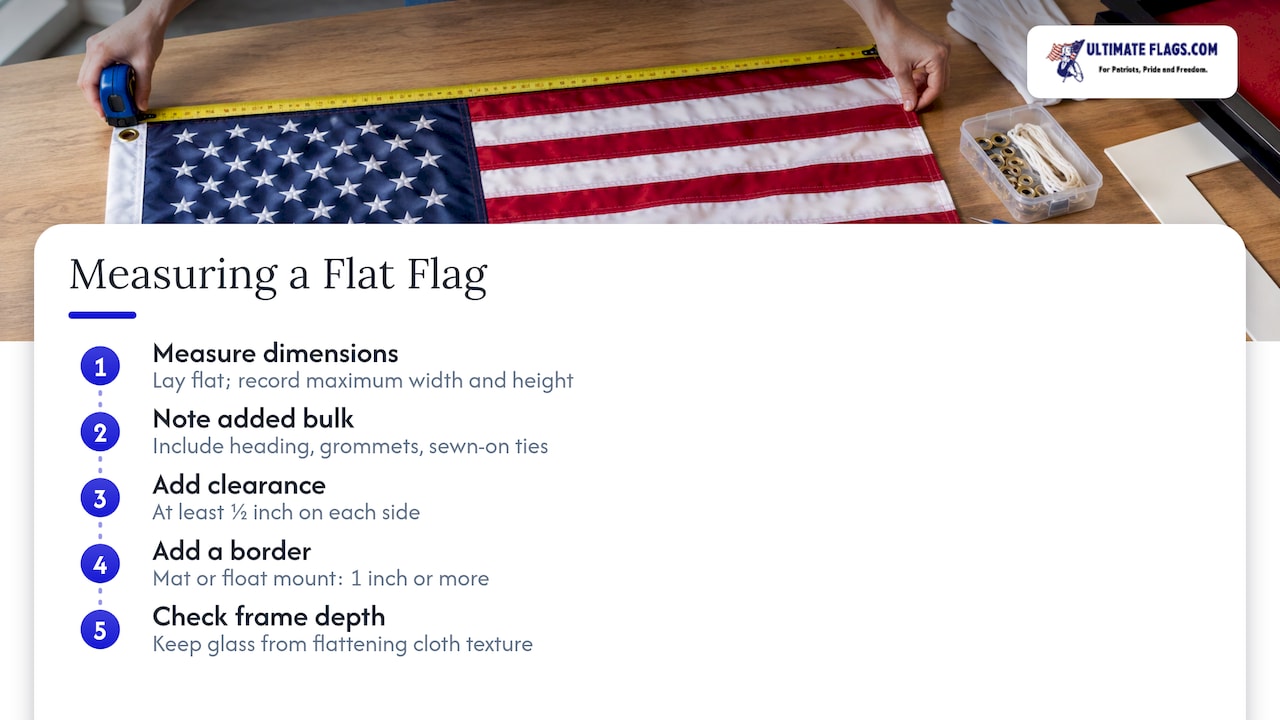
Lay the flag on a clean, flat surface and measure its full width and height. If the edges are uneven, as they often are on an old hand-sewn flag, record the maximum in each direction. Note the thickness of any heading, grommets or sewn-on ties, because those add bulk behind the glass.
Then add breathing room. A good rule is at least half an inch on each side, so the fabric is never pressed against the frame’s edge. Many framers go further with a mat or float mount, leaving a border of an inch or more so the flag appears to hover. Whatever you choose, pick a frame with enough interior depth that the glass does not flatten the texture of the cloth.
Before you commit, check the standard sizes. A standard USA flag is commonly sold in 3×5 feet, and you can browse the full range on our flags by size page. A square 36×36-inch flag, for instance, is a different shape and needs a different frame, and we keep those together under the 36×36 inch listings.
Measuring a folded flag
Fold the flag into its triangle first, then measure the folded result. Do not rely on a catalog size. A folded flag’s dimensions depend on the flag’s size, its fabric weight and how tightly you fold. A typical folded memorial flag is about 11 inches high by 22 inches wide, according to This Old House’s woodworking guide, though your own may differ by a little. The same guide recommends working from the folded flag’s real measurements and allowing a small clearance so the flag sits snug without being forced.
That last point deserves repeating: a snug fit is good, a tight fit is not. Forcing a flag into a case crushes the folds, stresses the fibers and makes it very hard to remove later.
Materials That Protect the Cloth
A flag is a textile, and textiles are slowly harmed by light, acid, moisture and tension. The right materials matter as much as the right size. The Smithsonian Institution’s preservation guidelines for flags are the standard reference here, and they shape the advice that follows.
What should touch the flag
Avoid putting wood or ordinary paper directly against the fabric. The Smithsonian advises against acidic materials in direct contact with a flag because they can yellow and degrade the cloth over time. Instead:
- Use acid-free foam core, matboard or museum-grade backing as the base.
- Place a layer of acid-free tissue paper between the flag and any surface that is not acid-free.
- If your case is made of wood, line the inside faces with a barrier such as clear polyester film or acid-free matboard so the wood never meets the flag.
- If you build or buy a freshly varnished or glued case, let it air out for several weeks before the flag goes in, so fumes do not settle on the fabric.
Glass or acrylic
The Smithsonian recommends glass or plexiglass glazing when possible for some protection from ultraviolet light. Light damage is cumulative. Fading from sun and even bright indoor light cannot be reversed, so glazing is not decoration; it is the first line of defense. Leave a small gap between the flag and the glazing. That space gives the fabric room and reduces the chance of moisture collecting against it.
How to hold the flag in place
The golden rule for any flag with real value, sentimental or historical, is to avoid permanent changes. Do not glue, pin or sew into the flag. Instead:
- Hold it by the fit of the case, using soft padding behind it to press it gently forward.
- Use fully reversible, acid-free adhesive on the backing only, where it never touches the flag itself.
- For a sturdy flag, a napped fabric such as velvet can give just enough friction to keep a textile from sliding. The Smithsonian cautions that this should not be used on fragile or brittle flags.
A brand-new flag bought for display gives you more freedom. An old, brittle or stained one asks for the gentlest approach you can manage, and sometimes a conservator’s advice.
How to Frame a Flat Flag, Step by Step
- Prepare a clean surface. Wash your hands, clear a table and lay down clean acid-free paper.
- Lay the flag out. Smooth it gently without stretching. If it has deep creases from long storage, let it relax flat for a day or two before mounting.
- Measure and choose the frame. Allow half an inch or more on every side, and pick a frame or shadow box deep enough that the glazing will not touch the cloth.
- Build the backing. Cover acid-free foam core or matboard with a neutral fabric or leave it plain, and cut it to fit the frame’s interior.
- Position the flag. Center it on the backing. Check the canton is level and that the stripes run square to the frame.
- Secure it without damage. Use padding and the fit of the case, or reversible acid-free adhesive on the backing only. Do not put pins or stitches through a flag you want to keep.
- Add the barrier and glazing. Place acid-free tissue where the flag meets any material that is not acid-free, then close the frame with glass or acrylic.
- Seal the back. A dust cover on the back keeps out insects and grit.
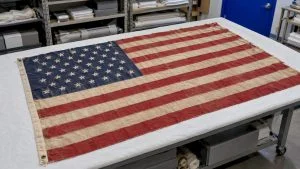
The pleasure of a flat display is how it reveals details: the weave of a cotton flag, the hand-stitched stars on an old 48 star banner, the faded red that tells how long it flew. If a 48 star flag is what you want to display, our USA 48 star flag in 3 x 5 ft. is the kind of piece that looks striking in a deep frame.
A DIY Flag Shadow Box: Building a Triangular Case
If you enjoy working with wood, building your own display case is rewarding, and it lets you size the case exactly to your flag. The outline below follows the method in This Old House’s flag display case guide.
- Fold the flag and measure it. Lay out the folded triangle and record its true dimensions.
- Cut three wooden sides. These form the triangle of the case, sized to the folded flag with a small allowance for clearance.
- Cut grooves. Make grooves along the inner faces to receive the glass front and the backing panel.
- Miter the corners. Accurate miters give a clean, tight triangle, so check each angle before cutting the final pieces.
- Sand and finish. Sand smooth and apply your finish, then let it cure fully and air out before the flag goes in.
- Fit the glass slightly loose. Wood expands and contracts with humidity. Glass that fits too tightly can crack as the frame moves.
- Assemble the case. Glue and clamp the three sides, keeping the corners square.
- Insert the flag from the back. Slide the folded flag in through the open back, then secure the backing with screws.
Two additions are worth making that the basic build does not require. First, line the interior with acid-free matboard or polyester film so wood never touches the flag. Second, add a thin layer of acid-free tissue around the folded flag before it goes in.
A note on a shadow box for more than a flag. If you want medals, a photograph or a service patch alongside the flag, build the box deeper than you think you need. Objects add thickness quickly, and you can always add a spacer behind the backing board.
Our Perspective
Flags have always been more than cloth. A banner raised over a battlefield, a folded triangle handed to a grieving family, a hand-sewn flag carried by a reenactor: each one holds a piece of the American story, and framing it is how we honor that story rather than let it fade in a drawer.
We have spent years as America’s oldest online flag store, and we have seen what people do with their flags. The ones that last are the ones treated with respect from the start. That means choosing the right size and quality of flag for the purpose, whether it will fly in the wind, hang in a hall or rest behind glass, and then giving it the setting it deserves.
For a flag that will be framed, we encourage you to think of the frame as part of the flag’s story. A well-sized, acid-free, UV-protected case turns a purchase into an heirloom. Our catalog of USA flags, state flags, military and service flags, and historic war flags is built for people who care about that kind of lasting display, from the Betsy Ross and Gadsden banners to the stars and stripes of every era.
Frame it deliberately. Hang it where it can be seen. Let the cloth keep whispering the tale it was made to tell.
John Hough
Hanging a Framed Flag Securely
A framed flag with glass and a deep wooden case can weigh far more than a picture. Hang it as though it were a heavy mirror.
- Skip the wire for heavy shadow boxes. Framers who work with deep cases recommend D-rings, wall anchors designed for heavy loads, or a French cleat instead of picture wire, which can stretch or slip under weight. The Frame Room’s guidance is one example of this advice. Locate a stud when you can.
- Tilt it slightly. The Smithsonian suggests angling a framed textile by at least 10 degrees, and up to 23 degrees, to reduce the stress that gravity puts on the fabric. A slight forward lean at the top is often enough. At the National Museum of American History, the Star-Spangled Banner is displayed at a 10-degree elevation in a custom enclosure with controlled conditions for exactly this reason.
- Choose the wall carefully. Keep the frame away from windows, direct sun, radiators and vents. Outside walls can sweat and run cold, so an interior wall is kinder to the fabric. Conservators generally advise keeping relative humidity moderate, since damp air invites mold.
- Check the level and the fastening. Once the frame is up, press gently on each corner. It should not shift, tap or sag.
For guidance on flags that are not framed at all but mounted on a wall by bracket, see our notes on flag bracket angle. And if some of your flags will fly outdoors while one precious piece stays inside, our hardware and flagpoles collection covers the mounting side.
Caring for a Framed Flag Over the Years
Framing is not a one-time act. A little attention each year keeps the flag in the condition you gave it.
- Limit light. Light damage builds up and cannot be undone. If the room is bright, rotate the display, draw the curtains during the day, or cover the frame when you are not enjoying it.
- Dust the glazing, not the flag. Wipe the front with a soft, dry cloth. Spray cleaner directly on the glass can seep behind it, so apply it to the cloth first, or use a product made for acrylic if that is your glazing.
- Look for condensation. Moisture on the inside of the glass is a warning sign. Open the case, let everything dry in a stable room, and replace any damp padding.
- Reopen rarely. Every time a flag is handled, it takes a little wear. Do it only when you must, with clean hands.
For a flag you plan to fly and also protect, our guide on how to care for a flag covers washing, drying and everyday handling. If you are choosing a flag meant for outdoor sun that will eventually retire to a frame, see our list of the best fade-resistant outdoor American flags in 2026.
Choosing a Flag Worth Framing
The best framed flags are chosen with the display in mind. Cotton has a traditional, matte look and suits historical flags and reenactment pieces. Sewn nylon gives rich color and is a favorite for military and state flags. Our flag qualities and uses guide explains the differences so you can match the material to the purpose.
Some ideas for a framed collection:
- A Union cavalry guidon in cotton for a history shelf or study.
- A POW MIA flag in honor of those who have not come home.
- A Merchant Marine flag to recognize service at sea.
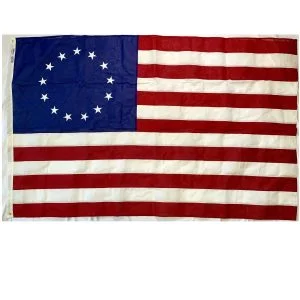
- Revolutionary-era designs such as the 15 star US flags for a patriotic gallery wall.
If you are framing several flags in a historical context, our piece on displaying Civil War flags with historical context offers ideas for presenting them thoughtfully.
Find Your Flag at Ultimate Flags
As America’s oldest online flag store, we carry the flags people frame most: USA flags, state flags, military and service flags, historic war flags and more, in a range of sizes and qualities. Whether you want a flag to fly, a flag to fold, or a flag to hang behind glass, you will find it in our collections.

Browse the full range at our flag collections, or start with USA flags or our military flags. Everything we sell is listed on our site, and each product page shows its size and material.
FAQ
Can I frame a flag without folding it?
Yes. A flat display shows the whole design and works well for small flags, vintage cotton flags and sports flags. Use a deep frame or shadow box, allow at least half an inch on each side, and keep acid-free backing and glazing in front of the cloth. A full 3×5-foot flag can be framed flat, but it needs a large, deep frame.
What size case do I need for a folded 3×5 flag?
Fold the flag first and measure the result, because folding changes the size. A typical folded memorial flag runs around 11 by 22 inches, but case depth matters too. Our guide to flag case size covers the depth burial flags need.
Should I use glass or acrylic?
Either works. The Smithsonian recommends glass or plexiglass because both offer some protection from ultraviolet light. Acrylic is lighter, which helps on heavy cases, and glass resists scratching. Whichever you choose, leave a small gap between the glazing and the flag.
Can I glue or pin the flag to the backing?
For any flag you want to keep, avoid it. Gluing, pinning or stitching into the cloth causes permanent damage. Hold the flag in place with a snug case and soft padding, or use reversible acid-free adhesive on the backing only.
Where should I hang a framed flag?
Choose an interior wall away from windows, sunlight, radiators and vents, and tilt the frame forward slightly. Use D-rings, cleats or heavy-duty anchors rather than wire if the case is heavy.
Sources
- Smithsonian Institution: Guidelines for the Preservation of Flags
- This Old House: How To Build a Flag Display Case
- National Museum of American History: Original Star-Spangled Banner Debuts in New Gallery
- The Frame Room: Framing A Flag