Founded on July 4, 1997, we’re America’s oldest online flag store—flying the banner longer than Google has existed.
Family-owned and based in O’Brien, Florida, we deliver high-quality flags to patriots, reenactors, military families, Southern heritage advocates, and defenders of freedom across the nation.
With a catalog of over 10,000 flags—from American Stars & Stripes to Gadsden, Confederate, military, historic war, custom designs, and more—every flag tells a story, and quality is non-negotiable.
Our roots run deep: descendants of Paul Revere continue a legacy of historical accuracy, First Amendment respect, and the unwavering belief that those who do not know history are doomed to repeat it.
We proudly support veterans, first responders, and nonprofit groups—ensuring America's defenders and their stories are never forgotten.
With decades of fast, caring service—even on backorders—and a team with over 65 years of combined experience, Ultimate Flags stands at the intersection of Patriots, Pride, Freedom, and Heritage—where every flag is a statement, a story, and a salute.
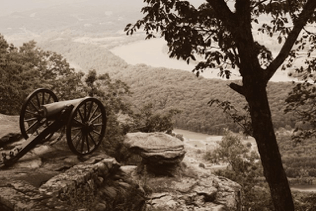
Time for another tale of Private Sam Watkins of the First Tennessee Infantry.It was 1863. Sam was in Chattanooga, preparing for the arrival of Grant’s army. That included fortifying Lookout Mountain (see photo above). Sam tells us:“About this time my father paid me a visit. Rations were mighty scarce. I was mighty glad to see him, but ashamed to let him know how poorly off for something to eat we were. We were living on parched corn.”Parched corn is a lot like those partly popped kernels in your popcorn, only a lot more tender. It’s easy to make: just take dried corn kernels and roast them over a fire. Oh, and corn was a lot better in those days.Anyway, Sam wanted to give his father a good dinner, so he took him over to the colonels’ tent:“Colonel Field, I desire to introduce you to my father, and as rations are a little short in my mess, I thought you might have a little better, and could give him a good dinner.““’Yes,” says Colonel Field, ‘I am glad to make the acquaintance of your father, and will be glad to divide my rations with him. Also, I would like you to stay and take dinner with me,” which I assure you, O kind reader, I gladly accepted.”So there they were in the Confederate Colonel Field’s tent, Sam eager for a good meal. Then Whit, the orderly, arrived: “Whit came in with a frying-pan of parched corn and dumped it on an old oil cloth, and said, ‘Dinner is ready.’ That was all he had. He was living like ourselves—on parched corn!”
Ah, dinner with the Colonel!
Thanks for reading. Please share our posts with your friends and family so they too can learn more about Southern Heritage and History.
The battle for the island of Saipan in 1944 was brutal, but the ingenuity and courage of one Marine saved a lot of lives on both sides.
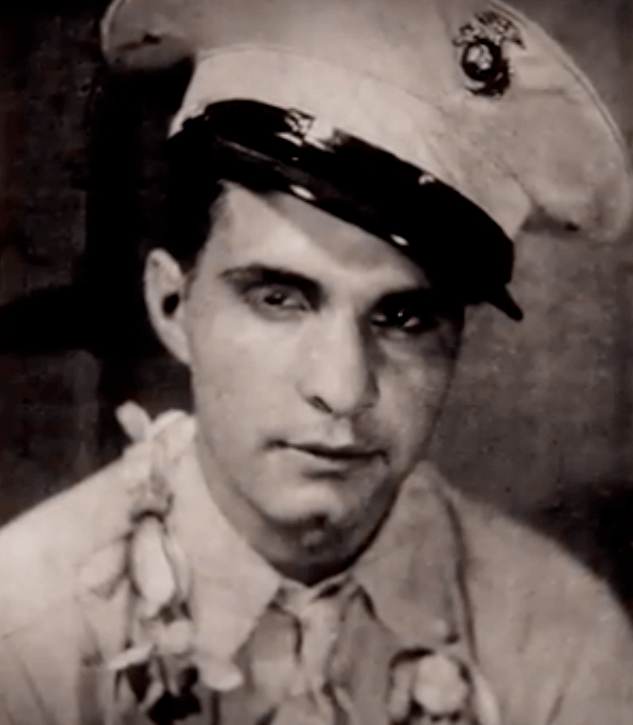
Guy Gabaldon grew up in poverty on the streets of East Los Angeles. Knowing how to live by his wits, he shined shoes at age 10 to help his parents and 6 siblings, and belonged to a street gang where he always took on the biggest kid. One day he got his nose broken in a fight, and went to the hospital to get it fixed. On that same night he got into another fight and got it broken again.
At age 12 Gabaldon met twins Lane and Lyle Nakano, children of Japanese immigrants, and became fascinated by Japanese culture. When the family took Guy in to live with them, he went to their Japanese school and became one of the family. Little did he know that what he learned then would lead him to perform one of the greatest feats of World War II.
Guy Gabaldon’s dream was to join the Navy, and serve on a submarine where he hoped he would see the most dangerous action. But his perforated eardrums and height of only 5 feet 3 inches disqualified him from the Navy. But Gabaldon remembered a Marine Corps ad looking for Japanese speakers. Although his Japanese was limited, he told them he “knew Japanese like a native,” betting that his Japanese was better than any Marine recruiter’s. Because the need for interpreters was so great, the Marines overlooked his size and perforated eardrums and swore 17 year old Guy into the US Marine Corps. at age 17.
Soon Gabaldon found himself engaged in the bloody fighting on Saipan. There he got the idea to use his knowledge to good advantage: “At night I’d usually go to caves — Saipan is just full of caves — and I’d get to one side of the mouth of the cave and I’d say, ‘You are completely surrounded. I’ve got a bunch of Marines here with me behind the trees. If you don’t surrender, I’ll have to kill you.’ And usually it worked.” He promised them dignity and to get them back to Japan when the war was over. The first time he went out, Private Gabaldon managed to get two Japanese prisoners. He was threatened with a court-martial. But he ignored that warning and on his next try, he captured over 50 enemy soldiers. After that, his missions became official: “I’d [capture] maybe 10 or 15, 20 at a time and one day I got 800.” There he was, surrounded by more than 800 Japanese, some of them still armed, but they were his prisoners. Guy Gabaldon is credited with single handedly capturing over 1,500 enemy soldiers and civilians. His citation for the Silver Star states he “daringly entered enemy caves, pillboxes, buildings and jungle brush, frequently in the face of hostile fire.” He was one tough little Marine – a kid from the streets of East LA and Marine Hero “Pied Piper of Saipan.” Well done private!
Thanks for reading! We hope you enjoyed our post. Please share with other proud patriots on social media. Brought to you by: Ultimate Flags
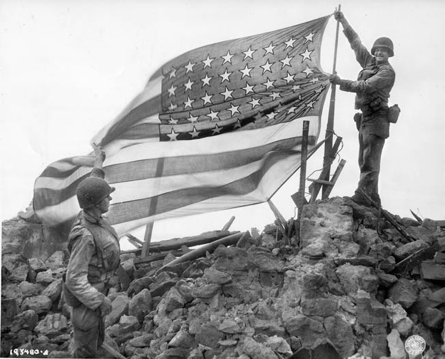
World War II: The 83rd “Thunderbolt” Division of the U. S. Army Infantry crossed the English Channel to Normandy in June 1944. It fought through the Hedgerows, across France and into Germany, including the Battle of the Bulge. In March 1945, the 83rd received orders to turn east and race toward Berlin. The 83rd had to move fast, so its commanding general ordered his soldiers to “utilize to the fullest extent” commandeered German vehicles.
The Division was nicknamed “The Rag-Tag Circus” by wartime correspondents because of its resourceful commander, Major General Robert C. Macon, who ordered to add the division’s transport anything that moved; “no questions asked.”
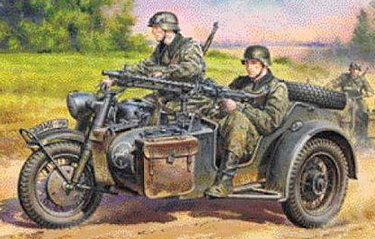
They commandeered anything on wheels––from bicycles to motorcycles to horses from the surrounding German countryside––to make a mad dash across northern Germany. Lineman Frank Fauver was there: “…the Germans were already on the run, so we commandeered anything that had an engine and that would run…. They called us the Rag-Tag Circus because when you looked at our convoy you couldn’t tell if it was German or American.” On motorcycles, cars, buses and Tiger tanks, the Thunderbolts raced. They had a fire engine with a banner reading, “Next Stop: Berlin.” Those fellows even captured an Me-109 fighter. And found someone to fly it! At first glance, it really was hard to tell if it was an American or German division. Fauver tells a great story: “One day when we were moving, we saw a German command car off to our rear. They were really making hay and when they came past us, I hollered ‘Germans!’ Then somebody fired just over their heads instead of shooting at them. Well, that got their attention. They thought that we were Germans but they took a second look at us and realized that the convoy that was moving was not German. So we commandeered their car, disarmed them, put them in the convoy, and took them with us, because we didn’t have time to take prisoners.” One of Germans was a general. In fourteen days the 83rd covered 280 miles, freed 75,000 Allied POWs and liberated several concentration camps. The papers called them “crack troops of the 83d,” and “ace shock troops,” but to those watching them it was “The Rag-Tag Circus.”
Last month we posted a spine-tingling and amazing story about the Ghosts of Gettysburg that just might make believers out of anyone. If you missed it, check it out here:
Since then, we’ve collected a few other first hand, up close and personal stories from some of you out there. We’d like to share a few of them with you today:
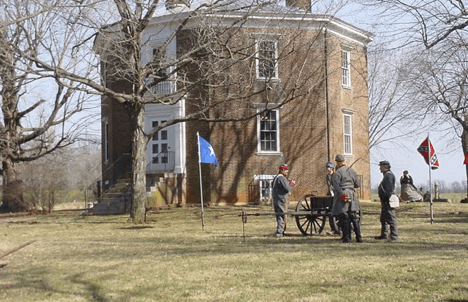
Here is one from Mike:“We went to Gettysburg a few years back. While at the Devil’s Den taking pictures I took 2 in quick succession of the same place. Maybe 10 seconds apart. “When we got back home a few days later we looked at the pictures. The first was normal. The second had smoke as from a campfire rising from behind the rocks?????”As you may know, the Devil’s Den is known for its numerous large rocks. Jerry sent this one:“Dave Shuffet, used to host Kentucky Life, a weekly show about life in every county and city in the Bluegrass.”“Dave is a very nice, humble, and very believable man.”“He went to the Octagon house in Franklin Kentucky. He filmed a ladle by the fire place start rocking by itself. Flashlights turn on and off when twisted firmly in place to off.”Dave came out of there, very shaken.Octagon Hall is shown during the Civil War is pictured above. It was the home of Andrew Caldwell, a supporter of the Confederacy. In 1862, the famous “Orphan Brigade” camped there, and later the Union Army spent time at Octagon. Confederate soldiers knew they could get shelter and medical care and be hidden from Union forces.
But today it is known as one of the most haunted spots in the South.
Visit it someday soon – if you dare!
Thanks for reading. Please share our posts with your friends and family so they too can learn more about Southern Heritage and History.
This is a favorite police story I have to share. It takes place on the Harbor Freeway in the Los Angeles area. Here’s how the officer tells it:
I stopped a guy for driving erratically on the Harbor freeway at 3:30 in the morning. The conversation went like this:He: “Do you know who I am?”Me: “No.”He (again): “Do YOU know who I am?”Me: “No.”He: “I am going to tell you who I am.”Me: “Please don’t. Please step out of your car.”He: “You can’t make me!”Me: “You are right, I can’t MAKE you step out of the car, but I can drag you out. Please step out of the car.”He: “Do you have any idea what I’ll do? I’ll have your badge!”Me: “Sir, you don’t need mine. You could have one of your own if you just went to the police academy. Please step out of your car.”Well, a short story made long: He stepped out of the car, and immediately fell down. He was so drunk he couldn’t walk. His blood alcohol was 0.19. I booked him into jail for DUI.
The next evening, the division police captain catches me in the hall, he said to me, “Remember that really drunk DUI you booked? Well, he is the mayor of Long Beach. Expect to go to court on that one.”
A few months later, I did have to testify. He was convicted. Lost his driving license. Had to go to rehab. Had to pay a big fine.
Good job, officer.
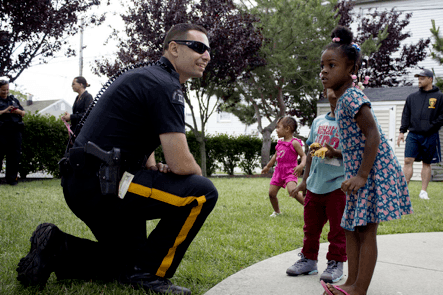
So, next time you see a local police officer or any First Responder, including the military, take just a moment and tell them, “Thanks for serving our community and country!”
Thanks for reading! We hope you enjoyed our post. Please share with all your fellow patriots. Brought to you by: Ultimate Flags
Doris Miller, known as “Dorie” to shipmates and friends, was born in Waco, Texas in October 1919.
He helped his parents and three brothers around the house by cooking meals and doing laundry, as well as working on the family farm. Miller was a good student and a fullback on the football team at Waco’s A.J. Moore High School. He was 6 feet 3 inches tall and weighed over 200 pounds.
In September 1939, shortly before his 20th birthday, Miller enlisted in the U.S Navy as Mess Attendant, to travel, and earn money for his family. Promoted to cook, he transferred to USS West Virginia where he became the ship’s heavyweight boxing champion. He was serving on that battleship when the Japanese attacked Pearl Harbor on December 7, 1941.
When Miller heard the “Battle Stations” alarm on that early Sunday morning, he headed for the antiaircraft battery magazine amid-ship. But torpedo damage had wrecked it, so he went on deck. Because of his strong build, he was assigned to carry wounded fellow sailors to safety. Then an officer sent him to the bridge to aid the mortally wounded Captain of the ship.
He took the initiative to man a 50 caliber Browning anti-aircraft machine gun, a weapon he had never been trained to operate:
Miller described firing the machine gun during the battle:
“It wasn’t hard. I just pulled the trigger and she worked fine. I had watched the others with these guns. I guess I fired her for about fifteen minutes. I think I got one of those Jap planes. They were diving pretty close to us.”
He fired until he ran out of ammunition.
The Japanese planes dropped two armor-piercing bombs through the deck of the battleship and five torpedoes into her side. Miller helped move injured sailors through oil and water to the quarterdeck, “unquestionably saving the lives of a number of people who might otherwise have been lost.”
With heavy damage and flooded decks, the crew abandoned ship. The West Virginia slowly settled to the harbor bottom.
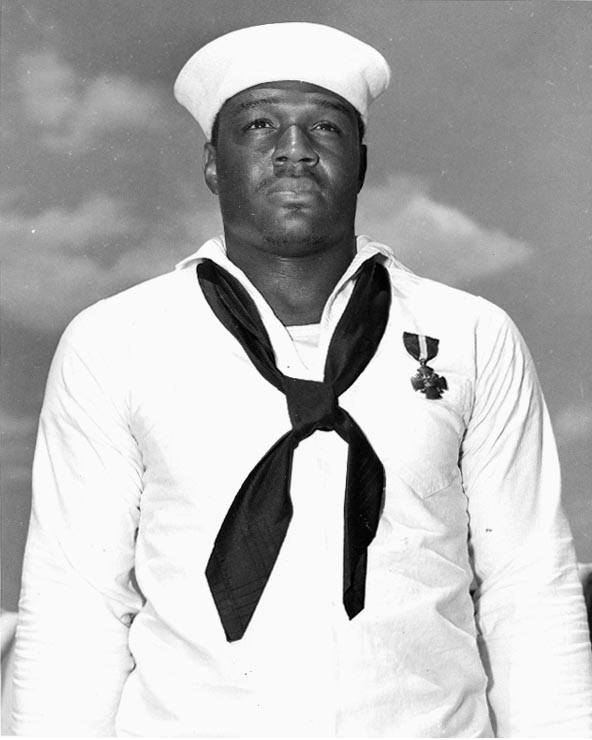
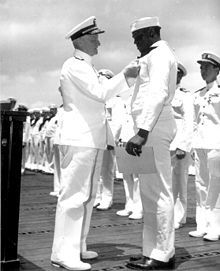
Admiral Chester W. Nimitz, Commander in Chief of the Pacific Fleet, personally presented the Navy Cross to Miller on May 27, 1942 on board aircraft carrier USS Enterprise. He was the first African American to be awarded the Navy Cross, at the time the third-highest Navy award for extraordinary courage in battle. The citation reads:
“For distinguished devotion to duty, extraordinary courage and disregard for his own personal safety during the attack on the Fleet in Pearl Harbor, Territory of Hawaii, by Japanese forces on December 7, 1941.”
“While at the side of his Captain on the bridge, Miller, despite enemy strafing and bombing and in the face of a serious fire, assisted in moving his Captain, who had been mortally wounded, to a place of greater safety, and later manned and operated a machine gun directed at enemy Japanese attacking aircraft until ordered to leave the bridge.”Nimitz also remarked:“This marks the first time in this conflict that such high tribute has been made in the Pacific Fleet to a member of his race and I’m sure that the future will see others similarly honored for brave acts.”
Nimitz awarding Miller Navy Cross aboard USS Enterprise
In addition to the Navy Cross, Miller, recognized as one of the “first US heroes of World War II,” became entitled to the Purple Heart Medal; the American Defense Service Medal, Fleet Clasp; the Asiatic-Pacific Campaign Medal; and the World War II Victory Medal.
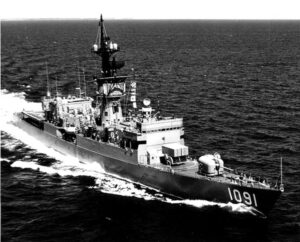
CBS radio broadcast an episode of the series “They Live Forever,” which dramatized Miller’s actions.In 1973, a Knox-class frigate, the USS Miller, was named in honor of American war hero, Doris “Dorie” Miller.
USS Miller, named in honor of “Dorie” Miller commissioned in 1973
Pretty good for a young Waco, Texas farmer and cook.
Thanks for reading! We hope you enjoyed our post. Please share with all your fellow patriots. Brought to you by: Ultimate Flags
Through the harsh winter of 1865, General Lee’s Army of Northern Virginia suffered a steady stream of desertions. At its worst, hundreds of men chose to put the war behind them. Execution waited for those caught in the act, but Lee’s greatest hope was to slow it down at best, and even try to stop it.
After the Hampton Roads peace conference failed, it became clear to many Southerners that the Federals were more than willing to fight to the bitter end. The North would accept only their full and unconditional surrender. As far as their new country was concerned, there was nothing left to lose.
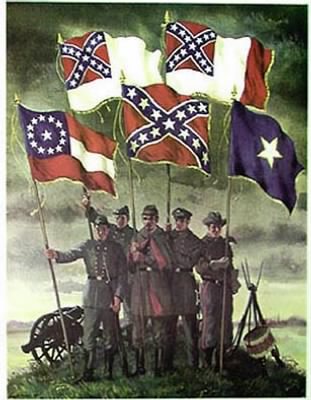
It seemed to the men was that the differences between North and South were irreconcilable, with no hope of peace as one country. But if they fought and held out long enough, just as their grandfathers before them had done against England, they would emerge victorious. They could not accept the idea of surrendering to Northerners.
Soon entire regiments were resolving to pledge themselves again to the cause, and desertions declined. Their greatest hope and prayer was that the Yankees would be defeated with the summer campaign. Despite setbacks, they felt God was still on their side.
On February 28th, the Richmond Daily Dispatch published these words of renewal – a proclamation of the South’s determination to conquer or die:
“The resolutions which have been passed by the various regiments of the Confederate army, and which they have published to the world, ring like inspiring trumpet tones on the air.”
“Wherever else the paralyzing suggestions of despondency and doubt are heard, they cannot affect the iron nerves of those heroes who have borne the brunt of this war; who have endured the winter’s frosts and the summer’s heart; who have slept on the bare ground, have lived on the coarsest food, marched weary miles in bare feet, poured out their blood like summer rain, and stood like a living wall between their country and its enemies.”
“These are the men who send forth words of hope and cheer and high resolve, and whose heroic souls, like the Aeolian harp, give forth stronger strains as the tempest increases.”
These men were determined that their labors, and suffering will not be for nothing. Voices of their fallen comrades will not cry out vain from the ground. They are heroes of the Confederacy and noble men, unlike anything the world had ever seen.
Thanks for reading. Please share our posts with your friends and family so they too can learn more about Southern Heritage and History.
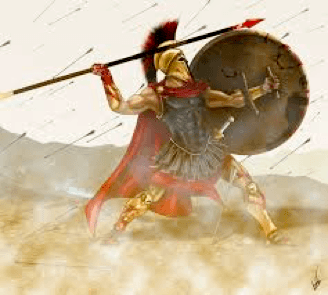
The ancient Spartans have given us some of the greatest lines in military history.Persian King Xerxes was trying to fight his way into Greece 2500 years ago during the Battle of Thermopylae (480 BC), one of the most famous battles in history . Spartan King Leonidas, along with a few thousand guys, was doing a good job of slowing him down. The idea was to give the rest of Greece a chance to get mobilized so they could send Xerxes packing.Anyway, Xerxes offered to cut Leonidas a great deal if he would get out of the way. I’m not sure who Xerxes thought he was dealing with, but Leonidas told him to take a hike. Then the Greeks were told more forcefully to lay down his arms. Leonidas replied with his famous line, “Molon Labe,” translating as a classical expression of defiance:“Come and take them.”
I’m sure you know those words, and that the citizens of Gonzales, Texas used them when they were told to give up their cannon (which they never did) during the Texas Revolution. The men of Gonzales fired the little cannon at the Mexican troops. And they raised a flag sewn from a woman’s wedding dress that showed a lone star, an image of the cannon, and the defiant words “Come and Take It.”
The British commander, Colonel Fuser, demanded Colonel McIntosh surrender Fort Morris’ via a written note. Though clearly outnumbered McIntosh responded defiantly:
“As to surrendering the fort, receive this laconic reply: COME AND TAKE IT!”.
Lack of intelligence of the area, combined with a big dose of Colonel McIntosh’s bravado, made the British think twice about an attack. They decided to skip it and withdrew.
Back to Xerxes and Leonidas: You may not have heard about is this next one. Persian King Xerxes sent a messenger to one of Spartan King Leonidas’ generals with the threat:
“Our arrows will block out the sun.” The Greek general replied:“Then we shall have our battle in the shade.”
Don’t you just love it!
Thanks for reading! We hope you enjoyed our post. Please share with all your fellow patriots. Brought to you by: Ultimate Flags
Private Sam Watkins’ Company H of the 1st Tennessee was camped on the Duck River, at a moment when there were no battles to win. The thing is, a soldier needs stuff to do or he gets bored and up to trouble. As the Bible says, “Idle hands are the devil’s workshop.” Or at least it can cause him to get into some sort of mischief.It seems that Sam’s sweetheart was living in Colombia, Tennessee, just down the river from his camp.Well, the Duck River at the time was high. As Sam put it, it “had on its Sunday clothes.” Sam got an idea to “slip off and go down the river in a canoe.” It was a great idea except for one problem: the boat leaked and soon sank.So Sam put his “sand paddles to work and landed in Columbia that night.” A Rebel knew how to march, and It was a matter of “damn the consequences.”
Sam put it this way:“Some poet has said that love laughs at grates, bars, locksmiths.”Sam was laughing, but he did think ahead. He asked his sweetheart to pray for him “because I thought the prayers of a pretty woman would go a great deal further ‘up yonder’ than mine would.”When Sam got back to camp, his superiors were waiting for him. He was sentenced to thirty days’ fatigue duty that’s (digging trenches, fetching water, and other labor intensive duties.) On top of that, the worst of it was he had to forfeit four months’ pay at eleven dollars per month – that’s $44.His sweetheart’s prayers must have worked, though, because General Leonidas Polk“issued an order that very day promising pardon to all soldiers absent without leave if they would return.”So, Polk ordered Sam’s release, but unfortunately never didn’t say anything about the fine. So, in Sam’s words,
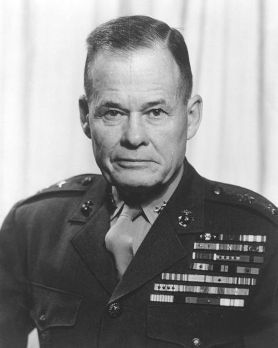
In his thirty-seven years of service to the United States Marine Corps, Lewis Puller, nicknamed “Chesty,” would rise through the ranks from Private to General, and become the most decorated Marine in American history.
How does a guy get a nickname like “Chesty”? It is said that he had perfect posture and his torso resembled a “full-size beer keg full of lead bricks.” There is the myth that his chest had been shot away and he got a new one – a steel plate.
Others say “chesty” was an old Marine expression meaning cocky. Puller himself was not sure of how he came by the name, but he wore it well.
This Southern boy from Virginia fought in Haiti, Nicaragua, WW II and Korea. He wore five Navy Crosses, a Distinguished Service Cross, Silver Cross, Two Legions of Merit, Bronze Star, Purple Heart… well, you get the idea. Thousands of words cannot do the man justice, but here are a few.
On Guadalcanal, two Marine companies were surrounded by a large enemy force. Rescue efforts failed, and the operation commander told Puller it was hopeless. Puller marched out of camp, went down to the beach, and hailed a destroyer off the coast. Boarding the ship, he directed fire on the enemy. The shelling, along with a second landing, cleared a path for the Marines to escape. By the time Puller left Guadalcanal, he had been shot twice and taken shrapnel from a mortar round.
Puller’s men admired him and his enemies feared him. He led from the front, fighting with his men in the trenches. He never flinched even under even the most serious fire. One time when a grenade landed next to him, the men around him dove for cover. But Puller glanced at it and nonchalantly said, “Oh, that. It’s a dud.” Well, I bet it wasn’t a dud until Puller ordered it to be.
In Korea, Puller’s 1st Marines were surrounded by Chinese infantry. There were some journalists with his force and they asked him what he was going to do about it. He is reported to have said:“All right, they’re on our left, they’re on our right, they’re in front of us, they’re behind us. They can’t get away this time.”
“Chesty” Puller inspired loyalty and courage in his Marines, treated his men well, insisted on the best equipment and discipline for his troops. He had no fear, and his win at all costs attitude won him those countless medals, citations, and ribbons.
Puller has been recognized as the “baddest dude” to ever wear the uniform of the United States Marine Corps, and represents the pinnacle of toughness.
To this day, Marines at Parris Island end their day by saying,
“Good night Chesty Puller, wherever you are!”
Thanks for reading! We hope you enjoyed our post. Please share with all your fellow patriots. Brought to you by: Ultimate Flags
John Baxley shares the economic reasons for the civil war. High schools and politicians have changed history to make this war solely about slavery, but that issue was not the main reason for the war. The struggle was about unfair taxation, at least according to the author. The background is examined in more detail in the story.
Key Takeaways:
The unfair 40-percent tariff on cotton was paid by the five Deep South cotton states, which financed 80 percent of the U.S. Treasury.
The South felt the only way it could change this unfair arrangement would be to legally secede and form its own country.
my paramount object in this struggle is to save the Union, and it is not either to save or destroy slavery.
“With all this hate and economic warfare against the South, the folks in Dixie had no choice but to leave the Union or face economic ruin. Truly a sad choice, as that is what happened to the South in the end despite their heroic attempt to form their own nation.”
Thanks for reading. Please share our posts with your friends and family so they too can learn more about Southern Heritage and History.
The Confederate monuments honor the sacrifice that many people made. There are many people that descended from war veterans of the Civil War, and they are upset at the recent removal of monuments that they care a lot about. Confederate history and heritage has been under attack lately and many people are upset by this.
Key Takeaways:
a closer reading of the orations given at the countless dedicatory ceremonies, of the newspaper articles that accompanied those events, and of correspondence surrounding that history, reveal that by far the underlying sentiment was to honor the veterans and others who suffered, fought and died decades earlier.
forty years after Vietnam—an excellent example, among many, being the recent erection of the monument to Vietnam veterans on the Capitol Square in Raleigh, North Carolina.
Indeed, instead of taking monuments down or hiding them, we should be putting more monuments up. That is the true spirit of North Carolina and the spirit that, I would suggest, mirrors the overwhelming sentiment of the citizens of this state.
“Throughout our history, usually forty or fifty years after the conclusion of each war or conflict, there are efforts to honor the old veterans who are quickly passing away.”
Thanks for reading. Please share our posts with your friends and family so they too can learn more about Southern Heritage and History.


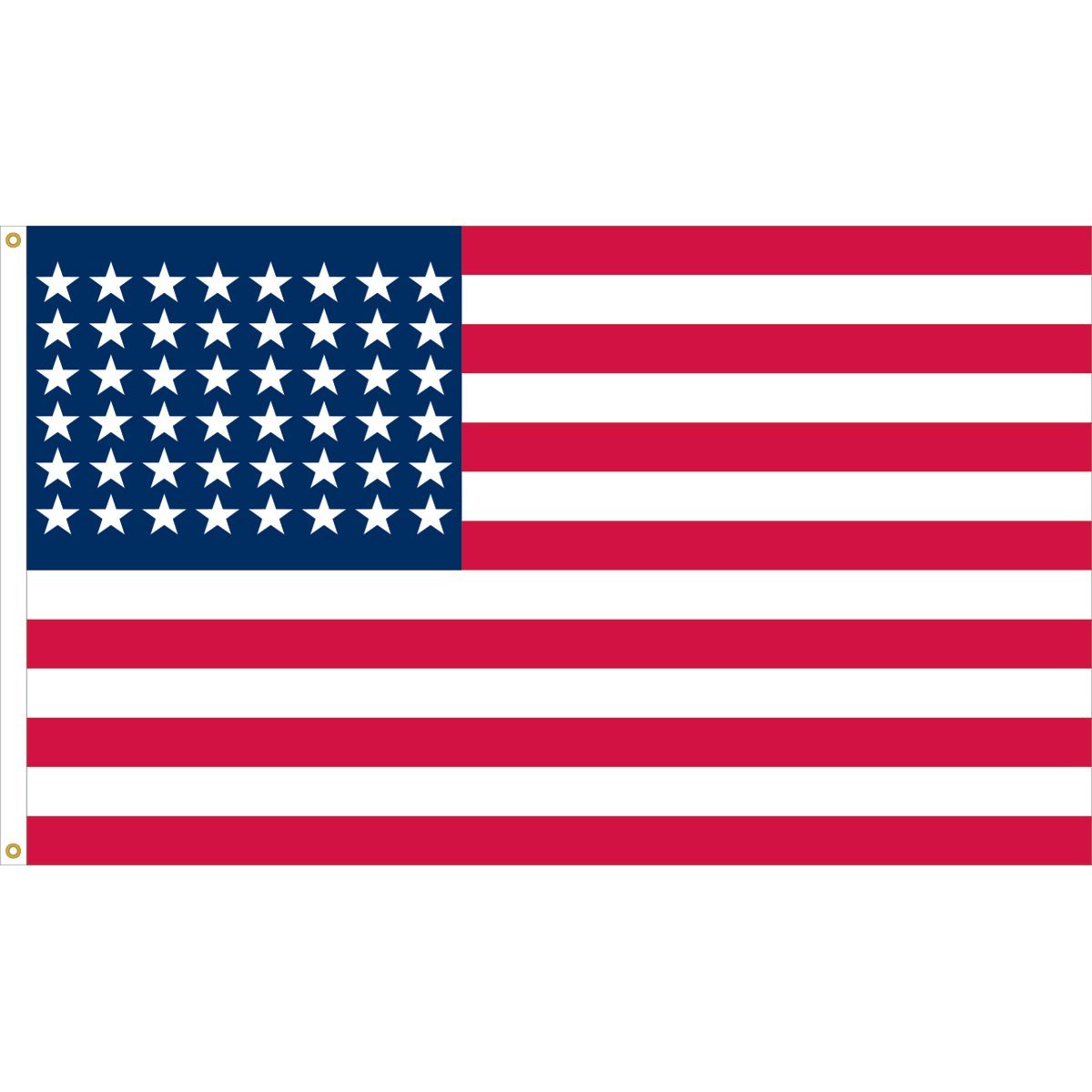
 American Flags – Buy Now!
 They commandeered anything on wheels––from bicycles to motorcycles to horses from the surrounding German countryside––to make a mad dash across northern Germany.