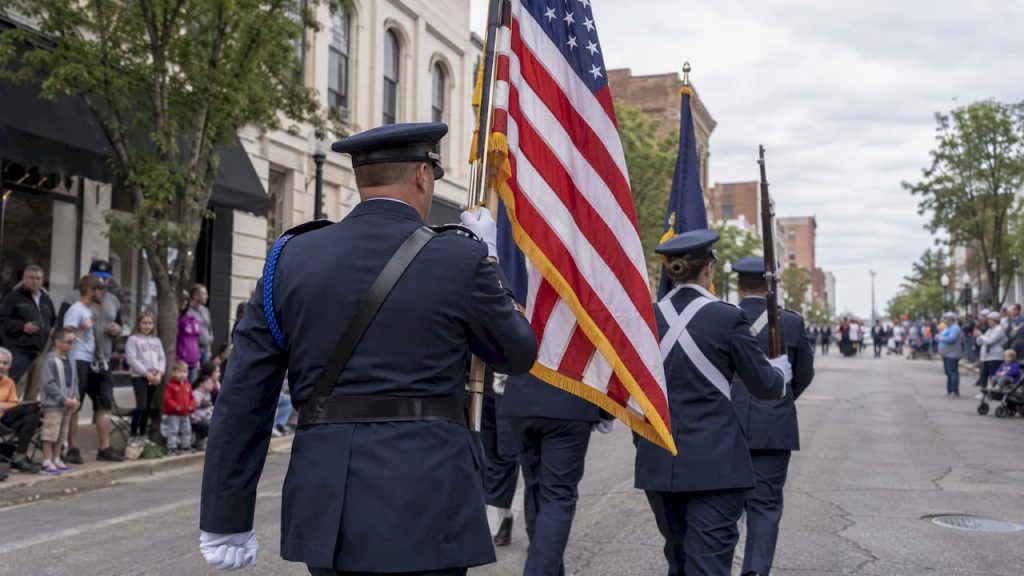
When the Stars and Stripes comes down Main Street, the rules are simple to state and worth knowing by heart. The flag takes the place of honor. It rides on a staff, never draped over a float or a fender. It is never dipped to anyone. And when it passes, everyone present faces it: uniformed service members salute, and everyone else stands at attention with a hand over the heart.
This guide walks you through each of those points, for the spectator on the curb and for the person who has been handed the pole and told to march. Every rule below comes from the federal Flag Code or from the Department of Veterans Affairs and veterans’ organizations that interpret it.
TL;DR
- Position of honor: In a procession with other flags, the U.S. flag marches on its own right, or in front of the center of a line of flags.
- When it passes: Civilians stand at attention with the right hand over the heart. Uniformed personnel salute. Men not in uniform remove non-religious headwear.
- On a float or vehicle: Fly it from a staff. Never drape it over the hood, top, sides or back.
- Never dip it: The U.S. flag is not lowered to any person or thing. Other flags may be.
- Keep it clean and free: Carry it aloft, keep it off the ground, and choose a flag built for outdoor wind.
Table of Contents
- Why a parade is where etiquette matters most
- Where the flag marches
- What to do when the flag passes
- Carrying the flag: for the person on the pole
- Flags on floats and vehicles
- Spectators, hats and everyday questions
- After the parade: care, storage and retirement
- Our perspective: why we care about the details
- Choosing a flag and gear for the parade route
- FAQ
- Sources
Why a parade is where etiquette matters most
A flag on a pole at home is displayed. A flag in a parade is moving through a crowd, and that is where the old customs were born. Armies carried colors into the field so that soldiers could see where to rally. A parade preserves that memory: the flag leads, the people turn toward it, and for a moment a street full of strangers shares one posture.
The VA’s guidance describes the flag as a living symbol rather than a piece of cloth. Hold that thought and nearly every rule that follows makes sense. You do not let a living symbol drag in the dirt, wear it as a costume, or bow it to a passing dignitary.
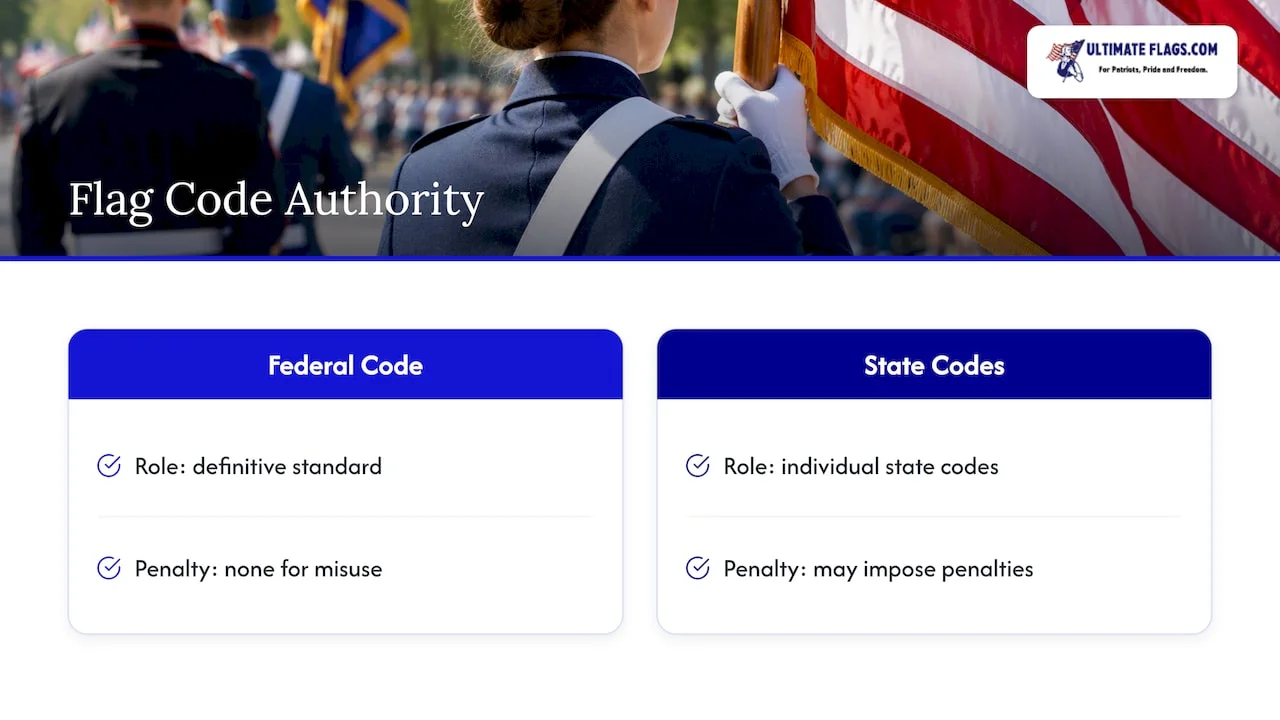
One honest note on authority. The federal Flag Code is guidance, and it carries no penalties for misuse, although individual states have their own flag codes and may impose penalties. The Code is the definitive standard for patriotic expression, and the way Americans honor the flag rests on choosing to follow it.
Where the flag marches
The position-of-honor rule is written plainly in 4 U.S.C. § 7: when the flag is carried in a procession with another flag or flags, it should be either on the marching right, which is the flag’s own right, or, if there is a line of other flags, in front of the center of that line.
Why the right? The Florida Department of State explains the old logic: the right arm is the sword arm, the point of danger, so the right is the place of honor. The VFW offers a handy translation for the street: the marching flag goes to the marchers’ right, which is the observer’s left.
A quick placement guide
| Situation | Where the U.S. flag goes |
|---|---|
| Two flags marching side by side | On the marching right (its own right) |
| A line of several flags | In front of the center of the line |
| Grouped flags on staffs | At the center and at the highest point of the group |
| Mixed with state or unit flags | Still leads; state and unit flags follow |
The grouped-staffs rule comes from the same section of the Code, which says the U.S. flag should be at the center and highest point when state, local or society flags are displayed together on staffs. If your group carries a state flag, a unit banner and Old Glory, there is never a debate about who goes first.
Planning a larger display on a pole or at an event stage? Our guide to displaying multiple flags covers one pole versus separate staffs.
What to do when the flag passes
This is the part spectators most often get wrong, usually out of simple unawareness. The rule sits in 4 U.S.C. § 9, which covers conduct when the flag is hoisted, lowered or passing in a parade or in review. As of 2026, here is how it breaks down:
- Uniformed personnel render the military salute.
- Veterans and members of the Armed Forces not in uniform may also render the military salute.
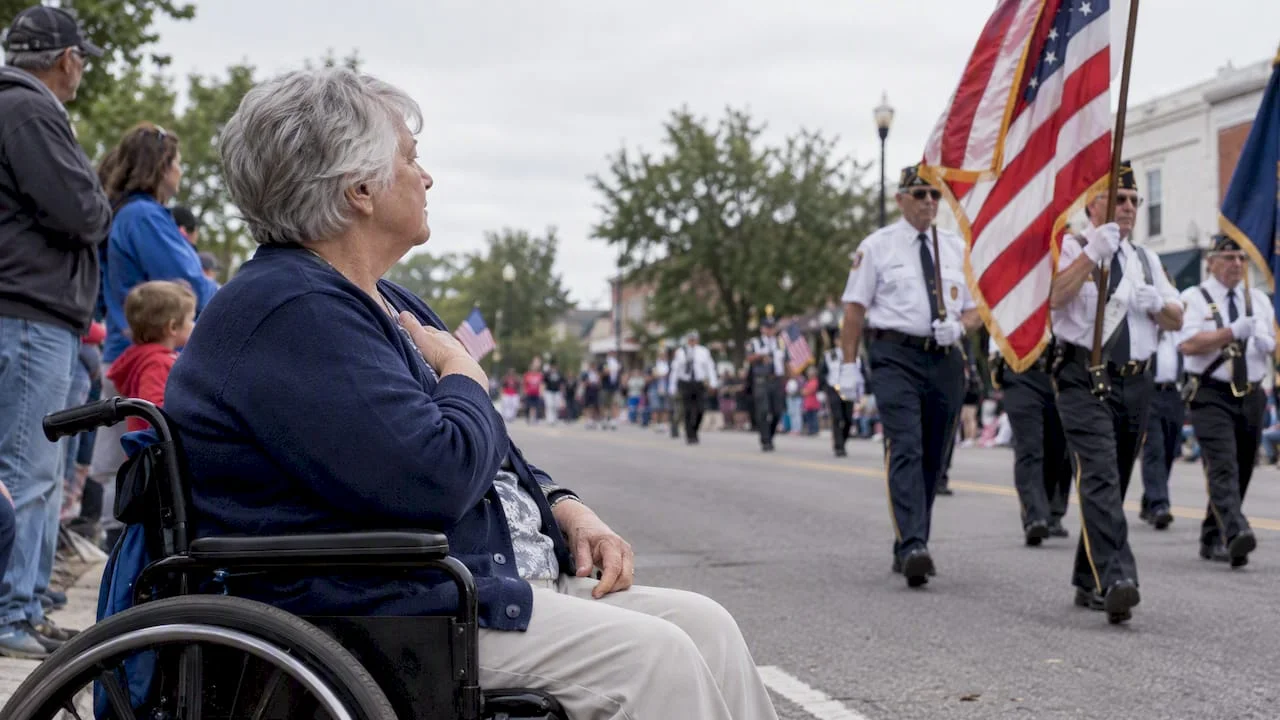
- Everyone else faces the flag and stands at attention with the right hand over the heart.
- Men not in uniform remove any non-religious headdress and hold it at the left shoulder, with the hand over the heart.
In practice, that means you stand up, put down the phone and the funnel cake, stop talking, and face the colors until they pass. Veterans’ groups put it the same way in their curbside summaries. If you are seated on a lawn chair, rise. If you are holding a child, you are teaching the lesson just by doing it.
A small, practical point: the flag is not a single moment. A color guard may be followed by units carrying their own banners. Remain attentive until the U.S. flag has fully passed, and do not wave a small flag at it while saluting. Hold your posture and let the colors go by.
What if you are in a wheelchair, or can’t stand?
The Code speaks of standing at attention, but its spirit is respect. Face the flag, place your hand over your heart, and give it your full attention. No reasonable person reads the Code as a test of physical ability.
Carrying the flag: for the person on the pole
Carrying the flag in a parade is an honor, and it comes with a few firm responsibilities.
Keep it aloft and free
The flag should fly from a staff or be carried so that it falls free, not bunched against the pole or tucked under an arm. In wind, a flag that wraps itself around its staff looks neglected. Choosing the right fabric helps: our flag qualities and uses guide explains which materials suit wind, sun and repeated outdoor use. An anti-furl rotating pole is a useful tool when a flag is to be displayed on a short staff, though a marching staff is a different matter and should be sturdy and balanced.
Never let it touch the ground
Plan for the finish line as well as the route. When the parade ends, the flag should not be rested on pavement, folded carelessly in the back of a truck, or leaned in the mud. Assign someone to receive it, or case it properly. The VA’s reasoning applies directly: a living symbol does not touch the ground, serve as clothing, or be used for advertising.
Do not dip it
This one surprises people. The Code holds that the U.S. flag is never dipped to any person or thing. It is a common belief that the flag should be lowered to salute a dignitary, a reviewing stand, or a passing officer. It should not. By contrast, state flags, regimental colors and other flags may be dipped as a mark of honor. If your unit carries both, the person with Old Glory stays steady while the others may dip.
Walk the route before you march
Overhead wires, tree limbs, banners and low bridges can snag a flag. A rehearsal walk is not fussy, it is how you avoid a torn flag on the parade route. A flag that gets damaged or soiled should be handled with care and not allowed to deteriorate in front of a crowd.
Flags on floats and vehicles
Floats are where well-meaning patriots most often go wrong, because a flag draped across a flatbed looks festive. The Code says otherwise. According to 4 U.S.C. § 7, the flag should not be displayed on a float in a parade except from a staff. It should also not be draped over the hood, top, sides or back of a vehicle, a railroad train or a boat.
For a car, truck or convertible, the same section is specific: when the flag is displayed on a motorcar, the staff should be fixed firmly to the chassis or clamped to the right fender. Not taped to a window, not stretched across the tailgate.
Float checklist
- Mount the flag on a staff, secured so that it cannot fall.
- Position the staff where wind will not press the flag against the float or its decorations.
- Keep bunting separate: if you want red, white and blue draped along the sides, use bunting, not a flag.
- Make sure no one sits on, leans on or covers the flag.
- Place the U.S. flag in the position of honor relative to any other flags on the float.
That bunting point is worth repeating. The Code has long treated the flag as something not meant for decoration. Bunting exists so that the flag does not have to be.
Spectators, hats and everyday questions
A parade crowd includes veterans, scouts, toddlers, tourists and people who have never read a word of the Code. Some customs are easy to share with the person standing next to you.
- Hats: For men not in uniform, remove non-religious headwear. Hold it at the left shoulder with the hand over the heart.
- Conversation: Pause it until the flag has passed.
- Phones: Lower them for the few seconds the colors pass in front of you.
- Small flags: Wave them as the parade passes, but don’t wave one while the colors are passing in front of you. Hold it still, and respectfully.
- Children: A quiet word beforehand, such as “stand up, hand on heart, the flag is coming,” is all it takes.
We find the best curbside etiquette is quiet, never scolding. Nobody has ever been moved to patriotism by being corrected loudly. If you see someone unsure, a quiet example does more than any lecture.
After the parade: care, storage and retirement
A parade is tough on a flag. Sun, wind, sweat on the hand-held edge, spilled soda and a brush with a curb can all leave marks. Here is how to treat the flag once the music fades.
- Check for damage. Look at the fly end, where fraying starts, and at the stitching near the header.
- Clean it gently. Our guide on how to clean your American flag with a short soak shows the respectful method, and our flag care guide covers storage.
- Fold it with care. The folded flag ends as a triangle of stars on blue, and our flag etiquette guide goes further into handling.
- Retire it when it is no longer fit. When a flag is too worn to serve as a symbol, it is retired respectfully, not tossed out. Our Independence Day flag etiquette page covers flag retirement.
Memorial Day parades have a rhythm of their own, since the flag is at half-staff until noon. See our guide to Memorial Day flag etiquette for the exact steps. Half-staffing itself is a formal act of mourning: the flag is briskly hoisted to the peak for an instant, then slowly lowered to the half-staff position.
Our perspective: why we care about the details
We have sold flags for a long time as America’s oldest online flag store, and we have watched what happens at the edges of parade season. People call a flag “just fabric” until they are the one holding it in front of their town. Then the details matter very much.
Here is what we believe. The flag does not whisper tales to the careless; it speaks to anyone who treats it with care. A reenactor in a Revolutionary War unit, a veteran in a VFW color guard, a Scout troop on the Fourth of July and a family riding a small-town float are all doing the same thing: carrying a story forward. The rules are how that story is passed on without being scuffed.
We also hold that expression matters. Americans display many flags, from Betsy Ross and Gadsden banners to state, military and unit flags, and a parade is where those traditions meet. The rule is not that other flags are unwelcome. It is that when Old Glory marches with them, it leads, it is never dipped, and it is carried free. Get those three things right and everything else follows.
For our customers, that means choosing a flag that suits the job. A parade flag needs strong stitching, a fabric that moves well in wind, and a staff you can hold for a mile. A flag meant for a mantel is a different purchase.
— John Hough
Choosing a flag and gear for the parade route
If you are outfitting a color guard, a veterans’ group, a Scout unit or a float, we carry the flags that march alongside Old Glory. Browse our full flag collections, including USA flags, US state flags, historic war flags, and military, police and first responder flags. Our military flags are a natural fit for service organizations, and we also stock flagpoles and hardware for staffs and mounting.
When choosing, think about wind and duration. A long route calls for sturdy construction; our flag qualities and uses guide can help you match fabric to the job.
FAQ
Do you have to put your hand over your heart when a flag passes in a parade?
Civilians should face the flag, stand at attention and place the right hand over the heart, according to 4 U.S.C. § 9. Men not in uniform should remove non-religious headwear. Uniformed personnel salute instead. The Code itself has no federal penalty, but it is the standard for respect.
Which side does the American flag go on in a parade?
It goes on the marching right, which is the flag’s own right. If there is a line of other flags, it goes in front of the center of that line, per 4 U.S.C. § 7. To a spectator, the marching right appears on the left.
Can you drape the American flag over a parade float or car?
No. The Code says the flag should be displayed on a float only from a staff, and should not be draped over a vehicle’s hood, top, sides or back. On a car, the staff should be fixed firmly to the chassis or clamped to the right fender, as 4 U.S.C. § 7 states.
Should the flag be lowered to salute a dignitary?
No. The U.S. flag is never dipped to any person or thing, according to the VA’s display guidelines. State flags, regimental colors and certain other flags may be dipped as a mark of honor, but the national flag stays up.
Sources
- 4 U.S. Code § 7: Position and manner of display (Cornell Law School)
- 4 U.S.C. § 9: Conduct during hoisting, lowering or passing of flag
- Guidelines for Display of the Flag (U.S. Department of Veterans Affairs)
- Flying the American Flag at Half Staff (U.S. Department of Veterans Affairs)
- Flag Etiquette (VFW)
- Flag Protocols and Display (Florida Department of State)