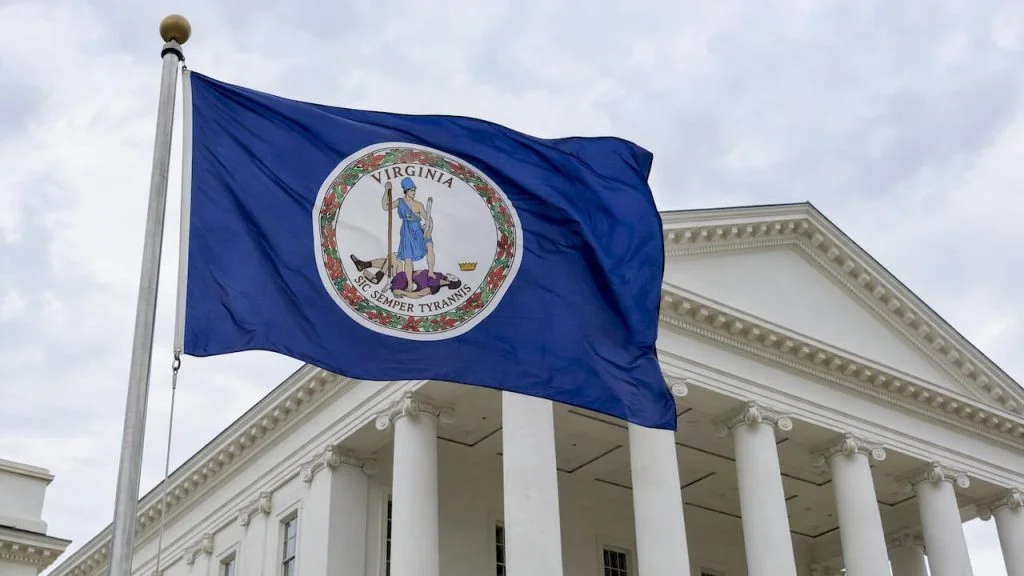
The Virginia flag is a deep blue banner with a white circle at its center. In the circle stands Virtus, the armed spirit of the Commonwealth, with her foot on a fallen tyrant. The flag was first authorized on April 30, 1861. The seal it carries is older: Virginia’s revolutionary leaders designed it in 1776, as the colony declared itself a free Commonwealth. The motto, “Sic Semper Tyrannis,” is Latin for “Thus always to tyrants.” It is among the boldest declarations on any American state flag.
The story runs from the Revolution through secession and the Civil War to the standardization of the twentieth century. Here it is, in order.
TL;DR
- The seal on Virginia’s flag was created in 1776. A committee that included George Mason and George Wythe shaped it, and Mason recommended the motto.
- The flag itself was first authorized by the Virginia Convention on April 30, 1861. The General Assembly had never approved a state flag design before that.
- Virtus stands over Tyranny, who wears a fallen crown, holds a broken chain and drops a scourge. The reverse of the seal, which is not on the flag, carries the word “Perseverando.”
- The flag’s design is now fixed in the Code of Virginia (§ 1-506). It has no Confederate symbols, though it flew beside Confederate flags in 1861 to 1865.
Table of Contents
- Where the Virginia Flag Begins: The Seal of 1776
- Reading the Flag: Virtus, Tyranny and a Broken Chain
- Sic Semper Tyrannis: What the Motto Means
- 1861: A Flag Is Authorized
- From Many Variants to One Official Flag
- Virginia Flag Timeline at a Glance
- Displaying a Virginia Flag Well
- Bring the Virginia Flag Home
- Going Deeper into Virginia and Civil War Flags
- FAQ
- Sources
Where the Virginia Flag Begins: The Seal of 1776
To understand the flag, start with the seal, because the flag is the seal’s obverse lifted onto a field of blue.
On July 5, 1776, the Virginia Convention adopted an ordinance creating a new seal for the independent Commonwealth. George Wythe designed it, and the dies were engraved in Paris. The committee behind the design included George Mason, George Wythe, Richard Henry Lee and Robert Carter Nicholas, who worked in the library at the College of William & Mary.
The moment matters. Virginia was breaking from a king, and a seal had always been the mark of royal authority. Colonial Virginia had sealed its documents under the Crown’s arms. The new Commonwealth needed something that said who held power now. According to the Commonwealth’s own account, the seal adopted in 1776 broke entirely with the tradition of sovereign’s arms. In place of a king’s coat of arms, Virginia chose virtue itself, and a warning to anyone who would rule by force.
The committee found its central figure in a book. They drew on a depiction of Virtus in Joseph Spence’s 1747 Polymetis, a British scholar’s study of Roman art, because the designers wanted to compare their new commonwealth to the glory of Rome. The republic they imagined drew its imagery from antiquity, not from the throne it was leaving.
Reading the Flag: Virtus, Tyranny and a Broken Chain
The design is not left to taste. The Code of Virginia describes it in detail. The obverse shows Virtus, the genius of the Commonwealth, dressed as an Amazon, with a spear in her right hand and a sheathed sword in her left, her left foot on Tyranny. Tyranny is a prostrate man with a fallen crown nearby, a broken chain in his left hand and a scourge in his right.
Every object carries meaning:
- The spear and sheathed sword. The General Assembly’s own publication reads Virtus as a figure of peace in the pose of a battle already won. Her spear point turns toward the ground, and her sword is sheathed as a symbol of authority, not of combat. She does not need to strike again.
- The fallen crown. Maryland, Virginia and New York are the only states with a flag or seal that displays a crown. In Virginia’s case it marks release from monarchical control.
- The broken chain and the useless scourge. Popular accounts read the chain as freedom from Britain’s limits on colonial trade and westward expansion, and the scourge as relief from punitive measures such as the Intolerable Acts.
- The Amazon’s bare breast. Virginia’s is the only U.S. state flag depicting nudity, following the classical depiction of Amazon warriors. It is also a later addition to the figure. In at least 1901, Secretary of the Commonwealth D.Q. Eggleston asked for the breast to be added because he thought the figure looked more like a man than a woman.
The flag shows only the obverse. The reverse of the seal holds a quieter allegory: Libertas with a wand and pileus, Aeternitas with a globe and phoenix, and Ceres with a cornucopia and an ear of wheat, with “Perseverando” above them. Liberty, eternity and abundance stand behind the warrior on the front.
Sic Semper Tyrannis: What the Motto Means
The Latin words translate as “Thus always to tyrants.” They answer the picture directly. Tyranny lies beneath Virtus’s foot, and the motto says that is where tyrants belong, always and everywhere. It is not a boast of conquest. It is a statement of principle, written by men who had just staked their lives on it.
The General Assembly’s record credits the motto to the same circle that built the seal: George Mason recommended “Sic Semper Tyrannis” for the seal during the 1776 Convention. Mason also drafted Virginia’s Declaration of Rights that summer, so the motto belongs with the most consequential statements of liberty of the era.
Soldiers and schoolchildren have long shared a wry gloss on the image: the motto means “Get your foot off my neck.” That joke, which dates as far back as the Civil War, shows how well the picture and the words work together. A symbol that survives that much teasing, and still stirs pride, is doing its job.
The original reverse inscription was different from the one we know. In 1776 it read “Deus nobis haec otia fecit” (“God has given us this ease”), and the General Assembly replaced it with “Perseverando” (“by persevering”) in 1779. Ease gave way to endurance, a better word for a young state still fighting a war.
1861: A Flag Is Authorized
For eighty-five years, Virginia had a seal and no official flag. The Virginia General Assembly never formally authorized a state flag design before the Virginia Convention of 1861. That Convention acted by ordinance on April 30, 1861, nearly two weeks after Virginia seceded. The Convention’s ordinance placed the seal’s obverse on a blue field, and that is the first official Virginia flag.
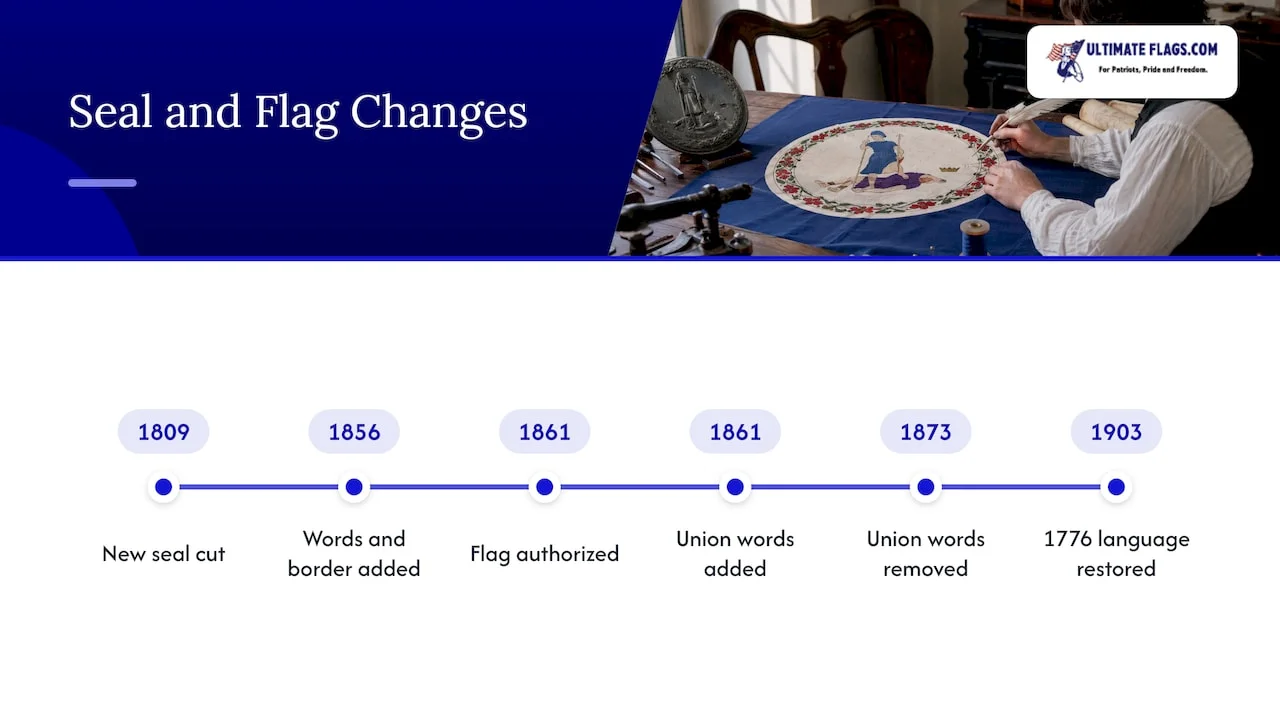
The seal itself had been re-engraved several times by then. New seals were cut in 1809 and again in 1856. The 1856 version was the first to place the words “Virginia,” “Perseverando” and “Sic Semper Tyrannis” within the space of the figures, along with a decorative floral border.
The war split the state’s identity in two. The Unionist Restored government of Virginia, formed in Wheeling under Governor Francis H. Pierpont, ordered the words “Liberty and Union” added to both faces of its seal in 1861. In 1873 the General Assembly directed that new seals be struck without those words. In 1903 it passed another law that essentially returned to the language of 1776. Many readers know the other half of this split from West Virginia’s founding, and the seal is where the two histories first diverge.
Is this a Confederate flag? No, and the distinction matters. Encyclopedia Virginia notes that the Confederate battle flag was never adopted as a national flag, and that the Virginia state flag of 1861 was a separate design, with the commonwealth’s seal in a white circle against a blue background. Virginia regiments carried the state flag alongside the Stars and Bars and later the Stainless Banner, which is why it appears in so many Civil War photographs and collections. Presence on the battlefield does not make it a Confederate emblem. Its imagery goes back to 1776.
The same distinction holds for the modern debate. In 2020, CNN catalogued the state flags that did carry Confederate symbols: Alabama, Arkansas, Florida, Georgia and Mississippi. Virginia’s flag did not appear on that list, because its design dates to 1776 and features the seal’s obverse, not a Confederate banner.
From Many Variants to One Official Flag
Through the late 1800s and early 1900s, Virginia’s flag drifted. By 1912, many variants of the seal had spread, which left confusion about which was the real one. That year the state moved to standardize the design, and in 1950 the General Assembly set the flag in law.
Later details followed. According to the state-symbols record, a white fringe was added to the fly in 1930. In 1931 the seal’s border was defined as a wreath of Virginia creeper, and in 1949 the Art Commission set the official color scheme.
The flag today follows the Code of Virginia, § 1-506: a deep blue field with a circular white center, bearing the coat of arms of the Commonwealth, painted or embroidered to show on both sides alike. That last clause matters if you are buying a flag. A well-made Virginia flag shows the figure on both faces, not as a mirror image.
Virginia Flag Timeline at a Glance
| Year | Event |
|---|---|
| 1776 | The Virginia Convention adopts the seal ordinance on July 5. Mason recommends the motto. |
| 1779 | “Perseverando” replaces the original reverse inscription. |
| 1809, 1856 | New seals are engraved. The 1856 version places the words within the figures. |
| 1861 | The Convention authorizes the first state flag on April 30. The Restored government adds “Liberty and Union” to its seal. |
| 1873, 1903 | The General Assembly removes those words, then returns to the 1776 language. |
| 1912 | The state moves to standardize the design. |
| 1930 to 1949 | Fringe, border and colors are defined. |
| 1950 | The design is set in law. |
Displaying a Virginia Flag Well
A flag with this much history deserves to be flown correctly. A few practical points for anyone hanging one:
- Choose the right size for the pole. A 3 x 5 ft. flag suits a standard residential pole. A 4 x 6 ft. flag suits taller poles and open lawns.
- Match the material to the place. Outdoor nylon takes sun and rain. Cotton and embroidered flags suit indoor display, reenactment and collections. Our Flag Qualities and Uses Guide explains the differences.
- Give it a clear background. The seal’s details, from the spear to the chain, read best against a plain wall or an open sky.
- Plan a multi-flag display. If you fly Virginia beside the Stars and Stripes, see displaying multiple flags on one pole or separate staffs.
If the symbolism interests you, our guide to what state flag symbols really say places Virginia among its neighbors.
Our Perspective
Some flags announce a place. Virginia’s flag announces a principle. In the same year that the colonies declared their independence, Virginia’s leaders did not choose a lion or a crown. They chose a woman in armor, her spear lowered and her sword sheathed, standing over a ruler who had overreached. That is a rare kind of confidence, and it is why we think the Virginia flag belongs in the homes of history enthusiasts, collectors, veterans and families who care about where American liberty began.
At Ultimate Flags, we call ourselves America’s oldest online flag store, and we have spent our years helping people tell stories through cloth. A Virginia flag tells one of the oldest. It also sits well beside the Revolutionary War banners, the Gadsden flag, the historic war flags and the Civil War reproductions that our customers collect, because the same ideas of resistance and self-government run through all of them. A good display lets those stories speak to one another.
We believe the best way to honor a flag is to know it. Read the seal, learn the motto, and then fly it proudly.
John Hough
Bring the Virginia Flag Home
We carry the flag of the Commonwealth in the sizes and qualities most collectors and homeowners ask for. Browse the full Virginia flag collection, or go straight to the 3 x 5 ft. standard Virginia flag, the 4 x 6 ft. large version or the outdoor nylon printed Virginia flag.

For a wider display, our US state flags and historic war flags sit side by side, and we also stock poles and hardware to fly them.
Going Deeper into Virginia and Civil War Flags
Virginia’s regimental history is its own subject. Our 61st Infantry Virginia flag in cotton embroidery is one example, and the Army of Northern Virginia battle flags are a natural next step. For background, read Manassas: Birth of the Battle Flag, our six Civil War flags and their meanings, and our guide to displaying Civil War flags with historical context. Our History of the Confederate Flag covers the banners Virginia’s regiments carried alongside the state flag.
FAQ
What does the Virginia flag mean?
It shows Virtus, the spirit of the Commonwealth, standing over Tyranny, who is represented by a fallen man with a broken chain and a scourge. The fallen crown signals freedom from monarchy. Virtus’s pose indicates a battle already won, with her spear lowered and her sword sheathed.
What does Sic Semper Tyrannis mean?
It is Latin for “Thus always to tyrants.” George Mason recommended it for the seal at the 1776 Virginia Convention. Paired with the image of Virtus over Tyranny, it says that tyrants belong in defeat, always and everywhere.
When was the current Virginia flag adopted?
The first official flag was authorized by the Virginia Convention on April 30, 1861. The state moved to standardize the design in 1912, and the General Assembly set it in law in 1950. The current design is specified in Code of Virginia § 1-506.
Is the Virginia flag a Confederate flag?
No. The flag’s design comes from the seal of 1776, and it carries no Confederate symbols. Virginia regiments used it during the Civil War alongside the Confederate national flags, but it remains a separate design from them.
Why is there a bare breast on the Virginia flag?
Virtus is drawn as an Amazon, in the manner of classical art. The breast was added in about 1901 at the request of an official who felt the figure looked too masculine. It makes Virginia’s the only state flag that depicts nudity.
Sources
- Seal of the Commonwealth of Virginia, Encyclopedia Virginia
- A Guide to Virginia Protocol and Traditions, Office of the Governor
- Seals of the Commonwealth, Commonwealth of Virginia
- Code of Virginia, Article 1. Symbols of Sovereignty
- Emblems of the Commonwealth of Virginia, Virginia General Assembly
- Nearly 250 years of history: How the Virginia flag came to be, Stars and Stripes
- Flag and seal of Virginia, Wikipedia
- Flag and seal of Virginia (VA flag), Wikipedia
- Virginia State Flag, NetState
- Confederate Battle Flag, Encyclopedia Virginia
- Mississippi changing its flag isn’t the end of Confederate symbols, CNN