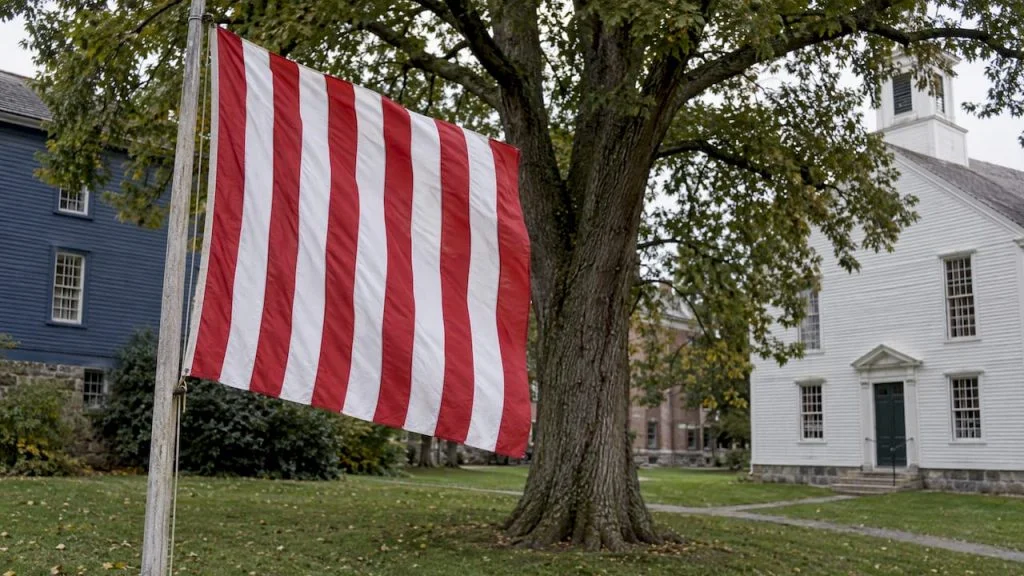
The Sons of Liberty flag is a banner of nine alternating red and white vertical stripes, flown by American colonists who defied British taxation in the 1760s. Its stripes are traditionally said to stand for the nine colonies that sent delegates to the Stamp Act Congress of 1765. Historians still debate that reading, and no single “official” design was ever issued. What the flag undeniably carries is a message: free people do not accept taxation without a voice.
Ready to step back into Boston’s streets before the Revolution? Let’s walk the story from the Liberty Tree to the flagpole in your yard.
TL;DR
- The Sons of Liberty flag has nine red and white vertical stripes, known in its day as the “Rebellious Stripes.”
- It symbolized colonial protest against British taxation and the defense of American economic freedom.
- The common explanation is nine colonies at the 1765 Stamp Act Congress. Other readings exist, including a link to the number “45” and to Benjamin Franklin’s divided snake.
- It is not the same as the thirteen-stripe Continental Colors, and nothing documents that one inspired the other.
- Reproductions are sold today in cotton and nylon for display, reenactment and commemoration.
Table of Contents
- What the Sons of Liberty flag represents
- Who the Sons of Liberty were
- The Rebellious Stripes: where the name comes from
- Why nine stripes?
- Was there one official design?
- Sons of Liberty flag vs. the Continental Colors
- Why the flag matters today
- Choosing a Sons of Liberty flag
- Our perspective
- Bring the Rebellious Stripes home
- FAQ
- Sources
What the Sons of Liberty flag represents
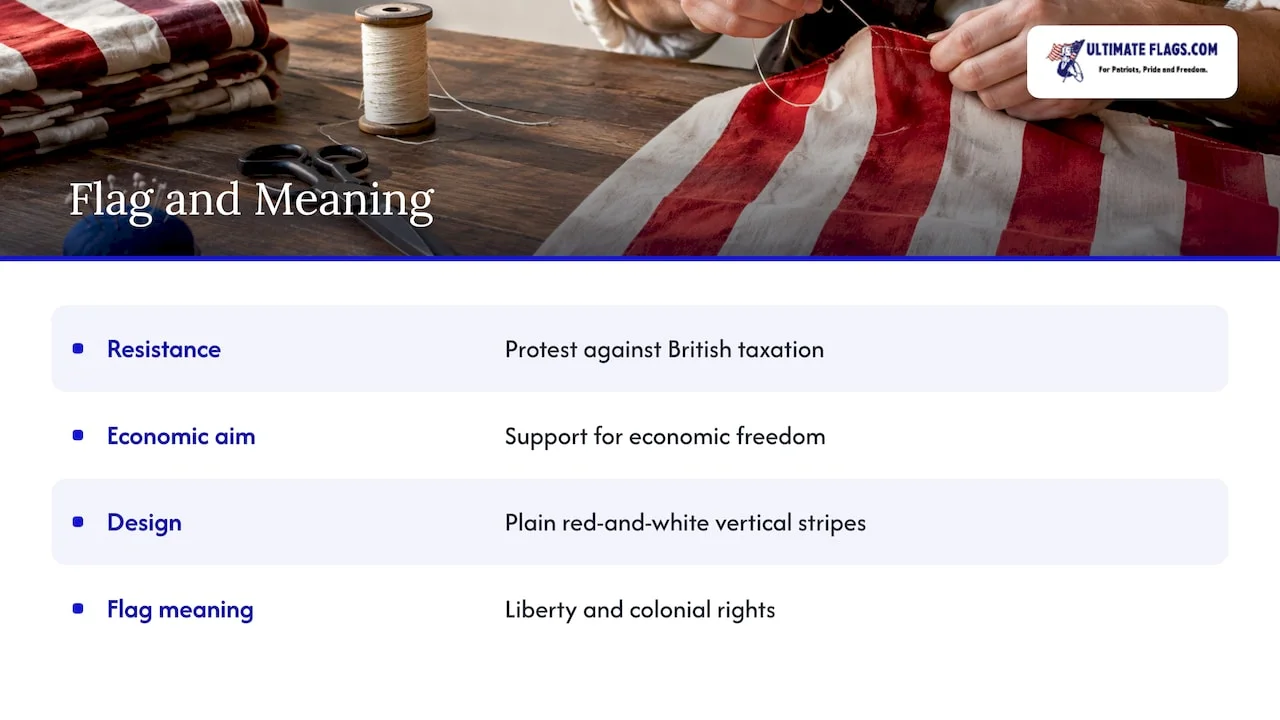
At its heart, the flag is a symbol of resistance. According to the U.S. District Court for the District of Puerto Rico’s historical account, it stood for the Sons of Liberty’s protest against British taxation and their support for American economic freedom. That single idea explains why it still resonates: it is a flag of principle rather than conquest, raised by ordinary colonists who believed that a government taxing them without their consent had overstepped its bounds.
The design is austere. There is no eagle, no canton, no star. Just stripes, red against white, in a plain vertical rhythm that reads from across a crowded square. Plain was the point. A banner that simple could be sewn quickly, hung from a pole or a tree limb, and recognized at once by friend and foe.
When people ask what the “meaning” of the Sons of Liberty is, they usually mean two things: what the group stood for, and what its flag says. The group stood for liberty and for colonial rights. The flag says the same thing without a single word.
Who the Sons of Liberty were
The American Antiquarian Society describes the Sons of Liberty as a secret organization of revolutionary-minded men, Paul Revere among them, who protested British taxation and later helped coordinate the Boston Tea Party. They were not an army, and they were not a government. They were printers, craftsmen, merchants and lawyers who organized crowds, circulated pamphlets and made imperial policy difficult to enforce.
Their gathering place became legendary. Boston’s Liberty Tree, an elm, served as a rallying point for meetings and demonstrations. Under its branches, a banner was a natural thing to raise.
Does the Sons of Liberty still exist?
The original organization belongs to the 1760s and 1770s, the years of the Stamp Act crisis and the road to the Tea Party. Today the name lives on as a historical reference and an enduring emblem of colonial defiance, and it is the legacy, not a membership roll, that people mean when they fly the flag.
The Rebellious Stripes: where the name comes from
The phrase “Rebellious Stripes” is the name given to the nine-stripe flag. The same court account says a flag of alternating red and white vertical stripes was soon produced by the Sons of Liberty in Boston and became known by that name, a banner of protest against British taxation.
The account also places a flagpole at Boston’s Liberty Tree in August 1767 and says the Rebellious Stripes was occasionally flown from it. So the picture is vivid: an elm that had witnessed the Stamp Act protests, a pole rising beside it, and a flag of red and white stripes snapping above the heads of men who refused to be quiet.
The name suits the object. “Rebellious” was an accusation the Crown hurled at the colonists, and the colonists wore it as a badge. A flag that dared to be called rebellious is a flag that has already decided which side of history it intends to stand on.
Why nine stripes?
This is the question that fills discussion boards, and the honest answer has layers.
The Stamp Act Congress explanation
The most widely repeated explanation ties the stripes to the Stamp Act Congress. The Fraunces Tavern Museum labels a Rebellious Stripes flag as adopted in 1767 and says its stripes represented delegates from the nine colonies that attended that congress in 1765.
The congress itself was a landmark. The District of Puerto Rico’s account says it met in New York in October 1765 after an invitation from James Otis, with representatives from nine colonies. Georgia, New Hampshire, North Carolina and Virginia sent none. For the first time, delegates from many colonies sat together to answer a British law with one voice, a quiet rehearsal for the unity that would come a decade later.
The “45” explanation
Not every historian accepts the colony-count theory. History.com’s 2025 account calls the flag “a bit of a mystery” and reports historian Dave Martucci’s alternative: that nine corresponds to the “45” symbol the Sons of Liberty used around the repeal of the Stamp Act. The number 45 referred to issue No. 45 of John Wilkes’s London newspaper The North Briton, which criticized the British government, and the digits 4 and 5 add up to 9.
The divided snake
Martucci has also pointed to a third possibility, linking the nine stripes to the nine segments of Benjamin Franklin’s 1754 divided-snake cartoon, whose pieces stood for colonies or regions. Each reading connects the flag to the same spirit of colonial union, which is perhaps why the nine-colony story endures even where proof is thin.
How to hold the uncertainty
The responsible way to tell the story: the nine-colony explanation is the traditional one and museums display it, but the flag’s symbolism is open to interpretation. That is no weakness. A banner that has provoked two and a half centuries of argument is a banner that still matters.
Was there one official design?
No. The Sons of Liberty were a loose, partly secret network, not a uniformed service with a regulation flag. Accounts differ on proportions, on the red and white order, and on later embellishments. This is why you will see variation among reproductions, and why a thoughtful buyer looks for a design that follows the well-known nine-stripe pattern.
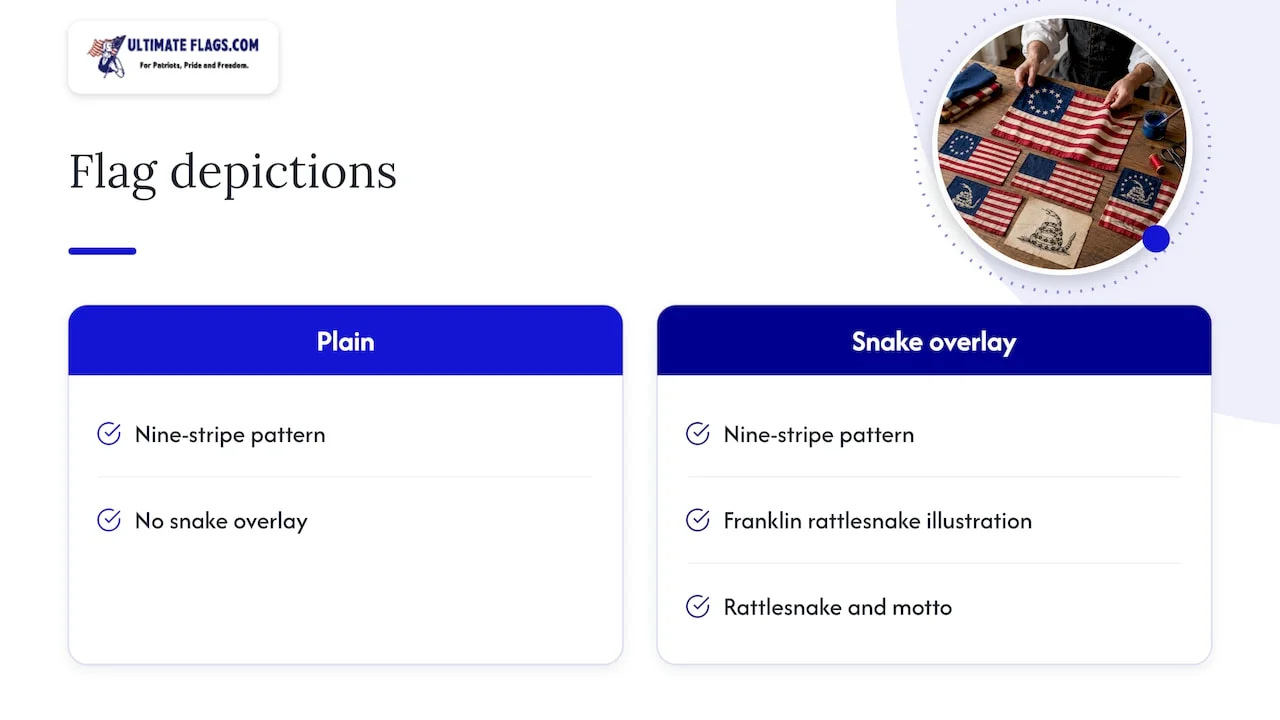
The flag is sometimes shown with a rattlesnake and motto laid over the stripes. The Fraunces Tavern Museum says the version it displays is overlaid with Benjamin Franklin’s rattlesnake illustration, and it identifies the rattlesnake as an early American-identity symbol associated with defending itself when provoked. Later books illustrated the flag this way, so you may meet both the plain striped version and the snake-bearing one.
If the snake rings a bell, it should. That coiled warning belongs to the same family of symbols as the Gadsden banner. You can read about that cousin in our history of the Gadsden flag.
Sons of Liberty flag vs. the Continental Colors
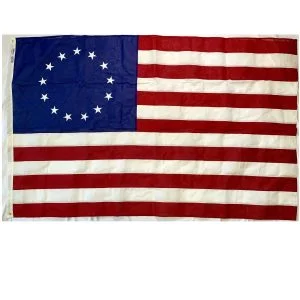
It is easy to confuse the nine vertical stripes with the thirteen red and white horizontal stripes of the Continental Colors, sometimes called the Grand Union flag. They are different flags with different jobs. A vexillology discussion of the period notes that the Continental Colors carried thirteen stripes and that no documentary evidence shows the Sons of Liberty flag inspired them.
The Library of Congress’s broader treatment of this evolution shows why the confusion arises: the stripes became a wider emblem of colonial union, not a possession of one group. The practical rule is simple.
| Feature | Sons of Liberty flag | Continental Colors |
|---|---|---|
| Stripes | Nine | Thirteen |
| Direction | Vertical | Horizontal |
| Colors | Red and white | Red and white |
| Association | Protest against British taxation | Union of the colonies |
| Canton | None | Union Jack |
Why the flag matters today
People fly the Sons of Liberty flag for many reasons: to honor the colonial resisters, to mark the Fourth of July with something beyond the familiar Stars and Stripes, or to express a conviction that citizens should hold their governments to account. It also appears in classrooms, museums and reenactment camps, where its simple stripes teach a complicated lesson about how revolutions begin.
The surviving example at the Fraunces Tavern Museum shows how reproductions travel through time. The museum records that its flag measures 75 by 50 inches, is made of nylon, and was given by Edmund Franklin Romig III in 1996 to the Sons of the Revolution in the State of New York. The object on display is itself a later interpretation, a reminder that the image has been carried forward by generations who loved it.
Choosing a Sons of Liberty flag
What you buy depends on how you will use it.
- For outdoor display: Look for a durable, fully sewn flag and pair it with a pole and hardware that suit your space. Our flag qualities and uses guide explains how materials differ.
- For reenactment or a period look: Cotton, sewn construction gives a traditional feel. We carry a 3 x 5 ft. cotton sewn Sons of Liberty flag for this purpose.
- For everyday flying: A 3 x 5 ft. standard Sons of Liberty flag is a practical choice.
- For a themed set: Our Revolutionary War flags let you build a display that tells the story of 1775 and its roots.
If you plan to hang several banners together, read displaying multiple flags on one pole or separate staffs first. For a home setup, house flagpole size and flagpole types and footing rules will save you guesswork.
Our perspective
We have sold flags for a long time, and we have noticed something about the Rebellious Stripes: people rarely ask for it casually. They ask because they want to hold a piece of the story in their hands.
Here is how we see it. The nine stripes are a lesson in how big movements begin small. Before there was a nation, there were colonists in a room, disagreeing with their government and deciding to say so together. A flag that captures that moment deserves to be made well and flown with pride.
That is why we offer the Sons of Liberty flag in more than one construction, and why we pair it with the Revolutionary War and Gadsden collections. Collectors, reenactors, teachers and patriots all come to this banner for different reasons, and we believe each of them should find a version that suits the purpose.
We also believe in telling the history honestly. The nine-colony explanation is the traditional one, and other readings exist. Knowing both makes the flag richer, not weaker, because it shows how much was at stake in the arguments of the 1760s.
John Hough
Bring the Rebellious Stripes home
Ultimate Flags is America’s oldest online flag store, with a catalog that runs from historic war banners to state, national and military flags, plus flagpoles and hardware to fly them. Whether you want a single Sons of Liberty flag or a full Revolutionary-era display, you can start with our flag collections and find the pieces that fit your wall, your pole or your reenactment kit.

Building out the rest of the display? Browse our Gadsden flags and hardware and flagpoles to complete it.
FAQ
What does the Sons of Liberty flag represent?
It represents colonial protest against British taxation and support for American economic freedom. Its nine stripes are traditionally said to stand for the nine colonies that sent delegates to the 1765 Stamp Act Congress, though other interpretations exist.
What is the Rebellious Stripes flag?
“Rebellious Stripes” is the name of the nine-stripe flag of alternating red and white vertical bars produced by the Sons of Liberty in Boston. It served as a symbol of defiance against British taxation.
What was the symbol of the Sons of Liberty?
Their best-known symbols were the Liberty Tree, where they gathered in Boston, and the nine-stripe flag flown from a liberty pole. Later illustrations sometimes added a rattlesnake and motto to the stripes.
Does the Sons of Liberty still exist?
The original organization was a product of the 1760s and 1770s, including the Stamp Act protests and the Boston Tea Party. Today the name is used as a historical reference, and the flag keeps that legacy visible.
Is the Sons of Liberty flag the same as the first American flag?
No. The Sons of Liberty flag has nine vertical stripes, while the Continental Colors had thirteen horizontal stripes and a Union Jack canton. No documentary evidence shows that one inspired the other.
Sources
- “The Rebellious Stripes” of the “Sons of Liberty”, U.S. District Court for the District of Puerto Rico
- Exhibition Labels, Fraunces Tavern Museum
- 8 Revolutionary War Flags Flown Before the Stars and Stripes, History.com
- Revolutionary Revere, Beyond Midnight, American Antiquarian Society