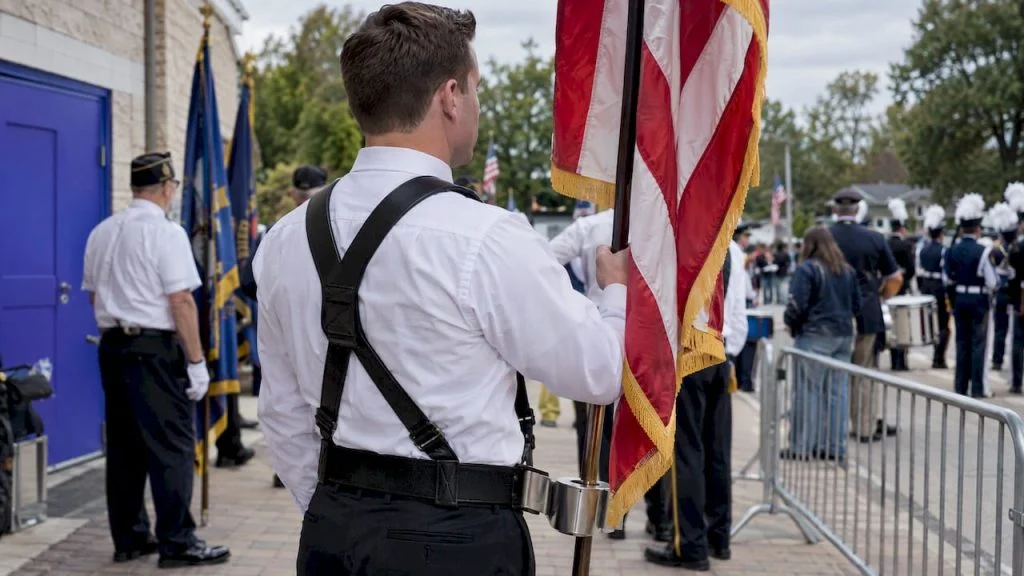
A parade flag harness is a belt or sling with a socket, or cup, that holds the foot of your flagstaff so your arms steer the flag instead of bearing its weight. For a short route, a single strap belt will do. For a long march, a color guard, or a heavy staff, a double strap harness that crosses the shoulders carries the load better. Whichever you choose, the cup must fit your pole’s diameter, and it must sit low enough that the flag rides at the right height.
A flag on a staff is a small act of reverence set in motion. It deserves to be carried upright, steadily, and without the quiet struggle of a tired wrist. This guide walks you through the types of carriers, the fit checks that matter, how to adjust the rig, and how to pair it with the right pole.
TL;DR
- A harness (also called a sling) holds the staff’s lower end in a socket, so the weight rests on your body, not your hands.
- Single strap belts suit short parades; double strap harnesses spread weight across both shoulders for long routes.
- Match the cup to your pole: measure the pole’s diameter at the foot, and check the cup’s stated maximum before you buy.
- Adjust so the socket sits below the waist and the finial height matches the rest of your color guard.
- Pick a pole of a practical length, and a flag size that suits the route.
Table of Contents
- What a Parade Flag Harness Is, and How It Differs From a Belt
- Single Strap or Double Strap: Which Do You Need?
- Materials and Design Features to Look For
- Fitting the Harness to Your Pole
- How to Wear and Adjust the Harness
- Choosing Poles for Parade and Color Guard Use
- Comfort Habits for a Long Route
- Perspective
- Equip Your Parade Unit
- FAQ
- Sources
What a Parade Flag Harness Is, and How It Differs From a Belt
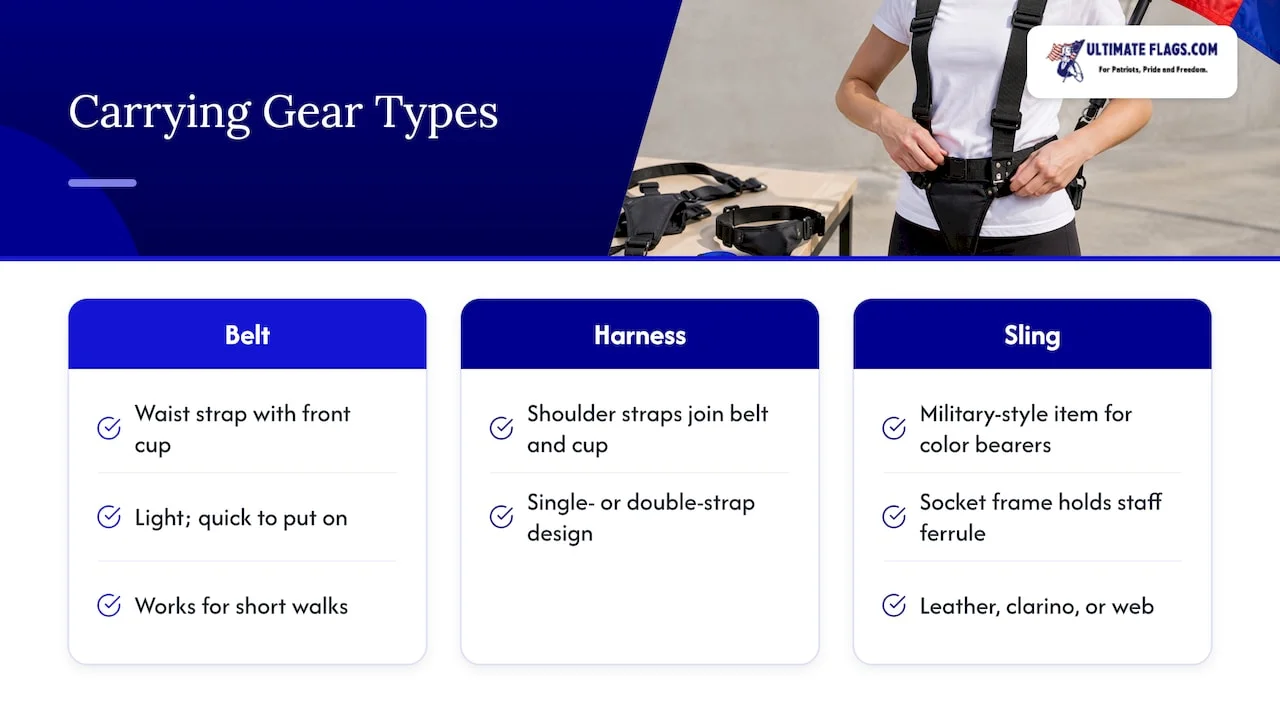
The words overlap, and sellers use them loosely. In practice, there are three common pieces of carrying gear.
The carrying belt. A single strap worn around the waist, with a cup mounted at the front. It is light, quick to put on, and fine for a short walk.
The single or double strap harness. Straps run over one or both shoulders and join to a belt and cup. The U.S. Army’s color guard guidance describes the carrier as a single or double leather or web strapped harness with a brass-colored or chrome cup, quoting Training Circular 3-21.5.
The sling. In military drill, the colors harness is often called a sling. It is a uniform item for a color bearer and comes in leather, clarino (a high-gloss synthetic leather), and web. The socket frame is a leather and metal rectangle holding a metal socket with a small hole in the bottom, through which the lower ferrule of the staff protrudes.
So a belt is the simplest form, and a harness is a belt with shoulder straps. When people search for a color guard flag harness, they usually mean the military-style sling with a cup.
Single Strap or Double Strap: Which Do You Need?
The decision comes down to how long you will carry and how heavy the rig is.
When a single strap or belt is enough
If your parades are short, a belt or neck-style holder is perfectly workable. A scout leader discussing the question in a community thread put it plainly: a full harness is best if you routinely march longer parades, while a lighter holder is fine for short ones. Think of a Fourth of July block walk, a school procession, or a ceremony at a memorial.
When a double strap harness earns its place
A long route, a large flag, a windy day, or a full color guard calls for a double strap harness. The Marine Corps manual notes that leather color slings and harnesses help distribute the staffs’ weight during extended standing. A web double sling does the same with two adjustable straps that cross over the shoulders, spreading the weight evenly and keeping the carry comfortable through lengthy parades.
| Factor | Single strap belt | Double strap harness |
|---|---|---|
| Best for | Short parades, quick ceremonies | Long routes, color guards, heavier flags |
| Weight carried by | Hips and waist | Shoulders and hips together |
| Setup time | Fast | A little longer |
| Stability in wind | Adequate | Steadier |
| Typical users | Scout units, school groups | Veterans’ honor guards, marching units |
Materials and Design Features to Look For
The three common materials each have a character.
- Leather. Traditional, formal, and firm. It can be adjusted with pre-punched holes for the buckles, and the DrillMaster notes it is highly recommended to buy a leather hole punch so you can add more holes for a precise fit.
- Web (nylon or cotton). Light, easy to clean, and common in white for dress uniforms. The Army guidance lists white, black, or olive drab as acceptable carrier colors.
- Clarino or synthetic leather. The look of polished leather with easier upkeep, used in drill and ceremonial settings.
Beyond the strap, inspect these details:
- The cup. It should be sturdy, with a smooth interior so the pole’s foot does not bind. Brass-colored or chrome finishes both appear in military guidance.
- The buckles. Metal buckles hold an adjustment better than light plastic clips over hours of marching.
- The shield or front plate. A broader front panel spreads pressure on the stomach and hips.
- Adjustability. More holes and longer straps mean the rig will fit over a heavy coat in November and a thin shirt in July.
Prices vary widely with material, hardware and construction, from simple webbed belts to leather harnesses with a shield. Compare the strap width, the cup material and the stated pole range rather than the price alone, and check each maker’s current listing.
Fitting the Harness to Your Pole
This is the check that most buyers skip, and it is the one that decides whether the carry feels secure.
Measure the foot of the pole
Use calipers or a flexible tape wrapped around the pole near the ferrule, then divide the circumference by 3.14 to get the diameter. Measure where the pole will actually sit in the cup, because some staffs taper or have a metal tip that is wider or narrower than the shaft.
Read the cup’s stated range
Carriers list the largest pole they accept. One equestrian flag carrier, for example, is made for poles up to 1-1/8 inches in diameter, and many parade waist carriers are designed around poles of about one inch to one and a quarter inches. A pole thicker than the cup allows will not seat, and a pole much thinner will wobble and tilt.
Test the seat, not just the size
The lower ferrule should drop into the socket and rest there without wedging or rattling. If the cup has a small hole in the bottom, as military sockets do, the ferrule should be able to protrude through it. Rest the staff in the cup at home and tilt it left and right. It should pivot freely without the pole’s end slipping out.
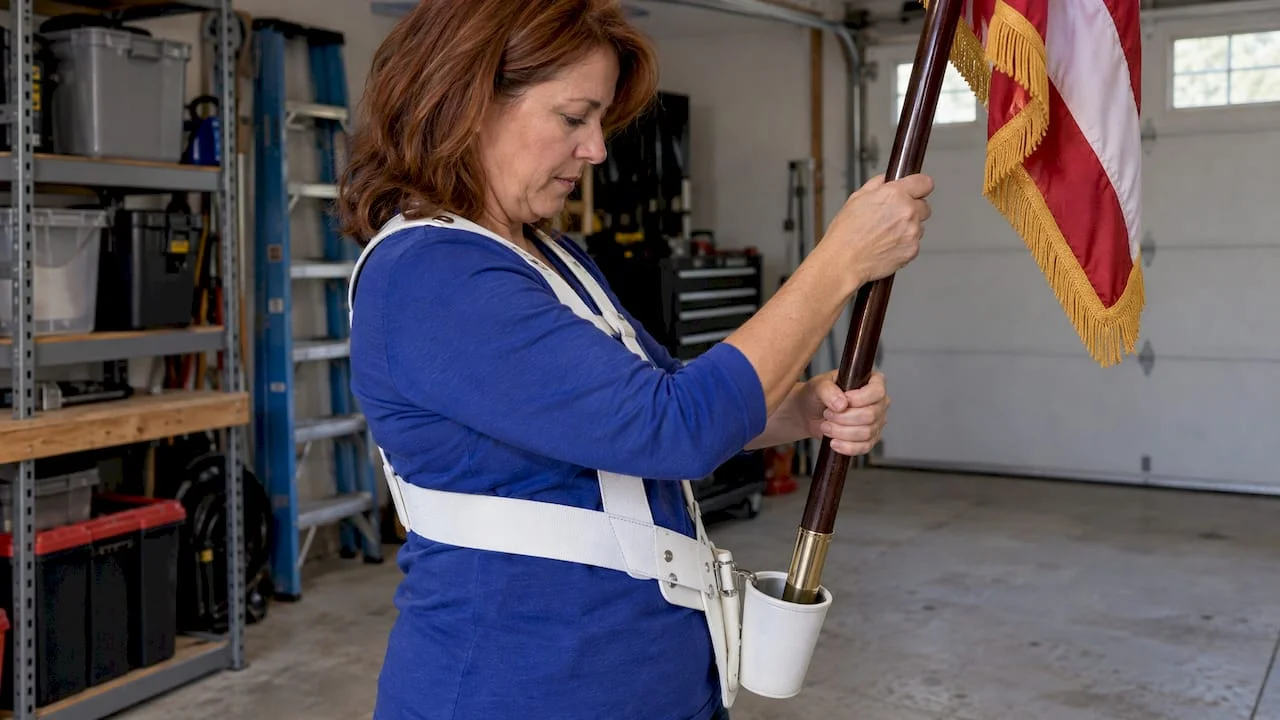
If a harness is slightly large for a thin pole, a wrapped layer of tape on the pole’s lower foot can take up the gap. Leave the hardware itself unmodified.
How to Wear and Adjust the Harness
A correct setup takes five minutes and saves an afternoon of fatigue.
- Put the belt on first. Settle it snugly at the waist so it will not slide when the staff leans.
- Set the cup height. The DrillMaster states the adjustable limits of the harness frame run from just above the crotch to just below it, barely touching the belt. Army guidance, quoted there, says the socket is below the waist and adjusted so the finials of all colors are of equal height.
- Adjust the shoulder straps. On a double strap harness, even tension on both sides keeps the cup centered and the pole vertical.
- Check against your team. The Marine Corps manual says that slings are adjusted so the colors are the same height at the carry, or, if that is impossible, the national colors are slightly higher than the organizational colors.
- Secure it. Marine color bearers wear the pistol belt over the sling to keep the sling firmly in place. Civilian groups can borrow the idea with a second belt over the harness.
- Recheck before every event. Guards should double-check socket levels before practices and performances, and adjust as needed.
A standard Marine color guard has four members of approximately equal height, which makes matching finial heights easier. If your group has mixed heights, adjusting each harness takes more care, and it is worth doing at rehearsal rather than at the staging area.
Choosing Poles for Parade and Color Guard Use
The harness and the pole are a pair. A superb carrier cannot rescue a pole that is too long, too heavy or poorly finished.
Length. The Canadian government’s flag protocol guide suggests that the pole or pike used to carry flags be 7 to 8 feet long, about 2.1 to 2.4 meters. That is guidance from Canada, but the proportion is a sensible starting point for American marching units too: tall enough to display the flag clear of heads, short enough to pass under banners and wires.
Diameter. Match the foot to your cup, as covered above.
Material. Wood is traditional and warm; metal is durable and consistent in weight. For a long route, a lighter pole with a good ferrule reduces strain.
Finial and hardware. A secure finial, a smooth ferrule, and a reliable joint if the pole is two-piece all matter once the wind picks up.
Flag size. A larger flag catches more wind. Our guide to choosing 3’x5’ or 4’x6’ for the route explains how the flag size changes the load on your harness. For carrying etiquette, see how to carry and honor Old Glory in a parade.
If you are choosing hardware as well, our flagpoles and hardware collection is the place to browse, and our note on which attachment fits your pole helps you match the flag to the staff.
Comfort Habits for a Long Route
Gear helps, but technique keeps you steady for the full mile.
- Break in leather early. Wear a new leather harness around the house with a loaded pole before parade day.
- Keep the pole vertical. Let the cup take the weight and use your hands only to guide.
- Wear padding where straps cross. A flat collar or thin uniform layer prevents chafing.
- Carry a spare buckle hole plan. A punch and a pencil mark let you fine-tune on the spot.
- Practice in wind. A breezy practice teaches you how the flag pulls, so the route holds no surprises.
This matters beyond comfort. A flag carried well tells the crowd that someone has taken care, and the people who walk behind it feel that care.
Perspective
We have spent years helping Americans find the right flag for the right moment, and the pattern is always the same: people think about the cloth first and the carry last. That is backwards. A flag is a story told in motion, and the way it travels down a street is part of the telling.
When a color guard steps off, the flags should rise together, the finials level, the staffs plumb. That unity does not happen by luck. It comes from poles chosen with care, flags sized for the route, and carriers set to the same height by people who rehearsed.
Our catalog of USA flags, state flags, military and service flags, historic war flags and flagpoles and hardware exists to equip exactly that moment. Whether you march for a veterans’ post, a historical reenactment unit, a political rally or a hometown holiday, we believe the flag deserves a steady bearer, and the bearer deserves gear that does not fight back.
Start with the pole, size the flag to the road, fit the carrier to the staff, and walk proud.
John Hough
Equip Your Parade Unit
Ready to pick the flag that will lead your march? Ultimate Flags, America’s oldest online flag store, carries USA flags, state flags, military and service flags, historic war flags and flagpoles and hardware for parades, reenactments and ceremonies.

Browse the full flag collections to find your colors, then pair them with a pole from our hardware and flag poles page. Marching with a historic unit? Our Civil War flag meanings guide and historic war flags will help you choose with authority.
FAQ
Do I need a harness, or can I carry the flag by hand?
For a very short walk you can carry a flag by hand, but a harness takes the weight off your wrists and keeps the pole upright. For a long parade, a heavy staff or a windy day, a harness is the better choice. Many marching units treat it as standard gear.
How do I know if a harness cup fits my flagpole?
Measure the pole’s diameter at the foot, then compare it with the cup’s stated maximum pole size. The ferrule should drop in without wedging and pivot freely. Many carriers are rated for poles of roughly one inch to one and a quarter inches, but always read the listing for the exact range.
What height should the socket sit at?
Military guidance places the socket below the waist and adjusts it so every flag’s finial is at the same height. Within that range, set the cup just above to just below the crotch line, close to the belt, then match the height to your teammates at rehearsal.
What length pole works best for parades?
Canadian government guidance suggests a pole or pike of 7 to 8 feet for carrying flags. In the United States, many units use a similar range. Choose the length that clears heads and overhead obstacles on your route while keeping the flag visible.
Is a leather or web harness better?
Leather offers a formal look and firm support, and it can be punched for fine adjustment. Web is lighter and easier to clean, and it is common in white for dress uniforms. Choose by the occasion, the uniform and the length of your route.
Sources
- The DrillMaster: Why We Carry Flagstaffs at the Same Level
- The DrillMaster: The Why of the Military Color Guard, US Army
- Marine Corps Drill and Ceremonies Manual (MCO P5060.20), 2025
- MCO 5060.20 Marine Corps Drill and Ceremonies Manual overview
- Government of Canada: flag protocol publication, 2001
- Parade flag holders discussion on r/BSA
- Flag carrier product specification for poles up to 1-1/8 inches