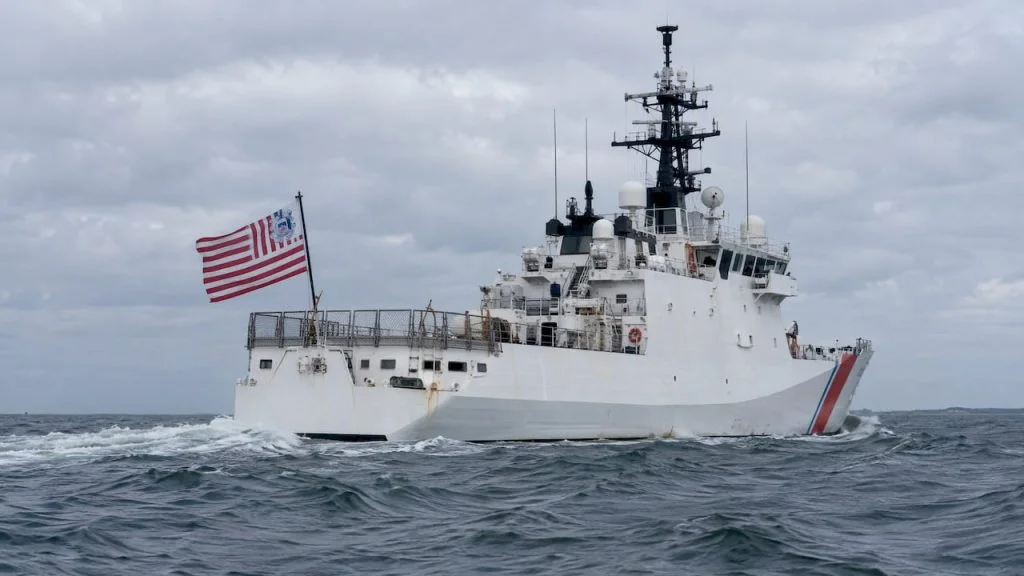
The Coast Guard ensign is a flag of sixteen vertical red and white stripes, with a white canton bearing the dark blue Coat of Arms of the United States and the blue and white Coast Guard emblem over the stripes. It has flown since 1799, making it one of the oldest distinctive flags in American service. It is the sign of the Coast Guard’s authority to stop, board and inspect vessels. Below, we walk through its design, its symbolism, its history and the rules for flying it.
TL;DR
- The ensign has sixteen vertical stripes, alternating red and white, beginning with red at the hoist. A white canton holds the dark blue Coat of Arms, and the Coast Guard emblem sits over the seventh red stripe.
- It was adopted on August 1, 1799, to set revenue cutters apart from merchant ships and to dispel fears that they were pirates.
- It is a mark of law enforcement authority, flown when a cutter boards, stops or seizes a vessel and customarily kept aloft on afloat assets.
- It is never half-masted, and it is not the same flag as the Coast Guard standard or the Auxiliary patrol ensign.
- Federal law restricts official use of the ensign itself, so know the rules before you display or reproduce it.
Table of Contents
- What the Coast Guard ensign looks like
- What the stripes, colors and symbols mean
- How the ensign began in 1799
- How the design has changed
- When and where the ensign is flown
- Ensign, standard, racing stripe and Auxiliary flag
- Official use and display: what to know
- Our perspective: why this flag deserves a place in the story of American flags
- Honoring the Coast Guard with a flag of your own
- Displaying Coast Guard flags with other flags
- FAQ
- Sources
What the Coast Guard ensign looks like
Picture a ship’s flag unlike any other in the American fleet. Where the national ensign carries stars and horizontal stripes, the Coast Guard’s flag runs in vertical bars, a deliberate break from the ordinary that a captain could recognize across open water.
The federal regulation that defines it, 33 CFR 23.15, gives the specification precisely:
- Stripes: sixteen perpendicular stripes, alternately red and white, beginning with red at the hoist (the edge nearest the pole).
- Union: in the upper quarter next to the hoist, the Coat of Arms of the United States in dark blue on a white field. It is half the length of the flag and extends down the hoist halfway.
- Emblem: the distinctive Coast Guard emblem in blue and white, centered on a line with the lower edge of the union and over the center of the seventh vertical red stripe from the hoist. It covers a horizontal space of three stripes.
The emblem itself is defined in 33 CFR 23.10. It is the shield of the Coat of Arms of the United States, circled by an annulet inscribed “UNITED STATES COAST GUARD 1790,” all in front of two crossed anchors. In full color, the anchors and ring are white, outlined in Coast Guard blue, and the shield has a blue chief above thirteen alternating white and red stripes: seven white and six red.
That date, 1790, is worth pausing on. It marks the founding of the Revenue Marine, the ancestor of today’s Coast Guard, nine years before the ensign itself was prescribed.
What the stripes, colors and symbols mean
Every element of this flag was chosen with intent, and the Coast Guard’s own history office records the symbolism in its Traditions document.
The sixteen stripes
The sixteen vertical stripes represent the number of states in the Union when the flag was adopted in 1799. It is a snapshot of a young republic, still finding its footing on the sea, with a customs fleet charged with collecting the revenue that kept the new government alive.
The colors
According to the same document, the colors carry their own meaning:
- Red stands for youth and the sacrifice of blood for liberty’s sake.
- Blue stands for justice and the covenant against oppression.
- White symbolizes the desire for light and purity.
The canton
The canton holds thirteen stars, thirteen leaves on the olive branch, thirteen arrows and thirteen bars on the shield. Each thirteen speaks for the original states that formed the nation. The olive branch and arrows, held in the eagle’s talons, have long been read as the twin readiness for peace and for defense, a fitting pairing for a service that rescues sailors in one hour and enforces the law in the next.
The emblem and the crossed anchors
The crossed anchors are the old sign of the sea service. Laid over the stripes, with the founding year of 1790 circling the shield, they tie the flag to the very first days of American maritime enforcement.
How the ensign began in 1799
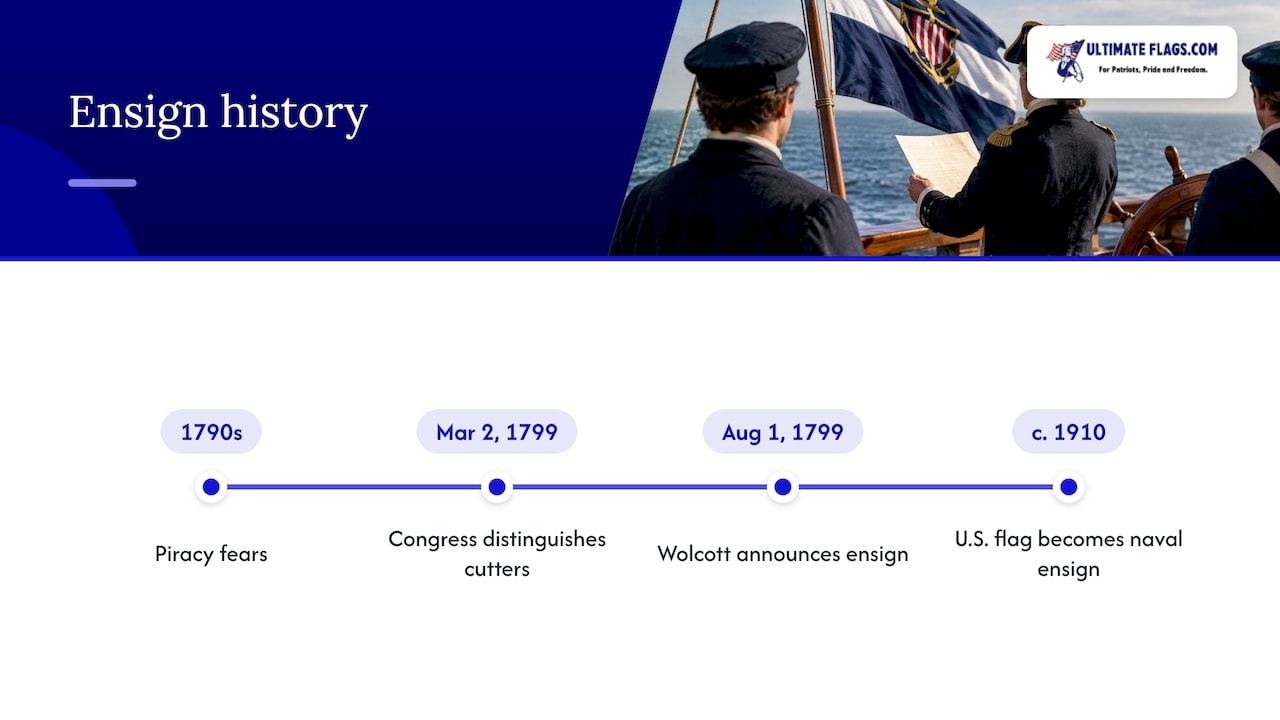
The story begins with a problem of trust. In the 1790s, revenue cutters patrolled American waters and stopped merchant vessels to inspect cargo. To a merchant captain, an armed vessel hailing him without any clear mark of authority could look like a pirate.
The U.S. Coast Guard History Center traces the answer. Congress passed the Customs Administration Act on March 2, 1799. Its Section 102 said that the cutters and boats employed in the revenue service would be distinguished from other vessels by an ensign and pendant, with marks prescribed by the President. The act also authorized revenue cutters flying the ensign to fire on any vessel that failed to stop when ordered.
On August 1, 1799, Treasury Secretary Oliver Wolcott issued the order, acting under authority from President John Adams, announcing the distinguishing ensign and pennant. The flag was designed to distinguish revenue cutters from merchant ships and to dispel fears that they were pirates.
In those early years the revenue ensign did something unusual. As Military.com’s history of Coast Guard flags explains, it flew in place of the national flag while in American waters. Around the time of a 1910 executive order by President Taft, cutters began flying the U.S. flag as their naval ensign, and the revenue ensign became the Service’s distinctive flag.
How the design has changed
The ensign has proven remarkably steady. The History Center’s account lists the major changes:
| Year | Change |
|---|---|
| 1799 | Ensign and pennant prescribed for revenue cutters |
| 1910 | Revenue Cutter Service emblem added by Taft executive order, to distinguish it from the customs house ensign |
| 1927 | The badge changed |
| 1957 | Coat of arms corrected to conform to the 1782 design |
| 1967 | Visual Identification System introduced the Racing Stripe and a simplified emblem, adopted in 33 CFR 23.15 on April 17, 1967 |
Over more than two centuries, the vertical stripes and the dark blue arms have held. That continuity is much of the flag’s power: a sailor of 1799 would know the cloth at once.
When and where the ensign is flown
The ensign is a working flag first and a symbol second. Per the History Center, it is required whenever a Coast Guard vessel takes active measures in connection with boarding, examining, seizing, stopping or heaving to a vessel in order to enforce U.S. law. The regulation behind it, 33 CFR 23.05, calls it a mark of authority and says the distinctive markings of Coast Guard aircraft serve the same purpose.
The customs of display are specific:
- It is customarily displayed on afloat assets at all times, underway or not.
- It flies from the highest part of a cutter’s mast, or the top of the foremast if there is more than one mast.
- When a cutter is dressed for holidays or ceremonies, the ensign moves to the starboard yardarm to make room for the U.S. ensign.
- Shore units are not required to fly it. If they do, it is hoisted below the U.S. ensign.
- It flies with the U.S. ensign from 8:00 a.m. to sunset.
- It is never half-masted.
That last point says something. Even in mourning, the sign of lawful authority on the water does not come down to half-staff.
Ensign, standard, racing stripe and Auxiliary flag
Flag searches around the Coast Guard bring up several similar terms. Here is how they sort out.
The ensign and the standard
The Coast Guard has two official flags: the Coast Guard standard and the Coast Guard ensign, as the USO’s rundown of Coast Guard facts notes. The ensign is the striped flag described above. The standard is the ceremonial flag of the service. If you are looking for a flag to carry in a parade or place in an office, the standard is the one made for that purpose, while the ensign belongs to the vessel and its enforcement authority.
The racing stripe
The racing stripe is not a flag but a hull marking. Defined in 33 CFR 23.12, it is a broad diagonal red stripe followed by two narrow stripes, first white and then blue, with the Coast Guard emblem centered in the red band. It was adopted in 1967 as the trademark red slash that appears on Coast Guard vessels and aircraft.
The Auxiliary patrol ensign
The Coast Guard Auxiliary has its own flag. Under 33 CFR 5.46 and 5.47, the Auxiliary patrol ensign has a white field with a medium blue Auxiliary emblem centered on a broad red diagonal slash, followed by two narrow parallel stripes of white and then blue. Vessels accepted as facilities display it on patrol. If a Coast Guard commissioned, warrant or non-commissioned officer is aboard, the Coast Guard ensign is displayed in its place.
The national ensign
Most American vessels fly the national flag as their ensign. Coast Guard vessels are the notable exception, adding their own distinctive flag as the sign of their lawful power to stop and board.
Official use and display: what to know
Because the ensign marks law enforcement authority, the law treats it seriously. The Coast Guard’s trademark and licensing page states that the ensign is restricted to official use under 14 USC 638. It also separates three things that people often blur together: the Coast Guard mark, which can be licensed for commercial use, the seal, which is for official use only and not to be reproduced outside the Service, and the ensign.
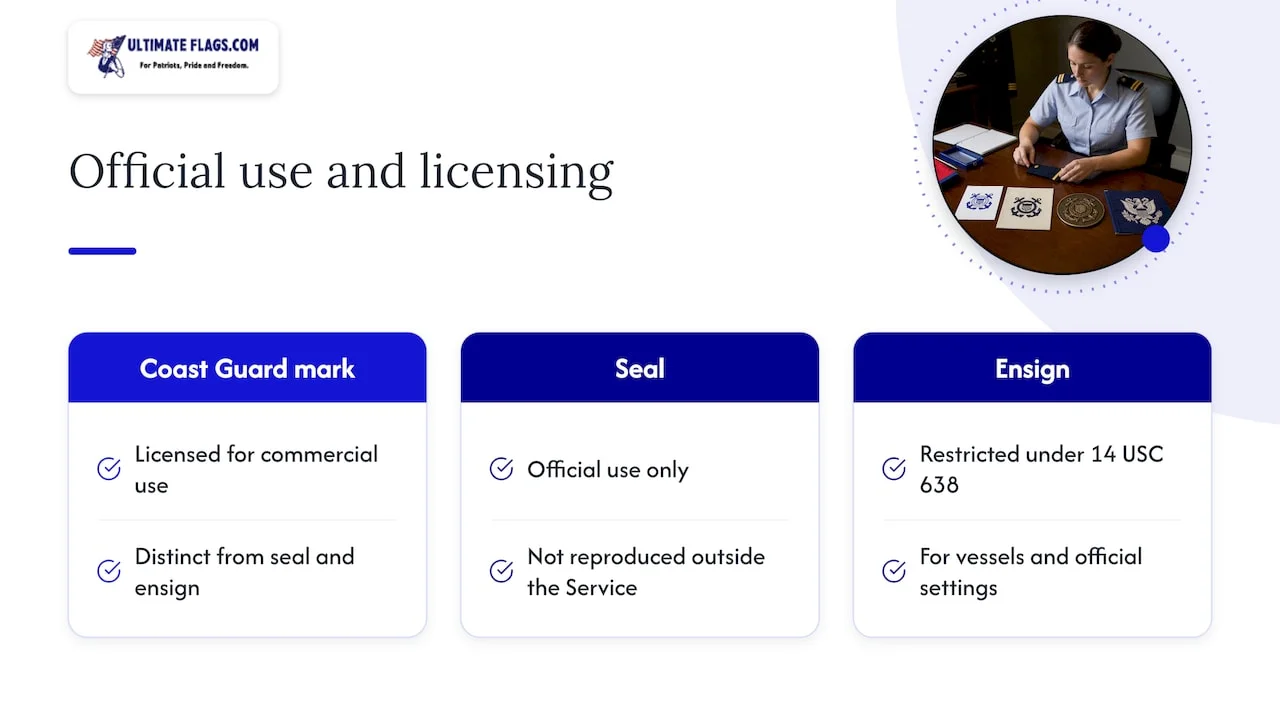
In practice, that means the ensign belongs on Coast Guard vessels and in official settings. If you are a veteran, a family member, a collector or a history lover who wants a Coast Guard flag to honor service, take a moment to review that page and the Service’s guidance before using any flag or design in a way that could be mistaken for official use, such as on a boat underway or in commercial products. Questions about a particular use are best put to the Coast Guard’s trademark office through that page.
Our perspective: why this flag deserves a place in the story of American flags
We have spent years telling the stories of history through flags, and few banners say as much with so few words as this one. Sixteen stripes, a shield, two anchors, a date: 1790. There is no slogan on it, and none is needed.
What moves us is the reason it exists. A young nation sent small, armed vessels out to collect the revenue that kept the republic solvent, and the ensign was how the government told every captain that the vessel hailing him spoke with lawful authority. Over two centuries that same cloth has come to stand with the people who pull sailors from the water and who guard our ports and shores.
That is why we carry Coast Guard flags alongside our military, service-honoring and historic collections. A flag like this is not decoration for its own sake. It is a way for a veteran, a coastie’s family, a maritime history enthusiast or a collector to say that this service, and its long blue line, matters.
If you want to honor the Coast Guard, learn what each flag means, display it with the respect the tradition demands, and choose a flag built to last in wind and weather.
John Hough
Honoring the Coast Guard with a flag of your own
For many of our customers, the draw is personal: a father who served, a daughter at the Academy, a love of the sea. We offer a dedicated selection of Coast Guard flags, and individual listings such as the 3 x 5 ft. standard Coast Guard flag, a heavy duty outdoor version and a double sided nylon embroidered flag for those who want a different finish.

If you are building a display, our hardware and flag poles cover the mounting side, and our guide to flag qualities and uses helps you match a flag to indoor, outdoor or ceremonial display. Serving family members of other branches? Browse our Marine Corps flags and Merchant Marine flags, or see everything in our full flag collections.
Displaying Coast Guard flags with other flags
Most home and office displays pair a Coast Guard flag with the Stars and Stripes. The principle in the Service’s own custom is a good guide: the U.S. flag holds the place of honor, and the Coast Guard flag, when flown at a shore location, goes below it. Our guide on displaying multiple flags walks through one pole versus separate staffs.
If you boat, note that flag rules afloat have their own traditions. Our article on yacht ensign rules for U.S. boaters covers how recreational vessels fly their colors. Remember that the Coast Guard ensign itself is not a flag for a private boat.
FAQ
What does the Coast Guard ensign symbolize?
The sixteen stripes stand for the number of states in the Union in 1799, and the thirteen stars, arrow points, olive leaves and shield bars in the canton stand for the original thirteen states. Red is tied to youth and sacrifice for liberty, blue to justice, and white to the desire for light and purity. Together they mark a vessel with lawful authority to stop and board.
When was the Coast Guard ensign adopted?
Treasury Secretary Oliver Wolcott announced it on August 1, 1799, under authority from President John Adams and following the Customs Administration Act of March 2, 1799. It was created so revenue cutters could be told apart from merchant ships and not mistaken for pirates. The racing stripe and simplified emblem were added in 1967.
Is the Coast Guard ensign the same as the Coast Guard flag?
The Coast Guard has two official flags: the standard and the ensign. People searching for a Coast Guard flag may mean either. The ensign is the striped flag with the Coat of Arms canton, flown as the sign of law enforcement authority. The standard is the service’s ceremonial flag.
Is the ensign ever flown at half-staff?
No. According to the Coast Guard History Center, the ensign is never half-masted. It flies with the U.S. ensign from 8:00 a.m. to sunset, and when a cutter is dressed for ceremonies it moves to the starboard yardarm to make room for the national flag.
Can civilians fly the Coast Guard ensign?
The ensign is restricted to official use under 14 USC 638, according to the Coast Guard’s trademark page. Civilians who want to show support can display Coast Guard flags on land in a respectful way, and should check the Service’s guidance for anything beyond personal display.
Sources
- 33 CFR 23.15, Coast Guard ensign (eCFR)
- 33 CFR 23.10, Coast Guard emblem (eCFR)
- Coast Guard Traditions (U.S. Coast Guard History Program)
- The Long Blue Line: The Ensign, Coast Guard’s brand identity since 1799
- History of Coast Guard Flags (Military.com)
- 33 CFR 23.12, Coast Guard identifying insignia
- 25 Coast Guard Facts for 225 Years (USO)
- 33 CFR Parts 5 and 6, Auxiliary patrol ensign (GovInfo)
- U.S. Coast Guard Trademark and Licensing Program