Collectors buy WWII German military flags because the category sits where three things meet: a short, well-documented 1935-1945 design history, a battlefield record that spans Europe and the Atlantic, and bold graphic layouts that flag historians still study. Most pieces that change hands in 2026 are modern reproductions made for reenactors, museums and display cases, not wartime originals — so the real buying questions are about pattern accuracy, fabric and the legal lines around display, not politics.
- WWII German military flags cover 1935-1945 designs, from war ensigns to unit colors.
- Collectors pursue them for battlefield history, design study, reenactment and museum-style display.
- The swastika flag became Germany’s sole national flag on September 15, 1935.
- Nearly everything sold today is a modern reproduction, not a wartime original.
- Owning one is legal in the United States; Germany bans public display under Section 86a.

Why do collectors buy WWII German military flags?
The short answer: these flags document a ten-year slice of history that collectors of militaria, reenactors and museums cannot get any other way. Between 1935 and 1945 Germany flew one of the most tightly standardized flag systems ever put into regulation — a national flag, a war ensign, naval jacks and unit colors, each with defined patterns, proportions and dates of introduction. A collector who wants a display wall to read as history, not decoration, reaches for flags that can be dated, explained and sourced. WWII German designs do all three.
The interest is historical, not ideological. Serious collectors treat these flags the way armor collectors treat helmets: as artifacts of a documented period, handled with context and without celebration. Museums such as the Imperial War Museum and the National WWII Museum display original German flags behind glass with exactly that framing — dates, units and provenance — and private collectors largely follow the same practice.
1. Battlefield history you can hold
German war flags flew over every major naval and land engagement of the European theater, from the Atlantic convoy battles to the fall of Berlin. Because the designs changed mid-war, a flag can be pinned to a window of time: the 1935 pattern of the Kriegsmarine war flag differs visibly from the revised 1938 pattern, which lets a knowledgeable collector date a piece at a glance. That built-in chronology is a big part of the appeal — the object itself carries its own timeline.
2. Design and vexillology
Flag historians study WWII German designs because they are disciplined examples of state vexillology: strict proportions, regulated shades and specific placement rules for the Iron Cross and the off-center swastika disk. The straight-armed Balkenkreuz cross that marked German aircraft and vehicles from 1935 onward became one of the most recognized military markings of the twentieth century. Whether one admires the era or not, the designs are part of the reference canon that modern flag standards are measured against, and collectors of design history want the objects, not just the drawings.
3. Reenactment, film and museum work
Living-history units, documentary producers and theater costume shops all buy these flags by size and pattern. A 3 x 5 ft reproduction is the workhorse: big enough to read at a distance, small enough to stage indoors, and light enough to fly from a portable pole. Educational displays and classroom history units use the same sizes for the same reasons, which is why the 3 x 5 ft standard dominates reproduction sales in 2026.
4. Documentation and teaching
A growing share of buyers are teachers, librarians and museum volunteers building history displays that need the real object rather than a photograph. For them the flag is a primary-source stand-in: a labeled reproduction, displayed with dates and explanatory text, does the same educational work as an artifact that exists only in a handful of institutional vaults.

The flags collectors actually look for
The category is narrower than most people expect. Germany regulated each design by law, so the collector’s checklist is short and every entry has a fixed definition:
| Flag | Era | Design notes | Who collects it |
|---|---|---|---|
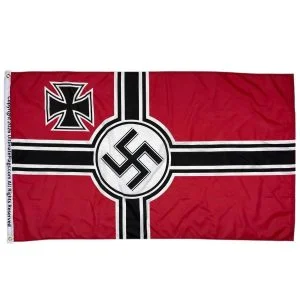
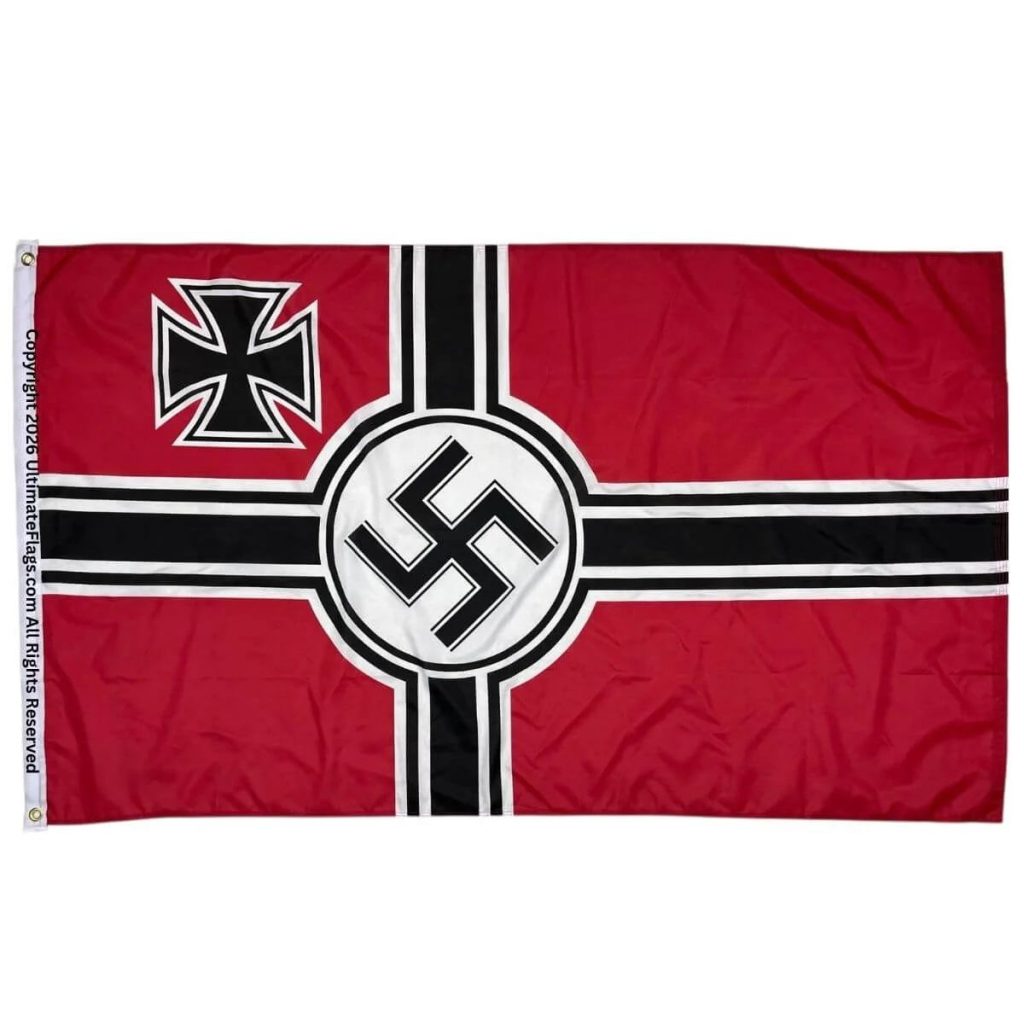
| Kriegsmarine war flag (Kriegsflagge) | 1935-1945 | Red field, black Iron Cross in the canton, swastika disk; revised pattern introduced in 1938 | Naval historians, reenactors, film props |
| National war flag (Heer pattern) | 1935-1945 | Army variant of the war ensign with the same regulated layout | Land-forces collectors |
| National flag with centered swastika | 1935-1945 | Civil national flag: black swastika on a white disk, centered on red | General historical displays |
| Reich service and official flags | 1933-1945 | Government and organizational flags flown alongside the national flag | Specialist institutional collectors |
| Imperial German war flag (WWI) | 1871-1918 lineage | Black-white-red with iron cross; collected alongside WWII pieces for contrast | WWI-era militaria collectors |
Notice what sits at the top of the list: the naval war ensign, not the plain national flag. The war flags carry the most specific historical content — dates, patterns and service branches — which is exactly what a display needs to make its point.
Originals versus reproductions
This is the single most important distinction in the category. Original wartime flags survive mainly in museums and specialist collections; documented pieces sell at militaria auctions for prices that put them far beyond a display budget, and the open market carries a heavy share of mislabeled fakes. Everything sold openly through flag retailers in 2026 — including every flag discussed here — is a modern reproduction built to the historical pattern.
That is not a downgrade; it is the point. A reproduction is made to be displayed, staged and handled. Collectors who want an original treat that as a separate hobby with separate rules: provenance paperwork, auction-house authentication and a budget to match. Collectors who want a faithful flag for a display case buy a well-made reproduction and label it honestly.
Reproduction quality splits into two construction camps. Printed flags carry the design in flat ink and cost less; sewn and embroidered flags build the field and emblems from actual fabric panels, closer to how the originals were made. A sewn cotton reproduction with embroidered details hangs with the weight and matte finish of a period piece, which is why collectors and reenactors gravitate to it for display work.

The law: owning, selling and displaying
The legal picture is the part every buyer should understand before the flag ships, and it splits sharply by country.
United States. No federal law restricts owning, selling or displaying Nazi-era German flags. The First Amendment covers symbolic display, and the flags remain part of the open militaria market. The practical limits come from private rules — schools, employers and homeowners associations can still regulate what flies on their property.
Germany. Section 86a of the German criminal code bans the public display of symbols of unconstitutional organizations, including the swastika, the SS runes and the swastika-bearing war flag. Exemptions exist for art, science, research and teaching, which is how museums operate, but a private flag flown from a balcony is not exempt. Importing and exporting Nazi-symbol items into or out of Germany also runs into the same law.
Elsewhere in Europe. Austria and several other European states restrict Nazi symbols outright. France and the United Kingdom generally do not ban ownership, but public display can cross into prosecution where it amounts to incitement or harassment. The rule of thumb for a collector in 2026: own and display freely in the US, keep any public display in Europe to educational and museum contexts, and never ship a swastika-bearing flag to a country that bans it.
For the full legal walkthrough of private ownership, see our guide to whether it is legal to own a Nazi flag in the United States.
How collectors vet a reproduction before buying
A display flag only works if it reads as the historical pattern, so experienced buyers check the same five things every time:
- Pattern accuracy. The swastika disk placement, the Iron Cross layout and the proportions should match the dated regulation pattern — the 1935 and 1938 war flag variants are the benchmark most collectors measure against.
- Construction. Sewn fabric panels and embroidered emblems read as period construction; a single printed layer reads as a cheap export flag from across the room.
- Fabric. Cotton and wool give the matte, weighted hang of period flags; glossy lightweight polyester gives it away as modern.
- Size. The 3 x 5 ft format fits standard display cases and poles; larger 4 x 6 ft and 5 x 8 ft pieces suit stage and outdoor work.
- Honest labeling. A seller who calls a reproduction a reproduction is telling you how they will handle everything else. Claims of “wartime original” at retail prices are the oldest red flag in militaria.
Ultimate Flags carries the WWII German military flags discussed above as sewn and printed reproductions across multiple sizes — Shop Ultimate Flags for the current lineup and the rest of the period catalog.
Related questions collectors ask
Did Germany fly two national flags between 1933 and 1935?
Yes. After January 1933, a decree made the swastika flag a co-national flag alongside the black-red-gold Weimar tricolor, and both flew together until September 15, 1935, when the Reich Flag Law — part of the Nuremberg Laws — made the swastika flag the sole national flag. Flags from the 1933-1935 dual period are a distinct collecting niche because of that overlap.
What is the difference between the war flag and the national flag?
The national flag carried the centered swastika disk on a plain red field and served civil use. The war flag (Kriegsflagge) added the Iron Cross in the canton and a swastika disk offset toward the hoist, marking it as a military ensign for naval and armed-forces use. Two different legal designs, flown for two different purposes.
What does the Iron Cross on the war flag mean?
The Iron Cross is Germany’s military decoration symbol, in use since 1813, and on the war flag it appears in its straight-armed Balkenkreuz form. It marks the flag as a military ensign rather than a civil one — the same reason modern German military flags still carry it.
FAQ
Why do collectors buy WWII German military flags?
For battlefield history, design study, reenactment and museum-style display. The 1935-1945 flag system is tightly documented, so each flag can be dated and explained — which is what collectors of period militaria want.
Is it legal to own a WWII German war flag in the United States?
Yes. No federal law restricts owning, selling or displaying Nazi-era German flags, and the First Amendment protects symbolic display. Private rules at schools, employers and HOAs can still apply.
What is the WWII German war flag called?
The Kriegsflagge, or war ensign — the version with the Iron Cross canton and offset swastika disk used by the Kriegsmarine and armed forces from 1935 to 1945, in 1935 and 1938 patterns.
Did Germany have two national flags from 1933 to 1935?
Yes. The swastika flag and the Weimar tricolor flew side by side as co-national flags until September 15, 1935, when the Reich Flag Law made the swastika flag the sole national flag.
Are WWII German flags sold today wartime originals?
No. Flags sold through retailers are modern reproductions built to the historical patterns. Documented originals survive mostly in museums and trade at specialist militaria auctions.
What does the Iron Cross on the German war flag mean?
It marks the flag as a military ensign. The Iron Cross has been Germany’s military symbol since 1813, and on the WWII war flag it appears in the straight-armed Balkenkreuz form.
What size WWII German flag works best for display?
A 3 x 5 ft reproduction fits standard display cases, stages and portable poles, which is why it is the most common size. Larger 4 x 6 ft and 5 x 8 ft pieces suit outdoor and theatrical use.
One last thing
Handle the flag the way a museum does, and it holds both its value and its purpose. Keep it out of direct sun — UV light fades printed and dyed red faster than almost any other color — store it folded in acid-free tissue rather than plastic, and display it with a label: the pattern year, the service branch and one line of context. A dated, labeled reproduction reads as history. The same flag unlabeled reads as noise, and 2026 collectors increasingly treat the documentation as part of the object.