No — a double-sided flag is not necessary for most outdoor flagpoles, but it is the right call whenever a design carries text, lettering or a one-directional emblem that has to read correctly from the back. A standard single-layer flag shows a mirror image of the design on its reverse, which is fine for symmetrical flags viewed at a distance. A true double-sided flag uses two full panels sewn back to back with a blockout liner between them, so both faces read correctly and hold full color up close. Pick by what your flag says, not just how it flies.
- Most outdoor flags fly fine single-sided; the back shows a mirrored, lighter design.
- Go double-sided when text or emblems must read correctly up close.
- True double-sided means two panels plus a blockout liner, not just thicker fabric.
- 2-ply embroidered flags read reversed on the back, by traditional construction.
- Double-sided flags weigh more, so match your pole and hardware to the load.

Why this matters when you are buying
Side one or side two, a flag is still one purchase, and the construction decides whether people can read it from the street. Buy a printed banner for a storefront without a blockout liner and every customer walking past sees a backwards logo. Buy a true double-sided flag for a tall pole nobody sees up close and you paid for weight you did not need. Neither mistake breaks the display — but one of them wastes the money, and this page keeps you on the right side of that line.
Is a double-sided flag necessary for outdoor display?
Only when the reverse side is actually read at close range. A double-sided flag is necessary for flags with wording, directional designs or crests displayed near eye level — house and garden flags by the mailbox, storefront banners, vertical displays on a building face — because a mirrored image undermines the whole message. For flags flying high on a pole, where viewers see the general shape and color rather than the fine print, a standard single-layer flag does the job and flies easier in light wind.
The three constructions you will see are worth separating before you compare listings:
| Construction | What the back shows | Best for |
|---|---|---|
| Single-layer flag | Mirror image of the front; fainter on printed fabric | Symmetrical designs on poles viewed from a distance |
| 2-ply sewn and embroidered | Design embroidered on both faces; words read reversed | Traditional sewn flags, all-weather pole display |
| True double-sided with blockout liner | Same as the front, reading correctly | Text, logos, street-view and storefront displays |
Read the table by the middle column and the decision makes itself: if a reversed or fainter image on the back does not bother you, save the money; if it does, pay for the second panel.

When a double-sided flag is worth the money
The added panel and liner earn their keep in specific situations:
- The flag carries words. A name, a motto or a house number reads backwards from the back of any single-layer flag. If people see the reverse at reading distance, two-panel construction is the only fix.
- The emblem is one-directional. Seals, crests and logos with a definite left and right look wrong mirrored. Symmetrical designs — many state flags, most stars-and-stripes layouts — do not have this problem.
- The display is vertical. A banner hung flat on a building or a street-side sign gets read from both sides at close range. This is the strongest case for double-sided, since a mirror image on one face undoes the display.
- The reverse faces the street, not the sky. Garden flags by a sidewalk and house flags on a porch sit where neighbors read them. Tall poles put the back 20 feet in the air, where nobody checks.
- Both sides carry the message for an event or storefront. When the flag is doing advertising work, a faded mirror image on the customer-facing side costs more than the second panel ever will.
When a standard flag does the job just fine
Most American, state and military flags flown on residential poles fall in this camp. A single-layer flag is lighter, so it lifts in a breeze that leaves a heavier two-panel flag hanging limp. The reverse shows a mirror image, but with a design that reads the same flipped — stars, stripes, most simple emblems — nobody notices at flying height. For seasonal displays, temporary setups and any budget-conscious purchase where the flag is seen mostly from one side, spending the difference on a better single-layer flag in heavier fabric buys more visible quality than a second panel would.
The trade-offs: weight, wind and cost
A true double-sided flag roughly doubles the fabric in the flag and adds a liner, and all of it hangs on the same hoist. The extra weight matters most in light wind — the flag needs a stronger breeze to fly — and the greater surface load matters most in strong wind, where hems, grommets and pole hardware take more strain. A well-made double-sided flag accounts for this with reinforced headings and stronger stitching, but a cheap one on a light house pole will show its seams before a single-layer flag would. Match the hardware to the construction: brass grommets in a reinforced canvas header at 3×5 feet and above, and a pole rated for the load.
Price follows the construction for the same reason. Two printed panels plus a liner cost more to make than one, so a true double-sided flag sits above its single-layer twin at any size. That premium buys correct-reading reverses and blockout opacity — worth it exactly when the back gets read, wasteful when it does not.
Double-sided or 2-ply embroidered — what is the difference?
This one trips buyers, and the flag industry uses the words loosely. A true double-sided flag is a printed construction: two separately made faces with a blockout liner between them, so the back reads exactly like the front. A 2-ply embroidered flag is a sewn construction: the design is embroidered into two layers of fabric, and per traditional flag construction the design and words appear reversed on the reverse face — the same behavior as any traditional sewn flag, in a heavier, longer-wearing build.
Ultimate Flags' double nylon embroidered line works this way: the Gadsden Don't Tread on Me flag, for example, is embroidered on both sides in double-ply nylon, in sizes from 12×18 inches up to 5×8 feet, with the design reading reversed on the back. That is the honest description of what you are buying, and it is the right construction for an all-weather sewn flag. If a listing claims embroidered embroidery "reads correct on both sides," read the fine print twice — fully sewn traditional flags show the reverse reversed.
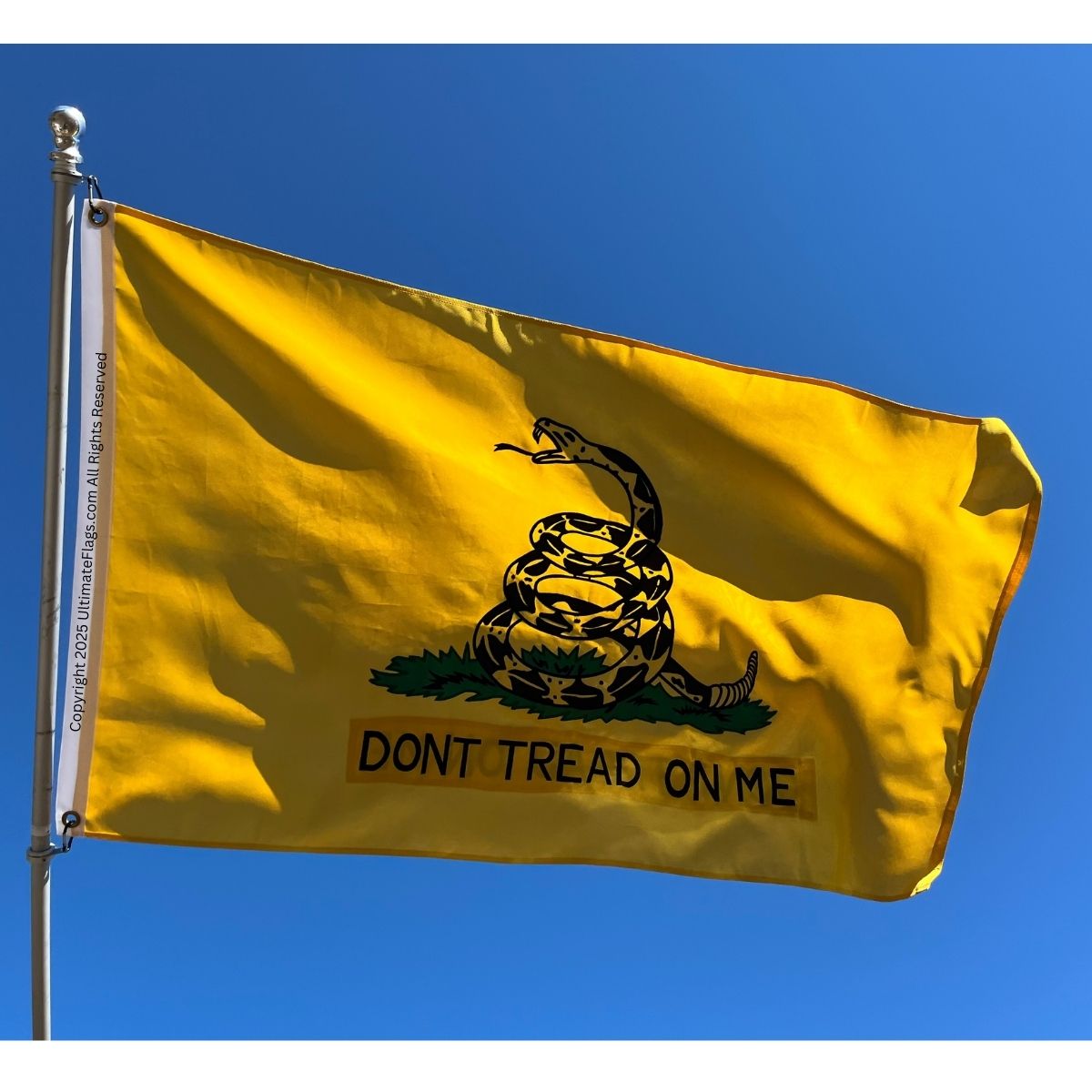
When you are ready to compare constructions side by side, the double-sided printed Shop Ultimate Flags Gadsden banner in 3×5 feet sits next to the embroidered line above, and seeing both in one order settles the question faster than any listing description.
How to pick the right construction for your display
- Look at the design first. Symmetrical emblem with no words — a standard flag flies fine single-sided. Words, a seal or a directional logo — plan on two-panel construction.
- Walk to where the back will be seen. Stand where a passerby stands. If the reverse is readable at arm's length, buy double-sided; if it is 20 feet up, do not bother.
- Check the pole and hardware. Double-sided flags are heavier. Reinforced headings, metal grommet rings and a pole rated for the load keep the extra fabric from finding your hardware's weak point.
- Read the construction, not the label. "Double-sided" on a listing can mean a blockout liner, two sewn panels or just a heavier print. Ask what the reverse shows and buy on the answer.
Related questions about double-sided flags
What is the difference between double-sided and 2-ply?
Double-sided means two printed panels with a blockout liner, so the back reads correctly. 2-ply means two layers of fabric — often embroidered — with the design showing reversed on the reverse face, per traditional sewn-flag construction. The first reads correct from both sides; the second is heavier and longer-wearing but mirrored on the back.
Does a double-sided flag fade faster?
No faster than the same fabric in a single-layer flag — fading is driven by sun exposure, wind and the ink or dye, not the panel count. What double-sided construction does change is weight: a heavier flag in light wind flies less, and the extra surface takes more wind load at the hems.
Do double-sided flags come in large sizes?
Yes. In the store's sewn line, double nylon embroidered flags run from 12×18 inches up to 5×8 feet, and true double-sided printed flags are made in the standard outdoor sizes — the practical ceiling is your pole's load rating, not the construction.
FAQ
Is a double-sided flag necessary for outdoor display?
No — only when the reverse is read at close range or the design has text or a directional emblem. On a tall pole viewed from a distance, a standard single-layer flag works fine and flies easier in light wind.
What does the back of a normal flag look like?
A single-layer flag shows a mirror image of the front — clearly reversed on sewn fabric and fainter on printed flags. Symmetrical designs hide this; words and seals do not.
What makes a flag truly double-sided?
Two full panels sewn back to back with a blockout liner between them. The liner stops each side’s color bleeding through, so both faces read correctly with full color.
Is a 2-ply embroidered flag the same as double-sided?
No. A 2-ply embroidered flag has the design embroidered into two layers, and the design reads reversed on the back, as traditional sewn flags always have. It is heavier and more durable, but it is not a correct-reading double-sided flag.
Do double-sided flags need a stronger pole?
They need hardware matched to the weight. A double-sided flag carries roughly twice the fabric plus a liner, so reinforced headings, metal grommets and a pole rated for the load matter most at 3×5 feet and above.
What sizes do double-sided flags come in?
Standard outdoor sizes are all available. In the store’s sewn line, double nylon embroidered flags run from 12×18 inches through 5×8 feet, and printed double-sided flags come in the common residential and commercial sizes.
One last thing
The Oregon state flag is the only U.S. state flag with different designs on each side — a seal on the front, a beaver on the back — and every one of them is made as a true two-sided flag, because the reverse is part of the design. Your flag almost certainly is not Oregon. But the test it teaches is the right one: if the back of your flag is meant to say something, build it so it says it correctly; if the back is just the back, spend the money on fabric and hardware instead.
Related guides