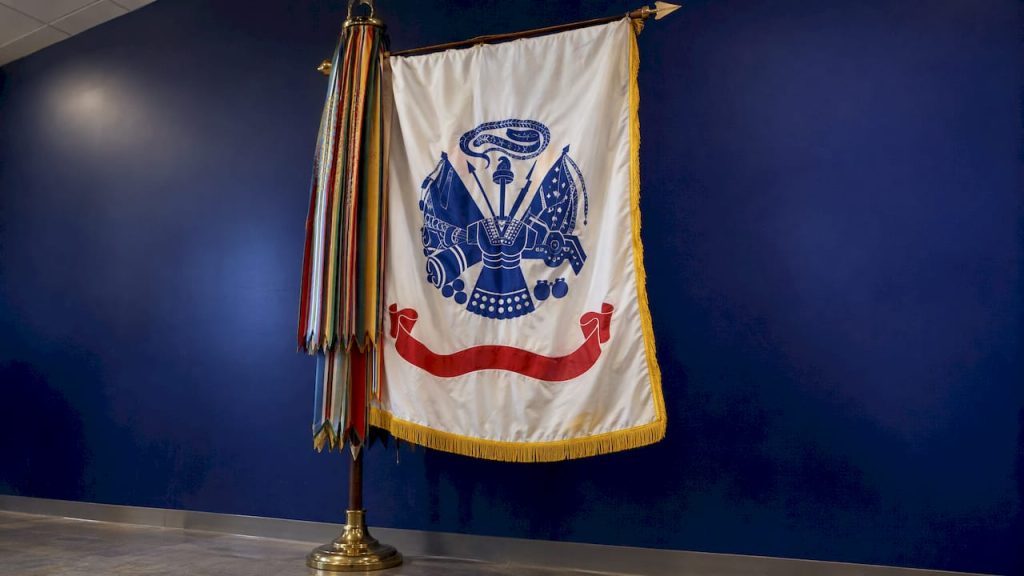
The U.S. Army flag is a white silk banner carrying the Department of the Army seal in blue, a scarlet scroll reading “UNITED STATES ARMY,” and the year 1775, the founding of the service. Every part of it is a deliberate statement: the Roman armor means strength and defense, the sword and cannon are the tools of the soldier’s trade, the Phrygian cap is liberty, and the streamers hanging from the staff record the campaigns the Army has fought since Lexington. This guide walks through each element, the 1956 order that created the flag, and how to read the streamers, so that when you see it at a ceremony, a memorial or on a home flagpole, you know exactly what it says.
TL;DR
- The Army flag’s center is the Department of the Army seal, whose cuirass, sword, musket, cannon and drum stand for strength, the Army’s tools and its public pledge to serve the Nation.
- The motto “This We’ll Defend” and the Phrygian cap on a sword point signal constant readiness to defend and preserve the United States.
- The flag was established by Executive Order 10670 on June 12, 1956, and the date 1775 beneath the scroll marks the Army’s birth.
- 190 campaign streamers hang from the staff, each embroidered with a campaign name and year, in the colors of that war’s campaign ribbon.
- If you want an Army flag of your own, our Army flag collection and Army emblem flags are the place to start.
Table of Contents
- What the Army flag looks like
- The seal at the heart of the flag
- “This We’ll Defend” and the Phrygian cap
- Why 1775 and why 1956
- What the streamers stand for
- Reading the colors: a campaign-by-campaign guide
- How the streamers are displayed
- Displaying an Army flag at home
- Find your Army flag with us
- Our perspective
- Frequently asked questions
- Sources
What the Army flag looks like
The design is set down in law, not left to taste. Executive Order 10670, signed June 12, 1956, describes a flag 4 feet 4 inches on the hoist (the side nearest the pole) and 5 feet 6 inches on the fly (the free end). It is made of white silk or rayon with yellow fringe 2½ inches wide. In the center sits the Department of the Army seal in ultramarine blue. Beneath it a scarlet scroll carries the words “UNITED STATES ARMY” in white, and below the scroll are the Arabic numerals “1775.”
That is the ceremonial flag, the one you see carried at the head of a formation or posted beside the national colors. Its look is simple on purpose. White silk is the field, blue is the seal, red is the scroll, and the three together echo the national colors without copying the Stars and Stripes. The yellow fringe gives it the formal bearing of the colors carried by regiments for centuries.
There is also a smaller cousin. According to DePaul University’s Army ROTC page, the Army field flag, authorized in 1962, matches the Army flag but is smaller, with an ultramarine blue background, a white seal, a white scroll with scarlet lettering, white 1775 numerals and no streamers. It is the practical, outdoor version of the same banner.
The seal at the heart of the flag
The seal is where the flag speaks most richly, and it is worth reading slowly. Each object in it was chosen to say something about what the Army is and what it promises.
According to Army Regulation 840-1, the Roman cuirass (a piece of body armor) at the center is a symbol of strength and defense. The sword, esponton (a short pike carried by officers in the 18th century), musket, bayonet, cannon, cannon balls and mortar bombs represent the traditional implements of the Army. The drum and drumsticks symbolize public notification of the Army’s purpose and its intent to serve the Nation and its people.
That last symbol is easy to overlook, and it is the most moving. A drum is how an army once told the countryside it was marching. Placing it in the seal says the Army’s purpose is announced openly, in service to the people it defends.
The date and the flags in the seal
The seal also carries history on its face. The Army’s Institute of Heraldry explains that the U.S. flag, in a design from the Nation’s formative years, and the second flag in the seal emphasize the Army’s role in establishing and protecting the Nation. The date MDCCLXXVIII (1778) and the words “War Office” point to the seal’s origin, and the seal still authenticates official Department of the Army documents.
So two dates sit on one flag. The 1778 on the seal speaks to the age of the emblem, while the 1775 under the scroll speaks to the age of the Army itself.
“This We’ll Defend” and the Phrygian cap
Above the cuirass sits a crest that would have been familiar to the men who fought at Concord and Bunker Hill. Army Regulation 840-1 describes a Phrygian cap, the Cap of Liberty, supported on the point of an unsheathed sword, together with the motto “This We’ll Defend” on a scroll held by a rattlesnake. The regulation notes that this symbol appeared on some American colonial flags, and that it signifies the Army’s constant readiness to defend and preserve the United States.
Read it as a sentence. Liberty is the cap, the sword holds it up, and the motto names the vow. The rattlesnake reaches back to the defiant spirit of colonial banners, a creature that warns before it strikes and does not retreat. If you have ever stood before a Gadsden flag and felt that old current of resolve, you already understand the visual language the Army inherited from the Revolution.
The motto is also a good answer to a common question. When people ask what the Army flag “means,” the shortest honest reply is this: liberty, held up by readiness, defended by those who serve.
Why 1775 and why 1956
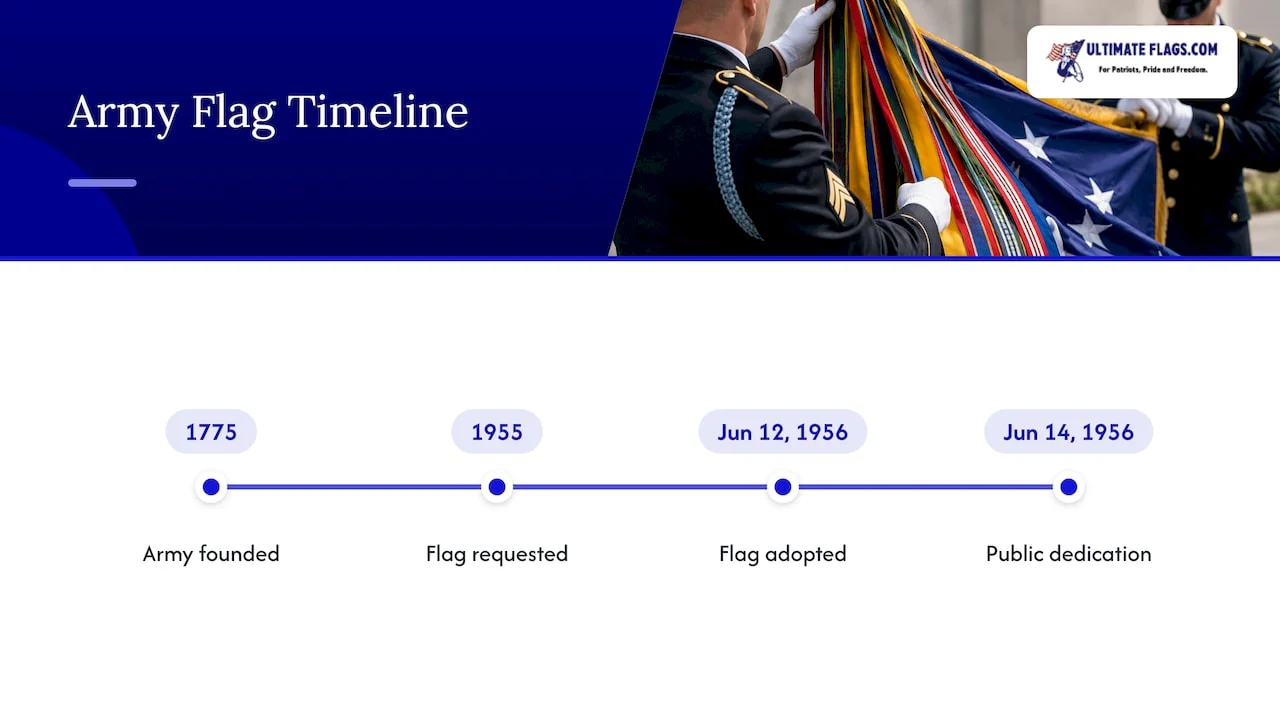
The Army traces its birth to 1775, the year of Lexington and Concord, which is why the number is stitched under the scroll. That founding date has a practical effect. As the VA’s history of military service flags notes, the Army’s 1775 precedence is why its flag is placed first when service flags are displayed in order of seniority.
Yet the flag itself is far younger than the service. The same VA article explains that before 1956 the Army was the only armed service without a flag to represent the entire force. In 1955, Secretary of the Army Wilber M. Brucker asked for one after a need arose for the Army to be represented in joint service ceremonies. The flag was adopted through Executive Order 10670 on June 12, 1956.
The U.S. Army Center of Military History records that the flag was dedicated and unfurled to the public on June 14, 1956, at Independence Hall in Philadelphia. The choice of place was fitting: the building where the Declaration was signed, in the city where the Army’s story began, on the day the Army marks as its birthday. The Center also notes that the Secretary of the Army designates which Army headquarters and agencies are authorized to display an Army flag.
Before that day, soldiers marched under unit colors and the national flag. The Army as a whole had no banner of its own. After 1956 it did, and it chose to wear its entire history on the staff.
What the streamers stand for
The streamers are the part of the flag that people ask about most, and for good reason. According to the Army’s own flag page, the 190 streamers attached to the staff denote the campaigns fought by the Army throughout the nation’s history. Each is 2¾ inches wide and 4 feet long, embroidered with a campaign name and the year or years. The colors derive from the campaign ribbon authorized for service in that war.
Think of them as a timeline in cloth. From the first streamer, Lexington 1775, to the most recent, each one is a chapter. The American Battlefield Trust describes how the colors and designs convey information at a glance, and how the flag is always presented with every streamer attached as a constant reminder of where the Army came from.
How the tradition grew
The habit of recording battles on banners is older than the Army flag. Per the same army.mil page, it rose to prominence in the Civil War, when organizations embroidered battle names on their colors. In 1890 units were authorized silver bands engraved with battle names on their color staffs. In World War I, when American Expeditionary Forces units could not obtain those bands, General Pershing authorized small ribbons bearing the names of operations. In 1921 every color-bearing Army organization was authorized the large campaign streamers now displayed.
The Center of Military History adds that the War Department published the first list of official Army campaigns on October 30, 1919, with 76 campaigns, and that in 1920 it ordered campaigns embroidered on streamers in the colors of the campaign medal ribbon.
A happy accident in 1956
The story of how the Army flag got its streamers has a twist worth telling. The Association of the U.S. Army recounts that in May 1955 the Office of the Quartermaster General was directed to submit a flag design. Three streamer proposals were considered, and the Quartermaster Depot in Philadelphia accidentally manufactured an embroidered streamer for each campaign under the third proposal. With no time to fix the error before the Chief of Staff’s briefing, the inscribed-streamer option was the one adopted, and Secretary Brucker approved it on April 3, 1956.
It is a fitting origin for a flag about perseverance: the design that endures was the one already stitched and waiting.
Why the flag’s streamers are longer
The AUSA article also explains a detail that sharp-eyed collectors notice. Flag streamers were made 12 inches longer than unit streamers, and the campaign years were added, to tell them apart. The Chief of Military History also left out some World War II “war service” streamers, such as ground combat, air combat and antisubmarine recognition, because they honored combat participation outside defined campaign areas.
Reading the colors: a campaign-by-campaign guide
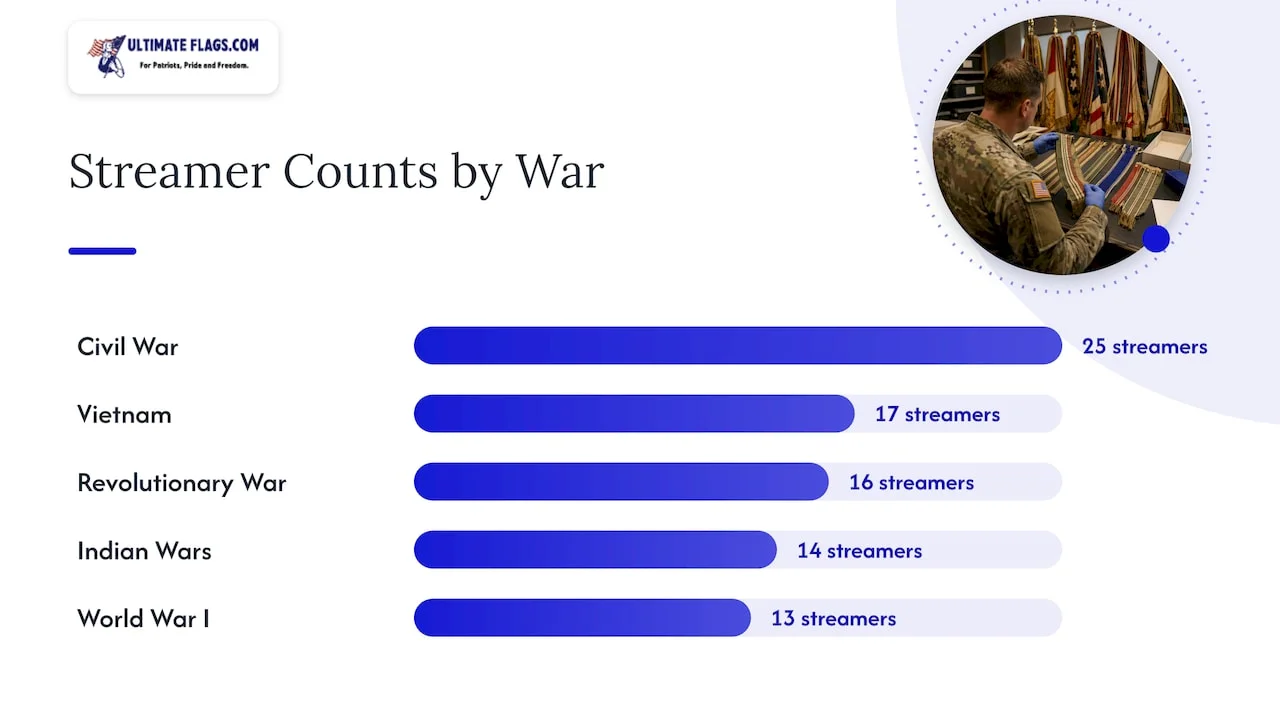
The Institute of Heraldry’s description of the Army flag and streamers lists the streamers by war and gives each war’s colors. The pattern is the ribbon of that war’s campaign medal, so once you know a color, you can place a streamer in history before you read a word.
| War or conflict | Streamers | Colors |
|---|---|---|
| Revolutionary War | 16 | Scarlet with white center stripe |
| War of 1812 | 6 | Scarlet with two white stripes |
| Mexican War | 10 | Green with white center stripe |
| Civil War | 25 | Blue and gray equally divided |
| Indian Wars | 14 | Scarlet with two black stripes |
| War with Spain | 3 | Yellow with two blue stripes |
| China Relief Expedition | 3 | Yellow with blue borders |
| Philippine Insurrection | 11 | Blue with two red stripes |
| World War I | 13 | Double rainbow |
| Korean War | 10 | Light blue bordered white, white center stripe |
| Vietnam | 17 | Yellow bordered green, three red center stripes |
The same listing counts later campaigns too: Southwest Asia 3, Kosovo 2, Afghanistan 5 and Iraq 7, plus single streamers for the Dominican Republic, Grenada, Panama, Somalia, the Global War on Terrorism Expeditionary campaign and Inherent Resolve.
The Civil War streamers deserve a pause. Their colors are blue and gray, divided equally, a single cloth that holds both armies of a divided country. For anyone who studies that era, it is one of the quietest and most powerful touches on the whole flag. If that period draws you, our guide to six Civil War flags and their meanings goes deeper into the banners themselves.
The Revolutionary War streamers
The first sixteen streamers belong to the founding generation. The Center of Military History’s campaign listings run from Lexington (April 19, 1775) through Yorktown (September 28 to October 19, 1781), and include Ticonderoga, Boston, Quebec, Charleston, Long Island, Trenton, Princeton, Saratoga, Brandywine, Germantown, Monmouth, Savannah, Cowpens and Guilford Court House.
That is the same war that gave us the Betsy Ross flag and the Gadsden rattlesnake. If you collect the banners of that era, our article on Betsy Ross flag wars and battles of the Revolutionary War pairs naturally with the streamers above.
How the streamers are displayed
There is a protocol to the way the streamers are arranged. According to the Institute of Heraldry, when the Army flag is not being carried, the streamers are arranged so that the first (Lexington 1775) and the last (Abeyance 2014-2015) are centered, facing forward and fully readable. Streamers on organizational colors and the Army display flag are three feet long, while those on the Army ceremonial flag are four feet.
The DePaul ROTC page adds that the flag bears all streamers representing the Army’s campaigns since its inception, and that the Yorktown streamer should always be prominently displayed when the flag is not being carried. Yorktown is where the Revolution was effectively won, so it is a fitting streamer to keep in view.
Displaying an Army flag at home
Most of us will never carry the ceremonial flag with its 190 streamers, but a good Army flag on a porch bracket, in a den or beside a veteran’s memorial is a fine way to honor service. A few practical thoughts:
- Decide the purpose. An outdoor flag for a home flagpole is a different object from a fringed indoor flag for a stand or a wall.
- Choose the emblem or the seal. Some flags carry the Army emblem and others the traditional white-field design with fringe. Our Army emblem flags and our Army flags with fringes cover both.
- Mind the order. When several service flags fly together, the Army flag goes first, because of its 1775 founding date. Our guide to the best military flags for a home flagpole display shows how to arrange them.
- Match the pole. Our flagpoles and hardware range and our guide to flagpole types and footing rules help you pick a pole before you pick a flag.
For a plainer, field-style look, there is also the U.S. Army Green Flag in 3 x 5 ft. Standard.
Find your Army flag with us
We are America’s oldest online flag store, and we carry military and service flags for veterans, families, reenactors and collectors. Our U.S. Army flags collection is the natural starting point for the flag described in this article, and our wider service honoring flags and Armed Forces Day flags round out a full display for every branch.

Browse the whole catalog, from USA and state flags to historic war flags and poles, on our flag collections page.
Our perspective
A flag is a story you can hold in your hands, and the Army flag may tell the longest one in American life. Everything on it is chosen: the sword that lifts liberty, the drum that announces a purpose, the date that reaches back to Lexington, and streamers that carry the memory of every campaign in its own color.
We have spent our years as America’s oldest online flag store helping people bring that kind of story home. A veteran who flies the Army flag is not decorating. He or she is saying that service mattered, that the lineage is alive, and that the ones who came before are remembered. That is why we offer Army flags in the emblem designs and fringed styles that families ask for, alongside the poles and hardware that let them be flown properly.
When you choose an Army flag, choose the one that fits the place you will honor, then give it a good pole and a place of respect. The history on the cloth will do the rest.
John Hough
Frequently asked questions
What does the U.S. Army flag symbolize?
It symbolizes the Army’s strength, its readiness and its service to the Nation. The seal’s cuirass stands for strength and defense, the weapons for the Army’s traditional tools, and the drum for its public pledge to serve. The motto “This We’ll Defend” and the Phrygian cap on a sword point express readiness to defend and preserve the United States.
What does the 1775 on the Army flag mean?
It marks the year the Army was founded, the year of Lexington and Concord. The date also explains why the Army flag is placed first when the flags of the services are displayed in order of seniority.
How many streamers are on the Army flag?
The Army’s flag page counts 190 streamers, each denoting a campaign fought by the Army. Each is 2¾ inches wide and 4 feet long and is embroidered with the campaign name and year. The number has grown over time as new campaigns are recognized.
When was the Army flag created?
Executive Order 10670 established it on June 12, 1956, and it was dedicated at Independence Hall in Philadelphia on June 14, 1956. Before then the Army was the only armed service without a flag representing the whole service.
What is the difference between the Army flag and the Army field flag?
The field flag, authorized in 1962, is smaller and has an ultramarine blue background with a white seal and white lettering. It carries no streamers. The traditional Army flag has a white field, a blue seal, a scarlet scroll, yellow fringe and the streamers.
Sources
- Executive Order 10670, Establishing a Flag for the United States Army
- Army Regulation 840-1
- The Army flag, Army Values
- The Army Flag, DePaul University Military Science
- Department of the Army seal, The Institute of Heraldry
- United States Army Flag and Streamers, The Institute of Heraldry
- The History Behind Our Nation’s Military Service Flags, VA
- The Origin of the U.S. Army Flag, Center of Military History
- Determination of Official Army Campaigns, Center of Military History
- Listings of the Campaigns Displayed on the Army Flag, Center of Military History
- Campaign Streamers of the United States Army, AUSA
- So Gallantly Streaming, American Battlefield Trust