A service star flag is a white banner bordered in red, bearing one blue star for each family member serving in the U.S. Armed Forces. A blue star marks active service. A gold star, smaller and set inside the blue so a thin border of blue remains visible, marks a death in service. Silver stars exist too, but only as an unofficial gesture from private advocacy groups, never a government standard. Families of those currently serving may display it in a home window during war or hostilities.
TL;DR:
- The official service flag features a white field, red border, and blue stars, with gold stars indicating a death in service, all per federal standards.
- Displaying the flag is limited to immediate family members, including spouses, parents, children, and siblings, with the flag ideally shown in a window at home.
- The gold star must be smaller and with a thin blue border to signify a service member’s death, while silver stars are unofficial symbols used by advocacy groups for wounded or injured personnel.
- Only flags produced with Institute of Heraldry certification meet official specifications; homemade or mass-market flags may not adhere to the standards.
- Unauthorized commercial production of official-design flags can carry legal risks, and organizations may display custom versions using numerals or single stars within legal guidelines.
Table of Contents
- The Origins and History of the Service Star Banner
- What Are the Official Design and Display Rules?
- Who Can Display a Service Star Flag?
- Understanding Gold, Silver, and Organizational Variations
- How to Buy a Service Star Flag
- Manufacturing, Licensing, and the Law Behind the Banner
- Who Stands Behind This Guide
- A Publisher’s Note on Honoring the Tradition
- Get a Properly Made Service Flag From a Store That Knows the History
- Sources
- FAQ
The Origins and History of the Service Star Banner
The tradition begins with one man’s grief and ingenuity. In 1917, Captain Robert L. Queisser of Ohio’s 5th Infantry designed and patented a banner to honor his two sons fighting overseas, a private tribute that caught fire across a nation suddenly sending millions of its own into uniform. The design was as plain as it was powerful: a blue star on a white field meant a family had someone in harm’s way.
The gold star tradition emerged from that same wartime grief. Women’s patriotic committees, with encouragement reaching as high as President Woodrow Wilson, began covering the blue star of the fallen with gold, transforming private mourning into public memorial. That gesture gave rise to the phrase “Gold Star Mother,” a title still spoken with reverence more than a century later, as the National WWI Museum and Memorial documents.
What started as a grassroots custom eventually needed federal shape. A few key milestones defined that path:
- 1917: Queisser’s original blue star banner spreads informally through Ohio and beyond.
- World War I: The gold star memorial custom takes hold nationally, backed by Wilson-era patriotic committees.
- October 1942: Congress passes Public Law 77-750, standardizing the flag’s design and creating the companion service lapel button.
- Later conflicts: Veterans organizations reissue and distribute banners to new generations of military families.
What Are the Official Design and Display Rules?
The Institute of Heraldry’s fact sheet sets the specifications that separate an authentic service flag from a novelty knockoff. The field is white, rectangular, and bordered in red. Inside sits one blue star for each family member in uniform. If that service member dies while serving, a smaller gold star is placed directly over the blue one, leaving a thin ring of blue visible around the edge, a border rather than a replacement.
Displaying the flag alongside the U.S. flag comes with a firm rule: the service flag must be equal to or smaller than the American flag, never larger, and never positioned in the place of honor. That position belongs to the nation’s flag alone.
Quick fact: the gold star is intentionally smaller than the blue star it covers, a design detail specified so the blue border remains visible as a permanent visual record of service, according to the Institute of Heraldry.
A few placement conventions matter when multiple stars appear:
- Stars are arranged in horizontal rows, read left to right and top to bottom.
- Gold stars typically take the upper left position among a group of stars.
- The flag hangs so the union (the star field) is at the top left, whether displayed vertically or horizontally.
- No star pattern deviates from straight rows. The design leaves no room for decorative arrangement.
Who Can Display a Service Star Flag?
Federal statute and Department of Defense guidance both name the immediate family members authorized to fly the banner. The list is broader than most people assume, reaching well past parents and spouses.
§ 901 and confirmed by the Blue Star Mothers organization, authorized family includes:
- Husbands and wives of service members.
- Parents, including stepparents, adoptive parents, and foster parents.
- Children, including stepchildren and adopted children.
- Brothers and sisters, including half-siblings.
The flag is meant to hang in a window of that family member’s residence, visible to the street, a quiet public signal of private sacrifice. Organizations, from veterans’ posts to school groups, may display their own version too, typically substituting a single star paired with an Arabic numeral representing the total number of members serving.
One distinction trips up many families: displaying a gold star on a homemade or purchased banner is a personal tradition, not a government credential. Eligibility for the official Gold Star Lapel Button, the item issued by the Department of Defense to next of kin, follows its own separate criteria under DODI 1348.36. A family can honor a loved one with a gold star banner regardless of whether they also qualify for that federal lapel button.
Understanding Gold, Silver, and Organizational Variations
Not every star you see on a service flag carries the same official weight, and knowing the difference keeps the tradition honest.
The gold star is the only color change written into federal design standards, marking a death in service. Some manufacturers use a slightly undersized gold star specifically to preserve that thin blue border, the detail the Institute of Heraldry treats as non-negotiable.
Silver stars are a different story entirely. Advocacy groups have pushed a silver star to recognize service members wounded or injured in the line of duty, a meaningful gesture but one that carries no standing in federal statute. Readers should treat any silver star banner as a community-driven symbol, not a DoD-recognized design.
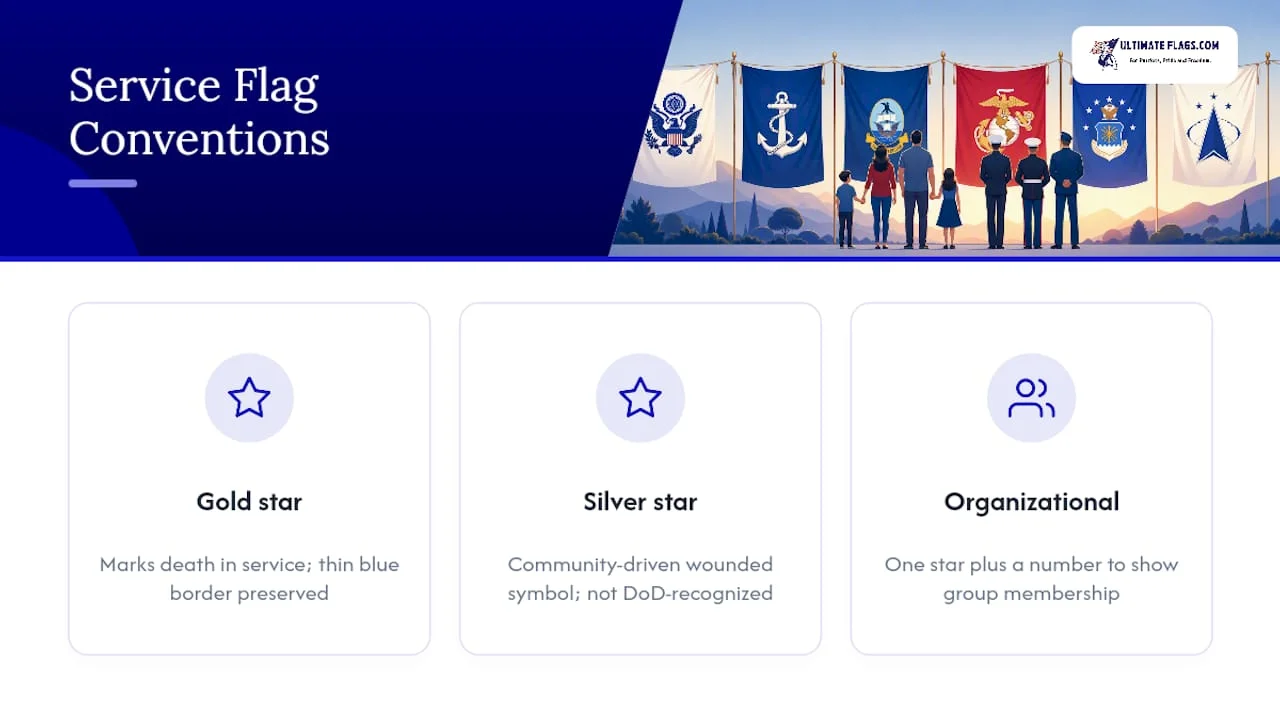
Organizational banners follow their own convention: a single star paired with a number, rather than a row of individual stars, when a group wants to represent a larger membership serving at once.
How to Buy a Service Star Flag
Buying a service flag is not like buying a decorative banner off a discount rack. Look for a seller who either references Institute of Heraldry design instructions directly or states plainly that the product follows official specifications for field, border, and star proportions. That single detail separates a respectful tribute from a poorly proportioned imitation.
A few practical checks before you order:
- Indoor display calls for satin or a similar cloth; outdoor use demands weather-resistant fabric built to hold color and shape.
- Stitched, appliquéd stars tend to outlast printed designs, especially with repeated window exposure to sunlight.
- Choose a size that stays visually smaller than any U.S. flag it will be paired with.
- Ask directly whether the manufacturer holds a certificate of authority or otherwise follows the federal design standard.
Pro Tip: A slightly higher price often reflects sewn construction and fade-resistant dye rather than markup. For a flag that sits in direct window sunlight for months, that difference shows up fast.
Manufacturing, Licensing, and the Law Behind the Banner
Not just anyone can legally manufacture and sell a service flag bearing official specifications. The Secretary of the Army serves as executive agent for the Institute of Heraldry, issuing certificates of authority to manufacturers to keep the design consistent nationwide. That oversight traces back to Congress’s original 1942 standardization under Public Law 77-750, later refined through subsequent statutes and DOD instructions.
A short list worth knowing if you represent an organization or simply want to verify a purchase:
- Unauthorized commercial manufacture of the officially specified design can carry legal risk under the statutory provisions tied to the Institute of Heraldry’s certificate system.
- Organizations may legally adapt display, using numerals or a single star, within the bounds DoD guidance already permits.
- When in doubt about a statute’s exact language, 36 U.S.C. § 901 remains the primary text to consult.
Who Stands Behind This Guide
This article comes from an experienced online flag store that has supplied military, historical, and commemorative flags built around real design standards, not guesswork. Author John Hough covers military and historical flag topics with an emphasis on getting the sourcing right. Readers curious about how flags carry memory forward might also enjoy Ultimate Flags’s piece on flags as historical witnesses or its tribute to a true frontier hero.
A Publisher’s Note on Honoring the Tradition
A service star in a window still says something a text message never could: someone here has skin in this fight. Fly it with the specifications in mind, and let the gesture stay as sincere as Captain Queisser intended in 1917.
— John Hough
Get a Properly Made Service Flag From a Store That Knows the History
Ultimate Flags carries service banners built to reflect the specifications covered above, not mass-produced guesses at what a “military-style” flag should look like. The team can walk you through fabric choice, sizing relative to a companion U.S. flag, and stitched-versus-printed star construction before you order.

If you’re outfitting a home window for a family member currently serving, or you want a banner that honors someone who didn’t come home, ask about material and certification details before you buy, then browse Ultimate Flags’s collection of commemorative and historical flag pieces for related tributes. Custom orders and sizing questions go straight to customer support, so you get a banner sized correctly the first time.
Sources
- Service Flags and Service Lapel Button — The Institute of Heraldry fact sheet
- Blue Star Mothers service flag
- Congressional Research Service summary — Service Flag and Lapel Button (IF11200)
FAQ
Who Can Hang a Blue Star Service Flag?
Immediate family of a currently serving member, including spouses, parents (including step, adoptive, and foster parents), children, and siblings including half-siblings, as defined under 36 U.S.C. § 901.
What Is the Gold Star Family Flag, and How Does It Differ From a Lapel Button?
The gold star family flag shows a smaller gold star superimposed on the blue star to mark a death in service, a personal display tradition anyone in the family can fly. The federal Gold Star Lapel Button is a separate government-issued item with its own eligibility rules under DOD instruction, so displaying the flag doesn’t automatically mean a family qualifies for the button.
Is There an Official Silver Star Service Flag?
No. Silver star banners are used informally by advocacy groups to recognize wounded or injured service members, but silver has no standing in federal design statute, unlike the officially defined blue and gold stars.
Does Every Service Member’s Family Get an Official Flag?
Not automatically. Families are authorized to display the flag under federal guidance, but the banner itself is typically purchased or made rather than issued, so eligibility means the right to display, not a guaranteed shipment from the government.
What’s the Difference Between the Service Flag and Other Military Tribute Banners?
The service flag follows a specific, federally referenced design (white field, red border, blue or gold stars) tied to a family member’s active status, while other military tribute or honor flags are typically general commemorative designs without that same statutory basis.