The North Carolina state flag you see today was adopted by the General Assembly in 1885. It is a close descendant of the first official state flag, approved by the secession convention in June 1861. Its two dates, May 20, 1775 and April 12, 1776, record two claims to the first American break with Britain. One of them is a cherished tradition that historians have long disputed. The other is a documented act of the colony’s own Provincial Congress. Each claim tells you something about how North Carolinians see themselves.
This is the full story, in order: the banners flown before statehood, the 1861 flag carried into war, the 1885 redesign, the 1991 adjustments and what every element means. If the flag has you thinking about flying one, we have a short guide at the end.
TL;DR
- North Carolina had no official state flag until the 1861 convention. Before that, colonists mostly saw the flag of England and then Great Britain.
- The current design dates to 1885 and keeps the 1861 flag’s basic layout, with a blue union, a white star, the letters N and C, and red and white bars.
- The top date, May 20, 1775, refers to the Mecklenburg Declaration, which most historians doubt. The bottom date, April 12, 1776, marks the Halifax Resolves, which are well documented.
- The 1991 General Assembly made minor changes, setting the flag’s length at one and a half times its width.
- Texas adopted its Lone Star Flag in 1839, so it was first, even though North Carolina’s 1775 date looks earlier on paper.
Table of Contents
- Before the state flag: banners of a colony
- 1861: the first official state flag
- 1885: the flag we know
- 1991: small changes
- What the flag looks like, and what each part means
- The two dates: one tradition, one record
- Did North Carolina or Texas adopt its flag first?
- A flag for the state you love
- Our perspective
- Bring the North Carolina flag home
- FAQ
- Sources
Before the state flag: banners of a colony
A flag is a young idea for a state that is old. Colonial North Carolina did not fly a banner of its own. NCpedia notes that the flag most often seen would have been the one belonging to the mother country. Before the Act of Union in 1707 that meant St. George’s Cross of England. After 1707 it meant the Union flag, which joined the Scottish St. Andrew’s Cross to the English one. The same source records that Royal Governor William Tryon carried two such flags during the Alamance campaign of 1771, in the War of the Regulation.
That is the answer to a question many people ask: what flag did North Carolina have before its own? It had the flag of the Crown. The colonists who later pressed for independence were, for most of their history, living under the very banner they would reject.
The Revolution did not immediately change this. After the war, the new state used the national colors of the young republic. A distinct North Carolina flag arrived only when the state stood on the brink of another break.
1861: the first official state flag
NCpedia states that North Carolina did not officially have a state flag until the constitutional convention of 1861. The convention met in the weeks when the state left the Union, and the flag was a product of that moment.
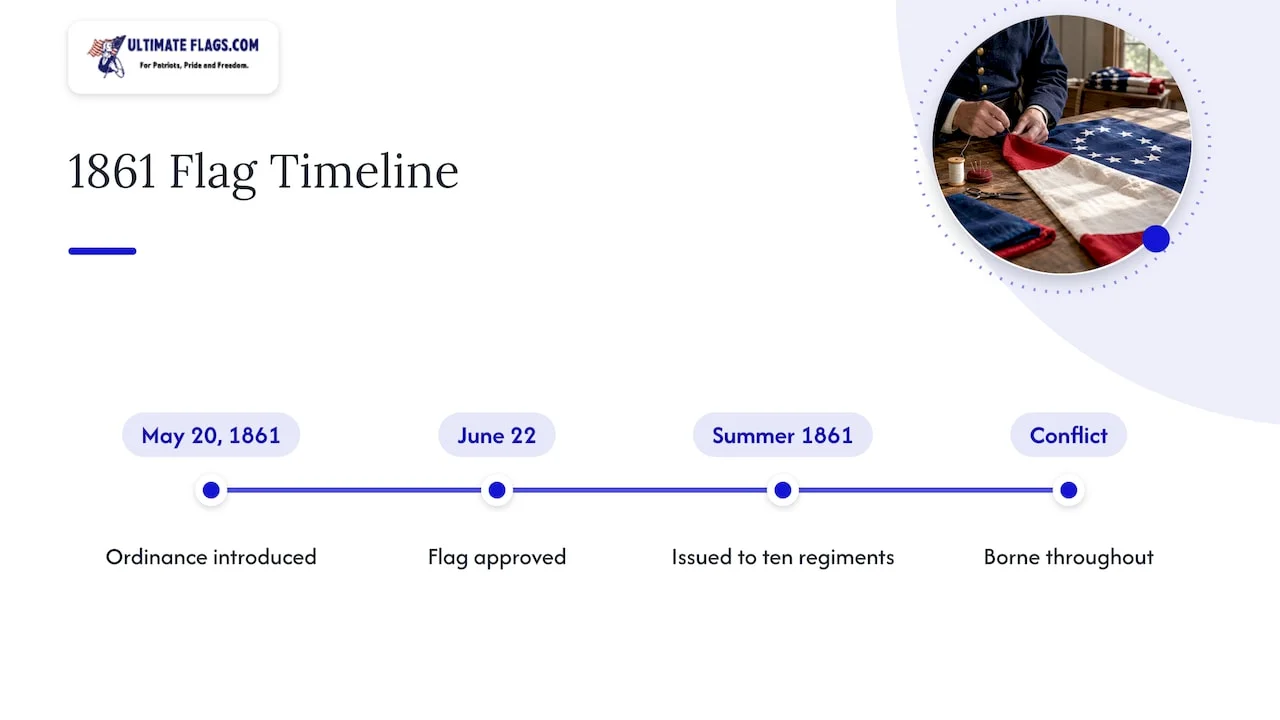
The North Carolina Secretary of State’s State Symbols publication records the sequence. On May 20, 1861, the day the secession resolution was adopted, Col. John D. Whitford introduced an ordinance to create a state flag. William Jarl Browne, a Raleigh artist, prepared a model and submitted it to the committee, and the convention approved it on June 22, 1861.
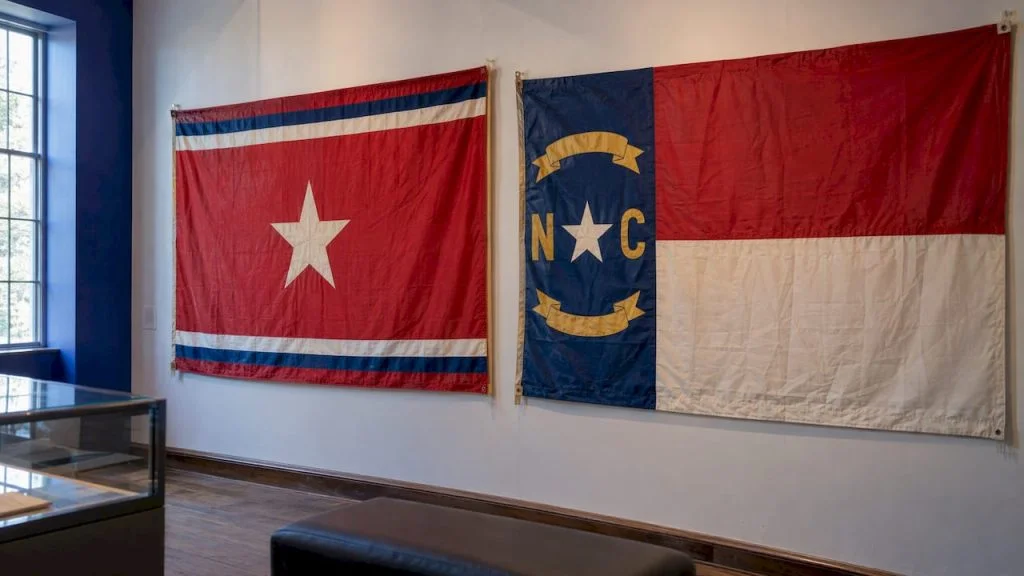
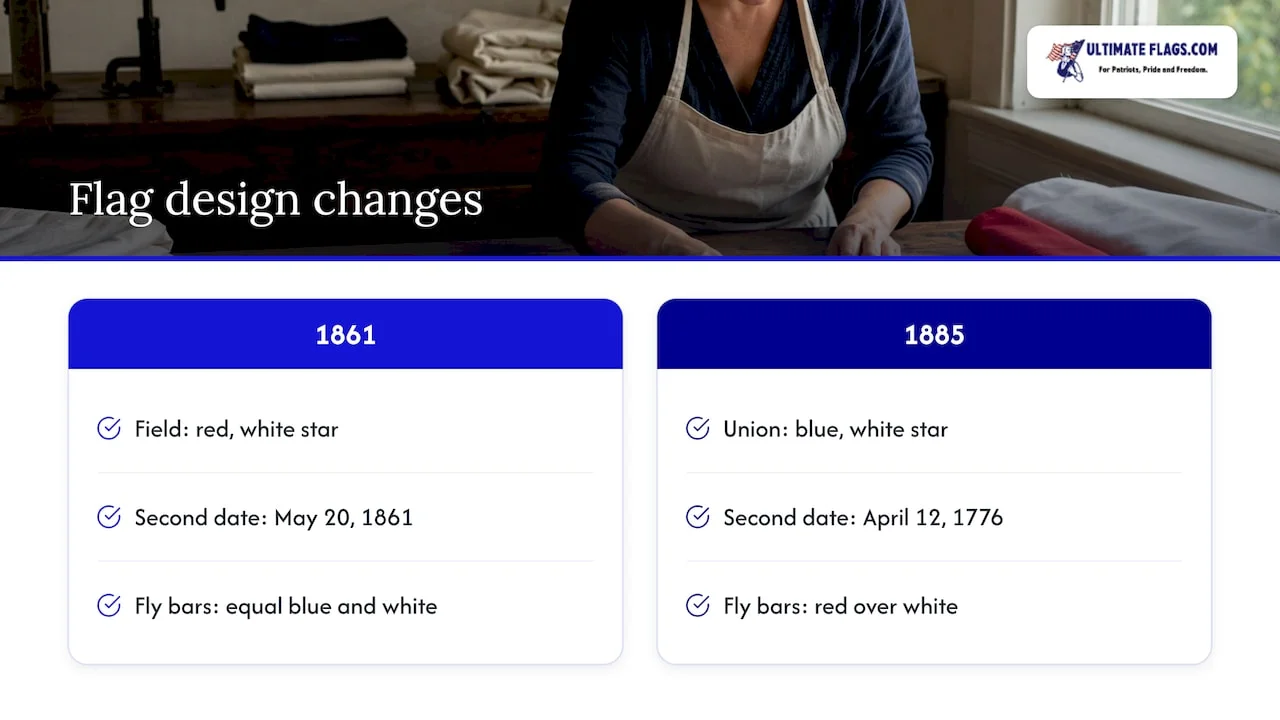
The design was a different animal from today’s flag. According to a 1913 account published by Carolana, the 1861 flag had a red field with a white star in the center. The date “May 20th, 1775” sat above the star and “May 20th, 1861” below it, with two bars of equal width, blue and white. The two May 20ths were a deliberate pairing. NCpedia explains that they symbolized North Carolina breaking ties with governments it found undesirable: the 1775 date for the Mecklenburg tradition, and the 1861 date for secession.
This flag went to war. The same 1913 account says it was issued to the first ten regiments of State troops in the summer of 1861 and was borne by them throughout the conflict. It was the only flag, apart from the national and Confederate colors, used by North Carolina troops during the Civil War. For collectors and reenactors, that makes the 1861 pattern one of the central banners of the state’s military history. We carry the North Carolina Republic 1861 to 1865 flag for exactly that audience, and our Civil War flag guide covers how to read the provenance of related banners.
1885: the flag we know
Twenty years after the war, the legislature took up the design again. According to the Secretary of State’s publication, General Johnstone Jones introduced the redesign bill on February 5, 1885, and it passed its final reading a month later after little debate. The act was ratified on March 9, 1885.
The change was straightforward. The Carolana account says the second date, May 20, 1861, was replaced with April 12, 1776, commemorating the Halifax Resolves. The red field gave way to a blue union holding the white star with gilt letters N and C. The bars remained at the fly, now red over white. The result is the flag in use today, and it looks far more like the Stars and Stripes than the 1861 original did.
One explanation for the new colors comes from a Civil War history site, which says the blue replaced the old red in memory of the Bonnie Blue Flag used as a symbol of secession. Treat that as one account of the thinking rather than the settled reason; the act itself simply set out the new design. What is clear is that the legislature chose to remove the secession date and keep the 1775 date, and added a date from the Revolution in its place.
1991: small changes
The design then stood untouched for more than a century. The Secretary of State’s publication states that from 1885 to 1991 there was no change in the flag. In 1991 the General Assembly made minor changes: it changed the flag’s length from one third more than its width to one half more, and removed the commas before the years in the date inscriptions. That is why the statute today reads “May 20th 1775” with no comma.
These details matter when you buy a flag. A flag built to the statutory proportions is 3:2, which is the same ratio as a standard 3 x 5 foot flag and close to it.
What the flag looks like, and what each part means
The statute, as set out by NCpedia, describes the flag this way: a blue union with a white star in the center, the gilt letter N on the left and the gilt letter C on the right. The circle containing the star is one third the width of the union. The fly has two equal bars, red above and white below. Gilt semicircular scrolls above and below the star carry the two dates in black letters.
| Element | What it is | What it stands for |
|---|---|---|
| Blue union | Vertical field at the hoist | Carries the star, letters and dates |
| White star | Center of the union | North Carolina’s place as one of the original 13 states |
| Letters N and C | Gilt, either side of the star | The state’s initials |
| Red and white bars | Equal bars on the fly | Colors shared with the national flag |
| Upper scroll | May 20th 1775 | The Mecklenburg Declaration tradition |
| Lower scroll | April 12th 1776 | The Halifax Resolves |
The red, white and blue were not the subject of a formal explanation in the statute. The meaning most people give them is simply the colors of the national flag.
The two dates: one tradition, one record
The dates are the heart of the flag and the reason people search for its history. They are not equal in evidentiary weight, and the story is better when you know why.
April 12, 1776: the Halifax Resolves
The lower date is solid ground. The Raleigh News & Observer reported in 2022 that the Halifax Resolves were adopted at the Fourth Provincial Congress, one of five assemblies convened to move North Carolina from royal to state government. The assembly authorized the state’s delegates to the Continental Congress to vote for independence, an important step toward the Declaration of Independence. The same article notes that two copies survive, one in the National Archives and one in the State Archives of North Carolina. NCpedia calls the resolves the first official statement by an American colony calling for a united declaration of independence from British rule.
May 20, 1775: the Mecklenburg Declaration
The upper date has a longer and more tangled history. In North Carolina tradition, citizens of Mecklenburg County declared themselves free of British rule on May 20, 1775, more than a year before Philadelphia. NCpedia’s entry says the text did not surface until 1819, 44 years after the event, when it was published in the Raleigh Register. The original was said to have been lost in a fire in 1800, and the published version was reconstructed from memory by John McKnitt Alexander.
The same entry explains that the document’s authenticity was not seriously questioned until Thomas Jefferson’s works were published in 1829. Jefferson had written to John Adams in 1819 dismissing it as a hoax. ABC11 in Raleigh quoted historians who regard the declaration as spurious in the form we have it. Many historians hold that a real set of radical resolutions, the Mecklenburg Resolves, was passed in late May 1775. Those resolves fell short of declaring independence.
So why does the date remain? Because the flag records belief as well as proof. For generations, North Carolinians held that their state was the first to speak for freedom, and the 1775 date has flown on the flag since 1861. The 1885 legislature kept it and added the documented Halifax date beside it. The result is a flag that carries both the legend and the record, and many native North Carolinians would not want it any other way.
Did North Carolina or Texas adopt its flag first?
People often compare the two because both states have a strong independence identity. The Texas Vexillological Commission reports that the Lone Star Flag was officially adopted by the Third Congress of the Republic of Texas on January 25, 1839. North Carolina’s first official state flag was approved in June 1861 and the current design in 1885. Texas was first by a wide margin, though it began as the flag of a republic and not of a state.
A flag for the state you love
If this history has you thinking about the flag on your own pole, a few practical points help.
- Choose the design for the story you want to tell. The current 1885 flag is the official state banner. The 1861 pattern is a historical flag, and it belongs with reenactment, collections and Civil War study.
- Match the material to the use. A sewn cotton flag suits indoor display and historical settings. Outdoor nylon is made for the wind and weather of an everyday pole.
- Check the size against the pole. A 3 x 5 foot flag is the common standard for a home pole, and it matches the 3:2 shape the statute prescribes. Our flagpole guide helps with the pole and footing.
Our perspective
A state flag is a short history lesson stitched in cloth. North Carolina’s is one of the best, because it refuses to choose between legend and record. It holds May 20, 1775 and April 12, 1776 side by side, and it asks each generation to ask what it means to stand first.
We have spent our years telling the stories of history through flags, from the banners of the Revolution to the colors carried in 1861. When we look at the North Carolina flag, we see a banner that has been to war, been redrawn in peacetime, and been kept by people who love the state. That is why we offer it in more than one form: the 1885 state flag for the pole at home, and the 1861 Republic flag for the collector, the reenactor and the student of the Civil War.
Whichever you choose, fly it with an understanding of what the dates say. That knowledge is what turns a piece of fabric into a piece of heritage.
John Hough
Bring the North Carolina flag home
We carry the state flag in several sizes and materials, from sewn outdoor nylon to cotton, along with the historical 1861 patterns. Browse the full North Carolina flag collection, or go straight to the sewn outdoor 3 x 5 North Carolina flag. For other states, our state flag meanings guide and full flag collections are a good place to start.

Flagpoles and hardware are in the store too, so the flag and the pole can come together.
FAQ
What is the history of the North Carolina flag in brief?
Colonial North Carolina flew the flag of England and then Great Britain. The state’s first official flag was approved by the convention on June 22, 1861, with a red field and the dates May 20, 1775 and May 20, 1861. The legislature adopted the current design in March 1885, replacing the secession date with April 12, 1776.
What does the NC flag mean?
The star and the letters N and C stand for the state, and the red, white and blue echo the national colors. The upper scroll, May 20th 1775, refers to the Mecklenburg Declaration tradition. The lower scroll, April 12th 1776, marks the Halifax Resolves, the first official colonial call for a united declaration of independence.
Why does the flag have two dates?
The 1861 flag paired the Mecklenburg date with the date of secession. In 1885 the legislature kept the 1775 date and replaced the secession date with the Halifax Resolves. Together the dates record two claims to be first in the move toward independence.
Has the North Carolina flag changed since 1885?
Only slightly. The Secretary of State’s publication says the 1991 General Assembly changed the flag’s length from one third more than its width to one half more, and removed the commas before the dates. The design is otherwise the one adopted in 1885.
Sources
- State Flag of North Carolina, NCpedia
- Flag, State, NCpedia
- Mecklenburg Declaration of Independence, NCpedia
- North Carolina State Symbols, Secretary of State
- The North Carolina State Flag, Carolana
- What do dates on NC flag mean?, Raleigh News & Observer
- Mecklenburg Declaration: a date on North Carolina’s flag, ABC11
- Texas Vexillological Commission Report on the Lone Star Flag