
 BUY Rebel Flags For Sale
North Carolina was one of the last Southern states to leave the Union, and one of the most reluctant. Yet once it went, it gave more soldiers to the Confederacy than almost any other state, and it marched to war under a flag that still shapes the North Carolina state flag today.

A State That Wanted to Stay
By the spring of 1861, seven states had left the Union, but most North Carolinians did not favor secession. In February 1861, voters even turned down a call for a secession convention. Then came April 12 and the bombardment of Fort Sumter in South Carolina. The Confederate cannon fire killed no one and caused only minor injuries, but three days later came an announcement from Washington that changed everything.
Today we think of April 15 as the day federal taxes are due. In 1861 there was no income tax, but that date became charged with emotion for another reason. President Lincoln issued a proclamation that included these words:
“Now, therefore, I, Abraham Lincoln, President of the United States, in virtue of the power in me vested by the Constitution and the laws, have thought fit to call forth, and hereby do call forth, the militia of the several States of the Union, to the aggregate number of 75,000, in order to suppress said combinations…”
The “said combinations” meant the new Confederate States of America. Secretary of War Simon Cameron informed North Carolina’s governor that the state’s quota was two regiments, about 1,560 officers and men, to be used against their Southern neighbors.
Governor John W. Ellis answered: “You can get no troops from North Carolina.”
“It Fell Slowly and Sadly by the Side of a Secessionist”
Debate over secession had been going on across the state, and many leading citizens took part. One of them was Zebulon B. Vance, a Unionist who would later serve as North Carolina’s wartime governor and be elected to the office three times in all. When word of Lincoln’s call for troops arrived, Vance was in the middle of a speech for preserving the Union, his arm raised in the air. He later recalled:
“When my hand came down from that impassioned gesticulation, it fell slowly and sadly by the side of a secessionist.”
Any chance of a peaceful settlement had vanished. A state convention voted North Carolina out of the Union on May 20, 1861, and the state joined the Confederacy.
The Flag of the North Carolina Republic

The same convention passed a flag ordinance creating the banner known today as the North Carolina Republic flag. It carried a red field at the hoist with a white star and two dates, May 20, 1775 and May 20, 1861, and two horizontal bars of blue and white.
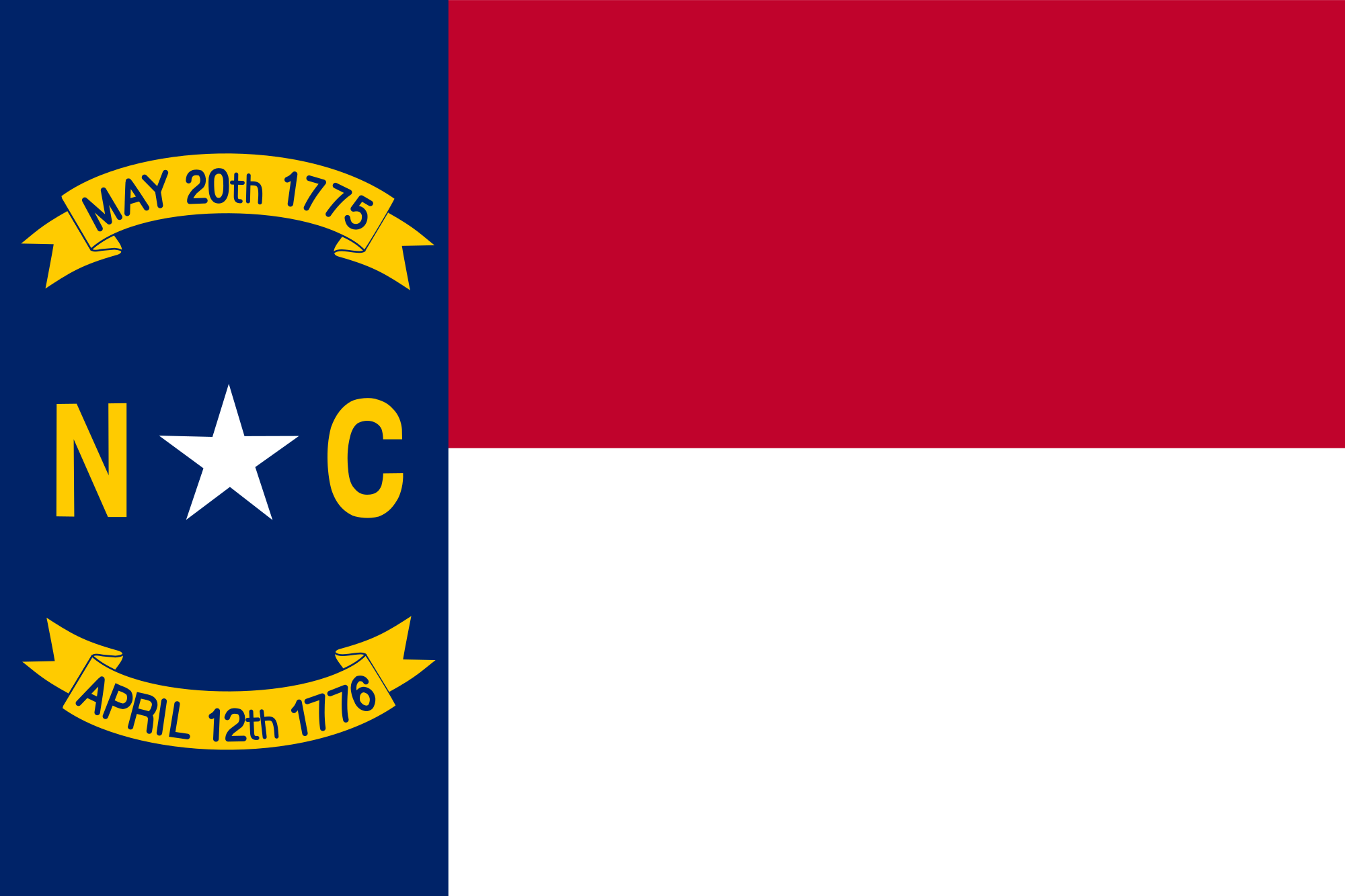
North Carolina troops were rightly proud of their state flag and carried it throughout the war. The people of the state admired it so much that it clearly shaped the current state flag, adopted in 1885. That flag keeps the star, the letters N and C, and the date May 20, 1775, along with April 12, 1776, the date of the Halifax Resolves, when North Carolina became the first colony to formally instruct its delegates to vote for independence.
Why May 20, 1775? The Mecklenburg Declaration
The date May 20, 1775 honors the Mecklenburg Declaration of Independence, a resolution by the citizens of Mecklenburg County declaring that they had separated from Great Britain. To understand it, we have to go back a month.
In the early hours of April 19, 1775, British General Thomas Gage sent troops out of Boston toward Concord, Massachusetts, to seize the colonists’ gunpowder and arms. Warned by riders such as Paul Revere, William Dawes and Dr. Samuel Prescott, about 70 Minutemen gathered on the green at Lexington to face the British advance guard of several hundred Redcoats. Both sides were wary. Suddenly a shot rang out. Eight Minutemen were killed, and the British marched on to Concord.
By then the colonial militia had gathered in force, and the tables were turned. At Concord’s North Bridge, the shot later immortalized by Ralph Waldo Emerson as “the shot heard round the world” was fired, and the British were driven back to Boston under fire the whole way. Lord Percy, who led the relief column that rescued them, wrote afterward: “Whoever looks upon them as an irregular mob will find himself much mistaken.” The first American rebels had made their mark.
According to North Carolina tradition, on May 19, 1775, elected representatives of Mecklenburg County met at the courthouse in Charlotte to discuss rising tensions with the British government. That same day an express rider arrived with news of Lexington and Concord. After hearing that British soldiers had killed and wounded fellow British subjects, the delegates drew up resolutions that included these words:
“…we the citizens of Mecklenburg County, do hereby dissolve the political bands which have connected us to the Mother Country, and hereby absolve ourselves from all allegiance to the British Crown, …who have wantonly trampled on our rights and liberties, and inhumanly shed the innocent blood of American patriots at Lexington.”
The original document was lost in a fire, and the surviving text was written down from memory years later, so historians still debate whether the declaration happened exactly as remembered. What is certain is that Mecklenburg County adopted the strongly worded Mecklenburg Resolves on May 31, 1775. Either way, North Carolina still honors these early patriots, whom many believe were the first Americans to declare independence from Great Britain, and in 1861 North Carolinians placed that date on the flag they carried to war.
Thanks for reading. Please share our posts with your friends and family so they too can learn more about Southern Heritage and History.
Brought to you by: Ultimate Flags