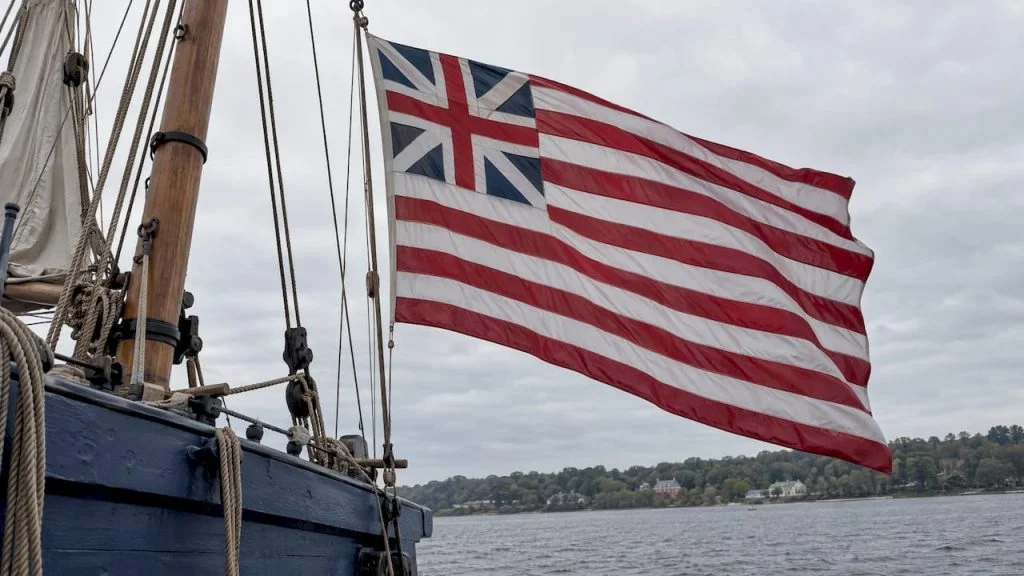
The Grand Union flag, also called the Continental Colors, was a banner of thirteen alternating red and white stripes with the British Union Flag in its upper corner. It flew over American forces in 1776 and early 1777, and it is considered the first national flag of the United States, though Congress never formally adopted it. It is the banner of a people who had taken up arms but had not yet declared a separate nation, and that tension is what makes it so compelling.
TL;DR
- The Grand Union flag has 13 red and white stripes and the British Union in the canton. “Continental Colors,” “Congress flag,” “First Navy Ensign” and “Cambridge Flag” are other names for it.
- It first appeared aboard the Continental Navy ship Alfred in December 1775, and it was raised near Cambridge, Massachusetts, in early 1776.
- The stripes stood for the united colonies. The Union Jack showed that the colonies still sought redress within the British Empire, not a final break.
- Congress never officially adopted it. It was the de facto flag until the Stars and Stripes arrived in June 1777.
- Its designer is unknown, and several popular stories about it are better described as tradition than documented fact.
Table of Contents
- What the Grand Union Flag Looked Like
- Where and When It First Appeared
- What the Stripes and the Union Jack Meant
- Was It the First Flag of the United States?
- From Grand Union to Betsy Ross and Beyond
- Why the Grand Union Still Matters
- Perspective
- Bring the Continental Colors Home
- Displaying a Historical Flag Well
- FAQ
- Sources
What the Grand Union Flag Looked Like
Picture a field of thirteen horizontal stripes, red and white in alternation, and in the upper hoist corner the crossed crosses of the British Union. That is the whole design, and its simplicity is part of its power. According to the U.S. District Court for the District of Puerto Rico, it carried several names: the Congress flag, the First Navy Ensign, the Cambridge Flag and the Continental Colors.
The name “Grand Union” is the one most people use today, and it fits. The word “union” works twice over: it is the vexillological term for the canton design, and it is the very idea the thirteen stripes expressed, colonies standing together. Historians often prefer “Continental Colors” or “Continental Union flag,” because those names echo how the flag was used in its own day, by the forces of the Continental cause.
If you have ever looked at a reproduction and wondered whether the stripes should number nine, twelve or thirteen, the answer from the period descriptions is thirteen. A January 1776 Naval Committee description, as summarized on Wikipedia’s Continental Union Flag entry, spoke of the British Union flag striped red and white in the field.
Where and When It First Appeared
Every great symbol has an origin story, and this one has two that compete.
The Alfred in Philadelphia, December 1775
The documented story begins on the Delaware River. A study published by the Flag Research Center’s Raven journal records that the first Continental Colors was delivered to the ship Alfred on December 2, 1775, and raised aboard her the following day. The Puerto Rico federal court’s account agrees on the date and names the man at the halyard: John Paul Jones, then a Continental Navy lieutenant, who claimed to have raised it.
That is why the flag carries the name First Navy Ensign. Before it ever rippled over a camp, it was a ship’s flag, and the fledgling navy needed one badly. Anyone curious about how ensigns work at sea today can read about maritime flag basics, the same tradition of signaling nationality and purpose that the Continental Navy was beginning to practice.
Prospect Hill, January 1, 1776
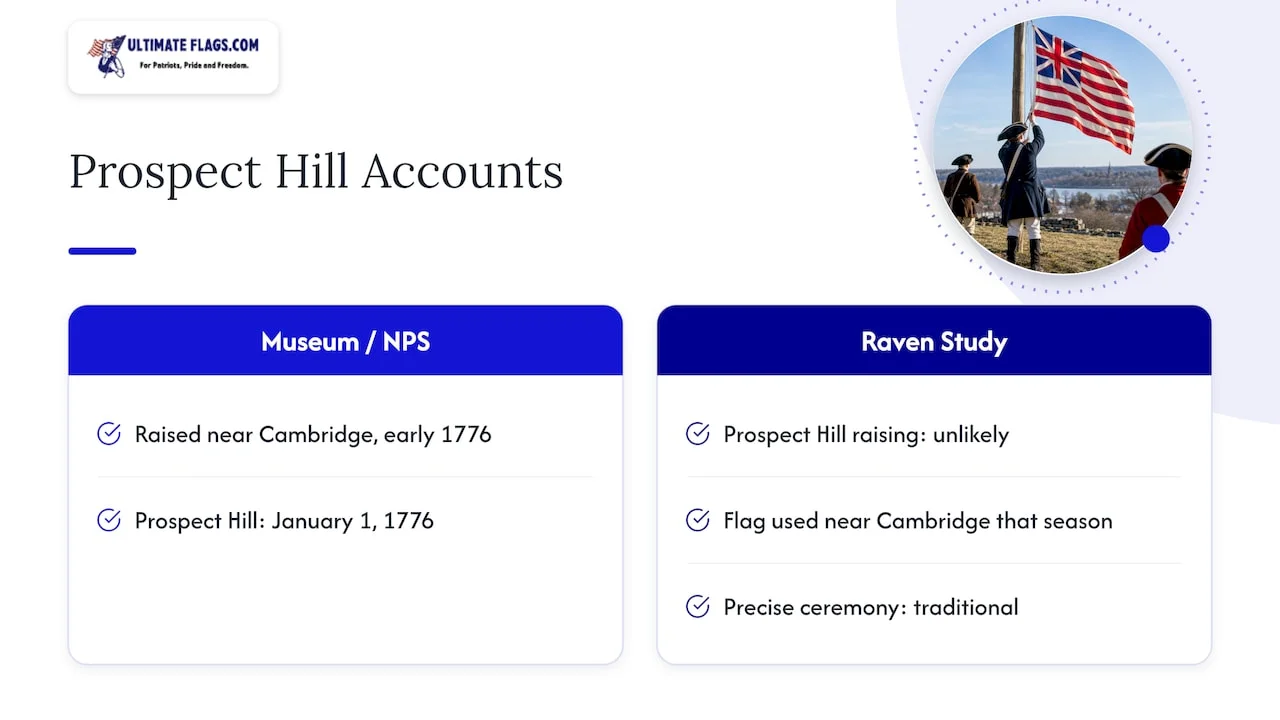
The more famous tale takes place on land. The Smithsonian’s National Postal Museum tells us the flag was widely believed to have been raised by George Washington’s army at Prospect Hill, near Cambridge, Massachusetts, on January 1, 1776, and it describes the Grand Union as the first known flag flown as a symbol of the new country. The National Park Service says Washington unfurled the flag near Cambridge in early 1776, during the Siege of Boston, and notes that some historians call it the first United States flag.
The Raven study, however, regards the specific Prospect Hill flag-raising story as unlikely. A careful reader holds both pictures at once: the flag was certainly in use around Cambridge in that season, and the precise ceremony remains a matter of tradition. That is not a loss. Legends cling to banners precisely because the banners mattered.
What the Stripes and the Union Jack Meant
This is the question that stops people: why would revolutionaries fly the flag of the Crown they were fighting?
The answer lies in the moment. In 1775 and early 1776, the colonies were at war in Massachusetts but had not declared independence. The National Park Service explains that the design and its name emphasized the commitment of all thirteen colonies to act together, and to remain part of Great Britain despite their disagreements with the mother country. It presents the flag as a deliberately transitional symbol, one that bound the colonies to each other while keeping the British Union, a banner of resistance and collective action before full separation.
Breaking the design into its parts:
| Element | What it represented |
|---|---|
| Thirteen stripes | The thirteen colonies, the “United Colonies” (NH Sons of the American Revolution) |
| Red and white alternation | A striped field that set the flag apart from the plain British red ensign |
| British Union in the canton | The kingdoms of England and Scotland, and the colonies’ ties to Britain at the time |
A contemporary Philadelphia observer, quoted in the Wikipedia summary above, described the stripes as emblematic of the thirteen United Colonies. The message was unity first. Separation would come later.
Was It Copied from the East India Company Flag?
You will often read that the design borrowed from the East India Company’s striped ensign. It is a tempting comparison, since the two look alike. Researcher Peter Ansoff, writing in the Raven study, finds no documentary link between them. If the company’s flag had any influence, he concludes, it was more likely through the general idea of distinguishing a British-style red ensign than through any sympathy for the company. Resemblance is not proof of borrowing, and the designer of the Grand Union remains unknown, as the National Park Service states.
Was It the First Flag of the United States?
Short answer: it is considered so, with a caveat. The Puerto Rico court describes it as the first national flag of the United States, in use as a naval ensign and garrison flag by Continental forces through 1776 and early 1777. Yet Colonial Williamsburg points out that the Continental Union flag, popularly known today as the Grand Union, was never officially adopted by the Continental Congress.
Both statements are true. It served as the de facto flag, in the words of the Raven study, until the Stars and Stripes were adopted in June 1777. The Flag Act of 1777 then authorized an official national flag with thirteen stars on a blue field replacing the British Union in the canton.
That swap tells the whole story in one stroke. The stripes carried over. The old Union gave way to a new constellation. A people who began by asking for their rights as Englishmen ended by declaring themselves something new, and their flag changed one corner to say so.
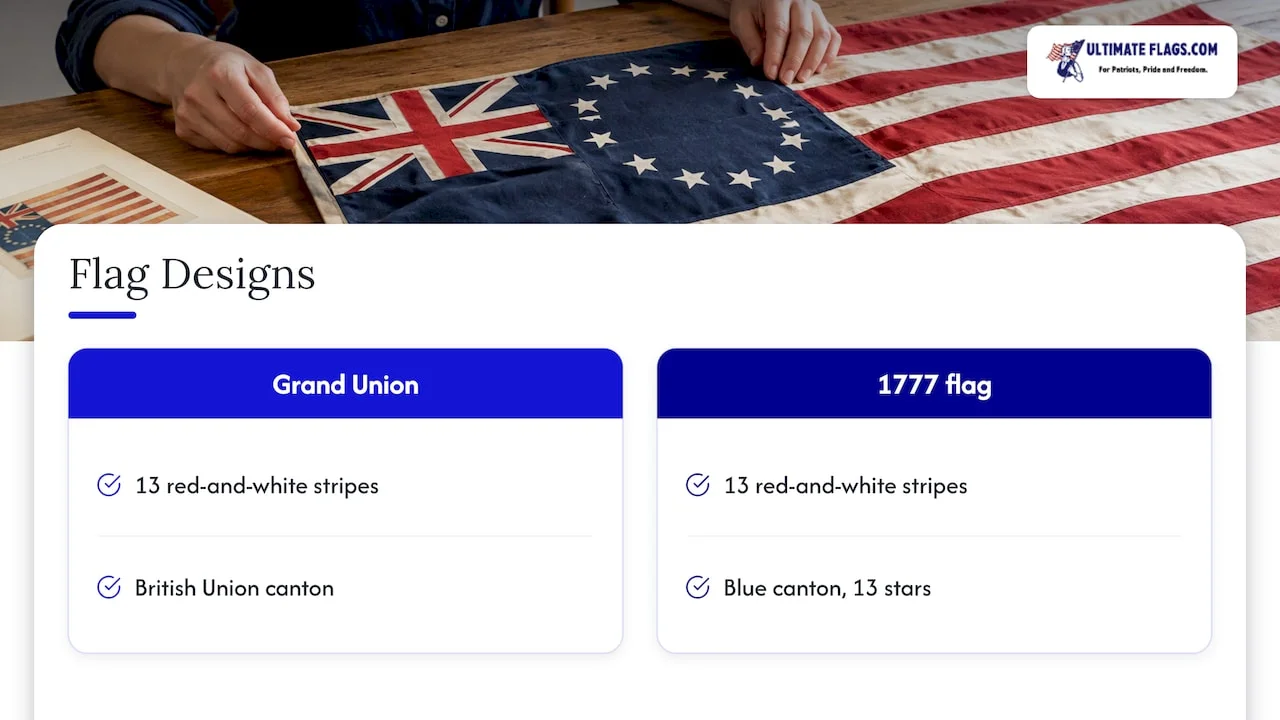
From Grand Union to Betsy Ross and Beyond
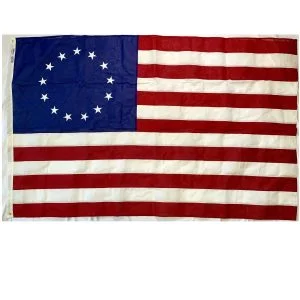
Many Americans picture the Betsy Ross circle of thirteen stars as the first flag. It makes sense to ask where it fits. Colonial Williamsburg notes that the Ross family tradition about the first Stars and Stripes appeared in print around 1870, and that documentary evidence beyond oral family accounts is lacking. The Grand Union, by contrast, has period records behind it: ship deliveries, committee descriptions and eyewitness remarks.
Collectors who love the whole sweep of the Revolution often display these flags side by side: the Continental Colors, the thirteen-star designs and the Gadsden and Bunker Hill banners. If that story interests you, our own articles on the Betsy Ross flag in Revolutionary War battles and on Betsy Ross flag wars and battles pick up where this one leaves off.
Why the Grand Union Still Matters
A flag that lasted perhaps eighteen months might seem a footnote. It has proven otherwise.
In 1968 the Postal Service issued a six-cent stamp on July 4, which the National Postal Museum says commemorated flags carried by colonists and citizens of a new nation. The Grand Union was part of that tribute. Colonial Williamsburg still flies a Continental Union flag daily to indicate that its exhibit sites are open, so a visitor walking Duke of Gloucester Street meets the same stripes and Union that Americans saw in 1776.
For teachers, reenactors, museum volunteers and history enthusiasts, the flag is a teaching tool. It lets you stand in a moment before the outcome was known, when loyalty, grievance and resolve were braided together. It whispers a more complicated tale than the one we usually tell, and a more human one.
Perspective
At Ultimate Flags, we have spent years among the banners of the Revolution, and the Grand Union is the one that rewards a second look. Most visitors arrive expecting a simple Stars and Stripes ancestor. They leave understanding that the first banner of the American cause was a flag of hard choices: thirteen stripes bound together, a Union canton still in place, and a people not yet ready to say the final word.
We believe that is exactly why it belongs on a wall, a pole or a reenactor’s staff. A flag like this is not decoration alone. It is a conversation starter, a classroom lesson and a tribute to those who stood together before independence was certain. Our catalog of Revolutionary War flags exists so that collectors, educators and patriots can own that story in cloth, from the Continental Colors to the thirteen-star designs and beyond.
When you choose a Grand Union flag, choose it for what it says: that unity came first, and freedom followed.
John Hough
Bring the Continental Colors Home
If this history has you ready to display it, we carry the Grand Union in several forms. Our Grand Union Continental Flag collection gathers the options in one place, including the outdoor sewn nylon embroidered 3 x 5 ft. flag for the porch or flagpole and the cotton 4 x 6 ft. flag for a more traditional, period-style look.

Building a wider display? Browse our Revolutionary War flags, the 13 star American flags, or the full range of flag collections. Looking for the right pole and hardware? You will find those there as well.
Displaying a Historical Flag Well
A few practical thoughts for anyone flying or showing a reproduction.
- Decide on indoor or outdoor use first. A cotton flag suits a study, a classroom or a reenactment camp. A sewn nylon flag is the sensible choice for a pole outside.
- Match the size to the space. A 3 x 5 ft. flag fits a standard residential pole, while a 4 x 6 ft. flag makes a statement on a longer staff or a wall.
- Give it context. A small card noting the dates, December 1775 for the Alfred and June 1777 for the Stars and Stripes, turns a flag into a lesson.
- Display it with its descendants. Pairing the Continental Colors with a thirteen-star flag shows visitors the change in the canton at a glance.
For guests who ask why a British Union appears on an American flag, the sentence to remember is this: the colonies were united, but not yet separated.
FAQ
Is the Grand Union flag the same as the Continental Colors?
Yes. Continental Colors, Congress flag, First Navy Ensign and Cambridge Flag all refer to the same striped design with the British Union in the canton. “Grand Union” is the name most people use today, while historians often favor “Continental Colors” or “Continental Union flag.”
Who designed the Grand Union flag?
Nobody knows. The National Park Service states that the designer is unknown. The flag appears in records of ship deliveries and committee descriptions in late 1775 and early 1776, but no document names its creator.
Was the Grand Union flag officially adopted?
Not by the Continental Congress, according to Colonial Williamsburg. It nonetheless served as the de facto flag of the new country, used as a naval ensign and garrison flag, until the Stars and Stripes were adopted in June 1777.
Why does it have the British flag on it?
The colonies were resisting, not yet declaring independence. The National Park Service describes the design as showing the thirteen colonies acting together while still part of Great Britain, a transitional symbol before full separation.
How is it different from the Betsy Ross flag?
The Grand Union has stripes and a British Union canton. The Betsy Ross design has stripes and a circle of thirteen stars on blue. The Grand Union is documented in period records, while the Ross story rests largely on family tradition that first appeared in print around 1870.
Sources
- The Grand Union Flag, U.S. District Court for the District of Puerto Rico
- The Evolution of the American Flag, National Postal Museum
- Flags of Bunker Hill: Banners of Liberty, National Park Service
- Sir Charles Fawcett Redux, Raven (Flag Research Center)
- The Grand Union Flag, NH Sons of the American Revolution
- What Was the First American Flag? Colonial Williamsburg
- Continental Union Flag, Wikipedia