Posted on

Giant of the Revolution – “Virginia Hercules”

If Hollywood ever wants to create another box office hit war movie complete with mystery, romance, and swashbuckling action, it would have to be centered around Revolutionary War hero Peter Francisco. A five-year-old boy who was abandoned at a harbor in Virginia grew up to be one of our courageous soldiers in the War for Independence. 

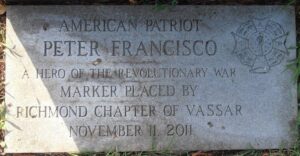
Peter Francisco, born Pedro Francisco, was known as the “Virginia Giant”, the “Giant of the Revolution” and sometimes as the “Virginia Hercules”, was a Portuguese-born American patriot and soldier of the American Revolution. Peter is said to have stood six and a half feet tall, and weighed in at 260 pounds.

At age 16 Peter enlisted as a private. It did not take long before his fighting skills and bravery became well known. He was always in the middle of every battle he fought, and was wounded repeatedly, but kept on fighting in more battles.  

When General “Mad Anthony” Wayne stormed Stony Point, Peter was the second man over the British walls. But by that time he was already famous for his exploits. After several years in the northern battles, he joined a militia company in the South. At the Battle of Guilford Courthouse in March he killed eleven British soldiers before getting bayoneted in the leg.

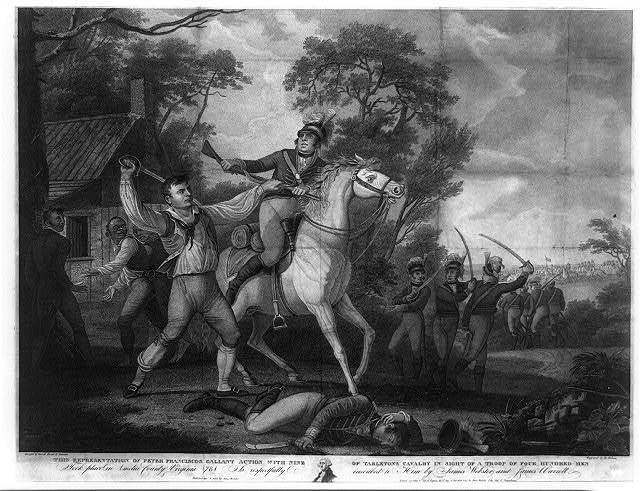
While recovering, he encountered nine British soldiers. Unarmed, Peter seized a sword from one of the men. He then killed that man and wounded and drove off the other eight. Their commander sent a hundred men to chase him, but they failed to even find him.

He later wrote of escape, “This was the last favor I ever did for the British.”

General George Washington is reputed to have said of Peter:

“Without him we would have lost two crucial battles, perhaps the War, and with it our freedom. He was truly a One-Man Army.”
 

Thanks for reading! We hope you enjoyed our post. Please share with all your fellow patriots. Brought to you by: Ultimate Flags
Posted on

Texans: 42 Yankees: 5,000 – No Problem – Texans Win!

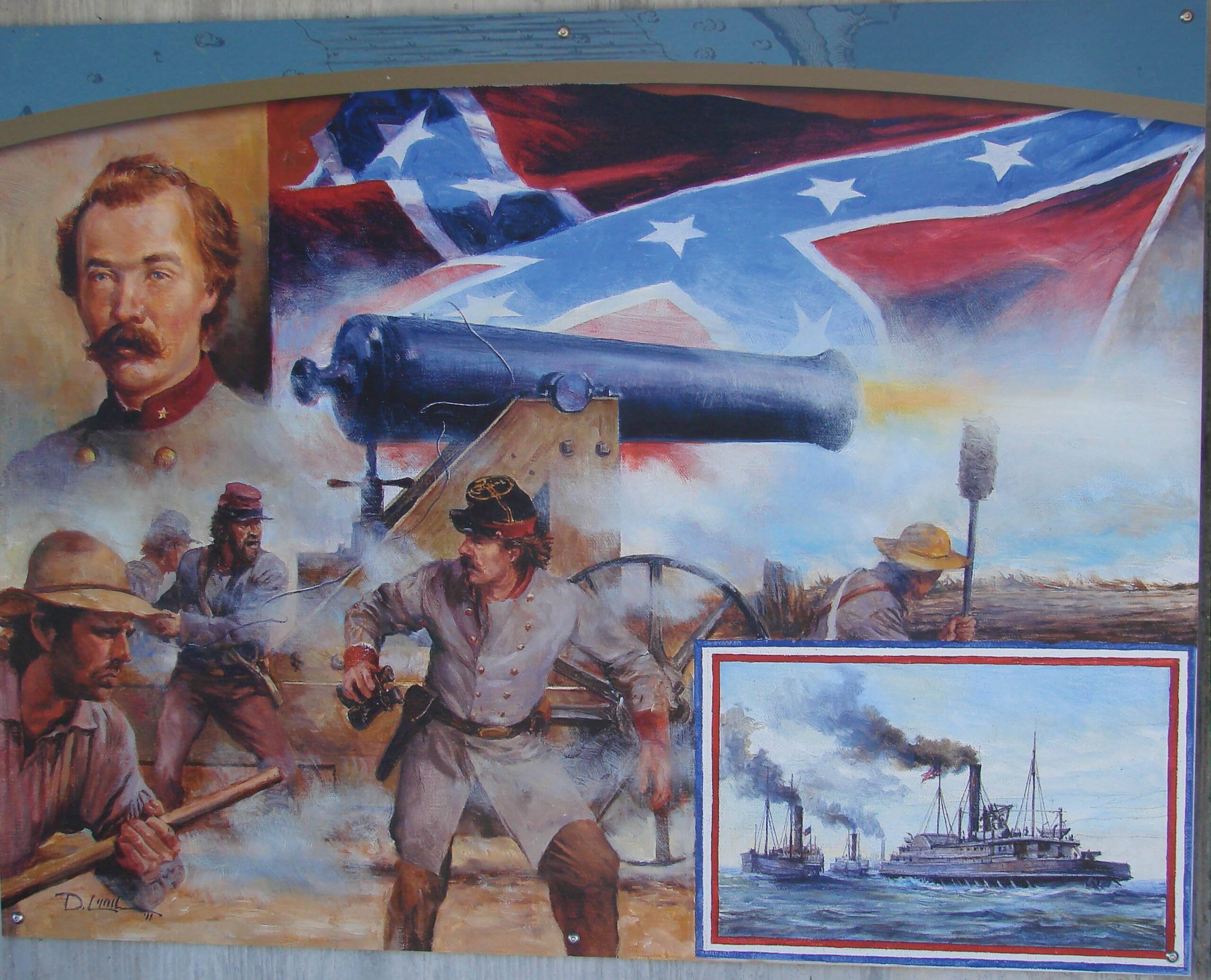
It was 1863. Union gunboats were a threat to the Texas interior because of rivers that emptied into the Gulf of Mexico. A fort built was at one of these vulnerable points:  Sabine Pass, where two rivers meet the Gulf.  

A Texas artillery unit was sent to man the fort.   It was not long before four Union gunboats appeared, escorting troop transports up the river – a total of 5,000 Federals. The Texans numbered 42. The situation appeared hopeless, so top command ordered the Guards to destroy the fort and retreat.  

The Texans talked it over and decided to fight.  After all, it was just a few thousand Yankees.

The gunboats started firing, the fort taking hits.  The Texans blasted two of the gunboats, two other vessels got grounded, and the whole thing was a mess for the invaders.   Most of the Union force withdrew, two boats surrendered, all with no casualties to the Rebels. But the surrender was a problem: the Texans didn’t need hundreds of prisoners marching up to the fort, only to discover a few dozen men.  So the Texan commander waded out into the river to accept the Union surrender and arrange for their custody without risk to the fort.  

An overwhelming force had been defeated, perhaps the most lopsided victory of the war.  And an invasion stopped in its tracks.

Forty-two Texans can sure make a statement.

Thanks for reading. Please share our posts with your friends and family so they too can learn more about Southern Heritage and History.

Brought to you by: Ultimate Flags

Posted on

Sherman’s Slash and Burn

In an earlier post we got a 10 year old girl’s view of the war as Sherman started his destructive march through Georgia.(Click here to read.) Here are more details.

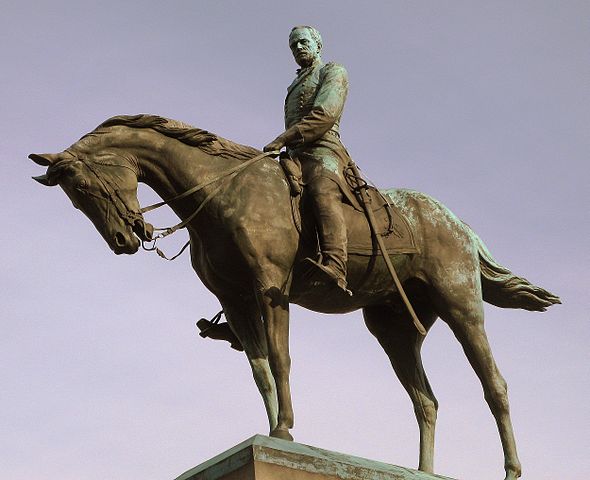
Needless to say that there will never be a statue like the one above honoring Union General Sherman in Georgia. And here’s the reason why.

Sherman’s  Special Field Orders No. 120 authorized a new kind of warfare. Part of it reads:

“…should the inhabitants burn bridges, obstruct roads or otherwise manifest local hostility, then army commanders should order and enforce a devastation more or less relentless, according to the measure of such hostility.”In case you doubt how severe he meant this to be, this will clarify Sherman’s intentions, from one of his telegrams to Ulysses S. Grant:

“Until we can repopulate Georgia it is useless to occupy it, but utter destruction of its roads, houses, and people will cripple their military resources. … I can make the march and make Georgia howl.”One of Sherman’s officers, John Acheson, wrote these words:

“…scores of poor families have I seen, who had had no hand in bringing the present trouble upon the country, left without a mouthful to eat, and not knowing where to turn to get it, or what in the world to do to relive their distress.”While Texas General Hood was negotiating with Sherman on the treatment of civilians in Atlanta, Hood wrote to Sherman:

“And now, sir, permit me to say that the unprecedented measure you propose transcends, in studied and ingenious cruelty, all acts ever before brought to my attention in the dark history of war.”

His scathing messages to Sherman reveal a lot. In one of them he wrote:  

“…there are a hundred thousand witnesses that you fired into the habitations of women and children for weeks, firing far above and miles beyond my line of defense.”Sherman achieved the status of war hero after the war, but not in the lands where he “slashed and burned.”

Thanks for reading. Please share our posts with your friends and family so they too can learn more about Southern Heritage and History.

Brought to you by: Ultimate Flags

Posted on

Password: “Victory or Death”

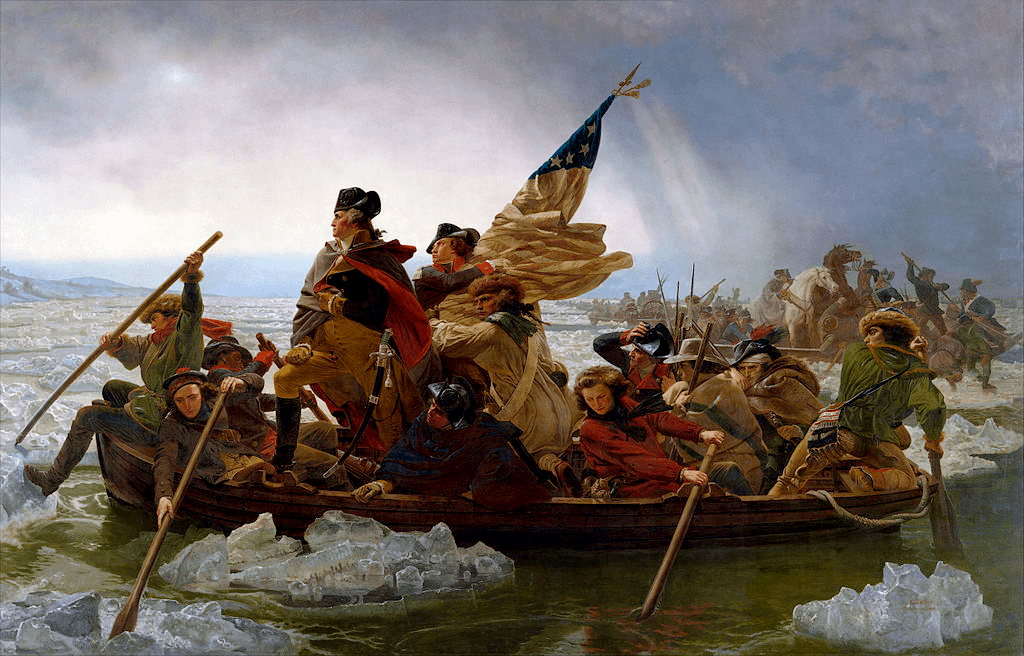
The battle was on Christmas Day of 1776. The place was Trenton, on the Delaware River of New Jersey. It was the scene of “Washington crossing the Delaware.”America had declared its independence not quite six months before, but the year’s battles had been one disaster after another. Philadelphia was in panic. The Continental Congress had to flee the city, but before it left this instruction was given to General Washington:“…until Congress shall otherwise order, General Washington shall be possessed of full power to order and direct all things.The Americans had been driven out of New York, and the harsh winter took its toll on Washington’s troops. Many of them were about to have their enlistment expire, and the General needed to act fast. He decided to attack at Trenton. The password for this operation was “Victory or Death.”It was a cold, dark night. Heavy snow and sleet came down as Washington and his men crossed a river running with flowing ice. His soldiers were poorly clothed, some without gear for their feet. Landing on the other side, they marched on to Trenton, some leaving traces of blood on the snow. Two froze to death.But the rebels surprised the Hessians, who attempted to form up in the town. American artillery and attack from front and read swiftly brought the battle to an end. Four Americans were wounded in the attack. The Hessians lost 20 killed and about 100 wounded.  One thousand Hessians were captured.Lieutenant James Monroe was wounded in the battle. The army’s surgeon saved his life, repairing a damaged artery in his shoulder. James Monroe went on to be America’s fifth president.  Founding Father and future president James Madison, and future Supreme Court Justice James Marshall were also present at the battle.This is not the end of the story, though. Washington’s decision to attack at Trenton not only gave the army and our new nation a need boost of morale, but provided a valuable resource after the war.The Hessian prisoners at Newtown signed a parole of honor, and Washington allowing them to keep their personal baggage without examination. They were all treated well, and were scattered throughout the western counties of Pennsylvania and parts of Virginia. Many decided to stay in America when the war was over, settling in the German communities of the Keystone State. Among them were critically needed metal workers, Germans of high skill. Their contributions were vital to the new nation’s industry, one that eventually became second to none.


Thanks for reading! We hope you enjoyed our post. Please share with all your fellow patriots. Brought to you by: Ultimate Flags
Posted on

“They came burning Atlanta to day…”

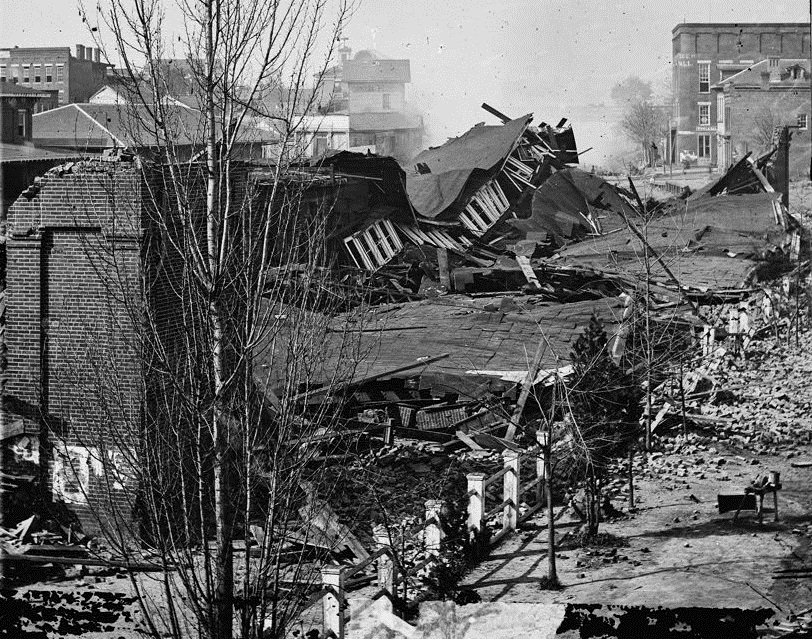
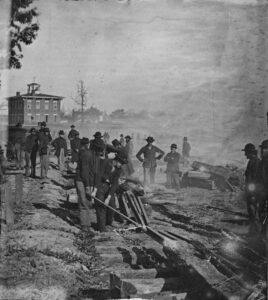
After capturing Atlanta in September 1864 during the Civil War, Maj. Gen. William T. Sherman,  ordered the destruction of all railroads, factories, and commercial buildings of possible use to the Confederacy. Though houses and churches were not targeted, some were looted and burned nonetheless. Here’s one of the many stories.

Ten-year-old Carrie Berry and her family lived in Atlanta, Georgia when Sherman arrived and started burning his way to the Georgia coast.

Here are some of Carrie’s diary entries: Sunday (13 Nov 1864):

“The federal soldiers have been coming to day and burning houses and I have ben looking at them come in nearly all day.”

Monday:

“They came burning Atlanta to day. We all dread it because they say that they will burn the last house before they stop.”

Tuesday:

“This has been a dreadful day. Things have ben burning all around us. We dread to night because we do not know what moment they will set our house on fire.”

Wednesday:

“Oh what a night we had. They came burning the store house and about night it looked like the whole town was on fire.  We all set up all night.  If we had not set up our house would have ben burnt up for the fire was very near and the soldiers were going around setting houses on fire where they were not watched. They behaved very badly.” The Union troops left the next day, and while her house was “torn up so bad,” it was still standing. On the 22nd of November she wrote:

“It is just a week today since the federals were burning. Papa and Mama say that they feel very poor. We have not got anything but our little house.  It is still very cold.”  

Four days later:

“I ironed this morning and in the afternoon I picked up nails and when I came home Papa and Grandpa were here. The Yankees payed Grandpa a visit and took every thing he had…” On January 2nd she was back in school.  She reports

“…studying arithmetic, spelling, reading and geography. We are all trying to see which will learn the most.”

This was a glimpse of the Civil War, as seen from the eyes of an innocent and brave 10 year old girl living in the South.

Sherman’s army destroying rail infrastructure in Atlanta, 1864

Thanks for reading. Please share our posts with your friends and family so they too can learn more about Southern Heritage and History.

Brought to you by: Ultimate Flags

Posted on

The Man Behind The Stars and Stripes – Francis Hopkinson

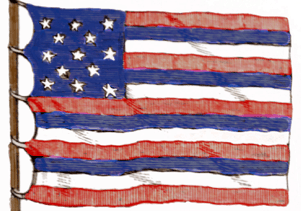
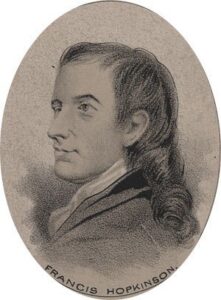
Betsy Ross made flags for 50 years, and we are all familiar with the famous circular 13-star design. Fewer know about Francis Hopkinson, signer of the Declaration of Independence and designer of our Stars and Stripes. Letters between Hopkinson and the Continental Congress tell the story, and these letters can be found in the National Archives.   In 1780 Hopkinson was the Treasurer of the Continental Loan Office. He also consulted with a committee to design the Great Seal of the United States. We have a letter he wrote to the committee, with a proposed design for the seal. In that letter, he also wrote about having designed the American flag in 1777. Since he was a public servant, his design was free, what he called “Labours of Fancy.” He did suggest, however, that receiving a “Quarter cask of the public wine” would be a nice show of appreciation. (This was thought a reasonable request, but by the time it made its way through the red tape of the government, it was never approved and Hopkinson never got his cask of wine.)The Continental Congress had in fact adopted our flag in July of 1777, a design described and provided by the Marine Committee. Hopkinson had served as the chairman of a board under that committee.While no flags have survived from that period, and we don’t have the original drawing, we do have a sketch likely done by Hopkinson that shows the linear pattern of the stars. It is that pattern that we proudly fly today as the Hopkinson Flag.

Francis Hopkinson


Thanks for reading! We hope you enjoyed our post. Please share with all your fellow patriots. Brought to you by: Ultimate Flags
Posted on

The Grand Old Union

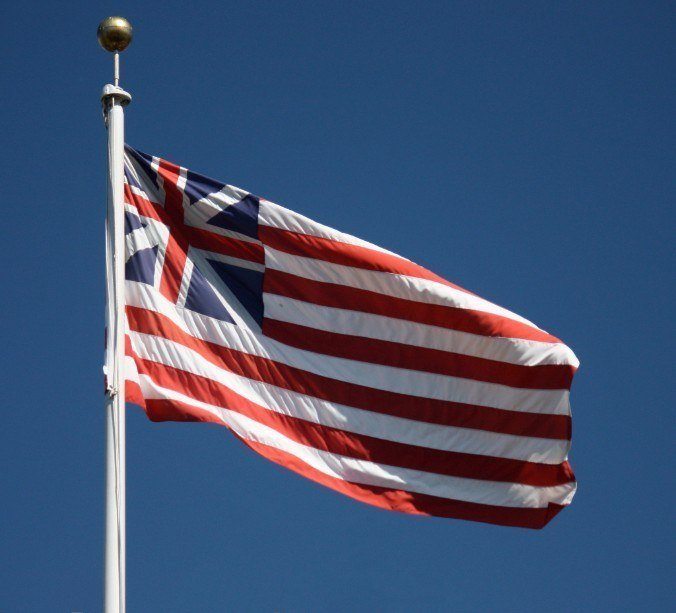
Americans love their Stars and Stripes, and fly it proudly.  But many do not know that it was not the one flying when the 13 Colonies declared Independence on July 4th, 1776.

The first flag that the early United States used as its “national flag” is known by several names, like Continental Colors and Grand Old Union. It’s usually called  the Grand Union, and it was being used by Americans in 1775 when the conflict with Britain began. As you can see it has the 13 stripes we know so well, but instead of stars on a white field, the British Union flag is displayed.When American colonists first began their struggle for greater liberty, full independence was not yet in the cards. Loyalty to the king was still proclaimed, even while fighting against the oppressive laws passed by British Parliament.  Because of this we also see the Union, or the “King’s Colors,” in the upper left corner. In those days what we now call the Union Jack really represented the King and his authority, and was not really a “national flag” as we think of one today. In fact, the Union flag had been a symbol of defiance to British governmental policies in North America at a time when King George III was not viewed as an antagonist to American freedom.

A diary entry of a British officer in Massachusetts, written May 1st, 1775, may help clarify:“The Rebels have erected the Standard at Cambridge; they call themselves the King’s Troops and us the Parliaments.” The “Standard” he mentions was the Union flag.   The stripes have their own origin. Colonial merchant ships had been using a red and white striped flag long before the War of Independence, and a striped flag was used by members of the Sons of Liberty Society who resisted unfair taxation and played a major role in battling the Stamp Act of 1765.  Originally consisting of nine stripes for the nine American colonies, this flag grew to 13 during the Revolutionary War. The Grand Union was the first naval ensign used aboard American ships of war.  The stripes were a natural part of the design because of their familiarity to American sailors.


Thanks for reading! We hope you enjoyed our post. Please share with all your fellow patriots. Brought to you by: Ultimate Flags
Posted on

“..forevermore do honor to our heroic dead.”

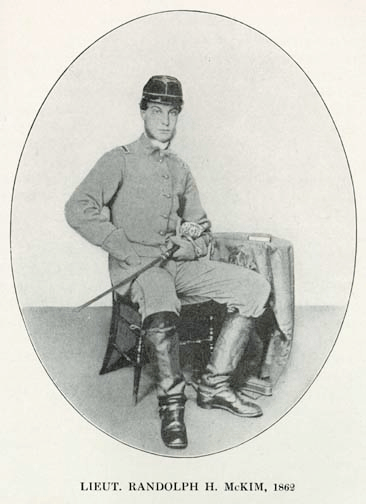
Randolph Harrison McKim enlisted as a Confederate private at the beginning of the Civil War. He rose through the ranks to become a lieutenant. After the war, he became pastor of the Episcopal Church of the Epiphany in Washington, D.C., where he served for 32 years.

McKim wrote a book about his experiences in the war, and included these words:

“We would not do aught (anything) to perpetuate the angry passions of the Civil War, or to foster any feeling of hostility to our fellow citizens of other parts of the Union. But we must forevermore do honor to our heroic dead.”

“We must forevermore cherish the sacred memories of those four terrible but glorious years of unequal strife. We must forevermore consecrate in our hearts our old battle flag of the Southern Cross… “

“The people that forgets its heroic dead is already dying at the heart and we believe we shall be truer and better citizens of the United States if we are true to our past.”

Well said, McKim for this message that everyone needs to hear, believe, and be true to.

Many today continue to honor those men and the “old battle flag of the Southern Cross.”

Thanks for reading. Please share our posts with your friends and family so they too can learn more about Southern Heritage and History.

Brought to you by: Ultimate Flags

Posted on

“I have not yet begun to fight!”

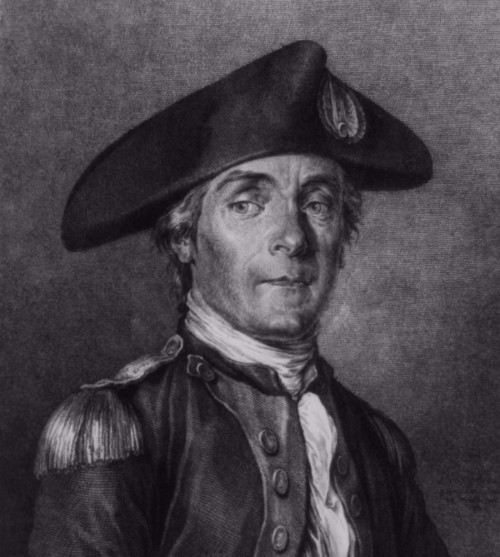
Famed US naval officer John Paul Jones was born in Scotland in 1742. At age 13 he began his career at sea, as a ship’s boy on the Friendship sailing between Britain and Virginia and the West Indies. By 21 he was the captain of his own ship.

Jones joined the Continental Navy during the American Revolution he was in Philadelphia shortly after the Revolution began. His friend, Joseph Hewes, a delegate to the Continental Congress, commissioned him as first lieutenant on the vessel Alfred.  He later commanded the sloop Providence.

Jones proved himself a capable officer and commander. Congress sent him to France as captain of the Ranger with orders to attack enemy commerce in British waters. In 1778 he captured the sloop of war Drake in a fierce struggle, and his capture of prizes and prisoners was creating a furor in the British press.

The French now took note of Jones and sent him off in August 1779 in command of a fleet of five naval vessels and two privateers. Jones’s ship was the Bonhomme Richard, around nine hundred tons and slow, but the most heavily armed vessel he had commanded.

On September 23, Jones fought one of the great battles of the Revolution off the Yorkshire coast. The enemy was the Serapis, one of the British escorts of a large convoy. In the battle, mostly fought in moonlight, the Bonhomme Richard grappled with the Serapis. With the two vessels lashed together, the British captain asked Jones if he wished to surrender. Jones shouted his famous reply, “I have not yet begun to fight.”

Surely Jones had not, and by dawn he had accepted the enemy’s surrender. This victory was the highlight of John Paul Jones’s career and  life.

Jones was always a rough and ready type, not willing to give up, and was in his element when the chips were down. When a roaring charge was needed, Jones was the fellow to get.  When life is hanging in the balance, fear and indecision are your enemies, and Jones was nothing if not decisive and unafraid.  He once wrote these words in a letter: “I wish to have no Connection with any Ship that does not Sail fast for I intend to go into harm’s way.”

After the war, he served in the Russian navy in the Black Sea in a war with the Turks. He died in Paris,in 1792, still an American citizen, and one of the great heroes of the U.S. Navy.

Today we still honor John Paul Jones by flying his unique American flag, called the Serapis after the ship he captured.


Thanks for reading! We hope you enjoyed our post. Please share with all your fellow patriots. Brought to you by: Ultimate Flags
Posted on

Nathan Forrest: No Wonder He Won So Many Battles

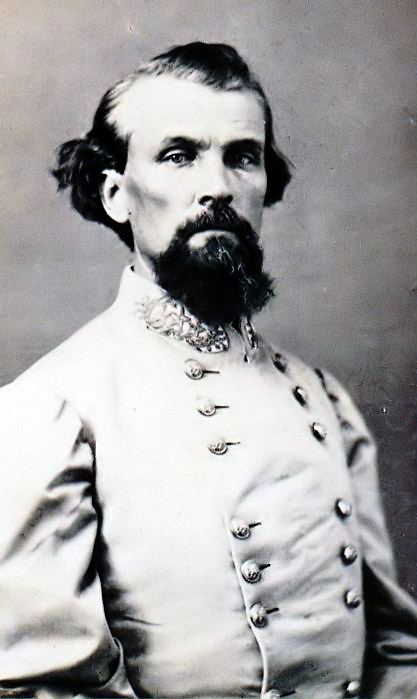
Nathan Bedford Forrest, simply put, is a controversial figure. The son of a blacksmith, he came from an untamed area of Tennessee. Forrest had practically no schooling, but went on to become one of the highest-ranking generals of the Civil War.  Like him or not, he was a smart man, a master tactician.  And he did not put up with fools,  and that included those few who were senior to him. There are many stories about Forrest. Here’s one about a Union officer who became very upset after he surrendered to Forrest.  

It was April of 1863 and a force of the Union cavalry under Colonel Abel Streight had orders to cut the Confederate railroad south of Chattanooga. Forrest chased the Union boys for 16 days, catching up with them in Rome, Georgia. Forrest only had 500 men with him, but he maneuvered them around to make it look like he had far more.

Streight finally surrendered his 1,700 soldiers to the Confederates. But when the colonel realized that he had conceded defeat to less than a third his number, he demanded that his surrender be reversed so he could battle it out. That demand went nowhere, naturally, and it was probably for the best for Streight. Forrest was known for defeating forces greater than his own in open battle.There is a story after the war about a Yankee officer was in business with Forrest. The officer came to his house one day, and as soon as Forrest’s horse saw the blue uniform, the horse attacked him, trying to bite and kick him. One of Forrest’s men saw what was happening, came over and saved the officer.

The Yankee officer told Forrest that it was no wonder he won so many battles, since his horses fought for him with as much fury as his men did.

Thanks for reading. Please share our posts with your friends and family so they too can learn more about Southern Heritage and History.

Brought to you by: Ultimate Flags
Posted on

The Battle at Stone’s River

Here is another tale of Private Sam Watkins, Company H, 1st Tennessee:“It was Christmas. John Barleycorn was general-in-chief. Our generals, and colonels, and captains, had kissed John a little too often…. We marched plumb into the Yankee lines, with their flags flying.”“I called Lieutenant-Colonel Frierson’s attention to the Yankees, and he remarked, “Well, I don’t know whether they are Yankees or not…”There was a lot of confusion about the situation, especially when the Yankees pulled back over the hill:“Oakley, color-bearer of the Fourth Tennessee Regiment, ran right up in the midst of the Yankee line with his colors, begging his men to follow. I hallooed till I was hoarse, “They are Yankees, they are Yankees; shoot, they are Yankees.”The shooting began, but confusion continued. Then a shell fragment struck Sam in the arm, “…and then a minnie ball passed through the same paralyzing my arm, and wounded and disabled me.”Just then General Cheatham came up, not so fazed by John Barleycorn as the rest. He was calling to his men, “Come on, boys, and follow me.” Sam tells the rest:“The impression that General Frank Cheatham made upon my mind, leading the charge, I will never forget. I saw either victory or death written on his face…as he was passing me I said, ‘Well, General, if you are determined to die, I’ll die with you.’”

“We were at that time at least a hundred yards in advance of the brigade, Cheatham all the time calling upon the men to come on. He was leading the charge in person. Then it was that I saw the power of one man, born to command, over a multitude of men then almost routed and demoralized.”

“I saw and felt that he was not fighting for glory, but that he was fighting for his country because he loved that country, and he was willing to give his life for his country and the success of our cause.”The Rebels won the field that day, and General Cheatham and Sam lived to fight again.

Thanks for reading. Please share our posts with your friends and family so they too can learn more about Southern Heritage and History.

Brought to you by: Ultimate Flags
Posted on

Battling the Barbary Pirates

North African pirates were menacing folks at least as far back as the Crusades. We have tales of them sailing as far north as Iceland, not only capturing merchant ships but plundering ports and taking captives for the slave trade.It was the habit of European nations to pay tribute to the scoundrels, rather than fight them. Eventually, the pirates organized into North African Barbary States, controlling the eastern half of North Africa along the Mediterranean Sea.  Their leaders got rich by extortion. But things were about the change. Before independence, American Colonial vessels were British, and protected by British payments to the pirates. After declaring independence, they were no longer covered by that deal, and the new nation had to pay their own tribute, which they did during the 1700s, over Thomas Jefferson’s objections.Then Thomas Jefferson was elected president, and he declared there was to be no more tribute, and sent the American Navy and Marines to deal with matters.It took some work, including landing Marines to assault a fortress in Tripoli, but eventually a treaty was worked out to protect American shipping. (Tripoli was the first American victory on foreign soil, with the Stars and Stripes flying over the fortress. The “Marine’s Hymn” still celebrates this with the line, “…from the shores of Tripoli.”)America had to send the Navy in again after the War of 1812, but things were settled in very short order: an American flag meant the vessel was safe.


Thanks for reading! We hope you enjoyed our post. Please share with all your fellow patriots. Brought to you by: Ultimate Flags