You can tell a WWI flag from a WWII flag by its dated design. A World War I flag carries the black-white-red patterns of the German Empire — a white war flag with a tall black cross and the imperial eagle — while a World War II flag carries the revised 1935-1945 German patterns: a swastika-bearing national flag and a red naval war ensign with the Iron Cross in the canton. On the American side the two wars are harder to separate, because the same 48-star flag flew through both. Every one of these patterns was set by regulation, so each design has a fixed date range you can check against.
- WWI German flags: black-white-red tricolor and a white war flag with the imperial eagle, 1867-1918.
- WWII German flags: swastika national flag and the red Kriegsmarine war ensign, 1935-1945.
- Both eras used a flag named Reichskriegsflagge — 35 years apart, with completely different designs.
- The same 48-star American flag flew through both world wars, 1912-1959.
- Date the German field first; it separates the two wars faster than anything else.

How do you tell a WWI flag from a WWII flag?
The two wars produced two different flag systems, and the differences are printed right on the fabric. Use this table as your first check:
| Flag | WWI era (1914-1918) | WWII era (1939-1945) |
|---|---|---|
| German national flag | Black-white-red tricolor of the German Empire | Swastika flag, sole national flag from September 15, 1935 |
| German war flag | White field, tall black cross, imperial eagle (1903-1918 pattern) | Red field, Iron Cross in the canton, swastika disk (1938-1945 pattern) |
| United States | 48-star flag, official July 4, 1912 | The same 48-star flag |
| Russia / Soviet Union | White-blue-red tricolor of the Russian Empire | Soviet red flag with hammer, sickle and star (adopted in the mid-1920s) |
| Japan | Rising Sun battle flags plus the national flag | The same Rising Sun and national designs |
| Britain and France | Union Jack (since 1801) and the French tricolor — unchanged | The same flags |
The pattern is simple: Germany redesigned its flags twice between the wars, so the German side always separates 1914 from 1939. Most of the Allies flew the same flags in both wars, which is why collectors anchor a mixed display on the German pieces and the dated regalia around them.
The German flags: two different countries, one name
Here is the trap that catches new collectors: both world wars flew a German war flag called the Reichskriegsflagge — literally, the Reich war flag. The name is the same; the designs are 35 years and two governments apart.
WWI: the Imperial German war flag, 1867-1918
The German Empire flew a black-white-red horizontal tricolor as its national flag, adopted with the North German Confederation in 1867 and kept at unification in 1871. Its army and navy carried the Imperial German War Flag: a white field with a tall black cross running to the edges, the black Prussian eagle on a white disk at the center, and a black-white-red canton bearing the Iron Cross. The final pattern was adopted in 1903, so the flag that flew through World War I is the 1903-1918 design. When the Empire fell in November 1918, the design was retired with it.
WWII: the swastika-era flags, 1935-1945
After 1918 the Weimar Republic flew black-red-gold. In March 1933 a decree made the swastika flag a co-national flag alongside the old black-white-red, and on September 15, 1935 the Reich Flag Law made it the sole national flag. The navy — renamed the Kriegsmarine in 1935 — carried a red war ensign with the Iron Cross in the canton and a swastika disk offset toward the hoist. A first 1935 pattern was revised to its final wartime form in 1938, and that 1938-1945 ensign is the WWII version collectors know from the Battle of the Atlantic. It stayed in official use until Germany’s surrender on May 8, 1945.

So the German check comes down to the field and the cross. White field with a centered black cross and an eagle: Imperial, WWI. Red field with the Iron Cross pushed into the canton: WWII. Nearly every mislabeled flag we see mixes one era’s field with the other era’s emblem, and once you know the two patterns you spot it at a glance.
The American flag: the same one in both wars
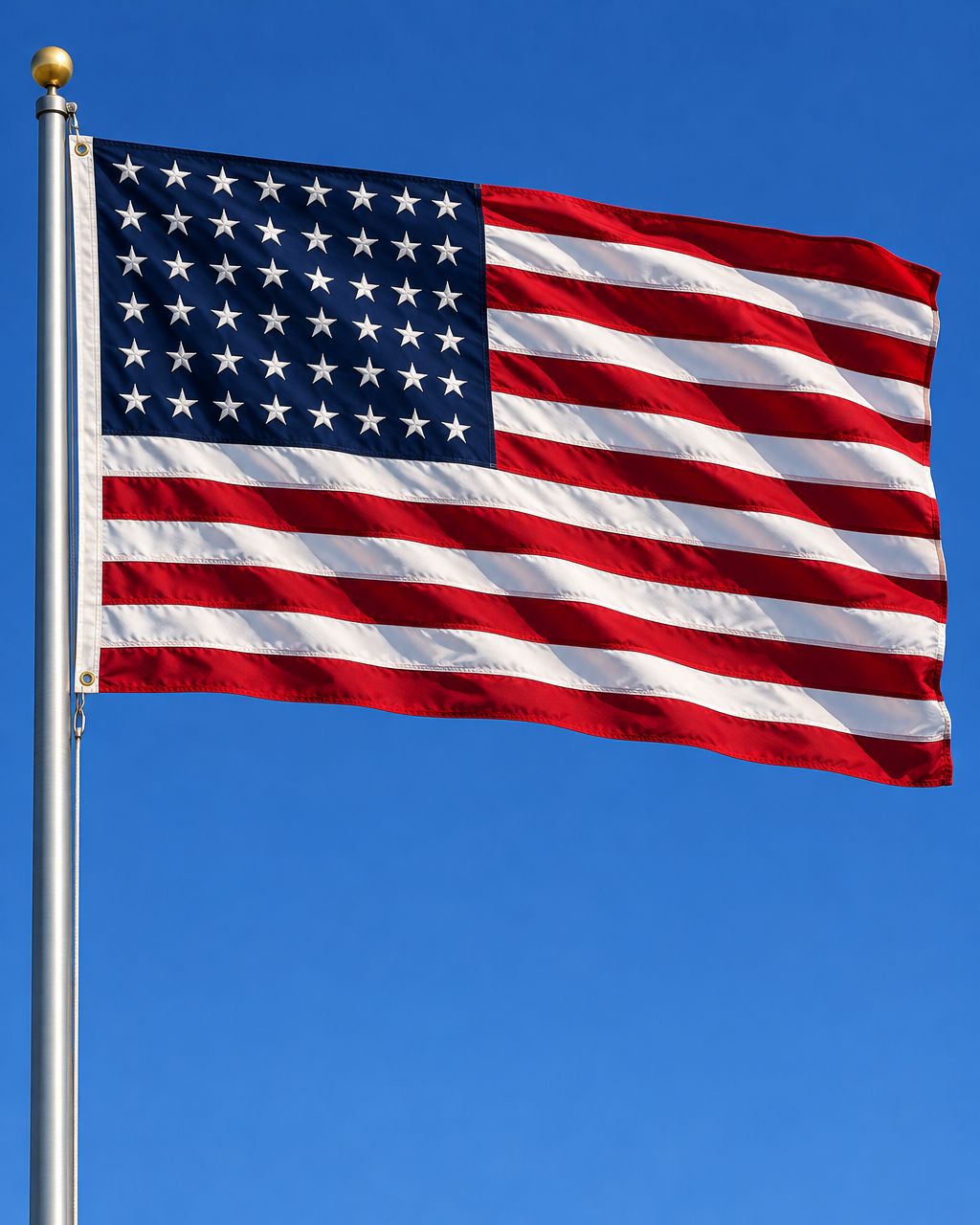
The United States flew the 48-star flag in both world wars, which makes the American side the least useful for dating. The 48th and 49th states, New Mexico and Arizona, joined in 1912, and the 48-star flag became official on July 4, 1912 — two years before the war began in Europe. It flew through World War I, World War II and the Korean War, and stayed official until Alaska earned the 49th star in 1959. That 47-year run is the longest of any version of the Stars and Stripes.
For a WWI-era display, the 48-star flag is the period-correct choice — and so is a WWII display. Stars in six rows of eight, sewn or embroidered, reads correctly for either war. If a 48-star flag in a collection has you curious about flying one, we have a full guide on whether you can fly a 48 star flag today.
The other nations: same flags, different neighbors
Most countries kept their flags across both wars, so the quickest secondary checks are the ones that did change:
- Russia. WWI flew the white-blue-red tricolor of the Russian Empire. By WWII the hammer-and-sickle red flag of the Soviet Union, adopted in the mid-1920s, had replaced it.
- Austria-Hungary. The empire dissolved in 1918, so its double-eagle standards exist only in WWI-era collections.
- The Ottoman Empire. Its red star-and-crescent flag flew through WWI; the Republic of Turkey adopted a new design in the 1920s and 1930s and stayed neutral through most of WWII.
- Britain and France. The Union Jack and the French tricolor flew unchanged in both wars — they cannot date a display, only support it.
- Japan. The Rising Sun battle flag dates to the Imperial Japanese Army in 1870 and the Navy in 1889, and it flew in both wars; the white-field national flag did too.
Four quick checks for a flag in hand
When a reproduction or an inherited flag lands on your table, run these in order:
- Date the German field. Black-white-red means the Empire era; red with the Iron Cross canton and swastika disk means 1935-1945. This one check resolves most mixed lots.
- Check the cross placement. The Imperial war flag centers its tall black cross and eagle on the field; the WWII war ensign pushes the Iron Cross into the canton beside the swastika disk. A design that mixes the two is a fantasy piece, not a regulation pattern.
- Count the American stars. 48 stars in six rows of eight fits both world wars; 45 or 46 stars predate WWI; 49 or 50 stars postdate it.
- Read the maker’s pattern year when present. Honest reproductions are labeled by pattern — our 1938-1945 Kriegsmarine and 1903-1918 Imperial designs, for example, carry their eras in the listings. A seller who dates the pattern is a seller who built it to the regulation.
Everything discussed here lives in one place on our shelves — browse the World War flag collection when you are ready to compare the patterns side by side. Most designs come in a standard 3 x 5 ft printed version, with sewn cotton and double-nylon embroidered constructions on the popular patterns.
Why the two wars separate so cleanly on German flags
Between 1918 and 1935 Germany went through three flag regimes in seventeen years: the Imperial black-white-red fell with the Empire in 1918, the Weimar Republic flew black-red-gold from 1919, and from 1933 to 1935 the old black-white-red and the swastika flag flew side by side as co-national flags. The September 15, 1935 Reich Flag Law ended the overlap. That whiplash is why German WWI and WWII flags look nothing alike — each war fought under a country that had rebuilt its flag system from scratch, and each pattern was fixed by law rather than by tradition. It is also why the 1933-1935 dual-flag period is its own small collecting niche today.
Related questions collectors ask
Did any flag fly in both WWI and WWII?
Yes. The 48-star American flag (1912-1959), the British Union Jack, the French tricolor and Japan’s Rising Sun and national flags all flew in both wars. That is exactly why German pieces are the dating anchors in mixed-war displays.
What is the difference between the two Reichskriegsflagge designs?
The Imperial version, flown 1867-1918, is white with a tall black cross, the Prussian eagle on a central disk and a black-white-red canton. The Nazi-era version, flown 1935-1945, is red with the Iron Cross in the canton and an offset swastika disk. Same name, completely different countries and designs.
Which German WWI flags are safe to display today?
The Imperial German designs carry no restricted symbols, and reproductions are collected and displayed openly. For the WWII-era designs, the display rules differ by country — no United States law restricts them, while Germany and Austria restrict public display of swastika-bearing flags. Keep pieces labeled by pattern year and displayed with historical context, the way museums do.
FAQ
How do you tell a WWI flag from a WWII flag?
Date the German design first: black-white-red and the eagle-marked white war flag are WWI (1867-1918), while the swastika national flag and the red Kriegsmarine ensign are WWII (1935-1945). The American 48-star flag flew in both wars, so it cannot separate them.
What flag did Germany use in WWI?
A black-white-red tricolor as the national flag, and the Imperial German War Flag (Reichskriegsflagge) for the army and navy — white with a tall black cross, the Prussian eagle and a black-white-red canton with the Iron Cross. The final pattern dates to 1903.
What flag did Germany use in WWII?
The swastika flag was the sole national flag from September 15, 1935, and the armed forces flew war flags built around the Iron Cross — the Kriegsmarine’s red ensign in its final 1938-1945 pattern is the version most collectors mean.
Was the American flag the same in both world wars?
Yes. The 48-star flag became official on July 4, 1912 and flew through both world wars until 1959, a 47-year run — the longest of any version of the Stars and Stripes.
What is the Reichskriegsflagge?
It means “Reich war flag” and names the war flag of the German armed forces in two separate eras: the Imperial design of 1867-1918 and a completely different swastika-era design of 1935-1945. Always date the design, not the name.
Which countries changed their flags between the wars?
Germany, Russia (Empire to Soviet Union), Austria-Hungary (dissolved in 1918) and the Ottoman Empire (replaced by the Republic of Turkey). Britain, France, Japan and the United States kept the same flags.
What size WWI or WWII flag works best for display?
A 3 x 5 ft reproduction is the workhorse — it fits standard display cases, stages and portable poles. Larger 4 x 6 ft and 5 x 8 ft pieces suit outdoor flying and theatrical use.
One last thing
Buy the pattern year you actually want, and label it. A 1903-1918 Imperial ensign and a 1938-1945 Kriegsmarine flag are both “Reichskriegsflagge” in a listing title, and the two will not mix in a period-correct display. Collectors in 2026 treat the documentation as part of the object: keep the pattern year with the flag, store it folded in acid-free tissue out of direct sun, and any reproduction you buy from us will match the regulation design it claims. When you are comparing eras, our World War flag collection keeps every dated pattern in one place.