Most authentic 48 star flags sell for $20 to $100 on the collector market in 2026. An ordinary cotton example in good condition brings $30 to $75, and clean, larger or maker-labeled pieces move past $150. Rare documented examples — wool bunting flags with a maker's label, framed presentation pieces, Native American woven flags — have carried auction estimates from $200 to $1,200. The label sewn inside the heading, not the 48 stars themselves, is usually what pushes a flag into the serious-money range.
- Most authentic 48 star flags sell for $20-$100 in 2026.
- Maker-labeled wool bunting flags reach $200-$300 at auction.
- The design was official July 4, 1912 through July 3, 1959.
- Condition, size and a maker’s label drive the price up.
- Reproductions cost far less and handle outdoor flying better.

How much is an authentic 48 star flag worth?
The honest answer depends on what kind of 48 star flag you are holding, because the era produced millions of them and the market sorts them by construction, size and paperwork. The figures below come from live listings and auction house estimates checked in November 2026 on eBay, LiveAuctioneers and Invaluable.
| Flag type | Typical value in 2026 | Where it usually sells |
|---|---|---|
| Standard cotton or bunting 3×5 ft | $20-$75 | eBay, estate sales |
| Larger 4×6 ft or 5×8 ft examples | $50-$150 | eBay, local auctions |
| Wool bunting with a maker's label | $200-$300 | Regional auction houses |
| Framed schoolhouse or casket flags | $20-$75 | LiveAuctioneers, eBay |
| Navajo-woven and one-of-a-kind pieces | $1,000 and up | Specialist auctions |
A plain cotton 48 star flag is worth more as a keepsake than as a commodity. The same design flew over every schoolhouse, porch and military base in the country for nearly five decades, so supply is deep and the base values stay modest. What separates a $30 flag from a $300 one is almost always a sewn-in maker's label or documentation tying the flag to a specific place or service.
Why the 48 star flag is the most common "old" flag
The 48 star flag was official longer than any American flag before it: from July 4, 1912 until July 3, 1959, a run of 47 years. Congress added two states in quick succession — New Mexico on January 6, 1912 and Arizona on February 14, 1912 — and the flag that resulted carried the country through the end of World War I, all of World War II, the Korean War and the early Cold War. That history is exactly why values stay grounded: factories turned out millions of cotton and wool examples for schools, homes and the military, and a large share of them survived in attics and trunks.
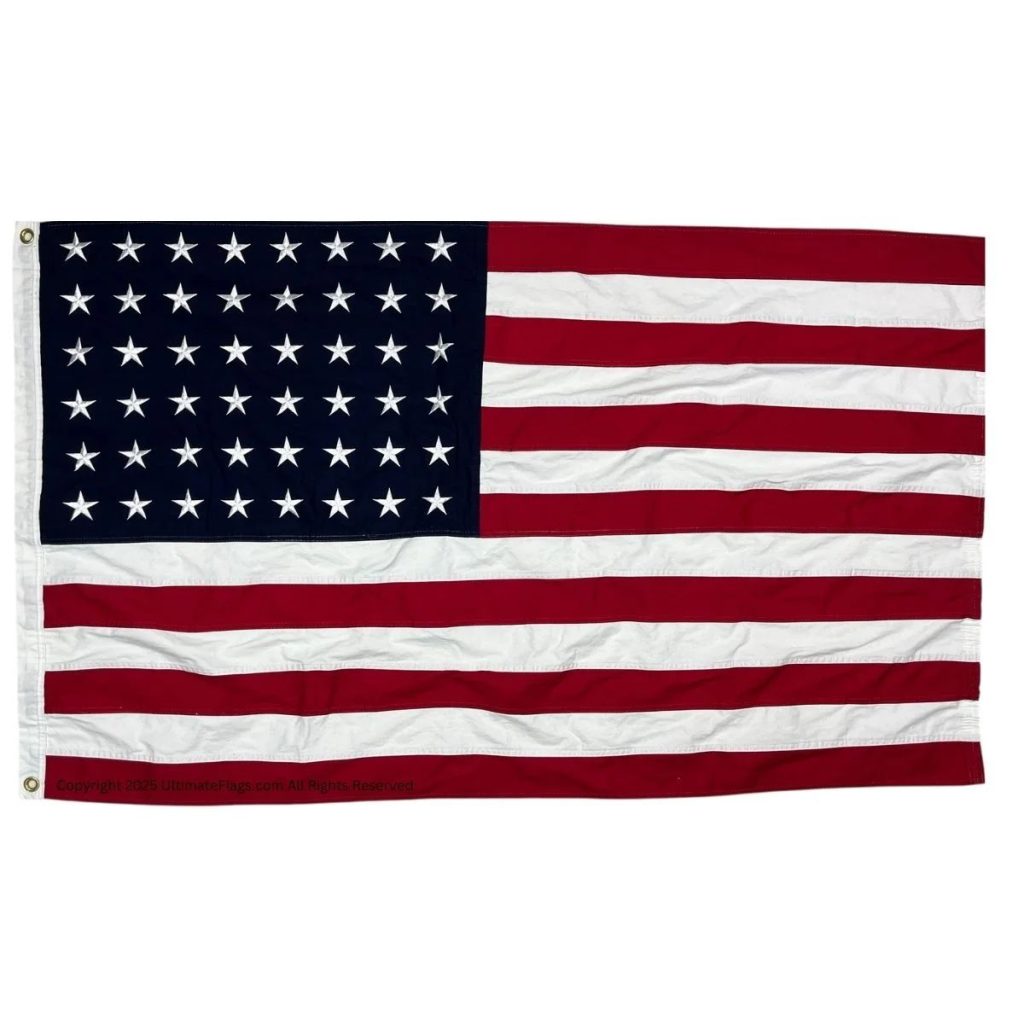
The 50 star flag finally outlasted the 48 star design's longevity in 2007, but for 95 years the 48 star version held the record. Its star pattern is fixed and easy to check: six rows of eight stars, established as the official arrangement in 1912.

What makes a 48 star flag worth more
- A maker's label. Flags stamped or sewn with the name of a historic maker — Annin is the classic example, a flag house dating to 1847 — sell at the top of the range. An Annin 100% wool bunting 4×6 ft flag with its original label carried a $200-$300 estimate at a Worthington Galleries auction in October 2024.
- Condition. Fading, fraying fly ends and mildew cut values hard. A crisp flag with strong reds, intact stripes and sound stitching outsells a weathered twin several times over.
- Size. Small parade and schoolhouse flags are plentiful, so larger display sizes in clean shape command a premium.
- Construction. Sewn stripes and embroidered or appliqued stars signal an earlier, costlier build than the printed economy flags common during the World War II years.
- Documentation. A flag tied to a named ship, base, family or event — with photos or papers to back it — leaves the commodity market entirely.
- Framing and storage. A professionally framed, UV-protected flag preserves both the textile and the value.
What the top examples actually sold for
The high end of the market is small but real. The Annin wool bunting flag above carried a $200-$300 estimate at auction. A framed 48 star schoolhouse flag listed at $75 on LiveAuctioneers in 2026, and a mid-century casket flag with 48 gold stars carried an estimate near $20 — proof that sentiment alone does not move price without documentation. At the very top, a Navajo-woven American flag carried a $1,200 auction estimate, because handwoven indigenous versions are genuinely scarce rather than merely old.
The pattern across all of these: scarcity and a story set the price, not the star count. A warehouse of identical cotton flags keeps ordinary examples in the $20-$100 lane no matter how proud the family history behind one of them is.
How do you tell if a 48 star flag is authentic?
Start with the fabric. Period flags are wool or cotton bunting — wool feels slightly fuzzy and smells distinctly animal when damp, cotton is soft and matte — while modern reproductions are usually nylon or polyester with a synthetic sheen. Check the stars next: earlier pieces have sewn or embroidered stars, wartime economy versions have printed ones, and both are legitimate for the era. Look for a canvas heading, brass grommets and any maker stamp along the hoist. Our guide to telling a 48 star flag replica from an antique walks through the full inspection, including the traps that make wear look like age.
One caution worth stating plainly: a label can be faked and a story can be borrowed, so weigh any premium against the physical evidence on the flag itself.
Are 48 star reproductions worth buying instead?
For anyone who wants to actually fly the flag, a reproduction is the smarter buy in 2026. A genuine example worth owning as a collectible should stay indoors, out of the sun and wind, because one season on a pole can erase a third of its value. Reproductions are built to fly: the 48 star flag collection at Ultimate Flags includes sewn cotton versions with embroidered stars in 3×5, 4×6 and 5×8 ft, plus a heavy-duty 2-ply double nylon build made for exposed outdoor poles.

A reproduction also lets you mark the real occasions the design belongs to — Veterans Day, a World War II family anniversary, a museum-style display — without putting a $200 antique at risk in the weather. Keep the original for the case, and fly the reproduction on the pole.
FAQ
How much is an authentic 48 star flag worth in 2026?
Most sell for $20 to $100, with ordinary cotton examples in good condition bringing $30 to $75. Maker-labeled wool bunting flags carry auction estimates of $200 to $300, and rare handwoven pieces can top $1,000.
When was the 48 star flag the official American flag?
July 4, 1912 through July 3, 1959 — 47 years, longer than any earlier version. New Mexico and Arizona statehood in 1912 added the 47th and 48th stars.
Why are 48 star flags so common and inexpensive?
The design flew for nearly five decades across both World Wars and Korea, so factories produced millions. Deep supply keeps ordinary examples in the $20-$100 range.
What makes a particular 48 star flag worth more?
A sewn-in maker’s label such as Annin, excellent condition, larger size, sewn rather than printed construction, and documentation tying the flag to a specific ship, base or family all raise the price.
How are the 48 stars arranged on an authentic flag?
Six rows of eight stars, the official pattern set in 1912. A 48 star flag with a different arrangement is a novelty or a homemade piece, not the official design.
Should I fly an authentic antique 48 star flag outdoors?
No. Sun and wind quickly strip value from a collectible flag. Keep the antique indoors or framed and fly a sewn reproduction, which is built to take the weather.
How do I know if my 48 star flag is authentic?
Check the fabric for wool or cotton bunting, look for sewn or printed stars consistent with the era, and inspect the heading and grommets for canvas and brass. A maker’s stamp on the hoist is the strongest single sign.
One last thing
The framed gold-star casket flags of this era often carry the humblest estimates of all — one mid-century 48 gold star example listed near $20 in 2026 — because the market prices cloth and paperwork, not emotion. If you own one, its value to your family does not need an auction house to confirm it; if you are buying, buy the fabric and the label, not the story.
Related guides