The best historic Georgia state flag for a heritage display is the 1956-2001 Old Georgia flag in double nylon embroidered fabric — it reads correctly from both sides, handles year-round weather, and comes in sizes from 3×5 ft up to 10×15 ft. If you want the same look for less, the 3×5 ft standard double-sided polyester version is the smart buy for a light-wind pole. And for a museum-style indoor display, nothing beats the sewn cotton embroidered version. Georgia flew the 1956 flag longer than any design before or since — 45 years, from February 1956 until January 2001 — which is exactly why collectors and Georgia families still ask for it first.
- Best overall: the 1956-2001 Old Georgia flag in double nylon embroidered for year-round outdoor display.
- Best budget pick: the 3×5 ft standard double-sided polyester Old Georgia flag for light-wind poles.
- Best for indoor collections: the sewn cotton embroidered Old Georgia flag.
- Georgia flew the 1956 flag for 45 years — February 1956 to January 2001.
- Every flag here is a modern reproduction, not a wartime original.

Why the 1956 flag still anchors a Georgia heritage display
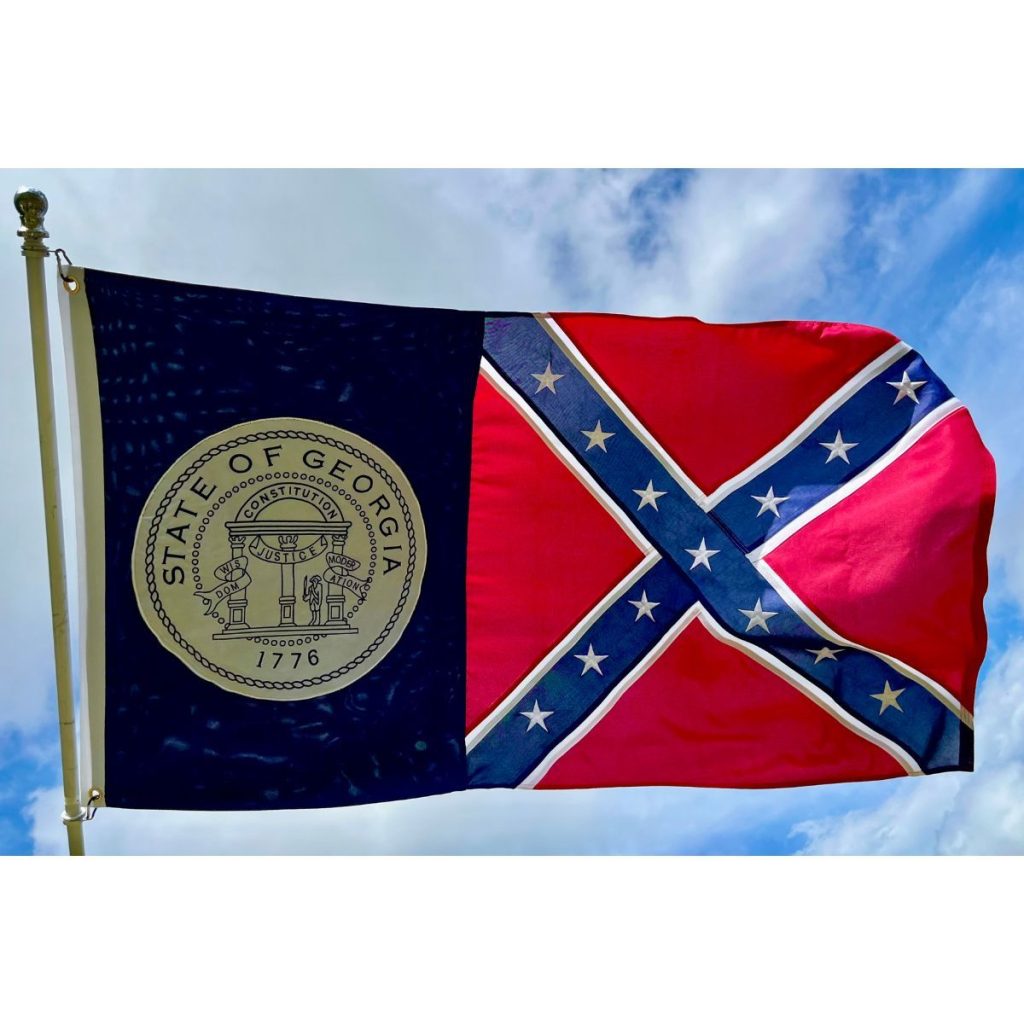
The 1956 design put the Georgia state seal on a vertical blue band at the hoist and the Confederate battle flag across the right two-thirds of the field. The Georgia General Assembly adopted it in February 1956, two years after the U.S. Supreme Court's Brown v. Board of Education decision, and historians widely tie the redesign to the fight over school desegregation. It flew over the state capitol, courthouses and schools until January 2001, when legislation replaced it. That 2001 replacement proved so unpopular it lasted barely two years before Georgia adopted its current flag in 2003.
Displaying the 1956 design today is a statement about Georgia history and collecting, not politics — and that is the spirit this guide keeps. Families fly it for its 45-year run, reenactors use it for period accuracy, and collectors value it as the most recognizable Georgia state flag ever made.
What makes the best historic Georgia state flag
- An accurate design. The real 1956 flag carries the state seal on the blue band and a 13-star battle emblem on the red field. A reproduction that blurs either detail is not worth hanging.
- Fabric matched to the setting. Nylon and polyester handle rain and sun outdoors; cotton belongs indoors.
- Reads correctly from both sides. A double-sided or double-nylon build shows the seal right-reading from either direction.
- A size that fits the pole. A 3×5 ft flag suits most residential poles; larger flags need taller, heavier-duty poles.
- Stitching that survives. Quad-stitched fly ends and reinforced metal grommets separate a flag you fly for years from one you replace every season.
The best historic Georgia flags at a glance
| Flag | Best for | Standout feature | Key limitation |
|---|---|---|---|
| 1956-2001 Old Georgia flag, double nylon embroidered | Year-round outdoor display | Embroidered on both sides, sizes 3×5 to 10×15 ft | Heaviest and most expensive build |
| 1956-2001 Old Georgia flag, 3×5 ft standard double-sided | Budget and light-wind poles | Two flags sewn back to back with a liner | Best in fair weather |
| 1956-2001 Old Georgia flag, sewn cotton | Indoor and collector displays | Authentic cotton weave with embroidered design | Not for outdoor or wet use |
| Georgia 1902-1906 state flag | Early Georgia history displays | Pre-1956 design with the state coat of arms | Made in 5×8 ft only |
1. Old Georgia double nylon embroidered: best for year-round outdoor display
This is the flag we point Georgia families to first. The 1956 design is embroidered into two layers of double-ply nylon, with the seal sewn on both sides so nothing reads backward on the reverse. Sizes run from 3×5 ft up through 10×15 ft, so it works on a suburban pole or a commercial mast. Quad-stitched edges and brass grommets are built for permanent display — the kind where the flag stays up through rain, sun and wind.
Old Georgia double nylon embroidered pros:
- Embroidered design on both sides, not printed
- Sizes from 3×5 ft up to 10×15 ft
- Double- and quad-stitched edges, reinforced grommets
- UV-stable, waterproof nylon built for permanent display
Cons:
- Heavier fabric needs a decent breeze to fly its best
- The largest sizes call for heavy-duty poles and hardware
Best for: a permanent outdoor pole where the flag stays up day after day.

The Old Georgia double nylon embroidered flag flying outdoors — seal and battle emblem both right-reading.
2. Old Georgia 3×5 ft standard double-sided: best budget heritage flag
If your pole sees light to moderate wind, or you simply want the 1956 look without spending much, the standard polyester version earns its keep. Two flags are sewn back to back with a liner between them, so the seal reads correctly from either side. The dye goes through the weave and resists fading, the edges are double stitched with a quad-stitched fly end, and reinforced metal grommets attach to any standard pole.
Old Georgia 3×5 ft standard double-sided pros:
- True double-sided construction with a liner
- Bright, fade-resistant through-dye
- The most affordable of the three 1956 builds
Cons:
- Suited to fair-weather display rather than year-round storms
- Printed dye rather than embroidery
Best for: seasonal displays, events, parades and light-wind residential poles.

The 3×5 ft double-sided Old Georgia flag on an outdoor pole in full sun.
3. Old Georgia sewn cotton embroidered: best for indoor and collector displays
Cotton is what a mid-century Georgia flag actually felt like, and that matters on a wall. The cotton version of the Old Georgia flag is embroidered, full-textured and made in 2×3, 3×5 and 4×6 ft sizes. It hangs beautifully in a den, a museum case or an honor display, and it is the build reenactors reach for when the camera matters. The tradeoff is simple: cotton soaks up rain and mildews, so this flag belongs indoors. If your display sees weather, choose the nylon or polyester builds above.
Old Georgia sewn cotton pros:
- Authentic cotton weave that looks, feels and moves right
- Embroidered design with real depth and texture
- Made in 2×3, 3×5 and 4×6 ft sizes
Cons:
- Not for outdoor or wet use
- Too heavy for long-term marching
Best for: indoor displays, museums, honor guards and collections.
4. Georgia 1902-1906 flag: best for early Georgia history
Want to tell a longer story than the 1956 era? Georgia's flag from 1902 to 1906 carried the state coat of arms on a blue field — no battle emblem at all. The store's 5×8 ft nylon embroidered version is a single-size specialty piece, and it pairs well with the 1956 flag in a timeline display: coat of arms era, then battle emblem era, then the current 2003 design. It is a narrower pick, but for a heritage wall covering Georgia's whole flag history, it fills a gap nothing else does.
Georgia 1902-1906 flag pros:
- Pre-1956 design with the state coat of arms
- Embroidered nylon with double- and quad-stitched edges
- Outdoor-capable fabric
Cons:
- Made in 5×8 ft only
- Harder to source than the 1956 designs
Best for: timeline displays and early-state-history collectors.
A quick timeline of Georgia's state flags
- 1879: Georgia adopts its first official state flag.
- 1902-1906: The state coat of arms joins the blue field.
- February 1956: The General Assembly adopts the design with the battle emblem across two-thirds of the field.
- January 2001: The 1956 flag is retired and replaced by a blue design bearing seals and ribbons.
- 2003: Georgia adopts its current flag, based on the First National "Stars and Bars" layout, with the state coat of arms and the words "In God We Trust."
How to display a historic Georgia flag
A reproduction deserves honest context. Label the display with the dates the design actually flew — February 1956 to January 2001 — so visitors know exactly which era they are seeing. Fly it with the same care as any state flag: keep it off the ground, bring cotton versions indoors before rain, and retire a tattered one respectfully. In a public space, lead with the history — the dates, the 2001 retirement and the 2003 replacement. Facts keep the conversation calm, and a dated plaque turns a flag into an exhibit.
How we ranked these historic Georgia flags
We ranked on the criteria above: design accuracy, fabric matched to the setting, two-sided readability, size range and stitching. All four flags come from Ultimate Flags' verified Old Georgia collection, and each earned a distinct use-case slot so you can match the flag to the way you actually display. No wartime originals are involved — these are quality reproductions, and we say so plainly.
Which historic Georgia flag should you choose?
If the flag flies outdoors year-round, buy the double nylon embroidered Old Georgia flag. If it flies in fair weather or you want the lowest cost, the 3×5 ft double-sided standard is the pick. Wall display or collection? Cotton. And if you are building a full Georgia timeline, add the 1902-1906 coat of arms flag beside it. When in doubt, start in the Shop Ultimate Flags Old Georgia collection and pick the fabric that matches your pole.
FAQ
What is the old Georgia flag?
The old Georgia flag is the state flag Georgia flew from 1956 to 2001: a blue band with the state seal at the hoist and the Confederate battle flag across the right two-thirds of the field. It served as the official state flag for 45 years.
Why did Georgia change its flag in 1956?
The Georgia General Assembly adopted the new design in February 1956, two years after the Brown v. Board of Education decision. Historians widely tie the redesign to the era’s fight over school desegregation.
When was the old Georgia flag retired?
In January 2001, when legislation replaced it with a new design. That 2001 replacement itself lasted only until 2003.
What flag does Georgia fly now?
Georgia’s current flag, adopted in 2003, is based on the First National Confederate ‘Stars and Bars’ layout, with the state coat of arms in a circle of thirteen stars and the words ‘In God We Trust.’
Can I still buy the old Georgia flag?
Yes. Reproductions are sold in standard polyester, double nylon embroidered and sewn cotton builds, in sizes from 2×3 ft up to 10×15 ft. Ultimate Flags stocks the full range in its Old Georgia collection.
Does any city still fly the 1956 Georgia flag?
Yes. Trenton, Georgia, adopted the 1956 design as its official city flag after the state retired it.
What size old Georgia flag should I fly at home?
A 3×5 ft flag suits most homes and residential poles. Move up to 4×6 ft or larger only when your pole is tall and sturdy enough to carry it.
Is the old Georgia flag the same as the Confederate battle flag?
No. The battle emblem fills only the right two-thirds of the 1956 flag; the hoist third is a blue band carrying the Georgia state seal.
One last thing
The shortest-lived official Georgia flag is not the one you think. The 2001-2003 design — a blue field crowded with inlaid seals and ribbon banners — was replaced after barely two years, the quickest retirement in the state's flag history. If your collection wants that transitional design too, it exists as its own chapter alongside the 1956 and current flags.