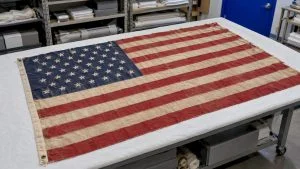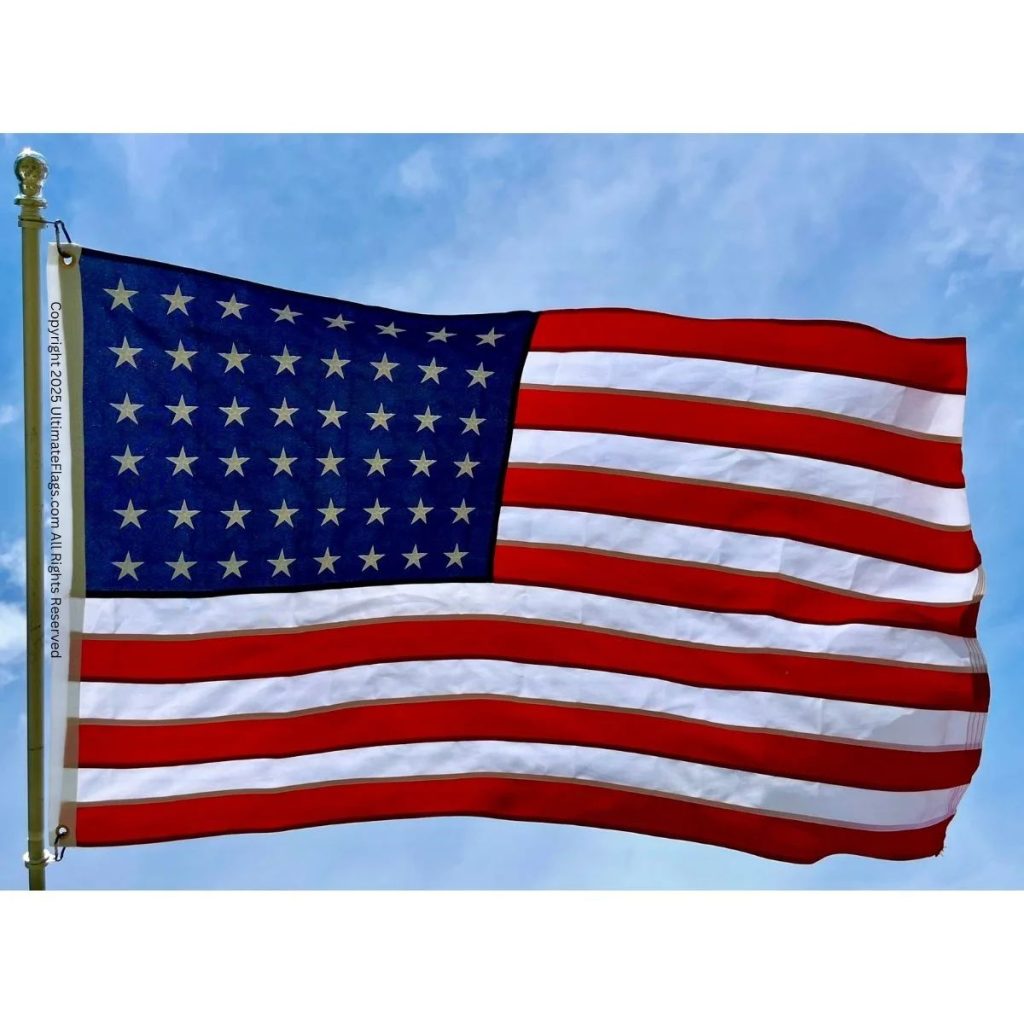
Best overall: the sewn 2-ply double nylon 48 star flag — embroidered stars on both sides and the closest thing on the market to the flag that flew over America from 1912 to 1959. Best for ceremonial and indoor displays: the sewn cotton 48 star flag in 3×5, 4×6 and 5×8 ft sizes. Best budget option: the printed 3×5 ft standard polyester 48 star flag. All three sit in the Ultimate Flags 48 star flag lineup, and each one answers a different collecting question, so the right 48 star flag depends on where it will fly and who will see it.
- The sewn 2-ply double nylon 48 star flag wins overall: embroidered stars, all-weather, longest lasting.
- Sewn cotton is the collector and ceremony pick; it is not made for year-round outdoor weather.
- Printed standard polyester is the budget pick for fair-weather porches, parades and events.
- The 48 star design was official from 1912 to 1959 — 47 years, the longest any US flag design has served.
- Buy by display, not by habit: nylon outdoors, cotton indoors, polyester on a budget.

What makes the best 48 star flag for collectors
Six checks settle it before any comparison table:
- Correct star field. 48 stars in six staggered rows of eight — the exact pattern President Taft's 1912 executive order standardized. A flag with a wrong arrangement is not a 48 star flag, whatever the label says.
- Construction that matches the display. Embroidered stars and sewn stripes for collections and ceremonies; through-printed polyester for everyday fair-weather flying.
- Fabric honesty. Cotton looks and feels period-correct but should not live outside; nylon sheds rain; polyester trades lifespan for price.
- Sizes that fit the pole or the room. 3×5 ft suits most home mounts; 4×6 and 5×8 ft fill larger rooms, stages and bigger poles.
- Accurate proportions. The same 1912 order set the flag's proportions, so a well-made reproduction keeps them.
- Documentation. A store that dates the design (1912 to 1959) and explains its history is easier to trust than one that does not.
48 star flags at a glance
| Flag | Best for | Standout feature | Key limitation |
|---|---|---|---|
| Sewn 2-ply double nylon 48 star flag | All-weather outdoor display | 48 embroidered stars on both sides | Highest cost of the three |
| Sewn cotton 48 star flag | Ceremonial and indoor displays | Traditional cotton with embroidered stars | Not built for extended outdoor exposure |
| Printed 3×5 ft standard polyester | Budget and fair-weather display | Light weight, flies in a slight breeze | Printed, not sewn; shorter outdoor life |
1. Sewn 2-ply double nylon 48 star flag: best for outdoor display
This is the working replica. The double-nylon version at Ultimate Flags uses two plies of nylon with 48 embroidered stars on both sides, sewn — not printed — stripes, two brass grommets, quad-stitched seams and a reinforced fly end. That is the construction list of a flag meant to spend its life on a pole, and it is the one to hang outdoors if you want a 48 star flag that outlasts the seasons.

Sewn 2-ply double nylon 48 star flag pros:
- Embroidered stars on both sides; stripes sewn, not printed
- Double-ply nylon sheds rain and resists fading and tearing
- Quad-stitched seams and a reinforced fly end handle steady wind
- Weight and drape come closest to a period 48 star flag
Cons:
- Costs more than the other two versions
- Heavier fabric needs a reasonable breeze to fly at full stretch
Best for: outdoor poles, veteran memorials and year-round display.
2. Sewn cotton 48 star flag: best for ceremonial and indoor displays
Cotton is the traditionalist's fabric, and this version covers the sizes collectors actually ask for: 3×5, 4×6 and 5×8 ft. The stars are embroidered and the stripes sewn, the mounting is brass grommets, and the seams are double-stitched. The store's own product guidance is blunt about the trade: cotton flags are not designed for extended outdoor exposure, so plan this one for indoor and ceremonial duty.

Sewn cotton 48 star flag pros:
- Embroidered stars and sewn stripes on thick premium cotton
- Three sizes — 3×5, 4×6 and 5×8 ft — for rooms, stages and large poles
- The traditional look museums, schools and honor guards expect
- Brass grommets and double-stitched seams for careful handling
Cons:
- Not made for extended outdoor exposure
- Heavy when wet and slower to dry than nylon
- Needs gentler care than the synthetic versions
Best for: classrooms, museums, reenactment camps, ceremonies and framed collector displays.
3. Printed 3×5 ft standard polyester 48 star flag: best budget pick
The standard version is printed rather than sewn, but it is printed through, so the design reads correctly on both sides. The fabric is a 100% synthetic, waterproof super-weave polyester with bright, fade-resistant inks, double-stitched edges all around and reinforced grommet holes with metal rings. Because it is light, it flies well even in a slight breeze — the store lists it as its most popular quality level, and for good reason Today: it is the easy choice for parades, events, seasonal porch display and gifts.
Printed standard polyester 48 star flag pros:
- The lowest-cost way to own a correct 48 star design
- Light weight flies in the slightest breeze
- Through-printed, so the design shows on both sides
- Waterproof synthetic material with reinforced metal grommets
Cons:
- Printed, not sewn — collectors will notice at close range
- Fair-weather construction; not for year-round storms
- Shortest outdoor lifespan of the three
Best for: parades, events, seasonal display and first-time buyers on a budget.
How we ranked these 48 star flags
The six criteria above did the sorting. All three flags carry the correct six-by-eight star field, so construction and fabric fit decided the order. The double nylon wins on durability and authenticity of feel, the cotton wins on tradition and ceremony, and the polyester wins on price. No printed flag outranks a sewn one for a collection, and no cotton flag belongs at the top of an outdoor ranking — which is why the three sit in this order rather than a different one.
A short history worth knowing before you buy
The 48 star flag became official on July 4, 1912, after New Mexico and Arizona pushed the state count to 48, and it served until July 3, 1959 — 47 years, longer than any other American flag design until the 50-star flag passed it in 2007. President Taft's executive order of June 24, 1912 standardized both the staggered six-by-eight star pattern and the flag's proportions, which is why accurate reproductions share the same clean geometry. This is the flag that flew during World War I, World War II — including the one raised on Mount Suribachi at Iwo Jima in 1945 — and the Korean War. For the etiquette side of flying one today, the guide Can you fly a 48 star flag today? covers lighting, weather and half-staff rules in detail.
Which 48 star flag should you buy?
Buy the sewn 2-ply double nylon if the flag will live outdoors. Buy the sewn cotton if it will hang indoors, travel to reenactments or headline a ceremony — the 4×6 and 5×8 ft sizes fill a large room in a way a 3×5 printed flag cannot. Buy the printed standard polyester if you want a correct 48 star flag for a parade, a fair-weather porch or a budget gift. When you are ready to Shop Ultimate Flags Store, all three versions sit side by side in the 48 star flag category, which makes comparing fabric and size in one place simple.
FAQ
What years was the 48 star flag official?
July 4, 1912 to July 3, 1959. It followed New Mexico and Arizona statehood and gave way to the 49-star flag after Alaska joined the Union — 47 years in total, the longest run of any US flag design until the 50-star flag passed it in 2007.
How are the 48 stars arranged?
In six staggered rows of eight — 6-8-6-8-6-8. President Taft’s June 24, 1912 executive order set that pattern and the flag’s proportions.
Which 48 star flag is best for outdoor use?
The sewn 2-ply double nylon version. It has embroidered stars on both sides, sewn stripes, quad-stitched seams and a reinforced fly end for all-weather flying.
Can a cotton 48 star flag fly outside?
Not for extended periods. The store’s own guidance says cotton flags are for indoor and ceremonial use; for permanent outdoor display choose the double-nylon version.
What size 48 star flag should I buy?
3×5 ft fits most home poles and standard displays. Choose 4×6 or 5×8 ft cotton for large rooms, stages and ceremonies where the flag is the centerpiece.
Was the Iwo Jima flag a 48 star flag?
Yes. The flag raised on Mount Suribachi in February 1945 carried 48 stars — the design had been official since 1912 and served through World War II.
Is a printed 48 star flag acceptable to display?
Yes, for parades, events and fair-weather display. Collectors and ceremonies generally prefer sewn and embroidered versions for their look and durability.
One last thing
One detail even careful buyers miss: the 1912 executive order set the flag's proportions as well as its star pattern, so a 48 star flag that looks slightly too long or too square is drifting from the documented design. Check the geometry, then buy the fabric that matches where the flag will actually fly — that single decision matters more than any other on this page.