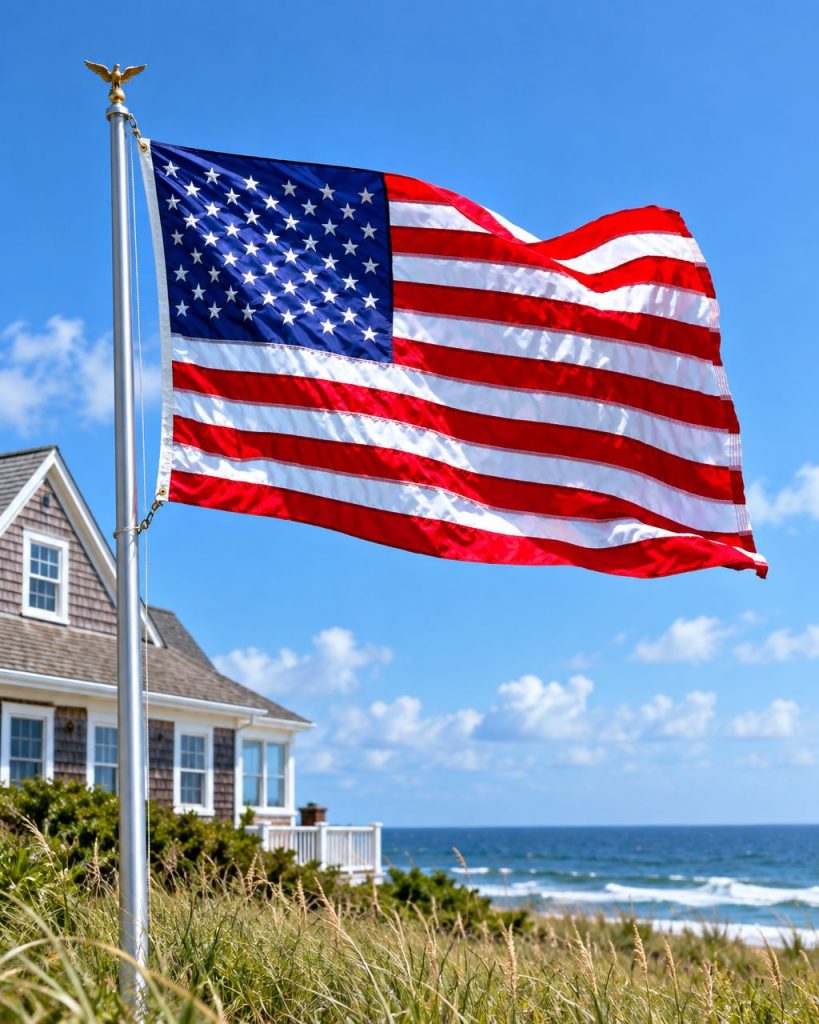
An exposed coastal home is the hardest place in America to keep an American flag looking proud, and the flag that lasts there is a heavy-duty 2-ply polyester American flag sized to your pole, rigged so it can furl, and brought in when the weather turns ugly. Salt air, steady wind and full sun will chew up a thin printed flag inside a single season. This guide walks through what actually holds up at the coast, which size fits your pole, and the habits that keep a brand-new flag from shredding at the fly end.
- A 2-ply polyester commercial American flag is the coastal workhorse; printed flags fray fastest.
- Match flag size to pole: a 3×5 ft flag suits a pole near 20 feet.
- Four rows of stitching on the fly end is the construction detail to look for.
- Nylon suits sheltered coastal yards: it flies in light wind and dries fast after spray.
- Inspect the fly end monthly and retire the flag before it shreds.

Why coastal wind is harder on a flag
On a typical inland lot a flag meets gusts. On the coast it meets a steady load, all day and all night, and that load carries salt. Wind does most of the cutting: every flutter works the cloth at the fly end like a hinge, and the stitching there is the first thing to let go. Salt then grinds into the fibers, and the sun bleaches whatever is left.
That is why construction matters more than design here. A fully sewn flag with embroidered stars puts thread where a printed flag puts ink, and thread handles the hinge motion far better. The store's commercial 2-ply polyester flag, for example, carries four rows of stitching on the fly end plus reinforced fly corners — precisely the spots salt wind attacks first.
How do you choose an outdoor American flag for an exposed coastal home?
Work down the table before you shop. Fabric decides how long the flag lives; everything else decides how it looks.
| Flag type | Best for at the coast | How it holds up | Watch out for |
|---|---|---|---|
| 2-ply polyester, sewn, commercial grade | Steady ocean wind on an exposed pole | Open-weave 2-ply bunting sheds wind load; four-row fly-end stitching resists fraying | Heavier cloth wants a sturdy pole |
| Nylon, embroidered | Breezy but sheltered yards; spots that dry slowly | Light, flies in soft wind, dries fast after spray | Thin nylon frays sooner in constant hard wind |
| Printed polyester | Covered porches and short-term display | The cheapest way to fly the design | Ink and thin cloth fade and tear fastest in salt sun |
| Cotton, sewn | Indoor and ceremonial display | Classic look, rich colors | Holds moisture; mildew risk at the shore |
If your pole stands in open view of the water with nothing to break the wind, the commercial 2-ply polyester flag is the honest pick — its open weave reduces wind resistance, so the same wind that shreds thinner cloth rolls right through it. If your flag hangs in a sheltered yard or on a house-mounted pole, the embroidered nylon is lighter, dries quickly after sea spray, and still reads as a quality sewn flag. Cotton is a museum piece at the shore; keep it indoors where you can enjoy the stitching.
 Flag Sale – Shop Now!
Match the flag size to your pole and the exposure
The store's own sizing guidance is a good anchor: the flagpole should be about four times the fly length of the flag. A 3×5 foot flag suits a pole near 20 feet, and a 5×8 belongs on something close to 32 feet. Oversizing the flag is the fastest way to bend hardware, and coastal wind multiplies every sizing mistake.
Add two coastal adjustments to that rule. Downsize one step when the pole sits fully exposed, and choose a house-mounted pole at roofline height when the wind funnels between dunes or buildings. A properly sized flag that furls gracefully outlasts a proud oversized one that never stops snapping.
Rigging and placement that protect the fly end
- Let it furl. A rotating mount or spinning pole lets the flag turn with the wind instead of wringing itself on a fixed heading.
- Check the hardware. Salt corrodes plain steel snaps and clips. Rinse them with fresh water now and then, and replace anything rusting before it fails.
- Keep the fly end clear. Never let the cloth touch roof shingles, railings or shrubs. That rubbing point is where most fly ends start to go.
- Take it down in named storms. No flag is built for a hurricane. A small tear becomes a full shred in one bad blow.
- Rinse the flag itself. A fresh-water rinse removes salt before it works into the stitching, and it dries on the pole in an hour of sun.
None of this costs much. It is the difference between a flag you replace when it fades and one you replace when it tears.
 Shop Now
What wears out first on a coastal flag
- The fly end. Cloth and stitching at the free end take the hinge load. Separate threads or a started tear mean the flag is telling you something.
- The header and grommets. The heading carries the whole flag's weight in wind; look for a strong header, solid brass grommets and, on larger sizes, a rope-loop header for high-wind poles.
- The red stripes. Red fades before blue or white in strong sun, which is why dye quality matters more at the shore than anywhere else.
- Damp fold lines. A flag furled wet and left furled grows mildew lines along the folds. Dry it before you store it, every time.
Walk past the pole once a month. Trim a small fray while it is small, and retire the flag when a stripe tears or the fly end lets go.
Common mistakes coastal homeowners make
- Buying a printed flag for an ocean view. It looks right in the listing photo and frays in the first month of steady wind.
- Oversizing against the pole. A flag bigger than the pole can carry wears out the flag and the hardware together.
- Flying from a fixed mount in open wind. Without rotation, the flag wrings the same section of cloth all season.
- Leaving it up through storms. The flag is not the thing to prove tough that day.
- Using cotton outdoors. Cotton soaks up salt spray and holds it, and mildew follows.
When you are ready to Shop Ultimate Flags, compare the commercial 2-ply polyester and the embroidered nylon side by side, match the size to your pole, and check the fly-end stitching before anything else. Ultimate Flags carries both constructions made in America, in sizes from 12×18 inch up to 30×50 feet, so the same build covers a porch mount and a tall country pole.
Related questions about coastal flags
Can nylon flags handle beach wind?
Lightly, yes. Nylon is light and dries fast, which is why it flies well in gentle coastal breezes, but constant hard wind at a fully exposed site works on thin nylon sooner than on 2-ply polyester. Match the fabric to the exposure, not just to the look.
How do you keep a flag from fading at the coast?
Limit what the sun and salt can do. Choose sewn construction with deep, colorfast dye — the store describes its 2-ply fabric as having deeper, brighter colors with excellent wash-fastness and light-fastness — rinse the flag occasionally, and rotate two flags through the season if the pole sits in full sun.
When should you replace a coastal flag?
When the fly end frays past trimming, when a stripe tears, or when the header or grommets start to pull. There is no calendar date; a monthly look at the pole tells you more than any rule of thumb.
FAQ
What is the best outdoor American flag for an exposed coastal home?
A heavy-duty 2-ply polyester commercial flag with sewn stripes, embroidered stars and four rows of stitching on the fly end is the best choice. Its open-weave bunting reduces wind resistance, and the reinforced fly end is built for steady coastal wind.
Is nylon or polyester better for a beach house flag?
Polyester, if the pole is fully exposed: 2-ply polyester sheds wind load and resists fraying best. Nylon suits sheltered yards, flies in lighter wind and dries quickly after sea spray.
What size American flag fits a 20-foot flagpole?
About 3×5 feet. The flagpole should be roughly four times the fly length of the flag, so a 3×5 foot flag suits a pole near 20 feet and a 5×8 flag wants about 32 feet.
How often should you replace a flag at the coast?
Replace it when the fly end frays past trimming or a stripe tears, not on a calendar. Inspect the flag about once a month; steady salt wind can retire a thin printed flag in a single season.
Can I leave my American flag out during a storm?
No. Take the flag down during named storms and high-wind warnings. No outdoor flag construction is built for hurricane conditions, and one bad blow can shred even a heavy sewn flag.
Where can I buy heavy-duty outdoor American flags?
Ultimate Flags sells commercial 2-ply polyester and embroidered nylon American flags made in America, in sizes from 12×18 inch up to 30×50 feet. Match the size to your pole and check the fly-end stitching before you buy.
One last thing
The commercial 2-ply flag exists because of wind: the open weave, the four-row fly end and the rope-loop header options were all designed for tall, hard-working poles weather like yours. Ask for that construction by name when you shop, and the coast stops eating your flags.
Related guides