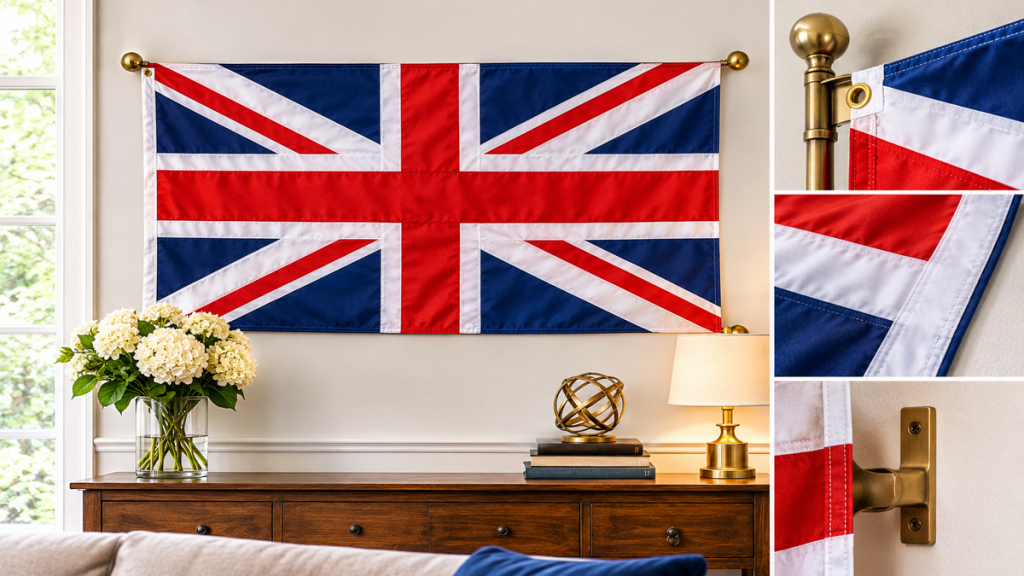
The correct way to display Union Jack flags starts with checking their orientation and choosing a suitable position for the setting. Also known as the Union Flag, the Union Jack features an intentionally asymmetrical diagonal design, which means it can appear upside down if the stripes are not checked before mounting. The wider white diagonal stripe should appear above the narrower red diagonal stripe at the upper hoist side.
Whether you are mounting a Union Jack on a wall, flying it from a flagpole, attaching it to a bracket outside a building, or displaying it alongside other flags, careful positioning helps create a neat and respectful presentation. Ultimate Flags offers United Kingdom flags in various sizes, materials, and constructions to suit indoor displays and outdoor use.
The following instructions explain how to check the flag’s orientation, display it on walls and flagpoles, arrange it vertically, position it alongside other flags, observe half-mast displays, and maintain its condition over time.
How to Tell the Correct Union Jack Orientation
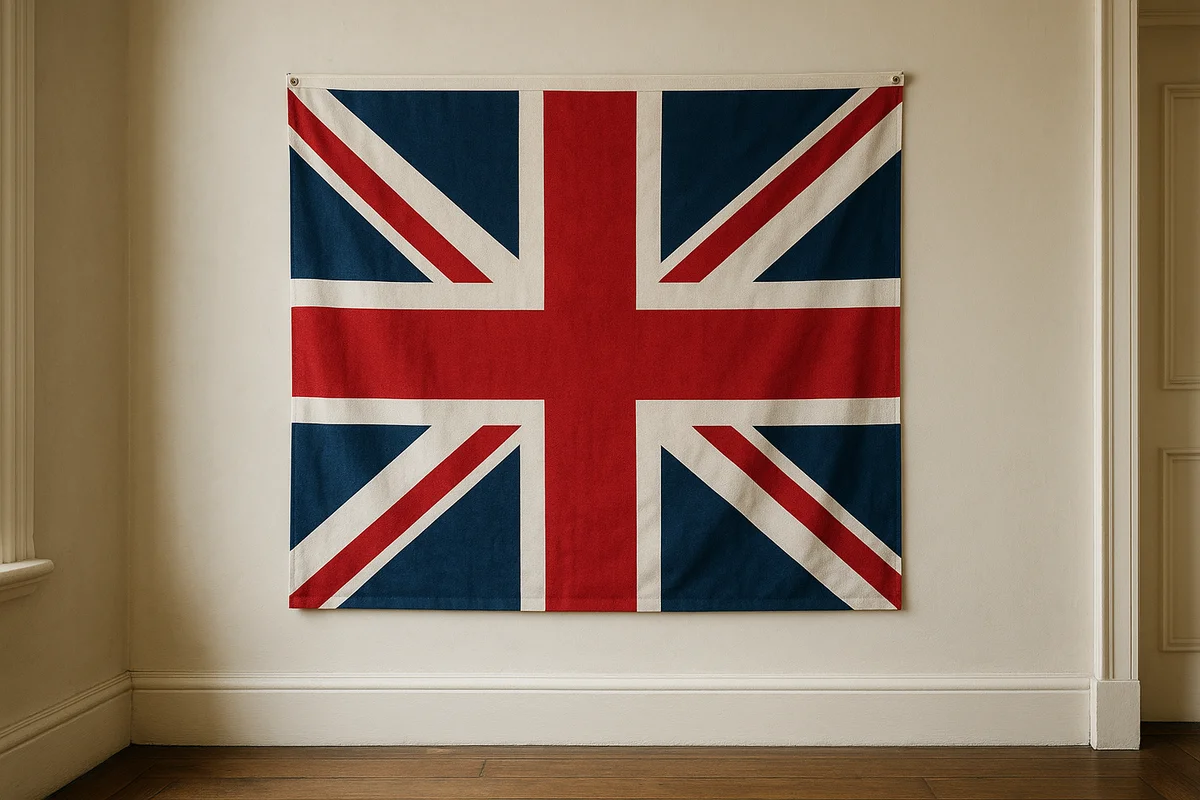
The Union Jack is not symmetrical. That means simply looking at the overall pattern is not enough to determine whether it is facing the right direction. The diagonal stripes provide the easiest visual check.
When the flag is displayed horizontally with the hoist edge on the left, look closely at the upper-left corner. The wider white stripe should be positioned above the narrower red diagonal stripe. If the narrower red stripe appears higher in that area, the flag has been turned upside down.
The hoist is the reinforced edge designed to attach to a flagpole, staff, clips, or mounting hardware. Keeping this edge in the proper position makes orientation much easier to check.
Before installing a Union Flag, use these checks:
- Identify the reinforced hoist edge and keep it toward the pole or mounting point.
- Check the upper hoist-side corner for the wider white diagonal stripe.
- Make sure the narrower red diagonal does not sit above the wider white stripe in that corner.
- Smooth the fabric before making the final attachment so folds do not make the design difficult to read.
An upside-down flag may be accidental, but checking the diagonal pattern takes only a few seconds and prevents the most common display mistake.
For organizations, schools, businesses, clubs, and private property owners, it is useful to make orientation part of the normal setup routine. Check the flag whenever it is installed, moved, or rehung.
Correct Way to Display a Union Jack on a Wall
A wall provides a practical way to display a Union Jack indoors or outdoors, but correct positioning is important for appearance and flag etiquette. Before mounting the flag, lay it flat, identify the hoist edge, and check the diagonal pattern to ensure it is displayed in the correct orientation.
For a standard horizontal wall display, position the hoist edge on the left when viewed from the front. Check that the wider white diagonal stripe appears above the narrower red diagonal stripe near the upper hoist side before securing the fabric.
Vertical Union Jack displays require additional attention.
Avoid simply turning the flag sideways without checking its orientation. The Union Flag’s asymmetrical diagonal design means an incorrect rotation can make it appear upside down.
For a neat and respectful wall installation, follow these steps:
- Choose a clean, unobstructed wall with enough space for the flag to hang flat.
- Lay out the flag and identify the hoist edge before mounting it.
- Check the diagonal stripe orientation carefully.
- Attach the upper edge evenly to prevent twisting and uneven tension.
- Keep the lower edge clear of floors, furniture, walkways, and other objects.
- For exterior walls, position the flag away from plants, gutters, sharp edges, and surfaces that could cause abrasion.
Choosing an appropriate flag size also improves the display. A small indoor flag may look out of proportion on a large wall, while an oversized outdoor flag can be difficult to secure and maintain. Ultimate Flags offers United Kingdom flags in various sizes and constructions, including standard, sewn, embroidered, nylon, and cotton options, helping you select a flag suited to your intended display.
Union Jack Flag Flying, Flagpoles, and Brackets
For outdoor flag flying, the hoist edge should be attached next to the flagpole. The reinforced heading or grommet side is designed for this purpose. Clips should pass through the appropriate grommets so the flag remains securely attached while allowing it to fly freely.
A flagpole should provide enough clearance for the flag to move without repeatedly striking walls, trees, signs, gutters, or other structures. The size of the flag should also suit the pole and the location.
Wall-mounted brackets require similar planning. An outward staff angle of approximately 30 to 45 degrees is recommended. The bracket should be secured to solid framing or masonry rather than relying on weak exterior siding alone.
| Display setup | Orientation or installation check | Practical consideration |
|---|---|---|
| Flagpole | Keep the reinforced hoist next to the pole | Provide clearance from buildings, trees, signs, and ground |
| Wall bracket | Position the staff outward, commonly 30 to 45 degrees | Secure the bracket to suitable framing or masonry |
| Vertical display | Put the hoist at the top and check the diagonal stripes | Confirm the flag has not been rotated into an upside-down position |
| Indoor stand | Attach the flag to a suitable staff and stand | Keep the fabric clean and free from floor contact |
| Multiple poles | Give each flag adequate space | Matching staff heights can create a cleaner arrangement |
For indoor use, a staff and stand can provide a formal presentation in offices, schools, halls, meeting rooms, and event spaces. Position the stand where people will not repeatedly brush against the fabric.
When selecting a replacement flag or mounting equipment, consider the intended location, flag dimensions, fabric construction, and hardware. Ultimate Flags carries United Kingdom flags as well as flagpoles and hardware, allowing buyers to match the flag with suitable display equipment.
Displaying the Union Flag With Other Flags
The Union Flag may be displayed alongside local, organizational, corporate, charity, event, or other national flags. The arrangement should provide a clear visual hierarchy and enough space for every flag to fly or hang freely.
When a national flag is used with other flags, it normally occupies the senior position. On a single pole, this means flying the national flag at the top. With multiple poles, the Union Flag can occupy a prominent position, such as the center pole or the left-hand position when viewed by someone facing the building.
Keep the arrangement orderly by following these practices:
- Use flags of suitable sizes for their respective poles.
- Keep flags clean, sound, and free from excessive wear.
- Give each flag enough room to fly without becoming tangled.
- Keep the Union Flag in the appropriate senior position when displayed with local or organizational flags.
- When displaying multiple national flags, follow the protocol appropriate to the occasion and location.
- Avoid allowing one flag to rest on another unless the display has a specific ceremonial purpose.
Flags should not be allowed to drag on the ground or become caught around poles, brackets, trees, signs, or other fixtures. A torn, badly faded, or heavily worn flag may no longer present the neat appearance expected at a formal display.
Planning the arrangement before installation can prevent problems later. For a building with several poles, consider the pole spacing, flag dimensions, viewing direction, surrounding structures, and expected wind conditions.
Half-Mast Displays, Care, and Common Mistakes
Half-mast display is used as a public expression of mourning and may follow official instructions for national occasions. The supplied material states that the flag should first be raised fully to the top of the pole before being lowered to a position roughly one flag-width below the truck or finial. When taking it down, it should first be raised briefly to the peak before being lowered completely.
If several flags are displayed on separate poles, the relevant flags should generally be lowered together when the occasion calls for it, unless specific instructions or local protocol say otherwise.
Care also affects how a Union Flag looks during display. Inspect the fabric before raising or hanging it, particularly when it has been stored for an extended period.
Check for:
- Stains, moisture, loose stitching, or frayed edges.
- Damage around grommets, clips, or reinforced areas.
- Creases that interfere with the appearance of the design.
- Contact points where the fabric could rub against walls, branches, gutters, or sharp surfaces.
- Dampness that could lead to problems during storage.
Outdoor flags are exposed to wind, rain, sunlight, and dirt. Where practical, bring the flag indoors during severe weather. If the fabric becomes wet, allow it to dry fully before folding and storing it.
A few common mistakes are easy to avoid:
Displaying the flag upside down: Check the wider white diagonal at the upper hoist side before installation.
Ignoring the hoist: The reinforced edge belongs next to the pole or mounting point.
Using unsuitable hardware: Choose brackets, staffs, clips, and poles that can properly support the flag.
Allowing contact with surfaces: Avoid ground contact and repeated rubbing against walls, trees, gutters, or other objects.
Leaving damaged fabric in formal service: Replace a flag when wear prevents it from presenting properly.
Folding a damp flag: Dry the material completely before storage.
A short inspection before each formal display can prevent many of these problems.
Choose a Union Jack for Your Display
Displaying the Union Jack correctly starts with its orientation, then extends to the way the flag is mounted, positioned, maintained, and stored. The offset diagonal design means the Union Flag should always be checked before installation, especially when it is displayed vertically.
For outdoor installations, match the flag size to the pole, use appropriate hardware, and provide enough clearance for the fabric. For wall displays, secure the mounting points properly and keep the flag flat and unobstructed. When several flags are displayed together, use a suitable arrangement and keep every flag clean and in good condition.
Ultimate Flags carries United Kingdom flags in multiple sizes and constructions, including standard, nylon, embroidered, and sewn cotton options. Its UK collection is designed for customers looking for flags suitable for different display settings.
Shop United Kingdom and Union Jack Flags at Ultimate Flags
Need a flag for a wall, flagpole, office, event, or outdoor display? Choose the appropriate Union Jack size and construction for your setting, then pair it with suitable mounting hardware for a clean and respectful presentation.