Knowing how to fold a Union Jack properly helps protect the fabric, preserve its appearance, and keep it ready for its next display. Whether you are putting away a flag after an event, preparing it for storage, or packing it for transport, careful handling starts with a clean, dry surface and enough space to support the fabric.
Ultimate Flags offers Union Jack flags in different materials and sizes, making it important to choose a folding method suited to the flag’s construction and condition. A modern flag used regularly may tolerate gentle folding, while an older, delicate, embroidered, or hand-sewn flag may need additional support and a less restrictive storage method.
For everyday use, the goal is to create a neat, manageable fold without dragging, twisting, forcing sharp creases, or trapping moisture between layers. The following instructions cover folding a Union Jack with two people or folding it alone, along with practical advice for storage and transport.
Prepare the Union Jack Before Folding
Before you fold the flag, give it a quick inspection. The fabric should be clean and completely dry, particularly if the flag has recently been displayed outdoors. Rain, condensation, dirt, and grit can become trapped between folded layers and may contribute to staining, mildew, or fabric wear during storage.
Choose a clean, smooth surface that gives you enough room to lay the flag flat. A large table, clean bed, or suitable floor covering can work for smaller flags. Large flags may require a wider open area, but avoid placing the fabric directly on grass, pavement, concrete, or another dirty surface.
Keep the flag supported throughout the process. Pulling it across a rough surface can place unnecessary stress on stitched edges, grommets, rope attachments, and decorative details.
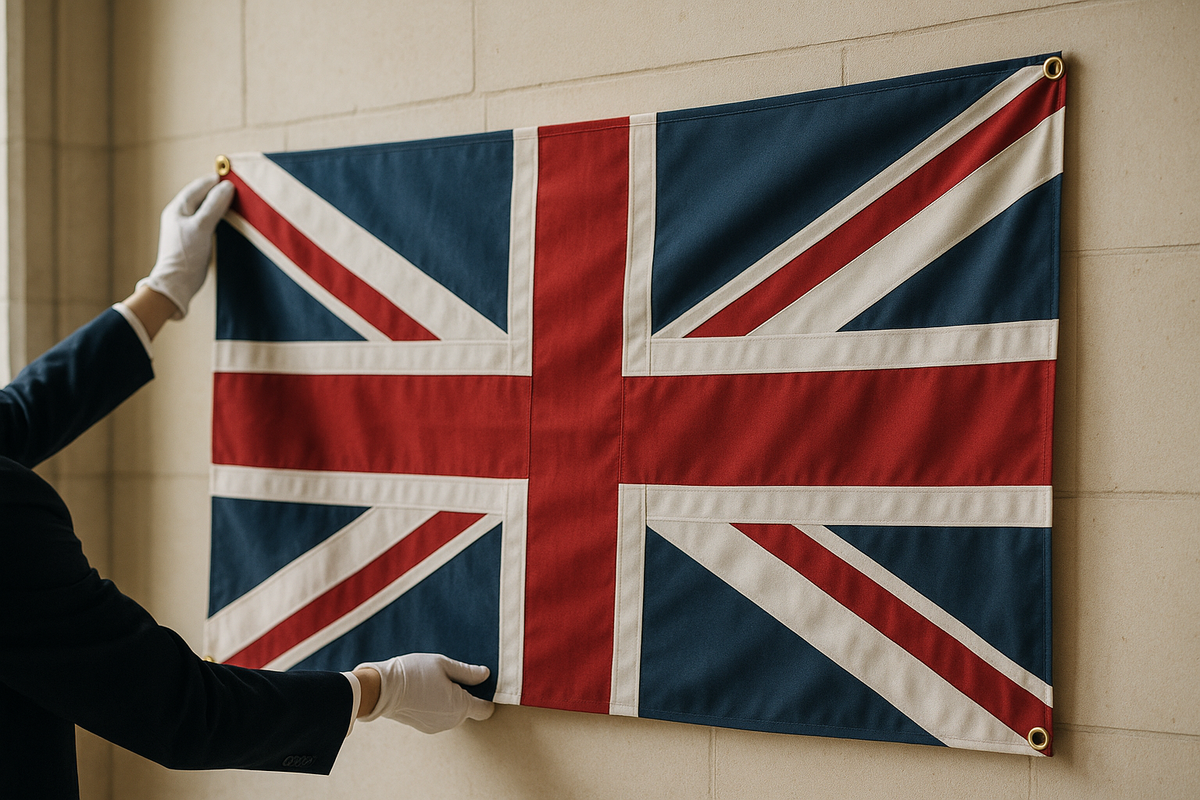
Orientation also deserves attention. The Union Jack may appear symmetrical at first glance, but its diagonal elements are offset. When the flag is viewed horizontally with the staff or hoist on the left, the broader white portion of the diagonal should appear above the red diagonal in the upper-left corner. If the red appears above the broader white section in that position, the flag is upside down.
Before folding, check these points:
- The fabric is dry and reasonably clean.
- The folding surface is smooth and free from dirt.
- The flag is not caught on clips, rope, hardware, or other objects.
- The corners and edges are lying flat.
- You have enough room to fold without dragging the fabric.
For outdoor flags, inspect the fittings as well. Loose clips, damaged cords, or worn attachment points can contribute to fraying when a flag is flown in windy conditions. Taking a few moments to check the flag before storage can help prevent avoidable damage.
How to Fold a Union Jack With Two People
Folding a large flag is usually easier when two people can support the fabric from opposite sides. This keeps the material under control and reduces the chance of it touching the ground.
Start with the Union Jack fully extended and the design facing outward. Each person should hold an appropriate corner or edge, keeping the fabric reasonably taut without stretching it.
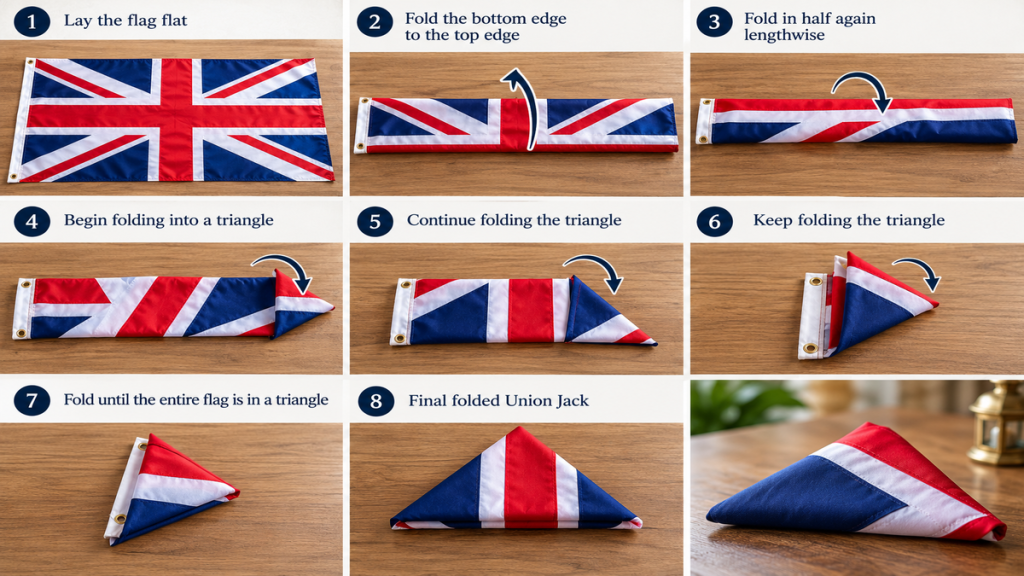
Bring the lower edge upward to meet the top edge. This creates a long rectangle. Keep the corners aligned as you bring the two edges together. Once the first fold is in place, gently smooth the fabric from the center toward the outside edges.
If the resulting rectangle is still too wide for your storage space, fold it lengthwise again. Avoid pressing down aggressively. The aim is to create orderly layers rather than hard, permanent creases.
Next, work from the fly end, which is the edge opposite the staff, rope, clips, or eyelets. Make even folds toward the hoist. Each fold should be similar in width, with the edges kept as square and aligned as possible.
Do not pull tightly around grommets, clips, or other fittings. Hardware can create pressure points within the folded fabric, particularly when the flag is stored for an extended period.
A simple two-person sequence is:
- Hold the flag by suitable corners or edges and keep it supported.
- Bring the lower edge up to meet the upper edge.
- Smooth the first fold from the center outward.
- Fold lengthwise again if the storage space requires a narrower shape.
- Begin folding from the fly end toward the hoist.
- Keep the folds even and avoid forcing hardware into sharp creases.
- Place the finished flag flat in its storage location.
For a large Union Jack, take your time. Rushing the process can lead to uneven folds, twisted corners, or fabric being pulled across the floor. A second person can also help identify a section that has folded over or become trapped before the next layer is made.
Folding a Union Jack Alone
You can also fold a Union Jack on your own. The process requires a little more control because one person has to manage the fabric while creating each fold.
Place the flag face down on a clean, smooth surface. A table or bed can make the process easier for a smaller flag. For a larger flag, use a clean floor covering and make sure you have enough space to work without letting the edges touch dirty surfaces.
Begin by bringing one long side inward toward the center. Smooth the material with your hands so the fabric lies flat. Bring the opposite long side over the first fold. Continue smoothing the layers as you work.
Once the flag has been reduced to a manageable rectangle, fold from the fly end toward the hoist. Keep the sections even and adjust the fold width according to the drawer, cabinet, bag, or box where the flag will be stored.
When working alone, these habits make the process easier:
- Move gradually instead of trying to fold the entire flag in one motion.
- Smooth each layer before making the next fold.
- Keep the edges aligned as closely as practical.
- Keep grommets, clips, and other fittings from creating hard pressure points.
- Never allow the flag to drag across the floor.
- Stop if you discover moisture, dirt, or damage that needs attention first.
The finished fold does not need to resemble a formal military or ceremonial flag fold. For routine household, business, event, or storage use, a clean and orderly fold is the practical objective.
If you are dealing with a very large flag, rolling may be preferable to repeated folding for long-term storage. A clean tube can provide support while reducing the formation of hard fold lines.
Store and Transport the Flag Properly
Correct folding is only part of caring for a flag. The way you store it after folding can affect its condition when you are ready to display it again.
A cool, dry cupboard is suitable for many household flags. A breathable cotton bag can help protect the fabric from dust while allowing air circulation. An appropriately sized archival-style box can also work when the flag needs to remain protected for a longer period.
Avoid sealing a flag in plastic if there is any possibility that moisture remains in the fabric. Damp material enclosed without airflow can develop mildew and unpleasant odors. Direct sunlight, heaters, and areas prone to condensation should also be avoided during storage.
For large flags, banners, and ensigns, rolling around a clean tube can be a practical alternative to folding.
| Flag situation | Recommended handling or storage | Avoid |
|---|---|---|
| Damp or dirty flag | Dry completely and remove loose dirt before folding | Storing while damp or folding dirt into the fabric |
| Small ceremonial flag | Fold carefully and store flat in a dry cupboard or suitable box | Sharp creases, heat, sunlight, and condensation |
| Large flag or banner | Consider rolling around a clean tube | Tight folds and pressure on stitched edges |
| Flag being transported | Use a fabric bag, clean sleeve, or sturdy tube | Rough equipment, muddy items, and heavy objects |
| Historical or custom flag | Support the fabric and protect detailed printing or specialist materials | Twisting, snagging, or compressing the flag |
Transport requires the same level of care. A clean sleeve, fabric bag, or sturdy tube can keep the flag separate from rough equipment and other objects that could snag the material. Do not place heavy equipment on top of a folded flag.
If the flag has been used outdoors, check it before packing. Look for damp areas, loose stitching, dirt, or damaged fittings. Allow the fabric to dry fully before putting it away.
For collectors and customers who use historical reproductions, custom flags, or specialty designs, storage deserves additional attention. Different fabrics and construction methods may respond differently to folding, pressure, moisture, and prolonged storage. When choosing a flag, consider where it will be displayed, how frequently it will be used, and how it will be stored between displays.
Union Jack Orientation, History, and Reliable Resources
Knowing the basic history of the flag can make correct handling and orientation easier to understand. The Union Jack combines elements associated with England, Scotland, and Ireland. Its diagonal components are offset, which is why simply rotating or reversing the flag can produce an incorrect orientation.
Use established resources when checking flag history, heraldry, display conventions, or downloadable diagrams. Suggested resources include:
- GOV.UK for official guidance concerning flag flying and government conventions.
- The College of Arms for heraldic information relating to the component crosses.
- The National Archives and UK Parliament for historical information.
- Museums and established vexillological organizations for diagrams and specialist reference material.
The current design dates to 1801, when the Kingdom of Great Britain and the Kingdom of Ireland were united. The design incorporates the red cross of St. George, the saltire associated with St. Andrew, and the saltire associated with St. Patrick.
For practical use, remember that correct orientation matters when the flag is being displayed, but folding itself does not require a special ceremonial pattern. The safest approach is to keep the fabric clean, dry, supported, and neatly aligned.
Keep Your Union Jack Ready for Its Next Display
Once you know how to fold a Union Jack, the process becomes straightforward. Start with a clean and dry flag, use a smooth surface, and keep the fabric away from the ground. With two people, align the edges before folding and work from the fly toward the hoist. When folding alone, create manageable layers and smooth each one before continuing.
For storage, choose a dry location with adequate airflow. Smaller flags can be folded and stored flat, while large flags may benefit from being rolled around a clean tube. During transport, use a protective bag, sleeve, or tube and keep the flag away from rough equipment and heavy objects.
Good flag care protects the appearance of the fabric and helps keep it ready for its next use. Whether your Union Jack is displayed at home, at a business, during an event, or as part of a collection, careful handling provides a simple way to preserve its condition.
Ultimate Flags carries United Kingdom flags alongside a broad selection of national, historic, military, and specialty flags. They also provide resources covering flag care, display, history, quality, and sizing, supporting customers who want to choose and maintain flags for different uses.
Ready to replace an old flag or add a Union Jack to your collection? Visit Ultimate Flags to view available flags, sizes, quality options, and related flag products.